• 검색 결과가 없습니다.

Novel Iron Loss Modeling of the BLDC Motor for Fuel Pump by Considering Non Sinusoidal Distributed Magnetic Flux Density Effect in Stator Core

N/A
N/A
Protected

Academic year: 2021

Share "Novel Iron Loss Modeling of the BLDC Motor for Fuel Pump by Considering Non Sinusoidal Distributed Magnetic Flux Density Effect in Stator Core"

Copied!
2
0
0

로드 중.... (전체 텍스트 보기)

전체 글

(1)

- 758 -

BLDC 전동기 고정자 코어의 비정현적인 자속밀도 분포특성를 고려하기 위한 철손 모델링에 대한 연구

주나이드, 쿳시야, 황규윤, 권병일 Hanyang University

Novel Iron Loss Modeling of the BLDC Motor for Fuel Pump by Considering Non Sinusoidal Distributed Magnetic Flux Density Effect in Stator Core

Junaid Ikram, Qudsia Junaid, Kyu-yun Hwang, Byung-Il Kwon Hanyang University

Abstract - In the design and analysis of electric machines the precise calculation of iron loss has incredible significance. It is tough to foresee iron losses precisely in machines due to distribution of non sinusoidal flux density. It is necessary to approximate the iron losses for the precise computation of efficiency. This paper presents a novel approach for the prediction of iron losses of the brushless dc (BLDC) motors by considering the effects of minor hysteresis loops in the simplified model. The novel iron loss model results are compared with the simplified model and with finite element method (FEM).

1. Introduction

The current technological growth in manufacturing of permanent magnet (PM) having high energy product has led to remarkable performance improvement of PM machines. A PM machine has many advantages over other machines like higher efficiency, and smaller size [1]. Accurate prediction of iron losses is required for the higher efficiency.

In PM motors iron losses make a large proportion of the total losses than induction motors due to elimination of rotor copper losses.

An earlier paper [2] presented a comprehensive model for iron losses but it not included minor hysteresis loops. The prediction of iron losses in [3, 4] were made by considering the minor hysteresis loops but in these papers rise and fall time of tooth flux density was assumed to be the time interval in which the magnet edge transverses one tooth width.

The novel iron loss model is proposed in this paper. The proposed model includes the minor hysteresis loops and it considers the rise and fall time of the flux density in the tooth as the time interval in which the magnet edge transverses one sloth pitch. The results obtained by the novel model are compared with finite element method (FEM) and also with the simplified model which is reference [2]. The results shows that the proposed model can calculate iron losses accurately.

2. Proposed Iron loss Modeling

In the proposed iron loss model hysteresis loss is calculated by considering the effects of minor hysteresis loops. The eddy current loss in tooth is calculated by considering the fact that the flux density reaches its maximum value in the time interval in which a magnet edge transverses one slot pitch. The effects of circumferential component of flux density in tooth and radial component of flux density in yoke are considered for eddy current loss calculation. The model also considers the effects of motor geometry for the eddy current losses. Fig. 1 shows the brushless dc (BLDC) motor model that is used in this paper.

<Fig. 1> Fuel type BLDC motor model

2.1 Total Iron Loss Model

In the magnetic materials the iron losses are measured for the sinusoidal flux density  of varying magnitude and frequency. The total iron losses 

 

can be expressed for sinusoidal flux density with angular frequency 

as

 

 

 

 

 

(1)

Where 

, 

are hysteresis and eddy current loss densities and

, 

are hysteresis and eddy current loss coefficients respectively.

2.2 Eddy Current Loss Model [2]

The convenient form to represent eddy current loss density for any arbitrary flux density waveform of the time period T can be written as

 

 



 

 (2) It is stated that time required for the flux density to change from zero to maximum value was found to be the same as required for the magnet edge to transverse one slot pitch. Time required by the magnet edge to transverse one slot pitch is used for the calculation of eddy current loss instead of time required for the magnet to transverse one tooth width time as it was used in earlier assumption [5]. For m-phase machine with q slots per pole per phase time required by the magnet to transverse one slot pitch can be written as

∆   

 

 (3)

It is stated that flux density in the tooth 



changes from zero to peak value four times in one time period. By considering this effect and substituting Eq. 3 into Eq. 2, we can write as



 

  



(4)

The eddy current loss in tooth when we consider the effects of motor geometry and longitudinal component of flux density can be written as



 

  



(5)

Where 

and 

are the correction factor for motor geometry and longitudinal component of flux density respectively. The time required by the magnet of width 

to pass a point on the stator yoke can be written as

∆   



  

 (6)

Where  is the magnet coverage,  is the inner radius of the

stator, and  is the number of poles of the machine. It is stated that

2009년도 대한전기학회 하계학술대회 논문집 2009. 7. 14 - 17

(2)

- 759 -

Name Value Name Value

outer radius of stator 17.5 tooth width 9.3

thickness of magnet 2.5 yoke width 1.8

yoke flux density 1.2 tooth height 4.6

tooth flux density 1.5 magnet coverage 0.944 tooth volume 0.000000515 inner radius of stator 11.1 yoke volume 0.000005068 air gap length 0.5

speed (RPM) 6500 7000 7500 8000 8500

By simplified model(W) 1.03 1.15 1.28 1.42 1.56

By FEM (W) 1.15 1.29 1.44 1.60 1.77

By Novel Model(W) 1.21 1.35 1.49 1.64 1.79

circumferential component of flux density 

at any point in the yoke changes two times from –B

peak

to + B

peak

in each time period. By considering this effect and substituting Eq. 6 into Eq. 2, the eddy current loss in the yoke of BLDC motor can be written as



 

 

 

(7)

The complete form of eddy current loss in yoke by considering the effect of normal component of flux density can be written as



 

 

 

(8)

Where 

is the eddy current loss due to normal component of flux density in the yoke and is related to motor geometry

   



 

(9)

2.3. Hysteresis Loss Model [3, 4]

The above model can calculate eddy current loss very accurately but the hysteresis loss calculated from Eq. 1 do not consider minor hysteresis loops. To consider minor hysteresis loops following equation that had been used for hysteresis loss calculation is used in the proposed model for hysteresis loss calculation.

 



(10) Here 



is the minor hysteresis loops loss coefficient and is given as [6]



     

  

(11)

Here  is a constant with value in the range 0.6 to 0.7,  is the maximum value of flux density and

is the variation in flux density as shown in Fig. 2.

<Fig. 2> Variations in flux density

Hysteresis loss density in the tooth and yoke that is used in the proposed model can be written as

 

 

 



(12) 

 

 

 



(13) Where 

 

, 

 

are the minor hysteresis loops loss coefficients for the teeth and for yoke respectively, 



, 



are the tooth and yoke flux density respectively. The BLDC motor designed for the fuel pump has sinusoidal flux density in the tooth whereas yoke has non sinusoidal flux density waveform as shown in Fig. 3(a). The harmonics present in the flux density waveform of yoke are as shown in Fig. 3(b).

(a)  of yoke (b) Components of harmonics <Fig. 3> Harmonics in 

of yoke

3. Analysis Results

The various parameters of the experimental motor are shown in Table I. The values of the other parameters taken for this model are

=44,  =2.2, 

=0.04, 

=22, 

=1.14, 

=1.35, 

 

=1.0, 

 

=1.44.

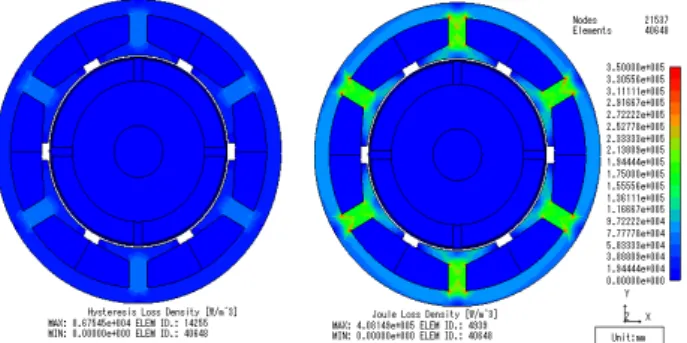
Fig. 4 shows the hysteresis and eddy current loss densities for fuel type BLDC motor model. Table II shows the comparison of the novel iron loss model with FEM. It shows good consistency between predicted iron losses of novel model and FEM.

(a) Hysteresis loss density (b) Eddy current loss density

<Fig. 4> Distribution of hysteresis and eddy current loss densities by FEM

<Table I> Parameters of the BLDC Motor

<Table II> Results

4. Conclusion

A novel iron loss model of BLDC motor was demonstrated in this paper. The novel iron model considered the effects of minor hysteresis loops due to non sinusoidal flux density. The results of the iron loss calculated by novel model in stator teeth and yoke were compared with simplified iron loss model and with FEM. The results showed a good consistency between the novel model and FEM.

[References]

[1] W. Roshen, “Iron loss model for permanent magnet synchronous motors,” IEEE Trans. on Magn., vol. 43, no. 52, August 2007.

[2] C. Mi, G. R. Slemon and R. Bonert, “Modelling of iron losses of permanent magnet synchronous motor,” IEEE Trans. Ind. Appl., vol. 39, no. 3, May/June 2003.

[3] F. Deng, “An improved iron loss estimation for permanent brushless machines,” IEEE Trans. on Energy Convers., vol. 14, no. 4, December 1999.

[4] M. K. Jamil and N. A. Demerdash, “Harmonics and core losses of permanent magnet dc motors controlled by chopper circuits,”

IEEE Trans. on Energy Convers., vol. 5, no. 2, June 1990.

[5] G. R. Slemon and L.Xian, “Core losses in permanent magnet motors,” IEEE Trans. on Magn., vol. 26, pp. 1653-1655, September 1990.

[6] J. D. Lavers, P. P. Biringer and H. Hollitscher, “A simple method

of estimating the minor hysteresis loss in thin laminations,” IEEE

Trans. on Magn., vol. 13, pp. 386-388, September 1978.

수치

Fig.  4  shows  the  hysteresis  and  eddy  current  loss  densities  for  fuel  type  BLDC  motor  model

참조

관련 문서

The problem of atom migration can be solved by considering the thermodynamic condition for equilibrium; namely that the chemical potential of an atom must be the same

2재화 2요소 헥셔-올린 모형에서는 어느 한 경제에서 어느 한 요소의 양이 증가하면, 그 요소를 집약적으로 사용하는 산업의 생산량은 증가하고 다른

웹 표준을 지원하는 플랫폼에서 큰 수정없이 실행 가능함 패키징을 통해 다양한 기기를 위한 앱을 작성할 수 있음 네이티브 앱과

_____ culture appears to be attractive (도시의) to the

【판결요지】[1] [다수의견] 동일인의 소유에 속하는 토지 및 그 지상 건물에 관하여 공동저 당권이 설정된 후 그 지상 건물이 철거되고 새로 건물이 신축된 경우에는

After first field tests, we expect electric passenger drones or eVTOL aircraft (short for electric vertical take-off and landing) to start providing commercial mobility

Green color indicates that the output shaft of the geared motor rotates in the same direction as the output shaft of the motor..

1 John Owen, Justification by Faith Alone, in The Works of John Owen, ed. John Bolt, trans. Scott Clark, &#34;Do This and Live: Christ's Active Obedience as the