• 검색 결과가 없습니다.

Analysis of Aspiration Risk Factors in Severe Trauma Patients: Based on Findings of Aspiration Lung Disease in Chest Computed Tomography

N/A
N/A
Protected

Academic year: 2021

Share "Analysis of Aspiration Risk Factors in Severe Trauma Patients: Based on Findings of Aspiration Lung Disease in Chest Computed Tomography"

Copied!
8
0
0

로드 중.... (전체 텍스트 보기)

전체 글

(1)

Received: April 28, 2020 Revised: June 30, 2020 Accepted: June 30, 2020 Trauma and InJury

Correspondence to Jungnam Lee, M.D., Ph.D.

Department of Traumatology, Gil Medical Center, Gachon University College of Medicine, 783 Namdong-daero, Nam- dong-gu, Incheon 21565, Korea Tel: +82-32-460-3010 Fax: +82-32-460-3247 E-mail: [email protected] Co-correspondence to Woo Sung Choi, M.D., Ph.D.

Department of Emergency Medicine, Gil Medical Center, 783 Namdong-daero, Namdong-gu, Incheon 21565, Korea Tel: +82-32-460-3901

Fax: +82-32-460-3019 E-mail: [email protected]

analysis of aspiration risk factors in Severe Trauma Patients: Based on findings of aspiration lung disease in Chest Computed Tomography

Gyu Jin Heo, M.D.

1

, Jungnam Lee, M.D., Ph.D.

2

, Woo Sung Choi, M.D., Ph.D.

1

, Sung Youl Hyun, M.D.,Ph.D.

2

, Jin-Seong Cho, M.D., Ph.D.

3

1

Department of Emergency Medicine, Gil Medical Center, Incheon, Korea

2

Department of Traumatology, Gil Medical Center, Gachon University College of Medicine, Incheon, Korea

3
Department of Emergency Medicine, Gil Medical Center, Gachon University College of Medicine, Incheon, Korea

Purpose: The present study will identify risk factors for aspiration in severe trauma patients by comparing patients who showed a sign of aspiration lung disease on chest computed tomography (CT) and those who did not.

methods: We conducted a retrospective review of the Korean Trauma Data Bank be- tween January 2014 and December 2019 in a single regional trauma center. The inclusion criteria were patients aged ≥18 years with chest CT, and who had an Injury Severity Score ≥16. Patients with Abbreviated Injury Scale (AIS)-chest score ≥1 and lack of medical records were excluded. General characteristics and patient status were analyzed.

results: 425 patients were included in the final analysis. There were 48 patients show- ing aspiration on CT (11.2%) and 377 patients showing no aspiration (88.7%). Aspira- tion group showed more endotracheal intubation in the ER (p=0.000) and a significant- ly higher proportion of severe Glasgow Coma Scale (GCS) (p=0.000) patients than the non-aspiration group. In AIS as well, the median AIS head score was higher in the aspi- ration group (p=0.046). Median oxygen saturation was significantly lower in the aspi- ration group (p=0.002). In a logistic regression analysis, relative to the GCS mild group, the moderate group showed an odds ratio (OR) for aspiration of 2.976 (CI, 1.024–8.647), and the severe group showed an OR of 5.073 (CI, 2.442–10.539).

Conclusions: Poor mental state and head injury increase the risk of aspiration. To con- firm for aspiration, it would be useful to perform chest CT for severe trauma patients with a head injury.

Keywords: Pneumonia, aspiration; Tomography, X-ray computed; Multiple trauma;

Risk

(2)

analysis of aspiration risk factors in Severe Trauma Patients: Based on findings of aspiration lung disease in Chest Computed Tomography

Gyu Jin Heo, M.D.

1

, Jungnam Lee, M.D., Ph.D.

2

, Woo Sung Choi, M.D., Ph.D.

1

, Sung Youl Hyun, M.D.,Ph.D.

2

, Jin-Seong Cho, M.D., Ph.D.

3

1

Department of Emergency Medicine, Gil Medical Center, Incheon, Korea

2

Department of Traumatology, Gil Medical Center, Gachon University College of Medicine, Incheon, Korea

3
Department of Emergency Medicine, Gil Medical Center, Gachon University College of Medicine, Incheon, Korea

Purpose: The present study will identify risk factors for aspiration in severe trauma patients by comparing patients who showed a sign of aspiration lung disease on chest computed tomography (CT) and those who did not.

methods: We conducted a retrospective review of the Korean Trauma Data Bank be- tween January 2014 and December 2019 in a single regional trauma center. The inclusion criteria were patients aged ≥18 years with chest CT, and who had an Injury Severity Score ≥16. Patients with Abbreviated Injury Scale (AIS)-chest score ≥1 and lack of medical records were excluded. General characteristics and patient status were analyzed.

results: 425 patients were included in the final analysis. There were 48 patients show- ing aspiration on CT (11.2%) and 377 patients showing no aspiration (88.7%). Aspira- tion group showed more endotracheal intubation in the ER (p=0.000) and a significant- ly higher proportion of severe Glasgow Coma Scale (GCS) (p=0.000) patients than the non-aspiration group. In AIS as well, the median AIS head score was higher in the aspi- ration group (p=0.046). Median oxygen saturation was significantly lower in the aspi- ration group (p=0.002). In a logistic regression analysis, relative to the GCS mild group, the moderate group showed an odds ratio (OR) for aspiration of 2.976 (CI, 1.024–8.647), and the severe group showed an OR of 5.073 (CI, 2.442–10.539).

Conclusions: Poor mental state and head injury increase the risk of aspiration. To con- firm for aspiration, it would be useful to perform chest CT for severe trauma patients with a head injury.

Keywords: Pneumonia, aspiration; Tomography, X-ray computed; Multiple trauma;

Risk

INTRODUCTION

Aspiration occurs commonly in severe trauma patients, and risk factors are known to include loss of conscious- ness, facial injury, and elevated intra-abdominal pressure [1,2]. Although it is not possible to ascertain the exact incidence of aspiration in severe trauma, depending on the research methods, the incidence is reported to be 6–54% [3-6]. Aspiration is known to cause lung disease from mild bronchiolitis to aspiration pneumonia and aspiration pneumonitis [7,8], and the development of these lung diseases increases the rate of progression acute respiratory distress syndrome (ARDS) [9,10]. Therefore, prevention and awareness of aspiration is an important issue in the management of severe trauma patients.

Previous studies on aspiration in severe trauma pa- tients have investigated the presence of foreign bodies in the oropharynx, or in the larynx during endotracheal intubation [9,10]. These methods are limited by the fact that oropharyngeal foreign bodies cannot be considered clear evidence of aspiration, and that laryngeal foreign bodies cannot be checked without attempting intubation.

It is expected that the diagnostic accuracy of testing for aspiration could be improved by using chest computed tomography (CT). However, there have been few previ- ous studies on severe trauma patients showing findings of aspiration on chest CT. Hence, the purpose of the present study was to identify risk factors for aspiration in severe trauma patients by comparing patients who showed signs of aspiration lung disease on chest CT and those who did not. In addition, clinical differences were compared between the two patient groups, including the rate of en- dotracheal intubation in the emergency room (ER), the intensive care unit (ICU) admission rate, and the in-hos- pital mortality rate.

METHODS

Subjects and study period

The Korean Trauma Data Bank (KTDB) is a system for collecting data about trauma care from regional trau- ma centers and specialized trauma training institutions, which started with 5 regional trauma centers in 2013, and

includes a total of 17 locations now in 2020. Based on the National Emergency Department Information System (NEDIS), a designated coordinator in each hospital col- lects data on dead, transferred, and hospitalized patients who visited the ER for trauma, and this data is also man- aged by a board-certified physician at a trauma center.

Patients who were transferred to the trauma center in accordance with the field triage decision scheme under- went chest CT, all following the judgment of the trauma physician. Among these patients, those with alert mental status and without the signs and symptoms of chest or abdominal trauma and are focused assessment with so- nography for trauma (FAST) all negative did not undergo chest CT [11].

The present study focused on patients registered in the KTDB who had visited a single regional trauma center between January 1st 2014 and December 31st 2019. The inclusion criteria were patients aged ≥18 years who had undergone chest CT, and who had an Injury Severity Score (ISS) ≥16. The exclusion criteria were patients with an Abbreviated Injury Scale (AIS)-chest score ≥1, patients who had been transferred from the ER to another hospital while alive, patients who did not have a recorded Glasgow Coma Scale (GCS) score, patients whose data could not be inspected due to mis-recording of the chart number, patients with duplicate chart numbers, and patients for whom access to the patient records was restricted due to a suicide attempt. In addition, patients were excluded if they had a chest injury making it difficult to differentiate traumatic lung injury, such as pulmonary contusion, and aspiration lung disease on CT.

Study design and methods

Patients with suspected aspiration in the estimation of a certified radiologist, based on findings of bilateral perihi- lar, ill-defined, alveolar consolidations, multifocal patchy infiltrates, posterior dominant distribution of lung opac- ities, and segmental or lobar consolidation on chest CT, were classified in the aspiration group; patients without the above findings were classified in the non-aspiration group.

As general characteristics, the patients’ sex, age, mech-

anism of accident, time of accident, past medical history,

status at discharge from the ER, and intubation in the ER

(3)

were compared between the aspiration and the non-aspi- ration group. Mechanism of accident was categorized as motor vehicle traffic accident (TA), pedestrian TA, mo- torcycle TA, fall down/slip down or unknown, and time of accident was categorized as 00:00–08:00, 08:00–16:00, or 16:00–24:00. Status at discharge from the ER was cate- gorized as ward, ICU or death in the ER.

The patient status at ER arrival was compared between the aspiration group and the non-aspiration group. Pa- tient status at ER arrival included vital signs, initial GCS, ISS, and AIS. For vital signs, the initial systolic and diastol- ic blood pressure (SBP and DBP, respectively), heart rate, respiratory rate, body temperature, and oxygen saturation were included. In patients who regained spontaneous cir- culation after cardiopulmonary resuscitation (CPR), the first vital signs after restoring circulation were used. The initial GCS was categorized as mild (14–15), moderate (9–13), or severe (3–8), and for patients whose GCS was only recorded after intubation, the verbal response was scored as 1 point. ISS was categorized as severe (16–24) or critical (>25).

Analysis and statistics

After categorization, the data was analyzed statistically using SPSS statics version 24.0 (SPSS Inc., Chicago, IL, USA). For discrete variables, univariate analysis was per- formed using the chi-square test, and for continuous vari-

ables with a non-normal distribution, the Mann-Whitney U test was used. A logistic regression analysis was per- formed to investigate the risk factors associated with aspi- ration. Results with a p-value <0.05 were considered to be statistically significant.

RESULTS

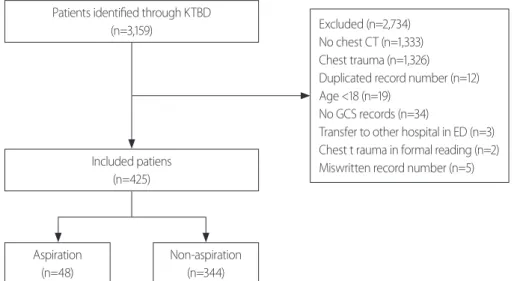
There were 3,159 patients registered in the KTDB between January 1st 2014 and December 31st 2019. Of these, 1,333 patients without chest CT scans were excluded, and 1,326 patients with AIS-chest ≥1 were excluded. A further 75 patients were excluded due to mis-recorded or duplicate chart numbers, transfer from the ER to another hospital, being under 18 years of age, or due to trauma affecting the interpretation of CT scans, and the remaining 425 patients were included in the final analysis. Of these 425 patients, there were 48 patients showing aspiration on chest CT (11.2%) and 377 patients showing no aspiration (88.7%) (Fig. 1).

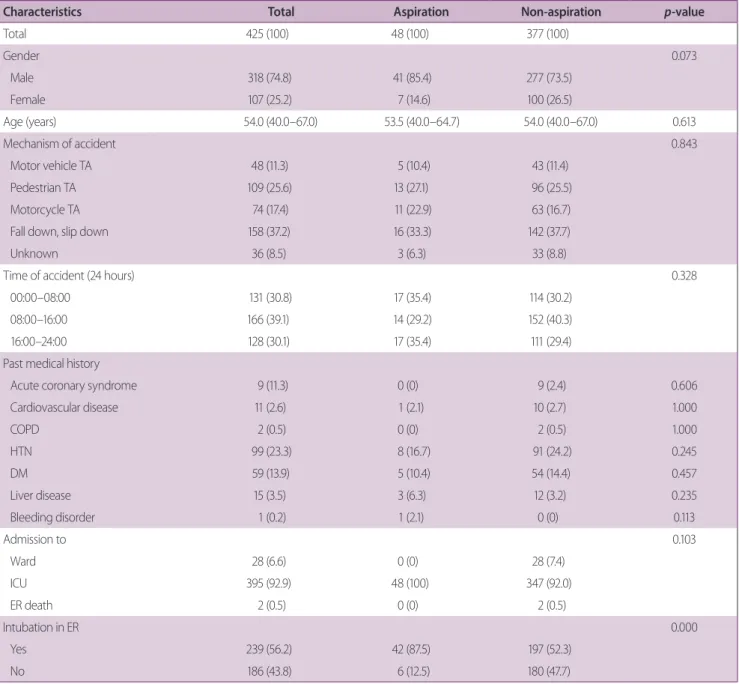
When general characteristics were compared between the aspiration group and the non-aspiration group, endo- tracheal intubation was performed in the ER for 239 pa- tients in total, with 42 patients from the aspiration group (87.5%) and 197 patients from the non-aspiration group (52.3%), which was a significantly higher rate of intuba-

Fig. 1. Enrollment and grouping. KTDB: Korea Trauma Data Bank, CT: computed tomography, GCS: Glasgow Coma Scale, ED: emergency department.

Patients identified through KTBD

(n=3,159) Excluded (n=2,734)

No chest CT (n=1,333) Chest trauma (n=1,326) Duplicated record number (n=12) Age <18 (n=19)

No GCS records (n=34)

Transfer to other hospital in ED (n=3) Chest t rauma in formal reading (n=2) Miswritten record number (n=5) Included patiens

(n=425)

Aspiration (n=48)

Non-aspiration

(n=344)

(4)

tion in the aspiration group (p=0.000). The mean age was 53.5 years (median value, 40.0–64.7 years) in the aspira- tion group and 54.0 years (median value, 40.0–67.0 years) in the non-aspiration group, which was not a statistically significant difference (p=0.613). Likewise, there were no significant differences in sex, mechanism of accident, time

of accident or past medical history, or status at discharge from the ER (Table 1).

When patient status upon arrival at the ER was com- pared between the two groups, in terms of mental status, the aspiration group showed 11 mild patients (22.9%), 6 moderate patients (12.5%), and 31 severe patients

Table 1. Baseline characteristics and demographics feature of patients

Characteristics Total Aspiration Non-aspiration p-value

Total 425 (100) 48 (100) 377 (100)

Gender 0.073

Male 318 (74.8) 41 (85.4) 277 (73.5)

Female 107 (25.2) 7 (14.6) 100 (26.5)

Age (years) 54.0 (40.0–67.0) 53.5 (40.0–64.7) 54.0 (40.0–67.0) 0.613

Mechanism of accident 0.843

Motor vehicle TA 48 (11.3) 5 (10.4) 43 (11.4)

Pedestrian TA 109 (25.6) 13 (27.1) 96 (25.5)

Motorcycle TA 74 (17.4) 11 (22.9) 63 (16.7)

Fall down, slip down 158 (37.2) 16 (33.3) 142 (37.7)

Unknown 36 (8.5) 3 (6.3) 33 (8.8)

Time of accident (24 hours) 0.328

00:00–08:00 131 (30.8) 17 (35.4) 114 (30.2)

08:00–16:00 166 (39.1) 14 (29.2) 152 (40.3)

16:00–24:00 128 (30.1) 17 (35.4) 111 (29.4)

Past medical history

Acute coronary syndrome 9 (11.3) 0 (0) 9 (2.4) 0.606

Cardiovascular disease 11 (2.6) 1 (2.1) 10 (2.7) 1.000

COPD 2 (0.5) 0 (0) 2 (0.5) 1.000

HTN 99 (23.3) 8 (16.7) 91 (24.2) 0.245

DM 59 (13.9) 5 (10.4) 54 (14.4) 0.457

Liver disease 15 (3.5) 3 (6.3) 12 (3.2) 0.235

Bleeding disorder 1 (0.2) 1 (2.1) 0 (0) 0.113

Admission to 0.103

Ward 28 (6.6) 0 (0) 28 (7.4)

ICU 395 (92.9) 48 (100) 347 (92.0)

ER death 2 (0.5) 0 (0) 2 (0.5)

Intubation in ER 0.000

Yes 239 (56.2) 42 (87.5) 197 (52.3)

No 186 (43.8) 6 (12.5) 180 (47.7)

Values are presented as number (%) or median (interquartile range).

TA: traffic accident, COPD: chronic obstructive pulmonary disease, HTN: hypertension, DM: diabetes mellitus), ICU intensive care unit, ER: emergency

room.

(5)

(64.6%), while the non-aspiration group showed 217 mild patients (57.6%), 37 moderate patients (9.8%), and 123 severe patients (32.6%), meaning that there was a signifi- cantly higher proportion of severe patients in the aspira- tion group (p=0.000). In AIS as well, the median AIS head score was 4.0 (4.0–5.0) in the aspiration group and 4.0 (3.0–5.0) in the non-aspiration group, which was higher in the aspiration group (p=0.046), and the median AIS abdomen score was 0.0 (0.0–0.0) in the aspiration group and 0.0 (0.0–2.0) in the non-aspiration group, which was significantly lower in the aspiration group (p=0.027). Me- dian oxygen saturation was significant lower in the aspira- tion group, at 96.0 (89.2–98.0), than in the non-aspiration group, at 98.0 (95.0–99.0) (p=0.002). The vital signs of blood pressure, heart rate, respiratory rate, and body tem-

Table 2. Patient status at ED arrival

Characteristics Total Aspiration Non-aspiration p–value

Total 425 48 377

Vital sign in ER arrival

SBP (mmHg) 136.0 (114.0–157.5) 131.5 (114.2–165.7) 136.0 (114.0–157.0) 0.740

DBP (mmHg) 81.0 (69.5–95.0) 79.5 (61.2–95.5) 81.0 (70.0–95.0) 0.164

Heart rate 85.0 (73.0–100.0) 88.0 (73.2–103.0) 84.0 (73.0–100.0) 0.479

Respiratory rate 20.0 (18.0–22.0) 20.0 (18.0–24.0) 20.0 (18.5–22.0) 0.490

Body temperature 36.4 (36.0–36.8) 36.0 (35.6–36.8) 36.4 (36.0–36.8) 0.109

O2 saturation 98.0 (94.0–99.0) 96.0 (89.2–98.0) 98.0 (95.0–99.0) 0.002

Initial GCS 0.000

Mild (13–15) 228 (53.6) 11 (22.9) 217 (57.6)

Moderate (9–12) 43 (10.1) 6 (12.5) 37 (9.8)

Severe (3–8) 154 (36.2) 31 (64.6) 123 (32.6)

ISS of patients 0.441

Severe (16–24) 238 (56.0) 24 (50.0) 214 (56.8)

Critical (>25) 187 (44.0) 24 (50.0) 163 (43.2)

AIS of patients

AIS (head) 4.0 (3.0–5.0) 4.0 (4.0–5.0) 4.0 (3.0–5.0) 0.046

AIS (facial) 0.0 (0.0–2.0) 0.0 (0.0–2.0) 0.0 (0.0–2.0) 0.628

AIS (abdomen) 0.0 (0.0–2.0) 0.0 (0.0–0.0) 0.0 (0.0–2.0) 0.027

AIS (extremities) 0.0 (0.0–3.0) 0.0 (0.0–2.0) 0.0 (0.0–3.0) 0.279

AIS (external) 0.0 (0.0–1.0) 0.5 (0.0–1.0) 0.0 (0.0–1.0) 0.624

Values are presented as number (%) or median (interquartile range).

ED: emergency department, SBP: systolic blood pressure, DBP: diastolic blood pressure, GCS: Glasgow Coma Scale, ISS: Injury Severity Score, AIS: Abbrevi- ated Injury Scale.

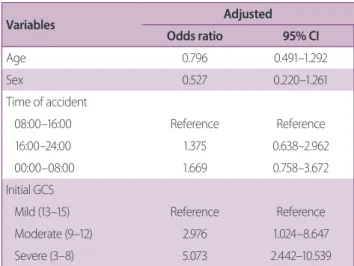
Table 3. Logistic regression analysis on aspiration

Variables Adjusted

Odds ratio 95% CI

Age 0.796 0.491–1.292

Sex 0.527 0.220–1.261

Time of accident

08:00–16:00 Reference Reference

16:00–24:00 1.375 0.638–2.962

00:00–08:00 1.669 0.758–3.672

Initial GCS

Mild (13–15) Reference Reference

Moderate (9–12) 2.976 1.024–8.647

Severe (3–8) 5.073 2.442–10.539

Values are presented as number (%) or median (interquartile range).

CI: confidential interval, GCS: Glasgow Coma Scale.

(6)

perature, and the ISS showed not significant differences between the groups on arrival in the ER (Table 2).

In a logistic regression analysis including age, sex, time of accident, and GCS on admission to the ER, relative to the GCS mild (13–15) group, the moderate (9–12) group showed an odds ratio (OR) for aspiration of 2.976 (CI, 1.024–8.647), and the severe (3–8)group showed an OR of 5.073 (CI, 2.442–10.539). Consistent with the chi-square tests above, there were no statistically significant differ- ences in aspiration rate according to age, sex, or time of accident (Table 3).

DISCUSSION

In a study by Benjamin et al. [9], when aspiration was judged by the presence or absence of an aspiration event, the incidence of aspiration among severe trauma patients was 25.4%. Aspiration pneumonitis develops within min- utes when a patient aspirates ≥0.3 cc per 1 kg body weight of highly acidic gastric contents [12]. Aspiration lung diseases are characterized by bilateral, ill-defined, alveo- lar consolidations, multifocal patch infiltrates, posterior dominant distribution of lung opacities, and segmental or lobar consolidation on chest CT scans [13,14]. In the present study, based on chest CT scans taken soon after trauma, the incidence of aspiration among severe trauma patients was found to be 11.2%. The fact that the inci- dence was lower than the previous study is thought to be due to differences in how aspiration was identified, and identifying aspiration based on chest CT findings con- sistent with aspiration lung disease is expected to be the more diagnostically accurate method.

Altered mental status is related to aspiration, and more severely altered mental status is known to be associated with higher risk of aspiration [15,16]. Studies on severe trauma patients have also shown worse mental status in the aspiration group compared to the non-aspiration group [9,10]. Patients with impaired consciousness show decreased or loss of the gag and cough reflexes. These reflexes help to protect against aspiration, and so patients with impaired consciousness are more susceptible to aspi- ration [17,18]. The present study also showed lower GCS on admission to the ER among severe trauma patients,

and multivariate logistic regression analysis showed that, compared to patients with mild (13–15) impairment of mental status, the OR for aspiration for moderate (9–12) patients was 2.976 (CI, 1.024–8.647) and for severe (3–8) patients was 5.073 (CI, 2.442–10.539), meaning that worse mental status was associated with higher risk of aspira- tion, which was consistent with previous studies.

Fawcett et al. [10] reported that, among severe trauma patients, the aspiration group show higher max head AIS scores than the non-aspiration group, and Benjamin et al.

[9] also found that head AIS scores were higher in severe trauma patients with aspiration compared to those with- out aspiration. Traumatic head injury causes impairment or loss of consciousness [19]. Head injury in severe trau- ma also often causes vomiting, to the extent that vomiting is considered evidence of a potential intracranial injury, and this could also increase the risk of aspiration [20]. In the present study of severe trauma patients, there was a higher distribution of AIS-head scores in the aspiration group compared to the non-aspiration, which is consis- tent with previous research.

In two previous prospective studies, aspiration patients showed statistically higher ISS than non-aspiration pa- tients (aspiration 26.0 vs. non-aspiration 17.0, p=0.027;

aspiration 25.0±1.7 vs. non-aspiration 21.9±1.5, p-val- ue=0.04) [8,9]. In the present study, there was no signif- icant difference in ISS between the aspiration group and the non-aspiration group, with 24 severe patients (score 16–24, 50%) and 24 critical patients (score >24, 50%) in the aspiration group and 214 severe patients (score 16–24, 56.8%) and 163 critical patients (score >24, 43.2%) in the non-aspiration group (p=0.441). This is thought to be because patients who did not undergo chest CT were not included in the study. Given that head injury and impaired consciousness are risk factors for aspiration, as seen above, isolated brain injury patients may not have undergone chest CT scanning, resulting in selection bias affecting the results. Since recent studies recommend whole-body CT for severe trauma patients [21-24], it would also be beneficial to consider chest CT to check for aspiration in patients with isolated brain injury.

Aspiration pneumonia causes hypoxia and increased

infiltration of the lung field [1]. In the present study, the

median oxygen saturation was significantly lower in the

(7)

aspiration group, at 96.0% (interquartile range [IQR], 89.2–98.0%), than in the non-aspiration group, at 98.0%

(IQR, 95.0–99.0%) (p-value=0.002). The frequency of endotracheal intubation in the ER was also significantly higher in the aspiration group, at 42 patients (87.5%), than in the non-aspiration group, at 197 patients (52.3%) (p-value=0.000). This is thought to be related to the poorer mental state and hypoxia shown by the aspiration group in this study.

This study had several limitations. First, this was a ret- rospective study conducted at a single regional trauma center. The number of patients enrolled in the study was insufficient for a more thorough statistical comparison of relevant factors between the aspiration group and the non-aspiration group. Second, because it is difficult to differentiate between aspiration lung disease and trau- matic lung injury from radiologic findings, patients with an AIS-chest score of ≥1 point were excluded from this study. Consequently, patients with traumatic lung injury accompanied by head injury were omitted, which could have affected the results by selection bias. Third, regard- ing the significantly lower oxygen saturation upon arrival at the ER, patients who had been transferred from anoth- er hospital or brought by the emergency services (119) are usually intubated or administered oxygen before arrival.

Since there are no precise records of oxygen administra- tion before arrival at the hospital, this makes it difficult to precisely analyze differences in oxygen saturation.

Fourth, for patients whose initial GCS was not recorded but who had GCS recorded only after intubation, the verbal response was scored as 1 point to proceed with the analysis. This is because there are cases where intubation is performed immediately upon arrival at the ER since the patients subject to this study were severe trauma patients with ISS >15. Although patients who were intubated without the previous record of GCS should be excluded from the study since their GCS cannot be referred to, be- cause the intubated patients before GCS recording tend to be intubated due to severely impaired consciousness, they were scored as 1 point. It is thought that this may have affected the accuracy of the statistical analysis.

CONCLUSION

In severe trauma patients, poor mental state and head injury increase the risk of aspiration. In order to test for aspiration, it would be useful to perform chest CT for severe trauma patients with head injury to check for ac- companying aspiration lung disease. Therefore, in severe trauma patients with head injury or poor mental state, various measures should be considered to reduce the risk of aspiration, and this will need to be investigated further in studies with a larger sample size of patients.

REFERENCES

1. Raghavendran K, Nemzek J, Napolitano LM, Knight PR. Aspi- ration-induced lung injury. Crit Care Med 2011;39;818-26.

2. Sharon M henry, Saud A Al Turki, Col MW Bowyer, Kimberly A Davis, Julie A Dunn, et al. Advanced trauma life support stu- dent course manual. 10th ed. Chicago (IL):American College of Surgeons;2018.

3. McNicholl BP. The golden hour and prehospital trauma care.

Injury 1994;25:251-4.

4. Yates DW. Airway patency in fatal accidents. Br Med J 1997;2:1249-51.

5. Ottosson A. Aspiration and obstructed airways as the cause of death in 158 consecutive traffic fatalities. J Trauma 1985;25:538- 40.

6. Lockey DJ, Coats T, Parr MJ. Aspiration in severe trauma: a pro- spective study. Anesthesia 1999;54;1097-8.

7. Hu X, Lee JS, Pianosi PT, Ryu JH. Aspiration-related pulmonary syndromes. Chest 2015;147:815-23.

8. Marik PE. Pulmonary aspiration syndromes. Curr Opin Pulm Med 2011;17:148-54.

9. Benjamin E, Haltmeier T, Chouliaras K, Siboni S, Durso J, Inaba K, et al. Witnessed aspiration in trauma: frequent occurrence, rare morbidity--a prospective analysis. J Trauma Acute Care Surg 2015;79;1030-6; discussion 1036-7.

10. Fawcett VJ, Warner KJ, Cuschieri J, Copass M, Grabinsky A, Kwok H, et al. Pre-hospital aspiration is associated with increased pulmonary complications. Surg Infect (Larchmt) 2015;16;159-64.

11. McCoy CE, Chakravarthy B, Lotfipour S. Guidelines for field

triage of injured patients: in conjunction with the morbidity

(8)

and mortality weekly report published by the center for disease control and prevention. West J Emerg Med 2013;14:69-76.

12. Marik PE. Aspiration pneumonitis and aspiration pneumonia.

N Engl J Med 2001;344:665-71.

13. Franquet T, Giménez A, Rosón N, Torrubia S, Sabaté JM, Pérez C.

Aspiration diseases: findings, pitfalls, and differential diagnosis.

Radiographics 2000;20:673-85.

14. Komiya K, Ishii H, Umeki K, Kawamura T, Okada F, Okabe E, et al. Computed tomography findings of aspiration pneumonia in 53 patients. Geriatr Gerotol Int 2013;13:580-5.

15. DiBardino DM, Wunderink RG. Aspiration pneumonia: a re- view of modern trends. J Crit Care 2015;30:40-8.

16. Adnet F, Baud F. Relation between Glasgow Coma Scale and aspiration pneumonia. Lancet 1996;348:123-4.

17. Moulton C, Pennycook AG. Relation between Glasgow Coma Score and cough reflex. Lancet 1994;343:1261-2.

18. Moulton C, Pennycook A, Makower R. Relation between Glasgow Coma Scale and the gag reflex. BMJ 1991;303:1240-1.

19. Blyth BJ, Bazarian JJ. Traumatic alterations in conscious-

ness: traumatic Brain injury. Emerg Med Clin North Am 2010;28:571-94.

20. Nee PA, Hadfield JM, Yates DW, Faragher EB. Significance of vomiting after head injury. J Neurol Neurosurg Psychiatry 1999;66:470-3.

21. Huber-Wagner S, Lefering R, Qvick LM, Körner M, Kay MV, Pfeifer KJ, et al. Effect of whole-body CT during trauma resus- citation on survival: a retrospective, multicentre study. Lancet 2009;373:1455-61.

22. Becker CD, Poletti PA. The trauma concept: the role of MDCT in the diagnosis and management of visceral injuries. Eur Radi- ol 2005;15(Suppl 4):D105-9.

23. Broder J, Warshauer DM. Increasing utilization of computed tomography in the adult emergency department, 2000-2005.

Emerg Radiol 2006;13:25-30.

24. Huber-Wagner S, Biberthaler P, Häberle S, Wierer M, Dobritz

M, Rummeny E, et al. Whole-body CT in haemodynamically

unstable severely injured patients--a retrospective, multicentre

study. PLoS One 2013;8;e68880.

수치

Fig. 1. Enrollment and grouping. KTDB: Korea Trauma Data Bank, CT: computed tomography, GCS: Glasgow Coma Scale, ED: emergency department.
Table 1. Baseline characteristics and demographics feature of patients
Table 2. Patient status at ED arrival

참조

관련 문서

A retrospective analysis of coronary computed tomography angiography with 299 subjects showed that the detection rate of coronary artery disease was higher in

There has been increased use of 4-dimensional cardiac computed tomography (4DCT) for the evaluation of valve disease particularly before valve surgery or transcatheter aortic

Perioperative screening for peripheral arterial disease (PAD) in lumbar spinal stenosis (LSS) patients is important because untreated PAD increases the risk of severe

Purpose: To evaluate the clinical value of the multi-detector row computed tomogra- phy (MDCT) in the quantitative assessment of lung volumes and to assess the relation- ship

Pattern and predictors of occult mediastinal lymph node involvement in non-small cell lung cancer patients with negative media- stinal uptake on positron emission tomography.

Objective: To evaluate the value of airway computed tomography (CT) in patients with obstructive sleep apnea (OSA) as a predictor of cerebrocardiovascular disease (CCVD) clinically,