• 검색 결과가 없습니다.

Improvement Directions for the G-SEED System from the Resident's Perspective - Focused on Certification Assessment Criteria for Apartment Buildings -

N/A
N/A
Protected

Academic year: 2021

Share "Improvement Directions for the G-SEED System from the Resident's Perspective - Focused on Certification Assessment Criteria for Apartment Buildings -"

Copied!
8
0
0

로드 중.... (전체 텍스트 보기)

전체 글

(1)

1. Introduction

1.1. Research Backgrounds and Objectives

Responding to aggravating depletion of energy and natural resources, and climate change including environmental pollution, global warming, and desertification since the 1990s, the international community has actively discussed environmentally friendly improvements such as the reduction of energy use and carbon emissions. The building section in particular is providing immediate causes for global climate change problems since it takes about 50% of carbon emissions, 20∼50% of waste discharge, 33%

of energy consumption, 40% of resource use, and 17% of water consumption.

1)

So, many countries over the world have developed and implemented green building certification systems appropriate for their building environment to assess sustainable performances of buildings since the early 1990s. Among them, there are LEED (Leadership in Energy and Environmental Design) of the U.S., BREEAM (Building Research Establishment Environment Assessment Method) of the U.K., and CASBEE (Comprehensive Assessment System for Building Environmental Efficiency) of

pISSN 2288-968X, eISSN 2288-9698 http://dx.doi.org/10.12813/kieae.2014.14.4.019

Japan. In Korea, the green building certification system targeting apartment buildings was first introduced in 2002 after incorporating systems operated by the Ministry of Construction and Transport and the Ministry of Environment. Since then, the green building certification criteria for mixed-use and office buildings was implemented in 2003, for school buildings in 2005, for retail buildings and hotels in 2006, and for small houses and existing buildings (apartment buildings and office housings) in 2011. In February 2013, under the Green Building Development Support Act, the green building certification system and the housing performance recognition system became the G-SEED (Green Standard for Energy and Environmental Design).

Though related studies have been conducted after the implementation and revision of the green building certification and G-SEED, most of them have focused on the summary of the system and status, or improvements. Also, many studies have focused on supplementation and improvement of the certification system after they compared other countries’ standards and criteria with those of Korea. 2) More recently, there has been a new research trend of studying improvements in scoring scale of the certification criteria

1) G-SEED Online Total Operation System, 2013 (http://g-seed.or.kr)

2) Se-Kyung Oh, Min Suk Han, Pyeong Chan Lim. An Improvement on Evaluation Methods of Green Building Certification Criteria, Journal of the Korean Association of Asian Studies. Vol. 14. No. 1. 2011. p.219-241

KIEAE Journal

Korea Institute of Ecological Architecture and Environment 68

1)

Improvement Directions for the G-SEED System from the Resident's Perspective

- Focused on Certification Assessment Criteria for Apartment Buildings - Choi, Yeo Jin

*

⋅Lhee, Sang Choon

**

* School of Architecture, Catholic University of Daegu, South Korea ([email protected])

** Corresponding author, GypHyun ENC Co. Ltd., South Korea ([email protected])

A B S T R A C T K E Y W O R D

The building section is providing immediate causes for global climate change problems since it takes about 50% of carbon emission, 20∼50% of waste discharge, 33% of energy consumption, 40% of resource use, and 17% of water consumption. So, many countries over the world have developed and implemented green building certification systems to assess sustainable performances of buildings since the early 1990s. In korea, the green building certification system to induce the diffusion of sustainable buildings was first introduced in 2002 and developed as an improved version of the G-SEED(Green Standard for Energy and Environmental Design) system in 2013 after major revisions of related legislations. This research conducts a survey targeting residents on an apartment building that was certified as green building and examines the importance of assessment criteria on apartment buildings to certify green buildings using the Analytic Hierarchy Process(AHP) method. And it proposes a new direction on certification assessment standards from the resident's prospective. As a result, assessment criteria such as indoor environment, ecological environment, energy

& environment pollution, and maintenance management among 7 main ones turned out important on assessing the G-SEED system for apartment buildings, while criteria such as material & resource, water circulation management, and land use & transportation did relatively unimportant.

ⓒ 2014 KIEAE Journal

G-SEED, Resident, Assessment criteria, Weight,

Analytic hierarchy process

A C C E P TA N C E IN F O Received July 1, 2014

Final revision received August 3, 2014

Accepted August 6, 2014

(2)

based on surveys targeting specialists and engineers at architectural, construction, and consulting firms specialized in eco-friendly buildings. 3)4) However, the comprehensive and resident-oriented revision of G-SEED criteria including its assesment standards, which reflects residents’ opinions, has not been made. 5) Therefore, this study aims to examine scoring scales of the revised G-SEED criteria for apartment buildings and to examine the importance of each assessment standard based on the result of resident survey so as to provide references for future revisions of scoring scale and improvement directions.

1.2. Research Methods and Scopes

This research conducts a survey targeting residents in an apartment complex that was certified as a green building to examine the importance of assessment criteria and suggest improvement directions regarding changes in scoring scales of assessment standards, extra score, etc. The research methods are as below.

First, the definition of the G-SEED and recent revision and certification status were reviewed. In particular, assessment standards and scoring scales for apartment buildings were examined. Also, AHP (Analytic Hierarchy Process) method was explained. Then, a survey targeting residents in an apartment complex certified as a green building in Joong-gu, Daegu in 2013 was conducted in February, 2014. Lastly, based on the result of the survey, the importance of each standards were analyzed and compared with the scoring scales of the current certification criteria.

2. The G-SEED System

2.1. Introduction of G-SEED

The G-SEED 6) grants certification to an eco-friendly building that contributes to saving energy and reducing pollution throughout the entire construction process from design, construction to maintenance. Also, from selection of site and material, maintenance to destruction, it targets the life cycle of a building which is designed to harmonize humanity and nature with an aim to realize sustainable development and examines its environmental effects. Under the Green Building Development

3) Yeo-Jin Choi. Analyzing Weights of Certification Assessment Criteria on the G-SEED System Using the AHP Method, Journal of the Korea Institute of Ecological Architecture and Environment. Vol. 13. No. 6. 2013. p.113-120 4) Hyun-Sook Jang, Sang-Ho Lee. A Comparison Study on the Importance and

Problems of Assessment Items of the G-SEED System, Journal of the Korea Institute of Ecological Architecture and Environment. Vol. 14. No. 1. 2014.

p.113-120

5) Kwang-Ho Ahn, Hyeong-Geun Kim, Yong-Seok Choi. A Study on Way Improvement of User-centered Green Building Certification System based on BIM, Journal of the Architectural Institute of Korea, Planning & Design. Vol. 28.

No. 1. 2012. p.101-108

6) G-SEED Online Total Operation System, 2013 (http://g-seed.or.kr)

Support Act implemented in February, 2013, the G-SEED was revised with the incorporation of related legislations and regulations (the green building certification of the Building Act and the housing performance recognition system of the Housing Act). It comprehensively assesses eco-friendliness of a building. The revision includes that nine special sector categories were reorganized into seven, public buildings with the total floor area of over 3,000m

2

are required to acquire the certification, the certification is valid for five years and will be renewed if necessary, explanation on giving extra scores when a person who received certain education from an expert institute participates in the design of a building or innovative design scheme is introduced is provided, and the English title of the G-SEED is confirmed for branding and PR.

2.2. Certification Status

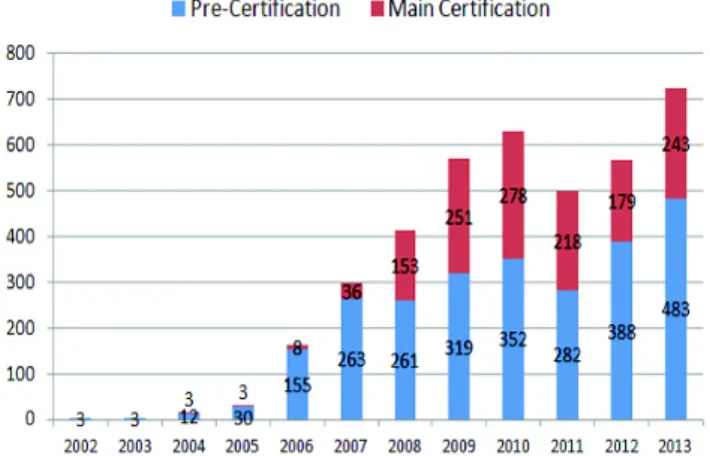
The G-SEED has two steps consisting of pre-certification and main certification. Pre-certification grants a preliminary certificate based on a design layout, an assessment document by a design /construction company, and a document confirming that the design will be applied to a building. At the main certification stage, the official certificate is issued after inspection based on background materials and an assessment document by a company. According to the certification status of the G-SEED Online Total Operation System, the total of 3,923 buildings has obtained the certification among which 2,551 cases are pre-certification, and 1,372 are main certification. The number of certification has dramatically increased since 2006 (Fig. 1) implying that buildings have steadily acquired the certification. Also, 1,484 school buildings, 1,293 apartment buildings, 590 office buildings acquired the certification and they take up about 86% of the total certification. On the other hand, the number of certification for mixed-use buildings, retails, and hotels is relatively low. Fig 2 shows certification status of green buildings by use.

Fig. 1. Certification Status of Green Building by Year

(3)

Level 1 Level 2 Detail assessment criteria Point Weight

Land use & transportation (18 pts)

Ecological value Ecological value of existing site 2

15 Adjacent site impact Validity on prevention plan to interfere solar access 2

Occupancy environment Community facility, Pedestrian walkway inside complex, Outside

pedestrian walkway network 8

Transportation load reduction Public transportation access, Bicycle storage & road, Distance

between city & complex centers 6

Energy & environment pollution (21 pts)

Energy saving Energy performance 12

Sustainable energy resource Renewable energy use 3 25

Global warming prevention CO

2

emission reduction, No use of specific substance for ozone

layer 6

Material & resource (15 pts)

Resource saving Variability 3

Waste minimization Validity on prevention plan to use living furniture 3 15 Living waste recycling Recyclable resource recycling, Food garbage reduction 4 Sustainable resource Green certified item, Information on carbon emission quantity 5 Water circulation management

(15 pts)

Water circulation system Validity on prevention plan to reduce rainwater load 4 Water use saving Validity on prevention plan to reduce living water, rainwater use, 10

graywater 11

Maintenance management (8 pts)

Site management Rationality of environment-conscious site management plan 1 Building management Validity on operation/maintenance document & guideline 2 5

Unit management User manual 1

Repairability Private area, Common area 4

Ecological environment (18 pts)

Green space within site Green network, Natural green proportion 4 Ecological function of outdoor 10

space/building envelope Biotope area factor 10

Habitat Biotope 4

Indoor environment (28 pts)

Air environment Low-emitting material, Natural ventilation, Ventilation performance

of housing unit 12

20 Thermal environment Automatic temperature control device by each room 2

Acoustical environment Light-weight impact sound block, Heavy-weight impact sound block, Partition wall sound insulation, Noise on traffic sound,

Restroom plumbing noise 10

Light environment Sunshine securing proportion 4

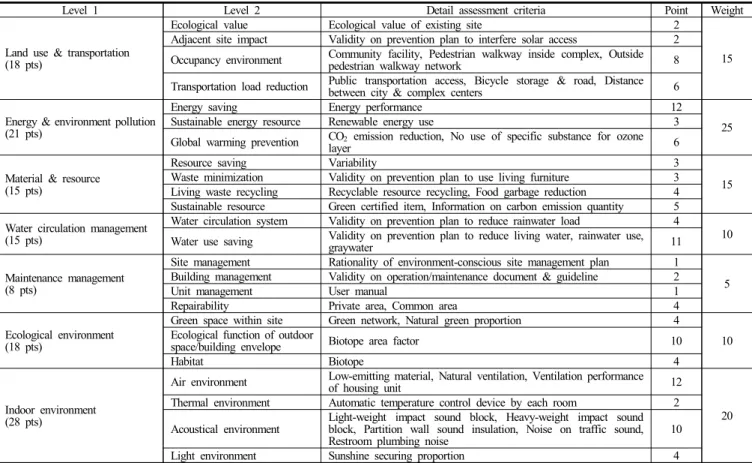
Table 1. Certification Assessment Criteria, Points &   Weights(Apartment Buildings)

Fig. 2. Certification Status of Green Building by Use

2.3. Certification Assessment Criteria and Points for Apartment Buildings

The assessment criteria of the G-SEED for apartment buildings were reorganized from nine categories to seven – land use &

transportation, energy & environment pollution, material &

resource, water circulation management, maintenance management, ecological environment, and indoor environment – with 24 assessment criteria and the total of 123 points. Table 1 shows assessment categories, criteria, points, and weights. The criteria and points are as follows: land use & transportation (4 items, 18 points), energy & environment pollution (3 items, 21 points), material &

resource (4 items, 15 points), water circulation management (2 items, 15 points), maintenance management (4 items, 8 points),

ecological environment (3 items, 18 points), and indoor environment (4 items, 28 points).

3. AHP (Analytic Hierarchy Process) and Survey

3.1. Introduction of AHP 7)

The AHP (Analytic Hierarchy Process) is a decision making tool developed by Thomas Saaty in the early 1970s. It focused on the fact that the human brain utilizes analytic process step by step or hierarchically when making a decision. It helps reach a conclusion by systematically and hierarchically identifying the nature of a complex decision making process. The AHP is an effective tool to express various goals, assessment criteria, or elements in a hierarchical structure and to decide the relative importance of those elements and priority of alternatives by conducting pairwise comparison regarding the relation among the elements.

The AHP has four theoretical backgrounds for its application.

First, elements of one level must have dependency on the higher level. Second, two elements in the same level can be compared, and they should meet reciprocal comparison to show preference between the two. Third, it has homogeneity that the preference between the two is expressed by a standard decided within a limited scope.

7) Saaty, T. L., The Analytic Hierarchy Process, N.Y. McGraw-Hill, 1980.

(4)

Lastly, it has expectation that all alternatives and standards are perfectly included in a level to achieve the goal of decision making.

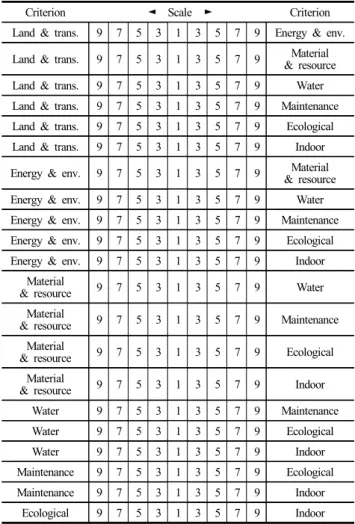
The application of the AHP is as follows. First, create a hierarchy of decision making elements related to each other. Second, calculate relative weight between the elements via pairwise comparison. As a standard for a quantitative judgment, 9-point standard (Table 2) is usually used. Third, relative importance or weight between the elements is calculated. Fourth, logical consistency of AHP survey respondents is checked. The consistency index (CI) and the consistency ratio (CR) can be used. 8) Lastly, priorities are decided by incorporating the relative importance of the decision making elements.

3.2. Survey

The survey used in this research focused on the assessment criteria and standards of G-SEED for apartment buildings. The target was residents in an apartment building in Joong-gu, Daegu with 730 households, which acquired the certification in May, 2013.

The perspective of the building is shown in Fig. 3.

The certification point and level of G-SEED certified building is shown in Table 3, and the final certification point is 68.56 implying that the building level is rated as good. 9) More specifically, the building obtained 13.40 points in land use & transportation, 33.54 in

8) Saaty suggested that CR value below 0.1 is acceptable, but below 0.2 is not acceptable. Therefore, if CR value is over 0.2, the survey should be conducted again or be excluded from the final analysis.

9) The building’s pre-certification was completed in March, 2010 which is before the revision of the G-SEED. Therefore, there were four certification categories and two certification levels. The criteria for main certification was same as the pre-certification.

energy/resource & environment load, 6.27 in ecological environment, and 15.35 in indoor environment.

No. Assessment item Acquired point

1 Land use & transportation 13.40

2 Energy·Resource

& Environment load (Management) 33.54

3 Ecological environment 6.27

4 Indoor environment 15.35

Certification point 68.56

Certification level Good

Table 3. Certification Point and Level of G-SEED Certified Building

Criterion ◄ Scale ► Criterion

Land & trans. 9 7 5 3 1 3 5 7 9 Energy & env.

Land & trans. 9 7 5 3 1 3 5 7 9 Material

& resource Land & trans. 9 7 5 3 1 3 5 7 9 Water Land & trans. 9 7 5 3 1 3 5 7 9 Maintenance Land & trans. 9 7 5 3 1 3 5 7 9 Ecological Land & trans. 9 7 5 3 1 3 5 7 9 Indoor Energy & env. 9 7 5 3 1 3 5 7 9 Material

& resource Energy & env. 9 7 5 3 1 3 5 7 9 Water Energy & env. 9 7 5 3 1 3 5 7 9 Maintenance Energy & env. 9 7 5 3 1 3 5 7 9 Ecological Energy & env. 9 7 5 3 1 3 5 7 9 Indoor

Material

& resource 9 7 5 3 1 3 5 7 9 Water Material

& resource 9 7 5 3 1 3 5 7 9 Maintenance Material

& resource 9 7 5 3 1 3 5 7 9 Ecological Material

& resource 9 7 5 3 1 3 5 7 9 Indoor

Water 9 7 5 3 1 3 5 7 9 Maintenance

Water 9 7 5 3 1 3 5 7 9 Ecological

Water 9 7 5 3 1 3 5 7 9 Indoor

Maintenance 9 7 5 3 1 3 5 7 9 Ecological

Maintenance 9 7 5 3 1 3 5 7 9 Indoor

Ecological 9 7 5 3 1 3 5 7 9 Indoor

Table 4. Survey Form of Level 1

Criterion ◄ Scale ► Criterion

Ecological value 9 7 5 3 1 3 5 7 9 Adjacent site Ecological value 9 7 5 3 1 3 5 7 9 Occupancy

environment Ecological value 9 7 5 3 1 3 5 7 9 Transport load

Adjacent site 9 7 5 3 1 3 5 7 9 Occupancy environment Adjacent site 9 7 5 3 1 3 5 7 9 Transport load

Occupancy

environment 9 7 5 3 1 3 5 7 9 Transport load Table 5. Survey Form of Level 2Land Use & Transportation 」 Importance intensity Definition

1 Equal important

3 Moderate important

5 Strong important

7 Very Strong important

9 Extreme important

Table 2. Rating Scale of Pariwise Comparison

Fig. 3. Perspective of G-SEED Certified Building

(5)

The survey was conducted in February, 2014 targeting the residents, and 19 out of 32 survey sheets were returned. Table 4 and 5 show survey categories of level 1 and 2 with a 9-point scale, and the importance was examined via priority between two elements.

The lack of consistency means unreliable results in AHP, so 6 survey sheets with CR ratio of over 0.2 were excluded from the final analysis.

(CR=0.025) Ecological

value Adjacent

site Occup.

environ. Transport load Ecological value 1.000 0.676 0.482 1.232

Adjacent site 1.479 1.000 0.746 0.807 Occup. environ. 2.074 1.340 1.000 2.170 Transport load 0.812 1.239 0.461 1.000 Table 7. Comparison Matrix ofLand Use & Transportation

(CR=0.015) Energy saving Sustainable

energy Global

warming

Energy saving 1.000 1.497 1.103

Sustainable energy 0.668 1.000 1.240

Global warming 0.907 0.806 1.000

Table 8. Comparison Matrix ofEnergy & Environment Pollution

(CR=0.052) Resource

saving Waste

min. Waste

recycling Sustainable resource Resource saving 1.000 0.828 0.807 0.397

Waste min. 1.208 1.000 0.542 0.807 Waste recycling 1.240 1.844 1.000 0.394 Sustainable resource 2.520 1.240 2.537 1.000 Table 9. Comparison Matrix ofMaterial & Resource

(CR=0.0) Water circulation Water use saving

Water circulation 1.000 1.026

Water use saving 0.974 1.000

Table 10. Comparison Matrix ofWater Circulation Management

(CR=0.003) Site mgnt Building mgnt Unit mgnt Repairability

Site mgnt 1.000 1.161 1.132 0.907

Building mgnt 0.861 1.000 1.000 0.980

Unit mgnt 0.884 1.000 1.000 1.046

Repairability 1.103 1.020 0.956 1.000

Table 11. Comparison Matrix ofMaintenance Management

(CR=0.036) Green space Ecological function Habitat

Green Space 1.000 1.306 1.000

Ecological function 0.766 1.000 0.575

Habitat 1.000 1.738 1.000

Table 12. Comparison Matrix ofEcological Environment

(CR=0.003) Air Thermal Acoustical Light

Air 1.000 3.377 1.694 0.709

Thermal 0.296 1.000 0.796 0.568

Acoustical 0.590 1.256 1.000 0.833

Light 1.411 1.762 1.200 1.000

Table 13. Comparison Matrix ofIndoor Environment

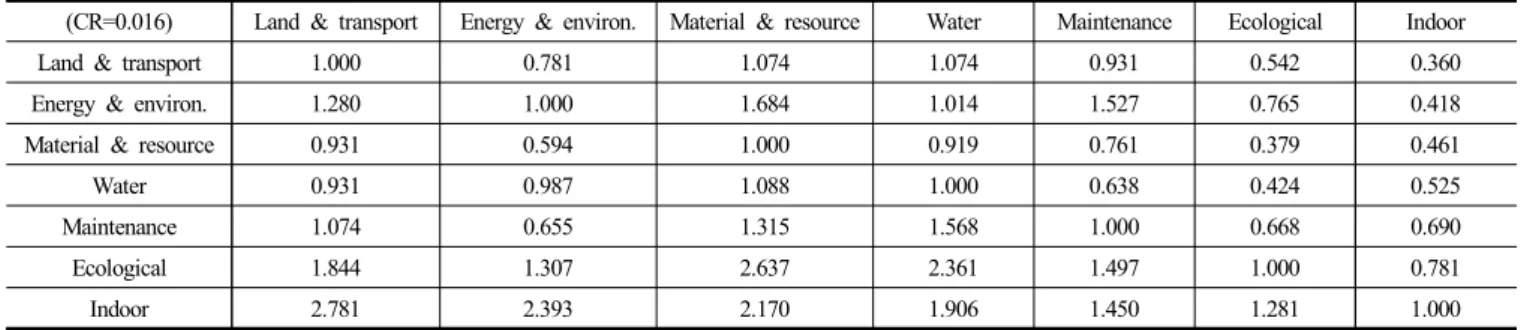
3.3. Pairwise Comparison Matrix and Consistency Verification To meet reciprocal comparison, this research used a geometric average by calculating geometric average of respondents’ values to each element of individual comparison matrix, incorporating them, and creating pairwise comparison matrixes by levels. Then, the consistency of these comparison matrixes were verified. The comparison matrix of level 1 is shown in Table 6, and the CR ratio was 0.016 meaning it is acceptable according to the Saaty’s suggestion. Comparison matrixes of land use & transport, energy &

environment pollution, material & resource, water circulation management, maintenance management, ecological environment, and indoor environment are shown in Table 7 to 13, and all matrixes’ CR values are below 0.1 implying they have consistency.

4. Importance of Assessment Criteria for Apart- ment Buildings

4.1. Importance of Level 1 Criteria (X)

Level 1 criteria of G-SEED for apartment buildings consists of seven categories - land use & transport, energy & environment pollution, material & resource, water circulation management, maintenance management, ecological environment, and indoor environment. The results of survey on the importance of level 1 criteria (X) are 0.103, 0.137, 0.091, 0.102, 0.128, 0.201, 0.238 respectively as shown in Table 14. The total sum of the importance (CR=0.016) Land & transport Energy & environ. Material & resource Water Maintenance Ecological Indoor

Land & transport 1.000 0.781 1.074 1.074 0.931 0.542 0.360

Energy & environ. 1.280 1.000 1.684 1.014 1.527 0.765 0.418

Material & resource 0.931 0.594 1.000 0.919 0.761 0.379 0.461

Water 0.931 0.987 1.088 1.000 0.638 0.424 0.525

Maintenance 1.074 0.655 1.315 1.568 1.000 0.668 0.690

Ecological 1.844 1.307 2.637 2.361 1.497 1.000 0.781

Indoor 2.781 2.393 2.170 1.906 1.450 1.281 1.000

Table 6. Comparison Matrix of Level 1

(6)

of level 1 criteria is 1, so each category takes up 10.3%, 13.7%, 9.1%, 10.2%, 12.8%, 20.1%, and 23.8%. Survey respondents consider level 1 criteria including indoor environment, energy &

environment pollution, maintenance management, etc. as rather important. This shows that the respondents consider the creation of ecological environment via green network and habitat, the establishment of air environment and thermal environment which minimize hazards to residents to improve the quality of indoor environment, and acoustical environment related to sound insulation between units, which is a social issue, as important. Also, it means that the respondents recognize energy use and reducing carbon emissions which are directly linked to climate change and maintenance management through efficient building and unit management as important environmentally friendly performance factors. On the contrary, land use & transportation, material &

resource, and water circulation management were less important.

4.2. Importance of Level 2 Criteria (Y)

Table 15 shows the importance of level 2 criteria (Y). For criteria under the land use & transportation, ecological value takes up 19.1%, adjacent site 23.5%, occupancy environment 37.3%, transportation load 20.0%. This shows that occupancy environment establishment including plans for community centers and facilities inside a complex, pedestrian roads for comfortable walking environment and their links to resting facilities, and systematic linkages between internal and external facilities of a complex as well as transportation is the most important criteria. As for energy &

environment pollution, energy saving takes up 39.2%, sustainable energy 31.1%, and global warming 29.8%, implying that energy saving related to pre-criteria of energy consumption that examines carbon emission reduction is the most important. In the material &

resource category, resource saving accounts for 16.3%, waste minimization 20.3%, waste recycling 23.1%, and sustainable resource 40.2%, meaning sustainable resource recycling related to assessment on the use of certified sustainable product for resource recycling, information label about carbon emission of materials, and assessment on inherent carbon. As for water circulation management, water circulation system and water use saving take up 50.6% and 49.4% respectively. Under the maintenance management category, site management accounts for 26.1%,

repairability 25.5%, unit management 24.5%, and building management 23.9% in the order of importance, but the difference is not so big. As for ecological environment, green space takes up 35.8%, ecological function 24.9%, and habitat 39.4%, showing that the quality improvement of ecological environment inside a complex by providing habitat. In the case of indoor environment, air environment accounts for 34.0%, thermal environment 14.0%, acoustical environment 20.4%, and light environment 31.6%, implying that air environment including the use of products with low indoor air pollutant emissions, natural ventilation providing fresh air from outside, which residents can control, and ventilation performance that can maintain fresh indoor air by emitting indoor air pollutants to the outside is the most important.

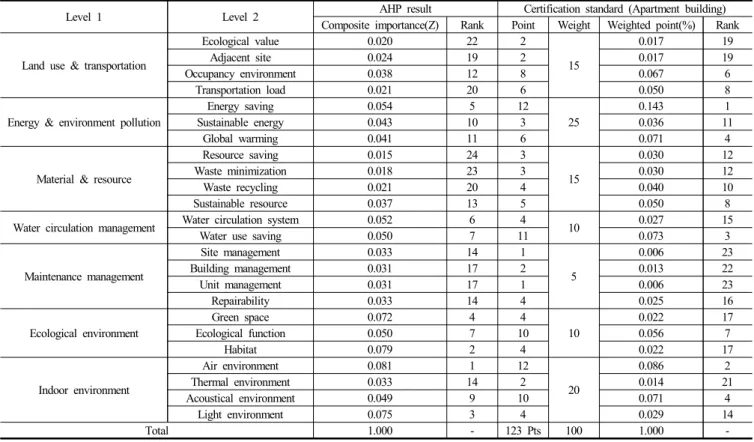
4.3. Composite Importance by Assessment Criteria (Z) Table 16 shows the composite importance by assessment criteria (Z). The value of each item was calculated by multiplying the importance of level 1 criteria (X) by the importance of level 2 criteria (Y). In the indoor environment, air environment and light environment take up 8.1% and 7.5% respectively. In the ecological environment, habitat, green space, and ecological function account for 7.9%, 7.2%, 5.0% respectively. Also, in the energy and environment pollution, energy saving takes up 5.4%, in the water circulation management, water circulation system 5.2% and water use saving 5.0%. These eight items take up 51.3% of the composite importance, meaning they are considered important in the green building certification system for apartment buildings.

Level 1 Level 2 Importance(Y) Rank

Land use &

transportation

Ecological value 0.191 4

Adjacent site 0.235 2

Occupancy environment 0.373 1 Transportation load 0.200 3 Energy &

environment pollution

Energy saving 0.392 1

Sustainable energy 0.311 2

Global warming 0.298 3

Material &

resource

Resource saving 0.163 4

Waste minimization 0.203 3

Waste recycling 0.231 2

Sustainable resource 0.402 1 Water circulation

management

Water circulation system 0.506 1

Water use saving 0.494 2

Maintenance management

Site management 0.261 1

Building management 0.239 4

Unit management 0.245 3

Repairability 0.255 2

Ecological environment

Green space 0.358 2

Ecological function 0.249 3

Habitat 0.394 1

Indoor environment

Air environment 0.340 1

Thermal environment 0.140 4

Acoustical environment 0.204 3

Light environment 0.316 2

Table 15. Importance(Y) & Ranking of Level 2

Level 1 Importance(X) Rank

Land use & transportation 0.103 5 Energy & environment pollution 0.137 3

Material & resource 0.091 7

Water circulation management 0.102 6

Maintenance management 0.128 4

Ecological environment 0.201 2

Indoor environment 0.238 1

Table 14. Importance(X) & Ranking of Level 1

(7)

On the contrary, the respective shares of ecological value, transportation load, and adjacent site in the land use &

transportation are 2.0%, 2.4%, 2.1%. Also, resource saving, waste minimization, waste recycling in the material & resource take up 1.5%, 1.8%, 2.1% respectively. It implies that those items are considered less important in the green building certification system for apartment buildings.

The comparison between the composite importance of assessment criteria drawn from the AHP survey and the importance of weighted points of the green building certification for apartment buildings shows that energy saving in the energy & environment pollution, water use saving in the water circulation management, ecological function in the ecological environment, and air environment in the indoor environment, which have higher importance with more than 5 points, have a similar order to that of the AHP result in terms of importance. However, occupancy environment of the importance of the land use & transportation, global warming of the energy & environment pollution, sustainable resource in the material & resource, and acoustical environment of the indoor environment was different when the assessment criteria was compared with the AHP result. Also, assessment criteria with higher importance in the current certification system have low composite importance in the AHP result. On the other hand, water circulation system in the water circulation management, green space and habitat in the ecological environment, and light

environment of the indoor environment showed higher composite imoprtance in the AHP result. Therefore, the result of the AHP result of this research can be utilized when the assessment criteria points and weight of the green building certification system will be adjusted.

5. Conclusions

This research conducted the AHP survey on the assessment criteria for apartment buildings, targeting residents in a certified green apartment building. The importance of each evaluation item was calculated and the result was compared with the points of the current certification system.

The result of this research with AHP analysis is as below.

(1) In the level 1 criteria consisting of the land use &

transportation, energy & environment pollution, material &

resource, water circulation management, maintenance management, ecological environment, and indoor environment, the importance of the indoor environment, ecological environment, energy & environment pollution, and maintenance management account for 23.8%, 20.1%, 13.7%, 12.8% respectively, considered more important.

(2) In the level 2 criteria, the composite importance of air environment and light environment of the indoor environment,

Level 1 Level 2 AHP result Certification standard (Apartment building)

Composite importance(Z) Rank Point Weight Weighted point(%) Rank

Land use & transportation

Ecological value 0.020 22 2

15

0.017 19

Adjacent site 0.024 19 2 0.017 19

Occupancy environment 0.038 12 8 0.067 6

Transportation load 0.021 20 6 0.050 8

Energy & environment pollution

Energy saving 0.054 5 12

25

0.143 1

Sustainable energy 0.043 10 3 0.036 11

Global warming 0.041 11 6 0.071 4

Material & resource

Resource saving 0.015 24 3

15

0.030 12

Waste minimization 0.018 23 3 0.030 12

Waste recycling 0.021 20 4 0.040 10

Sustainable resource 0.037 13 5 0.050 8

Water circulation management Water circulation system 0.052 6 4

10 0.027 15

Water use saving 0.050 7 11 0.073 3

Maintenance management

Site management 0.033 14 1

5

0.006 23

Building management 0.031 17 2 0.013 22

Unit management 0.031 17 1 0.006 23

Repairability 0.033 14 4 0.025 16

Ecological environment

Green space 0.072 4 4

10

0.022 17

Ecological function 0.050 7 10 0.056 7

Habitat 0.079 2 4 0.022 17

Indoor environment

Air environment 0.081 1 12

20

0.086 2

Thermal environment 0.033 14 2 0.014 21

Acoustical environment 0.049 9 10 0.071 4

Light environment 0.075 3 4 0.029 14

Total 1.000 - 123 Pts 100 1.000 -

Table 16. Comparison between Composite Importance(Z) and Certification Standard of Assessment Criteria

(8)

habitat, green space, and ecological function in the ecological environment, energy saving of the energy & environment pollution, and water circulation system of the water circulation management was 8.1%, 7.5%, 7.9%, 7.2%, 5.0%, 5.4%, 5.2%, 5.0% respectively, considered more important in the green building certification for apartment buildings.

The survey result targeting residents in a certified apartment building of this research is expected to be references for improvements of scoring scale and criteria division of G-SEED for apartment buildings. The importance by project stakeholders (architects, constructors, owners, and users) related to the certification criteria for apartment buildings should be examined and compared. Also, research on applying the AHP analysis to other certification criteria for different types of buildings such as schools and office buildings that take up a significant portion in the certification should be conducted.

Acknowledgement

This work was supported by research grants from the Catholic University of Daegu in 2014 (No.20141298).

References

[1] G-SEED Online Total Operation System, 2013. (http://g-seed.or.kr) [2] Se-Kyung Oh, Min Suk Han, Pyeong Chan Lim. An Improvement on

Evaluation Methods of Green Building Certification Criteria: Focused on the Case of Japan, U.K and U.S.A, Journal of the Korean Association of Asian Studies. Vol. 14. No. 1. 2011. p.219-241

[3] Kwang-Ho Ahn, Hyeong-Geun Kim, Yong-Seok Choi. A Study on Way Improvement of User-centered Green Building Certification System based on BIM, Journal of the Architectural Institute of Korea, Planning &

Design. Vol. 28. No. 1. 2012. p.101-108

[4] Yeo-Jin Choi. Analyzing Weights of Certification Assessment Criteria on the G-SEED System Using the AHP Method, Journal of the Korea Institute of Ecological Architecture and Environment. Vol. 13. No. 6.

2013. p.113-120

[5] Hyun-Sook Jang, Sang-Ho Lee. A Comparison Study on the Importance and Problems of Assessment Items of the G-SEED System, Journal of the Korea Institute of Ecological Architecture and Environment. Vol.

14. No. 1. 2014. p.113-120

[6] Saaty, T. L., The Analytic Hierarchy Process, N.Y. McGraw-Hill, 1980.

[7] Aczel, J. and Saaty, T. L., Procedure for Synthesizing Ratio Judgments,

Journal of Psychology, Vol. 27. 1983. p.93-102.

수치

Fig. 1. Certification Status of Green Building by Year
Table 1. Certification Assessment Criteria, Points &   Weights(Apartment  Buildings)
Table 2. Rating Scale of Pariwise Comparison
Table 8. Comparison Matrix of 「 Energy & Environment Pollution 」
+3

참조

관련 문서

• 이명의 치료에 대한 매커니즘과 디지털 음향 기술에 대한 상업적으로의 급속한 발전으로 인해 치료 옵션은 증가했 지만, 선택 가이드 라인은 거의 없음.. •

 The Dutch physicist Pieter Zeeman showed the spectral lines emitted by atoms in a magnetic field split into multiple energy levels...  With no magnetic field to align them,

Modern Physics for Scientists and Engineers International Edition,

If both these adjustments are considered, the resulting approach is called a bootstrap-BC a -method (bias- corrected-accelerated). A description of this approach

Five days later, on 15 January 1975, the Portuguese government signed an agreement with the MPLA, FNLA and UNITA providing for Angola to receive its independence on 11

· 50% exemption from tuition fee Ⅱ for the student with a TOPIK score of level 3 or higher or completion of level 4 or higher class of the Korean language program at the

14 For individuals with a triglyceride concentration of 200–499 mg/dL, pharmacological therapy should be considered to lower triglyceride concentration after

웹 표준을 지원하는 플랫폼에서 큰 수정없이 실행 가능함 패키징을 통해 다양한 기기를 위한 앱을 작성할 수 있음 네이티브 앱과