Carbon/Epoxy 복합재료의 피로수명예측에 관한 신뢰성 해석 A Reliability Analysis on the Fatigue Life Prediction in
Carbon/Epoxy Composite Material
장성수* Seong-Soo Jang*
<Abstract>
In recents years, the statistical properties has become an important quantity for reliability based design of a component. The effects of the materials and test conditions for parameter estimation in residual strength degradation model are studied in carbon/ epoxy laminate. It is shown that the correlation between the experimental results and the theoretical prediction on the fatigue life distribution using the life distribution convergence method is very reasonable.
Keywords : Reliability, Residual Strength Degradation Model, Life Distribution Convergence Method
* 교신저자, 정회원 거창전문대학 자동차기계과 조교수, 工博 E-mail : [email protected]
* Corresponding Author, Prof., Geochang provincial college, Dept. of automotive & Mechanics, Ph. D.
1. 서 론
신뢰성 이론은 1951년 W. Weibull 교수가 신 뢰성함수인 Weibull 분포에 이론을 처음발표하 면서 시작되었으며, 1960년 NASA에 의한 인공 위성 개발때 많은 이론이 개발되어 오늘에 이 르고 있으며 신뢰성이 요구되는 분야의 구조설 계에 있어서는 신뢰성평가
(1~3)가 이루어진 기계 적 물성데이터를 반드시 필요로 한다. 복합재료 (composite material)는 가공성이 좋은 경량의 기지재료에 섬유상 혹은 입상의 강화소재를 복 합함으로서 구조재료로서 요구되는 우수한 기 계적 성질을 갖는 재료이지만, 비균질 이방성 구조를 가지고 있기 때문에 피로실험과정에서 복잡한 파손의 형태를 나타낸다. 이러한 파손형
태를 해석하기 위하여 잔류강도 저하모델, 강성 저하모델 등에 관한 통계적 연구가 일부 이루 어 지고 있다. 피로하중하에서 잔류강도저하를 전제로한 통계적 연구는 복합재료를 이용하여 Broutman
(4)등에 의해 시작되었으며, 잔류강도 저하모델의 유효성은 많은 연구가들에 의해 재확 인 되었다. Weibull 분포
(5~15)는 파라미터들의 정확한 산출이 요구되어 지는데, 잔류강도 저하 모델의 파라미터 결정법에 관한 유효성 평가 연구는 매우 미흡한 실정이다.
그리고 잔류강도 저하모델의 파라미터 결정법 중의 하나인 수명분포일치법에 대한 유효성 검 증 연구는 전무한 실정이다.
따라서 본 연구에서는 수명분포일치법(life
distribution convergence method, 이하, L.D.C.M.)
(15)을 이용하여 파라미터산출 후 신뢰성기법을 이 용한 실헙값과의 비교를 통해 수명분포일치법 의 적합성을 비교, 검증하였다.
2. 이론해석
Yang
(12,13)은 일정진폭 반복하중하에서 n 피로
사이클 후 잔류강도 R(n)의 저하는 식 (1)과 같고, 등가극한강도 R
i(0)는 식 (2)와 같이 정 의됨을 보고하였다.
R
c(n ) = R
c(0 ) - ȼ
cKS
bn (1)
여기서, b, c, K는 실험데이터에 의해 결정되 는 상수이고, S는 응력범위, ȼ는 2모수 Weibull 분포의 규모모수이다.
여기서, R
i(0)는 i번째 피로시험편의 정적극한 강도를 의미한다.
정적극한강도 분포를 2모수 Weibull 분포형태 로 표현하면 식 (3)과 같고, 잔류강도 저하모델 에 의한 피로파괴 사이클수 N은 식 (4) 그리고 피로수명 N의 통계적 분포는식 (5)와 같다.
FR( 0)(x)= P[R(0 )≤x] = 1 - exp [ - ( x
ȼ )Ȼ]
(3)
여기서, Ȼ는 형상모수, ȼ는 규모모수이다.
N= [ R
c(0 ) - ɍ
cmax]
ȼ
cKS
b(4)
§Þƌß á©ã§= ƌä á©ã«Þ×ß = ÞĸƁ¤¬ƀƌňÀ ´ËƁ ßćƁ
Î
ä
§Þƌß á × é ƌ ï Î
á Îà ¸ËÃãà ÞćÎƀ ƌňÀ ´ËƁ îĸƁ¤¬ƀ
ßćƁ
ķ
ä é ƌ > ×
(5)
잔류강도 저하모델을 근거로 한 피로수명 피
로수면분포예측과 잔류강도거동 예측은 식 (1)의 파라미터 b, c, K에 크게 의존하며, 수명분포일 치법을 요약하면 식 (6)과 같다. 수명분포일치 법은 응력범위 S의 수를 n, i번째 응력범위 S
i에 서 피로시험편수를 m이라 하고, 아래 식 (6)과 같이 잔차 ȟ를 최소화함으로서 산출할 수 있는 방법이다.
ȟ=∑i = 1J 【{m + 0.4i + 0.3 }-
{1 - exp [ - (Ni+ɍcmax i/ȼcKSbi
1/KSbi
)
Ȼ
c]} 】2
(6)
3. 실험방법 및 실험데이터
신뢰성해석을 위한 실험값과의 비교는 충분 한 양의 실험데이터가 있는 참고문헌[6]의 정적 극한강도 및 피로수명 실험데이터를 이용하였 으며, 실험재료는 한국화이버(주)에서 제작된 탄소섬유/에폭시[0/45/90/-45]
2s이다. 인장시험은 18개의 시험편이 이용되었고, 피로시험은 하중 제어, 정현파, 주파수 4Hz, 응력비 0.1, 적용응 력(S)은 정적극한강도에 대한 최대 작용응력의 비 q(= ɍ
max/ ɍ
u)=0.6, 0.6375, 0.675, 0.7125, 0.75, 0.825 6개 응력수준에서 각 10개의 시험편을 이 용하여 실험된 데이터들이 이용되었다.
4. 결과 및 고찰
Table 1은 수명분포일치법을 이용하여 정적극 한강도에 대한 모수, 일정진폭 피로데이터 그리 고 식 (6)를 이용하여 Delphi 5.0 소프트웨어로 프로그램하여 산출된 파라미터값들을 제시하고 있다.
피로수명분포의 형상은 파라미터 c값에 크게
의존하며 c값이 클수록 작은 산포를 갖는다. 본
연구에서 수명분포일치법으로 산출한 c값은
17.226이고, 심봉식 등
(6)이 최우추정법(maximum
likelihood method, 이하, M.L.M)으로 산출한 c
값은 12.387로 나타났는데 수명분포일치법에 의
한 c값이 최우추정법에 의한 c값 보다 매우 큰
값으로 나타나 수명분포일치법이 최우추정법
보다 정확하고 적합한 파라미터 결정방법임을
추측할 수 있다.
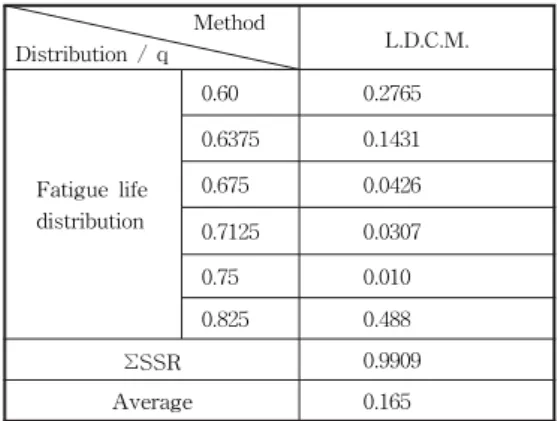
Table 2는 수명분포일치법을 이용한 Table 1 의 파라미터값으로 예측한 분포와 중앙순위에 의한 실험값과의 산포인 식 (7)의 잔차제곱합
Parameters
Method b c K
L.D.C.M. 10.28 17.226 1.21×10-49 M.L.M.(6) 15.667 12.387 2.97×10-50 Table 1. Parameters of the residual strength degradation model in carbon/epoxy laminate
Method
Distribution / q L.D.C.M.
Fatigue life distribution
0.60 0.2765
0.6375 0.1431
0.675 0.0426
0.7125 0.0307
0.75 0.010
0.825 0.488
ȭSSR 0.9909
Average 0.165
Table 2. SSR by life distribution convergence method in carbon/epoxy laminate
Method q
Experimental
results(mean) L.D.C.M.
0.60 770345 695934
0.6375 187080 244464
0.675 75120 91078
0.7125 29428 35736
0.75 12438 14674
0.825 3056 2779
Table 3 Comparison between the experimental results and the prediction of fatigue life by the life distribution converge- nce method in carbon/epoxy laminate
Method
Materials M.T. L.D.C.M.
graphite/epoxy laminate(15)
Average of
SSR 0.327 0.215
carbon/epoxy
laminate Average of
SSR - 0.165
Table 4. Comparison of SSR between the minimization technique and life distribution convergence method in composite materials
(residual sum of square, SSR)과 잔차평균값을 제시하고 있는데 매우 낮은 잔차제곱합으로 수 명분포일치법이 피로수명분포예측에 매우 적합 한 파라미터 산출법임을 알 수 있다.
SSR =
∑mi = 1
(F
m( i)- F
p( i))
2(7)
여기서,
Fm( i)은 중앙순위(median rank)에 의 한 실험데이터의 분포이고,
Fp( i)은 모델에 의해 예측된 분포이다.
Table 3은 식 (4)의 피로수명 예측식을 이용 하여 각 응력수준에 대한 수명분포일치법에 의 한 예측피로수명과 실험에 의한 평균값과의 비 교결과를 제시하고 있는데, 실험값과 훌륭한 일 치를 보이고 있음을 알 수 있다.
Table 4는 두 종류의 복합재료(graphite/epoxy laminate, carbon/epoxy laminate)에 대한 파라미 터결정법의 비교를 위해 최소화기법(minimization technique, 이하, M.T.)과 수명분포일치법(L.D.C.M.) 의 예측 분포와 중앙순위에 의한 실험값과의 산 포인 잔차제곱합을 제시하고 있는데, 수명분포일 치법이 최소화기법 보다 더 낮은 잔차제곱합을 갖는 것으로 나타나 수명분포일치법이 잔류강 도 저하모델 해석에 적합한 파라미터 결정방법 임을 추측 할 수 있다.
또한 Table 4는 carbon/epoxy 복합재료의 경
우에 대한 수명분포일치법에 의한 잔차제곱합
을 제시하고 있는데, 잔차제곱합 0.165로 매우 낮
은 잔차제곱합을 갖는 것으로 나타나, 수명분포일
치법이 carbon/ epoxy 복합재료의 경우에도 피
로수명분포예측에 적합한 것으로 확인되었다
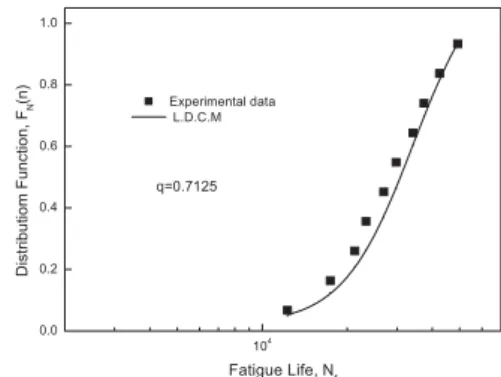
Fig. 1~6은 각 응력수준에서 수명분포일치법
으로 예측한 피로수명분포와 실험에 의한 중앙
순위 파손확률로 환산한 값과의 관계를 제시하
고 있는데, 수명분포일치법에 의한 예측결과가
carbon/epoxy 복합재료, 인장-인장 피로하중조
건에서도 저응력, 고응력 모든 응력수준에서 실
험값과 훌륭한 일치를 보이고 있었다. Fig. 1과
Fig. 6의 경우 즉, 응력수준 q=0.60, 0.825에서는
수명분포일치법에 의한 예측결과가 실험값에
의한 중앙순위 파손확률 보다 안전한 예측을
보이고 있었다. Fig. 2~5의 경우 즉, 응력수준
q=0.6375~0.75에서는 특이성 없이 실험값과 훌
륭한 일치를 보이고 있었다.
105 106 0.0
0.2 0.4 0.6 0.8 1.0
Experimental data L.D.C.M
q=0.60
Distributiom Function, FN(n)
Fatigue Life, N
f
Fig. 1. Comparison between the experimental results and the prediction of fatigue life distribution by the life distribution convergence method in carbon/epoxy laminate (q=0.60).
104 105
0.0 0.2 0.4 0.6 0.8 1.0
q=0.6375
Distributiom Function, FN(n)
Fatigue Life, N
f Experimental data L.D.C.M
Fig. 2. Comparison between the experimental results and the prediction of fatigue life distribution by the life distribution convergence method in carbon/ epoxy laminate (q=0.6375).
104 105
0.0 0.2 0.4 0.6 0.8 1.0
q=0.675
Distributiom Function, FN(n)
Fatigue Life, Nf Experimental data L.D.C.M
Fig. 3. Comparison between the experimental results and the prediction of fatigue life distribution by the life distribution convergence method in carbon/ epoxy laminate (q=0.675).
͑
0.0 1040.2 0.4 0.6 0.8 1.0
q=0.7125
Distributiom Function, FN(n)
Fatigue Life, Nf Experimental data L.D.C.M
Fig. 4. Comparison between the experimental results and the prediction of fatigue life distribution by the life distribution convergence method in carbon/ epoxy laminate (q=0.7125).
103 104
0.0 0.2 0.4 0.6 0.8 1.0
q=0.75
Distributiom Function, FN(n)
Fatigue Life, N
f Experimental data L.D.C.M
Fig. 5. Comparison between the experimental results and the prediction of fatigue life distribution by the life distribution convergence method in carbon/ epoxy laminate (q=0.75).
102 103 104
0.0 0.2 0.4 0.6 0.8 1.0
q=0.825
Distributiom Function, FN(n)
Fatigue Life, Nf Experimental data L.D.C.M
Fig. 6. Comparison between the experimental results and the prediction of fatigue life distribution by the life distribu- tion convergence method in carbon/ epoxy laminate (q=0.825).
따라서 인장-인장 피로하중하의 carbon/epoxy 복합재료에 있어서도 피로 잔류강도 저하모델 에 의한 피로특성예측은 유용한 것으로 확인되 었다. 또한 잔류강도저하모델의 파라미터 b, c, K 산출방법의 경우 수명분포일치법에 의한 예 측분포가 실험분포와 매우 좋은 일치를 보이고 있으므로 유용한 파라미터 결정법인 것으로 판 단된다.
5. 결 론
carbon/epoxy 복합재료에 대한 피로 잔류강 도 저하모델의 파라미터 산출방법에 대한 신뢰 성 연구를 통하여 다음과 같은 결론을 얻을 수 있었다.
1. 인장-인장 피로하중하의 carbon/epoxy 복 합재료의 경우 피로 잔류강도 저하모델 해석에 의한 피로수명 및 피로수명분포 예측은 유효성 이 있는 것으로 확인되었다.
2. 피로수명예측 및 피로수명분포 예측에 있어 서 잔류강도저하모델의 수명분포일치법에 의한 예측결과가 실험값과 매우 낮은 잔차를 갖으며 좋은 일치를 보이고 있으므로 carbon/epoxy 복합재료에 있어서도 수명분포일치법이 매우 유용한 파라미터 결정법인 것으로 확인되었다.
아울러 복합재료와 같이 피로수명산포가 큰 재료의 경우 잔류강도 저하모델을 이용한 신뢰 성 있는 피로수명예측, 피로수명분포예측, 잔류 강도예측, 잔류강도분포예측 등의 피로특성예측 을 위해서는 다양한 재료, 다양한 하중조건에 대한 파라미터 결정방법과 관련된 보다 많은 유효성 평가 연구가 필요할 것으로 판단된다.
참 고 문 헌
1) 日本機械學會基準, “統計的疲勞試驗 方法”, JSME S 002, pp. 1~120. (1981)
2) Little, R.E., “Manual on Statistical Planing and Analysis”, ASTM STP 744, pp. 52~53.(1975) 3) 西島敏, “疲勞試驗データの統計的整理”, 材料,
第 29卷 第 316号, pp. 132~137. (1981) 4) Broutman, L.J. and Sahu, S., “A New Theory to Predict Cumulative Fatigue Damage in Fiberglass Reinforced Plastics,” Composite Materials : Testing and Design (2nd Conference),
ASTM STP 497, pp. 170~188. (1972)
5) Radhakrishnan, K., “Fatigue and Reliability Evaluation of Unnotched Carbon Epoxy Laminates,” Journal of Composite Materials, Vol. 18, pp. 21~31. (1984)
6) 심봉식, 성낙원, 옹장우, “탄소섬유/에폭 시 복합재료의 잔류강도 저하해석에 의한 피로 수명 평가,” 대한기계학회논문집, 제15권, 제 6호, pp. 1908~1918. (1991)
7) Nishijima, S., “Statistical Analysis to Fatigue Test Data,” JSME S 002, pp. 132~137. (1981) 8) S. Nishijima, “Statistical Fatigue Prop- erties of Some Heat Treated Steels for Machine Structural Use,” ASTM STP 744, pp. 75~88. (1981)
9) Toshiyuki Shimokawa and Yasumasa Hamaguchi, “Distribution of Fatigue Life and Fatigue Strength in Notched Specimens of a Carbon Eight-Harness-Satin Laminate,”
Journal of Composite Materials, Vol. 17, pp. 64~76. (1983)
10) 田中道七, 酒井澾雄, “3 母數 ワイづル 分 布の母數推定についで,” 材料, 第28卷, 304 号, pp. 13~19. (1978)
11) Whitney, J.M., “Fatigue Characterization of Composite Materials,” ASTM STP 723, pp. 133~151. (1981)
12) Yang, J.N., Liu, M. D., “Residual Strength Degradation Model and Theory of Periodic Proof Tests for Graphite/Epoxy Laminate,”
J. of Composite Materials, Vol. 11, pp. 176~
203. (1977)
13) Yang, J.N., “Fatigue and Residual Strength Degradation for Graphite/Epoxy Composites Under Tension-Compression Cyclic Loadings,”
J. of Composite Materials, Vol.12, pp. 19~
39. (1978)
14) 김도식, 김정규, “잔류강도 저하모델의 파 라미터 결정법에 따른 피로수명 예측,” 대 한기계학회논문집, 제18권, 제8호, pp. 205 3~2061 (1994)
15. 김상태, 장성수, “피로수명예측을 위한 잔류 강도 저하모델의 파라미터 결정법 제안 (Ⅰ),” 대한기계학회논문집 A권, 제25권, 제5 호, pp. 874~882. (2001)
(2007년 4월 2일 접수, 2007년 8월 24일 채택)