Print ISSN: 2288-4637 / Online ISSN 2288-4645 doi:10.13106/jafeb.2020.vol7.no12.181
Gender Diversity and Financial Stability: Evidence from Malaysian Listed Firms
Mujeeb Saif Mohsen AL-ABSY
1, Qais ALMAAMARI
2, Tamer ALKADASH
3, Ammar HABTOOR
4Received: September 01, 2020 Revised: October 26, 2020 Accepted: November 05, 2020
Abstract
This study examines the relationship between gender diversity (women on the board and women on the audit committee) and a firm’s financial stability. The ordinary least square analysis was used to determine the relationship. To measure the financial stability of Malaysian suspect firms, i.e., firms with the lowest positive earnings, the Altman (1993) Z-Score measurement was utilized. The results indicate that women on the board are significantly and negatively associated with the firm’s financial stability. That is, they are related to low financial stability, which contradicts the agency and resource dependence theories. Regarding women directors on the audit committee, there is no significant relationship with financial stability, meaning that they cannot protect the company against financial distress. These results are robust and do not change when using different measurements of gender diversity, one-year lag of independent variables, and other methods of analysis, namely random effect panel data. This study is the first to alert policymakers, stakeholders, researchers, and society in general to the need to re-evaluate and strengthen the role of women directors in improving firms’ financial stability, particularly in emerging economies like Malaysia.
Keywords: Gender Diversity, Women Directors, Board of Directors, Audit Committee, Financial Stability, Malaysia JEL Classification Code: M40, M41, M42, M48
recognize the importance of a healthy, secure, and balanced economic and financial environment (Rubio & Yao, 2020), with constant, effective monitoring and scrutiny of financial stability (Chirila & Chirila, 2015). The root of unstable financial conditions, as suggested by the European Central Bank (ECB) (2010) annual report, is a mismatch between the balance sheet and high leverage of debt, and the rapid growth of financial institutions. These are all components of corporate governance (CG) ( Lupu, 2015).
The global financial crisis has therefore resulted in the re-examination of CG practices (Anginer, Demirguc-Kunt, Huizinga, & Ma, 2018; Lupu, 2015) in supporting financial stability (Lupu, 2015). Most policy decision-makers have questioned the extent to which managerial dominance and the inability of boards to supervise executives might have led to unwarranted risk-taking and financial instability (Anginer et al., 2018). It is argued that weak firm performance and high risk contribute significantly to financial instability; they are the negative consequences of board failure in performing the assigned tasks efficiently (Abdelbadie & Salama, 2019).
In the Malaysian context, the economic crisis in the middle of 1997 demonstrated the effects of weak CG (Abdul-Rahman & Ali, 2006; Ow‐Yong & Kooi-Guan, 2000). Since then, the spotlight has moved on to CG
1. Introduction
The financial crisis of 2007-09 substantially shook the global community, affecting both the developed and less developed economies and typified by lower economic activity, high unemployment, aggravation of the poverty level, and widening of the gap between rich and poor (Firtescu, 2012). Regulators, investors, and financial communities
1
First Author and Corresponding Author. Assistant Professor, Department of Accounting and Finance, College of Administrative and Financial Sciences, Gulf University, Kingdom of Bahrain [Postal Address: Street No. 4324, Sanad, 734, Kingdom of Bahrain]
Email: [email protected]
2
Assistant Professor, Department of Administrative and Human Resource, College of Administrative and Financial Sciences, Gulf University, Kingdom of Bahrain
3
Assistant Professor, Department of Administrative and Human Resource, College of Administrative and Financial Sciences, Gulf University, Kingdom of Bahrain
4
Assistant Professor, Faculty of Oil and Minerals, University of Aden, Aden, Yemen
© Copyright: The Author(s)
This is an Open Access article distributed under the terms of the Creative Commons Attribution Non-Commercial License (https://creativecommons.org/licenses/by-nc/4.0/) which permits unrestricted non-commercial use, distribution, and reproduction in any medium, provided the original work is properly cited.
(Shahwan, 2015), with measures taken by the government to boost the effectiveness of CG. Commencing in 1999 with the formation of a robust Finance Committee on Corporate Governance (FMCG), the committee conducted a review of CG and began the reformation of the Malaysian Code of Corporate Governance (MCCG), leading to the modification of the CG Code in 2000, 2007, 2012 and more recently in 2017.
The role of CG, like the board of directors, has been studied extensively (Abdelbadie & Salama, 2019). Earlier researchers have examined in-depth the effect of CG in respect of financial reporting quality, for instance, earnings management (EM), timely financial reporting, and firm performance. The impact of CG on a firm’s financial distress has been examined, for example, CEO duality, the independence of the board, including ownership structure (Abdullah, 2006); CEO duality, the existence of an audit committee (AC), the directorship and external ownership as well as the board structure (Miglani, Ahmed, & Henry, 2015); CEO duality, the board size, board structure, an independent board, and AC structure (Elloumi & Gueyie, 2001); board chairman’s characteristics (Al-Absy, 2020);
shares held by the controlling shareholders pledged for bank loans, controlling shareholding directors, and the deviation in control away from the cash flow rights (Lee & Yeh, 2004). However, to the best of our knowledge, no study has been made of the influence of women directors on financial stability.
The presence of women on the board of directors is one of the most important requirements of CG. The number of women directors is being increased voluntarily or through legislation in many countries, in recognition of the value of their participation (Abdullah, Ku Ismail, & Nachum, 2016; Srinidhi, Gul, & Tsui, 2011). Norway, Spain, Sweden, Israel, and France have legislated for 40%, 40%, 25%, 50%, and 50% women representation on the board, respectively (Burke & Vinnicombe, 2008; Gavious, Segev,
& Yosef, 2012; Staubo, 2010). Likewise, the Malaysian government in 2004 formulated a policy which stipulates that by 2016, 30% of high-level decision-making officers in the public sector should be women; the policy was extended to the private sector in 2011 (Abdullah, 2014;
Abdullah & Ku Ismail, 2016; Ku Ismail & Abdullah, 2013). The current policy (2020) is that all firms have to include at least 30% of women on their boards. To ensure the listed firms’ compliance with its regulations, the MCCG (version 2012) required boards to develop and report on their position on gender equality and how this aim should be accomplished.
This study examines the association between women on the board and AC and the firm’s financial stability.
It contributes to the literature in various ways. First, it extends knowledge by providing evidence of the impact of
women directors on firms’ financial stability, a topic that has not been examined yet. Second, the results may help regulators, policymakers, and shareholders to determine whether to increase the percentage of women representatives on the board and AC. The reason for selecting Malaysia for this research is that its business environment has certain attributes that can influence the practice of CG.
Two elements distinguish the ownership of Malaysian companies: concentrated shareholdings held by a family or individual, and the large proportion of government equity (Abdullah, 2006). These two features might influence the nomination of women directors to either the board or AC.
The Malaysian perspective is also significant as a result of numerous revisions by the regulatory authorities to the MCCG (2007, 2012, and 2017), in an attempt to improve the code. This implies that the earlier versions can be regarded as incomplete or difficult to apply.
2. Literature Review
Women directors on the board are increasingly seen as important (Srinidhi et al., 2011). They can strengthen their monitoring role (Adams & Ferreira, 2009) to enhance boardroom capabilities (Mathisen, Ogaard, & Marnburg, 2013) and are more likely to be independent (Bohren & Staubo, 2016; Staubo, 2010). Accordingly, gender diversity, as one of the board mechanisms, helps to solve the agency problems between owners and executives (Fama & Jensen, 1983).
From the perspective of resource dependence theory, the board structure is a strategic tool that helps to link external resources and the firm, thereby creating value. The board composition is thus influenced by environmental pressures and demands (Boyd, 1990). For example, pressure from society to appoint women directors to the board has increased (Luckerath-Rovers, 2009), as their presence is significantly related to higher firm performance (Abdullah et al., 2016; Adams & Ferreira, 2009), firm value (Carter, Simkins, & Simpson, 2003), and earnings quality (Srinidhi et al., 2011).
Women directors are equal and at times superior to their male counterparts in many aspects: education, knowledge, skills, ethics, reputation, and the ability to recognize the misuse of earnings (Lakhal et al, 2015; Singh, Terjesen,
& Vinnicombe, 2008). Adams and Ferreira (2009) state that boards with a higher percentage of women directors guarantee improved decision making and strict supervision of CEOs to be aligned with shareholders’interests.
Women directors are more independent and can strengthen the monitoring role of the board more readily than male directors (Bohren & Staubo, 2016; Carter et al., 2003;
Staubo, 2010). They ask more questions (Carter et al., 2003)
and participate more during meetings (Adams & Ferreira,
2009; Carter et al., 2003), expressing different points of
view (Mathisen et al., 2013). Chen, Eshleman, and Soileau (2016) conducted a study with 4267 firm-year observations for 2004 to 2013 and showed that women board directors are negatively related to internal control issues.
3. Hypothesis Development 3.1. Women on the Board
Concerning performance, women directors are significantly and positively associated with firm value (Carter et al., 2003) and with firm performance (Adams & Ferreira, 2009; Campbell & Mínguez-Vera, 2008). However, Wang and Clift (2009) found no relationship between women directors and firm performance. Concerning Malaysia, Abdullah et al. (2016) found that women directors have a significant relationship with lower market performance (Tobin’s Q) and higher accounting performance (ROA), while Yusoff, Fauziah, and Ramin (2013) found no relationship. In terms of earnings quality, women directors are significantly related to higher-quality earnings (Srinidhi et al., 2011). However, Upadhyay and Zeng (2014) found that a higher proportion of women directors had a significant relationship with lower corporate opacity (transparency).
Regarding the association between women on the board and earnings management (EM) (a measurement of financial reporting quality), a review of the literature on developed countries has found that women directors are significantly associated with lower EM (Gavious et al., 2012; Gul, Srinidhi, & Tsui, 2007; Gull et al., 2018; Kyaw, Olugbode, &
Petracci, 2015; Lakhal et al., 2015). This means that women on the AC significantly improve the quality of financial reporting, supporting both agency and resource dependence theories, although Arun, Almahrog, and Aribi (2015) found that women directors are significantly associated with higher levels of EM. In developing countries, however, Moradi et al.
(2012) found no relationship between women directors and EM. These results, which are incompatible with agency and resource dependence theories, suggest that because women’s representation on boards is small, their actual effect on EM may also be small (Arun et al., 2015; Moradi et al., 2012).
In the context of Malaysia, some previous studies, such as Buniamin et al. (2012), have found that women on the board are significantly associated with higher EM. However, Ku Ismail and Abdullah (2013) have found that they are significantly related to lower EM, while (Abdullah & Ku Ismail, 2012, 2016) found no relationship. The positive result of Buniamin et al. (2012) cannot be generalized as it has some limitations: (i) it selected only the year 2008 and (ii) it included only leverage and cash flow as control variables while ignoring other firm-specific and governance variables (Abdullah & Ku Ismail, 2016). Similarly, the negative result of Ku Ismail and Abdullah (2013) may not be generalized as
it also considered only the year 2008 and one measurement for women on the board.
In general, the low number of women directors does not help in mitigating EM or enhancing the quality of financial reporting as their voice is weaker (Abdullah & Ku Ismail, 2012, 2016). Empirically, Abdullah and Ku Ismail (2016) found that the proportion of firms with women directors on their boards was low (43%) and the majority of these firms (69%) had only one women director. Although their study extended the firm sample (2412 firm-year observations) and the period of study (2008 to 2011) and used several measurements for women on the board, their findings show that EM was not significantly mitigated. Nevertheless, with the support of agency and resource dependence theories, the following hypothesis is proposed:
H1: There is a positive relationship between women on the board and a firm’s financial stability.
3.2. Women on the Audit Committee (AC)
Having women directors on the AC could improve the committee’s effectiveness. Women directors are more independent (Bohren & Staubo, 2016; Staubo, 2010);
more likely to support shareholders’ interests (Adams &
Ferreira, 2009); and more ethical and more likely to detect earnings manipulation (Lakhal et al., 2015). Hence, they may strengthen the monitoring role of the AC in improving the quality of earnings and financial reporting, aligning with the theories of agency and resource dependence. Most previous studies such as Gavious et al. (2012), Gul et al.
(2007), Thiruvadi and Huang (2011) Zalata, Tauringana, and Tingbani (2018) have concluded that, in developed countries, women on the AC positively influence the quality of financial reporting, measured by EM. Similarly, studies by Ku Ismail and Abdullah (2013), Salleh, Hashim, and Mohamad (2012), and Zalata, Tauringana, and Tingbani (2018) have concluded that, in Malaysia, women on the AC positively influence the quality of financial reporting, measured by EM. This means that women on the AC may significantly improve the firm’s financial stability.
However, other studies have found no relationship between women on the AC and the quality of financial reporting, measured by EM, in developed countries (Sun, Liu, & Lan, 2011) and in Malaysia (Abdullah & Ku Ismail, 2012, 2016; Salleh & Haat, 2013). This means that women on the AC, in some circumstances, are unable to improve the quality of financial reporting. Nevertheless, based on the theories of agency and resource dependence and with support from previous studies, the following hypothesis is presented:
H2: There is a positive relationship between women on
the audit committee and a firm’s financial stability.
4. Research Methodology 4.1. Sample Selection
This research encompasses three successive years, 2013 to 2015. Sample selection was based on earnings figures measured by the ratio of return on asset (ROA), obtained through DataStream, as ROA provides investors with a clear picture of how efficient a firm’s managers are at making earnings relative to the firm’s assets. In Bursa, Malaysia, firms should have an uninterrupted profit of three to five full financial years to get listed in the main market. As in earlier studies which selected suspect firms, i.e., ROA from zero to 0.01 (Ugrin, Mason, & Emley, 2017) and from zero to 0.005 (Roychowdhury, 2006;
Yuliana, Anshori, & Alim, 2015), firms with one or more years of negative ROA were omitted. Then, the average ROA for each firm was calculated (ROA for 2013, 2014, and 2015, divided by 3) and placed in ascending order to identify the 300 firms with lower than average ROA (Al- Absy, Ismail, & Chandren, 2021; Al-Absy et al., 2020;
Al-Absy, Ku Ismail, & Chandren, 2018, 2019a, 2019b, 2019c, 2019d). 18 firms were eliminated from the sample because of incomplete data, leading to a final sampling size of 282 firms, or 846 firm-observations over the three years.
4.2. Regression Models
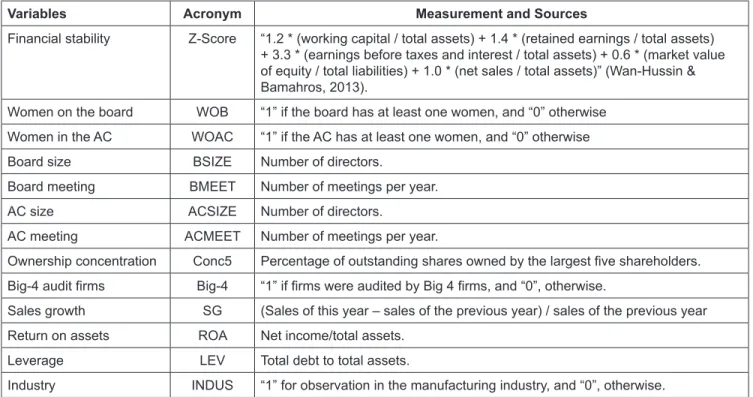
The regression model was used to determine the influence of women on the board and the AC on the firm’s financial stability. Numerous control variables were integrated into the model, including size and frequency of meetings of the board and AC, ownership concentration, type of audit firm, sales growth, leverage, return on assets (ROA), and manufacturing industry, to control the relationships. The following equation was calculated; details of the measurement of the variables are presented in Table 1.
Z-Score = β
0+ β
1WOB + β
2WOAC + β
3BSIZE + β
4BMEET + β
5ACSIZE + β
6ACMEET + β
7Big4 + β
8Conc5 + β
9SG + β
10LEV + β
11ROA + β
12INDUS + ε
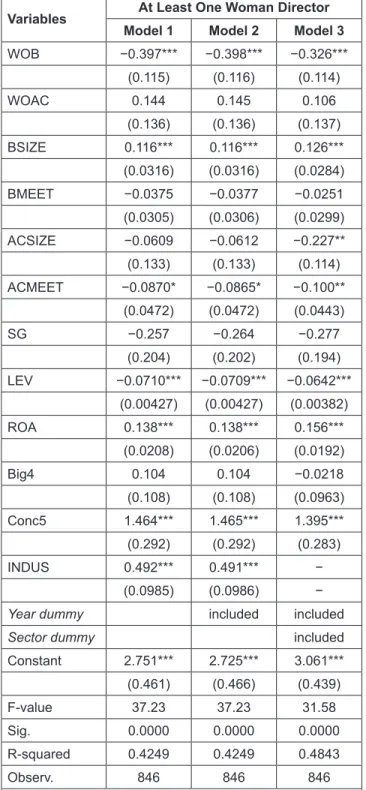
To offer robust results, the research re-estimated the core model, first by including a dummy variable for the three years (Sakawa & Watanabel, 2018) to control changes or discrepancies across the year. Second, dummy variables were integrated for the company sector (consumer, construction, industrial products, properties, plantation, technology, trade, and services), in place of INDUS in the main model, in addition to the year dummy variable.
Table 1: Summary of Variable Measurements
Variables Acronym Measurement and Sources
Financial stability Z-Score “1.2 * (working capital / total assets) + 1.4 * (retained earnings / total assets) + 3.3 * (earnings before taxes and interest / total assets) + 0.6 * (market value of equity / total liabilities) + 1.0 * (net sales / total assets)” (Wan-Hussin &
Bamahros, 2013).
Women on the board WOB “1” if the board has at least one women, and “0” otherwise Women in the AC WOAC “1” if the AC has at least one women, and “0” otherwise
Board size BSIZE Number of directors.
Board meeting BMEET Number of meetings per year.
AC size ACSIZE Number of directors.
AC meeting ACMEET Number of meetings per year.
Ownership concentration Conc5 Percentage of outstanding shares owned by the largest five shareholders.
Big-4 audit firms Big-4 “1” if firms were audited by Big 4 firms, and “0”, otherwise.
Sales growth SG (Sales of this year – sales of the previous year) / sales of the previous year Return on assets ROA Net income/total assets.
Leverage LEV Total debt to total assets.
Industry INDUS “1” for observation in the manufacturing industry, and “0”, otherwise.
4.3. Descriptive Statistics
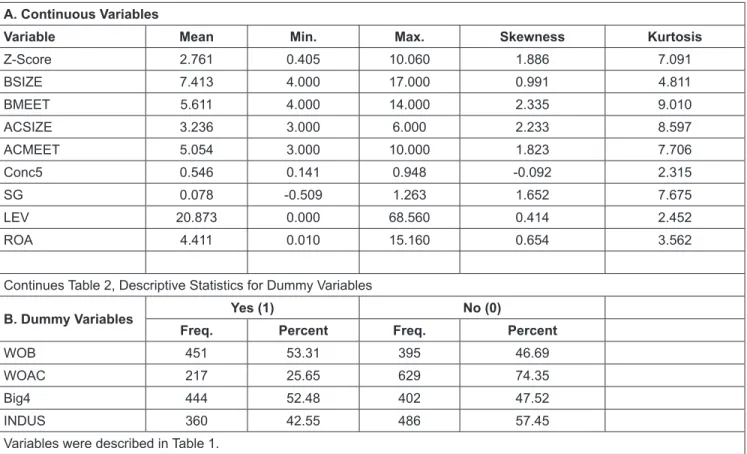
Table 2 shows that the mean value of financial stability is 2.761, suggesting that the firms selected generally fall into the grey area (Z-Score mean 1.81 to 2.99). In other words, the firms are not in serious financial distress because the value of Z-Score is not below 1.81; nevertheless, they are not financially stable as the average is less than 2.99 (Altman, 1968). Table 2 also shows that 451 (53.31%) firm-year observations indicate the appointment of at least one woman director on the board (WOB). This result is higher than that of Abdullah and Ku Ismail (2016), who reported that the proportion of firms with women directors on their boards was low (43%) for the period 2008 to 2011. This indicates that more than one woman on the board, showing a slight increase over time. 217 (25.65%) firm- year observations indicate the presence of at least one woman director on the AC (WOAC), again higher than that of Abdullah and Ku Ismail (2012) where 109 (17%) firm-year observations were reported for the year 2008. However, it is lower than that of Abdullah and Ku Ismail (2016), wherein 856 (35%) firm- year observations were reported for the period 2008 to 2011.
Concerning the control variables, the mean value of board size (BSIZE) is 7.413 directors while the frequency of
meetings (BMEET) is 5.611 times a year. The mean value of AC size (ACSIZE) is 3.236 and the frequency of meetings (ACMEET) 5.054 times a year. The mean percentage of shares owned by the largest five shareholders is 54.60%, and Big-4 companies are the auditors in 444 (52.48%) firm- year observations (Big-4). Regarding the company-specific characteristics, the average value of return on assets (ROA), leverage (LEV), and sales growth (SG) is 4.41%, 20.87%, and 7.80%, respectively. Lastly, the result shows that 360 (42.55%) firm-year observations are for manufacturing firms (INDUS).
4.4. Diagnostic Tests
To address the outlier problem, the research winsorized the extreme values of some observations: Z-score, BMEET, and SG by applying 2% and ACMEET by applying 1%
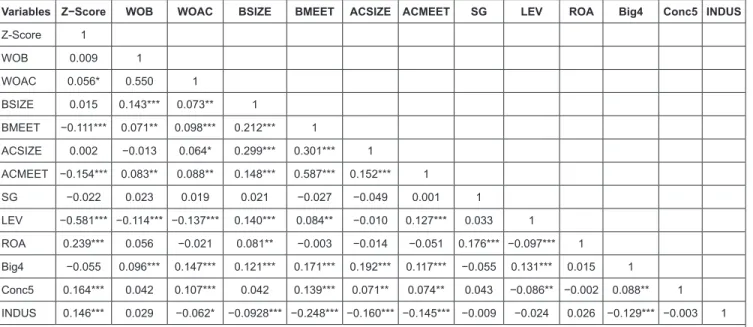
for the top and bottom observations. Table 2 indicates that the skewness and kurtosis for all variables are within the acceptance level, which means that all variables are normally distributed. In terms of multicollinearity, Table 3 shows that there is no evidence of severe problems as the value of correlations does not exceed the threshold of ±0.80.
Table 2: Descriptive Statistics for the Continuous Variables A. Continuous Variables
Variable Mean Min. Max. Skewness Kurtosis
Z-Score 2.761 0.405 10.060 1.886 7.091
BSIZE 7.413 4.000 17.000 0.991 4.811
BMEET 5.611 4.000 14.000 2.335 9.010
ACSIZE 3.236 3.000 6.000 2.233 8.597
ACMEET 5.054 3.000 10.000 1.823 7.706
Conc5 0.546 0.141 0.948 -0.092 2.315
SG 0.078 -0.509 1.263 1.652 7.675
LEV 20.873 0.000 68.560 0.414 2.452
ROA 4.411 0.010 15.160 0.654 3.562
Continues Table 2, Descriptive Statistics for Dummy Variables
B. Dummy Variables Yes (1) No (0)
Freq. Percent Freq. Percent
WOB 451 53.31 395 46.69
WOAC 217 25.65 629 74.35
Big4 444 52.48 402 47.52
INDUS 360 42.55 486 57.45
Variables were described in Table 1.
Table 3: Pearson Correlation
Variables Z−Score WOB WOAC BSIZE BMEET ACSIZE ACMEET SG LEV ROA Big4 Conc5 INDUS