국가 바이오모니터링 프로그램을 위한 소변 중 금속류 동시분석법 개발 및 검증
조용민* · 양민호* · 임호섭*
†· 차상원** · 이재익*** · 김기훈*** · 한상범****
*주식회사 스마티브 생명환경연구소, **한국외국어대학교 화학과,
***한국과학기술연구원 도핑콘트롤센터, ****중앙대학교 약학대학
Development and Validation of the Simultaneous Analytical Method of Urinary Metals and Metalloids for the National Biomonitoring Programs
Yong Min Cho*, Minho Yang*, Hosub Im*
†, Sangwon Cha**, Jaeick Lee***, Ki Hun Kim***, and Sang Beom Han****
*Institute for Life & Environmental Technology, Smartive Corporation
**Department of Chemistry, Hankuk University of Foreign Studies
***Doping Control Center, Korea Institute of Science and Technology
****Department of Pharmaceutical Analysis, College of Pharmacy, Chung-Ang University
ABSTRACT
Objectives: This study developed and validated an analysis method of urinary metals and metalloids that can be applied inductively with coupled plasma mass spectrometry (ICP-MS).
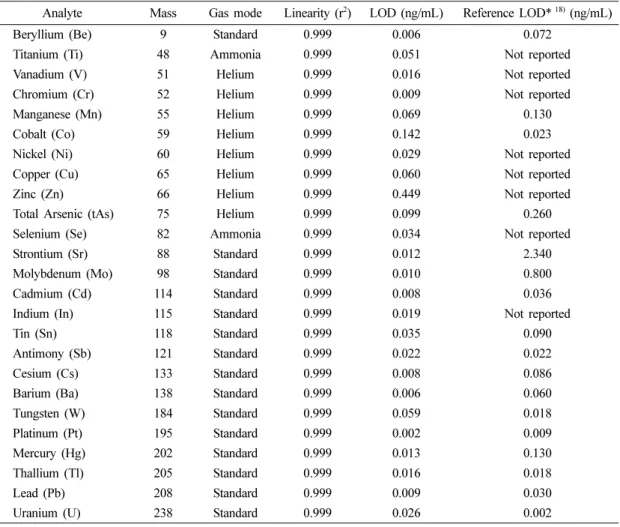
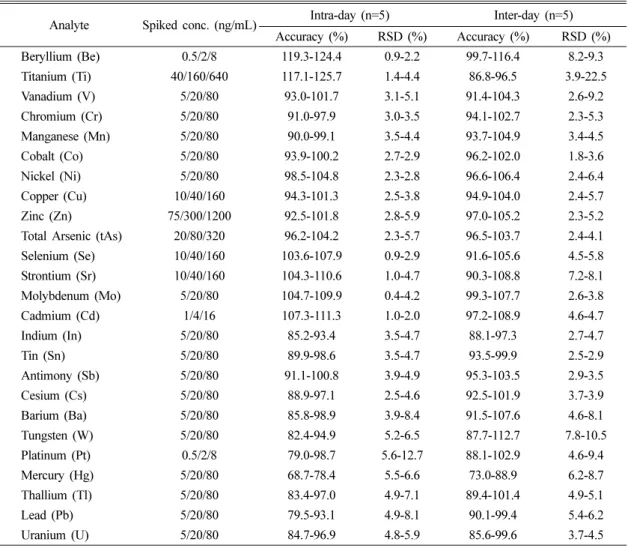
Methods: 0.3 mL of urine was used to analyze 25 metal and metalloid compounds using ICP-MS. The validation of the analytical method included linearity, accuracy, precision, and the calculation of detection limits.
In addition, a comparison test was performed with the graphite furnace atomic absorption spectrometry (GF- AAS) method, which is the current standard method, with urine samples of 66 healthy subjects.
Results: The linearities (R
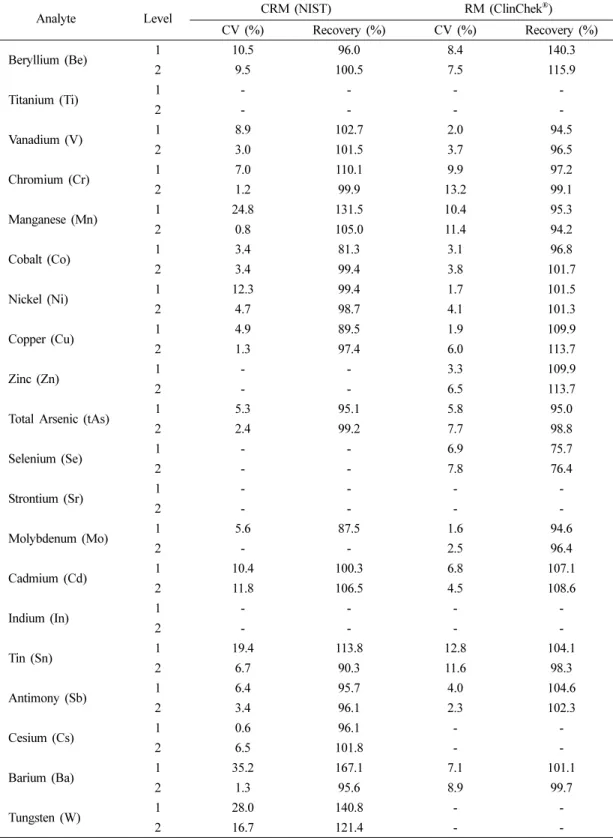
2) of calibration curves of all 25 compounds were ≥ 0.999. Of the 25 compounds, the intra-day and inter-day accuracy% of 17 and 20 met ≤15%, respectively. In addition, fifteen compounds showed
≤15% recovery% for certificated reference materials. Intraclass correlation coefficients of the comparison between the current methods and new methods in this study were 0.952 (p-value<0.001) and 0.911 (p- value<0.001) for urinary cadmium and mercury, respectively.
Conclusion: This study proposes an efficient simultaneous methodology that can analyze multi elements in smaller sample amounts. More reproduction experiments are needed in the future.
Key words: Urinary metals, ICP-MS, simultaneous analysis, biomonitoring
I. 서 론
생체시료 중 환경유해물질 또는 그 대사산물의 농 도를 측정하는 방법, 즉 인체 바이오모니터링은 환 경유해물질에 대한 일반인구집단의 노출수준을 평가
하기 위한 효과적인 기법으로 널리 활용되고 있다.
1-2)환경유해물질의 직업적, 환경적 노출수준을 평가한 많은 연구들에서 인체 바이오모니터링이 적용되어 왔다. 또한 일반인구집단의 환경오염물질 노출수준 평가를 위한 국가적 조사에서도 인체 바이오 모니터
†
Corresponding author: Institute for Life & Environmental Technology, Smartive Corporation, Dobong-ro 110 na-gil, Dobong-gu, Seoul, 01454, Korea, Tel: +82-2-911-2221, Fax: +82-2-911-2231, E-mail: [email protected] Received: 17 September 2019, Revised: 5 November 2019, Accepted: 6 November 2019
원 저 Original articles
링이 이루어진다. 국가를 대표하는 일반인구집단의 인체 바이오모니터링은 국민들의 전반적인 환경유해 물질 노출수준에 대한 공간적, 시간적 트렌드를 제 시하며 인구집단 중 환경유해물질 노출수준이 높은 위험집단을 구분하는 참고 값(reference value) 산정 의 근거가 되기도 한다.
3-4)우리나라를 비롯한 세계 각 국에서 국가단위의 바 이오모니터링 프로그램이 이루어지고 있다. 프로그 램마다 그 역사는 다르지만, 금속류는 우리나라를 비 롯하여 대부분 국가의 바이오모니터링 프로그램에서 가장 오래전부터, 가장 많이 다루어진 항목이다.
5-7)체내 금속류 노출은 환경보건 분야의 전통적인 주제 였으며, 현재까지도 공중보건 분야에서 가장 중요한 위험요인 중 하나로, 특히 우리나라와 같은 아시아 국가들에서 더욱 중요성이 강조될 수 있다.
8)생체시료 중 금속류 분석방법은 지난 수십년 동안 상당한 기술적 진화가 있었으며, 전통적인 불꽃원자 흡수분광법(flame atomic absorption spectrometry)에 서 전자열원자흡수분광법(electrothermal atomic absorption spectrometry)으로, 또 유도결합플라즈마 (ICP, inductively coupled plasma) 방식으로 발전하 였다.
9)한편 금속류 노출평가를 위한 생체시료로는 소변과 혈액 등이 사용되며, 비침습적이고 경제적인 방법으로 모발, 손톱 등이 활용되기도 한다. 소변은 개인에게 노출된 총 금속량을 평가하는데 적합한 바 이오 마커이며,
10)식품 섭취 등을 통하여 노출되는 유기 성분보다는 환경이나 직업 등을 통하여 노출되 는 무기성분의 금속원소를 평가하는데 보다 적합한 마커이다.
11)금속류는 다양한 환경 매체 중에 편재하므로, 다 양한 항목에 대한 복합적 노출을 평가하여야 하는 데, 특히 여러가지 물질들이 상호작용하여 건강영향 을 야기하는 다항목 노출 접근방법(multipollutant approach) 의 관점에서, 보다 많은 항목의 정량적 농 도를 검출할 수 있는 분석방법의 개발이 필요하다
10-12)