| Abstract |
Purpose: This study examined the effect of calf muscle fatigue on postural sway according to foot posture (a pes cavus, a normal foot, and a pes planus).
Methods: The subjects of this study were 12, 11, and 9 students of U University with a pes cavus, a normal foot, and a pes planus, respectively, according to a Navicular Drop Test. Postural sway was measured with a balance instrument (BioRescue, RM Ingenierie, France) while the subjects stood static on two legs as well as during one-leg standing using the dominant leg in two conditions (with the eyes open and with the eyes closed for 30 seconds). Muscle fatigue was then induced in the calf muscle of the dominant leg, and both muscle fatigue and postural sway were measured using an EMG. To compare the degree of postural sway between the three groups after muscle fatigue was induced, the change values were calculated. The results were analyzed using a Kruskal–Wallis test, and a post-hoc test was conducted using the Bonferroni correction.
Results: Significant inter-group differences were detected for postural sway during two-leg standing with the eyes closed and during one-leg standing with the eyes open and with the eyes closed (p<0.05). The post-hoc test showed significant differences between the pes cavus and normal foot groups and between the pes planus and normal foot groups for all three variables (p<0.05).
However, no significant difference was detected between the pes cavus and pes planus groups (p>0.05).
Conclusion: The results of this study show that the pes cavus and pes planus cause more fatigue and postural sway than a normal foot. Therefore, attention should be paid to changes in balance caused by muscle fatigue.
Key Words: Muscle fatigue, Foot posture, Postural sway
†Corresponding Author : Jong-Sung Chang ([email protected])
Original Article Open Access
발 자세에 따른 종아리 근육의 피로유발이 자세 흔들림에 미치는 영향
이명희⋅장종성
1†1)위덕대학교 물리치료학과,
1영남이공대학교 물리치료과
Effect of Calf Muscle Fatigue on Postural Sway According to Foot Posture
Myoung-Hee Lee, P.T., Ph.D⋅Jong-Sung Chang, P.T., Ph.D
1†Department of Physical Therapy, Uiduk University
1
Department of Physical Therapy, Yeungnam University College
Received: December 9, 2019 / Revised: December 9, 2019 / Accepted: December 11, 2019
ⓒ 2019 Journal of Korea Proprioceptive Neuromuscular Facilitation Association
This is an Open Access article distributed under the terms of the Creative Commons Attribution Non-Commercial License
(http://creativecommons.org/licenses/by-nc/3.0) which permits unrestricted non-commercial use, distribution, and reproduction
in any medium, provided the original work is properly cited.
Ⅰ. 서 론
발은 보행을 하는 동안 체중을 지지하고 힘을 생산 하는 데 매우 중요하며, 균형을 유지하기 위해서도 중요한 기능을 한다. 발에서 나타나는 문제는 신체 움직임 및 자세 안정성과 관련이 될 수 있으며, 그 정도의 심각성과 연령에 따라 삶의 질에 영향을 줄 수 있다(Menz et al., 2016). 편평발은 세로활의 높이가 감소되고 목말뼈의 안쪽 돌림이 나타나는 경우를 말 하며 선행연구에서 이러한 요소가 통증을 동반하고 보행 시 속도와 균형에 영향을 주어 낙상의 위험을 증가시킨다고 하였다(Sung et al., 2017). 하지만 다른 선행 연구에서 심각한 구조적 편평발이 아닌 경우 훈 련을 통하여 자세 흔들림과 족저압의 분포가 향상될 수도 있다고 하였다(Marencakova et al., 2018).
또 다른 흔한 발의 자세는 오목발로서 편평발과 반대로 세로활이 정상 범위에 비해 높게올라간 형태 를 말하며, 보행이 불안정되고 발목 삠이 흔하게 나타 나며 중간발가락뼈 머리와 발의 가쪽면에 통증을 수 반한다(Eleswarapu et al., 2016). 오목발과 정상발, 편평 발을 대상으로 보행 시 운동학적인 차이를 분석한 선 행 연구에서는 오목발에서 정상발과 편평발에 비해 차이나는 요소들이 발견된다고 하였는데, 뒷발부분의 이마면과 수평면에서의 각도가 다르고 , 초기접지기와 중간입각기 동안 중간발의 움직임이 덜 일어난다고 하였다. 또 같은 연구에서 전유각기 동안 중간발에서 의 움직임 범위 감소는 편평발에서 나타나 발의 자세 에 따라 보행 시 움직임에 영향을 준다고 보고하였다 (Buldt et al., 2015).
근피로는 일반적으로 지속적인 신체활동 후에 나 타나는 근수축력의 감소로 정의할 수 있다(Enoka &
Duchateau, 2008). 근피로의 결과 중 대표적인 것으로 균형능력 감소, 근력 감소 등을 들 수 있다(Bisson et al., 2012; James et al., 2010). 국소근육의 피로는 간접적 으로 관절의 운동감각과 위치감각을 감소시키는 것으 로 알려졌고(Abd-Elfattah et al., 2015), 이는 신경계 흥 분에 대한 반응의 감소를 유발하고 (Hunter et al., 2004)
또 그로 인한 근수축의 감소로 설명 가능하다 (Dideriksen et al., 2011).자세 안정성은 지지면 내에서 중력중심의 움직임을 최소화 하는 능력으로 정의할 수 있는데, 젊은 성인을 대상으로 실시한 선행연구에 서 다리의 근피로 유발이 자세 흔들림을 증가시킨다 는 결과를 보였다(Ledin et al., 2004). 또한 편평발을 가진 대상자들이 정상발보다 더 큰 자세 흔들림이 나 타나고 흔들림의 속도도 더 빠르게 나타난다고 하였 다(Hertel et al., 2002). 하지만 Cote 등(2005)의 연구에 서는 편평발과 정상발 사이에 유의한 차이를 볼 수 없었다.
현재까지 오목발 , 정상발, 편평발의 세 가지 경우 근피로 유발 후 자세 흔들림을 비교한 선행연구가 없 었으므로 본 연구에서는 종아리 근육의 근피로 유발 시 오목발 , 정상발, 편평발에서 나타나는 자세 흔들림 의 변화를 비교하여 균형에 어떠한 영향을 주는지 알 아보기 위해 실시하였다 .
Ⅱ. 연구 방법
1. 연구 대상
본 연구는 경주소재의 U대학 학생들 중 신경학적 병력이 없고 발 이외의 근골격계 질환이 없으며 navicular drop test를 하였을 때, 오목발(pes cavus)의 소견을 보인 12명과 정상소견(normal)을 보인 11명, 편평발 (pes planus)의 소견을 보인 9명을 대상으로 실 시하였다. 이들은 모두 본 연구의 목적과 절차에 대한 설명을 듣고 자발적으로 참여의사를 밝혔으며 연구계 획서를 확인한 후 연구동의서를 작성하였다 . 본 연구 는 영남이공대학교 생명윤리위원회의 승인을 받아 진 행하였다(YNC 201811-02).
2. 측정방법 및 도구
본 연구에서 자세 흔들림을 평가하기 위해 균형
측정기(AP1153 BIORESCUE, RM INGENIERIE, FRANCE)을 이용하였으며, 이 장비는 환자 및 일반인, 운동선수를 대상으로 정적 및 동적 균형 능력을 측정 하기에 적합한 장비이다 . 측정 가능한 변수로는 족저 압 , 눈을 감은 상태와 눈을 뜬 상태에서의 자세 흔들림 (롬버그 검사), 안정성한계 등이 있다. 본 연구에서는 대상자들의 두발서기 및 한발서기(우세발) 시 자세 흔들림을 측정하였고 두 조건 모두에서 눈 뜬 상태와 눈 감은 상태를 모두 측정하였다.
3. 실험 절차
대상자들의 종아리 근피로 유발 후 균형에 어떠한 변화가 있는지 확인하기 위해 먼저 균형측정기(BIO Rescue, RM INGENIERIE, France)를 활용하여 두발서 기 및 우세다리 한발서기 시 자세 흔들림을 측정하였 는데 눈 뜬 상태와 눈 감은 상태 모두에서 실시하였다 . 이후 굴러온 공을 편한 다리로 차는 방법을 통해 우세 측 다리를 확인한 후 우세측 다리의 종아리 근육에 근피로를 유발하기 위해 한발서기를 한 채로 뒷꿈치 를 들어 발바닥쪽굽힘을 하도록 요구하였다. 이 때 균형을 잃어 낙상하는 것을 예방하기 위해 연구보조 자가 대상자의 옆에서 관찰하였고 모든 동작 수행 시 근전도를 이용하여 점검하며 피로도를 확인하였다.
근피로가 유발된 후 대상자들은 다시 눈 감은 상태와 눈 뜬 상태에서 두발서기 및 우세다리 한발서기 시 자세 흔들림을 측정하였다.
4. 자료 분석
본 연구에서 수집된 자료는 기술통계를 이용하여
평균 및 표준편차를 구하였고, SPSS 19.0을 이용하여 통계처리 하였다. 세 그룹을 비교하기 위하여 근피로 유발 전후 자세 흔들림의 변화를 계산하였고 그 변화 값을 Kruskal-Wallis를 사용하여 통계처리 하였다. 통 계학적 유의성을 검정하기 위해 유의수준 α를 0.05로 설정하였고 Bonferroni correction을 통하여 사후검정 을 실시하였다.
Ⅲ. 연구 결과
1. 연구 대상자의 일반적인 특성
본 연구에 참가한 오목발 그룹 , 정상 그룹, 편평발 그룹의 일반적 특성은 Table 1과 같다.
2. 근피로 유발 전후 자세 흔들림의 변화
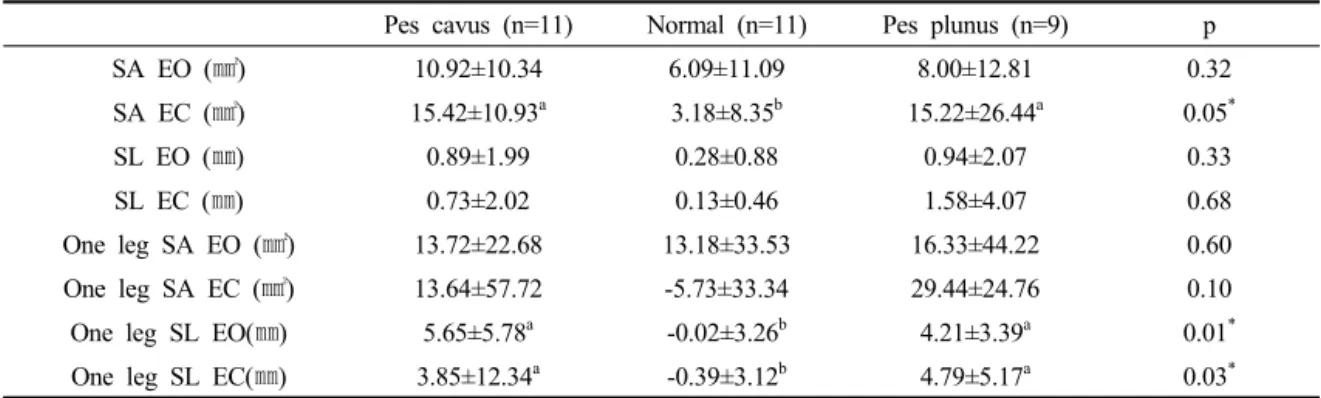
근피로 유발 전과 후의 차이를 비교한 결과 눈을 감은 상태에서의 두발서기 시 자세 흔들림 면적, 눈을 뜬 상태와 눈을 감은 상태에서의 한발서기 시 자세 흔들림 길이의 세 가지 변수에서 통계적으로 유의한 차이가 나타났다(p<0.05)(Table2). 사후검정 결과, 이 세 가지 변수 모두에서 오목발 그룹과 정상발 그룹 사이, 또 편평발과 정상발 그룹 사이에 유의한 차이를 보였으며(p<0.05)(Table2), 오목발 그룹과 편평발 그룹 사이에는 유의한 차이가 나타나지 않았다(p>0.05) (Table2).
Characteristics Pes cavus (n=11) Normal (n=11) Pes planus (n=9) p
Age (years) 21.91±2.07 21.55±1.44 21.78±1.30 0.87
Heights (㎝) 164.36±8.05 168.73±9.68 168.20±9.61 0.49
Weights (㎏) 59.09±13.36 61.27±13.80 67.56±14.48 0.39
Foot length (㎜) 244.55±16.04 256.82±22.28 260.00±20.62 0.19
Table 1. General characteristics of subjects (n=31) (mean±SD)
Ⅳ. 고 찰
발과 발목을 비롯한 다리의 손상은 발의 형태나 적용되는 부하의 크기에 따라 결정된다 (LaFiandra et al., 2002). 편평발은 인대와 근육의 느슨함에 의해 정 상발에 비해 운동성이 높아져 근육의 피로, 발목의 불안정성과 발의 불균형을 일으키고, 오목발은 평편 발보다 운동성이 적으며 움직임 감소로 인하여 충격 흡수 능력의 감소 등으로 인하여 부상의 위험이 많아 지게 된다(Angin et al., 2013; Buldt et al., 2015). 또한 전신 혹은 국소적인 근피로는 균형조절의 출력 제한, 근육의 반응 속도 감소, 다리의 관절 움직임을 느리게 하여 다양한 과제 수행 과정의 균형 유지를 어렵게 하며 다른 손상을 유발하는 위험 요소가 된다(Paillard, 2012; Wojcik et al., 2011). 본 연구에서는 종아리 근육 에 피로를 유발하였을 때 오목발, 정상발, 편평발의 발 자세에 따라 균형을 평가하고자 하였고, 근피로 유발 후 눈을 감은 상태에서의 두발서기 시 자세 흔들 림 면적, 눈을 뜬 상태와 눈을 감은 상태에서의 한발서 기 시 자세 흔들림 길이의 세 가지 변수에서 정상 그룹 에 비해 오목발과 편평발 그룹에서 흔들림의 증가를 확인하였다.
본 연구의 자세 흔들림 검사에서 피로 유발 전후의 차이값은 눈을 감은 상태에서의 두발서기 시 자세 흔 들림 면적 , 눈을 뜬 상태와 눈을 감은 상태에서의 한발
서기 시 자세 흔들림 길이의 세 가지 변수에서 차이가 있었으며, 오목발과 편평발 그룹에서 흔들림이 크게 증가하는 것을 알 수 있었다. Kim 등(2015)은 정상발과 편평발의 정적 및 동적 균형능력을 비교한 연구에서 정적 균형에서는 편평발의 균형 능력이 떨어지는 것 을 보였고, 동적 균형에서는 두 그룹간의 차이가 없는 것으로 나타났으며 이는 편평발에 무게가 가해졌을 때 과도한엎침으로 인해 지지면이 불안정해짐에 따라 목말밑 관절의 불안정을 야기시켜 정적 균형이 감소 하게 된다고 하였다. 본 연구에서는 근피로를 유발하 고 난 후 오목발과 편평발 그룹 모두에서 안정성이 떨어지는 것을 볼 수 있었다 . 이는 목말밑 관절의 불안 정성을 일으키는 편평발의 요인과(Kim et al., 2015) 발의 가로활이 높아져 있는 오목발에 의해 발목뼈의 운동성 감소로 인하여(Buldt et al., 2015) 자세의 움직 임을 제어하는 능력이 감소한 것으로 생각된다.
근피로 유발 후 전후의 자세 흔들림의 변화는 대부 분 근피로 후에 증가되는 것을 확인할 수 있으며 , 오목 발과 편평발에서 더 크게 나타나고 , 두발서기 시 보다 한발서기 시에 더 크게 나타나는 것을 알 수 있다.
발목의 불안정성이 균형을 유지하는데 있어 부정적인 영향을 미치게 되고, 발목의 근피로가 불안정성을 더 유발하여 균형을 유지하는 것에 어려움이 있을 것으 로 생각된다 . 또한 한발서기에는 좁은 지지면과 근피 로에 의한 영향으로 안정성이 더 감소하고 이동면적 Pes cavus (n=11) Normal (n=11) Pes plunus (n=9) p
SA EO (㎟) 10.92±10.34 6.09±11.09 8.00±12.81 0.32
SA EC (㎟) 15.42±10.93
a3.18±8.35
b15.22±26.44
a0.05
*SL EO (㎜) 0.89±1.99 0.28±0.88 0.94±2.07 0.33
SL EC (㎜) 0.73±2.02 0.13±0.46 1.58±4.07 0.68
One leg SA EO (㎟) 13.72±22.68 13.18±33.53 16.33±44.22 0.60
One leg SA EC (㎟) 13.64±57.72 -5.73±33.34 29.44±24.76 0.10
One leg SL EO(㎜) 5.65±5.78
a-0.02±3.26
b4.21±3.39
a0.01
*One leg SL EC(㎜) 3.85±12.34
a-0.39±3.12
b4.79±5.17
a0.03
**