* 이 논문은 2009년도 성신여자대학교 학술연구조성비 지원에 의하여 연구되었음.
†교신저자:최민영 (성신여자대학교 미술대학 산업디자인과) E-mail: [email protected]
TEL: 02-920-7504 FAX: 02-920-2089
사용자의 감성반응에 기초한 형태 분석 도구에 대한 연구*
A Study on the Form Analysis Tools Based on the User’s Emotional Response
최민영*† Min-Young Choi*†
성신여자대학교 미술대학 산업디자인과*
Department of Industrial Design, Sungshin Women's University*
Abstract
Recently the studies on user-centered design and form-development have become issues of general interest as the key methods for successful design. For form analysis on user it is important needs that an integrated approach of existing methods and development of expert tool for designer. Moreover analysis methods and tools have to meet with the designers needs of visual result, clear direction, concrete formative factor, user's emotional response and designer-friendly interface. This study proposed the main concepts of form analysis tool based on the user's emotional response ; integrated management, variables set-up, visual result of analysis, in-depth analysis with data mining and correlation, and reinforcement of user-centered analysis. Specific analysis tool consists of 5 functions:
Project Management, Analysis Frame Set-up, Data Input-output, Basic Analysis, and In-depth Analysis. The feasibility of proposed tool was verified by a case study of mobile phone design in under-graduate class.
Keywords : Form Analysis, User's emotion, Data mining, Cellular phone, User Centered Design
요 약
최근 사용자 중심의 디자인과 형태개발 및 분석은 성공적 디자인의 중요한 방법론으로 부각되고 있다. 사 용자의 형태분석을 위해서는 기존 방법의 통합적인 접근과 더불어 디자이너의 전문도구로서 고찰되고 개발되 는 것이 요구된다. 특히 기존의 분석도구들은 디자이너의 요구에 적합할 수 있도록 분석결과의 시각화과 명확 한 방향성 제시가 요구되며, 사용자 감성반응을 형태분석에 응용할 수 있는 다각적인 방법의 모색이 요구된 다. 또한 분석도구로서의 전문성을 강화하고 디자이너가 손쉽게 사용할 수 있도록 디자이너 친화적 인터페이 스의 적용이 필요하다. 본 연구는 사용자 감성반응을 기존의 형태분석 도구에 활용하기 위한 방법과 체계를 분석하며, 이를 통하여 사용자의 감성적 반응에 기초한 형태분석 도구를 제시하였다. 구체적인 형태분석의 도 구는 통합적 관리, 변수설정, 분석결과의 시각화, 데이터마이닝을 통한 심층 분석, 사용자 중심 분석결과의 연 관성 강화의 5가지 컨셉으로 제시되었으며, 프로젝트 관리, 분석프레임 설정, 데이터 입출력, 기초 분석, 심층 분석의 5가지 모듈로서 개발되었다. 제안된 도구는 모바일 폰의 사례조사를 통하여 그 효용성을 알아보았으 며, 도구 활용의 사용성과 형태분석의 타당성이 검증되었다.
주제어 : 형태분석, 사용자 감성, 데이터마이닝, 휴대폰, 사용자중심디자인
1. Introduction
Recently the studies on user-centered design and user-centered form-development have become issues of general interest as the key methods for successful design.
Designer should understand aesthetic, functional and emotional needs and represent to design concept and shape. For these, designers use various methods for form analysis on user and recognize as the core process in product design development.1) But unfortunately, the existing methods of form analysis on user still require highly specialized statistical skills and complicated procedures to designers. Because of that, designers uniformly use the only simple-method like Image-map, preference and shape-keyword. With only application of biased-methods, designer cannot get so in-depth result of analysis as to fulfill the needs of designer and apply the design development. Therefore, the form analysis on user needs an integrated approach of existing methods, synthesis analysis-methods and development of expert tool for designer. Moreover analysis methods and tools have to meet with the designers needs of visual result, clear direction, concrete formative factor and designer-friendly interface. Our discussion draw upon experience gained in the development of analysis tool and the educational-application for cellular phone design.
The aim of this study is to explore the current methods, to formulate the system and guidance of form analysis on user, and to develop the expert-tool to adapt designer easily to analysis and apply the form of product design.
In this study, we have researched, compared and categorized the various methods (Image-map, K-J map, Conjoint Analysis, Morphological Chart, Semantic Differentiated Analysis, Multi- Dimensional Scaling, and Cluster Analysis) from a practical point of view with design process. Especially, we have analyzed the relation with the result of each method and then developed an integrated frame for effective form analysis on user.
After of all, this study has proposed the main concepts of specific form analysis tools which designers can apply on design development, visualize the results and 1) Brenda Laurel (2003). Design Research, THE MIT PRESS 70.
management form analysis data on user.
2. Analysis of Current Methods
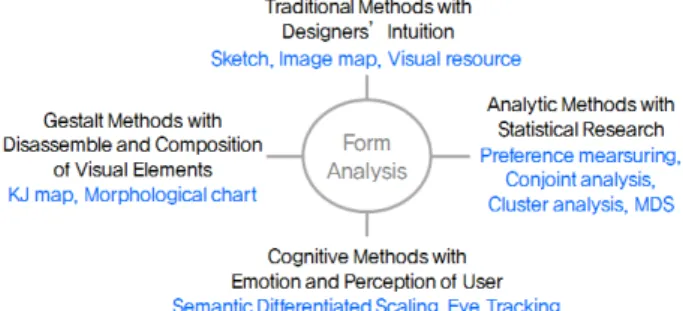
2.1. Methods for Form AnalysisThe various methods for form analysis are divided into 4 categories; traditional methods with the designers’
intuition, gestalt methods with disassemble and composition of visual elements, analytic methods with statistical research of social science and cognitive methods with emotion and perception of user.2)
Figure 1. Classification of methods for form analysis.
Sketch is the most typical method for form analysis and development used by designer. Sketch methods expand range of designers’ perception and simulate the overall form by sight.3) Image-map is the methods for analysis of concrete shape and design keyword and support designer to grasp the meaning of correlation with shapes. But Image-map is not an accurate map by measurement of forms but mental map of designer by an outline of correlation.4)
The representative methods of gestalt approach are K-J map and Morphological Chart. K-J map is systematic meaning-analysis methods following to a way of thinking
2) Min Young Choi (2003). A Study on the Methods of Eye Tracking Analysis Based on the Properties in Visual Perception of User, Journal of Korean Society of Design Science, 16(4), 199.
3) Nigel Cross (1989). Engineering Design Method, John Wiley
& Sons, 74.
4) Lee Myoung-Sik, Choi Chun-kyu & Koo Ja-Ryong (2003).
Marketing Research, Hyung Seol, 235.
of brainstorming. The advantage of K-J map is that designer can make structure of complex information about form in a short time with a point of expert view.5) K-J map applies not only a written words but also images as raw data to make a structure of information and Image-map. Morphological Chart is the methods to have a clear grasp of independent factor of form and explore possible alternatives through the compositions of factors and attributes.6)
As analytic methods with statistics, designers put Preference measuring, Conjoint Analysis, Cluster Analysis and Multi-Dimensional Scaling (MDS) to practical use for form analysis on user. Preference measuring is used frequently for design-evaluation because of converting the qualitative value into quantitative value without difficulty. Conjoint Analysis can make it possible to find primary and fundamental factors of preference which cannot be identified though preference measuring.7) Especially, designers can make out the main factors and attributes of form and suggest alternatives of factional factorial design by composition of preferred factors and attributes of user. Cluster Analysis and Multi-Dimensional Scaling (MDS) are the methods to identify the features and correlations of design groups or individual designs by means of measuring of similarity.8) These methods present more objective analysis-result than K-J map or Image-map but make some difficulty to set the standard of similarity in form.
Cognitive and emotional methods are being watched with keen interest as the aspect of user-centered form analysis. Semantic Differentiate Scaling (SDS) makes a close investigation into user’s emotional value by researching of semantic structure of epithets related to
5) Coyne R. D. (1990). Knowledge Based Design Systems, Addison-Wesley, New York, Part1-2.
6) Zwicky F (1967). The Morphological Approach to Discovery, Invention, Research and Construction, Symposition on Methodologies, 316.
7) Heo Myung-Hoi (2005). SPSS Classification Analysis, SPSS, Chapter 5.
8) Green P. E., & Carmone F. J. (1970). Multi Dimensional Scaling and Related Technique in Marketing Analysis, Allyn&Bacon, 23.
form.9) SDS is the influential methods to measure user’s response in emotional design or kansei-engineering.
Eye-tracking method is the representative way to apply bio-feed back to form analysis on user. Designer can easily understand the result of analysis because the result is visual and point out specific element of form.10) 2.2. Analysis of Current Methods
The methods for form analysis have various features referred to (Table 1) according to goals, objectives, input-data, output-results, the time required, and stage of process data.
Synthetic methods like sketch and Image-map have some advantages of time-reduction, designer-friendly activity, but on the other hand have some disadvantages of subjective decision and difficulties of user participation. Analytic methods based on statistic give designer objective, expert, and user-participative approach, but on the other hand require specialized-skill and a lot of time. Generally, visual analysis is performed by sketch, Morphological Chart and Conjoint Analysis.
Visual analysis is designer-oriented approach and improves creativity and deduction of synthesis alternatives. Verbal analysis is performed by Semantic Differentiated Scaling (SDS) and K-J map.11) Image-map, K-J map, Cluster Analysis, and MDS have a common feature of map-based problem-solving in a representative aspect. Map-based methods are possible to analyze on both side of visual and verbal aspect and attach importance to proper setting of input-variables.
Above-mentioned methods have relation to each other with mixed use according to stage of design process and goal of analysis. But, in reality, designers tend to make biased use of form analysis methods one by one, and to
9) Charles E. Osgood, George J. Suci, & Percy H. Tannenbaum (1957). The Measurement of Meaning, University of Illinois Press. 3-36
10) Min Young Choi (2003). A Study on the Methods of Eye Tracking Analysis Based on the Properties in Visual Perception of User, Journal of Korean Society of Design Science, 16(4), 199.
11) McDougall & Fry J. N. (1975). Combining Two Methods of Image Measurement, Journal of Retailing, 50, 60.
Method Main Goal Input Output Feature Direction
Sketch Design direction
concept, ideation Image, Diagram Design alternatives
Short time, Subjective Exploratory, Visual
Overall-stage
To be objective To be Effective
Image-map Design direction Image, word Feature
Keyword
Short time, Subjective
Visual, Early-stage To be objective
K-J map Design Key word Image, word Design keyword Target group
Visual, specialized, Short time, Iterative
Early-stage
To need verification
Morphological Chart
Ideation of form Possible design
Factor and
attribute Structural alternatives Creative and analytic thinking, Early-stage
To apply as input-variable Preference
measuring Design evaluation Image,
Questionnaire Preference mark
User-participatory Clear quantification
Late-stage
To apply with other methods
Conjoint Analysis Finding the main design element
Factor and attribute
Factional factorial design
Sub element oriented Gestalt approach
Overall-stage
To apply as input-variables, Standards
for selecting samples Semantic
Differentiated Scaling
Finding user’s response and differentiated factor
Semantic words
Diagram, Design keyword Comparative result
User-participatory Comparative approach
Verbal, Early-stage
To apply as input-variable with cluster analysis and MDS Cluster Analysis Design positioning
Design direction
Comparative evaluation
One dimensional grouping
Objective, Overall-stage Comparative approach
To clearly define variables Multi
Dimensional Scaling
Design positioning Design direction
Comparative evaluation
Multi dimensional grouping
Objective, Comparative approach
Visual, Overall-stage
To clearly define variables Table 1. Analysis of current methods.
avoid applying complex methods for participation of user. Therefore these methods must have complementary relation to each other and be necessary to an integrated approach.
3. Development of Form Analysis Tools
3.1. Integrated Frame and Guidance
Integrated analysis frame based on the user emotional response is necessary for to development of form analysis tools for designer. For these, current methods have to be re-classified integrated systems rather than one by one method and integrated frame should be set by analysis-goal, result types and specific application methods. Factor and attribute extracted by Morphological Chart, alternatives sampled by orthogonal planning of Conjoint Analysis, and semantic words on Semantic
Differentiated Scaling (SDS) have important meaning to set the basic variables for form analysis on user.
Systematic setting of the basic factor makes the result of analysis to be useful and practical. Visualization of the analysis results is also important to and map-based form is the most general types for visualization. Preference measuring is very simple methods for the evaluation of form through user-participatory emotional measurement and can be applied as data-mining standards for in-depth analysis connected with other methods. Data-mining12) is necessary for in-depth analysis and make possible to find the fundamental features in all of visual aspect, verbal aspect and user aspect. As (Table 2) shows, form analysis on user's emotion is performed by 3 stage; the primary stage for variables set-up, the basic analysis, the in-depth analysis. Especially, the integrated frame is proposed by the five guidance of integrated management, 12) Heo Myung-Hoi & Lee Yong Gu (2003). Data-mining model-
ing, SPSS, Chapter 5.
Stage Objective Specific method Result Advantage
Primary stage
Visual variable - Formative Variables
- Sampling of image
Factor and Attribute by Morphological Chart Orthogonal Plan of Conjoint
Analysis
Visual data-base
Objective variables setting Effective project setting Generalization of status
Verbal variables - Semantic words
Extraction of Words by SDS(Semantic Differentiated
Scaling)
Verbal data base Emotional approach Clear concept generation User variables
- AIO
AIO (User's Attitude, Interest,
Opinion) Persona User participatory project
setting
Basic Analysis
Designer-oriented direction Image map by K-J methods Design concept Objective heuristic guidance
User-oriented direction
Hierarchy map by Cluster Analysis
Image map by MDS (Multi-Dimensional Scaling)
Design concept Standard of visual result
In-depth analysis
Formative Features
Data-mining by Preference measuring
Extraction of formative value by Conjoint Analysis
Specific formative feature Preference group
Optimal formative composition Integrated result and analysis Clear direction Insight through specific visual
result
Clearing of ambiguous factors Semantic Features
Data-mining by Preference measuring Profile analysis by SDS
Specific design keyword Preference group Emotional factor User Features Data-mining by Preference
measuring
Specific user profile Target user persona Table 2. Integrated frame of form analysis tools based on user.
variables set-up through current method, visual result of analysis, in-depth analysis with data mining and correlation of separated methods, and reinforcement of user-centered analysis.
3.2. Data Structure and Variables
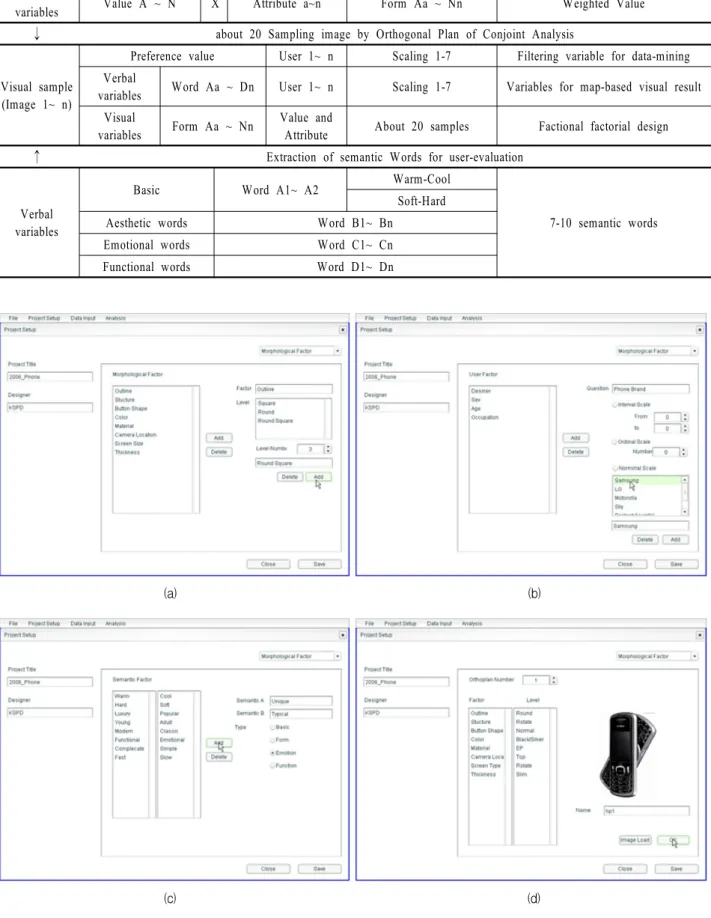
For the development of specific tool, it is necessary to structure the various data of form analysis, and systematic data architecture becomes a basis of in-depth analysis. Data are consists of visual variables, verbal variables and user variables referred to (Table 3). Visual variables represent formative feature of form, and make visual samples (like picture, sketch and computer modeling) through the composition of factors and attributes of form. Verbal variables represent semantic and emotional feature of user’s response and have a function as input data for map-based visual result. Verbal variables consists of 4 types words; basic, aesthetic, emotional, function words. Visual samples have
properties on both sides of visual and verbal variables and users evaluate visual samples in aspects of preference and semantic response.
3.3. Function and Interface of Tools
All components of analysis too-kit has designed by Adobe Flash 8.0 platform according to the 6 guidance;
operating in same windows, serial task-flow, effectiveness of data-management, visualization of result, pop-up windows of in-depth analysis, designer-friendly operation data-of mining. Specific analysis method and tool consists of 5 components: Project Management, Analysis Variables Set-up, Data Input-Output, Basic Analysis, and In-depth Analysis.
'Project Management' and 'Variables set-up' help designer easily to make a structure of complex visual, verbal and user variables. ‘Variable Set-up’creates visual value and attribute of 20 Sampling- images by Orthogonal Plan of Conjoint Analysis and assist to input
Visual
variables Value A ~ N X Attribute a~n Form Aa ~ Nn Weighted Value
↓ about 20 Sampling image by Orthogonal Plan of Conjoint Analysis
Visual sample (Image 1~ n)
Preference value User 1~ n Scaling 1-7 Filtering variable for data-mining Verbal
variables Word Aa ~ Dn User 1~ n Scaling 1-7 Variables for map-based visual result Visual
variables Form Aa ~ Nn Value and
Attribute About 20 samples Factional factorial design
↑ Extraction of semantic Words for user-evaluation
Verbal variables
Basic Word A1~ A2 Warm-Cool
7-10 semantic words Soft-Hard
Aesthetic words Word B1~ Bn
Emotional words Word C1~ Cn
Functional words Word D1~ Dn
Table 3. Data structure of form analysis tools based on user.
(a) (b)
(c) (d)
Figure 2. Screen interface of tools; (a) set-up of visual variables, (b) set-up of user variables, (c) set-up of verbal variables, (d) Input of visual sample.
(a) (b)
(c) (d)
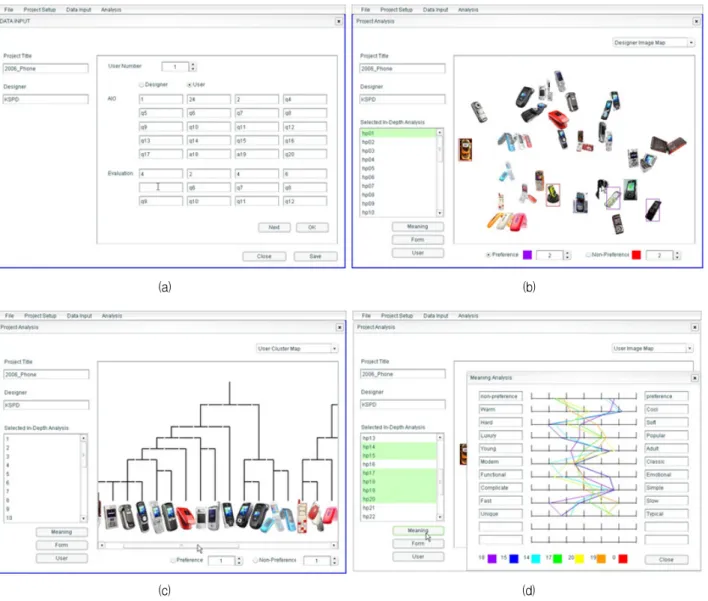
Figure 3. Screen interface of tools; (a) Data Input-Outputr), (b) Image-map View of Basic Analysis, (c) Hierarchy view of Basic Analysis, (d) In-depth Analysis.
visual sample.'Data Input-Output' transforms raw data automatically for the interchange with external statistical program and data. 'Basic Analysis' is executed with preference analysis in visual chart based on image map and hierarchy in order to draw a concrete conclusion rapidly. 'In-depth Analysis' has functions of data-mining for getting specific concept, direction, and features for used centered form-development and embodies effective user interface through pop-up widows, list mode, direct image selection and comparative display. The filtering variables of ‘In-depth Analysis’ are selected by clicking of image or list with preference and semantic response of user's emotion.
4. Test and Evaluation
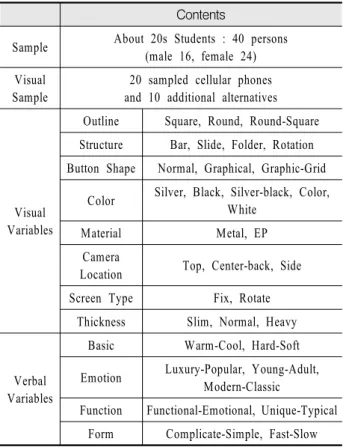
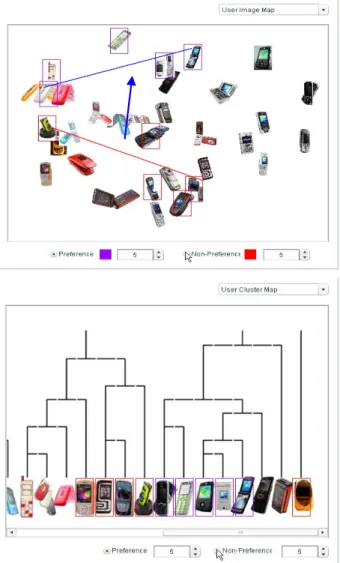
The feasibility of proposed method and tool was verified by a case study of mobile phone design in under-graduate class. (Table 4) illustrates brief of preliminary test. The upper part of (Figure 4) shows the result of basic analysis on designer and mapping-shape is taken a serious view of the outline, surface finishing, and color according to expert aspect. Character ‘A’
means the points to keeping in mind. On the other hand, the lower part of (Figure 4) shows the result of basic analysis on user and mapping-shape is dependent on thickness and structure of overall form. Image-mapping based on MDS and SDS increases the efficiency and
Contents
Sample About 20s Students : 40 persons (male 16, female 24) Visual
Sample
20 sampled cellular phones and 10 additional alternatives
Visual Variables
Outline Square, Round, Round-Square Structure Bar, Slide, Folder, Rotation Button Shape Normal, Graphical, Graphic-Grid
Color Silver, Black, Silver-black, Color, White
Material Metal, EP
Camera
Location Top, Center-back, Side
Screen Type Fix, Rotate
Thickness Slim, Normal, Heavy
Verbal Variables
Basic Warm-Cool, Hard-Soft Emotion Luxury-Popular, Young-Adult,
Modern-Classic
Function Functional-Emotional, Unique-Typical Form Complicate-Simple, Fast-Slow Table 4. Brief of preliminary test.
objectivity.
‘Basic Analysis’ can make synthetic judgment possible because visual images and static results are provided in same windows. ‘Basic Analysis’ with user preference helps to find a clear border of design-direction and to accomplish comparative analysis according to user-groups.13) The upper part of (Figure 5) illustrates the case of female-user and mapping shape is different from the lower part of (Figure 4). Female-user points out bright color and simple shape as preference-factor of form. the lower part of (Figure 5) is a sample which illustrated by the hierarchy view of analysis result.
Hierarchy view provides more clear border-line and boundary of preference among design alternatives.
‘In-depth Analysis’ of form analysis on user provides formative, semantic and user features in detail. (Figure 6) shows that ‘Cool, Hard, Simple, Luxury, Fast, Unique’
are closely related to preference. Especially, ‘Cool, Luxury, Unique’ are the keywords representing user's semantic features and ‘Simple, Fast’ are index of 13) Catherine Courage & Kathy Baxter (2005). Understanding
Your User, Morgan Kaufmann. 71-75.
dividing the border of preference and non-preference.
‘In-depth Analysis’ on formative features revealed that
‘Thickness’ and ‘Structure’ are significant of visual factor and users respond positively to slim, non-graphical button shape, and round-square.
A
A A
Figure 4. ‘Basic Analysis’ the result on designers (upper), the result on user (lower).
Figure 5. ‘Basic Analysis’ the result on female-user (upper), hierarchy view of the result on user (lower).
Figure 6. ‘In-depth Analysis’ Semantic feature (upper), Formative feature (lower).
5. Conclusion and Future Works
In this study, we have suggested the frame and guidance integrated with various methods for user-centered form analysis tools. In the concrete, form analysis tools based on the user's emotional response were performed by 3 stage (the primary stage for variables set-up, the basic analysis, and the in-depth analysis) and were developed by the five guidance (integrated management, variables set-up through current method, visual result of analysis, in-depth analysis with data mining and correlation of separated methods, and reinforcement of user-centered analysis). The proposed tools were designed through integrated data-structure and 5 functional components and will be used for design
concept, direction of style, trend analysis and successful alternative-evaluation. Semantic variables based on user's emotional response, image-map oriented visualization of analysis-result and ‘In-depth Analysis’ with data-mining support designer to performed practical works substantially. At the aspect of education, students leading preliminary test effectively used tool with minimum effort and time, in their own research work and the result of analysis was concrete, objective, practical and expressed tangibly, so that designers could clear of an obscure form-matter in the previous research. Moreover, the proposed tool-kit can be applied to user-research, other field of design analysis and estimation of design similarity.
However, form analysis tools has some improvements
for developing as designer-expert tool and has need of more specific statistic-function and differentiated function classified by product. Also, it is necessary to develop a manual or tutorial and research on the application of tools in various practical design studies.
References
∙ Brenda Laurel (2003). Design Research, THE MIT PRESS 70.
∙ Catherine Courage & Kathy Baxter (2005).
Understanding Your User, Morgan Kaufmann. 71-75.
∙ Charles E. Osgood, George J. Suci, & Percy H.
Tannenbaum (1957). The Measurement of Meaning, University of Illinois Press. 3-36.
∙ Coyne R. D. (1990). Knowledge Based Design Systems, Addison-Wesley, New York, Part1-2.
∙ Green P. E., & Carmone F. J. (1970). Multi Dimensional Scaling and Related Technique in Marketing Analysis, Allyn&Bacon, 23.
∙ Heo Myung-Hoi (2005). SPSS Classification Analysis, SPSS, Chapter 5.
∙ Heo Myung-Hoi & Lee Yong Gu (2003). Data-mining modeling, SPSS, Chapter 5.
∙ Lee Myoung-Sik, Choi Chun-kyu & Koo Ja-Ryong (2003). Marketing Research, Hyung Seol, 235.
∙ McDougall & Fry J. N. (1975). Combining Two Methods of Image Measurement, Journal of Retailing, 50, 60.
∙ Min Young Choi (2003). A Study on the Methods of Eye Tracking Analysis Based on the Properties in Visual Perception of User, Journal of Korean Society of Design Science, 16(4), 199.
∙ Nigel Cross (1989). Engineering Design Method, John Wiley & Sons, 74.
∙ Zwicky F (1967). The Morphological Approach to Discovery, Invention, Research and Construction, Symposition on Methodologies, 316.
원고접수:09.05.28 수정접수:09.06.19 게재확정:09.06.19