• 검색 결과가 없습니다.

Free-standing graphene intercalated nanosheets on Si(111)

N/A
N/A
Protected

Academic year: 2021

Share "Free-standing graphene intercalated nanosheets on Si(111)"

Copied!
12
0
0

로드 중.... (전체 텍스트 보기)

전체 글

(1)

124

Free-standing graphene intercalated nanosheets on Si(111)

Trung T. Pham

*

and Robert Sporken

**★

Abstract

By using electron beam evaporation under appropriate conditions, we obtained graphene intercalated sheets on Si(111) with an average crystallite size less than 11nm. The formation of such nanocrystalline graphene was found as a time-dependent function of carbon deposition at a substrate temperature of 1000°C. The structural and electronic properties as well as the surface morphology of such produced materials have been confirmed by reflection high energy electron diffraction, Auger electron spectroscopy, X-ray photoemission spectroscopy, Raman spectroscopy, scanning electron microscopy, atomic force microscopy and scanning tunneling microscopy.

Key words: Graphene on Si, porous graphene, graphitic carbon, Si substrate, 3D graphene, electron beamevaporation

* Dept. of Materials Technology, HCMC University of Technology and Education, Vietnam. And Nanotechnology Lab - SHTP Labs, R&D center

**Research Center in Physics of Matter and Radiation (PMR),University of Namur (FUNDP)

★ Corresponding author:

e-mail:[email protected], tel: ++84-(0)903782080

※ Acknowledgment

Manuscript received Aug. 23, 2017; revised Sep. 18, 2017 ; accepted Sep. 19, 2017

This is an Open-Access article distributed under the terms of the Creative Commons Attribution Non-Commercial License

(http://creativecommons.org/licenses/by-nc/3.0 ) which permits unrestricted non-commercial use, distribution, and reproduction in any medium,

provided the original work is properly cited.

(2)

I. Introduction

In recent years, graphene nanosheets have attracted much attention as an excellent material for the fabrication of power sources based on carbon compounds for various applications such as portable electronic devices, electric vehicles, and energy storage systems due to the high energy density, high operating voltage and low self-discharge rate.

Known as the case of rechargeable lithium ion batteries (commercial Li-ion cells), graphite is commonly used as an anode electrode because of its high coulombic efficiency, acceptable specific capacity and cyclic performance by forming intercalation compounds from Li and C atoms as LiC

6

[1, 2].

However, theoretical specific capacity of the three dimensional graphite within the sp

2

carbon structure is quite low because of the limited Li-ion storage sites [3, 4]. Then, an alternative has recently been reported as graphene - the thinnest material made from a single layer of sp

2

bonded carbon atoms in a two-dimensional honeycomb crystal lattice, which possesses outstanding electrical, optical, thermal, and mechanical properties [4-9]. Therefore, enormous efforts during the past ten years have been devoted to grow, transfer and characterize graphene on various substrates using many different methods such as mechanical exfoliation of highly oriented

pyrolytic graphite (HOPG)[4], chemical vapor deposition (CVD) on metal substrates[10], electron beam evaporation [11-12], epitaxial growth on bulk SiC by thermal decomposition [13], etc. Although the aim is to produce large scale of graphene sheets for high-performance metal- oxide-semiconductor field-effect transistors (MOSFETs), graphene nanosheets become bigger advantages for energy storage due to their capacity in the same given volume of containers, which qualify as a potentially promising anode material for lithium ion batteries [14-15]. Therefore, finding a suitable method in order to produce a such nanosheets of graphene is highly desirable.

However, production of such graphene nanosheets for that application is up to now only from using water suspension of graphene oxide (GO), followed by thermal reduction of deposited multilayers in order to obtain reduced- graphene oxide (rGO). Reduction of GO into graphene-like sheets results in a graphitic structure, but it still contains many defects[16, 17]

which could impact more or less on the electrical

conductivity of graphene. In addition, the uniform

control of graphene nanosheets attached on the

electrode plate for obtaining the optimal

performance of device is also a challenge. To

compete with this technique in the growth of a such

nanocrystalline graphene for those potential

applications, we developed a process to

produce a free-standing graphene

(3)

intercalated nanosheets (3D porous-like structure) made of a few graphene layers on Si(111) by using an electron beam evaporation (EBE) in ultrahigh vacuum (UHV).

EBE is considered as a potential method to produce super-clean and high quality of thin films on any arbitrary semiconductor substrates due to its in-situ deposition of atoms in UHV compared to other ones. From experimental evidences, it was found that the evolution of our porous graphene materials on Si(111) acts as a function of the growth time during carbon atoms deposition at a substrate temperature of 1000°C. The structural and electronic properties of our graphene nanosheets were examined in detail by reflection high energy electron diffraction (RHEED),Auger electron spectroscopy (AES), X-ray photoemission spectroscopy (XPS), Raman spectroscopy. In particular, we present here scanning electron microscopy (SEM),atomic force microscopy (AFM) and scanning tunneling microscopy (STM) images which establish unambiguously the graphitic nature of such materials.

II. Experimental details

Si(111) (ρ> 50 Ω.cm, n-type) samples are obtained by annealing (up to 1000°C) in UHV (pressure below 2.0 × 10

-10

mbar) until a nice 7×7 reconstruction is observed in RHEED and STM. Carbon is deposited using an e-beam

evaporator from Tectra GmbH with a graphite rod of 99.997% purity from Goodfellow Cambridge Ltd. Silicon is evaporated from resistively heated n-type silicon in the same chamber where carbon is deposited. The samples are prepared in situ by evaporating carbon on the Si(111) surface at a substrate temperature of 1000°

C (measured with an IR pyrometer). The carbon deposition rate is measured by a quartz crystal oscillator. The pressure in the chamber is kept below 1.0 × 10

-8

mbar during the evaporation.

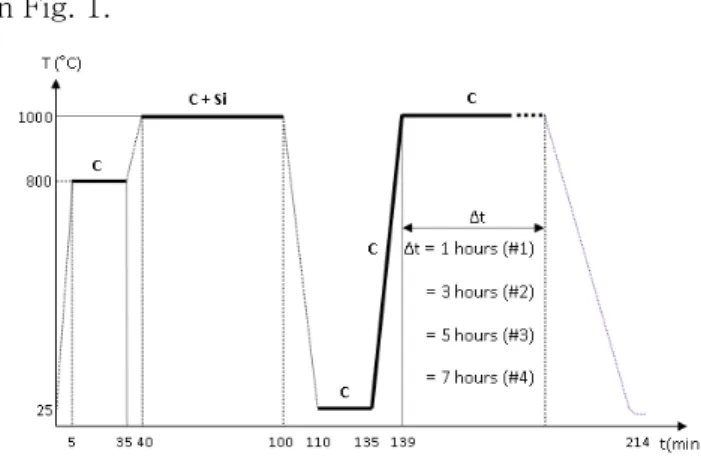
The experimental procedure for obtaining graphene nanosheets on Si(111) as described in Fig. 1.

First, the Si(111) surface is carbonized for 30 min at a substrate temperature of 800 ° C, followed by

slowly heating to 1000°C (as detailed by Liu et al. [18] in order to obtain a good crystallinity of 3C-SiC film). After one hour for SiC formation at this temperature under carbon and silicon flux (the rate of Si and C is approximately ∼1.5:1 in

Fig. 1: A growth process for the formation of graphene nanosheets on Si(111) 7×7 substrate.

Solid black line stands for C and Si flux ON.

(4)

which carbon evaporation rate is held constant at 7×10

14

atoms.cm

-2

.min

-1

), we stop the silicon and carbon flux and gradually decrease the substrate temperature to room temperature.

Then, we restart carbon deposition on top of the sample for obtaining a few carbon layers (amorphous carbon) at this room temperature.

After that, we slowly heat the sample (in about 4min) up to 1000°C during carbon deposition for various growth times as 1 hour (sample #1), 3 hours (sample #2), 5 hours (sample #3), 7 hours (sample #4). The carbon flux is then shut off and the sample is cooled down to 200°C at 20°C.min

-1

and finally, free-cooled to room temperature.

Reflection high energy electron diffraction (RHEED, Riber), Auger Electron Spectroscopy (AES, Omicron) and STM (VP2 from Park Instrument) analyses were performed in situ while Raman, XPS and AFM were performed after transportation in the atmosphere. XPS analysis was made with a K-Alpha spectrometer from Thermo Scientific with a monochromated Al Kα X-raysource (1486.6eV) and a resolution of 0.1eV. Raman scattering measurements were performed using a LabRamHR system with a 514nm laser excitation source and an objective of 100×. No outgassing was possible before performing the XPS, the Raman and the AFM measurements.

The SiC and HOPG crystals used as references were analyzed in the same chambers after outgassing at 600°C for several hours (except

for the XPS and Raman measurements). An oxide layer is still present on the SiC after such outgassing [19] while the HOPG showed no oxygen contamination.

III. Results and discussion

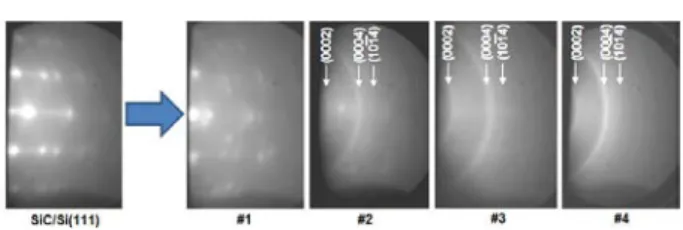
Fig. 2 shows the RHEED patterns of the sample after

SiC growth and followed by carbon layers deposition.

As observed, the diffraction rings are visible

in the RHEED patterns of the sample #1 after

carbon deposition on top of SiC layers

although they are still very faint. Besides SiC

streaks, some Si faint spots could still be

observed on the surface which is probably

diffused from the substrate [20]. The rings

appear more clearly in the samples #2, #3

together with very faint SiC streaks, meaning

that carbide formation on the surface still

occurs during this growth time and the SiC

streaks disappear from RHEED patterns in the

sample #4 after more carbon coverage. The

sharp concentric rings are present for

polycrystalline graphitic materials on top of the

samples [12, 21] and position of these rings can

Fig. 2: RHEED patterns of the respective

samples under various growth times on Si(1

(5)

be determined as marked in the RHEED image in Fig. 2.

Based on this RHEED technique, the diffraction ring canbe expressed by

L , 2 θ

Bragg

= R

=

α (1)

withθ

Bragg

is very small, R is the ring radius and L is the distance from the sample to the phosphor screen. Combining (1) with the Bragg condition, the lattice spacing for hexagonal graphitic structure of a reciprocal lattice point with indices (hkil) will be found

R , d

hkil

= λ L (2)

where L and λ are known, R is measured directly on the screen. By using the rings (0002) and (1014) in the sample #3, the lattice spacing in (2) is found to be ∼ 3.39 Å which is very close to the expected value for adjacent layers of graphite 3.35 Å (error about 1.1%). Indeed, the derivatives of AES spectra around the CKLL transition on our samples were recorded in Fig.

3(a). Compared with the spectra of SiC and HOPG, it is clear that the shape of the curve of the sample #1 is similar to the one of SiC while the samples #2, #3, #4 are similar to the one of HOPG. The energy difference D between the maximum and the minimum of the curve was measured ∼ 22.6 eV for samples #2 → #4 as in HOPG and∼ 11 eV for sample #1 as in SiC.

The graphitic properties of the carbon film on three samples #2, #3, #4 and the carbide on sample #1 are further confirmed by XPS data on C1s core level shown in Fig. 3(b). The spectrum shape of sample #1 is very similar to the SiC spectrum (except for the weaker component at 285.5 eV, which corresponds to the native oxide found on SiC[19]) while the others look similar with the one of HOPG. One can see that a transition from Si-C bonds to C-C bonds occurs gradually in those samples when the growth time is longer. The main peak of sample #2 appears at 284.7 eV (corresponding to C-C bonding) which is practically identical to the one of HOPG while a weaker component is still observed at 283.3 eV (corresponding to Si-C formation). This component is strongly reduced in sample #3 and disappeared in sample #4 with thicker graphitic carbon formation. It is consistent with the appearance of the faint SiC streaks in sample #2 and no longer observed in sample

#4 as proposed by the RHEED patterns.

Raman measurements were performed using a

Fig. 3: (a) Differentiated AES spectra around

the CKLL transition after carbon growth on top

of the preformed SiC layers on Si(111) at

1000°C with different time of carbon deposition

(samples #1 → #4); (b) C 1s XPS spectra

recorded on corresponding samples (HOPG

and bulk SiC as references).

(6)

514 nm (2.41 eV) laser source to investigate the vibrations related to C-C bonds in the samples. The Raman spectra of four studied samples together with the commercial multi- wall carbon nanotubes (MWCNTs) and CVD single layer graphene (SL), included for comparison as plotted in Fig. 4 (a). The data reveals that the sample #1 does not show the typical sp

2

related signatures of C-C bonds in the systems while graphitic bonds are present on remaining samples in which the appearance of G (1587 cm

-1

), 2D (2696 cm

-1

) and defect-related D (1350 cm

-1

) and D' (1620 cm

-1

) bands confirm the graphitic nature of the grown layers, in good agreement with our AES and XPS characterization. In general, the presence of G and 2D bands is considered as characteristic for graphene [22]. Thus, it can be inferred that graphene layers formed on the surface of samples samples #2 → #4.

Compared to HOPG, a few layers of graphene could be grown on our samples. According to our experimental process in Fig. 1, a thin SiC layer was produced before carbon deposition for graphene formation, which may induce a Raman shift of graphene related bands. Indeed, the G band of epitaxial graphene grown on C- and Si- terminated SiC has often similar frequency (∼ 1586 - 1590 cm

-1

), which is upshifted from ∼ 6 - 10 cm

-1

compared to that of HOPG (∼ 1580 cm

-1

) [23, 24]. This is due to stress caused by the lattice mismatch between graphene and SiC. However, the 2D band is quite different in comparison with the one of HOPG (2726 cm

-1

). For epitaxial multi- layer graphene on C-face SiC, it is ∼ 2730 cm

-1

(higher) while it is 2702 cm

-1

(lower) on Si-face SiC [25]. This is attributed to the interface interaction between graphene and Si-face SiC (∼

30 % of carbon atoms from the first graphene layer are covalently bonded to SiC [26, 27]), while such covalent bonds are absent at the interface between graphene and C-face SiC [13, 27]. The frequency of G and 2D bands of our materials is similar to that of epitaxial graphene on Si-face of 3C-SiC. A similar observation was made by Ouerghi et al. [28]

who produced epitaxial graphene on Si-face 3C- SiC/Si(111) in UHV. However, the observation of these spectra reveals very intense defect-related bands (D and D' bands). By means of peak fittings (Lorentzian fittings for sample #4 as a representative), a quantitative analysis of the main spectral features was carried out and information about the intensities and FWHM (Full Width at Half Fig. 4: (a) Raman measurements recorded at λ =

514 nm (E

laser

= 2.41 eV) of samples #1, #2, #3,

#4, MWCNTs and CVD-produced single layer

graphene; (b) corresponding intensity ratios; (c)

FWHM of D and 2D bands and (d) crystal size of

the measured samples derived from the I

D

/I

G

ratios.

(7)

Maximum) of each peak were obtained. Fig. 4(b) summarizes the information about the intensity ratios I

D

/I

G

and I

2D

/I

G

of the graphitic samples and isolated points represent similar ratios calculated from MWCNTs and SL graphene data. The values for the I

2D

/I

G

ratios, ranging from 0.74 (sample #2), 0.75 (sample #4) to 1.05 (sample #3) indicate highly ordered structures, contrary to the low value of 0.44 for MWNTs (decrease in quality due to strong treatments for purification and functionalization). These high I

2D

/I

G

ratio values suggest thatthe crystalline areas might be constituted of two or more layers of graphene since the values of the FWHM of the2D bands for these three samples lie around 60 cm

-1

(see Fig. 4(c)), while the value for SL is ∼ 30 cm

-1

. Although these high intensities of the 2D band indicate the crystallinity of the samples, the values of the I

D

/I

G

ratios are even larger than the values of the I

2D

/I

G

ratios. Commonly, the presence of intense and broad D bands suggests defects in the honey- comb network, however, in this case the D bands are very sharp (∼ 35 - 40 cm

-1

in our samples contrary to ∼ 60 cm

-1

for MWCNTs)which could be the indication of particular types of symmetry breaking elements like frontiers among polycrystals rather than vacancies or bare edges.

Also, further characterization is underway to determine the exact nature of these intriguing intense and sharp D bands. For the sake of relating the Raman data to crystal sizes, we have used the formula derived by Cancado et al.[29]. Results

indicate an average crystal size of 8-11 nm depending on the growth time as shown on Fig. 4(d).

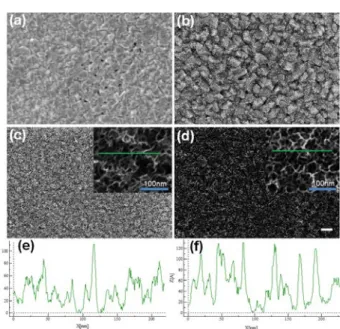
All studied samples are characterized by using SEM technique. Except for sample #1, it shows similar surface morphology with the formation of small porous-like structure as imaged on corresponding samples #2 → #4 for an illustration in Fig. 5.As observed, our materials are vertically aligned to the underlying substrate and are randomly intercalated to each other forming many small domains with dimensional size of 10 - 70 nm like a free-standing graphene intercalated nanosheets as proposed by Zhang et al.[30].

That is the reason why RHEED patterns suggest that these domains are randomly oriented (see above). In addition, the density

Fig. 5: SEM images taken from all studied

samples showing the surface morphology of (a)

sample #1, (b) sample #2, (c) sample #3, (d)

sample #4. Scale bar is 200nm. (e)& (f)Height

profiles measured from an inset in (c) and (d),

respectively show the pore size as well as the wall

height of our pores.

(8)

of nano-pores on the surface increases with an increase of the amount of deposited carbon atoms on the sample which is clearly

visible in samples #2 → #4. Also, the wall thickness of our porous graphene was measured about 1-2nm which equals to about 3-6 layers of graphene and the wall height of such material is estimated from 0 to 125Ådepending on the area based on means of SEM profiling as taken on Figs. 5(e) & (f).

In order to confirm our above analyses, we took some STM and AFM images on the sample #3 (best sample) for more precise evaluation as shown in Fig. 6. A large-scale STM image of 2×2µm

2

was performed with a root mean square roughness about 3.65 nm as presented in Fig. 6(a). The surface of our sample is quitely rough with the formation of many domains which are made from tiny bunches ofsp

2

bonded carbon nanosheets.

This result is consistent with the observation of SEM images on this sample.

Despite that roughness, the atomic resolution is still found at smaller scales of 80×80 Å

2

(Fig.

6(b)) together with an inset of ∼ 15×15 Å

2

taken on the same sample. Such an observation of triangular shape is in good agreement with STM measurements on HOPG which can be explained by the fact that the AB stacking of the layers in graphite breaks the symmetry, leading to two inequivalent carbon atoms per unit cell [31]. Therefore, they appear as the bright spots (blue dots) in the image where carbon atoms with a higher electron density lie directly above atoms in the plane below and represent only half the total number of carbon Fig. 6: (a) Large scale of STM image on sample

#3: 2×2 µm

2

with tiny bunches which could be

of graphene nanosheets and (b) a nano-scale

image of 80×80 Å

2

with an inset of atomic

resolution of the AB stacking in graphene layers

with electronic noise marked by blue arrows. (c)

Surface topographic AFM images of sample #3

and (d) the corresponding phase image.

(9)

atoms in the plane. Furthermore, Fig. 6(c) is an AFM surface topography image of sample

#3, which shows a rather rough morphology containing many different grains and the corresponding AFM phase image obtained inside different graphene grains exhibits only weak contrast differences as seen in Fig. 6(d).

It represents an indication that the differences in physico-chemical properties among the different grains are not large. In other words, our materials are homogeneous on this sample.

This is in accordance with our XPS, Raman, SEM and STM analyses on this sample.

IV. Conclusions

In conclusion, we have grown free-standing graphene intercalated nanosheets as 3D porous graphene materials on Si(111) through the prior formation of several SiC layers, followed by a few layers of amorphous carbon deposited at room temperature which could act as a barrier to prevent out-diffusion of silicon atoms from the substrate during graphene formation at a substrate temperature of 1000 ° C. The experimental results confirmed a determinant influence of the growth time on the crystal evolution of graphene formation on Si(111). Especially, we obtained the real space SEM, AFM and STM images for an interpretation on the micro- /nano-structural properties of such 3D graphene materials.

V. Acknowledgments

Trung T. PHAM would like to thank Paul Thiry for useful discussions on RHEED patterns, Francesca Cecchet on AFM images and Etienne Gennart for technical support.

References

[1] H. Nozaki, K. Nagaoka, K. Hoshi, N. Ohta, and M. Inagaki, "Carbon-coated graphite for anode of Lithium ion rechargeable batteries: Carbon coating conditions and precursors," Journal of Power Sources, vol.

194, no. 1, pp. 486 - 493, 2009.

[2] L.-Z. Bai, D.-L. Zhao, T.-M. Zhang, W.- G. Xie, J.-M. Zhang,and Z.-M. Shen, "A comparative study of electrochemical performance of graphene sheets, expanded graphite and naturalgraphite as anode materials for Lithium-ion batteries," ElectrochimicaActa, vol. 107, pp. 555 - 561, 2013.

[3] J. Tarascon and M. Armand, "Issues and challenges facingrechargeable lithium batteries," Nature, vol. 414, no. 6861, pp.

197-200, 2001.

[4] K. S.Novoselov, A. K. Geim, S. V.Morozov, D. Jiang, Y. Zhang,S. V. Dubonos, I. V.

Grigorieva, and A. A.Firsov, "Electric field effect in atomically thin Carbon films,"

Science, vol. 306, pp. 666-669, 2004.

[5] K. S.Novoselov, A. K. Geim, S. V.Morozov,

D. Jiang, I. V. Katsnelson, I. V. Grigorieva,

(10)

S. V. Dubonos, and A. A.Firsov, "Two- dimensional gas of massless dirac fermions in graphene," Nature, vol. 438, pp. 197-200, 2005.

[6] A. K. Geim and K. S. Novoselov, "The rise of graphene," Nature Materials, vol. 6, pp.

183-191, Mar. 2007.

[7] R. R. Nair, P. Blake, A. N. Grigorenko, K.

Novoselov, T. J.Booth, T. Stauber, N. M. R.

Peres, and A. K. Geim, "Fine structure constant defines visual transparency of graphene,"Science, vol. 320, p. 1308, 2008.

[8] A. A. Balandin, S. Ghosh, W. Bao, I. Calizo, D. Teweldebrhan,F. Miao, and C. N. Lau,

"Superior thermal conductivity ofsingle- layer graphene," Nano Letters, vol. 8, no. 3, pp. 902-907,Feb 2008.

[9] C. Lee, X. Wei, J. W. Kysar, and J. Hone,

"Measurement of elastic properties and intrinsic strength of monolayergraphene,"

Science, vol. 321, pp. 385-388, 2008.

[10] J. Wintterlin and M.-L. Bocquet,

"Graphene on metal surfaces," Surface Science, vol. 603, no. 10-12, pp. 1841- 1852,2009.

[11] P. ThanhTrung, F. Joucken, J. Campos- Delgado, J.-P.Raskin, B. Hackens, and R.

Sporken, "Direct growth of graphitic carbon on Si(111)," Applied Physics Letters, vol. 102, no. 1, pp. 013118-n/a, 2013.

[12] J. Tang, C. Y. Kang, L. M. Li, W. S. Yan, S. Q.

Wai, and P. S. Xu, "Graphene films grown on Si substrate via directdeposition of solid-

state carbon atoms," Physica E, vol. 43, no.8,pp. 1415-1418, 2011.

[13] J. Hass, W. A. de Heer, and E. H. Conrad,

"The growthand morphology of epitaxial multilayer graphene," Journal ofPhysics:

Condensed Matter, vol. 20, no. 32, pp.

323202-n/a, 2008.

[14] X. Li, Y. Hu, J. Liu, A. Lushington, R. Li, and X.

Sun, "Structurally tailored graphene nanosheets as Lithium ion batteryanodes: an insight to yield exceptionally high Lithium storageperformance," Nanoscale, vol. 5, pp.

12607-12615, 2013.

[15] G. Kucinskis, G. Bajars, and J. Kleperis,

"Graphene in Lithiumion battery cathode materials: A review," Journal of PowerSources, vol. 240, pp. 66- 79, 2013.

[16] S. Pei and H.-M. Cheng, "The reduction of graphene oxide,"Carbon, vol. 50, no. 9, pp. 3210-3228, 2012.

[17] F. Banhart, J. Kotakoski, and A. V.

Krasheninnikov, "Structural defects in graphene," ACS Nano, vol. 5, no. 1, pp.

26-41,2011.

[18] Z. Liu, J. Liu, P. Ren, Y.Wu, and P. Xu,

"Effects of carbonization and substrate temperature on the growth of 3C-SiC on Siby SSMBE," Applied Surface Science, vol.

254, no. 10, pp. 3207-3210, 2008.

[19] L. Johansson, P.-A. Glans, and N.

Hellgren, "A core level andvalence band photoemission study of 6H-SiC(000- 1)," SurfaceScience, vol. 405, no. 2-3, pp.

288-297, 1998.

(11)

[20] T. T. Pham, C. N. Santos, F. Joucken, B.

Hackens, J.-P.Raskin, and R. Sporken,

"The role of SiC as a diffusion barrier in the formation of graphene on Si(111),"

Diamond andRelated Materials, vol. 66, pp.

141-148, 2016.

[21] J. Hackley, D. Ali, J. DiPasquale, J. D.

Demaree, and C. J. K.Richardson,

"Graphitic carbon growth on Si(111) using solidsource molecular beam epitaxy," Applied Physics Letters, vol.

95,pp. 133114-n/a, 2009.

[22] A. C. Ferrari, J. C. Meyer, V. Scardaci, C.

Casiraghi,M. Lazzeri, F. Mauri, S. Piscanec, D. Jiang, K. S. Novoselov, S. Roth, and A. K.

Geim, "Raman spectrum of graphene andgraphene layers," Phys. Rev. Lett., vol.

97, pp. 187401-n/a, Oct.2006.

[23] W. A. de Heer, C. Berger, M. Ruan, M.

Sprinkle, X. Li, Y. Hu,B. Zhang, J. Hankinson, and E. Conrad, "Large area andstructured epitaxial graphene produced by confinement controlled sublimation of silicon carbide,"

Proceedings of the National Academy of Sciences, vol. 108, no. 41, pp. 16900- 16905,2011.

[24] N. Sharma, D. Oh, H. Abernathy, M. Liu, P. N. First, and T. M. Orlando, "Signatures of epitaxial graphene grown on Si- terminated 6H-SiC (0001)," Surface Science, vol. 604, no. 2, pp. 84-88, 2010.

[25] O. Kazakova, V. Panchal, and T. L. Burnett,

"Epitaxialgraphene and graphene-based devices studied by electricalscanning probe

microscopy," Crystals, vol. 3, no. 1, pp.

191-233,2013.

[26] J. D. Emery, B. Detlefs, H. J. Karmel, L. O.

Nyakiti, D. K.Gaskill, M. C. Hersam, J.

Zegenhagen, and M. J. Bedzyk, "Chemically resolved interface structure of epitaxial graphene on SiC(0001)," Phys. Rev. Lett., vol.

111, pp. 215501-n/a, Nov. 2013.

[27] K. V. Emtsev, F. Speck, T. Seyller, L. Ley, and J. D. Riley, "Interaction, growth, and ordering of epitaxial graphene onSiC(0001) surfaces: A comparative photoelectron spectroscopystudy," Phys. Rev. B, vol. 77, pp. 155303-n/a, Apr. 2008.

[28] A. Ouerghi, A. Kahouli, D. Lucot, M.

Portail, L. Travers,J. Gierak, J. Penuelas, P. Jegou, A. Shukla, T. Chassagne, and M.

Zielinski, "Epitaxial graphene on cubic SiC(111)/Si(111)substrate," Applied Physics Letters, vol. 96, no. 19, pp.

191910-n/a,2010.

[29] L. G. Cancado, K. Takai, T. Enoki, M. Endo, Y. A. Kim,H. Mizusaki, A. Jorio, L. N. Coelho, R. . Magalhaes-Paniago, and M. A. Pimenta,

"General equation for the determination of the crystallite size La of nanographite by Raman spectroscopy," Applied Physics Letters, vol. 88, no. 16, pp. 163106-n/a, 2006.

[30] L. Zhang, F. Zhang, X. Yang, G. Long, Y. Wu,

T. Zhang,K. Leng, Y. Huang, Y. Ma, A. Yu,

and Y. Chen, "Porous 3D graphene-based

bulk materials with exceptional high

surfacearea and excellent conductivity for

(12)

supercapacitors," ScientificReports, vol. 3, no. 1408, 2013.

[31] Y. Wang, Y. Ye, and K. Wu, "Simultaneous observation ofthe triangular and honeycomb structures on highly orientedpyrolytic graphite at room temperature: An STM study," Surface Science, vol. 600, no. 3, pp. 729-734, 2006.

BIOGRAPHY

Trung T. Pham (Member)

2002 : BS degree in Physical Electronics, University of Science Ho Chi Minh city, Vietnam.

2005 : MS degree in Physical Electronics, University of Science Ho Chi Minh city, Vietnam.

2015 : PhD degree in Physics and Nano Materials, University of Namur, Belgium.

2002~2015: Lecturer and researcher at Department of Physics, Faculty of Applied Sciences, HCMC University of Technology and Education, Vietnam.

2006~2007: Researcher at Nano Technology Laboratory, Saigon Hi-Tech Park, Vietnam.

2008~2009: researcher at Aeschlimann group of ultrafast phenomena at surfaces, Kaiserslautern, Germany.

2016~present: Senior researcher at at Nano Technology Laboratory, Saigon Hi-Tech Park, Vietnam.

2016~present: Lecturer and researcher at Department of Materials Technology, Faculty of Applied Sciences, HCMC University of Technology and Education, Vietnam.

Robert Sporken (Member)

1983: BS degree in Physics, Liège University, Belgium.

1983 : Agrégé de l'Enseignement Secondaire Supérieur, Liège University, Belgium.

1988 : PhD degree in Physics, University of Namur, Belgium.

1989-1991: Post-doctoral research associate, University of Illinois at Chicago, US.

1991-1993: Visiting professor, Université d'Aix- Marseille II (Marseille, France)

1992-2000: Senior researcher (chercheur qualifié), University of Namur, Belgium.

1997-present : Adjucnct Professor, Department of Physics, University of Illinois at Chicago, US.

2000-2002: Associate Professor, University of Namur, Belgium.

2002-present: Professor University of Namur,

Belgium.

수치

Fig. 1: A growth process for the formation of  graphene nanosheets on Si(111) 7×7 substrate
Fig. 2 shows the RHEED patterns of the sample  after
Fig. 5: SEM images taken from all studied  samples showing the surface morphology of (a)  sample #1, (b) sample #2, (c) sample #3, (d)  sample #4

참조

관련 문서

In this study, we have deposited poly acrylic acid films on three-dimensional (3D) PCL scaffolds using plasma polymerization and then plasma-polymerized 3D

From the results of this study, we concluded that two different sized graft materials have positive effects on new bone formation.. Additionally, smaller

스핀코팅 과정이 끝난 후 , 앞서 제조된 Graphene Oxide가 증착된 유리기판을 60℃온도에서 10분간 핫플레이트에서 건조시키고 오븐 을 이용하여 75℃온도에서

(a) is without vibration condition, (b) is with vibration casting condition... Figure 4.24 Measured proportional constant a as a function of Si content in Al-Si binary

그리고 Hummers' method로 graphite oxide을 만들고 Microwave range를 이용하여 박리된 graphene oxide를 합성하였고 FE-SEM, HRTEM 이미지를 얻고 XPS 데이터를 통해

16 and 4 subjects were i ncl uded.In subdi vi si on 3 the frequency spectrums showed short,i rregul ar pattern bel ow 300Hz i s accompani ed by si mul taneous l ong durati

16.TaguchiA,Tani motoK,OgawaM,Sunayashi kiT,WadaT.Effectofsi ze of regi on of i nterest on preci si on of bone mi neralmeasurements of the mandi bl e by quanti tati

The importance of the traditional music study in Korean humanistic science notwith- standing, little attempt has been paid on research method in the