—
ISSN 1229-3350(Print)
ISSN 2288-1867(Online)
—
J. fash. bus. Vol. 21,
No. 3:67-79, July. 2017
https://doi.org/
10.12940/jfb.2017.21.3.67
Commerce on Consumers' Attitudes and Intentions Focused on the characteristics of consumers and –
O2O mobile commerce-
Takhwan Ko Sunyoung Yeom MiYoung Lee ‧ ‧
†
Dept. of Fashion Design & Textiles, Inha University, Korea
Corresponding author
—
MiYoung Lee
Tel : +82-32-360-8137
Fax.: +82-32-865-8130
E-mail : [email protected]
Keywords Abstract
online to offline,
fashion mobile commerce, TAM model
—
This work was supported by INHA
UNIVERSITY Research Grant.
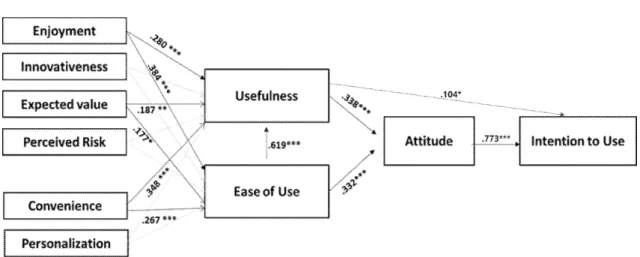
This study investigated consumers' enjoyment, perceived risks, expected values, and innovativeness factors and the effects of the convenience and personalization of "online to offline" (O2O) fashion mobile commerce on its perceived usefulness, perceived ease of use, and consumers' attitudes and intention to use O2O mobile commerce. A research model was developed using the Technology Acceptance Model (TAM). A mobile survey was conducted through smartphone messengers and SNSs targeting male and female college students in their 20s who are living in the Seoul Metropolitan Area. A total of 192 questionnaire responses were used in the analysis.
“Among the consumer characteristics, only enjoyment and expected values were found to make consumers feel that the O2O fashion mobile commerce is useful and easy to use. Among the mobile commerce characteristics, only convenience was found to have significant effects on consumers’ perceived usefulness and ease of use regarding O2O fashion mobile commerce.
Perceived usefulness was found to have the effects on attitudes as well as intention to use toward O2O mobile commerce. It was shown that positive attitudes toward O2O mobile commerce led to positive use intention toward O2O mobile commerce.
I. Introduction
As the digital economy flourishes, the borderline between offline and online is disappearing. As a result, the concept of Online to Offline (O2O), which connects these
two different domains, is expanding. The widespread
diffusion of the broadband network and smartphones
and the development of related technologies have already
made use of wired and wireless Internet across the
world. In particular, the growth of the mobile Internet