Received: 27 March 2019 Revised: 10 June 2019 Accepted: 19 June 2019
Copyright Ⓒ Korean Solar Energy Society This is an Open-Access article distributed under the terms of the Creative Commons Attribution NonCommercial License which permits unrestricted non-commercial use, distribution, and reproduction in any medium, provided the original work is properly cited.
Journal of the Korean Solar Energy Society Vol.39, No.4, pp.1-9, August 2019 https://doi.org/10.7836/kses.2019.39.4.001 pISSN : 1598-6411
eISSN : 2508-3562 OPEN ACCESS
다양한 ECA 소재를 활용한 shingled 구조의 태양전지 효율 비교 분석
장재준*・ 박정은**・ 김동식*・ 최원석* ・ 임동건***†
***
한국교통대학교 정보기술융합학과, 석사과정
***
한국교통대학교 전자공학과, 박사과정
***
한국교통대학교 전자공학과, 정보기술융합학과, 교수
A Comparison Analysis on the Efficiency of Solar Cells of Shingled Structure with Various ECA Materials
Jang Jae Joon* ・Park Jeong Eun** ・ Kim Dong Sik* ・ Choi Won Seok* ・ Lim Donggun***†
***
Department of IT Convergence, Korea National University of Transportation, MS Candidate
***
Department of Electronic Engineering, Korea National University of Transportation, Ph.D. Candidate
***
Department of Electronic Engineering, IT Convergence, Professor
†
Corresponding author: [email protected]
Abstract
Modules using 6 inch cells have problems with loss due to empty space between cells. To solve this problem made by shingled structure which can generate more power by utilizing empty space by increasing the voltage level than modules made in 6inch cell. Thus, in this paper, the c-Si cutting cells were produced using nanosecond green laser, and then the ECA was sprayed and cured to perform cutting cell bonding. Three types of ECA materials (B1, B2, B3) with Ag as the main component were used, and experimental conditions varied from 5 to 120 seconds of curing time, 130 to 210°C of curing temperature, and 1 to 3 of curing numbers. As a results of experiments varying curing time, B1 showed efficiency 19.88% in condition of 60 seconds, B2 showed efficiency 20.15% in 90 seconds, and B3 showed efficiency 20.27% in 60 seconds. In addition, experiments with varying curing temperature, It was confirmed highest efficiency that 20.04% in condition of 170°C with B1, 20.15% in condition of 150°C with B2, 20.27% in condition of 150°C with B3. These are because the Ag particles are densely formed on the surface to make the conduction path. After optimizing the conditions of temperature and curing time, the secondary-tertiary curing experiments were carried out. as the structural analysis, conditions of secondary-tertiary curing showed cracks that due to damp heat aging. As a result, it was found that the ECA B3 had the highest efficiency of 20.27% in condition of 60 seconds of curing time, 150°C of curing temperature, and single number of curing, and that it was suitable for the manufacture of Solar cell of shingled structure rather than ECA B1 and B2 materials.
Keywords:
분할 셀(Cutting cell),
결정질 실리콘 태양전지(c-Si solar cell), ECA(Electrically
Conductive Adhesive),
열화현상(Damp heat aging)
1. 서 론
세계적으로 에너지 수요가 증가함에 따라 재생 가능한 에너지의 연구가 지속적으로 진행되고 있다. 그 중 태양 광에너지의 연구가 활발한데, 그 이유는 태양광이 변환효율이 우수하고 친환경적인 에너지이기 때문이다. 대표 적으로 태양전지가 있다. 태양전지로 전력을 생산하기 위해서는 모듈화공정이 필요하다. 그 중 셀과 셀을 연결하 는 스트링 공정에서 널리 사용하는 방식은 셀과 셀을 리본으로 연결하여 스트링을 제작하는 방식이다. 이 방식은 셀과 셀 사이의 빈 공간이 생기는 문제점이 있으며, 이 빈 공간은 전력을 생산하지 못해 손실이 발생하게 된다
1-3)
.따라서 본 연구에서는 나노초 그린레이저를 사용하여 c-Si 셀을 컷팅한 후, 3가지의 ECA (electrically conduc- tive adhesive)를 사용하여 2개의 분할 셀을 접합한 shingled 구조의 태양전지를 제작하였다. 따라서 기존의 6inch 셀을 사용한 모듈의 셀과 셀 사이 빈 공간으로 인한 손실을 방지하고자 하였으며, ECA별 shingled 구조의 태양전지의 효율을 비교분석하여 적합한 소재를 확인하고자 하였다
4)
.2. 실험 방법
실험 방법으로 나노초 그린레이저의 laser power 90%, laser speed 100 mm/s, 주파수 500 kHz의 조건으로 15.6 × 15.6 cm
2
의 c-Si셀을 스크라이빙 하여 15.6 × 3.1 cm2
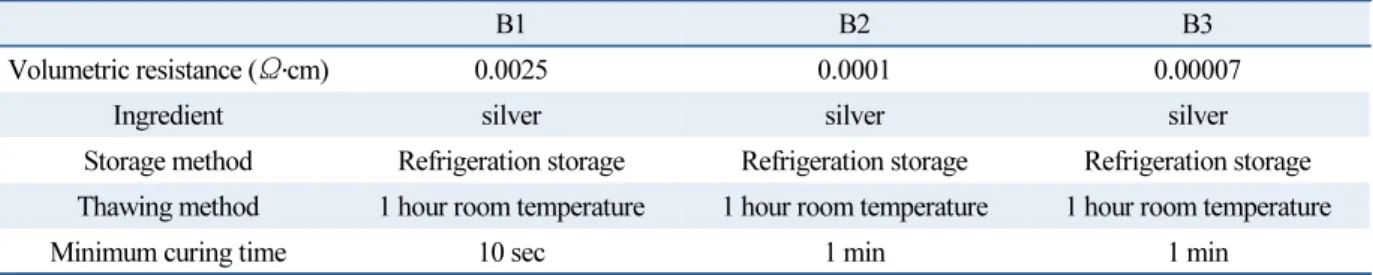
크기의 c-Si 분할 셀을 제작하였다. 그 후 공압식 디지털 디스펜서를 사용한 ECA 분사장치를 이용하여 3가지의 ECA B1, B2, B3를 각각 다른 분할 셀에 분사 후 접합하였다. Table 1은 각 ECA별 제원을 나타낸 표이다. 이후 접합시킨 셀을 건조기에 넣어 ECA를 경화시킴 으로써 shingled구조의 태양전지를 제작하였다. 실험조건으로는 ECA 경화 공정에서 경화시간 5 ~ 120초, 경화 온도 130 ~ 210℃, 경화횟수 1 ~ 3회로 가변하여 공정을 진행하였으며, 이후 제작된 shingled구조의 태양전지 의 효율을 측정하고 비교분석하여 shingled 태양전지 제작에 적합한 ECA소재를 선별하였다5,6)
.Table 1
Specification of ECA materialB1 B2 B3
Volumetric resistance (Ω․cm) 0.0025 0.0001 0.00007
Ingredient silver silver silver
Storage method Refrigeration storage Refrigeration storage Refrigeration storage Thawing method 1 hour room temperature 1 hour room temperature 1 hour room temperature
Minimum curing time 10 sec 1 min 1 min
3. 실험 결과
경화시간 가변실험에서 경화온도 150℃, 경화횟수 1회로 고정하고 5 ~ 120초의 경화시간을 가변하였으며, 경화온도 가변실험에서는 각 ECA별 높은 효율을 보인 시간조건과 경화횟수 1회로 고정하고, 130 ~ 210℃로 20℃ 단위로 가변하여 실험을 진행하였다. 이 후 경화횟수 가변실험으로 각 ECA별 높은 효율을 보인 경화시간,
경화온도의 조건으로 고정하였고, 경화횟수를 1 ~ 3회로 가변하여 실험한 후 효율을 측정하였다. 각 ECA별 가 변실험 결과로는 다음과 같다.
3.1 ECA 경화시간 가변 실험
(1) ECA B1
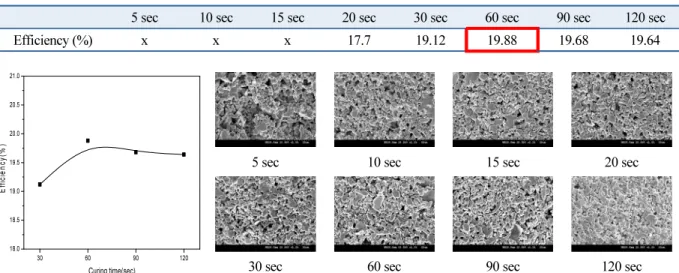
경화시간에 따른 접합특성 변화를 분석하기 위해 경화온도 150℃, 경화횟수 1회로 고정하고 5 ~ 120초의 경 화시간을 가변하여 실험을 진행하였다. 그 결과 경화시간 5초의 조건에서 분할 셀 간의 접합이 원활히 진행되지 않았다. 이는 Ag 입자들이 조밀한 형성을 이루지 못해 입자들 간 연결이 끊어졌기 때문이다. 10 ~ 15초의 경우 분할 셀 간의 접합이 이루어졌지만 스트링 연결 시 인두기-셀 간의 물리적인 장력이 발생하게 되어 접합부위가 벌어지는 문제가 발생하게 되었다. 경화시간 20초 이후부터는 접합이 원활히 진행 되었지만 20초 조건에서는 효율이 낮게 측정되었다. 경화시간 60초에서 19.88%의 가장 높은 효율을 보였으며, 이후의 경화시간 조건에서 효율이 점차 감소하는 경향이 보였다. 이는 시간이 지나면 지날수록 열이 계속 가해지면서 Ag입자에 열적 데미 지가 생겨 효율이 감소된 것을 알 수 있다
7)
. Table 2는 ECA B1의 경화시간 가변에 따른 효율을 나타낸 표이며, Fig. 1은 경화시간에 따른 FESEM 이미지와 효율그래프이다.Table 2
Efficiency changes with varying time of ECA B15 sec 10 sec 15 sec 20 sec 30 sec 60 sec 90 sec 120 sec
Efficiency (%) x x x 17.7 19.12 19.88 19.68 19.64
30 60 90 120
18.0 18.5 19.0 19.5 20.0 20.5 21.0
Efficiency(%)
Curing time(sec)
5 sec 10 sec 15 sec 20 sec
30 sec 60 sec 90 sec 120 sec
Fig. 1
Graph of efficiency change with varying time and surface structure SEM image of ECA B1(2) ECA B2
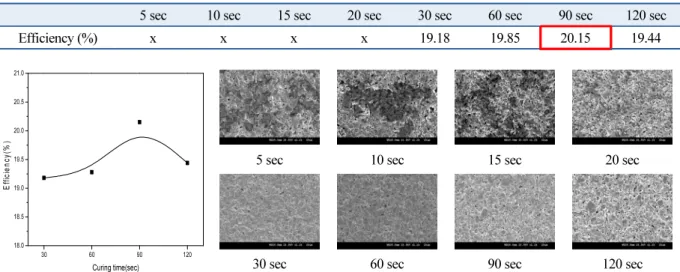
ECA B2의 특성을 분석하기 위해 경화온도 150℃, 경화횟수 1회로 고정하고 5 ~ 120초의 경화시간을 가변하 여 실험을 진행하였다. 경화시간 5초의 조건에서 경화시간이 짧아 분할 셀 간의 접합이 진행되지 않았다. ECA B2는 접합을 위한 최소온도가 높고, 경화시간이 오래 걸려 10 ~ 20초에서 접합이 원활히 진행되지 않았다. 경
화시간 30초 이후의 조건에서 셀 접합이 이루어졌으며, 경화시간 90초에서 20.15%의 가장 높은 효율을 보였다.
또한 120초의 조건에서는 90초의 조건에서 보다 낮은 효율을 보였다. 이는 경화시간이 길어져 열화 발생으로 인해 효율이 감소됨을 알 수 있다. Table 3은 ECA B2의 경화시간 가변에 따른 효율을 나타낸 표이며, Fig. 2는 경화시간에 따른 FESEM 이미지와 효율그래프이다.
Table 3
Efficiency changes with varying time of ECA B25 sec 10 sec 15 sec 20 sec 30 sec 60 sec 90 sec 120 sec
Efficiency (%) x x x x 19.18 19.85 20.15 19.44
30 60 90 120
18.0 18.5 19.0 19.5 20.0 20.5 21.0
Efficiency(%)
Curing time(sec)
5 sec 10 sec 15 sec 20 sec
30 sec 60 sec 90 sec 120 sec
Fig. 2
Graph of efficiency change with varying time and surface structure SEM image of ECA B2(3) ECA B3
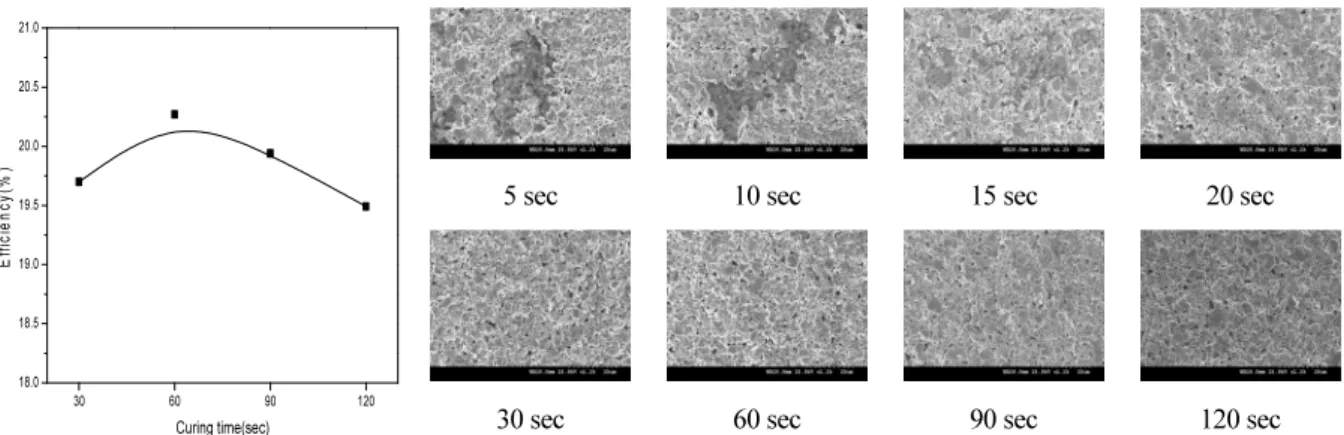
ECA B3의 특성을 분석하기 위해 경화온도 150℃, 경화횟수 1회로 고정하고 5 ~ 120초의 경화시간을 가변하 여 실험하였다. 경화시간 5초의 조건에서 셀 접합이 이루어지지 않았으며, 10 ~15초의 경화시간 조건의 경우 인두기-셀 간의 장력발생으로 인해 접합부분이 떨어지는 현상이 발생하게 되었다. 20초 이후 접합이 이루어졌 고, 60초의 조건에서 20.27%의 가장 높은 효율을 보였다. 이후 경화시간 조건에서 점점 효율이 감소하였다.
Table 4는 ECA B3의 경화시간 가변에 따른 효율을 나타낸 표이며, Fig. 3은 경화시간에 따른 FESEM 이미지와 효율그래프이다.
Table 4
Efficiency changes with varying time of ECA B35 sec 10 sec 15 sec 20 sec 30 sec 60 sec 90 sec 120 sec
Efficiency (%) x x x 19.43 19.7 20.27 19.94 19.49
30 60 90 120 18.0
18.5 19.0 19.5 20.0 20.5 21.0
Efficiency(%)
Curing time(sec)
5 sec 10 sec 15 sec 20 sec
30 sec 60 sec 90 sec 120 sec
Fig. 3
Graph of efficiency change with varying time and surface structure SEM image of ECA B33.2 ECA 경화온도 가변 실험
ECA B1, B2, B3의 경화시간을 효율이 가장 좋게 나온 조건 60초, 90초, 60초, 경화횟수 1회 조건으로 고정하 고 온도를 130 ~ 210℃로 20℃ 단위로 가변하여 실험을 진행하였다.
(1) ECA B1
경화온도 170℃의 조건에서 20.04%의 가장 높은 효율을 보였다. 이는 ECA B1에 함유된 윤활유가 원활하게 증발되어 Ag입자가 조밀하게 형성되었기 때문이다. 경화온도 190℃이후의 조건에서는 효율이 점차 줄어들었 다. 이는 높은 경화 열로 인한 열화현상으로 원활한 통전로가 형성되지 않아 효율이 감소하게 됨을 전기적 분석 결과 알 수 있다. Table 5는 ECA B1의 경화온도에 따른 접합 셀의 효율을 나타낸 표이며, Fig. 4는 경화온도에 따른 FESEM 이미지와 효율그래프이다.
Table 5
Efficiency changes with varying temperature of ECA B1130°C 150°C 170°C 190°C 210°C
Efficiency (%) 19.84 19.88 20.04 19.53 18.43
130 150 170 190 210
18.0 18.5 19.0 19.5 20.0 20.5 21.0
Efficiency (%)
Curing temperature ('C)
130°C 150°C 170°C 190°C 210°C
Fig. 4
Temperature specific efficiency graph and SEM images in ECA B1(2) ECA B2
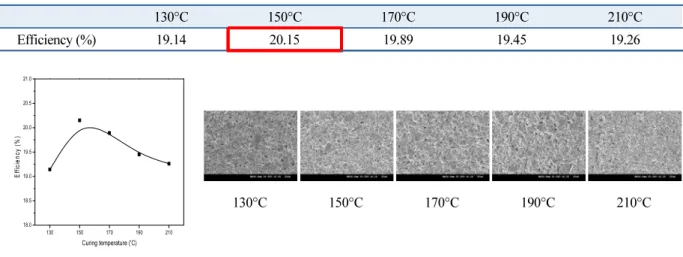
경화온도 150℃의 조건에서 20.15%의 가장 높은 효율을 보였다. 하지만 경화온도 170℃ 이상부터는 효율이 다시 감소하게 되었다. Table 6은 ECA B2의 경화온도에 따른 접합 셀의 효율을 나타낸 표이며, Fig. 5는 경화온 도에 따른 FESEM 이미지와 효율그래프이다.
Table 6
Efficiency changes with varying temperature of ECA B2130°C 150°C 170°C 190°C 210°C
Efficiency (%) 19.14 20.15 19.89 19.45 19.26
130 150 170 190 210
18.0 18.5 19.0 19.5 20.0 20.5 21.0
Efficiency (%)
Curing temperature ('C)
130°C 150°C 170°C 190°C 210°C
Fig. 5
Temperature specific efficiency Graph and SEM images in ECA B2(3) ECA B3
경화온도 150℃에서 20.27의 가장 높은 효율을 보였으며, 경화온도 210℃에서 19.31%의 가장 낮은 효율을 확인하였다. 170℃이상의 조건에서 은 입자 간 간격은 좁아졌으나 입자 사이에 균열이 생겨 효율 저하가 발생하 게 되었다. Table 7은 ECA B3의 경화온도에 따른 접합 셀의 효율을 나타낸 표이며, Fig. 6은 경화온도에 따른 FESEM 이미지와 효율그래프이다.
Table 7
Efficiency changes with varying temperature of ECA B3130°C 150°C 170°C 190°C 210°C
Efficiency (%) 19.67 20.27 19.64 19.43 19.31
130 150 170 190 210
19.2 19.4 19.6 19.8 20.0 20.2 20.4
Efficiency (%)
Curing temperature ('C)
130°C 150°C 170°C 190°C 210°C
Fig. 6
Temperature specific efficiency graph and SEM images in ECA B33.3 ECA 경화횟수 가변 실험
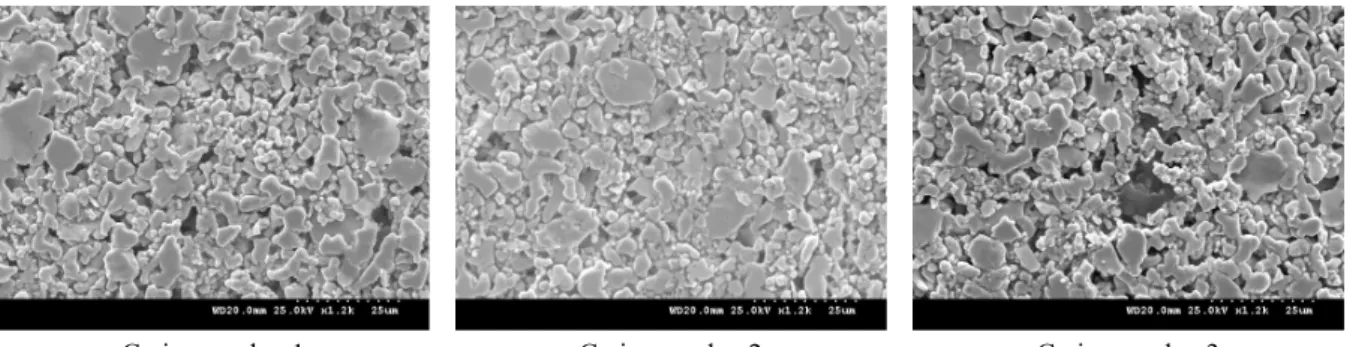
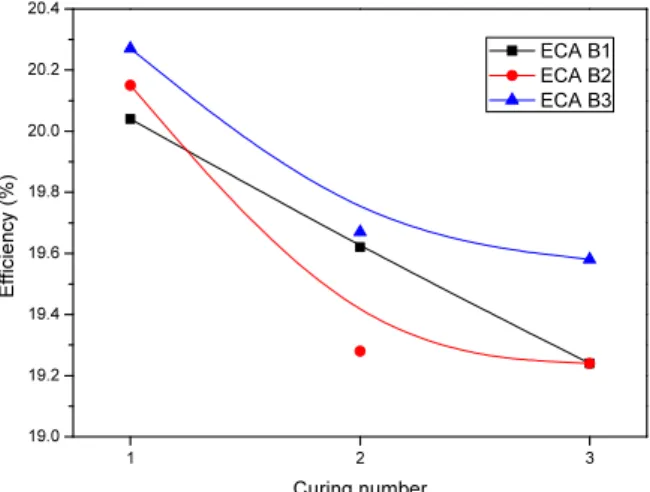
경화횟수 가변 실험 결과 ECA B1, B2, B3 모두 2차 경화에서부터 효율이 저하되었다. SEM이미지 분석을 통 해 경화횟수가 증가할수록 은 입자들이 조밀하게 형성되지 않은 것을 확인하였다. 이는 높은 열로 인한 열화현 상으로 ECA에 영향을 주어 효율이 낮아지는 것으로 판단하였다. Figs. 7, 8, 9는 각각 ECA B1, ECA B2, ECA B3,의 경화횟수 가변에 따른 FESEM 이미지 이며, Fig. 10은 조건에 따른 효율을 그래프로 나타낸 것이다.
Curing number 1 Curing number 2 Curing number 3
Fig. 7
Surface structure changes by varying number of curing in ECA B1Curing number 1 Curing number 2 Curing number 3
Fig. 8
Surface structure changes by varying number of curing in ECA B2Curing number 1 Curing number 2 Curing number 3
Fig. 9
Surface structure changes by varying number of curing in ECA B31 2 3 19.0
19.2 19.4 19.6 19.8 20.0 20.2 20.4
Efficiency (%)
Curing number
ECA B1 ECA B2 ECA B3
Fig. 10
Efficiency graph by varying number of curing4. 결 론
3가지의 ECA B1, B2, B3에 대하여 셀 접합 공정에서 경화시간, 경화온도, 경화횟수를 가변하여 실험을 진행 하였다. 모든 ECA 경화시간 조건에서 5 ~ 15초의 경화조건은 접합이 이루어지지 않거나 스트링 공정 시 인두 기-셀 간 장력으로 인해 ECA접합이 끊기는 현상이 발생하였다. 또한 경화시간을 효율이 가장 좋은 조건보다 길게 할수록 열화현상으로 인한 효율저하가 발생하였다. ECA B1은 경화시간 60초, 경화온도 170℃, 경화횟수 1회에서 20.04%의 효율을 보였으며, ECA B2는 경화시간 90초, 경화온도 150℃, 경화횟수 1회에서 20.15%의 효율을 보였다. ECA B2는 다른 ECA와 다르게 점도가 낮은 특성 때문에 비교적으로 경화시간이 더 길었다. 마 지막으로 ECA B3는 경화시간 60초, 경화온도 150℃, 경화횟수 1회에서 20.27%의 효율을 보였다. 따라서 각 ECA 소재 별 비교분석을 한 결과 ECA B3 소재가 ECA B1, B2 소재보다 shingled 구조를 가지는 태양전지 제작 에 적합한 소재임을 확인하였다.
후 기
본 연구는 한국전력공사의 2016년 선정 기초연구개발과제 연구비(R17XA05-1)와 산업통상자원부(MOTIE) 와 한국에너지기술평가원(KETEP)의 지원을 받아 수행한 연구 과제입니다(No.20193010014780).
REFERENCES