Korean J. Malacol. 31(4): 263-266 2015
- 263 -
사육 수온이 코끼리조개 Panopea japonica (A. Adams, 1850) 치패의 성장과 생존에 미치는 영향
남명모, 이주영, 이주, 강희웅, 김영대, 변순규, 유해균 국립수산과학원 동해수산연구소
Effect of Water Temperature Condition on Growth and Survival of Juvenile Geoduck (Panopea japonica A. Adams, 1850)
Myung-Mo Nam, JooYoung Lee, Chu Lee, Hee Woong Kang, Young Dae Kim, Soon-Gyu Byun and Hae-Kyun Yoo
East Sea Fisheries Research Institute NIFS, Gangneung 25435, Korea
ABSTRACT
This study was performed to determine the effect of water temperature condition on survival rate and growth of juvenile geoduck (Panopea japonica). Panopea japonica juveniles were bred for 6 weeks at 12, 15, 18, 21, 24 and 27℃ on incubator. Juveniles median lethal times (LT50) were 29 hours in 27℃, 14.5 day in 24℃, 37.4 day in 21℃.
Survival rate of water temperature 12, 15 and 18℃ showed a high survival rate in 95.0%, 95.0% and 93.3% at 6 weeks. As a result of culturing for 6 weeks at 12, 15, 18, 21 and 24℃, a daily growth of shell length and total weight was 0.10 mm, 0.12 mm, 0.13 mm, 0.16 mm and 0.14 mm, and 2.21 mg, 2.65 mg, 2.84 mg, 3.13 mg and 2.93 mg. Juvenile shell length and total weight have significantly increased at 15-21℃. However, mortality rate has significantly increased at more than 21℃. As a result, appropriate water temperature for juveniles culturing considered 15-18℃.
Key words: Juvenile geoduck, Panopea japonica, Culture, Water temperature, Median lethal time
서 론
코끼리조개 (Panopea japonica) 는 이매패강 (Bivalvia) 우럭목 (Myida) 족사부착쇄조개과 (Hiatellidae) 에 속하며, 일본 본토와 러시아 연해주, 사할린 쿠릴열도, 캄차카 연안 등 에 분포하고 우리나라에서는 동해 연안에서 출연하고 있다 (Nam et al., 2014). 코끼리조개는 잠입성 이매패류이며, 성 숙한 성체는 약 500g 내외로 크고 식용 가용부위가 55% 정도 로 많아서 상품가치가 높고 단백질이 풍부하여 양식 대상종으 로 개발 가치가 아주 큰 종이다 (You et al., 1993). 코끼리조
개는 서식 분포상 한해성 패류로서 우리나라에서는 동해의 울 진 이북에 제한되어 서식하며 산업적으로 가치가 커서 합리적 자원관리와 양식을 통해 지속적인 생산이 필요하다.
우리나라에서는 1980-90년대에 분사식 고압물펌프를 장착한 잠수기 어선에 의한 무분별한 남획으로 코끼리조개 자원이 급감 하여 2006년 이후 현재까지 생산량이 전무하며 수산자원 보호 를 위하여 4월 1일부터 7월 31일까지 채집이 금지되어있다.
코끼리조개류 (geoduck clam) 는 국외에서 1977년부터 채 취와 양식을 시작하여 생산량이 점차 늘어가고 있으며 소비증 가로 상품가치도 올라가고 있고 (Fig 1). 중국과 홍콩에서 80-90% 정도가 소비되고 있다 (Shamshak and King, 2015). 캐나다의 브리티시 컬럼비아주와 미국의 워싱턴주에서 는 P. generosa 종을 자연에서 대량 채취 및 대량양식하고 있 으며 (Beattie and Blake, 1999), 미국의 알레스카에서는 P.
abrupta 종을 제한적으로 채취하며, 멕시코의 캘리포니아 만 에서는 P. generosa와 P. globose를 채취하고, 뉴질랜드에서 는 P. zelandica를 채취하고 있다 (Andersen, 1971;
Beattie, 1992).
Received: November 16, 2015; Revised: December 22, 2015; Accepted: December 30, 2015
Corresponding author : Young Dae Kim
Tel: +82 (63) 2304-8504 e-mail: [email protected] 1225-3480/24593
This is an Open Access article distributed under the terms of the Creative Commons Attribution Non-Commercial License with permits unrestricted non-commercial use, distribution, and reproducibility in any medium, provided the original work is properly cited.
http://dx.doi.org/10.9710/kjm.2015.31.4.263
사육 수온이 코끼리조개 치패의 성장과 생존에 미치는 영향
- 264 - 코끼리조개에 대한 연구는 미국, 캐나다, 멕시코와 뉴질랜드 에서 분류와 생태, 생리, 발생, 종묘생산 등에 관한 연구가 1971년부터 진행되었으며 (Arney, 2013; Goodwin, 1973;
Goodwin et al, 1979; Marshall, 2012; Marshall et al., 2012), 국내에서는 1990년대에 서식환경과 성장, 유생의 생존 등에 대한 연구시도가 있었으나 (Kim et al., 1991; Lee, 1995, 1997; Lee and Rho, 1997; Lee et al., 1998, 1999) 그 이후 발생단계인 치패에 대한 연구는 전무한 실정이다.
본 연구에서는 동해안에 서식하는 코끼리조개를 대량 종묘 생산하기 위해 기초 연구로 사육 수온에 따른 치패의 생존율과 성장을 조사하였다.
재료 및 방법
1. 실험생물먹이 배양
코끼리조개의 먹이공급을 위하여 Isocrysis galbana와 Chaetoceros calcitrans를 배양하였다. 먹이의 배양을 위한 배지는 conwy medium를 사용하였다. 배지조성은 NaNO3
100 g, EDTA 45 g, H3BO3 33.6 g, NaH2PO4ㆍ2H2O 20 g, FeCl3ㆍ6H2O 1.3 g, MnCl3ㆍ4H2O 0.36 g, trace metal solution 1 ml, vitamin mix 100 ml에 final volume 1 L 로 사용하였다. 먹이생물은 19℃에서 배양하였다.
2. 실험생물 및 사육관리
본 실험에 사용된 코끼리조개는 강원도 속초에서 채집한 자 연산 코끼리조개 어미로부터 채란하여 동해수산연구소 강릉시 험포에서 콘크리트 사각수조 (5 ton) 에 수용하여 먹이생물을 1일 3회 공급하면서 3개월 동안 육성한 각장 7.1-7.6 mm (체
중 129.5-153.4 mg) 치패를 사용하였다.
실험에 사용한 치패는 외형적으로 건강한 개체를 현미경 (Carl zeiss, DE/STEMI 2000C) 과 저울 (CAS, CAY-120) 을 이용해 각장 및 체중을 측정 후 12, 15, 18, 21, 24 그리고 27℃로 설정한 인큐베이터 (EYELA, MTI-202) 에서 사육하 며 생존과 성장을 확인하였다. 각 실험구에는 치패를 20마리씩 3반복으로 수용하여 6주간 (42일) 사육하였으며, 먹이는 Isocrysis galbana와 Chaetoceros calcitrans를 1:1로 혼합 하여 5 x 10⁵ cell/ml로 1일 2회 공급하였고, 사육수는 동일한 수온으로 1일 50%를 환수하고 1주 간격으로 전량 환수하였다.
결과 및 고찰
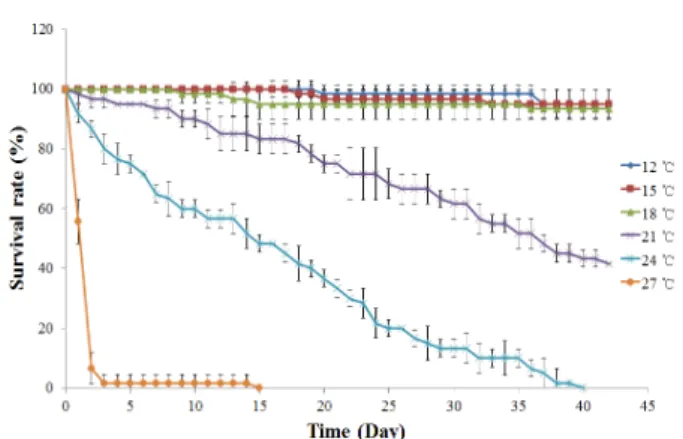
코끼리조개 치패의 적정 사육수온을 구명하기 위하여 12, 15, 18, 21, 24 그리고 27℃에서 6주간 사육한 결과 생존율은 Fig.
2와 같았다. 수온 27℃에서 반치사시간 (median lethal time, LT50) 은 29시간이었으며, 48시간 후에는 20 개체 중에서 평 균 4 개체가 생존하여 생존율이 6.7%로 떨어졌고, 72시간 후에 는 단 한 실험구에서 1 개체만 생존하였으며 이 개체는 15일 째 에 폐사하였다. 그리고 24℃에서 반치사시간 (LT50) 은 14.5일 이었으며, 20일 후에는 평균 7.3 개체가 생존하여 생존율이 36.7%로 떨어졌고, 38일 후에는 단 한 실험구에서 1 개체만 생 존하였으며 이 개체는 40일 째에 폐사하였다.
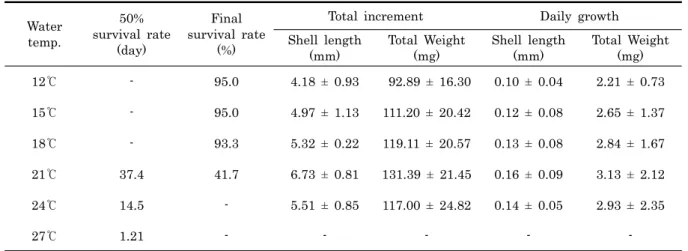
수온 21℃ 실험구에서 반치사시간은 37.4일이었으며, 20일 후에는 평균 15.0 개체가 생존하여 생존율이 75.0%로 떨어졌 고, 실험종료시점인 42일 째에는 평균 8.3 개체만 생존하여 최 종생존율이 41.7%로 낮았다. 그러나 수온 12℃, 15℃, 18℃
에서는 최종생존율이 각각 95.0%, 95.0%, 93.3%로 90% 이 상의 높은 생존율을 나타내었다 (Fig. 2, Table 1).
각 사육수온에서 각장과 체중의 일간성장률은 12℃에서는 0.100 mm, 2.212 mg, 15℃에서는 0.118 mm, 2.648 mg, Fig. 1. World production and value of geoduck by country,
1976–2012 (Shamshak and King, 2015). BC = British Columbia, WA = Washington, CA = Canada, US = United States.
Fig. 2. Comparative analysis of the survival rate according to the water temperature of the juvenile Panopea japonica.
Korean J. Malacol. 31(4): 263-266 2015
- 265 - 18℃에서는 0.127 mm, 2.836 mg, 21℃에서는 0.160 mm, 3.128 mg, 그리고 24℃에서는 0.138 mm, 2.925 mg으로 성 장하였다 (Fig. 3, 4, Table 1).
일반적으로 조개류의 인공종묘생산에서 중요한 환경요인은 수질, 수온, 먹이, 수용밀도 등 이다. 이중에서 가장 성장에 가 장 영향을 미치는 요인은 수온이다 (Lee, 1999; Kim et al., 2012). Lee (1999) 가 코끼리조개의 부화 유생을 대상으로 수 온에 따른 유생의 생존율을 보고하였으나 그 이후 치패 단계의 연구는 전무한 실정이다. 코끼리조개 유생은 채란 3-4주 후에 패각 끝부분에 족사가 발달하여 움직이는 변태기를 거치면서 바닥으로 내려가서 모래에 잠입하여 성장한다 (Nam et al., 2014). 부유유생이 모래에 잠입하여 안정적으로 성장하는 치 패 단계의 연구는 코끼리조개의 종묘를 대량생산하는 과정에 서 매우 중요하다.
코끼리조개가 자연 서식하고 있는 강원도 양양 연안의 경우 수심 25-30 m의 수온이 5.6-17.5℃로 알려져 있다 (Lee et al., 1998). 코끼리조개의 부화 유생의 경우 Lee and Rho
(1997) 는 수온 17℃에서는 성숙유생기 (full-grown stage) 까지 도달하지 못하고 전량 폐사한다고 하였으며, Lee et al.
(1999) 은 17℃에서 부화 후 13일 만에 전량 폐사하며, 14℃
에서는 21일간 생존율이 16.2%이고, 8℃에서는 21일 째 생존 율이 6.9%로 현저히 낮아진다고 보고하였다. 그러나 Nam et al. (2014) 은 수온 19℃에서도 정상적으로 난발생, 부화 및 유생사육이 가능하다고 하였다. 본 연구결과, 코끼리조개 치패 에서 수온 18℃에서도 생존 (생존율 93.3%) 및 성장이 양호한 것으로 확인되었다. 이는 치패 적정사육을 위한 한계 수온이 Nam et al. (2014) 의 유생 사육 수온과 유사한 것으로 나타 났다.
본 연구에서 12-21℃ 구간에서는 수온이 높아짐에 따라서 각장과 체중의 증가가 빨랐으며, 특히 15-21℃에서 각장과 체 중의 성장이 좋았다. 그러나 21℃ 이상의 고수온에서는 Fig. 2 에서와 같이 폐사가 현저하게 증가하므로 치패 사육수온은 15-18℃가 적정한 것으로 판단된다.
Water temp.
50%
survival rate (day)
Final survival rate
(%)
Total increment Daily growth
Shell length (mm)
Total Weight (mg)
Shell length (mm)
Total Weight (mg)
12℃ - 95.0 4.18 ± 0.93 92.89 ± 16.30 0.10 ± 0.04 2.21 ± 0.73
15℃ - 95.0 4.97 ± 1.13 111.20 ± 20.42 0.12 ± 0.08 2.65 ± 1.37
18℃ - 93.3 5.32 ± 0.22 119.11 ± 20.57 0.13 ± 0.08 2.84 ± 1.67
21℃ 37.4 41.7 6.73 ± 0.81 131.39 ± 21.45 0.16 ± 0.09 3.13 ± 2.12
24℃ 14.5 - 5.51 ± 0.85 117.00 ± 24.82 0.14 ± 0.05 2.93 ± 2.35
27℃ 1.21 - - - - -
Table 1. Effect of culture temperature on survival rate, total increment and daily growth in Panopea japonica
Fig. 3. Shell length change of juvenile Panopea japonica accorting to water temperature.
Fig. 4. Weight change of juvenile Panopea japonica accorting to water temperature.
사육 수온이 코끼리조개 치패의 성장과 생존에 미치는 영향
- 266 - 요 약
본 연구는 동해안산 코끼리조개 (Panopea japonica) 를 대 량 종묘생산하기 위한 기초 연구로 사육 수온에 따른 치패의 생존율과 성장에 대해 조사하였다.
코끼리조개 치패는 외형적으로 건강한 것을 선별하여 12, 15, 18, 21, 24 그리고 27℃로 설정한 인큐베이터에에서 6주 간 생존과 성장을 조사하였다. 수온별 반치사시간 (median lethal time, LT50) 은 27℃에서 29시간, 24℃에서 14.5일, 21℃에서 37.4일이었으며, 수온 12℃, 15℃, 18℃에서는 42 일간 생존율이 95.0%, 95.0%, 93.3%로 높았다. 사육 실험기 간 동안 수온별 각장과 체중의 일간성장률은 12℃에서는 0.100 mm, 2.212 mg, 15℃에서는 0.118 mm, 2.648 mg, 18℃에서는 0.127 mm, 2.836 mg, 21℃에서는 0.160 mm, 3.128 mg, 그리고 24℃에서는 0.138 mm, 2.925 mg이었다.
12-21℃ 구간에서는 수온이 높아짐에 따라서 각장과 체중의 증가가 빨랐으며, 특히 15-21℃에서 각장과 체중의 성장이 좋 았다. 그러나 21℃ 이상의 고수온에서는 폐사가 현저하게 증가 하므로 치패 사육을 위한 수온은 15-18℃가 적정한 것으로 판 단된다.
감사의 글
이 논문은 2 015년도 국립수산과학원 수산과학연구사업 (R2015012) 의 지원으로 수행된 연구이며 연구비 지원에 감 사드립니다.
REFERENCES
Andersen, A. (1971) Spawning, growth and spatial distribution of the geoduck clam, Panopea generosa (Gould) in Hood Canal. Thesis (Ph. D.). University of washington. United States of America.
Arney, B.D. (2013) Thermal and dietary optimization in the hatchery culture of juvenile pacific geoduck clams (Panopea generosa, Gould 1850). Thesis (MS).
University of British columbia. Canada.
Beattie, J.H. (1992) Geoduck enhancement in Washington State. Bulletin of the Aquaculture Association of Canada, 92: 18–24.
Beattie, J.H. and Blake, B. (1999) Development of culture methods for the geoduck clam in the USA (Washington State) and Canada (British Columbia).
World Aquaculture, 30: 50–53.
Goodwin, C.L. (1973) Effects of salinity and temperature on embryos of the geoduck clam (Panopea generosa Gould). Proceedings of the National Shellfisheries Association, 63: 93-95.
Goodwin, C.L., Shaul, W. and Budd, C. (1979) Larval
development of the geoduck clam (Panope generosa, Gould). Proceedings of the National Shellfisheries Association, 69: 73–76.
Kim, H.S., Park, Y.J., Kim, W.K., and Chang, J.W.
(1991) Studies on ecology and growth of Panope japonica in shore of Kangwon Province, Korea.
Bulletin of National Fisheries Research and Development Agency, 45: 269-282. [in Korean]
Kim J.M., Kim S.C., Hur J.W., Lim S.M., Kim Y.H., Deon S.C., and Kang K.H.. (2012) Effect of water temperature on the larval development and spat growth of the cockle shell, Fulvia mutica. The Korean Journal of Malacology, 28(1): 7-12. [in Korean]
Lee, C.S. (1995) Studies on artificial reproduction of the Pacific geoduck Panopea generosa. Ph. D. thesis, Cheju National University, Korea. pp. 109. [in Korean]
Lee, C.S. (1997) Studies on feeding activity and environmental tolerance of geoduck clam, Panopea generosa. Journal of Aquaculture, 10(2): 213-218. [in Korean]
Lee, C.S., Baik K.K., and Hong, K.E. (1998) Ecological studies on the habitat of geoduck clam, Panope japonica. Journal of Aquaculture, 11(1): 105-111. [in Korean]
Lee, C.S., Park, Y.J., Hong, K.E., and Kim, Y.D., (1999) Influence of water temperature and stocking density on the growth and survival rate of geoduck clam, Panope japonica larvae. Bulletin of the National Fisheries Research. [in Korean]
Lee, C.S. and Rho, S. (1997) Studies on the artificial seedling production of geoduck clam, Panope japonica. II. Development of egg and larvae. Journal of Aquaculture, 10: 25-32. [in Korean]
Nam, M.M., Lee, C., Kim, M., Kim, J.W. and Kim, Y.D., (2014) Development and growth in fertilized eggs and larvae of the Japanese geoduck, Panopea japonica reared in the laboratory. The Korean Journal of Malacology, 30: 303–309.
Marshall, R., McKinley, R.S. and Pearce, C.M. (2012) Effect of temperature on gonad development of the Pacific geoduck clam (Panopea generosa Gould, 1850).
Aquaculture, 338–341: 264–273.
Marshall, R. (2012) Broodstock conditioning and larval rearing of the geoduck clam (Panopea generosa Gound, 1850). Thesis (Ph. D.) University of British columbia. Canada.
Shamshak, G.L., King, J.R., (2015) From cannery to culinary luxury : The evolution of the global geoduck market. Marine Policy, 55: 81–89.
You, B.J., Jeong, I.H., Lee, K.H. and Choi, H.G. (1993) Quality and stability of frozen geoduck (Panope japonica A. Adams). Bulletin of the Korean Fisheries Society, 26(6): 549-556.