코끼리조개,
Panopea japonica
(A. Adams) 의 수정란 발생과 유생 성장남명모, 이주, 김미경, 김재원1, 김영대
국립수산과학원 동해수산연구소, 1강원도립대학 해양생명과학과
Development and growth in fertilized eggs and larvae of the Japanese geoduck, Panopea japonica reared in the laboratory
Myung-Mo Nam, Chu Lee, MeeKyung Kim, Jae Won Kim1 and Young Dae Kim East Sea Fisheries Research Institute NFRDI, Gangneung 210-861, Korea
1Dept. Marine Life Science and Aquaculture, Gangwon Provincial College, Gangneung 210-804, Korea
ABSTRACT
The development of Japanese geoduck, Panopea japonica, grown under culture conditions, has been examined through the morphological characteristics in fertilized egg, larvae and juvenile. Gametes were stripped from ripe broodstock and placed into two separate containers. Eggs were washed through a 40 μm sieve and fertilized with dilute sperm solution. Developing larvae were maintained at 19 ± 1℃. Fertilized eggs with 81.6 μm diameter developed to trochophores within 14 h and to D-stage larvae (116 μm shell length) within 27 h. Larvae were spontaneously settled at shell length of 311 μm after 20 days. The hatching from fertilized eggs and larval rearing were normally available in 18.5-21.5℃, and the growth was good in a cashmilon substrate, as well as sand. After rearing of day 108 from metamorphosis, the shell length of juvenile P. japonica reached 13 mm, and growth rate of shell length of the juvenile was 117.5 μm/d.
Key words: Geoduck, Development, Growth, Fertilized egg, Larvae, Juvenile, Panopea japonica
서 론
코끼리조개 (Panopea japonica, Japanese geoduck) 는 이매패강 우럭목 (Myoida) 족사부착쇄조개과 (Hiatellidae) 에 속하며, 일본 본토의 세토 (瀨戶) 내해, 홋카이도, 러시아 연 해주, 사할린, 쿠릴열도, 캄차카 연안 등에 분포하며, 우리나라 에서는 동해연안 울진 이북인 죽변, 강릉, 고성 연안에서 출현 하고 있다 (Habe, 1955; Okutani, 2000; Min et al., 2004).
코끼리조개는 수심 10-50 m의 저층 뻘이나 모래 속에서 서식 하는 500 g 내외 (각장 13-16 cm, 300-800 g) 의 대형패류
(Min et al., 2004) 로서 성숙한 개체는 식용가식부가 55% 내 외로 많고 향과 맛이 좋을 뿐만 아니라 단백질이 풍부하여 양 식 대상종으로 개발 가치가 아주 큰 종이다.
우리나라에서는 1980-90년대에 분사식 고압펌프를 장착한 잠수기 어선에 의한 무분별한 남획으로 자원이 급감하여 2006 년 이후 현재까지 생산량이 전무하며, 강원도와 경상북도 지역 에서는 수산자원 보호를 위하여 4월 1일부터 7월 31일까지 채 취를 금지하고 있는 실정이다.
코끼리조개류 (geoduck clam) 에 대한 연구로는 우리나라 코끼리조개와 유사하며 알래스카, 캐나다 및 캘리포니아에 주 로 서식하는 Pacific geoduck인 Panopea generosa (Goodwin, 1973, 1976; Goodwin, et al., 1979; Bennett, et al., 1982; Shaul and Goodwin, 1982; Breen and Shields, 1983; Harbo et al., 1983; Vadopalas et al., 2010; Liu et al., 2013) 와 Panopea abrupta (Bureau, et al., 2003; Campbell and Ming, 2003; Campbell et al., 2004) 를 대상으로 분류, 생태, 생리, 난발생, 종묘생산 등에 대한 연구가 있으며, Panopea globosa (Aragón-Noriega et Received: October 14, 2014; Revised: December 20, 2014;
Accepted: December 24, 2014
Corresponding author : Young Dae Kim Tel: +82 (33) 660-8546 e-mail: [email protected] 1225-3480/24542
This is an Open Access article distributed under the terms of the Creative Commons Attribution Non-Commercial License with permits unrestricted non-commercial use, distribution, and reproducibility in any medium, provided the original work is properly cited.
al., 2007) 에 대한 산란 및 난발생, New Zealand geoduck 인 Panopea zelandica (Gribben and Hay, 2003;
Gribben, et al., 2004; Gribben and Creese, 2005) 에 대 한 생태, 생리 및 종묘생산에 대한 연구가 있다.
코끼리조개에 대한 연구로는 일본에서 분포와 어업실태에 대한 보고가 있으며 (Lee et al., 1997), 우리나라에서는 연간 1-176톤이 채취되던 1990년대에 서식환경과 성장에 관한 연 구가 있었고 (Kim et al., 1991), Lee (1995) 가 번식생물학 적 연구, 종묘생산 (Lee and Rho, 1997; Lee et al., 1997), 섭식활동 및 환경내성 (Lee, 1997), 서식생태 (Lee et al., 1998) 에 대한 연구가 있다. 그러나 그 후 코끼리조개에 대한 연구는 지속되지 않았으며 체계적인 종묘생산기술도 확립되지 못하였다.
본 연구에서는 코끼리조개에 대한 대량 인공종묘생산 및 씨 뿌림으로 자원확대를 추진하기 위한 기초연구로서 수정란 및 유생의 발달에 대한 연구를 수행하였다.
재료 및 방법
1. 어미 확보 및 채란
실험에 사용한 재료는 채포허가를 받아 2014년 4-5월에 경 북 울진연안 (37°06′N, 129°23′E) 에서 채집하였으며, 서 식지 수심 및 수질은 다항목수질측정기 (YSI6600E) 를 사용 하여 측정하였다. 채집시에는 분사식 고압펌프를 장착한 선박 을 이용하여 잠수부가 수심 20-25 m에서 모래를 분사하여 흩 어낸 후 한 마리씩 채취하였으며, 채집된 코끼리조개는 아이스 박스에 담아서 공기를 주입하며 신속히 실험실로 옮겨 18℃
사육수조에 수용하고, Phaeodactylum tricornutum, Isochrysis galbana, Pavlova lutheri, Chaetoceros calcitrans를 혼합하여 40,000-60,000 cells/ml로 1일 2회 (9:00, 16:00) 공급하였다. 먹이 섭식율을 높여주기 위해 먹이 를 공급한 후에는 유수식인 사육수를 2시간 동안 정지시켜 주 었다. 모패 측정에는 암수 각 50마리를 사용하였으며, 성패의 생식소 중량 지수 (GSI) 는 (생식소중량/육중량) x 100으로 산 출하였다.
코끼리조개의 채란은 5월 20일부터 6월 3일까지 4회에 걸 쳐 실시하였다. 코끼리조개는 자웅이체이지만 외부의 형태나 성숙기의 생식소를 육안으로는 암수의 구별이 불가능하며, 생 식소 부분이 흰색이거나 옅은 황색을 띠는 30 g 정도의 탁구 공 모양의 둥근형으로서 내부에 위, 장, 당면체낭, 반투명한 젤 라틴모양의 당면체 (crystalline style) 등이 한 덩어리로 뭉쳐 져 있어 압착채란이 불가능하였다. 따라서 생식소 조직을 현미 경으로 암수를 구분한 한 후에 생식소를 칼로 잘게 절개하여 채란, 채정하고 수정시켰다. 암수 생식소는 10:1의 비율로 사
용하였으며, 수정 20분 후 세란을 실시하고 수정 후 2세포기로 난할이 이루어진 수정란을 계수하여 수정률로 판정하였다.
2. 수정란 발생 및 유생 사육
수정된 알은 망목 18 μm의 뮬러가제로 수거하여 수온 18℃
로 조절된 수조에 수용하여 부화시키며 관찰하였다. 수정란의 발생과정을 조사하기 위하여 비이커에 ml당 1,000개의 수정 란을 수용하고 발생단계를 광학현미경을 사용하여 30분 간격 으로 관찰하고 촬영하였다. 유생사육을 위해 황갈편모조류인 Isochrysis galbana와 Pavlova lutheri, 그리고 규조류인 Chaetoceros calcitrans를 1일 4회 (08:10, 11:20, 14:30, 17:40) 공급하였고, 착지기 이후에는 1일 3회 (9:00, 13:00, 17:00) 공급하였으며 공급밀도는 60,000-70,000 cells/ml 이 었다. 먹이생물 배양을 위하여 자외선 살균기로 멸균한 해수를 1 μm 여과기를 통과시켜 사육수로 사용하였다. 유생의 발생 단계별 소요시간은 검경된 유생의 50% 이상이 발생단계에 도 달하는 것으로 하였고 D상 유생의 생존율은 수온별로 섬모로 유영하는 개체를 완전하게 변태하였다고 판단하여 생존율로 계수하였다.
3. 채묘기질에 따른 채묘 및 성장
기질에 따른 부유유생의 착지 후 채묘효율과 성장을 조사하 기 위하여 500 liter 원형 PP수조의 바닥에 모래, 캐시미론 (cashmilon) 재질의 매트, 그리고 합성섬유망을 깔고 채묘를 실시하였다. 모래는 10 cm 깊이로 깔고 캐시미론과 합성섬유 망은 5 cm 두께를 사용하였으며, 각 수조에는 부착기 유생 60,000개체를 수용하였다. 환수는 착지기까지는 매일 사육수 조수의 1/2을 여과수로 교환하였으며, 바닥에 착지한 후에는 유수식으로 사육하였다. 실험 결과는 one-way ANOVA-test 를 실시하였으며, 평균 간의 유의성 (P < 0.05) 을 분석하기 위해 Duncan's multiple range test (Duncan, 1955) 를 실 시하였다. 또한 모든 통계 분석은 SPSS program (Ver.
14.0) 으로 검정하였다.
결과 및 고찰
1. 모패의 서식환경, 크기 및 생식소 지수
코끼리조개 채집지의 수심은 20-25 m, 수온 10.1-10.3℃, pH 8.0-8.1, 염분 33.9 ppt 이었으며, 저질은 미세사질 (0.062-0.125 mm) 54.2%, 세사질 (0.125-0.250 mm) 33.7%, 기타 12.1%로 이루어져 있었다. 서식장소에는 모래에 잠입 후 수관부 (siphon) 를 위로하여 바닷물을 빨아들이고 내 뿜은 모래 속 잠입흔적이 있었으며, 산란기에는 이것이 더욱 뚜렷하였다 (Fig. 1).
코끼리조개 모패의 계측 및 계량 형질을 측정한 결과, 평균 각장 105.6 ± 7.6 mm, 각고 66.7 ± 4.4 mm, 각폭 59.9 ± 4.8 mm, 전중량 362.0 ± 90.1 g, 생식소 31.0 ± 8.7 g 이었 으며, 생식소 중량 지수 (GSI) 는 암컷 21.6 ± 3.6 (14.3-28.9), 수컷 21.4 ± 3.4 (14.5-26.6) 로서 암수 간에 유 의적인 차이가 없었으며 형태나 색깔에서도 구분이 어려웠다 ( Fig. 2). Kim et al.(1991) 은 1월에 GSI가 19.0으로 연중 최 고이고 산란기는 1-4월, 주산란기는 3-4월이라고 하였으나 본 조사에서는 5월 20일부터 채란이 가능하였으며 6월 24일까지 채란할 수 있었다.
우리나라에서 코끼리조개는 1985년부터 동해안 어민들에 의해 발견된 후 말조개 또는 왕우럭조개로 잘못 불러왔으나
1987년에 국립수산진흥원에서 코끼리조개로 기록하였다 (Kim et al., 1991; Lee and Rho, 1997; Lee et al., 1998).
그러나 경북 울진 현지에서 확인한 결과 어획은 1974년부터 시작하였으며, 영덕군 병곡 연안에서도 많은 양을 어획하였다 고 하므로 이곳이 우리나라 코끼리조개 서식지의 남방한계로 여겨진다.
2. 수정란 발생 및 유생 성장
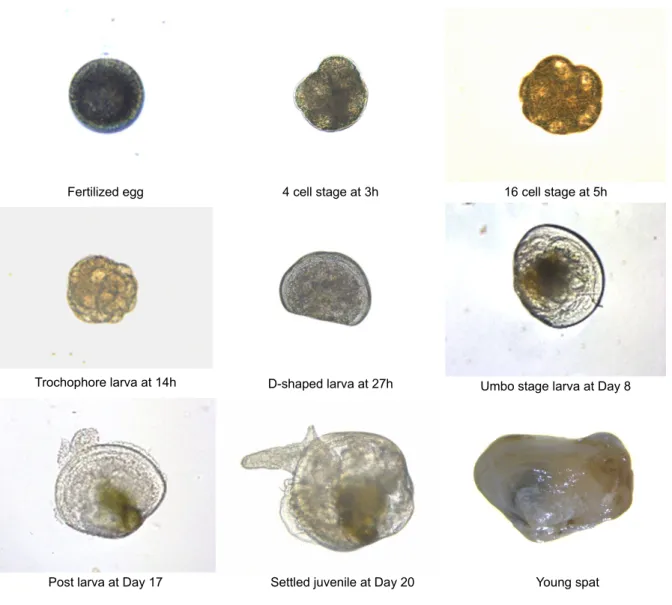
코끼리조개 난은 분리침성란으로 난경 80.2-82.9 (평균 81.6) μm 이었으며, 수정란은 수온 19℃에서 2시간이 지나 면 2세포기로 되고, 수정 3시간 후 4세포기, 4시간 후 8세포 기, 5시간 후 16세포기, 8시간 후 포배기가 되었다. 수정 후 14시간이 지나면 담륜자 유생이 되어 부상하였으며, 수정 27 시간 후에는 경첩모양의 D상 유생 (D-shaped larvae) 으로 발달하였고, 8일 후에는 각정기 (umbo stage)가 되고, 17일 째부터는 족사가 나타나기 시작하였다 (Fig. 3, Table 1).
D상 유생은 각장 116.4 ± 3.77 μm, 각고 96.8 ± 3.46 μm 이었고, 족사가 나타난 수정 18일 후의 유생 크기는 각장 291.4 ± 6.23 μm, 각고 255.1 ± 5.76 μm이었으며, 바닥에 안착한 수정 20일 후의 유생은 311.2 ± 7.71 μm, 각고 282.2 ± 8.54 μm 이었다 (Table 2).
Lee and Rho (1997) 는 코끼리조개 수정란의 난경이 70 μm라고 하였으나 본 조사에서는 평균 81.6 μm로서 컸다.
이는 동일한 속의 Panopea zelandica 77 μm (Gribben and Hay, 2003) 와 P. abrupta 82 μm (Goodwin et al. 1979) 와 크기가 비슷하였다.
코끼리조개의 D상 유생 크기 (116 μm) 는 Lee and Rho (1997) 의 보고 (110 μm) 와 비슷하였으며, Panopea Fig. 1. Outline appearance of Panopea japonica infiltrated in
the sand area located in the coast of Uljin, Gyeongbuk province.
Outline shape of male gonad Outline shape of female gonad Fig. 2. Gonad of male and female in Panopea japonica collected from the coast of Uljin, Gyeongbuk province.
Stages Lee (1997) This study
8℃ 11℃ 14℃ 17℃ 19℃
fertilized eggs 0 0 0 0 0
2 cells 2 hr. 2 hr.
4 cells 4 hr. 3 hr.
8 cells 21.2 hr. 9 hr. 5.4 hr. 4.3 hr. 4 hr.
16 cells 15 hr. 5 hr.
Blastula 46.0 hr. 23 hr. 18.7 hr. 12.3 hr. 8 hr.
Trochophore 87.3 hr. 2 day 33.8 hr. 23.6 hr. 14 hr.
D-shaped larvae 122.6 hr. 3 day 62.4 hr. 42.7 hr. 27 hr.
Umbo stage 23 day 8 day
Full-grown stage 36 day 18 day
Table 1. Comparison of elapsed time from fertilized eggs to full-grown larvae in each development stage of Panopea japonica
Fertilized egg 4 cell stage at 3h 16 cell stage at 5h
Trochophore larva at 14h D-shaped larva at 27h Umbo stage larva at Day 8
Post larva at Day 17 Settled juvenile at Day 20 Young spat Fig. 3. Developmental process of Panopea japonica reared in the laboratory.
zelandica (105 μm) 및 P. abrupta (122 μm) 와도 유사 한 경향을 보였다 (Goodwin et al. 1979; Gribben and Hay, 2003). D상 유생기에서 각정이 조금씩 돌출하여 각정기 유생으로 되며, 그 후 족사를 내고 바닥에 착지하여 종의 고유 한 생활로 이행할 수 있는 성숙기 (full-grown stage) 유생으 로 변한다. 코끼리조개 유생이 변태기 (metamorphosis) 까지 도달하는 일수 (18일) 와 그 크기 (291.0 μm) 는 P.
generosa (17 ± 1℃, 20일, 380 μm) 및 P. zelandica (17
± 1℃, 16일, 247 μm) 와는 비슷하지만, P. abrupta (17℃, 25일, 350 μm) 보다는 소요일수가 다소 빨랐다 (Table 3).
Lee and Rho (1997) 는 코끼리조개 유생은 17℃에서는 성 숙유생기 (full-grown stage) 까지 도달하지 못하고 전량 폐 사한다고 하였으나 본 조사에서는 19℃에서도 정상적으로 난 발생, 부화 및 유생사육이 가능하여 차이가 있었다.
3. 채묘기질에 따른 채묘 및 치패 성장
코끼리조개의 부유유생은 성장함에 따라 족사를 내어 유영 생활을 마치고 고형물에 일시적으로 부착한 후에 바닥에 가라 앉아서 저서생활을 하게 된다. 착지는 수정 후 18-22일에 대부 분 이루어졌으며 이때 각장 크기는 291-336 μm였다.
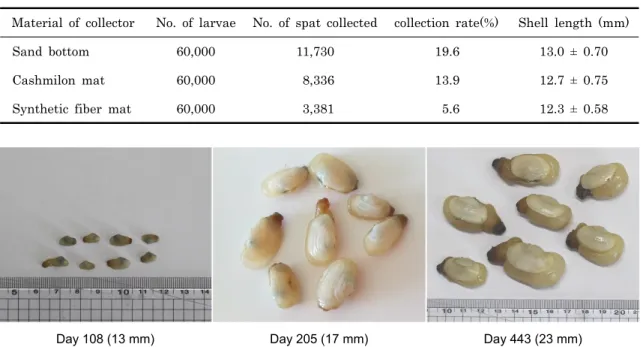
부유유생을 채묘용 수조에 수용한 후 110일간 사육하여 채 묘기질에 따른 성장과 채묘효율을 조사한 결과 모래 바닥에서 는 각장 평균 13.0 ± 0.70 mm, 채묘율 19.6%로 가장 양호하 였으며, 캐시미론 바닥에서도 각장 평균 12.7 ± 0.75 mm, 채 묘율 13.9%로 양호한 편이었으나 합성섬유그물에서는 각장 평균 12.3 ± 0.58 mm, 채묘율 5.6%로 불량하였다 (Table 4). 수조바닥에 가는 모래를 깔아 채묘하는 경우에는 성장 및 채묘율은 좋으나 시간이 지나면서 모래 바닥이 썩을 수 있어 모래를 교체하여 주는 노력이 필요하다. 그러나 캐시미론에서 는 사육관리가 용이하므로 종묘를 대량생산하고자하는 경우에
Species Initial juveniles
Author Period(days) Size (μm)
Panopea japonica 18 291 This study
P. zelandica 16 247 Gribben and Hay (2003)
P. generosa 20 380 Liu et al., (2013)
P. abrupta 25 350 Goodwin et al. (1979)
Paphies australis 22 234-254 Hooker (1997)
P. subtriangulata 17 230 Redfearn (1987)
Table 3. Advent period and size of initial juveniles in infaunal geoduck species
Period Stage Mean length (μm) Mean height (μm) n
Day 0 Eggs 81.6 ± 6.64 - 25
Day 1 Trochophore 87.0 ± 6.42 82.5 ± 5.51 20
Day 2 120.6 ± 6.32 94.6 ± 4.84 24
Day 3 D-shaped larvae 116.4 ± 3.77 96.8 ± 3.46 26
Day 4 144.2 ± 4.77 118.8 ± 4.21 26
Day 6 157.8 ± 6.74 134.9 ± 3.78 21
Day 8 Umbo stage 173.7 ± 5.18 145.6 ± 4.42 23
Day 10 193.5 ± 4.30 167.2 ± 3.98 20
Day 12 219.4 ± 3.62 175.1 ± 5.78 28
Day 14 244.2 ± 5.12 216.3 ± 6.33 26
Day 16 269.0 ± 7.10 232.8 ± 4.92 22
Day 18 Full-grown stage 291.4 ± 6.23 255.1 ± 5.76 23
Day 20 311.2 ± 7.71 282.2 ± 8.54 25
Day 22 336.1 ± 8.75 291.2 ± 7.91 25
Table 2. Mean of shell length and shell height (± standard error) in Panopea japonica from fertilized eggs to full-grown larvae. (n = number of eggs, trochophores, and veliger larvae measured at each rearing population)
활용가치가 있다고 판단된다.
부유유생이 착저한 6월 19일부터 10월 6일까지 모래 바닥 수조에서 108일간 사육한 결과 각장 13.0 ± 0.7 mm, 각고 7.9 ± 0.42 mm, 각폭 5.7 ± 0.54 mm, 전중량 0.4 ± 0.10 g 으로 성장하였으며, 일간성장률은 각장 117.5 μm, 각고 70.8 μm 이었다. 사육수는 자연해수로서 수온 18.5-21.5℃였다.
한편 2013년 5월에 생산한 종묘도 2014년 10월 6일에 각장 23.2 ± 1.2 mm, 각고 15.1 ± 1.07 mm, 각폭 14.5 ± 1.96 mm, 전중량 5.3 ± 1.29 g으로 성장 (Fig 4) 하여 자연해수로 연중 실내육성이 가능한 것으로 확인되었다.
요 약
코끼리조개의 대량 인공종묘생산을 추진하기 위한 기초연 구로서 수정란, 유생 및 치패의 발달을 조사하였다. 생식체는 잘 성숙한 어미에서 추출하여 희석 정자 용액으로 수정하였 으며, 발생유생은 수온 19 ± 1℃로 유지하였다. 수정란의 난 경은 평균 81.6 μm 이었으며, 수정 후 14시간 만에 담륜자 유생이 되어 부상하고, 27시간 만에 D상 유생 (각장 116 μm) 으로 발달하고, 20일 후에는 각장 311.2 μm로 성장하여 바 닥에 안착하였다. 18.5-21.5℃에서 정상적으로 부화 및 유생 사육이 가능하였으며, 채묘기질은 모래가 우수하였으나 캐시 미론도 양호하였다. 부유유생이 착저한 후 108일간 사육한 결과 각장 13 mm, 전중량 0.4 g으로 성장하였고 일간성장률 은 각장 117.5 μm 이었으며, 자연해수로 연중 실내육성이 가
능하였다.
감사의 글
본 연구는 국립수산과학원의 가리비 인공종묘 대량생산 및 산업화 (RP-14-AQ-62) 의 연구비 지원에 의해 수행되었으며 사육관리 및 실험과정에 많은 도움을 주신 김기승, 이수철, 김 유리씨에게 감사의 말씀을 드립니다.
REFERENCES
Aragón-Noriega, E.A., Chávez-Villalba, J., Gribben, P.E., Alcántara-Razo, E., Maeda-Martínez, A.N., Arambula-Pujol, E.M., García-Jurarez, A.R., and Maldonado-Amparo, R. (2007) Morphometric relationships, gametogenic development and spawning of the geoduck clam Panopea globosa (bivalvia: hiatellidae) in the central Gulf of California. Journal of Shellfish Research, 26: 423–
431.
Bennett, J.T., Turekian, K.K., Shaul, W.J., and Ropes, J.W. (1982) Using natural radionucleotides to measure shell growth rates and ages of the bivalves Arctica islandica (Linné) and Panope generosa Gould.
Journal of Shellfish Research, 2: 88-89.
Breen, P.A. and Shields, T.L. (1983) Age and size structure in five populations of geoduck clams (Panope generosa) in British Columbia. Canadian Technical Report of Fisheries and Aquatic Sciences, 1169: pp. 62.
Material of collector No. of larvae No. of spat collected collection rate(%) Shell length (mm)
Sand bottom 60,000 11,730 19.6 13.0 ± 0.70
Cashmilon mat 60,000 8,336 13.9 12.7 ± 0.75
Synthetic fiber mat 60,000 3,381 5.6 12.3 ± 0.58
Table 4. Settling rate in full-grown larvae of Panopea japonica depending on collecting substances.
Day 108 (13 mm) Day 205 (17 mm) Day 443 (23 mm)
Fig. 4. Juvenile of Panopea japonica reared after settlement in the laboratory.
Bureau, D., Hajas, W., Hand, C.M., and Dovey, G.
(2003) Age, size structure and growth parameters of geoducks (Panopea abrupta, Conrad 1849) from seven locations in British Columbia sampled in 2001 and 2002. Canadian Technical Report of Fisheries and Aquatic Sciences, 2494: pp. 29.
Campbell, A. and Ming, M.D. (2003) Maturity and growth of the Pacific geoduck clam, Panopea abrupta, in southern British Columbia, Canada.
Journal of Shellfish Research, 22: 85–90.
Campbell, A., Yeung, C.W., Dovey, G., and Zhang, Z.
(2004) Population biology of the Pacific geoduck clam, Panopea abrupta, in experimental plots, southern British Columbia, Canada. Journal of Shellfish Research, 23: 661–673.
Goodwin, C.L., Shaul, W., and Budd, C. (1979) Larval development of the geoduck clam (Panope generosa, Gould). Proceedings of the National Shellfisheries Association, 69: 73-76.
Goodwin, L. (1973) Effects of salinity and temperature on embryos of the geoduck clam (Panope generosa Gould). Proceedings of the National Shellfisheries Association 63: 93–96.
Goodwin, L. (1976) Observations on spawning and growth of subtidal geoducks (Panope generosa, Gould). Proceedings of the National Shellfisheries Association, 65: 49–58.
Goodwin, L., Shaul, W., and Budd, C. (1979) Larval development of the geoduck clam (Panope generosa, Gould). Proceedings of the National Shellfisheries Association, 69: 73–76.
Gribben, P.E. and Creese, R.G. (2005) Age, growth, and mortality of the New Zealand geoduck clam, Panopea zelandica (Bivalvia: Hiatellidae) in two North Island populations. Bulletin of Marine Science, 77: 119–135.
Gribben, P.E. and Hay, B.E. (2003) Larval development of the New Zealand geoduck Panopea zelandica (Bivalvia: Hiatellidae). New Zealand Journal of Marine and Freshwater Research, 37: 231-239.
Gribben, P.E., Helson, J., and Jeffs, A.G. (2004) Reproductive cycle of the New Zealand geoduck, Panopea zelandica, in two North Island populations.
Veliger, 47: 53–65.
Habe, T. (1955) Fauna of Akkeshi Bay XXI. Pelecypoda and Scaphopoda. Public of Akkeshi Marine Biology Station, 4: 20-27.
Harbo, R.M., Adkins, B.E., Breen, P.A., and Hobbs, K.L.
(1983) Age and size in market samples of geoduck clams (Panope generosa). Canadian Manuscript Report of Fisheries and Aquatic Sciences. 1714: pp.
77.
Hooker, S. H. (1997) Larval and postlarval development of the New Zealand pipi, Paphies australis (Bivalvia:
Mesodesmatidae). Bulletin of Marine Science, 61(2):
225-240.
Kim, H.S., Park, Y.J., Kim, W.K., and Chang, J.W.
(1991) Studies on ecology and growth of Panope japonica in shore of Kangwon Province, Korea.
Bulletin of National Fisheries Research and Development Agency, 45: 269-282. [in Korean]
Kim, W.K., Lee, C.S. Lee, J.Y., and Hur, S.B. (2002) Production of artificial seedling of the brackish water clam, Corbicula japonica. Journal of Aquaculture, 15:
23-29. [in Korean]
Lee, C.S. (1995) Studies on artificial reproduction of the Pacific geoduck Panopea generosa. Ph. D. thesis, Cheju National University, Korea. pp. 109. [in Korean]
Lee, C.S. (1997) Studies on feeding activity and environmental tolerance of geoduck clam, Panopea generosa. Journal of Aquaculture, 10(2): 213-218. [in Korean]
Lee, C.S. and Rho, S. (1997) Studies on the artificial seedling production of geoduck clam, Panope japonica. II. Development of egg and larvae. Journal of Aquaculture, 10: 25-32. [in Korean]
Lee, C.S., Baik K.K., and Hong, K.E. (1998) Ecological studies on the habitat of geoduck clam, Panope japonica. Journal of Aquaculture, 11(1): 105-111. [in Korean]
Lee, C.S., Rho, S., and Park, Y. J. (1997) Studies on the artificial seedling production of geoduck clam, Panope japonica. I. Spawning induction and hatching.
Journal of Aquaculture, 10: 113-121. [in Korean]
Liu, M.K., Wang, C.B., Kong, L.F., and Li, Q. (2013) Studies on artificial reproduction of the Pacific geoduck Panopea generosa. Marine Science, 37(8):
103-106. [in Chinese]
Min, D.G., Lee, J.S., Koh, D.B., and Je, J.G. (2004) Mollusks in Korea. pp. 566, Min Molluscan Research Institute, Seoul. [in Korean]
Okutani, T. (2000) Marine Mollusks in Japan. pp. 1173, Tokai University Press, Tokyo.
Redfearn, P. (1987) Larval shell development of the northern tuatua, Paphies subtriangulata Bivalvia, Mesodesmatidae. New Zealand Journal of Marine and Freshwater Research, 21: 65-70.
Shaul, W. and Goodwin, L. (1982) Geoduck (Panope generosa: Bivalvia) age as determined by internal growth lines in the shell. Canadian Journal of Fisheries and Aquatic Sciences, 39: 632-636.
Vadopalas, B., Pietsch, T.W., and Friedman, C.S. (2010) The proper name for the geoduck: resurrection of Panopea generosa Gould, 1850, from the synonymy of Panopea abrupta (Conrad, 1849) (Bivalvia: Myoida:
Hiatellidae). Malacologia, 52(1): 169−173.