• 검색 결과가 없습니다.

Corrosion of Fe-2.25%Cr-1.6%W Steel at 600 and 700℃ in N<sub>2</sub>/(0.5, 2.5)%H<sub>2</sub>S-mixed Gas

N/A
N/A
Protected

Academic year: 2021

Share "Corrosion of Fe-2.25%Cr-1.6%W Steel at 600 and 700℃ in N<sub>2</sub>/(0.5, 2.5)%H<sub>2</sub>S-mixed Gas"

Copied!
5
0
0

로드 중.... (전체 텍스트 보기)

전체 글

(1)

한국표면공학회지 J. Korean Inst. Surf. Eng.

Vol. 49, No. 4, 2016.

http://dx.doi.org/10.5695/JKISE.2016.49.4.339

<연구논문>

ISSN 1225-8024(Print) ISSN 2288-8403(Online)

Corrosion of Fe-2.25%Cr-1.6%W Steel at 600 and 700 o C in N 2 /(0.5, 2.5)%H 2 S-mixed Gas

Dong Bok Lee, Sang Hwan Bak

*

School of Advanced Materials Science and Engineering, Sungkyunkwan University, Suwon 16419, Korea

(Received July 6, 2016 ; revised July 29, 2016 ; accepted July 29, 2016)

Abstract

ASTM T23 steel with a composition of Fe-2.25%Cr-1.6%W corroded at 600 and 700

o

C for 5-70 h in N

2

/(0.5, 2.5)%H

2

S-mixed gas at 1 atm. It corroded rapidly, forming the outer FeS scale and the inner (FeS, FeCr

2

O

4

)-mixed scale. The ensuing outward diffusion of Fe

2+

ions during corrosion led to the protrusion of FeS platelets over the outer FeS scale. The formation of FeS at the surface facilitated the oxidation of Cr to FeCr

2

O

4

in the inner scale. Since the nonprotective FeS scale existed over the whole scale, T23 steel displayed poor corrosion resistance in the H

2

S-containing atmosphere.

Keywords : T23 steel, Corrosion, Sulfidation, Oxidation, H

2

S gas

1. Introduction

The integrated gasification combined cycle (IGCC) power plant is being built in Taean, Korea. IGCC is a rapidly emerging, advanced power generation system, which turns coal into synthesis gas (syngas) and produces the electricity [1]. It promises low emissions of pollutants and improved efficiency compared to coal-fired power plants that produce the electricity by directly burning coals [2]. However, H

2

S that was produced as a byproduct in the syngas seriously corrodes the gasification unit of IGCC [3].

The corrosion by H

2

S is also a major concern in oil refinery plants, high-temperature gas turbines, and petrochemical units, because H

2

S is also produced as a byproduct during gasification [4]. H

2

S dissociates into sulfur and hydrogen, reacts with steels to form nonprotective sulfides, and causes the hydrogen embrittlement [5].

In this study, ASTM T23 steel corroded at 600 and

700

o

C for up to 70 h in N

2

/(0.5, 2.5)%H

2

S-mixed gas, and its corrosion behavior was studied. The T23 steel was developed from T22 steel (Fe-2.25Cr-1Mo in wt.%) by partially substituting Mo by W, and adding a small amount of carbide forming elements such as Nb and V to achieve good weldability, ductility, and high-temperature creep resistance [6]. Its oxidation behavior was extensively studied in air [7], steam [8], and during creep [9]. Its high-temperature oxidation resistance was inferior owing to the low amount of Cr [7,8]. The purpose of this study is to investigate the high-temperature corrosion behavior of T23 steel in H

2

S-containing gas, which is not yet adequately studied.

2. Experimental Details

The T23 steel plate with a nominal composition of Fe-2.25Cr-1.6W-0.45Mn-0.25V-0.2Si-0.1Mo-0.05Nb- 0.06C in wt.% was cut into a size of 2x10x15 mm

3

, ground up to a 1000-grit finish with SiC paper, ultrasonically cleaned in acetone and alcohol, and corroded at 600 and 700

o

C for 5-70 h in flowing N

2

/ (0.5, 2.5)%H

2

S-mixed gas under the total pressure of 1 atm. The corrosion tests were performed by suspending each sample with a Pt wire, and heating

* Corresponding Author :Sang Hwan Bak

School of Advanced Materials Science and Engineering, Sungkyunkwan University

Tel : +82-31-290-7355 ; Fax: +82-31-290-7371

E-mail : [email protected]

(2)

inside the quartz reaction tube using the Kanthal tube furnace. The employed N

2

gas was 99.999% pure, and H

2

S gas was 99.5% pure. The H

2

S gas was so corrosive that the thermogravimetric analyzer could not be used for corrosion tests. The corroded samples were characterized by a scanning electron microscope (SEM), a high power X-ray diffractometer (XRD) with Cu-Kα radiation, and an electron probe micro- analyzer (EPMA).

3. Results and Discussion

Figure 1 shows the corrosion kinetics of T23 steel in N

2

/(0.5, 2.5)%H

2

S-mixed gas. Weight gains were measured using a microbalance before and after corrosion tests, excluding spontaneously spalled scales during corrosion and subsequent handling stage. Hence, Fig. 1 shows the underestimated corrosion rates. Nonetheless, it was clear that T23 steel gained excessive weights. It almost obeyed the linear corrosion kinetics, indicating poor corrosion resistance. Weight gains increased with an increase in the temperature and H

2

S gas concentration. Local cracking and partial spallation of scales, together with void formation in the formed scales were unavoidable in every sample. Such scale failure became more serious as corrosion progressed. The T23 steel corroded quite fast in H

2

S-mixed gas when compared in air [7] and steam [8] owing to the formation of sulfides and the hydrogen dissolution because of the H

2

S gas.

The corrosion of T23 steel at 600 and 700

o

C for 5- 70 h in N

2

/(0.5, 2.5)%H

2

S-mixed gas always led to

the formation of the outer FeS scale and the inner (FeS, FeCr

2

O

4

)-mixed scale, as typically shown in Fig. 2. The outer scale easily spalled off during handling after corrosion. The spalled scale was collected, pulverized manually, X-rayed, and identified as FeS (Fig. 2(a)). The outer scale was removed manually, and the inner scale was X-rayed as shown in Fig. 2(b). The inner scale consisted of FeS and FeCr

2

O

4

. In Fig. 2(b), α-Fe peaks belonged to the matrix. FeS has a very high concentration of cation vacancies so that Fe

1-x

S grows fast to form the outer scale through the outward diffusion of Fe

2+

ions [5].

The formed, outer FeS scale decreased the sulfur potential, and thereby increased the oxygen potential in the inner scale, resulting in the formation of the inner (FeS, FeCr

2

O

4

)-mixed scale. The oxygen source for the formation of the FeCr

2

O

4

spinel was the impurity oxygen in N

2

/(0.5, 2.5)%H

2

S-mixed gas.

On the other hand, the scale that formed during high- temperature oxidation in air consisted primarily of the outer Fe

2

O

3

layer and the inner (Fe

2

O

3

, FeCr

2

O

4

)- mixed layer [7].

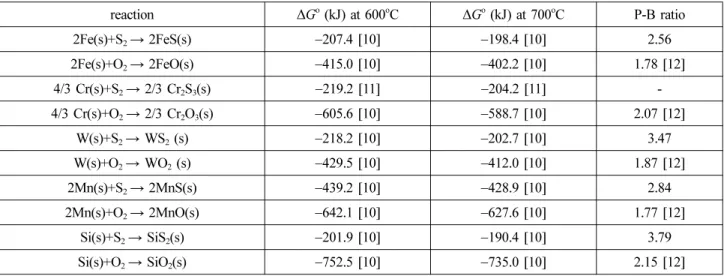
Table 1 shows that oxides of Fe and Cr are thermodynamically more stable than the corresponding sulfides [10,11]. The oxides of minor alloying elements such as W, Mn, and Si were not detected in Fig. 2 due to their dissolution or small amount in scales. The amount of Cr in T23 steel fell short of the amount necessary for formation of the con- tinuous, protective Cr

2

O

3

layer. Instead, nonprotective FeS existed over the entire scale, which was

Fig. 1. Weight gain versus corrosion time curves of T23 steel at 600 and 700

o

C in N

2

/(0.5, 2.5)%H

2

S- mixed gas.

Fig. 2. XRD patterns of T23 steel after corrosion at

600

o

C for 20 h in N

2

/2.5%H

2

S-mixed gas. (a) outer

scale, (b) inner scale.

(3)

responsible for the poor corrosion resistance of T23 steel. Table 1 also shows that the corrosion accom- panied the large volume expansion [12]. Furthermore, the hydrogen dissolution was inevitable during corrosion. Hence, scales that formed on T23 steel were always thick, fragile, and nonadherent.

The surface morphology of the scale that formed on T23 steel after corrosion at 600

o

C in N

2

/0.5%H

2

S gas for 5 and 70 h is shown in Figs. 3(a) and (b), respectively. FeS platelets protruded from the early corrosion stage through the ensuing outward diffusion of Fe

2+

ions [5] (Fig. 3(a)). Cracks developed across the surface scale due to the stress arisen by fast growth rate of the scale, volume expansion due to the formation of sulfides and oxides, and the hydrogen dissolution (Fig. 3(a)). FeS platelets kept protruding over the outer FeS scale during corrosion (Fig. 3(b)).

The increment of the H

2

S gas concentration from 0.5% to 2.5% led to the protrusion of fully developed, numerous FeS platelets over the outer FeS scale, as shown in Fig. 4. FeS platelets thickened, and coarsened as the corrosion progressed, eventually splitting vertically into a few pieces. Such mechanical failure of the formed scales was attributed to (1) the thermal stress arisen by the mismatch in the thermal expansion coefficients among the outer scale, inner scale, and the matrix, (2) the hydrogen dissolution in the scale, and (3) the growth stress generated by the anisotropic volume expansion as could be recognizable from the Pilling-Bedworth ratios listed in Table 1.

Figure 5 shows SEM/EPMA analytical result of T23 steel after corrosion at 700

o

C for 70 h in N

2

/ 0.5%H

2

S gas. Numerous FeS platelets protruded over the outer FeS layer owing to the increased corrosion

temperature, as shown in Fig. 5(a). They were fragile, and easily broke into a few pieces (Fig. 5(a).

They were about 100 - 400 μm long (Fig. 5(b)). The thickness of the outer, detached FeS layer and the inner (FeS, FeCr

2

O

4

)-mixed layer was about 100 μm and 200 μm, respectively (Fig. 5(b)). The concentration profiles of Fe, Cr, O, and S confirmed the formation of the outer FeS scale and the inner (FeS, FeCr

2

O

4

)- mixed scale (Fig. 5(c)). Sulfur and oxygen can easily Table 1. Standard free energies of formation (kJ) [10,11] and the Pilling-Bedworth ratios of sulfides and oxides [12].

reaction ΔG

o

(kJ) at 600

o

C ΔG

o

(kJ) at 700

o

C P-B ratio

2Fe(s)+S

2

→ 2FeS(s) −207.4 [10] −198.4 [10] 2.56

2Fe(s)+O

2

→ 2FeO(s) −415.0 [10] −402.2 [10] 1.78 [12]

4/3 Cr(s)+S

2

→ 2/3 Cr

2

S

3

(s) −219.2 [11] −204.2 [11] -

4/3 Cr(s)+O

2

→ 2/3 Cr

2

O

3

(s) −605.6 [10] −588.7 [10] 2.07 [12]

W(s)+S

2

→ WS

2

(s) −218.2 [10] −202.7 [10] 3.47

W(s)+O

2

→ WO

2

(s) −429.5 [10] −412.0 [10] 1.87 [12]

2Mn(s)+S

2

→ 2MnS(s) −439.2 [10] −428.9 [10] 2.84

2Mn(s)+O

2

→ 2MnO(s) −642.1 [10] −627.6 [10] 1.77 [12]

Si(s)+S

2

→ SiS

2

(s) −201.9 [10] −190.4 [10] 3.79

Si(s)+O

2

→ SiO

2

(s) −752.5 [10] −735.0 [10] 2.15 [12]

Fig. 3. SEM top view of the scales that formed on T23 steel after corrosion at 600

o

C in N

2

/0.5%H

2

S-mixed gas for (a) 5 h, and (b) 70 h.

Fig. 4. SEM top view of the scales that formed on T23 steel after corrosion in N

2

/2.5%H

2

S-mixed gas for 70 h.

(a) at 600

o

C, (b) at 700

o

C.

(4)

diffuse inwardly through cracks and the nonprotective FeS-containing scale. Major alloying elements such as Cr and W were primarily corroded in the inner scale, while minor alloying elements such as Mn and Si diffused outwardly to dissolve in the outer Fe

1-x

S layer. Such different elemental distribution depends on the concentration or thermodynamic activity, diffusivity, and the corrosion rate of each element.

In order to examine the detailed distribution of concerning elements in the outer/inner scale, the scale shown in Fig. 5 was analyzed using the EPMA mapping method, as shown in Fig. 6. The outer scale was detached off from the inner scale, partially fragmented owing to its mechanical weakness, and had Fig. 5. T23 steel after corrosion in N

2

/0.5%H

2

S-mixed gas at 700

o

C for 70 h. (a) SEM top view, (b) EPMA cross-sectional image, (c) line profiles along A-B as shown (b).

Fig. 6. EPMA results of the scale formed on T23 steel

after corrosion at 700

o

C for 70 h in N

2

/0.5%H

2

S-mixed

gas. (a) cross-sectional image of the outer scale, (b)

maps of (a), (c) cross-sectional image of the inner

scale, (d) maps of (c).

(5)

some microscopic voids (Fig. 6(a)). In the outer FeS scale, Mn was uniformly dissolved, although Cr and W were hardly recognizable (Fig. 6(b)). The inner scale was rather dense, because it formed mainly by the inward diffusion of gaseous species (Fig. 6(c)). It was rich in Fe, Cr, Mn and W (Fig. 6(d)). Sulfur was enriched mostly at the upper half of the inner scale.

The amount of sulfur at the lower half of the inner scale was limited owing to the consumption sulfur above.

4. Conclusions

T23 steel corroded at 600 and 700

o

C for 5- 70 h in N

2

/(0.5, 2.5)%H

2

S-mixed gas at 1 atm. The corrosion occurred almost linearly, being accompanied with large weight gains. The formed scales were always thick, nonadherent, and highly susceptible to cracking, because H

2

S formed nonprotective sulfide scales, and released hydrogen. The outward diffusion of Fe, Mn, and Si led to the formation of not only the outer FeS scale but also FeS platelets at the gas side. By contrast, Cr and W reacted with the inwardly migration to form FeCr

2

O

4

in the inner scale, where FeS coexisted. T23 steel was entirely nonprotective in H

2

S environments.

References

[1] D. Bell, B. Towler, and M. Fan, Coal Gasification and Its Applications, Elsevier, UK (2011), 137-156.

[2] O. Shinada, A. Yamada, and Y. Koyama, The Development of Advanced Energy Technologies in Japan IGCC: A Key Technology for the 21st Century,

Energ. Convers. Manage. 43 (2002) 1221-1233.

[3] N. J. Simms, J. F. Norton, T. M. Lowe, Alloy Corrosion in a Coal Gasification System, J. Phys.

IV, 3 (1993) 807-816.

[4] R. John, Shreir’s Corrosion, R. A. Cottis, M. J.

Graham, R. Lindsay, S. B. Lyon, J. A. Richardson, J. D. Scantlebury, F. H. Stott, 4th ed., Elsevier, UK (2010) 240-271.

[5] S. Mrowec, K. Przybylski, Transport Properties of Sulfide Scales and Sulfidation of Metals and Alloys, Oxid. Met., 23 (1985) 107-139.

[6] W. Bendick, J. Gabrel, B. Hahn, B. Vandenberghe, New Low Alloy Heat Resistant Ferritic Steels T/

P23 and T/P24 for Power Plant Application, Int.

J. Pres. Vessels Pip., 84 (2007) 13-20.

[7] S. H. Bak, M. J. Kim, J. H. Lee, S. J. Bong, S.

K. Kim, D. B. Lee, High-Temperature Oxidation Kinetics and Scales Formed on Fe-2.3%Cr-1.6%W Alloy, J. Kor. Ceram. Soc., 48 (2011) 57-62.

[8] A. Fry, S. Osgerby, M. Wright, Oxidation of Alloys in Steam Environments-A Review, NPL Report MATC(A)90, National Physical Laboratory, UK (2002).

[9] K. Sawada, M. Fujitsuka, M. Tabuchi, K. Kimura, Effect of Oxidation on the Creep Rupture Life of ASME T23 Steel, Int. J. Pres. Vessels Pip., 86 (2009) 693-698.

[10] I. Barin, Thermochemical Data of Pure Substances, VCH, Germany (1989).

[11] L. B. Pankratz, A. D. Mah, S. W. Watson, Thermo- dynamic Properties of Sulfides. U.S. Bureau of Mines Bulletin No.689, USA (1987).

[12] A. S. Khanna, Introduction to High Temperature

Oxidation and Corrosion, ASM Int. USA (2002)

204.

수치

Figure 1 shows the corrosion kinetics of T23 steel in N 2 /(0.5, 2.5)%H 2 S-mixed gas
Figure 5 shows SEM/EPMA analytical result of T23 steel after corrosion at 700 o C for 70 h in N 2 / 0.5%H 2 S gas
Fig. 6. EPMA results of the scale formed on T23 steel after corrosion at 700 o C for 70 h in N 2 /0.5%H 2 S-mixed gas

참조

관련 문서

약국은 당초 수집 목적과 합리적으로 관련된 범위에서 정보주체에게 불이익이 발생하는지 여부, 암호화 등 안전성 확보에 필요한 조치를 하였는지 여부 등을

/ 군사력이 약화되었고 전쟁에 대한 대비가 부족했다... / 문서에 조약의

따라서 버림, 반올림하여 백의 자리까지 나타낸 수가 같은 것은 ㉢입니다... 또한, 각각의 대응점에서 대칭의

동결방지 조치를 취하여 등을 사용하여 적절한 우려가 있는 곳은 보온재 드레인 호스 설치시 동결.

[r]

1 John Owen, Justification by Faith Alone, in The Works of John Owen, ed. John Bolt, trans. Scott Clark, &#34;Do This and Live: Christ's Active Obedience as the

사슴의 수는 조금씩 줄어들고 비버의 수는 늘어날 것이라고 쓰거나 오랜 시간에 걸쳐 생태계는 평형을 되찾아 늑대와 사 슴의 수는 적절하게 유지되고 강가의 풀과 나무도 잘

(Taekwondo, Weight Lifting Players) (90 min × 6 days/week) Warming