국내산 쌀보리 맥강을 이용한 glutamate로부터 GABA 생산
이미자
1,†
・ 김신혜1
・ 김형순2
・ 김현영1
・ 서우덕1
・ 최식원1
・ 이광식1
・ 장기창1
Production of γ-aminobutyric Acid Using the Korean Hull-less Barley Bran with Glutamate
Mi Ja Lee 1,† , Shin Hye Kim 1 , Hyung Soon Kim 2 , Hyun Young Kim 1 , Woo Duck Seo 1 , Sik Won Choi 1 , Kwang Sik Lee 1 , and Ki Chang Jang 1
ABSTRACT γ-Aminobutyric acid (GABA) has antihypertensive and anti-stress effects on humans. The present study aimed to investigate the effect of glutamate concentration, bran content, and barley cultivars on GABA production and determine the optimal reaction condition. Barley bran resulted in higher GABA productivity compared with that of rice bran. The higher the bran content, the higher was the GABA productivity. Furthermore, high glutamate concentration resulted in high GABA production.
However, there was a decrease in the glutamate conversion rate. The production of GABA varied with temperature and barley cultivar. The optimal condition for GABA production using barley bran was 0.15 g/mL barley content, 10 mM glutamate concentration, and 20°C reaction temperature. Under optimal condition, the GABA concentration was 10.34 mM, and glutamate conversion rate was 75.1%. Furthermore, the GABA productivity of the GABA production reaction using barley bran differed depending on the cultivar. Dasong and Yeongbaekchal showed higher GABA productivity than that by other cultivars.
Keywords : γ-aminobutyric acid, barley bran, rice bran
DOI : https://doi.org/10.7740/kjcs.2018.63.1.035Original Research Article
ⓒ 본 학회지의 저작권은 한국작물학회지에 있으며, 이의 무단전재나 복제를 금합니다.
This is an Open-Access article distributed under the terms of the Creative Commons Attribution Non-Commercial License (http://creativecommons.org/licenses/by-nc/3.0) which permits unrestricted non-commercial use, distribution, and reproduction in any medium, provided the original work is properly cited.
1)농촌진흥청 국립식량과학원 작물기초기반과 (Crop Foundation Division, National Institute of Crop Science, 181 Hyeoksin-ro, Iseo-myeon, Wanju-Gun, Jeollabuk-do 565-851, Korea)
2)서남대학교 환경화학공학과 (Department of Environmental & Chemical Engineering, Seonam University, Namwon 590-711, Korea)
†
Corresponding author: Mi Ja Lee; (Phone) +82-63-238-5332; (E-mail) [email protected]
<Received 21 October, 2017; Revised 4 January, 2018; Accepted 18 January, 2018>
γ-aminobutyric acid (GABA) 는 4개의 탄소를 중심 으로 구성되어 있는 비단백질 구성 아미노산으로 뇌와 척추 에 존재하며 신경전달물질로서 혈류개선을 통한 뇌의 산소 공급을 원활하게 하여 뇌의 대사를 촉진시키고, 결합하는 수 용체의 종류에 따라 신경억제를 통한 불안감 해소, 기억력 증강 또는 조울증 등에 영향을 준다(Shin et al., 2007; Lim et al., 2009). 또한 스트레스 해소, 혈압강하작용, 우울증 개 선, 중풍과 치매 예방, 불면, 비만, 갱년기장애 등에 효과가 있는 것으로 알려져 있으며, 최근의 연구에서는 Alzheimer’s disease (Rissma et al., 2007), 불안장애(Obata et al., 2008), 우울증(Hasler et al., 2007) 등의 질병이 GABA성 신경세 포(GABAergic neurons)의 GABA결핍에 원인이 있는 것으 로 보고되고 있다. 최근의 연구는 이러한 질병의 치료에 사 용하기 위한 기능성 식품에 관심이 집중되고 있고, GABA
는 다양한 식품 속에 포함되어 있으나 함량이 낮아 자연적 인 섭취로 GABA의 생리작용을 기대하기는 어려워 GABA 의 대량 생산을 위해 인위적으로 함량을 높이는 연구가 진 행되고 있다. 녹차(Jeng et al., 2007), 현미(Komatsuzaki et al., 2007), 보리(Chung et al., 2009), 밀(Young et al., 2011), 홍국미(Chuang et al., 2011) 등 다양한 종류의 식물을 활용 한 유산균 발효를 통하여 GABA생산성을 향상시키는 연구 들이 수행되었으며, monosodium glutamate (MSG)를 첨가 하여 GABA 생성량을 증가시키는 효과에 대한 연구 또한 활발히 이뤄지고 있다(Choi et al., 2006)
맥강과 미강은 보리와 쌀의 도정과정 중 발생하는 부산
물로 연간 생산량은 맥강은 6만2천톤, 미강은 10만톤에 이
르고 있다(Kim et al., 2004). 이러한 부산물들은 많은 섬유
소와 생리활성 물질들을 포함하고 있지만 일부가 사료 또
Table 1. Characteristics of different hull-less barley cultivars.
Cultivar Characteristics
Saessal Normal starch, 6-rowed
Jinmichapssal Low amylose starch (waxy), 2-rowed
Cheonghossal Normal starch, 6-rowed
Duwonchapssal Low amylose starch (waxy), 6-rowed
Jaeanchalssal Low amylose starch (waxy), 6-rowed
Dasongssal Normal starch, 2-rowed
Chalssal Low amylose starch (waxy), 6-rowed
Boseokchal Low amylose starch (waxy), 6-rowed, purple lema
Heuknarae Normal starch, 6-rowed, black lema
Yeongbaekchal Low amylose starch (waxy), 6-rowed
Betaone Low amylose starch (waxy), 6-rowed
Saechal Low amylose starch (waxy), 6-rowed
Daeanchal Low amylose starch (waxy), 2-rowed
는 퇴비로 활용되고 있을 뿐, 대부분 폐기되고 있는 실정이 다. 맥강과 미강으로부터 polyphenol 및 xylose등과 같은 여러 가지 기능성 물질들의 추출에 대한 연구들이 이루어 졌지만 GABA생성을 위한 곡물 부산물의 활용은 거의 연 구되어 있지 않다.
본 연구에서는 곡류 가공 부산물인 맥강과 미강에 포함 되어 있는 GAD를 활용하여 glutamate를 GABA로 전환하 는 반응에서 GABA의 생산성 향상을 위한 최적 반응조건 을 알아보고자 맥강과 미강의 첨가량, glutamate 농도, 반응 온도 및 국내산 쌀보리 품종에 따른 GABA의 생산성을 비 교하였다.
재료 및 방법
시험재료
본 실험에 사용한 맥강은 농촌진흥청에서 육성한 쌀보리 13 품종을 국립식량과학원 시험포장에서 표준 재배법에 준 하여 재배하였으며, 2015년 중순에 파종하고, 2016년 6월 에 수확하여, 14℃ 저장고에 저장하였다. 이들 품종들의 특 성은 Table 1에 나타내었으며, 이를 사다께 도정기(Sadake test mill, M05, Tokyo, Japan) 를 이용하여 73% 도정하여 사 용하였다. 미강은 (주)산마을(경남 창녕군 장마면)에서 구입 하였다. GABA와 monosodium glutamate는 Sigma Chemicals Co. (St. Louis, MO, USA) 에서 구입하였으며, 그 외 모든 시약은 1급 이상 시약을 사용하였다.
Glutamate의 GABA 전환 반응
Glutamate 의 GABA전환 실험은 10 mM glutamate 용액 에 맥강 0.15 g/mL를 첨가하여 20℃에서 6시간 동안 반응 시켰으며, 반응 후 80℃에서 20분동안 처리하여 효소 활성 을 정지시키고, 원심분리하여 상등액을 분석에 사용하였다.
GABA 및 glutamic acid 함량 분석
GABA 및 glutamic acid 함량은 AccQ·Tag UPLC (Waters,
Milford, MA) 분석 시스템을 이용하여 Limure et al. (2009)
의 방법에 기초하여 측정하였다. 시료는 멤브레인 필터를 이
용하여 여과하였으며, 여과한 시료는 UPLC분석을 하기 위
하여 AccQ-Tag 방법을 이용하여 유도체화하였다. UPLC분
석 시스템은 Waters Acquity를 사용하였고, 컬럼은 AccQ·Tag
ultra amino acid analysis column (3.9 × 150 mm; Waters),
컬럼온도는 49℃, 시료 온도는 20℃였으며, 검출기는 FLR
Detector (Waters) 로 파장은 EX. 266 nm, EM. 473 nm이었
다. 이동상은 A는 100% AccQ·Tag ultra UPLC amino acid
analysis eluent A, B 는 10% AccQ·Tag ultra UPLC amino acid
analysis eluent B, C 는 100% 증류수, D는 100% AccQ·Tag
ultra UPLC amino acid analysis eluent B 를 기울기 용리하였
으며, 유속은 0.7 ml/min이었고, 주입량은 1 μL이었고, 각 시
료는 3반복으로 측정하였다. 크로마토그램 데이터는 Empower
personal software (Waters) 를 사용하여 분석하였으며, GABA
를 제외한 아미노산 함량 분석은 Waters amino acids standards
(Waters) 를 이용하여 분석하였다.
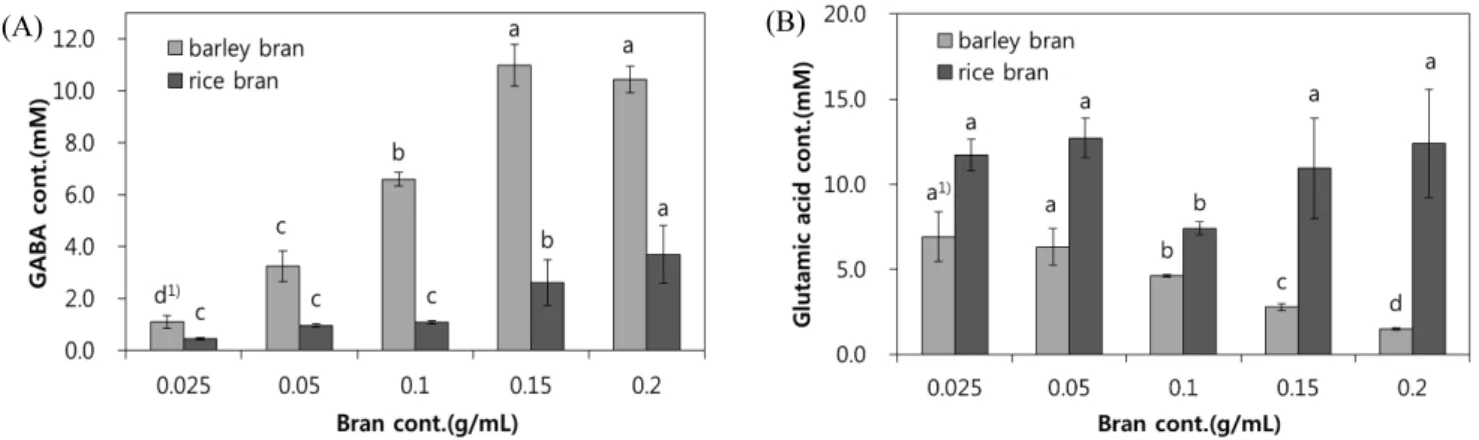
(A) (B)
Fig. 1. Effect of the initial bran content on the production of γ-aminobutyric acid (GABA) from glutamate using Saechal barley and rice bran. (A) GABA content, (B) Glutamic acid content. The solution containing barley and rice bran, and 10 mL of distilled water with 10 mM glutamate was incubated at 20°C for 6 h.
1)
Values with different letters differ significantly from each other (p<0.05).
통계처리
실험치는 평균값과 표준오차로 표시하였다. 통계분석은 SAS Enterprise Guide 4.0 (Statistical analysis system, 2016, Cray, NC, USA) 로 분석하고, 시료간의 유의적인 차이는 Duncan’s multiple range test 로 유의수준 5% (p<0.05)에서 검증하였다.
결과 및 고찰
미강 및 맥강 첨가량 변화에 따른 GABA 생산
미강 및 새찰쌀보리 맥강을 활용한 GABA생산 반응에서 이들 첨가량에 의한 GABA생산 효과를 알아보리 위하여 10 mM glutamate 용액 10 mL에 미강과 새찰쌀보리 맥강을 각각 0.025, 0.05, 0.1, 0.15 및 0.2 g/mL를 첨가하고 20℃
에서 6시간 반응시킨 후 GABA와 glutamic acid 함량 변화 를 확인하였다. Fig. 1에서 보는바와 같이 미강과 맥강 첨 가량이 증가할수록 GABA 생산량은 유의적으로 증가하였 다. 미강의 첨가량에 따른 GABA 생산량은 0.45-3.70 mM 범위였으며, 첨가량이 0.2 g/mL까지 GABA 생산량은 지속 적으로 증가하였다. 맥강의 경우에는 1.10-10.99 mM 범위 로 맥강 첨가량이 증가함에 따라 GABA 생산량이 급속하 게 증가하여 맥강 첨가량이 0.15 g/mL에서 최대 GABA 생 산량을 나타내었고 이후에 소량 감소하였다. 미강과 맥강 첨가량이 0.2 g/mL 이상의 경우에는 교반이 어려워져 실험 을 할 수 없었다. Glutamic acid 함량은 GABA 생산량과는 반대로 미강과 맥강 첨가량이 증가함에 따라 감소하는 경 향을 보였다. 맥강에 의한 GABA 함량이 최대인 0.15 g/mL 에서 전환되지 않고 남아있는 glutamic acid의 함량은 2.78 mM 이었으며, 미강의 경우에는 미강 첨가량이 0.2 g/mL에
서 glutamic acid는 12.40 mM이 전환되지 않고 남아 있었 다. 실험결과 맥강이 미강보다 약 2-3배 높은 GABA 생산량 을 보였고, GABA 최대 생산을 위한 맥강의 최적 첨가량은 0.15 g/mL 이었으며, 이러한 결과는 Limure et al. (2009) 이 보고한 결과와 일치하였다. 또한, Limure et al. (2009) 은 만약 반응기의 용량이 증가된다면 맥강 첨가량의 증가 가 가능할 것이고 이에 따라 GABA 생산량도 높아질 수 있 을 것이라고 보고하였는데 본 실험에서도 반응기의 용량이 증가 된다면 맥강 첨가량이 0.2 g/mL 이상에서도 교반이 가능할 것으로 생각된다.
Glutamate 농도에 따른 GABA 생산
일반적으로 GABA를 합성하는 공정은 GAD 효소의 촉매
작용에 의해 glutamate를 탈 탄산화시켜 GABA로 만드는 과
정이다. GABA 생산량을 향상시키기 위해서 초기 glutamate
농도를 10, 20, 30, 40 mM로 변화시켜 반응시켰으며, 이때
미강과 맥강 첨가량은 0.15 g/mL이었고, 20℃에서 6시간
반응시켰다. 실험 결과 생성된 GABA 함량과 반응하지 않
고 남아 있는 glutamic acid 함량 및 glutamate 전환율을
Table 2 에 나타내었다. 시험 재료인 맥강과 미강에 포함되어
있는 GABA 함량은 각각 1.22와 1.28 mM이었으며, glutamic
acid 함량은 각각 0.48과 1.27 mM이었다. Glutamate 농도
변화에 따른 GABA 생산량은 맥강과 미강 모두 glutamate
농도가 20 mM 까지는 GABA 생산량이 증가하였으나 그 이
상 농도에서는 유의적인 증가는 이루어지지 않았다. 맥강의
경우 GABA 생산량은 20 mM에서 높았지만 glutamate 전환
율은 10 mM에서 가장 높았으며, 미강의 경우에도 glutamate
농도가 10 mM에서 전환율이 가장 높았으며 그 이상의 농
Table 2. Effect of the initial glutamate concentration on the production of γ-aminobutyric acid (GABA) from glutamate using Saechal barley and rice brans.
Glutamate cont.
(mM)
Barley bran Rice bran
GABA (mM)
Glutamic acid (mM)
Glutamate conversion rate (%)
GABA (mM)
Glutamic acid (mM)
Glutamate conversion rate (%)
0 1.22±0.11
c1)0.48±0.06
c1.28±0.13
b1.27±0.04
e10 10.34±0.77
b2.49±0.19
c75.1 1.61±0.48
b7.21±1.83
d27.9
20 24.58±2.29
a11.28±1.05
b43.6 2.60±0.34
a21.46±1.99
c0.0
30 20.99±8.66
a14.76±5.82
b50.8 2.61±0.58
a28.71±4.95
b4.3
40 25.87±3.56
a26.68±3.07
a33.3 2.66±0.32
a39.88±4.81
a0.3
1)
Mean value of triplicates ± standard deviation.
Values with different letters in the same row differ significantly from each other (p<0.05).
(A) (B)
Fig. 2. Effect of barley cultivar on the production of γ-aminobutyric acid (GABA) from glutamate using barley bran. (A) GABA content, (B) Glutamic acid content. The solution containing 0.15 g/mL barley bran and 10 mL distilled water with 10 mM glutamate was incubated.
1)
도에서는 대부분이 전환하지 않고 그대로 남아있었으며 맥 강이 미강보다 훨씬 높은 GABA 생산 효율을 보였다. 그러 므로 본 실험의 경우 GABA 생산을 위한 최적 glutamate 농도는 10 mM 이었다. Liu et al. (2005)과 Saikusa et al.
(1994) 은 쌀의 침지 중 GABA 축적은 GAD활성과 관계가 있으며, 발아 보리에서의 GABA 함량이 발아된 밀이나 쌀 보다도 높다고 보고하였다. 본 실험에서는 GAD활성을 조 사하지는 않았지만 실험결과 맥강이 미강보다 훨씬 높은 GABA 생산을 보여 Ito (2004)와 Kihara et al. (2007)의 보 고와 같이 미강보다 맥강의 GAD 활성이 높을 것으로 생각 된다.
GABA 생산에서 품종과 온도의 영향
미강보다 높은 GABA 생산량을 나타낸 맥강을 활용하기 위하여 다른 국내산 보리 품종의 맥강이 GABA 생산에 미 치는 영향을 알아보았다. 국내 주요 쌀보리 품종 중 메성쌀 보리인 새쌀과 찰성쌀보리인 새찰쌀 및 단백질과 라이신
함량이 높은 찰성쌀보리인 대안찰쌀보리의 맥강을 이용하여 GABA 생산 실험을 하였다(Fig. 2). 이들 맥강은 200 g을 test mill (TM-05C, SATAKE, Japan) 로 154 g까지 도정하고 남은 부산물이다. GABA 생산량은 20℃에서 6시간 반응시킨 것 (2.13-6.86 mM) 이 40℃에서 반응시킨 것(2.03-3.80 mM)보 다 모든 품종에서 높았으며, 20℃에서 6시간 반응의 경우 품종별로 유의적인 차이를 나타내었고, 새쌀보리(6.86 mM)가 새찰쌀보리(4.76 mM)와 대안찰쌀보리(2.13 mM)보다 높은 GABA 생산량을 보였다. 전환되지 않고 남은 glutamic acid 함량은 20℃ 반응에서는 1.21-2.80 mM이었으며, 40℃
반응의 경우에는 3.52-4.20 mM로 40℃ 반응의 경우 전환 되지 않고 남은 glutamic acid 함량이 20℃ 반응에서 보다 높아 GABA 생산 반응은 40℃ 보다는 20℃가 적합하였다.
Paidaeng et al. (2014)은 brown rice를 발아시키고 이때
GABA 와 glutamic acid 함량을 조사하였는데, rice의 품종
에 따라 GAD활성과 glutamic acid 함량이 다르며 GABA
생산량은 이들과 깊은 관계가 있다고 보고하였다. 본 연구
Fig. 3. Production of γ-aminobutyric acid (GABA) from glutamate by barley bran which was produced from various cultivars.
The solution containing 150 mg/mL barley bran and 10 mL distilled water with 10 mM glutamate was incubated for 6 h at 20°C.
1)
Values with different letters differ significantly from each other (p<0.05).
Fig. 4. Concentration of glutamic acid in the production reaction of γ-aminobutyric acid (GABA) from glutamate by barley bran which was produced from various cultivars. The solution containing 150 mg/mL barley bran and 10 mL distilled water with 10 mM glutamate was incubated for 6 h at 20°C.
1)
Values with different letters differ significantly from each other (p<0.05).
에서는 보리 품종들이 GABA 생산 반응에 미치는 영향을 알 아보기 위하여 국내산 주요 쌀보리 13품종을 도정하여 얻어 진 맥강 0.15 g/mL, 10 mM glutamate 용액에서 20℃, 6시 간 반응시키고 생성된 GABA 농도와 반응하지 않고 남은 glutamic acid 농도를 분석하였다. 그 결과 GABA 함량은 보리 품종에 따라 0.79-7.87 범위로 품종별로 큰 차이를 나 타내었다 (Fig. 3). 찰성쌀보리 품종들의 평균 GABA 생산 량은 4.68 mM 이었으며, 메성 쌀보리 품종들의 평균 GABA 생 산량은 4.90 mM이었으나 찰성과 메성 품종들간의 뚜렷한
경향은 없었다. 다송은 7.40 mM과 영백찰은 7.87 mM로 시 험 품종 중에서 비교적 가장 높은 GABA 생산성을 나타내 었으며, 진미찹쌀은 0.79 mM로 가장 낮은 GABA 생산성을 나타내었다. 반응하지 않고 남은 glutamic acid 함량은 Fig.
4 에 나타내었다. Glutamic acid 함량은 1.33-6.09 범위였으
며, GABA 생산성이 높았던 다송(1.69 mM)과 영백찰쌀보
리(2.44 mM)가 비교적 낮은 glutamic acid함량을 나타내었
다. 그러나 통계처리 결과 GABA 생산량은 glutamic acid 함량
과 유의적인 상관관계를 나타내지는 않았다(r=-0.324, p<0.1).
적 요
곡류 가공 부산물인 미강과 맥강을 활용한 GABA 생산 성 향상을 위하여 맥강과 미강의 첨가량, glutamate 농도 및 보리 품종에 따른 GABA 생산량을 측정 비교하였다. 그 결과 맥강이 미강 보다 모든 조건에서 높은 GABA 생산성 을 보였고, 맥강을 활용한 GABA 생산 반응에서 최적 조건 은 맥강 첨가량은 0.15 g/mL, glutamate 농도는 10 mM, 반 응온도는 20℃로 이때 glutamate의 GABA로의 전환율은 75.1% 였다. 또한 보리 품종에 따른 GABA 생산성은 유의 적인 차이를 나타내었으며 다송과 영백찰쌀보리가 높은 GABA 생산성을 나타내었다. 본 연구결과 부산물인 맥강을 이용 하여 GABA 생산성을 향상시킬 수 있었으며, 보리 품종이 GABA 생산의 중요 요인으로 작용하였다.
사 사
본 논문은 농촌진흥청 연구사업(세부과제명: 곡류 가공 부산 물 이용 GABA 생산 기술 개발, 세부과제번호:PJ012107012018) 의 지원에 의해 수행되었습니다.
인용문헌(REFERENCES)