허베이 스피리트호 유류 유출사고에 대한 Trauma Signature (TSIG) 분석*
최영현1), 이무식1),*, 이재광2), 김지아3), 김정선4)
건양대학교 의과대학 예방의학교실1), 건양대학교 의과대학 응급의학교실2) 질병관리본부3), 건양대학교 의과학대학 응급구조학과4)
Trauma Signature (TSIG) Analysis of Hebei Spirit Oil Spill, Taean, Korea : 2007
Young-hyun Choi1), Moo-Sik Lee1)*, Jae-Kwang Lee2), Jee-A Kim3), Jung Sun Kim4)
Department of Preventive Medicine, College of Medicine, Konyang University
1)Department of Emergency Medicine, College of Medicine, Konyang University
2)Korea Centers for Disease Control and Prevention
3)Department of Emergency Medical Service, College of Medical Science, Konyang University
4)초 록
목적: 이 연구는 2007년 충남 태안군에서 발생한 허베이 스피리트호의 유류 유출사고에 대한 신체적,
심리적, 정신 건강영향에 대한 trauma signature (TSIG) 분석을 시도한 사례 연구이다.
대상 및 방법: TSIG 분석은 유류유출 사고와 관련된 위해 노출의 신체적, 심리적 결과를 검정하는 방 법론으로 태안지역 인구에 대하여 노출된 위해 프로필(hazard profile), 노출 스트레스 마트릭스(matrix of exposure stressors), “trauma signature” 요약 등을 분석한 것으로 위해요인, 손실, 변화 요인 등에 대하여 인위적 재난에 대한 분석을 저자들이 구조화된 틀을 활용하여 분석을 시도한 사례이다.
결과: 허베이 스프리트호 유류 유출사고의 특징(signature)은 다원, 다면적이고 한국에서 역사적으로
가장 큰 해양오염 사고로 태안 지역사회 및 인접한 지역에 영향을 준 것으로 요약된다. TSIG 분석결 과는 주요한 근거에 따른 신체적, 심리적, 정신적 요인에 대한 영향을 나타내었는데 이는 노출의 정도 (exposure severity)에 따른 위해도, 손실, 변화의 범주에 따른 결과였다. 노출의 정도는 낮음(low)에서 부터 극심(extreme)까지 그 범위가 다양하였으나 위험요인의 순위는 대부분 낮음에서 중등도 (moderate)의 중증도를 보였다.
결론: 허베이 스프리트호 유류 유출사고에 대한 TSIG 분석 사례연구는 재난 상황 등에서의 TSIG 분 석방법론의 적용가능성을 경험하였다.
핵심단어: 유류 유출(oil spill), TSIG 분석, 신체, 심리, 정신건강
* Received September 5, 2018; Revised September 27, 2018; Accepted September 27, 2018.
* Corresponding author: 이무식, 대전광역시 서구 관저동로 158 건양대학교 의과대학 예방의학교실
Moo-Sik Lee, Department of Preventive Medicine, College of Medicine, Konyang University, 158 Gwanjeo-dong-ro, Seogu, Daejeon, 302-832, Korea
Tel: +82-42-600-6404, Fax: +82-42-600-6401, E-mail: [email protected]
Introduction
In the early on morning of December 7, 2007, Hong Kong-registered oil tanker, the Hebei Spirit, carrying 263,000㎘ of crude oil from the United Arab Emirates to Daesan Harbor in the western coast of Korea, was collided with a crane-carrying barge of Samsung Heavy Industries tugboats. The crane barge had been set adrift after the cable linking it to a tug snapped in rough seas. The collision punctured three of the five oil containers on the Hebei Spirit and resulted in the leakage of crude oil.
Three different types of crude oil were involved: Iranian heavy oil, Upper Zakum oil, and Kuwait Export oil [1]. The oil contained various volatile organic compounds (VOCs) such as, benzene, toluene, ethylbenzene, xylene, polyaromatic hydrocarbon, and heavy metals which can induce various kinds of health effects [2]. Oil remaining in the damaged containers was pumped into undamaged containers and the breaches in the vessel were sealed [3, 4].
As a result, about 10,900 tons (12,547㎘) of crude oil spilled into the West sea, approximately 8 km away from the coast of Taean, Korea, which contaminated 1,218.3 km of coast and 2,000 ha of beach in the western coast of Korea including the Taean Coast National Park and many swimming beaches. Spilled oil contaminated 70.1km of coast line of Taeangun county, the most severe contaminated interval was 35km from Bangal 2Ri to Pado 1Ri(Figure 1). The devastating result was the contamination of 167 km of coastline from the gulf of Garorim to the coast of Anmyeon-eup in Taean [5]. Approximately 13,978 ha of fisheries or fish farms were damaged, and 15 swimming beaches were contaminated[6]. The coastline of Taeangun county, which had a population of
63,939 in 2006, was most severely hit, resulting in a loss of fishing and tourism for an indefinite period [6, 7].
After then, the emulsion state and tar balls of spilled oil spreaded to the southern sea and coast areas by ocean currents. On January 6, 2007, tar balls were identified in Jeju islands, approximately 205 miles away from the accident point. This disaster generated severe damages on the fishing grounds, sea farms, and beaches [3] (Figure 2).
From the day of the accident up to July 4, 2008, the total number of participants for land cleanup activities was 2,122,296, and included 556,323 residents, 1,226,730 volunteers, and 152,695 military personnel [8].
Hebei Spirit oil spill was the largest, worst oil spill accident in the history of Korea.
Amount of this oil spill was bigger than total 10,234㎘ from 1997 to 2006, 3,915 cases of ocean oil spill accidents in Korea [3, 4].
Compared to the Sea Prince spilled 5,000 tons of crude oil and fuel oil on the seashore of Yeosu in 1995, the spill amount is about 2.5 times more. More than the amount of oil spills to marine pollution accidents that occurred over 10 years from 1997 to 2006 [3, 4].
After a collision of oil tankers, oil spill leads to a fast and wide spread of oil by rapid ocean currents. The oil spill combined with strong waves and an unexpected wind direction resulted in more serious effects than that were initially envisaged. On December 9, two days after the accident, it was reported that the resulting oil slick was already 33 km long, 10 m wide, and 10 cm thick in some places [9].
The oil spilled from the Hebei Spirit was reported to contain volatile organic compounds (VOCs) such as benzene, toluene, ethylbenzene, xylene (BTEX), polycystic aromatic hydrocarbons
(PAHs), and heavy metals [4]. Certain VOCs, benzene in particular, are carcinogenic to humans, and are associated with haematological cancer, psychological, mental symptoms, and post-traumatic stress disorder.
Trauma signature(TSIG) analyses presented here were intended to bring perspective to these important but somewhat unexpected findings of nominal mental health and substance abuse effects at the level of the affected region.
Methods
Trauma signature analysis was adapted to analyze the physical and psychological health effects of Hebei Spirit Oil Spill, Taean, Korea.
TSIG analysis is defined as “an evidence-based method that examines the interrelationship between population exposure to a disaster, extreme event, or complex emergency, and the inter-related physical and psychological consequences for the purpose of providing timely, actionable guidance for effective health support that is organically tailored and targeted to the defining features of the event. TSIG analyses have been conducted on a wide spectrum of disasters, including natural, nonintentional technological, hybrid, and intentionally-perpetrated variants [10, 11].
TSIG examines the extent to which disaster survivors were exposed to empirically-documented risk factors for physical, psychological distress and mental health disorders. Grounded on the Disaster Ecology Model, TSIG is premised on the assumption that each disaster exposes the affected population to a novel pattern of traumatizing hazards, loss and change. This singular “signature” of exposure risks is a predictor (or series of predictors) of the psychosocial and mental health consequences.
Disaster-specific analysis is important because, as Kessler and team have documented across a spectrum of international disasters, “Secondary stressors unique to a particular disaster situation have more impact than the disasters themselves” in determining the prevalence of post-disaster mental disorders.
The TSIG analyses reported here entailed the following steps: retrieval and synthesis of published reports describing the Deepwater Horizon oil spill to produce a hazard profile;
review of the scientific literature on evidence- based risk factors for psychological distress and mental health disorders for persons exposed to technological disasters and especially oil spills; enumeration of spill-specific exposures and stressors; creation of a TSIG summary, based on the estimated psychological severity of exposures to hazards, losses, and changes;
and identification of major psychological risk factors that were present or absent in this event.
TSIG hazard profiles use an epidemiologic approach to disaster description that incorporates hazard, person, place, and time dimensions.
Type of disaster was based on classification schemes used by the Centre for Research on the Epidemiology of Disasters (CRED)90 and the World Association for Disaster and Emergency Medicine. Also, the review of the literature on psychological risk factors for oil spills. The disaster mental health literature on human population exposure to oil spills was searched to identify evidence-based risk factors. A summary of this literature was presented in the introduction.
Based on review of the scientific literature and news accounts, a table was constructed of disaster stressors experienced by the Mexican Gulf Coast citizens during the impact phase of the Deepwater Horizon oil spill. The resulting
“stressor matrix” classifies exposures to hazards, losses, and changes.
A composite TSIG summary table was constructed, displaying the most significant evidence-based psychological risk factors, grouped under the headings of hazard, loss, and change. The table presents exposure severity ratings for these risk factors. The ratings use order-of-magnitude (10-fold) differences between adjacent categories. Based on CRED’s database of international disaster events, dating from 1900 to the present, 90
ratings of “extreme” for a specific risk factor are reserved for disasters that produce consequences at that order of magnitude only several times every 50 to 100 years. “Very severe” ratings reflect the order-of-magnitude threshold reached with a frequency of 1 or several times within a 10- to 20-year period, while “severe” ratings occur 1 or several times within a 3- to 5-year period.
This study was approved by the Dankook University Hospital Institutional Review Board (DKUH201406013-HE003).
Figure 1. Highly contaminated area of Hebei Spirit oil spill
Figure 2. Map of daily spilled oil distribution from December 7th, 2007 to January 6th, 2008 and satellite photograph of the Hebei Spirit oil spill in the Korean Yellow Sea
(Source from European Space Agency)
Results
The hazard profile presents the event description including the event definition, spill characteristics, and place and tine of onset (Table 1). The Hebei Spirit oil spill was the largest volume of marine oil spilled in the history of Korea.
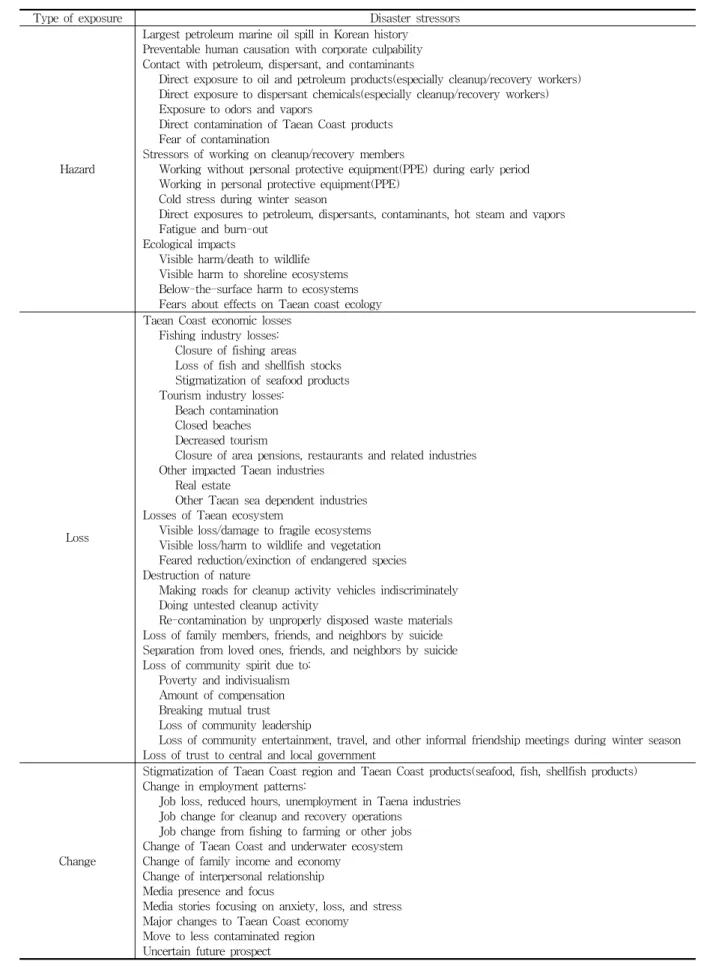
Disaster stressors were divided into those to exposure to hazards, losses, and changes.
Hazard related stressors included marine oil spills in Korean history, human causation with corporate culpability, contact with petroleum, dispersant, and contaminants, stressors of
working on cleanup and recovery members, and ecological impacts. Loss associated stressor included economic (industry) losses, ecosystem loss, destruction of nature, loss of family members, friends, and neighbors from suicide, and separation from loved ones, friends, and neighbors by suicide, loss of community spirit, loss of trust to central and local government.
Change related stressors included stigmatization of Taean Coast region and Taean Coast products, change in employment patterns, change to the ecosystem, economy, and interpersonal relationships, protracted media presence and focus, and uncertain future prospect(Table 2).
Table 1. Hazard profile of Hebei Spirit oil spill by trauma signature analysis
Event characteristic Hebei Spirit oil spill
Event description
Event definition Non-intentional anthropogenic(human-generated) technologcial disaster involving a hazardous materials spill(petroleum and dispersant chemicals) that generated severe ecological impact
Spill characteristics
Hazardous materials Petroleum :crude oil from Iran, the United Arab Emirates and Kuwait Volume of spill 12,547 ㎘(10,900 tons)
Surface area of spill Sea farm : 34,317 ha
Magnitude Largest-volume marine oil spill in Korean history
Clean-up tools
Oil fence :46.77 km Oil absorbant :486,607 kg Dispersant : 297,922 L Towel : 730,799 kg
Place
Location Northwest sea approximately 10km away from the coast of Taean, Korea Coordinates Latitude 36° 56' 00''
Longitude 126° 02' 06''
Coast line affected 1,218.3 km of the western coast of Korea including the Taean Coast National Park
Time of onset
Date/Time: accident 07 December 2007 07:06 AM(time of collision) Date tank hole sealed 9 December 2007
Table 2. Disaster exposure and stressor matrix in relation to categories of exposure of Hebei Spirit oil spill by trauma signature analysis
Type of exposure Disaster stressors
Hazard
Largest petroleum marine oil spill in Korean history Preventable human causation with corporate culpability Contact with petroleum, dispersant, and contaminants
Direct exposure to oil and petroleum products(especially cleanup/recovery workers) Direct exposure to dispersant chemicals(especially cleanup/recovery workers) Exposure to odors and vapors
Direct contamination of Taean Coast products Fear of contamination
Stressors of working on cleanup/recovery members
Working without personal protective equipment(PPE) during early period Working in personal protective equipment(PPE)
Cold stress during winter season
Direct exposures to petroleum, dispersants, contaminants, hot steam and vapors Fatigue and burn-out
Ecological impacts
Visible harm/death to wildlife Visible harm to shoreline ecosystems Below-the-surface harm to ecosystems Fears about effects on Taean coast ecology
Loss
Taean Coast economic losses Fishing industry losses:
Closure of fishing areas Loss of fish and shellfish stocks Stigmatization of seafood products Tourism industry losses:
Beach contamination Closed beaches Decreased tourism
Closure of area pensions, restaurants and related industries Other impacted Taean industries
Real estate
Other Taean sea dependent industries Losses of Taean ecosystem
Visible loss/damage to fragile ecosystems Visible loss/harm to wildlife and vegetation Feared reduction/exinction of endangered species Destruction of nature
Making roads for cleanup activity vehicles indiscriminately Doing untested cleanup activity
Re-contamination by unproperly disposed waste materials Loss of family members, friends, and neighbors by suicide Separation from loved ones, friends, and neighbors by suicide Loss of community spirit due to:
Poverty and indivisualism Amount of compensation Breaking mutual trust Loss of community leadership
Loss of community entertainment, travel, and other informal friendship meetings during winter season Loss of trust to central and local government
Change
Stigmatization of Taean Coast region and Taean Coast products(seafood, fish, shellfish products) Change in employment patterns:
Job loss, reduced hours, unemployment in Taena industries Job change for cleanup and recovery operations
Job change from fishing to farming or other jobs Change of Taean Coast and underwater ecosystem Change of family income and economy
Change of interpersonal relationship Media presence and focus
Media stories focusing on anxiety, loss, and stress Major changes to Taean Coast economy
Move to less contaminated region
Uncertain future prospect
The TSIG summary provided the major evidence-based physical, psychological, and mental risk factors according to the categories of exposures to hazards, losses, and changes, and ranked according to “exposure severity.”
The range of exposure severity is distribute from low to extreme. However, the rank of the majority of the risk factors were “low” or
“moderate” severity(Table 3).
Discussions
Oil spills are the one of the most tragic environmental disaster due to impact on the ecosystem and human health over the long-termly by chemical hazards, as well as psychological and socioeconomic effects [12].
Futhermore, oil spill disasters induce socioeconomic distress, including economic damage as well as a disruption to community interrelationship [13]. Oil spills have occurred in a variety of sizes worldwide. A study on the effect of oil spills on the body was limited. The study about the effect of oil spill was carried out mainly on the impact on the ecosystem and the research on the health effects that may occur to the person involved is minute. The study on about seven spills over 6 tons were only 26 by 2008. Most studies were cross-sectional research about the acute health effect of oil spill through comparing between a newly organized control group and locals, workers or volunteers who participated in the cleanup work after the accident. Also, most contents of study were about physical stimulation symptoms such as headaches, eye irritation, skin irritation, respiratory irritation and mental health issues such as depression, anxiety, and post-traumatic stress disorder (PTSD). In addition to cross-sectional research about physical stimulation symptoms and mental health, Spain
Prestige Oil spill research established in 2002 reported health effects of changes in cleanup workers after the accident [14], Respiratory symptoms persist after 5 years, health effects of changes functional, biological respiratory symptoms in cleanup workers after accident [15], Endocrine and immune research indicators in cleanup workers after 7 years [16]. The team has been in progress study on effect about the respiratory system and genotoxicity prolongedly. Goldstein(2011) [17] and Diaz(2011) [18] reported changes of blood, liver, respiratory, kidney, changes in nervous system function as mainly health result of oil spill through theirs studies. D'Andrea and Reddy(2013) [19] reported that the group experienced oil spill was higher physical symptoms and hematologic figures such as hemoglobin(Hb). hematocrit(Hct), aspartate aminotransferase(AST) eeflecting the liver function, alanine aminotransferase(ALT), alkaline phosphatase(ALP) at the time of British Petroleum Oil spill in Gulf of Mexico.
Hebei Spirit oil spill accident occurred on December 7, 2007, at 7:00 a.m. and the largest was a marine pollution incident in South Korea's history [8]. Economic damage induce psychologic distress in community [20]. Within 1 year after the Hebei Sprit oil spill, 4 residents committed suicide. Many peoples in the affected area suffered general sense of stress and depression. The Hebei Spirit oil spill may be characterized as a nonintentional anthropogenic (human-generated) technological disaster involving a hazardous materials spill (petroleum and dispersant chemicals) that generated a severe ecological impact.
Human-generated technological disasters have the potential to create significant risk for psychological distress and a range of mental health consequences equaling and often exceeding the effects produced by natural disasters.
au ma Si gnat ur e An al y si s of He be i Sp ri t Oi l Spi ll b le 3. Tr au m a si gna tu re s u mma ry of He b ei S p ir it oil spil l Ri sk fa ct or s for ph ys ical, ps ychol og ical di st re ss & me nt al disorders C ha ra cte ri stics of He be i Sp ir it oil spi ll Ex po su re sever ity * Lo w M od erate Sev ere V ery se ve re Ext rem posur e to hazards Di re ct p etrole um pr oduct /di sper sa nt expo sure 100, 000 c oa sta l dw elle rs an d 45 ,0 00 cle an up w or ker s < 10 ,000 ≥ 10 ,0 00 ≥ 100 ,000 ≥ 1 m illio n ≥ 10 m Mi ni ma l ex posur e to spi ll pr od uc ts 40 0, 00 0 Gul f Co as t po pul at io n Low < 10 ,000 ≥ 10 ,0 00 ≥ 100 ,000 ≥ 1 m illio n ≥ 10 m St ro ng fe ar rea cti on s pe rc ei ve d life threa t V ery few pe rs ons exp eri en ced sense of th re at to l ife < 10 ,000 ≥ 10 ,0 00 ≥ 100 ,000 ≥ 1 m illio n ≥ 10 m Se ve re , lif e-c hangi ng physi cal in ju ry N o lif e-t hr ea te ni ng onshor e in ju ri es due to sp ill < 10 0 ≥ 100 ≥ 1, 000 ≥ 10, 000 ≥ 10 0, Mi no r ai lm ent re qu ir in g me di ca l atte nti on Co as ta l cl ean up wo rk er s: ∼ 1, 000. In fir m ar y vi si ts /m on th fo r 8 mo nt hs < 1, 00 0 ≥ 1, 000 ≥ 10 ,0 00 ≥ 10 0, 00 0 ≥ 1 m Wi tn es si ng de at h or sever e harm to hum an s Se ve ral onshor e su ic id es /n o life th rea te ni ng in ju ri es due to s pi ll < 1, 00 0 ≥ 1, 000 ≥ 10 ,0 00 ≥ 10 0, 00 0 ≥ 1 m Wi tn es si ng gr ot es qu e scen es: dead w ild life 50 0, 00 0 Gul f Co as t po pul at io n < 1, 00 0 ≥ 1, 000 ≥ 10 ,0 00 ≥ 10 0, 00 0 ≥ 1 m Ex po su re to p ost- im pa ct se ve re envi ro nm en t A ll in fra stru ctu re rem ai ned in ta ct . Al l vi ta l se rv ic es o perat io nal < 1, 00 0 ≥ 1, 000 ≥ 10 ,0 00 ≥ 10 0, 00 0 ≥ 1 m M ultip le hi gh-i nt ensi ty i m pac ts C oast al pop ul at ions in 32 co un ties ; ot her s in th e st at es < 10 ,000 ≥ 10 ,0 00 ≥ 100 ,000 ≥ 1 m illio n ≥ 10 m Hum an -g ene ra te d co nt ri bu tio n To ta lly hum an -g ener at ed ev en t Low M od era te Se ve re V ery se ve re Ext rem posur e to lo ss M ortal ity Sev eral onshor e su ic id es du e to s pill(11 death s on oil ri g) < 1, 000 ≥ 1, 000 ≥ 10 ,0 00 ≥ 10 0, 00 0 ≥ 1 m B er eave m en t Few onshor e de at hs . 50 fi rs t- lin e rela tive s of 11 de ad oi l w or ker s < 4, 00 0 ≥ 4, 000 ≥ 40 ,0 00 ≥ 4 m illio n ≥ 4 m Los s of pr im ar y dw ellin g N o or ve ry fe w l osses of pri m ary dw el ling s < 1, 00 0 ≥ 1, 000 ≥ 10 ,0 00 ≥ 10 0, 00 0 ≥ 1 m Se ve re fi na nc ia l lo sses E st im at ed se ve re l oss es fo r 20 0, 00 0 w or ker s < 10 ,000 ≥ 10 ,0 00 ≥ 100 ,000 ≥ 1 m illio n ≥ 10 m Na tio na l fin an ci al l osses B illion s in costs Lo w M od erate Sev ere V ery se ve re Ext rem posur e to chang e Ev ac ua tion /d is pla cem en t/r eloc ati on to s he lters V ery few or no ev acu ati on s wi th lo ng term di sp la ce m ent <1 ,0 00 ≥ 1, 000 ≥ 10 ,0 00 ≥ 10 0, 00 0 ≥ 1 m ba sed on previ ous TS IG case studi es
There have been big and small oil spills that have occurred in Korea. However, The health effect assessment study related to the Hebei Spirit oil spill was the only study related to the health of local residents and cleanup workers.
There are many papers published in Korea and abroad about that. Levels of fatigue and fever were higher among residents not wearing masks than among those who did wear masks.
Urinary mercury levels increased among group not wearing work clothes or boots in a study of people who participated in the cleanup work [21]. Through study was to compare the distinction of peak expiratory flow(PEF) among pre-works and post-works in Hebei Spirit oil, measuring their own PEF after cleanup works, females, the number of working days on cleanup activities, and residents were found to be significant risk factors for low value of PEF [22]. The study reported that they recovered through artificial respiratory therapy after oil spill cleanup work [23]. It has been reported that polycyclic aromatic hydrocarbons (PAHs) played a more important role in causing oxidative stress than volatile organic compounds(VOCs) among harmful substances exposed during the cleanup work through the health effect assessment of the volunteers participating in the cleanup work [24]. It was reported that residents of medium-highly polluted areas showed significantly increased nervous system symptoms such as headaches nausea, and respiratory symptoms such as neck pain, cough, runny nose, and skin symptoms such as itchy skin and redness [24].
Also, The more exposure to oil control work, the more symptoms are appeared. It was confirmed that there was a relationship between oil exposure and acute physical
symptoms [12]. In a study of soldiers participating in the cleanup work, It was reported that the duration of the cleanup work was related to 17 acute physical symptoms [25]. It was reported that elementary school students of schools closer to the oil spill coast are more at risk to depression than elementary school students far away from the oil spill on the coast [26]. Cognitive Behavioral and Laughter Therapy programs were effective in treating anger after the oil spill in victimized local residence and mental symptoms of children [27]. As a results of analyzing the urine samples before and after the cleanup work of volunteers of university students participating in the cleanup work, The degree of trans-muconic acid, mandelic acid, 1-hydroxypyrene in the urine after the cleanup work was high [28]. It was reported that Oil spill exposure is one of the asthma risk factors for children [5]. As a result of Burden of disease(BOD) study by residents living on polluted coast, Years lived with disability(YLD) due to disorders caused by mental illnesses such as post-traumatic stress disorder or depression was high in males and disorders caused by diseases such as asthma or allergies was high in females [29].
TSIG that based on the Disaster Ecology Model, is assumed that each disaster exposes the affected population to a new pattern of traumatizing hazards, loss, and change. This singular “signature” of exposure risks is a predictor of the psychosocial, physical, and mental health results.
The combination of oil spill hazards and vulnerabilities, extreme loss of life, and paralyzing damage to infrastructure, predicts population-wide psychological distress, debilitating psychopathology, and pervasive traumatic grief.
However, mental health was not included in the national recovery plan initially. The limited health services provided in the early stages of the oil spill lacked coordination and empirical basis.
There is a need to customize and coordinate disaster general health assessments including physical and psychosocial distress, interventions, and prevention efforts around the stressors and consequences of each traumatic event. An analysis of the key features of the Hebei Spirit oil spill was conducted, defining its
“Trauma Signature” based on a synthesis of early disaster situation reports to identify the unique assortment of risk factors for post-disaster health results.
The hazard profile was the event description that was based on scientifically review of disaster data including sitreps from governmental agencies and available data from disaster monitoring and scientific resources. Subject matter experts may be contacted to assure that the event is correctly described from a disaster sciences perspective. This step describes the physical forces of harm that impact the human population in harm’s way in order to characterize “exposure to hazard.”
Disaster epidemiologic data are also collected on numbers of deaths, injuries, displaced, and affected.
The next step was disaster matrix that relate with matching the scientific event description to the literature on physical and psychological risk factors. That was summarized in a stressor matrix in which risk factors are divided into those of to exposure to hazards, losses, and change by disaster phases. Published many articles, news media may also be incorporated at this stage to enrich the list of stressors. Disaster stressor
were divided into those to exposure to hazards, losses, and changes.
The Trauma signature summary was the final step in TSIG analysis. This involves the construction of a summary table of salient physical and psychological risk factors, grouped into categories of exposure to hazard(Direct petroleum product/dispersant exposure, Minimal exposure to spill products, Strong fear reactions perceived life threat, Severe, life-changing physical injury, Minor ailment requiring medical attention, Witnessing death or severe harm to humans, Witnessing grotesque scenes: dead wildlife, exposure to a post-impact severe environment, multiple high-intensity impacts, human-generated contribution), loss mortality, bereavement, loss of primary dwelling, severe financial losses, national financial losses) and change(evacuation/displacement/relocation to shelters) with an estimate of the exposure severity for each risk factor.
TSIG analysis provided the framework for examining both the distinguishing features that set a disaster event apart as well as the presence and degree of severity of known risk factors for physical, psychological distress and mental health consequences. TSIG analysis combines expertise from disaster sciences(ie.
environmental engineering), disaster management, disaster public health, and disaster mental health.
There are wide-ranging of TSIG case studies that including examples of natural, human-generated, and hybrid disasters, and complex emergencies(ie. 2010 Haiti earthquake, 2010 Deepwater Horizon Oil Spil, 2011 US Super Tornado Outbreak, 2009 and 2011 river floods in the Upper Midwest, 2012 Hurricane Sandy, 2011 Great East Japan Disaster).
The final goal of TSIG analysis is to develop a system that operates in real-time to
rapidly inform health service support based on conversion of early and available disaster intelligence into actionable guidance. This study is one of the case studies developed to provide perspective on important disaster events globally and to create the platform for advancing the science of TSIG analysis.
The limitations of this TSIG analyses include the needs to better define and quantify exposures, long-term effects on Taean coast ecology, and to translate exposures (to hazards, losses, and changes) into empirical predictions of likely physical, mental, and psychological outcomes. However, at the current stage of development, expert consensus is sought for refining the TSIG methodology using a Delphi process. The overarching goal is to create a fully operational system to provide timely guidance for adapting disaster behavioral health support to the salient psychological risk factors in each disaster [11].
Summary
This TSIG analysis regarding national actions for marine oil spills could be indicated and suggested improvements in the response system could be made based on the present study.
Conflict of interest
All authors have no conflicts of interest to declare
REFERENCES
1. Environmental Science and Technology Centre, 2006. TC Spills Technology Databases. Oil Properties Database. <http://www.etc-cte.ec.gc.ca/
databases/spills/oil_prop_e.html>(accessed 28.12.07)
2. Arif AA, Shah SM. Association between personal exposure to volatile organic compounds and asthma among US adult population. Int Arch Occup Environ Health 2007;80(8):711-719
3. Ministry of Environment of Korea. Final report on the health effects among the residents and personnel participating in the cleanup of the Hebei Spirit oil spill, 2008 4. Korea Ocean Research and Development
Institute. Korean Ocean Research and Development Institute. Data of analysis results of Hebei Spirit crude oil. Ansan:
Marine Safety and Pollution Response Research Department, Korean Ocean Research and Development Institute; 2008
5. Jung SC, Kim KM, Lee KS, Roh SC, Jeong WC, Kwak SJ, Lee IJ, Choi YH, Noh SR, Hur JI, Jee YK. Respiratory effects of the Hebei Spirit oil spill on children in Taean, Korea.
Allergy Asthma Immunol Res
2013;5(6):365-3706. Na JU, Sim MS, Jo IJ, Song HG. The duration of acute health problems in people involved with the cleanup operation of the Herbei Spirit oil spill. Mar Pollut Bull 2012;64(6):1246-1251
7. National Emergency Management Agency of Korea, 2007. National Disaster Information.
Available from: <http://www.safekorea.go.kr/
dmtd/Index.jsp>(accessed on 1.1.11)
8. County of Taean. Taean Tonggyeyeongam, No.18. Taean: Planning and Inspection Office of Taean County, 2008. http://law.
taean.go.kr/asp/tong/tong_file/2007/02.pdf (accessed 5 Oct 2010)
9. Sim MS, Jo IJ, Song HG. Acute health problems related to the operation mounted
to clean the Hebei Spirit oil spill in Taean Korea. Mar Pollut Bull 2010;60(1):51-57 10. Shultz JM, Marcelin LH, Madanes SB,
Espinel Z, Neria Y. The “Trauma Signature”:
Understanding the psychological consequences of the 2010 Haiti earthquake. Prehosp
Disast Med 2011;26(5):353-366
11. Shultz JM, Neria Y. Trauma signature analysis: state of the art and evolving future directions. Disaster Health 2013;1(1):4-8 12. Cheong HK, Ha M, Lee JS, Kwon HJ, Ha
EH, Hong YC, Choi Y, Jeong WC, Hur J, Lee SM, Kim EJ, Im H. Hebei Spirit oil spill exposure and subjective symptoms in residents participating in clean-up activities.
Environ Health Toxicol 2011;26:e2011007
13. Aguilera F, Mendez J, Pasaro E, Laffon B.Review on the effects of exposure to spilled oils on human health. J Appl
Toxicol 2010:30(4):291-301
14. Rodríguez-Trigo G, Zock JP, Pozo-Rodríguez F, Gómez FP, Monyarch G, Bouso L, Coll MD, Verea H, Antó JM, Fuster C, Barberà JA, SEPAR-Prestige Study Group. Health changes in fishermen 2 years after clean-up of the Prestige oil spill. Ann
Intern Med 2010;153(8):489-498
15. Zock JP, Rodriguez-Trigo G, Rodriguez- Rodriguez E, Souto-Alonso A, et al.
Evaluation of the persistence of functional and biological respiratory health effects in clean-up workers 6 years after the Prestige oil spill. Environ Int 2014;62:72-77 16. Laffon B, Aguilera F, Rios-Vazquez J, Garcia-Leston J, Fuchs D, Valdiglesias B, Pasaro E. Endocrine and immunological parameters in individuals involved in Prestige spill cleanup tasks seven years after the exposure. Environ Int 2013;59:103-111
17. Goldstein BD, Osofsky HJ, Lichtveld MY.
The Gulf oil spill.
N Engl J Med
2011;364(14):1334-134818. Diaz JH. The legacy of the Gulf oil spill:
analyzing acute public health effects and predicting chronic ones in Luisiana. Am J
Disaster Med 2011;6(1):5-22
19. D'Andrea MA, Reddy GK. Health consequences among subjects involved in Gulf oil spill clean up activities. Am J Med 2013;126(11):
966-974
20. Grattan LM, Roberts S, Mahan WT Jr, McLaughlin PK, Otwell WS, Morris JG Jr.
The early psychological impacts of the Deepwater Horizon oil spill on Florida and Alabama communities.
Environ Health Perspect 2011;119(6):838-843
21. Lee SM, Ha M, Kim EJ, Jeong WC, Hur J, Park SG, Kwon H, Hong YC, Ha EH, Lee JS, Chung BC, Lee J, Im H, Choi Y, Cho YM, Cheong HK. The effects of wearing protective devices among residents and volunteers participating in the cleanup of the Hebei Spirit oil spill. J Prev Med
Public Health 2009;42(2):89-95
22. Kang IJ, Choi SY, Lee JE, Seo MH. Ghim BK. The Distinction of Cleanup Works of Hebei Spirit Oil Spill in Peak Expiratory Flow between Pre-works and Post-works.
Korean J Fam Med 2009;30(11):848-856
23. Kyung SY, Chon SY, Kim YJ, Lee SP,Park JW, Jeong SH. A case of respiratory failure after clean-up work of the Hebei Spirit crude oil spill in Taean. Tuberc
Respir Dis 2009;67(3):249-253
24. Lee CH, Park KH, Lee MJ, Choi WH, Kim H, Park CH, Kim DS, Yu SD. Health Effect Assessment on Volunteers Involved in the Cleanup Operation Following the Hebei Spirit Oil Spill Along the Taean
Coast, Korea.
A Occup Environ Med
2010;22(1):11-19 (Korean)25. Gwack J, Lee JH, Kang YA, Chang KJ, Lee MS, Hong JY. Acute health effects among military personnel participating in the cleanup of the Hebei Spirit oil spill, 2007, in Taean county, Korea. Osong Public
Health Res Perspect 2012;3(4):206-212
26. Ha M, Jeong WC, Lim M, Kwon HJ.Children's mental health in the area affected by the Hebei Spirit oil spill accident. Environ Health Toxicol 2013;28:51-54 27. Sohn JN, Lee YM. Effects of cognitive behavioral therapy program on mental
health problems in children dealing with trauma: Focused on community district victimized by oil spill. J Korean Acad
Nurs 2012;42(1):56-65
28. Ha M, Kwon H, Cheong HK, Lim S, et al.
Urinary metabolites before and after cleanup and subjective symptoms in volunteer participants in cleanup of the Hebei Spirit oil spill. Science of the Total
Environment 2012;429:167-173
29. Kim YM, Park JH, Choi KS, Noh SR, et al. Burden of disease attributable to the Hebei Spirit oil spill in Taean, Korea.