잎담배 중 유리 아미노산 분석
이정민
*․민혜정․장기철․황건중
KT&G 연구원
(2010년 11월 9일 접수;2010년 11월 22일 수정;2010년 11월 29일 승인)
The Analysis of Free Amino Acids in Tobacco
Jeong-Min Lee
*, Hey-Jung Min, Gi-Chul Jang and Keon-Joong Hwang KT&G Research Institute
(Received November 9, 2010; Revised November 22, 2010; Accepted November 29, 2010)
ABSTRACT - A simple and sensitive automatic amino acid analyzer method for the determination of free amino acids in tobacco was described. Sample preparation consisted of a single step of extraction with 0.1 mol HCl at ambient temperature in 60 min by sonication, followed by filtration of an aliquot. Automated amino acid analyzer was used to construct a post-column ninhydrin reaction unit to monitor amino acids separated by liquid chromatography using a series of eluting buffers. By optimization of sample preparation, separation of 19 amino acids was achieved. Limits of quantitation was 0.01 mg/g, coefficients of variation ranged from 0.5 % to 8.9 % and recoveries range from 85 % to 106 %. The method was applied to the analysis of amino acids contents of tobacco leaves in different varieties.
Key words : free amino acids, ninhydrin. automatic amino acid analyzer
담배 중 단백질과 아미노산은 건조, 저장 및 숙 성시 많은 변화가 발생한다. 아미노산은 효소․화 학적으로 반응하여 탈탄산과정과 탈아미노과정을 거쳐 dicarbonyl 화합물을 생성하고 이런 분해산물 들이 더 나아가 담배연기의 맛과 향에 영향을 미치 는 피라진류 화합물들을 생성시킨다(Davis et al., 1999).
아미노산, 일차 아민, 이차 아민 및 암모니아의 아미노기가 카르보닐 화합물과 반응하여 부산물을 생성하며, 이들은 담배연기의 중요한 향기성분으로 서 열분해시 비효소적 갈변반응과 관련된 화합물들
*연락저자 : 305-805 대전광역시 유성구 신성동 302 번지, KT&G 연구원
*Corresponding author : KT&G Research Institute, 302 Shinseong-dong, Yuseong-gu, Daejeon 305-805, Korea
(phone: 82-42-866-5389; fax: 82-42-866-5544; e-mail: [email protected])
을 생성시킨다(Tso, 1991). 그러므로 아미노산 분 석은 담배산업에 매우 중요한 연구 중의 하나이다.
과거에 담배 중 아미노산 분석법은 주로 trimethylsilyl 유도화체에 의한 GC 분석법(Laseter
et al., 1971)이나 ninhydrin 반응 후 TLC로 분리
(Noma et al., 1973)하는 방법들이 주로 수행되었 다. 1980년대 이후로 HPLC가 일반화되면서 HPLC 에서 아미노산의 검출능을 향상시키기 위하여 ninhydrin(Rubinstein et al., 1979), fluorescamine (Rubinstein et al., 1979), dansyl chloride(Dejonget al., 1982), 7-fluoro 또는 7-cloro-4-nitrobenz-
2,1,3-oxadiazole(Watanabe
et al.,
1981) o- phthaldehyde(Roth, 1971), phenyl isothiocyanate (Cohen et al., 1986)와 같은 유도체화 시약들이 이 용되었다.이 중 ninhydrin 유도화 방법은 아미노산 정량분 석을 위해 1940년대 후반에 도입되었다(Moore et
al., 1948). 그 이후 다양한 형태의 시료에 존재하
는 아미노기 함유 화합물들을 분석하는데 이용되어 왔다(Bailey, 1962; Hirs, 1967; Alexander et al., 1985; Hurst et al., 1995; Panasiuk et al., 1998).최근 HPLC와 같은 기기적 방법이 아미노기 함유 화합물들을 분석하는데 이용되고 있지만, 간편하고 편리한 ninhydrin 방법은 여전히 낮은 기기 비용 측면 그리고 대량 시료를 신속하고 간편하게 분석 할 수 있는 장점을 가지고 있다.
따라서 본 연구에서는 19종의 유리 아미노산을 동시 추출하고 on-line 상태에서 ninhydrin 방법으 로 post-column 유도체화한 후 photometer로 검출 할 수 있는 분석법을 수행하고, 잎담배 중 아미노 산 화합물들을 정량 분석하고자 하였다.
재료 및 방법
시약 및 재료
본 실험에 사용한 표준물질인 aspartic acid, threnonine, serine, asparagine, glutamic acid, proline, glycine, alanine, valine, cystine, methionine,
Table 1. Automated amino acid analyzer conditions for amino acid analysis
System
S7131 Reagent organizer
S4300 Amino acid reaction module S2100 Solvent delivery system Autosampler
Column Cation exchange LCA (150 × 4.6 mm, 7 ㎛) Detector Dual filter photometer (440 ㎚ 및 570 ㎚)
Eluent Buffer A(pH 2.9), buffer B(pH 4.2), buffer C(pH 10.5) Derivatization reagent 2 % Ninhydrin solution
Reactor temperature 130 ℃ Flow rate 0.45 mL/min Injection volume 100 μL
isoleucine, leucine, tyrosine, phenyl alanine, histidine, tryptophan, lysine, arginine은 Sigma- Aldrich사(USA)에서 구입하였다. Lithium citrate buffer와 eluent buffer 용액은 아주과학사에 구입하 여 사용하였고, 추출용매로 사용한 HCl은 Sigma- Aldrich사, 물은 3차 증류수를 사용하였다. 담배 시 료로는 황색종(AB3O, CD4L, UC2O, IC2O), 버어 리종(B1T, UB1T), 오리엔트종(Basma I/III, Izmir CU, 노스불가리아 CU) 등 원료엽 9종을 사용하였 다.
시료 추출
시료 1 g에 0.1 M HCl 용액을 15 mL 가하고 60분간 초음파 추출한 후 추출액을 6000 r/m에서 15분 동안 원심분리하였다. 상등액 1 mL과 lithium citrate buffer 1 mL(0.12 N, pH 2.2)을 혼합한 후 0.2 μm membrane filter로 여과하여 분석시료로 사 용하였다.
잎담배 중 유리 아미노산 분석
아미노산 분석은 automated amino acid analyzer(Sykam GmbH, Germany)를 이용하였다.
아미노산 함량 계산을 위하여 아미노산 표준용액은 10 ~ 100 nmol 범위로 제조하여 사용하였다. 추출 시료를 아미노산 분석기에 주입하여 Table 1에 기 술된 조건으로 분석하여 크로마토그램을 얻은 후 아미노산 종류와 함량을 분석하였다.
결과 및 고찰
잎담배 중 유리 아미노산 분석법의 회수율 및 재현성 잎담배 중 유리 아미노산 분석을 위해 ninhydrin post-column 유도화후 automated amino acid
(d) Basma I/III
(c) B1T
(b) AB3O
Aspartic acid Threonine Serine Asparagine Glutamicacid Glycine Alanine Valine Cystine Methionine Isoleucine Leucine Tyrosine Phenylalanine Histidine Tryptophan Lysine Arginine
Proline
Aspartic acid Threonine Serine Asparagine Glutamicacid Glycine Alanine Valine Cystine Methionine Isoleucine Leucine Tyrosine Phenylalanine Histidine Tryptophan Lysine Arginine
Proline
(a) Standard mixture of amino acids
Fig. 1. Chromatograms of standard mixture of amino acids and tobacco samples.
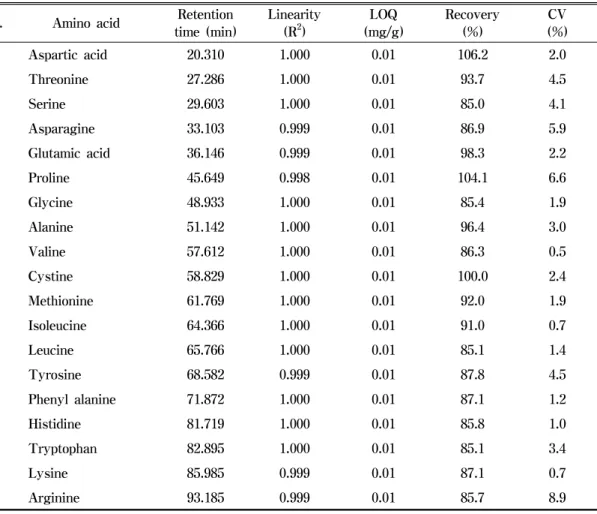
analyzer로 분석하는 방법을 이용하였다. 담배 시 료를 이용하여 시료 추출 및 방법의 정확성을 확인 하기 위하여 직선성, 회수율, 정량한계, 재현성 등 을 실험하였다.
19개 유리 아미노산은 Fig. 1의 아미노산 혼합
표준용액과 담배 시료 크로마토그램에 나타난 바와 같이 cation exchange LCA 컬럼에 의해 모두 분 리가 되었다. 각 아미노산의 머무름 시간, 정량한 계, 회수율 및 재현성 결과는 Table 2에 나타내었 다. 19개 아미노산의 검량선 직선성(R2)은 0.998 ~ 1.000 범위였고, 재현성은 변동율(CV %)이 0.5
%(valine) ~ 8.9 %(arginine), 정량한계는 0.01 mg/g 수준으로 미량까지 검출이 가능하였다. 회수 율 실험은 잎담배에 아미노산 혼합 표준용액을 첨 가하여 수행하였고 그 결과 aspartic acid 등 19개 성분에서 85 % ~ 106 % 수준을 나타내어 잎담 배 중 존재하는 유리 아미노산 함량 분석에 적절한 것으로 확인되었다.
Table 2. The retention time, linearity, limit of quantitation and recoveries of amino acids by the analysis
No. Amino acid Retention time (min)
Linearity (R2)
LOQ (mg/g)
Recovery (%)
CV (%)
1 Aspartic acid 20.310 1.000 0.01 106.2 2.0
2 Threonine 27.286 1.000 0.01 93.7 4.5
3 Serine 29.603 1.000 0.01 85.0 4.1
4 Asparagine 33.103 0.999 0.01 86.9 5.9
5 Glutamic acid 36.146 0.999 0.01 98.3 2.2
6 Proline 45.649 0.998 0.01 104.1 6.6
7 Glycine 48.933 1.000 0.01 85.4 1.9
8 Alanine 51.142 1.000 0.01 96.4 3.0
9 Valine 57.612 1.000 0.01 86.3 0.5
10 Cystine 58.829 1.000 0.01 100.0 2.4
11 Methionine 61.769 1.000 0.01 92.0 1.9
12 Isoleucine 64.366 1.000 0.01 91.0 0.7
13 Leucine 65.766 1.000 0.01 85.1 1.4
14 Tyrosine 68.582 0.999 0.01 87.8 4.5
15 Phenyl alanine 71.872 1.000 0.01 87.1 1.2
16 Histidine 81.719 1.000 0.01 85.8 1.0
17 Tryptophan 82.895 1.000 0.01 85.1 3.4
18 Lysine 85.985 0.999 0.01 87.1 0.7
19 Arginine 93.185 0.999 0.01 85.7 8.9
잎담배 중 유리 아미노산 분석
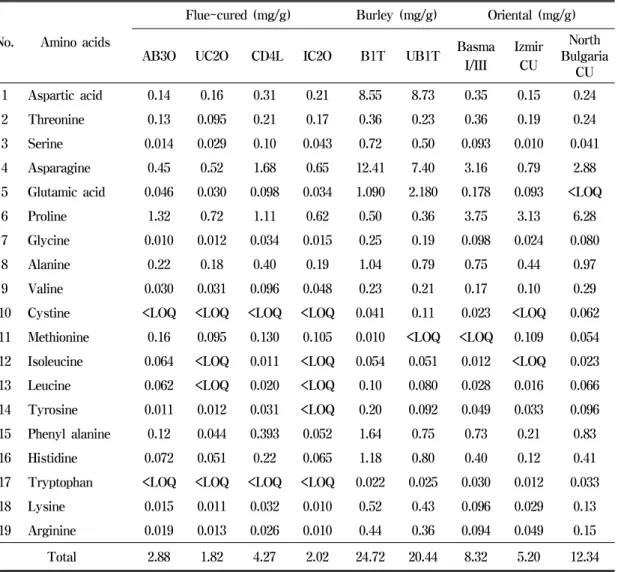
황색종, 버어리종 및 오리엔트종 등 9개 원료엽 의 유리 아미노산을 분석하여 담배 종류별 19개 아 미노산의 함량차이를 조사하여 Table 3에 나타내 었다. 분석한 유리 아미노산 총 함량은 황색종 AB3O, UC2O, CD4L, IC2O는 각각 2.88, 1.82, 4.27, 2.02 mg/g, 버어리종 B1T, UB1T는 각각 24.72, 20.44 mg/g, 그리고 오리엔트종 바스마 I/III, 이즈미르 CU, 노스불가리아는 각각 8.32, 5.20, 12.34 mg/g을 나타내었다. 원료엽 중 아미노 산 함량은 버어리종이 가장 높았고, 그다음이 오리 엔트종, 황색종 순이었다. Zhu 등(2008)이 보고한 결과에서도 버어리종이 21.10 mg/g으로 다른 품종
Table 3. Free amino acids amount of tobacco samples in different type
No. Amino acids
Flue-cured (mg/g) Burley (mg/g) Oriental (mg/g)
AB3O UC2O CD4L IC2O B1T UB1T Basma I/III
Izmir CU
North Bulgaria
CU 1 Aspartic acid 0.14 0.16 0.31 0.21 8.55 8.73 0.35 0.15 0.24 2 Threonine 0.13 0.095 0.21 0.17 0.36 0.23 0.36 0.19 0.24 3 Serine 0.014 0.029 0.10 0.043 0.72 0.50 0.093 0.010 0.041 4 Asparagine 0.45 0.52 1.68 0.65 12.41 7.40 3.16 0.79 2.88 5 Glutamic acid 0.046 0.030 0.098 0.034 1.090 2.180 0.178 0.093 <LOQ 6 Proline 1.32 0.72 1.11 0.62 0.50 0.36 3.75 3.13 6.28 7 Glycine 0.010 0.012 0.034 0.015 0.25 0.19 0.098 0.024 0.080 8 Alanine 0.22 0.18 0.40 0.19 1.04 0.79 0.75 0.44 0.97 9 Valine 0.030 0.031 0.096 0.048 0.23 0.21 0.17 0.10 0.29 10 Cystine <LOQ <LOQ <LOQ <LOQ 0.041 0.11 0.023 <LOQ 0.062 11 Methionine 0.16 0.095 0.130 0.105 0.010 <LOQ <LOQ 0.109 0.054 12 Isoleucine 0.064 <LOQ 0.011 <LOQ 0.054 0.051 0.012 <LOQ 0.023 13 Leucine 0.062 <LOQ 0.020 <LOQ 0.10 0.080 0.028 0.016 0.066 14 Tyrosine 0.011 0.012 0.031 <LOQ 0.20 0.092 0.049 0.033 0.096 15 Phenyl alanine 0.12 0.044 0.393 0.052 1.64 0.75 0.73 0.21 0.83 16 Histidine 0.072 0.051 0.22 0.065 1.18 0.80 0.40 0.12 0.41 17 Tryptophan <LOQ <LOQ <LOQ <LOQ 0.022 0.025 0.030 0.012 0.033 18 Lysine 0.015 0.011 0.032 0.010 0.52 0.43 0.096 0.029 0.13 19 Arginine 0.019 0.013 0.026 0.010 0.44 0.36 0.094 0.049 0.15 Total 2.88 1.82 4.27 2.02 24.72 20.44 8.32 5.20 12.34
과 비교하여 더 높은 함량을 나타내고 있었다. 버 어리종과 황색종의 경우 국내산이 외산보다 다소 높았으며, 오리엔트종은 국가별로 함량 차이를 보 였다.
Proline은 AB3O, UC2O, IC2O 황색종에서 총 유 리아미노산 함량 중 30 % ~ 45 % 범위로 아미노 산 중 가장 높은 함량으로 존재하였고 CD4L의 경 우에는 asparagine이 39 %로 가장 많이 검출되었 고, 그다음 proline이 26 % 순이었다. 즉, 국내산, 미국산, 인도산 황색종에서는 proline이 현저하게 높게 나타났고, 중국산 황색종에서는 asparagine과
proline이 다량 검출되어 잎담배 원산지별로 아미 노산 함량의 차이가 확인되었다. 황색종에서 가장 낮은 함량을 나타낸 아미노산으로는 cystine과 tryptophan으로 정량한계 이하로 검출되었다.
반면 proline은 버어리종에서 낮은 함량을 보였 고, Yang 등(1993)과 Zhu 등(2008)의 결과와 같이 asparagine과 aspartic acid가 버어리종 잎담배에서 가장 높은 함량으로 존재하는 것으로 확인되었다.
국내산 버어리종 B1T에 경우, 총 아미노산 함량 중 asparagine은 50 %이었고 aspartic acid는 35
%를 차지하였으며, 미국산 UB1T의 경우에는
aspartic acid가 43 %, aspargine이 36 %로 비슷한 수준이었다. 버어리종에서는 이들 두 아미노산이 전체 아미노산의 80 % 수준으로 존재하는 것으로
확인되었다. 그다음으로 많은 아미노산으로는
glutamic acid이었으며, methionine은 버어리종에서 가장 낮은 함량을 나타내었다.
오리엔트종에서는 총 아미노산 함량 중 proline 이 45 % ~ 60 % 범위로 가장 높은 함량을 나타 내었고, 다음은 asparagine으로 15 %에서 37 %까 지 함유되어 있었다. 세가지 다른 오리엔트종 중 이즈미르에서 전체 아미노산 중 proline의 비율이 가장 높았으며, 노스불가리아에서는 바스마와 이즈 미르의 2배 수준의 proline이 확인되었다. 19개 유 리 아미노산 중 황색종, 버어리종, 오리엔트종 원료 엽 모두에서 미량으로 검출된 아미노산은 cystine, methionine, tryptophan 등이었다.
결 론
본 연구에서는 담배 중 유리 아미노산을 동시 추 출하고 on-line 상태에서 post-column 유도체화한 후 photometer로 검출할 수 있는 분석법을 정립하 여 원료엽 중 아미노산 함량을 정량 분석하고자 하 였다. 아미노산 19종의 검량선 직선성은 0.998 ~ 1.000, 회수율은 85 % ~ 106 %, 재현성(CV %)은 9 %이내, 정량한계는 0.01 mg/g을 나타내었다. 따 라서 ninhydrin 유도체화 후 automated amino acid analyzer로 분석하는 방법은 잎담배 중 아미노산의 함량을 미량 수준까지 간편하게 분석할 수 있는 방 법으로 판단되었다.
잎담배 종류별(황색종 4종, 버어리종 2종 및 오 리엔트종 3종)로 유리 아미노산을 분석한 결과, 유 리 아미노산 총 함량은 버어리종이 가장 높았고, 그 다음이 오리엔트종, 황색종 순이었다. 버어리종 과 황색종인 경우 국내산이 외산보다 다소 높았으 며, 오리엔트종은 국가별로 함량 차이가 있었다. 버 어리종에서는 asparagine, aspartic acid 함량이 높 았고, 황색종과 오리엔트종에서는 asparagine, proline의 함량이 다른 아미노산에 비해 높았다. 미 량으로 검출된 아미노산은 cystine, methionine, tryptophan 등이었다.
참 고 문 헌
Alexander, R.R. (1985) Griffiths, J.M., Wilkinson, M.L. Identification of amino acids by thin-layer chromatography, Basic Biochemical Methods, Wiley, New York, pp. 24-28.
Bailey, J.L. (1962) Estimation of amino acids by ninhydrin, techniques in protein chemistry, Elsevier, Amsterdam, pp. 73-81.
Cohen, S.A., Bidlingmeyer, B.A., and Tarvin, T.L. (1986) PITC derivatives in amino acid analysis. Nature 320: 769-770.
Davis, D.D. and Nielsein M.T. (1999) Tobacco production, chemistry and technology, Blackwell Science, Oxford: U. K., p 273.
Dejong, C., Hughes, G.J., Wieringen, E. and Wilson, K.J. (1982) Amino acid analyses by high-performance liquid chromatography—an evaluation of the usefulness of precolumn DNS dervatisation. J Chromatogr 241: 345-359.
Hirs, C.H.W. Detection of peptides by chemical methods, Methods in Enzymology, Enzyme Structure vol. XI, Academic Press, San Diego, pp. 325–329, 1967.
Hurst, P.L., Sinclair, B.K. and Eason, J.R. (1995) Amino acids interfere with the ninhydrin assay for asparagines, Food Chemistry 53:
467–469.
Laseter, J.L., Weete, J.D., Albert, A. and Walkinshaw, C.H. (1971) Gas chromatographic determination of trimethylsilyl derivatives of free amino acids from a botanical source,
Analytical Letter 4: 671-681.
Moore, S. and Stein, W.H. (1948) Photometric ninhydrin method for use in the chromatography of amino acids,
J.
Biological Chem. 176: 367-388.
Noma, M., Noguchi, M. and Tamaki, E. (1973) Isolation and characterization of D-alanyl- D-alanine from tobacco leaves, Agr. Biol.
Chem. 37: 2439.
Panasiuk, R., marowicz, R., Kostyra, H. and Sijtsma, L. (1998) Determination of α-amino nitrogen in pea protein hydrolysates: a comparison of three analytical methods,
Food Chemistry 62: 36337.
Roth, M. (1971) Fluorescence reaction for amino acids, Anal. Chem. 43: 880-882.
Rubinstein, M., Chen-Kiang, S., Stein, S. and Udenfriend, S. (1979) Characterization of proteins and peptides by high-performance liquid chromatography and fluorescence monitoring of their tryptic digests, Anal.
Biochem. 95: 117-121.
Tso, T.C. (1991) Production, physiology, and biochemistry of tobacco plant, Ideals Inc., Beltsville, p 497.
Watanabe, Y. and Imai, K. (1981) High- performance liquid chromatography and sensitive detection of amino acids derivatized with 7-fluoro-4-nitrobenzo- 2-oxa-1,3-diazole,
Anal. Bioehem.
116:471-472.
Yang, S.S. and Smetena, I. Determination of free amino acids in tobacco by HPLC with fluorescence detection and precolumn derivatization. Chromatographia, 37: 593–98.
Zhu, X.L., Zhu, Q.S. and Gao Y. (2008) Fast analysis of free amino acids in tobacco by HPLC with fluorescence detection and automated derivatization,