• 검색 결과가 없습니다.

Delay Factors in Building Construction Projects in Rwanda

N/A
N/A
Protected

Academic year: 2021

Share "Delay Factors in Building Construction Projects in Rwanda"

Copied!
9
0
0

로드 중.... (전체 텍스트 보기)

전체 글

(1)

J. Korea Inst. Build. Constr. Vol. 19, No. 5 : 467-475 / Oct, 2019

https://doi.org/10.5345/JKIBC.2019.19.5.467 www.jkibc.org

Delay Factors in Building Construction Projects in Rwanda

1) Umuhoza, Esperance

1

An, Sung-Hoon

2*

Master’s course, Department of Architectural Engineering, Daegu University, Gyeongsan-si, Gyeongsangbuk-do, 38453, Korea

1

Professor, Department of Architectural Engineering, Daegu University, Gyeongsan-si, Gyeongsangbuk-do, 38453, Korea

2

Abstract

Delay is one of the most critical issues for construction projects and leads to huge losses in both developing and industrialized countries. The construction sector in Rwanda, a rapidly-developing nation, is no exception. Delays can be mitigated only once we have identify their primary causes, and these may not be the same in each region. This study aims to ascertain the main critical factors responsible for delays in building construction in Rwanda through an intensive literature review and questionnaire survey. A total of 40 delay causative factors were obtained from a literature review and were further classified into nine major categories. The questionnaire survey was distributed to about 80 respondents from clients, contractors, and consultants. From the list of 40 different factors, the top twelve most critical causes were identified as stoppage of work due to cash flow constraints, delay in approving design documents, confidentiality of physical plan, price fluctuations and delay in approving significant change, change orders, delay in performing inspections, Ineffective project planning, inadequate drawing details, unqualified labor, lack of materials on the market and dishonesty.

Keywords : delay factors, rwanda, risk assessment, risk management

1. Introduction

Delay is a ubiquitous issue for construction projects in both developing and industrialized countries [1]. As countries differ from each other in terms of their geographical, political, social, and financial situations, their reasons for the causes of late completion of projects may vary, let alone their magnitude on delay duration.

In particular, construction time overrun situations are most severe in developing countries due to their limited resources and lack of project management

Received : August 14, 2019 Revision received : October 10, 2019 Accepted : October 10, 2019

* Corresponding author: An Sung-Hoon

[Tel: 82-53-850-6518, E-mail: [email protected]]

ⓒ2019 The Korea Institute of Building Construction, All rights reserved.

skills. Moreover, construction works are mostly performed by small and local companies that rely heavily on the skills of the workers rather than project management [2-4]. As such, a considerable number of projects are delayed, and others are finally abandoned. For this reason, it is imperative to examine the critical causes affecting delays in the Rwandan context, as a step toward providing ways to mitigate the issue and benefit the construction industry in the process.

As in many developing nations, construction

project delay has been an ongoing issue in Rwanda,

with proposed and current projects either delayed

or postponed. Rwanda is a developing country

located in East Africa, which began to develop its

economy following the genocide in 1994. Although

the Rwanda’s construction industry is expected to

account for the majority of its gross domestic

(2)

Delay Factors in Building Construction Projects in Rwanda

product (GDP) growth at average annual growth of almost 4% since 2020[5], many construction projects are posing delay-related risks such as cost overruns and conflicts or claims. According to the findings of Amandin and Julius[6], 65,7% of public construction projects in just one district of Rwanda were delayed during 2012-2015. An example of the delayed projects is the Kigali convention center, which was initially scheduled to be completed in 2011, but was postponed until 2016. Another example is the Bugesera international airport construction project of Rwanda, which was expected to be completed by 2016, whose ground has not been broken [7].

According to Rwanda's annual report in 2018[8], building projects were one of the project types subject to significant delays in Rwanda. If these projects are delayed, it will increase government expenditure as well as slow down the urbanization of the country, which is one of the main goals of vision 2020 in Rwanda [9]. Besides, the delay would give investors a negative perception of the country, which may result in making investors reluctant and reducing competition in the local construction industry.

As Rwanda has recently had a great many investors and projects with foreign construction companies including Korean companies. For this reason, it is high time to conduct this research to help the practitioners to identify exact causes or sources of delays and to resolve the delay problems.

Even though many researchers have studied construction delay in different countries over the years, there are insufficient studies on the causes of delays in building construction in Rwanda. To be more specific, this study is considered to be the first research investigating the factors that may affect delays in building construction project in Rwanda.

This study is to find out the key factors contributing to the causes of delays in building

construction in Rwanda. Delays in residential, mix-use and commercial buildings in Rwanda are researched. A literature review of the related studies was conducted, and survey questionnaires were distributed to contractors, consultants and clients to get their opinions regarding the key factors affecting the delays in building construction in Rwanda. The top key factors were assessed and ranked by analyzing the chance of occurrence of all possible delay factors in the Rwandan context and their relative impact on delay duration.

2. Literature review

The most relevant empirical studies covering 20 countries, including both developing and developed countries across the five continents were initially reviewed to uncover possible causes of delay in construction projects. Among them, we chose some of them, focusing on the ones most cited or most recent.

From the studies we chose, we categorized nine types of delay causative factors: financial/economy-related, managerial-related, design-related, labor-related, material-related, equipment-related, environment, and site–related, information and communication- related, and government/local authorities–related factors [10-14].

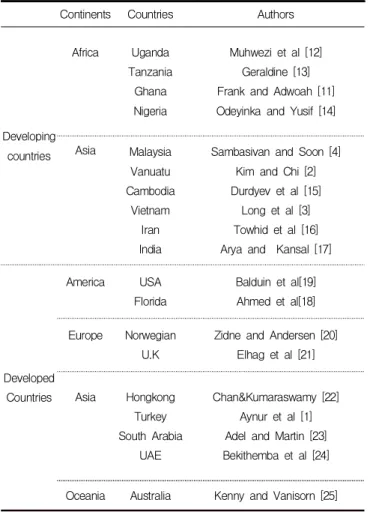
Therefore, the causative factors in both developing and developed countries are analyzed, and the findings are summarized in Table 1.

2.1 International studies

2.1.1 Developing countries

Internal causes of delays may arise from all the

participants in a construction project (e.g. contractor,

client and consultant) [11]. These include financial

-related, managerial-related, design-related, labor-

related, material-related, equipment-related, and

information/communication-related causes. Several

(3)

countries have also discovered those causes. Frank and Adwoa[11] found the main delay causes in building construction in Ghana to be financial group factors, which included delays in honoring payment certificates, and difficulty in accessing credit and fluctuation in prices. Material group factors are second followed by Managerial factors. Muhwezi et al. [12] in Uganda, Geraldine[13] in Tanzania, and Odeyinka and Yusif[14] in Nigeria added in their studies (1) managerial factors in the area of delays when assessing work’s changes and as inadequate site investigation by the consultants, (2) design related factors including design errors by designers and information related factors, and (3) resource supply related factors as major construction delay factors in those countries, respectively.

Table 1. Previous studies on delay factors worldwide

Continents Countries Authors

Developing countries

Africa Uganda Tanzania

Ghana Nigeria

Muhwezi et al [12]

Geraldine [13]

Frank and Adwoah [11]

Odeyinka and Yusif [14]

Asia Malaysia Vanuatu Cambodia

Vietnam Iran India

Sambasivan and Soon [4]

Kim and Chi [2]

Durdyev et al [15]

Long et al [3]

Towhid et al [16]

Arya and Kansal [17]

Developed Countries

America USA

Florida

Balduin et al[19]

Ahmed et al[18]

Europe Norwegian U.K

Zidne and Andersen [20]

Elhag et al [21]

Asia Hongkong Turkey South Arabia

UAE

Chan&Kumaraswamy [22]

Aynur et al [1]

Adel and Martin [23]

Bekithemba et al [24]

Oceania Australia Kenny and Vanisorn [25]

have also uncovered a similar list of delay factors.

From a list of 28 different delay causes in Malaysia through a survey questionnaire, Sambasivan and Soon[4] concluded that the main causes of delays were poor planning, poor management, inadequate supervisory skills of the contractor, delay payments, material shortage, labor supply, equipment availability and failure, poor communication, and reworks. In their studies on building construction delays in Vanuatu, Kim and Chin[2] highlighted the complexity of projects and labor absenteeism as the factors included in the most important delay cause, while bad weather was cited by Durdyev et al[15] in Cambodia. Other studies about construction delays that found almost the same causes as those illustrated above include Long Le-Hoai et al in Vietnam[4], Towhid et al[16] in Iran and Arya and Kansal[17] in India.

2.1.2 Developed countries

According to Ahmed et al[18], who investigated causes of delays in construction projects in Florida, revealed that code-related, design-related, construction -related, financial/economical, management /administrative and acts of God are the most critical delay categories.

And across those categories, building permit approval, requests for changes, change in drawings, incomplete documents, inspections, change in specifications, decision during development stage, and shop drawing approval are the ten most critical causes. By using the relative importance index method, Balduin et al. [19]

identified three similar major delay factors in the U.S.

In European countries, Zidne and Andersen[20]

conducted a study of delay and their remedies in

Norwegian projects, identified sponsor/owner/ client,

lack of commitment and or clear demands (goals and

objectives) as a major cause of delay and added to those

found in the above developed countries. In their studies

of construction cost and time attributes in U.K., Elhag

et al.[21] also identified project characteristics

(4)

Delay Factors in Building Construction Projects in Rwanda

and contract procedures as new categories of delay causative factors.

From other previous studies in developed countries of Asia and Oceania [1,22-25], the discovered top major delay factors are not different from those identified in the above studies.

2.2 Local studies

Amandin and Kule[4] researched project delays on cost overrun risks in Gasabo district, one of the 30 districts in Rwanda using an open-ended questionnaire. They found that the top five causes of delays for public construction projects from 2012 to 2019 were delayed payment, financial deficiencies on the part of client and contractor, material procurement and poor supervision.

Meanwhile, in their study about causative factors leading to cost overrun in dam construction projects in Rwanda, Gasasira et al[26] found that slow decision making, poor schedule management, poor cost estimation, poor contract management, poor design and delay in providing design, problem in land acquisition, and poor soil investigation were the top main causes.

3. Research Methods

From the literature review, a total of 40 delay factors were selected according to their frequencies and their fitness in the Rwandan context. These were generalized into nine types of delay causative factors, which were financial/economy-related, managerial-related, design-related, labor-related, material-related, equipment-related, environment and site–related, information and communication -related, and government/local authorities–related.

Based on these, the questionnaire was made.

Before making the questionnaire, a small pilot study was conducted through phone interviews with five consultants, five contractors and five clients.

The basic aim of this study was to check whether the delay factors captured through the literature review were relevant for Rwanda or not. Ultimately, we did not make any change to the identified delay factors.

A questionnaire survey was conducted to identify the opinions from clients, consultants, and contractors on the relative importance of causes of delays in building projects in Rwanda by assigning a probability of occurrence of the delay factors, assessing the impact of delay factors on construction’s duration, and specifying a stakeholder responsible for any delay factors.

The first section of the questionnaire pinpointed the background information about the respondents.

The second section contained 40 causes of building delays in Rwanda identified through an intensive literature review and a small pilot survey.

4. Analysis of Data

Data were collected from 80 respondents, and their demographic characteristics are shown in Table 2.

4.1 Analyzing Using International Project Risk Assessment Tool (IPRA)

The IPRA tool is used to rate the degree of risk factors on cost, schedule and quality of an international construction project [27]. It was adapted to this paper as it also helped to identify the ranking of factors affecting construction delays through assessing the degree of critical elements.

In addition, this tool is of great significance as it

provides a guideline for an assessment team to

determine both the level of occurrence and impact

of a certain factor. It is an advanced tool for

highlighting the degree of factors that may affect

the construction schedule.

(5)

Categories Demographic characteristics Frequency Percentage (%)

Age

25-30years old 30-35years old 35-40years old

41-above

26 16 22 16

32.5 20 27.5

20

Sex Male

Female

43 37

54 46 Type of

organization

Project management consultant Design consultants General contractors

Clients

25 25 20 10

31 31 25 13

Number of years working

experience

Less than 5 5-10 10-15 15-20

15 20 20 25

19 25 25 31 Building type Residential

Commercial Mixed use Institutional Educational

25 20 10 15 10

30 13 25 19 13

Project delivery method

Owner direct force General contractor Design build turnkey Build operate transfer Professional construction

management

30 27 13 5 5

38 34 16 6 6

Type of Contract

Competitive bidding Negotiated cost plus

Combination

38 27 15

47 34 19

For the likelihood of the occurrence section, a 5-point Likert scale is used and each value corresponds to their probability of the occurrences as shown in Table 3.

Sign Occurrence Probability

NA Not applicable to this project zero

1 Very low chance of

occurrence, rare and occurs only in exceptional

circumstances

(0~9%)

2 Low chance and unlikely to occur in most circumstances

(10~5%)

3 Medium chance and possible to occur in most circumstance

(35~64%)

4 High chance of happening and will probably occur in most

circumstances

(65~89%)

5 Very high chance of

occurrence and almost certain and expect in most

circumstances

(90~100%) Table 3. Division of likelihood of occurrence [27]

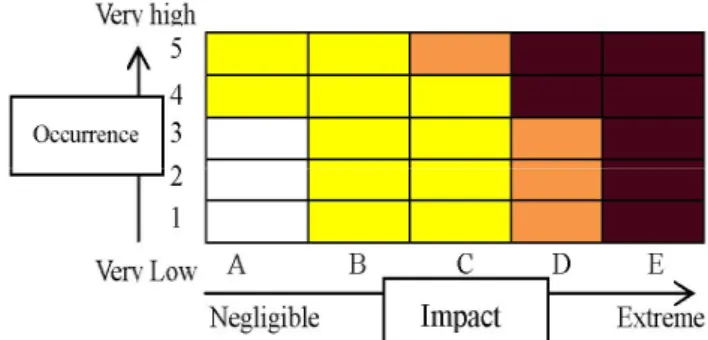
Figure 1. Risk factor assessment matrix of IPRA tool[28]

The relative impact of a factor determines the consequence of the factor occurring. The values used are A-negligible, B-low consequence, C-moderate consequence, D-significant consequence, and E- extreme consequence for the duration.

On the final matrix in Figure1, the two values (likelihood of occurrence and Relative impact) are combined. This gives the relative importance of factor which helps in ranking. The upper right area of the matrix in red represents the greatest risk factor and the lower left area in green is of lesser concern.

4.2 Result of Research

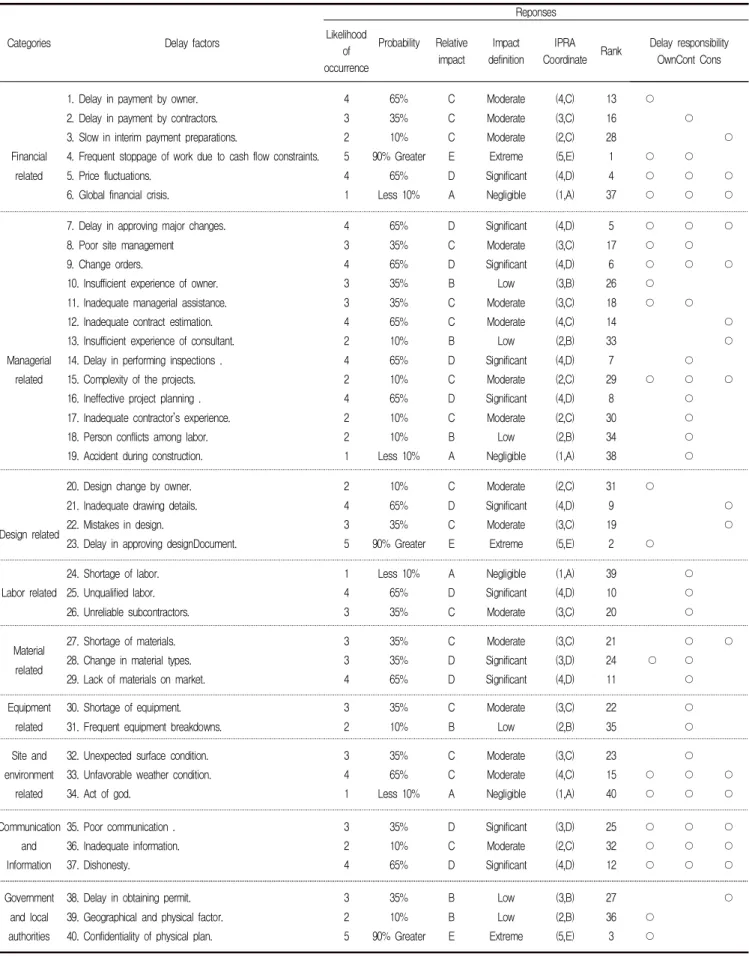
Table 4 indicates the results given to the different delay factors such as (1) likelihood of occurrence in terms of the 5-point Likert scale and their corresponding probability in terms of percentages, (2)the relative impact represented by the letters A-E according to their effect level that is explained in impact definition, (3) the combination of both likelihood and impact gave the IPRA coordinates used for ranking, and (4) each delay factor also corresponds to its responsible construction stakeholder such as Owner(Own),Contractor (Cont), Consultant(Cons) by using the (O) Sign.

5. Discussion of results

Of the 40 delay factors which were classified in

(6)

Delay Factors in Building Construction Projects in Rwanda

Table 4. List of factors affecting building construction delays in rwanda with results from respondents

Categories Delay factors

Reponses Likelihood

of occurrence

Probability Relative impact

Impact definition

IPRA

Coordinate Rank Delay responsibility OwnCont Cons

Financial related

1. Delay in payment by owner.

2. Delay in payment by contractors.

3. Slow in interim payment preparations.

4. Frequent stoppage of work due to cash flow constraints.

5. Price fluctuations.

6. Global financial crisis.

4 3 2 5 4 1

65%

35%

10%

90% Greater 65%

Less 10%

C C C E D A

Moderate Moderate Moderate Extreme Significant Negligible

(4,C) (3,C) (2,C) (5,E) (4,D) (1,A)

13 16 28 1 4 37

Managerial related

7. Delay in approving major changes.

8. Poor site management 9. Change orders.

10. Insufficient experience of owner.

11. Inadequate managerial assistance.

12. Inadequate contract estimation.

13. Insufficient experience of consultant.

14. Delay in performing inspections . 15. Complexity of the projects.

16. Ineffective project planning . 17. Inadequate contractor’s experience.

18. Person conflicts among labor.

19. Accident during construction.

4 3 4 3 3 4 2 4 2 4 2 2 1

65%

35%

65%

35%

35%

65%

10%

65%

10%

65%

10%

10%

Less 10%

D C D B C C B D C D C B A

Significant Moderate Significant Low Moderate Moderate Low Significant Moderate Significant Moderate Low Negligible

(4,D) (3,C) (4,D) (3,B) (3,C) (4,C) (2,B) (4,D) (2,C) (4,D) (2,C) (2,B) (1,A)

5 17

6 26 18 14 33 7 29

8 30 34 38

Design related

20. Design change by owner.

21. Inadequate drawing details.

22. Mistakes in design.

23. Delay in approving designDocument.

2 4 3 5

10%

65%

35%

90% Greater C D C E

Moderate Significant Moderate Extreme

(2,C) (4,D) (3,C) (5,E)

31 9 19

2

Labor related

24. Shortage of labor.

25. Unqualified labor.

26. Unreliable subcontractors.

1 4 3

Less 10%

65%

35%

A D C

Negligible Significant Moderate

(1,A) (4,D) (3,C)

39 10 20

Material related

27. Shortage of materials.

28. Change in material types.

29. Lack of materials on market.

3 3 4

35%

35%

65%

C D D

Moderate Significant Significant

(3,C) (3,D) (4,D)

21 24 11

Equipment related

30. Shortage of equipment.

31. Frequent equipment breakdowns.

3 2

35%

10%

C B

Moderate Low

(3,C) (2,B)

22 35

Site and environment

related

32. Unexpected surface condition.

33. Unfavorable weather condition.

34. Act of god.

3 4 1

35%

65%

Less 10%

C C A

Moderate Moderate Negligible

(3,C) (4,C) (1,A)

23 15 40

Communication and Information

35. Poor communication . 36. Inadequate information.

37. Dishonesty.

3 2 4

35%

10%

65%

D C D

Significant Moderate Significant

(3,D) (2,C) (4,D)

25 32 12

Government and local authorities

38. Delay in obtaining permit.

39. Geographical and physical factor.

40. Confidentiality of physical plan.

3 2 5

35%

10%

90% Greater B B E

Low Low Extreme

(3,B) (2,B) (5,E)

27 36 3

(7)

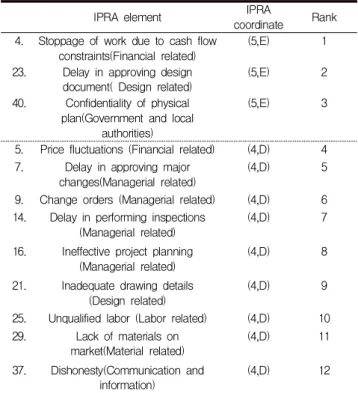
and pivot survey, the responses highlighted three factors as the most critical: stoppage of work due to cash flow constraints, delay in approving design document, and confidentiality of physical plan. These were followed by nine other critical factors: price fluctuations, delay in approving major changes, change orders, delay in performing inspections, ineffective project planning, inadequate drawing details, unqualified labor, lack of materials on market, and dishonesty (shown in Table 5 and Figure 2).

IPRA element IPRA

coordinate Rank 4. Stoppage of work due to cash flow

constraints(Financial related)

(5,E) 1

23. Delay in approving design document( Design related)

(5,E) 2

40. Confidentiality of physical plan(Government and local

authorities)

(5,E) 3

5. Price fluctuations (Financial related) (4,D) 4 7. Delay in approving major

changes(Managerial related)

(4,D) 5

9. Change orders (Managerial related) (4,D) 6 14. Delay in performing inspections

(Managerial related)

(4,D) 7

16. Ineffective project planning (Managerial related)

(4,D) 8

21. Inadequate drawing details (Design related)

(4,D) 9

25. Unqualified labor (Labor related) (4,D) 10 29. Lack of materials on

market(Material related)

(4,D) 11

37. Dishonesty(Communication and information)

(4,D) 12

Table 5. Summary of critical delay factors

Figure 2. Factors belong to high risk zone

that may cause construction delays in Rwanda was determined by the percentage value of the responses through the coordinates of both chance of occurrence and the relative impact of those factors. Therefore, when a factor was checked as a very high or high chance of occurrence and an extreme to significant impact on the construction delay, it was considered and classified in the critical and major causes.

Moreover, the results of the interview with four experts and from previous paper used IPRA tool [27,28] found that the critical risk factors are located in the red area (right) of the risk matrix, which are the ones that must be mitigated first. This concept is also applies to this paper, and we select the critical delay factors from the red area of the matrix.

The first three selected critical delay factors with very high likelihood and extreme impact are stoppage of work due to cash flow constraints, delay in approving design document, and confidentiality of physical plan. The reasons for these factors are respectively considered as financial instability, lack of good management during design, partial development of physical plans, or master plans of some areas by authorities of a local government.

The nine critical delay factors with high likelihood

and significant impact are found in the following

six categories: (1) in financial related factors, price

fluctuation; (2) in managerial related factors, delay

in approving major changes, change orders, and

delay in performing inspections and ineffective

project planning; (3) in design related factor,

inadequate drawing details; (4) in labor related

factor, unqualified labor; (5) in material related

factor, lack of materials on market; and (6) in

information and communication related factor,

dishonesty. The reasons why these factors are

critical in delaying building construction in Rwanda

are respectively considered as frequent instability

(8)

Delay Factors in Building Construction Projects in Rwanda

in the economy of the country, lack of managerial skills for building construction stakeholders, lack of attention and adequate time during designing, lack of attentiveness in selection of labors, buying materials on deadlines or slowness of importing materials from abroad and lack of authenticity of the information.

6. Conclusion

This paper describes the critical causes of delays in construction projects by emphasizing the two fundamental steps of ranking the delays as a way to mitigate their risks such as knowing their chance of occurrence and identifying their impact on the construction duration. The causes responsible for delays in building construction may differ in different regions of the world based on the characteristics of the construction industry, and the rules and regulations in the region where a project is carried out.

Based on this, the main causes of construction delays in Rwanda were highlighted, using a questionnaire survey. The analysis of the data revealed that frequent stoppage of work due to cash flow constraints, delay in approving design document, confidentiality of physical plan, price fluctuation, delay in approving major changes, change orders, delay in performing inspections, ineffective project planning, inadequate drawing details, unqualified labor, lack of materials on market, and dishonesty were among the significant factors that may cause delays.

We believe that the findings of this paper can be useful to all the participants (Clients, Contractors and Consultants) and academics. The list of most critical factors can be used by local or foreign construction stakeholders including Korean construction companies working in Rwanda to

better understand the possible risk factors that can be encountered during building construction projects and to make efforts to reduce them. The academics should conduct similar surveys in other regions of the world to find out the construction delay factors different from one country to another.

Acknowledgment

This research was supported by a Daegu University Research Grant, 2018.

ORCID

Esperance Umuhoza, https://orcid.org/0000-0002-7878-5026 Sung-Hoon An, https://orcid.org/0000-0002-0906-3302

References

1. Aynur K, Serdar U, Nihan AT. Causes of delays in construction projects in Turkey. Journal of Civil Engineering and Management. 2012 Jun;18(3):426-35.

https://doi.org/10.3846/13923730.2012.698913

2. Kim DY, Chi SH. Causes of schedule delays in building construction projects in vanuatu. Korea Institute of Building Construction. 2015 Jun;15(6):641-51.

https://doi.org/10.5345/JKIBC.2015.15.6.641

3. Long LH, Young DL, Jun YL. Delay and cost overruns in Vietnam large construction projects: A comparison with other selected countries. KSCE Journal of Civil Engineering. 2008 Jul;12(6):367-77.

https://doi.org/10.1007/s12205-008-0367-7

4. Sambasivan M, Soon WY. Causes and effects of delays in Malaysian construction industry. International Journal of Project Management. 2007 Jul;25(5):517-26.

https://doi.org/10.1016/j.ijproman.2006.11.007

5. Opportunities in the construction industry in Rwanda[Internet].

Business Sweden in Eastern Africa,2017[Cited: 2017 April 21].

Available from:

https://www.businessSweden.Se/Contentassets/46366e8d9f 584bf495f139ae7f2020d7/factpack-construction-industry-i n-rwanda-2017.pdf.

6. Amandin MM, Julius WK. Project construction projects Kigali.

(9)

factors influencing timely completion of road project in Rwanda:

Case of Government Externally Financed Projects. European Journal of Business and Social Sciences. 2016 Apr;5(01):

146-59.

8. Report of the auditor of state finances for the year ended 30 June 2017. Rwanda: Office of the auditor general of state finances, 2017 [Cited: 2018April20]. Available from:www oag.gov.rw/fileadmin/user-upload/Financial reports/Annual Report-june-2017-ExecutieSummary.pdf

9. The world bank. Project information documents/integrated safeguards datasheet(PID/ISDS). Rwanda affordable housing finance project, 2018. [Cited:2018 Sept 18]. Available from:

documents.Worldbank.org/curated/en/33851153767763132/p df/Project-Information-Document-Integrated-Safeguards-D ata-Sheet-Rwanda-Housing-Finance-Project-P165649.pdf 10. Kenny W, Vanissorn V. A study of the factors affecting

construction time in western Australia. Scientific Research and Essays. 2012 Oct;7(40):3390-8.

https://doi.org/10.5897/SRE12.138

11. Fugar FDK, Agyakwah-Baah AB. Delays in building construction projects in Ghana. Australasian Journal of Construction Economics and Building. 2010 Jul;10(1/2):103-16.

https://doi.org/10.5130/AJCEB.v10i1-2.1592

12. Muhwezi L, Acai J, Otim G. An assessment of the factors causing delays on building construction projects in Uganda. International Journal of Construction Engineering and Management. 2014 Mar;3(1):13-23.

https://doi.org/10.5923/j.ijcem.20140301.02

13. Geraldine K. Causes and effects of delays and disruptions in construction projects in tanzania. Australasian Journal of Construction Economics and Building Conference Series.

2012;1(2):52-9. https://doi.org/10.5130/ajceb-cs.v1i2.3166 14. Odeyinka AH, Yusif A. The causes and effects of construction

delays on completion cost of housing projects in Nigeria. Journal of Financial Management of Property and Construction. 1997 Jan;2(3):31-44.

15. Durdyev S, Omarov M, Ismail SOM. Causes of delay in residential construction projects in Cambodia. Cogent Engineering. 2017 Feb;4(1):1-12.

https://doi.org/10.1080/23311916.2017.1291117

16. Pourrostam T, Ismail A. Causes and effects of delay in Iranian construction projects. International Journal of Engineering and Technology. 2012 Oct;4(5):598-601.

in India: Causes and effects. IJSTE International Journal of Science Technology and Engineering. 2016 Dec;3(6):66-74.

18. Ahmed SM, Azher S, Castillo M, Kappagantula P. Construction delays in Florida: An empirical study. Miami: Florida International University (US); 2002. 44 p. Report No.: CEAS2952 19. Balduin JR, Manthei JM , Rothbart H , Harris RB. Causes of

delay in the construction industry. Journal of the construction Engineering Division .1971;97(2):177-87.

20. Zidane JTY, Andersen B. Causes of delay and their cures in major Norwegian projects. Journal of Modern Project Management. 2018 5(3);80-91.

21. Elhag TMS, Boussabaine AH. Evaluation of construction cost and time attributes. 15th Annual ARCOM Conference; 1999 Sep 15-17; Liverpool John Moores University, UK.

Reading(UK): Association of Researchers in Construction Management; 1999. p. 473-80.

22. Chan DWM, Kumaraswamy MM. Compresing construction durations: Lessons learned from Hong Kong building projects.

International Journal of Project Management. 2002 Jan;20 (1):23-35.

https://doi.org/10.1016/S0263-7863(00)00032-6

23. Adel AK, Martin S. Causes of Delays in Saudi Arabian Public Sector Construction Projects. Construction Management and Economics. 2009;27(1):23-35.

24. Bekithemba M, Eduard GO, Cletus M, Adrian P. Profiling causative factors leading to construction project delays in the United Arab Emirates. Journal of Engineering Construction and Architectural Management. 2017 Mar;24(2):346-76.

https://doi. org/10.1108/ECAM-05-2015-0072

25. Kenny, Vanissorn. A study of the factors affecting construction time in western Australia. Scientific Research and Essays. 2012 Oct;7(40):3390-8. https://doi.org/10.5897/SRE12.138 26. Gasasira I, Peter M, Eugene N. The causative factor leading

to cost overrun in dam construction project in Rwanda: Case study Kinoni 1 dam construction project. European Journal of Business and Social Sciences. 2016 Feb;4(11):142-68.

27. Walewski JA. International Project Risk Assessment (IPRA), [dissertation]. [Austin (Texas)]: The University of Texas at Austin; 2005. 388 p.

28. An SH, Lee YN, Jo HK. A study on the risk assessment

methodology and application for international plants

construction. Journal of Korean Institute of Construction

Engineering and Management. 2007 Oct;9(1):134-42.

수치

Table 1. Previous studies on delay factors worldwide
Table 4 indicates the results given to the different  delay factors such as (1) likelihood of occurrence in  terms  of  the  5-point  Likert  scale  and  their  corresponding probability in terms of percentages,  (2)the  relative  impact  represented  by
Table 4. List of factors affecting building construction delays in rwanda with results from respondents
Figure 2. Factors belong to high risk zone

참조

관련 문서

In addition to, the key factors of successful business start-up are demonstrated by synthetically examining how the factors influence the outcome of

Among the sub-factors, confidence, The factors of setting, team harmony, image and will power were higher in the group with national representative

The improvement factors of the performance showed significant increase in muscle strength, muscle endurance, cardiovascular endurance, power, agility and

Based on the literature reviews, this study employs six factors in two groups of influencing factors, web-site characteristics and individual characteristics

Following issues in co-teaching were studied in order to identify the central phenomena and their relevant factors involved in co-teaching to fomulate

Ross: As my lawfully wedded wife, in sickness and in health, until

다양한 번역 작품과 번역에 관한 책을 읽는 것은 단순히 다른 시대와 언어, 문화의 교류를 넘어 지구촌이 서로 이해하고 하나가

The index is calculated with the latest 5-year auction data of 400 selected Classic, Modern, and Contemporary Chinese painting artists from major auction houses..