• 검색 결과가 없습니다.

Analysis of Genetic Variation in the Small Subunit Ribosomal RNA Gene of Euplotes Ciliates for Developing Species Diagnostic Molecular Marker

N/A
N/A
Protected

Academic year: 2021

Share "Analysis of Genetic Variation in the Small Subunit Ribosomal RNA Gene of Euplotes Ciliates for Developing Species Diagnostic Molecular Marker"

Copied!
9
0
0

로드 중.... (전체 텍스트 보기)

전체 글

(1)

225 [Note]

종 식별분자마커개발을 위한섬모충류 Euplotes의

small subunit ribosomal RNA

변이성 분석

김선영·김세주1,†·민기식1·양은진2·유만호·최중기*

인하대학교 해양과학과,

1

인하대학교 생명과학과,

2

한국해양연구원 해양환경 연구본부

Analysis of Genetic Variation in the Small Subunit Ribosomal RNA Gene of Euplotes Ciliates for Developing Species Diagnostic Molecular Marker

SUN YOUNG KIM

, SE-JOO KIM

1,†

, GI-SIK MIN

1

, EUN JIN YANG

2

, MAN HO YOO AND JOONG KI CHOI*

Department of Oceanography, Inha University, Incheon 402-751, Korea

1

Department of Biological Sciences, Inha University, Incheon 402-751, Korea

2

Marine Environment Research Department, KORDI, Ansan P.O. Box 29, Korea

Small subunit ribosomal RNA (18S rRNA) 의 loop 부위들의 변이를 분석하여 해양 섬모충류의 종 특이 유전적 마커로써 이용 가능성을 확인하고자 9 종의 Euplotes (Hypotrichia : Ciliophora) 대하여 18S rRNA 유전자의 염기

서열 변이성을 조사하였다 . 연구 결과에 의하면 V1, V3 그리고 V5 부위는 종간 변이가 없었고 , V7 과 V8 은 종간 변이는 높으나 염기서열의 길이가 각각 44 bp 79 bp 길이가 짧아서 충분한 유전 정보를 가지기 어렵기 때문에

이 부위들은 종특이 분자마커로 적합하지 않았다 . 그러나 V2 와 V4 부위는 1.75~20.61% 로 높은 변이성을 보여주었 고 종간 계통 관계도 잘 나타내었다 . 또한 염기서열의 길이도 각각 123 bp 306 bp 마커 개발에 충분한 길이를

가지고 있었다 . 따라서 18S rRNA 의 V2 와 V4 부위는 섬모충류의 종 특이 분자 마커 개발에 가장 적합한 부위라는

결론을 얻었다 .

To verify which loop regions of 18S rRNA gene are suitable as species-specific genetic markers in ciliates, we analyzed the genetic variation of 18S rRNA gene among 9 Euplotes species (Hypotrichia : Ciliophora). In our result, no inter-specific variation was detected from V1, V3 and V5 regions, and the length of V7 and V8 are 44 bp and 79 bp, respectively, which are too short to make genetic marker. In contrast, V2 and V4 may be good candidate segments of species-specific diagnostic molecular markers because these two regions are most variable (1.75~20.61%) and showed good inter-specific phylogeny. Furthermore, the sequences of V2 and V4 are 123 bp and 306 bp, respectively in length which are enough to make species-specific marker.

Keywords: Euplotes , molecular marker, small subunit ribosomal RNA (18S rRNA), variable region, V2, V4

서 론

원생동물에 속하는 섬모충류는 수생부유생태계에서 종 다양성 이 높고 생물량이 많을 뿐 아니라 상위단계로의 에너지 전달자로 서 중요한 역할을 하고 있기 때문에 생태 및 분류학적으로 매우 중요한 분류군이라 할 수 있다 (James and Hall, 1995; Montagnes and Lynn, 1991; Sherr and Sherr, 1988). 그러나 중요성에

해서 섬모충류에 대한 분류학적 연구에 많은 논란이 있으며

(Montagnes and Lynn, 1991), 이와 같이 전통 섬모충류 분류의 장

애요인은 아래와 같다 . (1) 단세포 생물로 개체의 크기가 매우 미

소하다 ( 주로 200 µ m 이하 ). (2) 많은 종에 있어서는 성장 단계 , 영

양상태 등에 따른 심한 형태변이가 나타나 분류에 큰 혼란이 야

기되고 있다 . 한편 형태 변이를 관찰하기 위해서는 순배양 (pure

culture) 이 필요하지만 섬모충류의 실험실 순배양은 배양조건이 까

다로워서 많은 어려움이 따르고 있다 (Gifford, 1985). (3) 분류에

이용되는 주요 식별형질 (key character) 을 관찰하기 위해서는

protargol staining 또는 silver staining 복잡한 염색 과정이

요하지만 대부분의 섬모충류는 개체 크기가 작고 세포질이 약하 여 염색 기술을 적용하는데 많은 시간이 요구되고 기술적 어려움 도 많다 .

최근에 들어서 분자생물학의 발달과 더불어 생물의 유전자 염 기서열을 밝히는 일이 용이하게 되면서 다양한 생물종으로부터 얻 어진 염기서열 데이터베이스가 매우 빠른 속도로 축적되어가고 있 다 . 한편 염기서열 비교를 통해 종 식별이 가능하다는 것이 확인

These authors contributed equally to this work.

*Corresponding author: [email protected]

(2)

226 김선영·김세주·민기식·양은진·유만호·최중기

되면서 DNA 분류 (DNA taxonomy) 라는 새로운 분류기법이 출현

하게 되었으며 (Tautz et al ., 2003), 나아가 지구상의 모든 생물

을 염기서열 비교만으로 손쉽게 분류 동정할 수 있는 기반을 마

련하자는 DNA 바코드 개념까지 출현하여 활발한 연구가 진행되

고 있다 (Hebert et al ., 2003). 특히 섬모충류는 타 분류군에 비해 형태 위주의 정통 분류에 어려움이 큰 것으로 알려져 있으므로 전 문 분류학자가 아니라도 분류가 가능한 DNA 분류와 같은 새로운 분류 기법의 적용이 시급히 요구된다고 할 수 있다 .

유전자 염기서열 분석을 통한 섬모충류 연구는 1980 년대 후반

부터 시작되어 계통에 관한 새로운 사실들이 많이 밝혀지게 되었 는데 주로 small subunit ribosomal RNA (18S rRNA) 이용하

여 상위 분류군의 계통연구가 많이 이루어져 왔다 (Elwood et al ., 1985; Sogin et al ., 1986; Schlegel et al ., 1991; Orias et al ., 1991;

Greenwood et al ., 1991; Jerome and Lynn, 1996; Kusch and Heckmann, 1996; Lynn et al ., 1999; Shin et al ., 2000). 최근에는

18S rRNA 의 2 차 구조가 stem 부위와 loop 부위로 구성되었고 , stem

부위는 보존성이 높아서 상위 분류군의 계통분석에 유용하며 , loop

부위는 변이가 심하여 종간 관계와 같은 하위 분류군의 계통 연 구에 유용하다고 알려져 상위분류군 계통 연구뿐만 아니라 하위 분류군의 계통 연구 (Petroni et al ., 2002) 와 종 식별 연구 (Moon- van der Staay et al ., 2002) 에 활발히 이용되고 있으며 현재 1,000

여 개의 섬모충류 18S rRNA 전체 (complete) 염기서열이 GenBank

에 등록되어 있다 .

미토콘드리아 CO1( cytochrome c oxidase subunit 1) 유전자의

전체 길이는 1,500 bp 내외이지만 동물계의 DNA 바코드에는

중 한번의 염기서열결정 실험으로 얻을 수 있고 충분한 종 식별 해상력을 갖고 있는 600 bp 내외만을 이용하는데 (Hebert et al ,

2004b), 이는 다양한 시료를 분석해야 하는 종 식별 연구에서 비

용과 시간을 줄일 수 있는 매우 효과적인 전략이라 할 수 있다 . 진 핵 생물의 18S rRNA 는 대부분 1,800 bp 내외의 염기 길이를 가 지고 있어 전체 염기서열을 종 식별에 활용하기에는 길이가 다소

길다고 할 수 있다 . 따라서 18S rRNA 식별에 효율적으로

용하기 위해서는 이 유전자의 구조적 특성에 대한 연구를 통해서 종 식별 해상력이 높으면서도 한번의 염기서열 결정 실험으로 확 인할 수 있는 부위의 선정이 필요하다 . 하지만 섬모충류의 염기서 열 특성에 관한 기존 연구가 부족하기 때문에 표준화된 부위가 결 정되어 있지 않아 연구자에 따라 임의로 부위를 선정해 사용하고 있다 .

본 연구에서는 섬모충류 그룹 내에서 담수 , 기수 , 해양 등에

범위하게 분포하며 형태 및 분자적 연구가 비교적 잘 이루어진

Euplotes (Hypotrichia: Ciliophora) 속을 대상으로 18S rRNA

위별 염기서열 변이성 연구를 통해 종 식별에 보다 적합한 18S rRNA 의 염기서열 부위를 선별하고자 한다 .

재료 및 방법 섬모충류 채집 및 동정

인천 연안수에서 채집한 Euplotes 2 종을 수온 20

o

C, 염분 31 psu, 광주기 12:12h( : ) 조건하에서 순배양 하였으며 배양된

시료를 Quantitative Protargol Staining(QPS: Montagnes and Lynn,

1987) 방법을 이용하여 동정하였다 .

DNA 추출, 중합효소연쇄반응(PCR) 및 염기서열 결정 배양된 생시료를 해부현미경 하에서 마이크로 피펫으로 50 개체

이상을 추출하여 1.5 ml microcentrifuge tube 에 넣어 해수를 제거 한 후 DNeasy Tissue kit(Qiagene) 으로 제조사의 프로토콜에 의거 하여 게놈 DNA 를 추출하였다 . 18S rRNA 증폭을 위해 50 ng 의 게놈 DNA, 5 unit 의 Taq polymerase(Takara), 5 µ l 의 X10 buffer (Promega), 5 µ l 25 mM MgCl

2

(Promega), 18S rRNA 범용

프라이머를 사용하여 (Medlin et al ., 1988; forward primer, EuKA:

5’-CTG GTT GAT CCT GCC AG-3’; reverse primer, EuKB: 5’- TGA TCC TTC YGC AGG TTC-3’) forward primer 와 reverse primer 를 각각 5 pmole 첨가 한 후 , 반응 부피를 50 µ l 로 맞추었 다 . 중합효소연쇄반응은 핵산증폭기 모델 2400(PE Applied Biosystems) 을 이용하여 94

o

C 2 분 처리 후 95

o

C 15 초 , 55

o

C 30

초 , 72

o

C 3 분 과정을 35 회 반복하고 마지막으로 72

o

C 5 분 처리 하는 조건으로 수행하였다 .

반응 후 PCR 산물을 AccuPrep

®

PCR Purification kit (Bioneer)

를 이용하여 정제 한 후 , 증폭된 산물을 pGEM-T Easy vector (Promega) 에 제품에서 제시한 방법을 따라 접합 (ligation) 하였다 .

이를 E. coli 에 형질 전환시켜 ampicillin (50 µ g/ µ l) 이 포함된 LB

평판배지에서 청색 - 백색 (blue-white) 클론 선별법으로 선별하였다 .

선별된 클론들을 벡터 및 18S rRNA 유전자 범용 프라이머를 이

용하여 염기서열을 결정하였다 . 염기서열 결정은 ABI 3100 자동

염기서열 결정 장치 (Applied Biosystems) 이용하였다 .

염기서열 분석

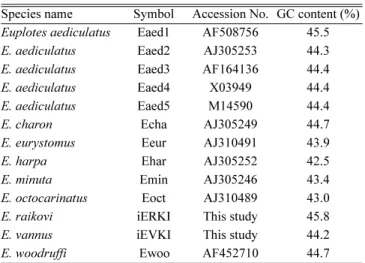
변이성 분석을 위해 본 연구에서 확인된 Euplotes 2 종의 18S rRNA 와 GenBank 에서 추출한 7 종 11 개 염기서열을 사용하여 총

9 종 13 개 염기서열을 ClustalX (Thompson et al., 1997) 로 정렬하 였다 . E. aediculatus 염기서열 5 개는 종내 변이성 분석에 이용되 었으며 , Eaed1 (AF508756) 종간 변이성 분석에 이용하여

총 9 9 염기서열이 종간 변이성 분석에 사용되었다 (Table 1).

전자 변이성 분석에 사용된 Euplotes 의 변이부위 선정은 18S rRNA

Table 1. List of

Euplotes

species used in this study.

Species name Symbol Accession No. GC content (%)

Euplotes aediculatus

Eaed1 AF508756 45.5

E. aediculatus

Eaed2 AJ305253 44.3

E. aediculatus

Eaed3 AF164136 44.4

E. aediculatus

Eaed4 X03949 44.4

E. aediculatus

Eaed5 M14590 44.4

E. charon

Echa AJ305249 44.7

E. eurystomus

Eeur AJ310491 43.9

E. harpa

Ehar AJ305252 42.5

E. minuta

Emin AJ305246 43.4

E. octocarinatus

Eoct AJ310489 43.0

E. raikovi

iERKI This study 45.8

E. vannus

iEVKI This study 44.2

E. woodruffi
Ewoo AF452710 44.7

(3)

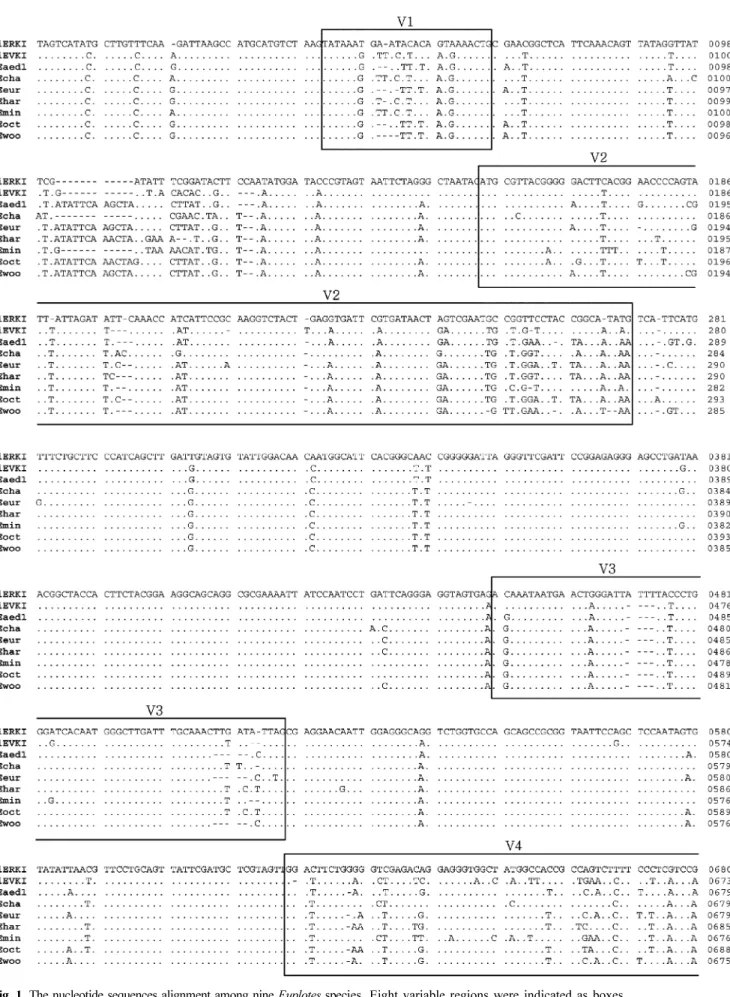
Fig. 1. The nucleotide sequences alignment among nine

Euplotes

species. Eight variable regions were indicated as boxes.

(4)

228 김선영·김세주·민기식·양은진·유만호·최중기

Fig. 1. (Continued)

(5)

의 2 차 구조가 밝혀져 있는 Tetrahymena canadensis 에 의거하여 진핵 생물에는 나타나지 않는 V6 부위를 제외한 8 개 변이부위

(variable region; V1, V2, V3, V4, V5, V7, V8, V9) 를 선정하였 다 (Fig. 1). 변이성 분석은 Mega 3.1 (Kumar et al. , 2004) 이용

하여 p -distance 값을 사용하여 종내 (intra-specific) 및 종간 (inter- specific) 변이성을 구하였다 . 계통수는 Mega 3.1 의 neighbor-joining (NJ) 방법으로 구하였는데 Kimura 2-parameter 를 거리계수 선택

(distance option) 으로 사용하였다 .

Fig. 1. (Continued)

(6)

230 김선영·김세주·민기식·양은진·유만호·최중기

결 과

인천연안에서 채집된 Euplotes 는 형태 분류를 통해서 E. vannus 와

E. raikovi 로 동정되었다 . 종에 대한 18S rRNA 전체 (complete)

염기서열 길이는 E. raikovi 는 1,858 bp, E. vannus 는 1,848 bp 이 며 염기서열 내 GC 비율은 각각 45.8% 와 44.2% 였다 (Table 1).

인천에서 채집된 Euplotes 두 종과 GenBank 에서 추출한 7 종의 종간분석에 사용된 염기서열의 정렬길이는 1,966 bp 이었고 (Fig. 1) 9 종의 18S rRNA 전체 염기서열의 종간 pairwise p -distance 값은

최소 1.84%, 최대 11.50%, 평균 5.99% 이었다 .

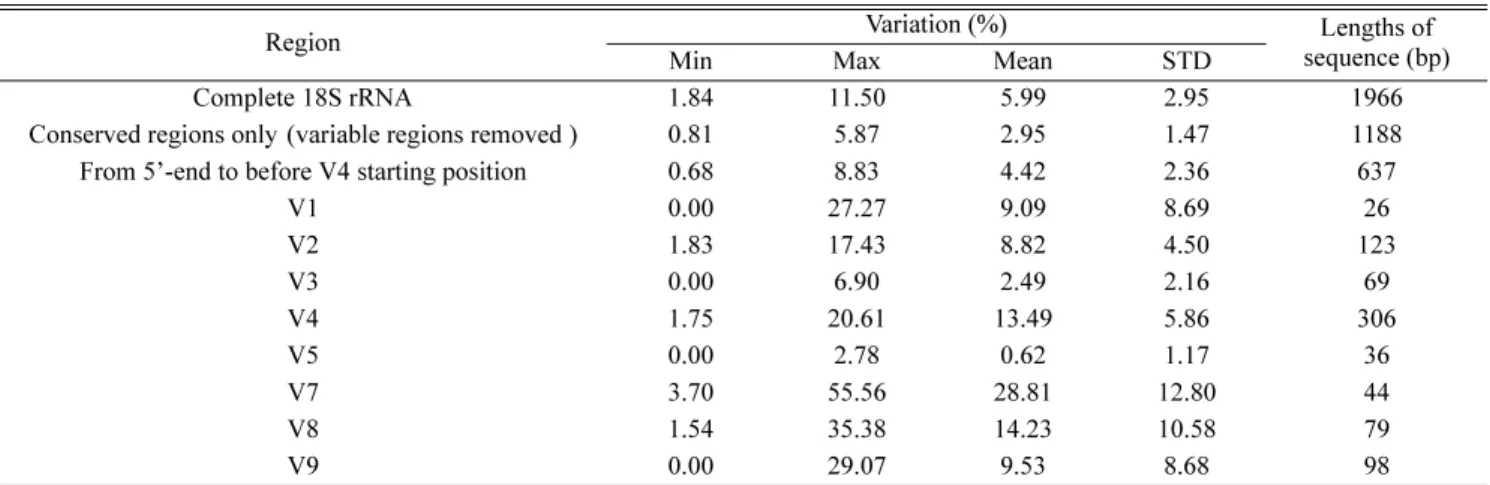
9 종의 염기서열의 부위별 변이성을 분석하기 위하여 18S rRNA

전체를 변이부위와 보존부위 (conserved region: 변이부위를 제외 한 부위 ) 로 나누어서 p -distance 로 분석하였다 . 그 결과 변이부위 를 모두 제외한 보존부위의 종간 변이성은 0.81-5.87%( 평균 2.95%)

로 변위부위가 포함된 전체 염기서열의 종간 변이성 ( 평균 5.99%)

보다 2 배 낮게 나타났다 (Table 2). V1 에서 V9 까지 변이부위에 따 른 평균 종간 p -distance 결과는 0.62-28.81% 나타났고 8

이부위에 대한 각각의 분석결과 9 종의 정렬된 염기서열의 길이는 V1 의 길이가 26 bp 로 가장 짧았고 , V4 가 306 bp 로 가장 길었다

(Table 2).

변위부위 V1, V3, V5, V7, V8, V9 의 길이는 100 bp 이하로 ,

단일 부위로 종 식별에 활용하기에는 부족한 길이를 보였다 . 또한

V1, V3, V5, V9 의 변위 부위에서 종간변이의 최소값이 0.00%

값을 나타냈다 . 따라서 100 bp 이상의 길이를 갖는 V2 V4

위에 대한 종간 p -distance 값을 구하면 , V2 부위의 종간 최소

이성은 1.83% ( Euplotes aediculatus 와 E. eurystomus 및 E. woodruffi

사이 ) 이고 최대 변이성은 17.43% ( E. raikovi 와 E. aediculatus , E.

octocarinatus 및 E. woodruffi 사이 ) 를 보였고 , V4 부위는 E.

eurystomus 와 E. woodruffi 간에 1.75% 로 최소 변이성을 보였고 , E. chron 과 E. eurystomus 및 E. woodruffi 사이 , 그리고 E. raikovi

와 E. vannus 사이에서 동일하게 20.61% 의 최대 변이성을 보였다

(Table 3). Euplotes 종간 계통 유연관계를 보고자 9 종에 대한 NJ tree 구성하였다 . 전체 18S rRNA 이용한 경우 (Fig. 2A) V2(Fig. 2B) V4(Fig. 2C) 부위만을 사용하여 만든 계통수

에는 차이가 나타나지 않았으며 , 동일한 계통 수지상 (topology) 을

보여 주었다 . 염기서열의 보존부위와 변이부위에서의 종내 변이성 을 분석한 결과 Euplotes aediculatus 5 개 염기서열간에는 변이성 이 나타나지 않았다 (0.00%).

Euplotes 종간 계통 유연관계를 보고자 9 종에 대한 NJ tree 를 구 성하였다 . 전체 18S rRNA 이용한 경우 (Fig. 2A) V2(Fig. 2B)

및 V4(Fig. 2C) 부위만을 사용하여 만든 계통수 간에는 차이가

타나지 않았으며 , 동일한 계통 수지상 (topology) 을 보여 주었다 .

염기서열의 보존부위와 변이부위에서의 종내 변이성을 분석한 결과 Euplotes aediculatus 5 개 염기서열간에는 변이성이 나타나 지 않았다 (0.00%).

Table 2. Inter-specific variation among 18S rRNA gene sequences of nine

Euplotes

species.

Region Variation (%) Lengths of

sequence (bp)

Min Max Mean STD

Complete 18S rRNA 1.84 11.50 5.99 2.95 1966

Conserved regions only (variable regions removed ) 0.81 5.87 2.95 1.47 1188

From 5’-end to before V4 starting position 0.68 8.83 4.42 2.36 637

V1 0.00 27.27 9.09 8.69 26

V2 1.83 17.43 8.82 4.50 123

V3 0.00 6.90 2.49 2.16 69

V4 1.75 20.61 13.49 5.86 306

V5 0.00 2.78 0.62 1.17 36

V7 3.70 55.56 28.81 12.80 44

V8 1.54 35.38 14.23 10.58 79

V9 0.00 29.07 9.53 8.68 98

Min, minimum distance value; Max, maximum distance value; STD, standard deviation.

Table 3. Uncorrected

p-

distance matrix of V2 and V4 regions among nine

Euplotes

species. Symbols are listed in Table 1. Upper right is for V2 region and lower left for V4.

iERKI iEVKI Eaed1 Echa Eeur Ehar Emin Eoct Ewoo

iERKI - 0.1193 0.1743 0.1193 0.1651 0.1560 0.1560 0.1743 0.1743

iEVKI 0.2061 - 0.0734 0.0642 0.0550 0.0367 0.0459 0.0642 0.0734

Eaed1 0.1711 0.1667 - 0.1009 0.0183 0.0550 0.1193 0.0642 0.0183

Echa 0.1886 0.1798 0.1930 - 0.0826 0.0642 0.1101 0.0917 0.1009

Eeur 0.1798 0.1623 0.0307 0.2061 - 0.0367 0.1009 0.0459 0.0367

Ehar 0.1711 0.1360 0.0921 0.1754 0.0702 - 0.0826 0.0459 0.0734

Emin 0.1798 0.0526 0.1447 0.1667 0.1491 0.1316 - 0.0734 0.1193

Eoct 0.1711 0.1447 0.0702 0.1886 0.0482 0.0570 0.1316 - 0.0826

Ewoo 0.1798 0.1754 0.0219 0.2061 0.0175 0.0789 0.1535 0.0570 -

(7)

고 찰

유전적 특성에 의해 다양한 종을 혼선 없이 명확히 식별하기 위 해서는 종 동정에 활용되는 유전자의 종내 변이성이 종간 변이성 에 비해 훨씬 낮은 특성을 가져야 한다 (Hebert et al. , 2003). 후생

동물 (Metazoa) 의 미토콘드리아 CO1 유전자는 이러한 특성을 잘

보여주고 있어서 종 식별에 유용하게 이용되고 있다 (Hebert et al ., 2003, 2004a, 2004b; Witt, 2006). 하지만 고등식물의 경우에는 미 토콘드리아의 길이가 150kb 이상으로 매우 길고 CO1 을 비롯한

대부분의 단백질 합성 (coding) 유전자의 종간 변이성이 거의 없어

종 식별에 이용할 수 없는 것으로 보고되었다 (Chase et al ., 2005).

후생동물 중에서도 해면동물과 자포동물과 같은 이배엽성 동물

(diploblastic animal) 이나 일부 삼배엽성 동물 (triploblastic animal:

예 , 곤충류인 모기류 ) CO1 유전자는 종간 변이성이 매우 낮아

CO1 유전자가 DNA 바코드에 적합하지 않다 (Hebert et al ., 2003;

Park et al ., 2003). 이처럼 식별에 가장 유용하다고 알려져

는 CO1 유전자조차도 분류군에 따라서는 종 식별에 적합하지 않

을 수 있다 .

후생동물의 미토콘드리아는 원형이고 길이는 16 kb 내외로 거 의 모든 분류군에서 비슷한 특성을 보여주고 있는데 반하여

Tetrahymena 와 같은 섬모충류의 미토콘드리아는 선형이며 길이도

50 kb 이상으로 매우 것으로 알려져 있다 . 현재까지 보고된

러 연구 결과를 바탕으로 섬모충류의 CO1 유전자는 후생동물의 CO1 유전자와는 매우 다른 특성을 가지고 있을 가능성이 높다

(Suyama and Miura, 1968). 따라서 섬모충류가 매우 분화된 분류

군이라는 점을 감안하면 CO1 유전자가 모든 섬모충류 분류군에

적용되기에는 쉽지 않을 것으로 예상된다 . 반면에 진핵 생물의 18S rRNA 는 염기서열의 보존성이 높아 모든 진핵 생물이 유사한 특 성을 보여주고 있고 , 범용 프라이머 (universal primer) 쉽게

작할 수 있으며 , 또한 이미 많은 분류군에서 연구 성과가 축적되

어 있어서 18S rRNA 가 종 식별에 적합하다는 것이 확인될 수 있

다면 연구가 미진한 다른 어떤 유전자를 이용하는 것보다 훨씬 효 과적으로 광범위한 분류군의 종 식별에 활용될 수 있을 것이다 .

18S rRNA 는 단백질 합성에 관여하는 리보솜의 구성성분으로

생체 내에서 기능을 발휘하기 위해서는 자기 접합 (self pairing) 에

의한 2 구조를 형성한다 (Neefs et al ., 1993). 2 구조는 stem

과 loop 갖는데 일반적으로 stem 부위는 염기서열의 보존성이

고 loop 부위는 보존성이 낮다 (Swann and Taylor, 1993; Wilmotte et al ., 1993; Crease and Taylor, 1998; Choe et al ., 1999; Hong et al ., 2002).

9 종의 Euplotes 18S rRNA 전체 염기서열을 사용한 분석에서

근연 종간의 종간 변이성이 평균 5.99% 로 나타났다 . 최근 DNA

분류에 많이 활용되고 있는 부위 (Floyd et al ., 2002; Blaxter, 2004;

Blaxter et a l., 2005) 18S rRNA 5’-end 에서 V4 부위 직전

위로 약 600-700 bp 포함하는 부위인데 부위의 평균 종간

변이성은 4.42% 오히려 전체 18S rRNA 변이성보다도 낮았

다 . 반면 변이부위 길이가 100 bp 이상으로 충분한 정보를 가지

고 있을 것으로 예상되는 V2 와 V4 부위의 평균 종간 변이성은 각 각 8.82% 및 13.49% 로 전체 염기서열에 비해 V2 는 1.47 배 , V4

는 2.25 배로 전체 18S rRNA 염기서열을 이용할 때 보다 변이성 이 2 이상 높게 나왔다 (Table 2). 한편 전체 18S rRNA 염기서

열을 사용해 만든 NJ tree(Fig. 2A) V2 V4 부위만을 각각

로 사용한 NJ tree(Fig. 2B Fig. 2C) 동일한 계통 수지상 (topology) 보여주었다 . 이러한 결과는 전체 18S rRNA 염기서

열과 마찬가지로 개별 변이부위 (V2 및 V4) 도 계통적 (phylogenetic)

시그널을 포함하고 있음을 보여주는 것으로 V2 및 V4 부위가 개 별적으로도 종 식별에 활용될 수 있음을 시사 하였다 . 한편 변이 부위가 대상 생물의 계통 관계를 잘 보여 주고 있음은 초파리를 비롯하여 다양한 진핵 생물을 대상으로 한 하위단계 계통 관계 연 구에서도 확인된 바 있어 본 연구 결과를 지지한다고 할 수 있다

(Crease and Taylor, 1998; Wuyts et al ., 2000; Petroni et al ., 2002).

본 연구 결과에 의하면 Euplotes 의 정렬간격 (gap) 을 포함한 V2

Fig. 2. Unrooted neighbor-joining trees for nine

Euplotes

species based

on the sequences of (A) complete 18S rRNA gene, (B) V2 and (C) V4

regions. The significance of each branch is indicated by bootstrap values

with 1,000 replications. Symbols are shown in Table 1.

(8)

232 김선영·김세주·민기식·양은진·유만호·최중기 와 V4 부위의 정렬된 염기서열 길이는 188 bp 315 bp 로써 한번

의 염기서열결정 (sequencing) 으로 얻을 있는 적당한 길이를

지고 있다 . 또한 V2 V4 부위 , 뒤에 존재하는 stem 부위는

기서열의 보존성이 매우 높아 진핵 생물 전체를 통해 사용될 수 있는 범용 프라이머를 만들 수 있는 부위가 존재하고 있어 실험 의 용이성도 높은 유전자 부위라 말할 수 있다 .

18S rRNA 는 진핵 생물 전체에서 적용될 수 있는 다수의 범용

프라이머 제작 부위를 가지고 있다는 점은 V2 및 V4 와 같은 변 이부위가 섬모충류는 물론 다양한 다른 분류군의 종 식별에도 확 대 적용될 가능성이 있음을 시사 하고 있다 . 그러나 많은 연구에

서 유전자의 변이성이 분류군에 따라 큰 차이가 있다고 보고 된

바 있으며 18S rRNA 에 대한 연구 또한 상위 분류군 연구에 치우

쳐 진행되어 온 관계로 근연 분류군간의 계통 관계에 대한 연구 는 의외로 부족하다 . 따라서 다양한 분류군의 종 식별에 유전자의 변이성을 이용하는 것이 적합하다는 판단을 하기에 충분한 연구

결과가 축적되어 있지 않으며 이와 같은 이유로 18S rRNA 의 변

이부위를 다양한 진핵 생물의 종 식별에 활용하기 위해서는 변이 부위의 유전자 내 (intragenomic), 종내 종간 변이성에 대한

밀한 조사가 먼저 선행될 필요성이 있다 .

사 사

본 연구는 인하대학교 교내연구비 (J.K. Choi-2006) 의 지원을 받아 수행되었습니다 .

참고문헌

Blaxter, M.L., 2004. The promise of a DNA taxonomy. Philos.

Trans. R. Soc. Lond B Biol. Sci., 359 : 669 679.

Blaxter, M., J. Mann, T. Chapman, F. Thomas, C. Whitton, R. Floyd and E. Abebe, 2005. Defining operational taxonomic units using DNA barcode data . Philos . Trans. R. Soc. Lond B Biol. Sci., 360 : 1935 1943.

Chase, M.W., N. Salamin, M. Wilkinson, J.M. Dunwell, R.P. Kesan- akurthi, N. Haidar and V. Savolainen, 2005. Land plants and DNA barcodes: short-term and long-term goals. Philos. Trans. R.

Soc. Lond B Biol. Sci., 360 : 1889 1895.

Choe, C.P., J.M. Hancock, U.W. Hwang and W. Kim, 1999. Analysis of the primary sequences and secondary structure of the unusu- ally long SSU rDNA of the soil bugs. Armadillidium vulgare . J.

Mol. Evol., 49 : 798 805.

Crease, T.J. and D. J. Taylor, 1998. The origin and evolution of vari- able-region helices in V4 and V7 of the small-subunit ribosomal RNA of branchiopod Crustaceans. Mol. Biol. Evol., 15 : 1430 1446.

Elwood, H.J., G.J. Olsen and M.L. Sogin, 1985. The small subunit ribosomal RNA sequences from the hypotrichous ciliates Oxytricha nova and Stylonychia pustulata. Mol. Biol. Evol., 2 : 399–410.

Floyd, R., E. Abebe, A. Papert and M. Blaxter, 2002. Molecular bar- codes for soil nematode identification. Mol. Ecol., 11 : 839–850.

Gifford, D.J., 1985. Laboratory culture of marine planktonic oligot- richs (Ciliophora, Oligotrichida). Mar. Ecol. Prog. Ser ., 23 : 257 267.

Greenwood, S.J., M. Schlegel, M.L. Sogin and D.H. Lynn, 1991.

Phylogenetic relationships of Blepharisma americanum and Colpoda inflata within the phylum Ciliophora inferred from complete small subunit rRNA sequences. J. Protozool., 38 : 1–6.

Hebert, P.D.N., S. Ratnasingham and J.R. De Waard, 2003. Barcod- ing animal life: cytochrome c oxidase subunit 1 divergences among closely related species. Proc. R. Soc. Lond. B. Suppl., 270 : 96 − 99.

Hebert, P.D.N., E.H. Penton, J.M. Burns, D.H. Janzen and W. Hall- wachs, 2004a. Ten species in one: DNA barcoding reveals cryptic species in the neotropical skipper butterfly Astraptes fulgerator.

Proc. Natl. Acad. Sci. USA , 101 : 14812 − 14817.

Hebert, P.D.N., M.Y. Stoeckle, T.S. Zemlak and C.M. Francis, 2004b. Identification of birds through DNA Barcodes. PLOS Biology, 2 : e312.

Hong, S.G., W. Jeong and H.S. Jung, 2002. Amplification of mito- chondrial small subunit ribosomal DNA of polypores and its potential for phylogenetic analysis. Mycologia, 94 : 823 − 833.

James, M.R. and J.A. Hall, 1995. Planktonic ciliated protozoa: their distribution and relationship to environmental variables in a marine coastal ecosystem. J. Plank. Res., 17 : 659 − 683.

Jerome, C.A. and D.H. Lynn, 1996. Identifying and distinguishing sibling species in the Tetrahymena pyriformis complex (Cilio- phora, Oligohymenophorea) using PCR/RFLP analysis of nuclear ribosomal DNA . J. Euk. Microbiol. , 43 : 492 − 497.

Kumar, S., K. Tamura and M. Nei, 2004. MEGA3: Integrated soft- ware for molecular evolutionary genetics analysis and sequence alignment. Brief. Bioinform ., 5 : 150 − 163.

Kusch J. and K. Heckmann, 1996. Population structure of Euplotes ciliates revealed by RAPD fingerprinting. Ecoscience , 3 : 378 − 384.

Lynn, D.H., A-D.G. Wright, M. Schlegel and W. Foissner, 1999. Phy- logenetic relationships of orders within the class Colpodea (Phy- lum Ciliophora) inferred from small subunit rRNA gene sequences.

J. Mol. Evol., 48 : 605 − 614.

Montagnes, D.J.S. and D.H. Lynn, 1987. A quantitative protargol stain (QPS) for Ciliates : method description and test of its quan- titative nature. Mar. Microb. Food Webs , 2 : 83 − 93.

Montagnes, D.J.S. and D.H. Lynn, 1991. Taxonomy of choreotrichs, the major marine planktonic ciliates, with emphasis on the alor- icate Forms. Mar. Microb. Food Webs, 5 : 59 − 74.

Moon-van der Staay, S.Y., G.W.M. van der Staay and P. Javorsky, 2002. Diversity of rumen ciliates revealed by 18S ribosomal DNA analysis. Reprod . Nutr. Dev., 42 : 76.

Neefs, J.-M., Y. Van de Peer, P. De Rijk, S. Chapelle and R. De Wachter, 1993. Compilation of small ribosomal subunit RNA structures. Nucleic Acids Res. , 21 : 3025 − 3049.

Orias, E., N. Hashimoto, M-F. Chau and T. Higashinakagawa, 1991.

PCR amplification of Tetrahymena rDNA segments starting with individual cells. J. Protozool., 38 : 306 − 311.

Park, S.J., W. Choochote, A. Jitpakdi, A. Junkum, S.J. Kim, N.

Jariyapan, J.W. Park and G.S. Min, 2003. Evidence supports con- specific relationship between morphologically and cytologically different two forms of Korean Anopheles pullus mosquitoes. Mol.

Cells , 16 : 354 − 360.

Petroni, G., F. Dini, F. Verni and G. Rosati, 2002. A molecular

approach to the tangled intragenetic relationships underlying phy-

(9)

logeny in Euplotes (Ciliophora, Spirotrichea). Mol. Phylogenet. Evol. ,

22 : 118 − 130.

Schlegel, M., H.J. Elwood and M.L. Sogin, 1991. Molecular evolu- tion in hypotrichous ciliates: sequence of the small subunit ribo- somal RNA genes from Onychodromus quadricornutus and Oxytricha granulifera (Oxytrichidae, Hypotrichida, Ciliophora).

J. Mol. Evol ., 32 : 64 − 69.

Sherr, E.C. and F.B. Sherr, 1988. Role of microbes in pelagic food webs : A revised concept. Limnol. oceanogr., 33 : 1225 − 1227.

Shin, M.K., U.W. Hwang, W. Kim, A.-D.G. Wright, C. Krawczyk and D.H. Lynn, 2000. Phylogenetic position of the ciliates Pha- codinium (order Phacodiniida) and Protocruzia (subclass Pro- tocruziidia) and systematics of the spirotrich ciliates examined by small subunit ribosomal RNA gene sequences. Europ. J. Protistol .,

36 : 293 − 302.

Sogin, M.L., A. Ingold, M. Karlok, H. Nielsen and J. Engberg, 1986.

Phylogenetic evidence for the acquisition of ribosomal RNA introns subsequent to the divergence of some of the major Tet- rahymena groups. EMBO J. , 5 : 3625 − 3630.

Suyama, Y. and K. Miura, 1968. Size and structural variations of mitochondrial DNA. Proc. Natl. Acad. Sci. USA , 60 : 235 − 242.

Swann, E.C. and J.W. Taylor, 1993. Higher taxa of basidiomycetes:

an 18S rDNA gene perspective . Mycologia , 85 : 923 − 936.

Tautz, D., P. Arctander, A. Minelli, R.H. Thomas and A.P. Vogler,

2003. A plea for DNA taxonomy. Trends Ecol. Evol., 18 : 70 − 74.

Thompson, J.D., T.J. Gibson, F. Plewniak, F. Jeanmougin and D.G.

Higgins, 1997. The Clustal X windows interface: flexible strat- egies for multiple sequence alignment aided by quality analysis tools. Nucleic Acids Res., 24 : 4876 − 4882.

Wilmotte, A., Y. van de Peer, A. Goris, S. Chapelle, R. de Baere, B.

Nelissen, J.M. Neefs, G.L. Hennebert and R. de Wachter, 1993.

Evolutionary relationships among higher fungi inferred from small ribosomal subunit RNA sequence analysis. Syst. Appl. Microbiol.,

16 : 436 − 444.

Witt, J.D., D.L. Threloff and P.D.N. Hebert, 2006. DNA barcoding reveals extraordinary cryptic diversity in an amphipod genus:

implications for desert spring conservation. Mol. Ecol ., 15 : 3073 −

3082.

Wuyts, J., P. De Rijk, Y. Van de Peer, G. Pison, P. Rousseeuw and R.

De Wachter, 2000. Comparative analysis of more than 3000 sequences reveals the existence of two pseudoknots in area V4 of eukaryotic small subunit ribosomal RNA. Nucleic Acids Res ., 28 : 4698 − 4708.

2007 3 12 원고접수

2007 년 8 월 21 일 수정본 채택

담당편집위원 : 현정호

수치

Table 1.  List of  Euplotes  species used in this study.
Fig. 1.  The nucleotide sequences alignment among nine  Euplotes  species. Eight variable regions were indicated as boxes.
Table 2.  Inter-specific variation among 18S rRNA gene sequences of nine  Euplotes  species.
Fig. 2.  Unrooted neighbor-joining trees for nine  Euplotes  species based on the sequences of (A) complete 18S rRNA gene, (B) V2 and (C) V4 regions

참조

관련 문서

After first field tests, we expect electric passenger drones or eVTOL aircraft (short for electric vertical take-off and landing) to start providing commercial mobility

1 John Owen, Justification by Faith Alone, in The Works of John Owen, ed. John Bolt, trans. Scott Clark, "Do This and Live: Christ's Active Obedience as the

We compared the distribution of Acinetobacter species in 95 clinical isolates which were determined by rpoB gene analysis, 16S rRNA gene analysis, and Vitek 2 system..

Background : The E133K genetic variation of AGGF1 gene that is a potent angiogenetic factor have been assumed genetic susceptible factor for Klippel-Trenaunay

Full genome cloning and nucleotide sequence analysis of hepatitis C virus from sera of chronic hepatitis patients in Korea. Detection of hepatitis C virus RNA

4-15 The variation of flexural rigidity in accordance with graphite contents and roasting temperature.. 4-16 The variation of porosity in accordance

Example 16.5: Small-Signal Gain Variation of NMOS Inverter..  the small-signal gain is the largest in

This section describes the overall structure of the diagnostic algorithm for abnormal situations using ANN. 6 illustrates the functional architecture of the diagnostic