고구마 소주 주박의 항균 및 항혈전 활성
김미선1, 이예슬1, 김종식2, 신우창3, 손호용1*
1안동대학교식품영양학과
2안동대학교생명과학과
3
(
주)
국순당Received: May 29, 2014 / Revised: June 9, 2014 / Accepted: June 9, 2014
서 론
주박은쌀
,
물,
누룩,
효모,
곰팡이,
유산균등을이용하여 술을제조한후,
술을걸러내는과정에서만들어지는부산물 로,
술지게미,
재강또는아레기등으로불린다.
주박은다양 한영양성분과유용생리활성성분을가지고있는것으로알 려져있으며[10, 22],
사용원료기질및첨가물,
사용누룩,
발효방법에따라다양한주박이부생된다[6].
최근전통주에 대한관심증가로주박생산이증가되면서주박에대한연구가활발히진행되고있으며
,
주박을이용한국수[16],
설기 떡[6],
장아찌[11]
등의가공식품제조연구및항당뇨[15],
비 만억제[33],
유해물질흡착제거[1],
고혈압[21],
항산화[10, 34], nitrite
제거효과[19],
보습[31],
미백,
주름개선[19, 36]
및알레르기개선효과
[12]
등이보고되면서주박을이용한기능성식품및화장품소재로의개발가능성
[27]
에대한연 구가활발히진행되고있다.
한편고구마
(Ipomoea batatas L.)
는메꽃과에속하는쌍떡 잎식물로감저,
초저라고불리는여러해살이풀로서,
원산지 는중앙아메리카멕시코유카탄반도지역으로알려져있으 며[2],
국내에서는일본을통해1763
년들여온것으로알려져있다
[26].
고구마는구근작물로재배가용이하며풍수해에강하고단위면적당생산량이높으며
,
당질함량이높은Anti-microbial and Anti-thrombosis Activities of Lees of Sweet Potato Soju
Mi-Sun Kim
1, Ye-Seul Lee
1, Jong Sik Kim
2, Woo-Chang Shin
3, and Ho-Yong Sohn
1*
1
Department of Food and Nutrition, and
2Department of Life Science, Andong National University, Andong 760-749, Republic of Korea
3
Research Institute, Kooksoondang Brewery Co. Ltd., Seongnam 460-120, Republic of Korea
Sweet potato soju (SPS), a form of traditional distilled alcoholic liquor in Korea, is manufactured by the distillation of fermented broth under normal pressure, thus providing it for a uniquely smooth taste infused with the flavor of sweet potato. After distillation, the lees of SPS is produced as by-product and discarded. In this study, the ethanol and hot water extracts of lees of SPS, and their subsequent organic solvent fractions using hexane, ethylacetate (EA), butanol, and water residue were prepared in an effort at the efficient re-use of the lees of SPS. The ethanol extraction yield was 1.36-fold higher than that of the hot water extraction, and the EA fraction revealed the highest total polyphenol content among the solvent fractions. The various extracts and solvent fractions did not demonstrate hemolytic activity at up to 0.5 mg/ml concentrations against human red blood cells. In the bio- activity assay, only the EA fraction displayed a broad spectrum of anti-microbial activity against different pathogenic and food spoilage bacteria, and demonstrated significant anti-coagulation activity by inhibitions of thrombin, prothrombin and blood coagulation factors. Furthermore, only the EA fraction from the hot water extract of the lees of SPS showed anti-platelet aggregation activity, which is comparable to aspirin (a commercially available drug). Our results suggest that the EA fraction of the hot water extract prepared from the lees of SPS has a high potential as a novel resource for anti-microbial and anti- thrombosis agents.
Keywords: Anti-coagulation, anti-platelet aggregation, anti-microbial, lees of sweet potato soju
*Corresponding author
Tel: +82-54-820-5491, Fax: +82-54-820-7804 E-mail: [email protected]
© 2014, The Korean Society for Microbiology and Biotechnology
고칼로리식품이며
,
국내에서는1906
년권업모범장이설립 된이후오랜기간의지속적인육종연구를통해다양한재 래종및자색고구마,
호박고구마등신품종이개발되어있다[35].
고구마는수분함량70%,
당질27.7%,
단백질1.3%
를 포함하여영양적으로우수하여구황식품,
전분제조및주정 가공용으로주로이용되어왔으나,
최근에는식이섬유,
미네 랄,
베타카로틴,
안토시아닌,
얄라핀등의유용기능성물질 이다량함유되어있음이알려지면서무공해건강식품으로각광을받고있다
[2, 8].
고구마와관련된연구로는고구마재배
,
저장,
품종개량[35],
갈변억제[20],
탁주및소주제조[4, 5, 26]
등에대한연구가주로이루어져왔으나,
최근에 는고구마지하부의항산화[7, 23, 29],
항당뇨[17]
및미백 효과[20]
와고구마잎,
줄기,
끝순의항산화[24],
항균,
항돌 연변이[25],
항염증,
및항알러지[18]
효과등의생리활성에 대한연구도활발히진행되고있다.
고구마는높은전분함유로주정발효원료로사용되어왔 으며
,
특히고구마소주는고구마를발효시켜알코올을얻고,
이를증류하여소주를얻어제조한다.
일반적인곡류와달리 고구마는섬유질이많기때문에,
고구마소주는상압증류로제조되며
[37],
특유의부드러운맛과향미로인해기호도가매우높다
[26].
본연구에서는탁주주박과유사하게별도의용도를찾지못하여대부분폐기되고있는고구마소주주 박의효율적인이용을위해상업적시설에서생산된고구마
소주주박의
ethanol
및열수추출물과이들의순차적유기용매분획물을조제하고각각의항균및항혈전활성을평 가하였으며
,
그결과고구마소주주박의ethylacetate (EA)
분획에서매우강력한항세균및항혈전활성을확인하였기 에이에보고하는바이다.
재료 및 방법
실험재료
본실험에사용된주박은
2012
년(
주)
국순당에서생산된 고구마소주주박을공급받아사용하였으며,
주박의ethanol
추출물제조를위해서는주박시료무게에대해10
배의95%
ethanol (Daejung Chemicals & Metals, Korea)
을가한 후 상온에서24
시간, 3
회반복추출하였으며,
추출액은filter paper (Whatsman No. 2)
로 거른 후 감압 농축(Eyela Rotary evaporator N-1000, Tokyo Rikakikai, Japan)
하여 분말로조제하였다.
열수추출물제조를위해서는주박시료 무게에대해5
배의증류수를가한후100
oC
에서30
분간고 온추출하였으며,
이후추출액은상기와동일한방법으로분 말로조제하였다.
조제된분말시료들은DMSO
에적당한농 도로녹여,
항균,
항혈전활성및적혈구용혈활성평가에사 용하였다.
사용시약은시약급이상으로Sigma (MO, USA)
의제품을구입하여사용하였다
.
실험에사용한주박시료는 안동대학교식품영양학과에서보관하고있다(voucher specimen 2012-KSD-8).
항균 활성
고구마소주주박시료의항균 활성은기존의보고된방 법과동일하게평가하였다
[13].
항균활성평가를위한그 람 양성세균으로는Staphylococcus aureus KCTC 1916, Staphylococcus epidermidis ATCC 12228, Listeria monocytogenes KACC 10550, Bacillus subtilis KCTC 1924
를,
그람음성세균으로Escherichia coli KCTC 1682, Pseudomonas aeruginosa KACC 10186, Proteus vulgaris KCTC 2433, Salmonella Typhimurium KCTC 1926,
진균 으로는Candida albicans KCTC 1940
및Saccharomyces cerevisiae IF0 0233
를사용하였다.
항세균활성평가의경 우, Nutrient broth (Difco, USA)
에각각의세균을접종하여37
oC
에서24
시간동안배양한후,
각균주를OD
6000.1
로조 정하여Nutrient agar (Difco, USA)
배지를포함하는멸균petri dish (90 × 15 mm, Green Cross, Korea)
에100
μl
도 말하고,
각각의시료5
μl
를멸균disc-paper (
지름6.5 mm, Whatsman No.2)
에가하여, 37
oC
에서24
시간동안배양하 였으며,
진균경우에는Sabouraud dextrose (Difco, USA)
를 이용하여동일한방법으로30
oC
에서24
시간동안배양후,
생육저지환의크기를측정하여항균활성을평가하였다[13].
대조구로는항세균제인
ampicillin
과항진균제인miconazole (Sigma, MO, USA)
을각각1
μg/disc
농도로사용하였으며,
생육저지환의크기는육안으로생육이나타나지않는부분 의지름을mm
단위로측정하였고, 3
회이상평가후대표 결과로나타내었다.
혈액응고 저해활성
혈액응고 저해활성은 시료의
thrombin time (TT), prothrombin time (PT)
및activated partial thromboplastin time (aPTT)
을측정하여평가하였다[14].
혈액응고에서중추적역할을수행하는
thrombin
의활성을평가하는TT
는37
oC
에서0.5 U thrombin (Sigma, MO, USA) 50
μl
와20 mM CaCl
250
μl,
다양한농도의시료10
μl
를Amelung coagulometer KC-1A (Amelung. Lemgo, Germany)
의 튜 브에 혼합하여2
분간 반응시킨 후,
표준혈장(MD Pacific Technology, China) 100
μl
를첨가한후혈장이응고될때까 지의 시간을 측정하였으며,
시료 대조군으로는 아스피린(Sigma, MO, USA)
을,
용매대조군으로는DMSO
를사용하 였다. Thrombin
저해활성은3
회이상반복한시료TT
실험의평균치를용매대조구인
DMSO
의TT
평균치의비로나타내었다
[14].
한편PT
는외인성응고계(II, V, VII
및X
인자
)
의응고활성을종합적으로측정하는방법으로,
혈장70
μl
와다양한농도의시료10
μl
를coagulometer
의튜브에첨가 하여37
oC
에서3
분간 가온 후, 130
μl
의PT reagent (MD Pacific Technology, China)
를첨가하고혈장이응고될때까 지의 시간을3
회 반복한 실험의 평균치로 나타내었으며, prothrombin
저해활성은3
회이상반복한시료PT
실험의 평균치를DMSO
의PT
평균치의비로나타내었다[14].
내인 성경로에의한혈액응고활성을평가하는aPTT
측정의경 우에는,
표준혈장70
μl
와 다양한 농도의 시료10
μl
를coagulometer
튜브에 첨가하여37
oC
에서3
분간 가온 후, 65
μl
의aPTT reagent (MD Pacific Technology, China)
를 첨가하고 다시37
oC
에서3
분간 반응하였다.
이후65
μl CaCl
2(35 mM)
을첨가한후혈장이응고될때까지의시간 을3
회반복한실험의평균치로나타내었으며, aPTT
연장 활성은3
회이상반복한시료aPTT
실험의평균치를DMSO
의aPTT
평균치의비로나타내었다[14].
혈소판 응집 저해 활성
혈소판은다양한혈구세포와함께내피세포의손상으로노 출된
collagen
등과 결합하여1
차 지혈 플러그(primary
hemostatic plug)
를형성하여혈전생성을개시하는중요한세포이다
[3].
고구마소주주박시료의혈소판응집저해활성은
,
미세전극에혈소판이부착되어응집됨에따라발생하는전기저항값의변화를측정하는
impedance
법을사용하여평가하였다
[30].
인간농축혈소판(platelet rich plasma:
PRP)
은적십자로부터공급받았으며PRP
의전처리및수세 과정은기존의보고[14]
와동일하게하였으며,
수세된혈소 판은suspending buffer (138 mM NaCl, 2.7 mM KCl, 12 mM NaHCO
3, 0.36 mM NaH
2PO
4, 5.5 mM glucose, 0.49 mM MgCl
2, 0.25% gelatin, pH 7.4)
에현탁하여최종 혈소판농도가5 × 10
8/ml
이되도록조정하였다.
혈소판응 집은Whole Blood Aggregometer (Chrono-log, USA)
를사 용해37
oC
에서측정하였으며, 10 mM CaCl
250
μl, suspending buffer 147.5
μl,
시료5
μl
가포함된반응cuvette
에혈소판50
μl
을 넣은 후3
분 동안37
oC
로 가온 후 응집유도제로collagen (1 mg/ml)
을2.5
μl
를넣고혈소판응집을측정하였 다.
응집반응은collagen
첨가 후12
분간 측정하였으며amplitude, slope, area under
를측정하여평가하였다[30].
이때
, amplitude (ohm)
는혈소판에응집유도제를첨가하였 을때일어나는최대응집정도를나타내며, slope
는응집유 도제를첨가한직후부터1
분동안의응집곡선의기울기를나타내며
, area under
는전체적인혈소판응집정도를표시하는것으로전기저항증가에따른
slope
곡선의하강면적을나타낸다
.
시료의혈소판응집저해활성은시료대신DMSO
를첨가한대조구와의상대적인
area under
값의비를백분율로나타내었다
[14, 30].
기타 분석
고구마소주주박시료의색차는색차계
(Super color SP- 80 Colormeter, Tokyo Denshoku, Japan)
로 분석하였으 며,
명도(lightness, L),
적색도(redness, a),
황색도(yellowness, b)
를3
회반복측정하여색차(
∆E)
를계산하였 다[29].
표준백색판은L
값이92.49, a
값이−0.12, b
값이1.37
이었으며,
색차는 다음의 식을 이용하여 계산하였다[
∆E = ]. Total flavonoid
의 함량은기존의보고된방법
[28]
에따라측정하였으며,
각각의시료 를18
시간methanol
교반추출하고여과한추출액400
μl
에90% diethylene glycol 4 ml
를 첨가하고다시1 N NaOH 40
μl
를넣고37
oC
에서1
시간반응후420 nm
에서흡광도 를측정하였다.
표준시약으로는rutin
을사용하였다. Total polyphenol
함량은시료400
μl
에50
μl
의folin-ciocalteau, 100
μl
의Na
2CO
3포화용액을넣고실온에서1
시간방치한후
725 nm
에서흡광도를측정하였다[28].
표준시약으로는tannic acid
를사용하였다.
총당정량의경우에는phenol- sulfuric acid
법을,
환원당정량의경우에는DNS
변법을이 용하였다[32].
각각의분석결과는3
회반복한실험의평균과 편차로나타내었다.
통계분석
실험결과는
SPSS 21.0
버전을사용하여mean
±SD
로나 타내었으며,
각 군간의 차이는ANOVA
로 분석하였으며,
Duncan
다중비교검증법으로통계적유의성검정을조사하였다
.
유의수준은p < 0.05
로하였다.
결과 및 고찰
고구마 소주 주박의 이화학적 특성 및 추출물 제조 고구마소주주박은
pH 4.22, brix 3.4,
수분함량92.9%
를 나타내어수용성고형분을상당량포함한약산성의유동성 고형물로(Table 1),
잔존ethanol
함량이3.4%
로기타주박 보다높게나타났다[6, 11].
이는고구마소주특유의높은점 성으로인한상압증류결과로이해되며,
고구마소주주박을 기질로이용한2
차발효(
예,
식초발효)
가가능함을제시하 고있다.
한편고구마주박은고구마특유의색깔로인해낮 은명도와높은황색도를나타내어,
기타의탁주및약주주 박과는색차면에서 큰차이를 나타내었다[10, 11].
주박의ethanol
추출수율은2.2%
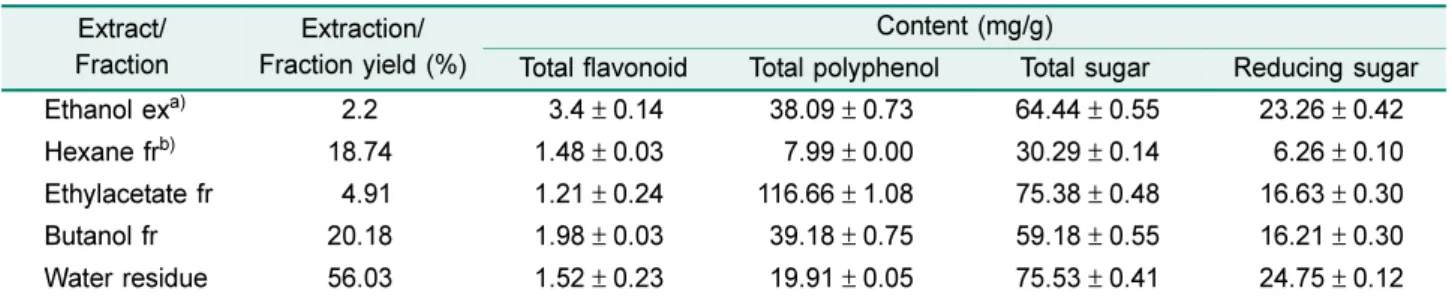
로열수추출수율보다1.36
배높 았으며(Table 2
및3),
유기용매 순차적 분획결과 지용성hexane
분획물이ethanol
추출물의18.74%
를차지한반면 수용성물잔류물은56.03%
를차지하였다.
주박ethanol
추L Δ
( )2+( )Δa2+( )Δb2
출물의
polyphenol
함량은38.09 mg/g
으로열수추출물보다1.88
배높았으며,
분획물들의polyphenol
및flavonoid
함량 분석결과EA
분획> butanol
분획>
물잔류물> hexane
분획순으로, flavonoid
함량은butanol
분획>
물잔류물>
hexane
분획> EA
분획순으로나타났다(Table 2).
반면주박의 열수 추출물은
61.54%
가 물 잔류물로, 33.26%
가butanol
분획으로 이행되었으며,
지용성hexane
분획은ethanol
추출물의18.4%
와대조적으로아주낮은0.52%
를 나타내었다(Table 3).
또한 열수 추출물의 분획물들의polyphenol
함량은EA
분획> butanol
및hexane
분획>
물잔류물순으로
, flavonoid
함량은hexane
분획> butanol
분획>
물잔류물> EA
분획순으로나타났다.
총당및환 원당함량평가결과ethanol
추출물에서는EA
분획및물잔 류물에서높은함량을나타낸반면,
열수추출물에서는물 잔류물및hexane
분획물에서높은함량을나타내었다(Table 2
및3).
따라서다양한유용활성은주박추출물의EA
분획 에서나타나리라예상되었다.
고구마 소주 주박의 항균활성
고구마소주주박의
ethanol
추출물및열수추출물과이들의순차적유기용매분획물을대상으로항균활성을평가 하였다
.
먼저대조구로사용된ampicillin
과miconazole
은각 각강력한항세균및항진균활성을나타내었다(Table 4).
고 구마소주주박의경우에탄올추출물및열수추출물의EA
분획에서만실험에사용된그람양성및그람음성세균에대Table 1. Physicochemical properties of the lees of sweet
potato soju.
Parameters Lees of sweet potato soju
pH 4.22 ± 0.2 0
brix 03.4 ± 0.04
Water content (%) 92.9 ± 0.8 0
Ethanol (% v/v) 03.4 ± 0.1 0
Color differences L
a)33.99 ± 0.67 a
b)01.69 ± 0.05
b
c)15.36 ± 0.34
∆E
d)54.37 ± 0.56
a)
L: degree of lightness (white +100-0 black).
b)
a: degree of redness (red +100- −80 green).
c)
b: degree of yellowness (yellow +70- −80 black).
d)
∆E: overall color difference (∆E = ).
Data are presented as the mean ± SD of three determinations. ( ) ∆ L
2+ ( ) ∆ a
2+ ( ) ∆ b
2Table 2. Component analysis of the ethanol extract and its solvent fractions of the lees of sweet potato soju.
Extract/
Fraction
Extraction/
Fraction yield (%)
Content (mg/g)
Total flavonoid Total polyphenol Total sugar Reducing sugar
Ethanol ex
a)02.2 03.4 ± 0.14 38.09 ± 0.73 64.44 ± 0.55 23.26 ± 0.42
Hexane fr
b)18.74 1.48 ± 0.03 07.99 ± 0.00 30.29 ± 0.14 6.26 ± 0.10
Ethylacetate fr 04.91 1.21 ± 0.24 116.66 ± 1.08 75.38 ± 0.48 16.63 ± 0.30
Butanol fr 20.18 1.98 ± 0.03 39.18 ± 0.75 59.18 ± 0.55 16.21 ± 0.30
Water residue 56.03 1.52 ± 0.23 19.91 ± 0.05 75.53 ± 0.41 24.75 ± 0.12
a)
ex: extract.
b)
fr: fraction.
Data are presented as the mean ± SD of three determinations.
Table 3. Component analysis of the hot water extract and its solvent fractions of the lees of sweet potato soju . Extract/
Fraction
Extraction/
Fraction yield (%)
Content (mg/g)
Total flavonoid Total polyphenol Total sugar Reducing sugar
Hot water ex
a)1.62 1.92 ± 0.10 20.23 ± 0.11 149.70 ± 1.10 30.40 ± 0.30
Hexane fr
b)0.52 4.09 ± 0.00 20.48 ± 0.01 141.23 ± 2.89 29.60 ± 0.36
Ethylacetate fr 4.08 0.72 ± 0.00 22.51 ± 0.01 65.41 ± 0.41 12.00 ± 0.96
Butanol fr 33.26 1.69 ± 0.04 20.58 ± 0.30 70.57 ± 0.83 20.37 ± 0.18
Water residue 61.54 1.29 ± 0.00 16.19 ± 0.11 123.82 ± 1.38 34.4 ± 0.66
a)
ex: extract.
b)
fr: fraction.
Data are presented as the mean ± SD of three determinations.
Table 4. Anti-microbial activities of the ethanol and hot water extracts, and their solvent fractions of lees of sweet potato soju against pathogenic and food-spoilage bacteria and fungi.
Samples/Chemicals
Growth inhibition zone (mm)
Gram positive bacteria Gram negative bacteria Fungi
SA
a)SE LM BS EC PA PV ST CA SC
Ampicillin 18.0 19.5 21.0 20.0 9.0 10.0 26.0 12.5 - -
Miconazole -
b)- - - - - - - 15.0 21.0
Ethanol extract Extract - - - - - - - - - -
Hexane fr
c)- - - 8.0 - - - - - -
Ethylacetate fr 9.5 9.0 10.0 10.0 7.5 11.0 14.5 7.0 - -
Butanol fr - - - - - - - - - -
Water residue - - - - - - - - - -
Hot water extract Extract - - - - - - - - - -
Hexane fr - - - - - - - - - -
Ethylacetate fr 11.0 11.5 16.0 14.0 10.0 13.0 18.0 12.0 - -
Butanol fr - - - - - - - - - -
Water residue - - - - - - - - - -
a)
SA: Staphylococcus aureus, SE: Staphylococcus epidermidis, LM: Listeria monocytogenes, BS: Bacillus subtilis, EC: Escherichia coli, PA: Pseudomonas aeruginosa, PV: Proteus vulgaris, ST: Salmonella Typhimurium, CA: Candida albicans, SC: Saccharomyces cerevisiae.
b)
-: No inhibition.
c)
fr: fraction.
The concentrations of the lees samples and antibiotics used were 500 μg/disc and 1 μg/disc, respectively. The growth inhibition zone expressed was included size of disc-paper (6.5 mm of diameter). The data represent a classical result of three indepen- dent determinations.
Table 5. Anti-coagulation activities of the different extracts and their solvent fractions of lees of sweet potato soju.
Samples Conc.
(mg/ml)
Anti-coagulation activity
a)Ethanol extract Hot water extract
TT PT aPTT TT PT aPTT
DMSO - 1.0 ± 0.0
a1.0 ± 0.0
a1.0 ± 0.0
a1.0 ± 0.0
a1.0 ± 0.0
a1.0 ± 0.0
aAspirin 1.5 2.6 ± 0.1
d1.7 ± 0.0
d1.3 ± 0.1
b2.6 ± 0.1
c1.7 ± 0.0
e1.3 ± 0.1
bExtract 5 1.1 ± 0.0
ab1.1 ± 0.0
b1.1 ± 0.0
a1.1 ± 0.0
a1.1 ± 0.0
b1.3 ± 0.1
bHexane fr
b)5 1.0 ± 0.0
a1.2 ± 0.0
c1.3 ± 0.0
b1.0 ± 0.1
a1.0 ± 0.0
a1.5 ± 0.1
bEthylacetate fr 5 >15.0
e>15.0
f>15.0
f>15.0
d>15.0
f>15.0
d2.5 1.5 ± 0.1
c3.8 ± 0.1
e3.1 ± 0.1
d1.5 ± 0.0
b1.7 ± 0.0
e2.3 ± 0.2
c1.25 1.2 ± 0.1
b1.2 ± 0.0
c1.4 ± 0.0
b1.1 ± 0.1
a1.3 ± 0.1
c1.3 ± 0.1
bButanol fr 5 1.2 ± 0.1
b1.2 ± 0.0
c1.6 ± 0.0
c1.5 ± 0.0
b1.5 ± 0.1
d1.5 ± 0.1
bWater residue 5 1.1 ± 0.1
ab1.0 ± 0.1
a1.6 ± 0.1
c1.1 ± 0.0
a1.1 ± 0.0
b1.4 ± 0.1
ba)
Anti-coagulation activity is calculated on the clotting time of sample divided by the clotting time of solvent control in blood coagulation assay. Data are presented as the mean ± SD of three determinations. The thrombin time (TT), prothrombin time (PT) and activated partial thromboplastin time (aPTT) of solvent control (dimethylsulfoximide) were 24.0 sec, 18.6 sec and 40.5 sec, respectively. Different letters within a column differ significantly (p < 0.05).
b)
fr: fraction.
해광범위한항균력을나타내었으며
,
항진균활성은나타나 지않았다(Table 4).
고구마 소주 주박의 적혈구 용혈활성 및 항혈전 활성 먼저인간적혈구를이용한고구마소주주박추출물의용
혈활성을평가한결과
, ethanol
및열수추출물과이들의분획물들은
0.5 mg/ml
농도에서10%
이하의미약한용혈활성 을나타내어적혈구용혈에따른급성독성은나타나지않으 리라판단되었다(results not shown).
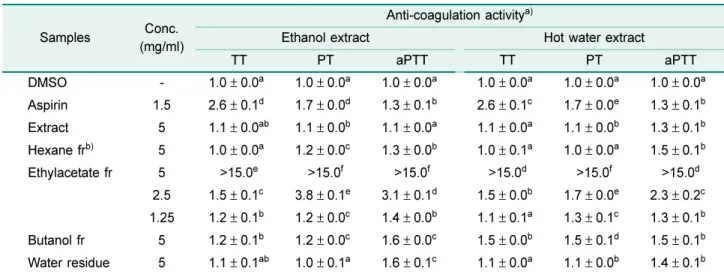
고구마소주주박의항 혈전활성평가를위해주박시료의항응고활성을TT, PT, aPTT
를각각측정하여평가하였다.
먼저대조구로사용된aspirin (1.5 mg/ml)
은무처리구에비해TT
는2.6
배, PT
는1.7
배, aPTT
는1.3
배연장시켜우수한혈액응고저해활성을 나타내었으며[14],
고구마소주주박시료(5 mg/ml)
의경우ethanol
및열수추출물의EA
및butanol
분획에서유의적 인TT
연장이나타났으며, PT
측정의경우에는ethanol
추 출물의물잔류물,
열수추출물의hexane
분획을제외한모 든분획물에서PT
연장효과가나타났고, aPTT
측정의경우 고구마소주주박의모든시료에서용매대조구인DMSO
보 다연장된혈액응고시간을나타내었다(Table 5).
가장강력 한활성은추출물의EA
분획에서나타난바, 5 mg/ml
농도 에서TT, PT
및aPTT
를 모두15
배 이상 연장시켰으며,
2.5 mg/ml
농도에서도아스피린에필적하는혈액응고저해활성을나타내었다
.
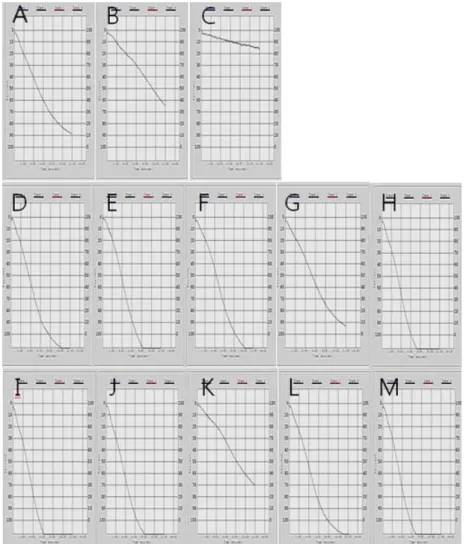
이러한결과는폐기되고있는고구마소Fig. 1. Diagrams of impedance changes during platelet aggregation after addition of aspirin and the extracts and solvent frac-
tions of lees of sweet potato soju in whole blood aggregometer. (A) DMSO, (B) aspirin (0.25 mg/ml), (C) aspirin (0.5 mg/ml), (D)
ethanol extract, (E)~(H) hexane fraction, ethylacetate fraction, butanol fraction and water residue of the ethanol extract prepared from lees
of sweet potato soju, (I) hot water extract, and (J)-(M) hexane fraction, ethylacetate fraction, butanol fraction and water residue of the hot
water extract prepared from lees of sweet potato soju, respectively. Platelet aggregation was induced by addition of 2.5 µl of collagen
(1 mg/ml) into cuvette containing 50 µl of washed PRP and measured the impedance changes for 12 min.
주주박의
EA
분획을이용한혈액응고저해물질개발이가 능함을시사하고있다.
주박 추출물의 혈소판 응집저해 활성
먼저용매대조구로사용된
DMSO
의혈소판응집능을평가하였으며
,
그결과amplitude 22
Ω, area under 154.3
을 나타내었다.
현재상업용으로이용되고있는혈소판응집저 해제인 아스피린(0.25 mg/ml)
은amplitude 16
Ω, area under 87.1
을나타내어DMSO
의56.4%
혈소판응집능을나 타내었으며,
농도의존적인혈소판응집저해를나타내었다(Fig. 1, Table 6).
고구마소주주박ethanol
및열수추출물 과이들의분획물을대상으로혈소판응집능을평가한결 과,
열수 추출물의EA
분획물에서만amplitude 17, area under 99.1
의값을나타내어아스피린과유사한64.2%
의혈 소판응집을나타내었다.
상기의연구결과는폐기되고있는 고구마소주주박의효율적재이용이가능함을제시하고있 으며,
고구마소주주박의열수추출물의EA
분획이항세균 및항혈전제로개발될수있음을제시하고있다.
요 약
고구마소주는전분과섬유질이많은고구마를발효시킨 후상압증류하여제조되어특유의부드러운맛과향미를가 진다
.
본연구에서는별도의용도가없어폐기되고있는고 구마소주주박의효율적인이용을위해,
주박의ethanol
및 열수추출물을조제하고이들을순차적유기용매분획하여 각각의hexane, ethylacetate (EA), butanol
분획물과물잔류물을조제하여각시료의항균및항혈전활성을평가하 였다
.
그결과,
주박의ethanol
추출효율이열수추출효율 보다1.36
배높았으며,
분획물중에서는EA
분획물이가장 높은total polyphenol
함량을나타냄을확인하였다.
고구마소주주박의추출물및분획물
(0.5 mg/ml)
은인간적혈구에대한용혈활성을나타내지않았으며
,
열수및ethanol
추출 물의EA
분획물에서만광범위항세균활성과강력한혈액 응고저해활성이나타났다.
또한혈소판응집저해활성의 경우열수추출물의EA
분획에서만아스피린과유사한응 집저해를나타내었다.
본연구결과는폐기되고있는고구마 소주주박의열수추출물의EA
분획이신규의항세균및항 혈전제로개발될수있음을제시하고있다.
Acknowledgments
This research was supported by High Value-added Food Tech- nology Development Program (No. 112073-3), Ministry for Food, Agriculture, Forestry and Fisheries, Republic of Korea.
References
1. Adachi A, Hamamoto H, Okano T. 2005. Use of lees materials as an adsorbent for removal of organochlorine compounds or benzene from wastewater. Chemosphere 58: 817-822.
2. Barnes SL, Sanders SA. 2012. Advances in functional use of sweet potato, [Ipomoea batatas (L.) Lam]. Recent Pat. Food Nutr. Agric. 4: 148-154.
3. Chen H, Qi X, He C, Yin Z, Fan D, Han G. 2013. Coagulation imbalance may not contribute to the development of portal Table 6. Platelet aggregation activities of the extracts and their solvent fractions of lees of sweet potato soju.
Chemicals/Samples (mg/ml)
Ethanol extract Hot water extract
Ampli tude
( Ω)
Slope ( Ω/min)
Lag time (sec)
Area under
PAR
a)(%)
Ampli tude
( Ω)
Slope ( Ω/min)
Lag time (sec)
Area under
PAR (%)
DMSO 22 3 16 154.3 100.0 22 3 16 154.3 100.0
Aspirin (0.25) 16 2 31 87.1 56.4 16 2 31 87.1 56.4
Aspirin (0.50) 4 0 122 26.7 17.3 4 0 122 26.7 17.3
Extract 28 4 20 213.9 138.6 27 6 16 238.4 154.5
Hexane fr
b)28 5 28 214.5 139.0 28 5 14 227.8 147.6
Ethylacetate fr 28 4 25 193.6 125.5 17 2 31 99.1 64.2
Butanol fr 22 3 22 148.1 96.0 28 4 18 206.4 133.8
Water residue 28 5 12 228.4 148.0 27 6 15 234.8 152.2
a)
PAR: Platelet Aggregation Ratio.
b)