약학회지 제
54
권제3
호164~167 (2010)
Yakhak Hoeji
Vol. 54, No. 3
164
황촉규 지상부의 성분분리 및 항산화활성
박은영·양기숙# 숙명여자대학교 약학대학
(Received December 30, 2009; Revised March 20, 2010; Accepted March 20, 2010)
Phytochemical Constituents and Antioxidant Activities of the Aerial Parts of Hibiscus manihot
Eun Young Park and Ki Sook Yang#
College of Pharmacy, Sookmyung Women’s University, Seoul 140-742, Korea
Abstract
— Column chromatographic separation of the MeOH extract from the aerial parts of Hibiscus manihot led to the isolation of four compounds. Their structures were characterized to be hentriacontane (1), palmitic acid (2), daucosterol (3) and 3-dihydrocaffeonyl-5-p-coumaroylquinic acid (4) by spectroscopic methods. The compounds (1~4) were for the first time reported from this plant. The solvent fractions were tested for their antioxidant activities by free radical scavenging and superoxide dismutase (SOD).
Keywords □
Hibiscus manihot, Hentriacontane, daucosterol, 3-dihydrocaffeonyl-5-p-coumaroylquinic acid
황촉규
(Hibiscus manihot Linne)
는아욱과(Malvaceae)
에속하 는중국원산의식물로서민간에서뿌리는점활제또는위염,
위궤양
,
인후염치료에쓰이고종자는이뇨및유즙분비촉진등에이용된다
.
뿌리에D-galactose, L-alvinose, L-rhamnose, xylose, glucose, D-galacturonic acid, aldovionic acid, rhamnogalac- turonic acid
등의당류와점액질이풍부하고1,2)꽃은flavonoid
를 함유하는것으로알려져있다.
3)천연물의항산화물질에대한연구가활발히진행되고있고
, ascorbic acid
및그유도체, coenzyme Q10
등의항산화물질의ROS
소거능에관한연구가알려졌으며, isoacetosidi, ellagic acid
등의
SOD
활성억제물질이보고되고있다.
4)본식물의지상부는자원이풍부하고예비검색에서뿌리나종 자보다항산화작용이우수하나거의연구된바없으므로지상부
의
MeOH
추출물을상법에의하여용매분획물을만들어항산화작용을실험하였으며
,
컬럼크로마토그라피를통하여4
종의화합 물을분리동정하였다.
실험방법
실험재료
본교약초원에서채취하여음건후세말로한황촉규의지상 부
3.0 kg
을100% MeOH
로70
oC
에서4
회환류냉각추출후여과하고 감압 농축하여
MeOH
추출물210.0 g
을 얻었다.
이MeOH
추출물에대하여용매를이용한계통적추출방법을실시하여
hexane
분획물31.0 g, dichloromethane
분획물1.8 g, ethylacetate
분획물1.0 g, butanol
분획물1.6 g
및물분획물2.0 g
을각각얻었다.
헥산분획으로부터화합물1~3의분리
헥산 분획
15 g
을silicagel
컬럼 크로마토그래피(CHCl
3: MeOH=40 : 1~5 : 1)
를 실시하여F1(821 mg), F2(1209 mg), F3(333 mg), F4(324 mg)
를얻었고, F1
을silicagel
칼럼크로마 토그래피를실시하여(Hexane : Aceton=80 : 1) HM-1(15 mg)
를 얻었다. F2
를silicagel
칼럼크로마토그래피를실시하여(Hexane : Aceton=1 : 1) HM-2(13 mg)
를얻었으며F4
를silicagel
칼럼크 로마토그래피를실시하여(CHCl
3: MeOH=5 : 1) HM-3(33 mg)
을단리하였다
.
#본논문에관한문의는저자에게로
(전화) 02-710-9578 (팩스) 02-715-9498 (E-mail) [email protected]
종설
황촉규지상부의성분분리및항산화활성
165
Vol. 54, No. 3, 2010
디클로로메탄분획으로부터화합물 4의분리
디클로로메탄분획
7.5 g
을silicagel
칼럼 크로마토그래피(CHCl
3: MeOH=20 : 1~5 : 1)
를실시하고,
다시silicagel
칼럼 크로마토그래피(Hexane : Aceton=1 : 1)
로분리한후,
이분획을다시
RP-18
칼럼크로마토그래피를실시하여(Acetonitile : H
2O=
5 : 5)
화합물4(22 mg)
를단리하였다.
DPPH를이용한용매분획물의항산화활성측정
각시료를농도별로조제한후시료
100
µl
에0.1 mM DPPH
용액
(99.5%
에탄올에용해) 1.9 ml
을가한후vortex mixer
로10
초간 진탕하고37
oC
에서3
분 동안 배양시켰다.
이 후spectrophotometer
를이용하여515 nm
에서흡광도를측정하였 다.
시료의항산화활성을측정하기위하여전자공여능(electron donating ability, EDA %)
에의한환원력으로표시하였다.
양성 대조약물로는ascorbic acid
를농도별로용시조제하여사용하였 으며각시료의항산화활성을비교검토하기위해서EDA
가50%
에이르도록하는데필요한시료의양(EDA
50)
을측정하였다.
SOD활성의측정
SOD
에의해O
2·가소거된정도를바탕으로SOD
활성을간 접적으로 측정하였다.
농도별로 시료용액을 가하고 각각hematoxylin
을넣어반응시킨후,
생성된H
2O
2에의한hema-
toxyline
의탈색된정도를분광학적방법으로측정하였다.
농도별로조제한시료를
100
µl
씩취하고KP buffer 1.37 ml
과
5 mM hematoxyline
용액을가한후진탕한다.
실온에방치 하여0, 5, 10
분후에spectrophotometer
를이용하여568 nm
에서흡광도를측정하였다
.
통계학적분석
모든 실험결과는
mean±SD
로 나타내었으며 자료분석은student's t-test
를이용하여유의성을검정하였다.
실험결과 및 고찰화합물의확인동정
HM-1
은white powder
로써EI-Mass spectrum
에서m/z 436
에서
molecular ion peak[M
+]
를, m/z 421
에서CH
3가 탈락된fragment ion peak
를관찰할수있었다.
실험결과및문헌과의비교로
HM-I
을분자량436,
분자식C
31H
64의hentriacontane
으 로확인동정하였다.
5)HM-2
는EI-Mass spectrum
에서m/z 256
에서molecular ion peak[M
+]
를,
그리고m/z 213, 129
에서fragment ion peak
를관 찰할 수 있었다. HM-2
는 분자량256,
분자식C
16H
32O
2인palmitic acid
로확인동정하였다.
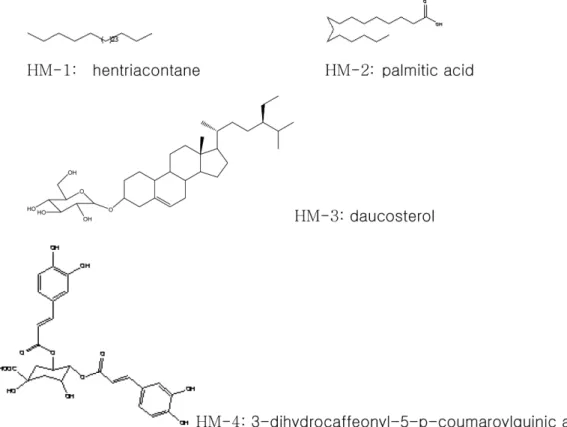
6)Fig. 1 −
Structures of the compound 1~4 from
Hibiscus manihot.166
박은영·양기숙J. Pharm. Soc. Korea
HM-3
은EI-Mass spectrum
에서m/z 576
에서molecular ion
peak[M
+]
를,
그리고m/z 396
에서fragment ion peak
를관찰할수있었다
. HM-3
을분자량576,
분자식C
35H
60O
6의sitosterol 3-O-
□-D-glucopyranoside
인daucosterol
로확인동정하였다.
6)HM-4
은EI-Mass spectrum
에서m/z 516
에서molecular ion peak[M
+]
를,
그리고m/z 195
에서fragment ion peak
를관찰할 수있었다. HM-4
을분자량516,
분자식C
25H
24O
12의3-dihydro- caffeonyl-5-p-coumaroylquinic acid
로확인동정하였다6)(Fig. 1).
화합물1의물리화학적성상
White powder, C
31H
64(M.W 436)
1
H NMR(CDCl
3, 500MHz)
δ0.81(s, 3H, CH
3), 1.23(m, J=7.0 Hz, 2H, CH
2), 1.96(m, J=4.95 Hz, 2H, CH
3CH
2)
13
C NMR(CDCl
3, 125MHz)
δ13.84(CH
3), 20.54(C-2,30 CH
2), 22.48(C-3,29 CH
2), 29.16 (C-4,28 CH
2), 31.74(C-5,27 CH
2), 38.71(C-6,26 CH
2), 38.88 (C-7,25 CH
2), 39.05(C-8,24 CH
2), 39.21(C-9,23 CH
2), 39.38 (C-10,22 CH
2), 39.55(C-11.21 CH
2)
화합물2의물리화학적성상
White powder, C
16H
32O
2(M.W 256)
1
H NMR(CDCl
3, 500MHz)
δ0.88(s, 3H, CH
3), 1.63(m, 2H, CH
2), 1.63(m, 2H, COCH
2CH
2), 2.34(t, J=7.5 Hz, 2H, COCH
2)
13
C NMR(CDCl
3, 125 MHz)
δ19.81(CH
3), 28.67(C-15), 28.83(C-14), 28.93(C-13), 31.45 (C-2), 173.28(C-1)
화합물3의물리화학적성상
White powder, C
35H
60O
6(M.W 576)
1
H NMR(pyridine-d
5, 500MHz)
δ0.68(s, 3H, H-18), 0.88(d, J=6.96 Hz, 3H, H-26), 0.89(d, J=2.8 Hz, 3H, H-27), 0.91(t, J=9.33 Hz, 3H, H-29), 0.92(d, J=3.15 Hz, 3H, H-29), 0.93(s, 3H, H-19), 4.01(m, J=5.39 Hz, 1H, H-5'), 4.09(m, 1H, H-3), 4.31(t, J=4.17 Hz, 1H, H- 2'), 4.33(t, J=3.75 Hz, 1H, H-3'), 4.46(t, J=5.25 Hz, 1H, H- 4'), 4.58(dd, J=2.01 Hz, 5.95, 1H, H-6'), 5.09(d, J=7.72 Hz, 1H, H-1'), 5.37(d, J=2.3 Hz, 1H, H-6)
13
C NMR(pyridine-d
5, 125 MHz)
δ12.48(C-18), 12.66(C-29), 19.52(C-21), 19.72(C-19), 19.92 (C-26), 20.48(C-27), 21.79(C-11), 23.9(C-28), 25.01(C-15), 26.91(C-23), 29.04(C-16), 30.09(C-25), 30.47(C-2), 32.57(C-8), 32.68(C-7), 34.72(C-22), 36.89(C-20), 37.43(C-10), 37.99(C-1),
39.85(C-4), 40.46(C-12), 42.99(C-13), 46.56(C-24), 50.86(C-9), 56.76(C-17), 57.34(C-14), 63.35(C-6'), 72.22(C-4'), 75.84(C-2'), 78.62(C-5'), 78.98(C-3'), 79.11(C-3), 103.09(C-1'), 122.42(C-6), 141.42(C-5)
화합물4의물리화학적성상
White power, C
25H
24O
12(M.W 516)
1
H NMR(CDCl
3, 500 MHz)
δ:
1.96(m, 2H, H-18), 2.6(m, 2H, H-19), 4.19(1H, H-3), 4.6 (1H, H-4), 4.85(1H, H-29), 6.31(d, 1H, H-8''), 6.62(d, H-5'), 6.66(dd, H-5''), 6.89(dd, H-6''), 7.03(d, H-2'), 7.26(d, H-2''), 7.59(d, H-72'')
13
C NMR(CDCl
3, 125 MHz)
δ:
30.42(C-2), 31.91(C-6), 63.98(C-3), 65.0(C-4, 5), 86.0(C-1), 114.99(C-8',8''), 115.21(C-2',2''), 116.14(C-5',5''), 123.51(C-6',6''), 130.2(C-7',7''), 147.26 (C-4',4''), 167.11(C-1'), (167.19(C-1''), 167.7(C-9',9'').
항산화능에미치는영향
노화와성인병질환의원인이활성산소에기인된것이라는학 설이점차인정되어짐에따라체내에서활성산소를조절하는
SOD, catalase, glutathione peroxidase
등의효소에대한연구와천연항산화제인셀레늄
,
토코페롤,
아스코르빈산,
베타카로틴,
글루타치온및합성항산화제인
BHA, BHT
등많은항산화제의개발연구가보고되어있다
.
7-10)천연물로서양파,
11)nut
류12) 등과같은식용으로쓰이는식물을비롯하여물냉이,
13)오가피,
14)박하등15)약용으로이용되는다양한추출물에대한연구가알 려져있다
.
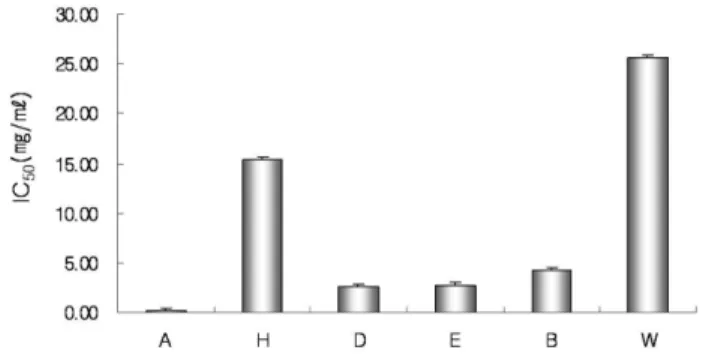
시료를첨가하지않은0.1 mM DPPH
용액1.9 ml
을50%
환원시키는데필요한시료의양(EDA%)
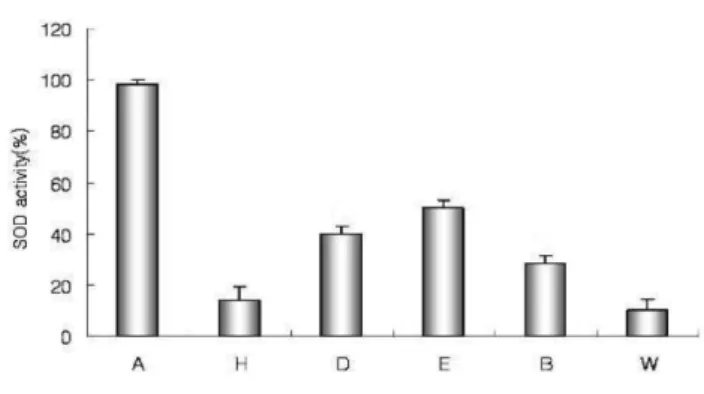
을측정한결과는 다음과같다(Fig. 2, Fig. 3).
Fig. 2 −
The radical scavenging effects of solvent fractions from
Hibiscus manihot(A: ascorbic acid, H: hexane, D:
dichloromethane, E: ethylacetate, B: butanol, W: H
2O)
Each value represents the mean±S.D (n=3). IC
50:
Required sample amount (
µg) for 50% reduction of 0.1 mM
DPPH solution 1.9 m
l.황촉규지상부의성분분리및항산화활성
167
Vol. 54, No. 3, 2010
항산화제로잘알려진아스코르빈산의
EDA
50은131.6
µg
으로 우수한항산화능을보였으며.
황촉규의디클로로메탄분획은EDA
501815.4
µg,
에틸아세테이트분획은EDA
502897.4
µg
항산화능을보여아스코르빈산에비해그다지효과를나타내지못 하였다
.
또한SOD
에의해O
2-가소거된정도를바탕으로SOD
활성을간접적으로측정하였다
.
강력한항산화제인아스코르빈산을비교물질로하여
SOD
활 성을측정한결과,
아스코르빈산의활성을100%
로할때,
디클로로메탄분획
40%,
에틸아세테이트분획50.3%
의활성을나타내었다
.
결 론
황촉규
hexane
분획으로부터hentriacontane(1), palmitic acid(2), daucosterol(3)
그리고dichloromethane
분획으로부터3- dihydrocaffeonyl-5-p-coumaroylquinic acid(4)
를분리하였으며이 들성분들은본식물에서는처음으로보고하였다.
메탄올추출물을
hexane, ethyl acetate, BuOH
및Water
분획으로나누어 유리기소거작용, SOD
활성을통한항산화활성을측정한결과유 리기소거작용은별로크지않았으나에틸아세테이트분획에서 가장큰SOD
활성을나타냄을확인하였다.
감사의 말씀
본연구는숙명여자대학교
SRC
여성질환연구쎈터지원(2009)
으로이루어졌으며이에감사드립니다
.
참고문헌
1)
배기환:
한국의 약용식물, (
주)
교학사, 333 (2003).
2)
한국 약용식물학 연구회:
종합 약용식물학,
학창사, 231 (2004).
3) Qiu, Y. : Extraction and determination of total flavones content in Hibiscus manihot flower. J. Herbal Nornal University Natural Science
30, 713 (2006).
4) Choi, J. Y., Kim, K. D., Park, J. K. and Kim, N. I. : Effects of green tea (-)-epigallocatechin-3-gallate and polyphenol on the proliferation and apoptosis of cultured human keratinocytes, melanocytes, fibroblasts, endothelial Cells, and human epidermoid carcinoma cells. Kor. J. Dermatol.
40, 375 (2002).
5) Golebiowski, M., Malinski, E., Nawrot, J., Szafranek, J. and Stepnowski, P. : Identification of the cuticular lipid composition of the Western Flower Thrips Frankliniella occidentalis.
Comparative Biochemistry and Physiology B-Biochemistry &
Molecular Biology
147, 288 (2007).
6)
국가한약재평가기술과학화연구사업단:
한약재성분분광분석자료집
.
도서출판 우림. 64, 67, 73, 118 (2007).
7)
柳善彦:
活性酸素と病氣.
化學同人. Japan (1989).
8)
유진:
활성산소(
유해산소)
가질병의원인이었다.
이화문화출판사. (1997).
9) Ray, G., Batra, S., Shukla, N. K., Deo, S., Raina, V., Ashok, S.
and Husain, S. A. : Lipid peroxidation, free radical production and antioxidant status in breast cancer. Breast Cancer Res.
Treat.
59, 163 (2000).
10)
정해영: Free radical
에의한노화및발암기전.
한국노화학회지 2
, 1 (1992).
11)
정명현,
이병주,
김경완:
양파(Allium cepa L.)
의항고지혈및 항산화활성에 관한연구.
생약학회지 28, 198 (1997).
12)
차배천,
이혜원,
최무영: Nut
류의항산화및항균효과,
생약학회지 29
, 28 (1998).
13) Ozen, T. : Investigation of antioxidant properties of Nasturtium officinale (watercress) leaf extracts. Acta. Pol. Pharm.
66, 187 (2009).
14) Sithisarn, P. and Jarikasem, S. : Antioxidant activity of Acanthopanax trifoliatus. Med. Princ. Pract.
18, 393 (2009).
15) Gursoy, N, Sihoglu, T. A. and Tepe, B. : Determination of in vitro antioxidative and antimicrobial propertiesand total phenolic contents of Ziziphora clinopodioides, Cyclotrichium niveum, and Mentha longifolia var. typhoides. J . Med. Food
12, 684 (2009).
Fig. 3 −