Anti-oxidant, Anti-coagulation, and Anti-platelet Aggregation Activities of Black Currant (Ribes nigrum L.)
Mi-Sun Kim and Ho-Yong Sohn*
Dept. of Food and Nutrition, Andong National University, Andong 36729, Korea
Received July 26, 2016 /Revised September 12, 2016 /Accepted September 26, 2016
The black currant (Ribes nigrum L.) is belong to the Grossulariaceae family, and has piquant berries, which can be eaten as raw or as processed foods, such as jams, jelly, juice and syrups. In this study, the fresh juice of black currant (FJBC) from Austria and its subsequent organic solvent fractions, such as hexane fraction, ethylacetate (EA) fraction, butanol fraction and water residue, were prepared and their in-vitro anti-oxidant, anti-coagulation and anti-platelet aggregation activities were evaluated. The FJBC and EA fraction, which has concentrated polyphenol and flavonoid, showed strong radical scav- enging activities and reducing power. The RC50s of EA fraction against DPPH anion, ABTS cation, ni- trite were 136.3, 66.2 and 115.5 μg/ml, respectively, those are 1/10, 1/16, and 1/7.7 of RC50s of vita- min C. In anti-coagulation assay, the FJBC, EA and butanol fraction showed significant inhibitory ac- tivities against thrombin, prothrombin and coagulation factors. Furthermore, the anti-platelet ag- gregation activities of EA and butanol fraction were the stronger than that of aspirin. The concen- trations required for 50% platelet aggregation inhibition of aspirin, EA and butanol fraction were 0.395, 0.192 and 0.261 mg/ml, respectively. The EA and butanol fraction have no hemolysis activities up to 0.5 mg/ml against human red blood cells. The results suggest that the FJBC and its EA and butanol fraction have high potentials as novel anti-thrombosis agents. This report provides the first evidence of anti-thrombosis activity of black currant.
Key words : Anti-oxidation, anti-coagulation, anti-platelet aggregation, black currant, Ribes nigrum L.
*Corresponding author
*Tel : +82-54-820-5491, Fax : +82-54-820-6281
*E-mail : [email protected]
This is an Open-Access article distributed under the terms of the Creative Commons Attribution Non-Commercial License (http://creativecommons.org/licenses/by-nc/3.0) which permits unrestricted non-commercial use, distribution, and reproduction in any medium, provided the original work is properly cited.
Journal of Life Science 2016 Vol. 26. No. 12. 1400~1408 DOI : http://dx.doi.org/10.5352/JLS.2017.26.12.1400
서 론
블랙커런트(black currant, Ribes nigrum L.)는 장미목 범의 귀과의 낙엽관목으로 유렵 북서부가 원산지이며, 열매와 잎이 식용으로 이용되고 있다. 러시아, 폴란드, 영국, 뉴질랜드 및 동부 유럽국가들에서 대량 재배되고 있으며 전 세계 생산량은 500,000~600,000톤/년으로, 유럽에서는 경제적으로 매우 중 요한 원예작물이다[18]. 국내에서는 카시스(cassis), 커런트 (currant), 양까막까치밥나무, 까막까치밥, 구즈베리 등의 다양 한 이름으로 불리기도 한다. 블랙커런트의 검은 열매는 즙이 많고, 신맛이 강해 주로 주스 생산에 사용되고 있으며[25], 잼, 젤리, 차 및 포도주 제조 등 기타 식품소재로도 많이 이용되고 있으며[29], 잎의 경우는 주로 다류로 개발되어 있다[10]. 상업 적 품종으로는 Magnus, Ben Ard, Ben Rua, Ben Hope 등이 다양하게 개발되어 있으며, 품종에 따라, 또한 재배지에 따라 관능성에 차이가 있다고 알려져 있으며[18], 품질을 결정하는
주요 요소로는 비타민 C와 폴리페놀성 화합물인 것으로 보고 되고 있다[11, 17].
블랙커런트에는 매우 많은 양의 anthocyanin (250 mg/100 g fresh fruit)들이 함유되어 있으며 total polyphenol 의 90%를 차지하는 것으로 알려져 있다[18]. 주요 anthocyanin 으로는 cyanidin 3-O-rutinoside, delphinidin 3-O-rutinoside, cyani- din 3-O-glucoside 및 delphinidin 3-O-glucoside이 알려져 있 으며[8, 11, 14], 그 외 다양한 phenolic acids와 flavonol 화합물 도 보고되어 있다[2, 7]. 현재까지 블랙커런트의 생리활성으로, 블랙커런트 주스의 유해미생물의 장관계 부착 및 증식 억제 [18]. 유해세균에 대한 항균활성 [6], 항바이러스 활성[28], 신경 세포보호효과[8], 항염증 활성[2], 알코올성 간 손상에 대한 보 호 효과[25], SH-SY5Y와 HL-60 세포 모델에서의 DNA 세포막 손상과 산화적 스트레스에 대한 보호효과[9], 요로 및 신장결 석 예방효과[12], 파킨스병에 대한 신경보호효과[22], 주스 및 종자의 페놀성 화합물[15, 17] 및 이의 심혈관 질환 예방효과 [21], 부위별, 채취시기별 및 품종에 따른 항산화 활성[26] 등이 보고되어 있다. 그러나 현재까지 블랙커런트의 항혈전 활성에 대해서는 알려진 바 없다. 본 연구에서는 다양한 유용생리활 성을 가진 블랙커런트의 추출물 및 이의 순차적 유기용매 분 획물의 항산화 및 항혈전 활성을 평가한 결과, 폴리페놀 고함 유 분획물에서 강력한 항혈전 활성을 확인하였기에 이에 보고 하는 바이다.
재료 및 방법
실험재료
본 실험의 블랙커런트 시료는 2014년 오스트리아에서 재배, 수확한 블랙커런트를 착즙한 주스(100%)를 구입하여 사용하 였다. 착즙액은 filter paper (Whatsman No. 2)로 거른 후 감압 농축(Eyela Rotary evaporator N-1000, Tokyo Rikakikai Co., Ltd. Japan)하여 분말로 조제하였다. 이후, 조제시료를 증류수 에 현탁한 후 hexane, ethylacetate (EA), butanol로 순차적 분 획하였으며, 최종적으로 물 잔류물을 회수하였다. 조제된 추 출물과 분획물은 DMSO또는 증류수에 적당한 농도로 녹여, 성분분석, 항산화 활성, 혈액응고 저해, 혈소판 응집저해, 적혈 구 용혈활성 평가에 사용하였다. 실험에 사용한 블랙커런트 시료는 안동대학교 식품영양학과에서 보관하고 있다(voucher specimen 2014-RN1~RN5).
항산화 활성
블랙커런트의 항산화 활성은 기존 보고[1]와 동일하게 DPPH (1,1-diphenyl-2-picryl hydrazyl) 음이온 소거능, ABTS [2,2-azobis(3-ethylbenzothiazoline-6- sulfonate)] 양이온 소거 능, nitrite 소거능 및 환원력 측정으로 평가하였다. 한편 다양 한 농도의 시료를 이용하여 각각의 활성 라디컬 소거활성을 측정한 후, 실험결과로부터 RC50 (표준조건에서 활성 radical 을 50% 제거하는 데 소요되는 시료의 양)을 계산하였으며, 이 를 근거로 시료들의 항산화 활성 정도를 비교하였다. 이때 활 성 대조구로는 vitamin C (Sigma Co., USA)를, 용매 대조구로 는 DMSO (Sigma Co., USA)를 사용하였다.
혈액응고 저해활성
블랙커런트의 혈액응고 저해 활성은 기존의 보고한 throm- bin time (TT), prothrombin time (PT) 및 activated partial thromboplastin time (aPTT) 을 측정하여 평가하였다[19]. 혈 장은 시판 control plasma (MD Pacific Technology Co., Ltd, Huayuan Industrial Area, China), PT reagent와 aPTT re- agent는MD Pacific Hemostasis (MD Pacific Technology Co., Ltd, Huayuan Industrial Area, China)의 분석시약을, 기타 시 약은 시약급 이상으로 Sigma Co. (St. Louis, MO, USA)의 제 품을 구입하여 사용하였다. 각각의 혈액응고활성은 3회 반복 측정하였으며, thrombin, prothrombin, 혈액응고인자 저해활 성은 시료 첨가시의 TT, PT 및 aPTT의 평균값을 용매 대조구 인 DMSO첨가시의 TT, PT및 aPTT 평균값의 비로 각각 나타 내었다[17]. 이때 시료 대조군으로는 aspirin (Sigma Co., St.
Louis, MO, USA)을, 용매 대조군으로는 DMSO를 사용하였으 며, 각각의 실험결과는 3회 반복실험의 평균± 표준편차로 나 타내었다[13].
혈소판 응집 저해 활성
혈소판 응집저해 활성은 수세된 농축 혈소판에 블랙커런트 시료를 첨가한 후, Whole Blood Aggregometer (Chrono-log, PA, U.S.A)의 미세전극에 혈소판이 부착, 응집됨에 따라 발생 하는 전기 저항값의 변화를 측정하여 평가하였다[24]. 보다 자 세하게는 10 mM CaCl2 50 μl, suspending buffer 147.5 μl, 블랙커런트 시료 5 μl가 포함된 반응 cuvette에 50 μl의 인간 유래 혈소판(5×10⁸ cells/ml)을 첨가하고 3분 동안 37℃로 가 온 후, 응집유도제로 collagen (1 mg/ml)을 2.5 μl를 넣고 혈소 판 응집을 측정하였다. 응집반응은 Whole Blood Aggregometer 의 교반장치를 이용하여 반응액을 500 rpm으로 교반시키면서 collagen 첨가 후 12분간 측정하였다. 이후 얻어진 응집곡선으 로부터 amplitude, slope, area under 를 측정하여 혈소판 응집 을 평가하였다[30]. 이때, amplitude (Ω)는 응집유도제를 첨가 하였을 때 일어나는 혈소판의 최대 응집도를 나타내며, slope 는 응집유도제를 첨가한 직후부터 1분 동안의 응집곡선의 기 울기를 나타내며, area under는 전체적인 혈소판 응집 정도를 표시하는 것으로 전기저항 증가에 따른 slope 곡선의 하강면 적을 나타낸다[23, 24]. 최종적으로 블랙커런트의 혈소판 응집 도(PAR: Platelet Aggregation Ratio)는 시료 첨가시의 area under 값과 용매대조구인 DMSO 첨가시의 area under값의 비를 백분율로 나타내었다[13].
인간 적혈구 용혈 활성 평가
블랙커런트의 인간 적혈구 용혈 활성은, 기존의 보고한 방 법[19]과 동일하게 평가하였다. 먼저 PBS로 3회 수세한 인간 적혈구(4%) 100 μl를 96-well microplate에 가하고 다양한 농 도의 시료용액 100 μl를 가한 다음 37℃에서 30분간 반응시켰 으며, 이후, 반응액을 10분간 원심분리(1,500 rpm)하여 상등액 100 μl를 새로운 microtiter plate로 옮긴 후 용혈에 따른 헤모 글로빈 유출 정도를 414 nm에서 측정하였다. 시료의 용매 대 조구로는 DMSO (2%)를 사용하였으며, 활성 대조구로는 tri- ton X-100과 amphotericin B를 사용하였다. 용혈활성은 다음 의 식을 이용하여 계산하였다.
(%) Hemolysis = [(S - C)/(T - C)] ×100.
S: 시료 첨가구의 흡광도, C: DMSO 첨가구의 흡광도, T:
triton 첨가구의 흡광도.
기타 분석
착즙액의 pH는 320 pH meter (Mettler Toledo, InLabR 413, UK)로 측정하였으며, brix 측정은 refractometer (Atago N-1E, Japan)를 이용하였고 산도는 시료 10 ml에 0.1 N NaOH 용액 을 가하여 pH 8.3이 될 때까지 적정하여 그 소비된 양을 acetic acid의 함량(%)으로 환산하여 나타내었다. 색차 분석은 색차 계(Super color SP-80 Colormeter, Tokyo Denshoku Co., Japan)를 이용하였으며, 명도(lightness, L), 적색도(redness,
Table 1. Physicochemical properties of the fresh juice of black currant (FJBC)
Parameter pH Brix (%) Acidity (%) L1 a2 b3 △E4
FJBC 2.85±0.1 14.0±0.6 2.81±0.1 4.39±0.12 5.04±0.13 1.22±0.08 88.18±0.13
1L: degree of lightness (white +100~0 black), 2a: degree of redness (red +100~-80 green), 3b: degree of yellowness (yellow +70~-80
black), 4△E: overall color difference ( ).
Table 2. Component analysis of the fresh juice of black currant (FJBC) and its subsequent organic solvent fractions
Juice/Fractions Fraction
Yield (%)
Content (mg/g)2 Total
polyphenol
Total flavonoid
Total sugar
Reducing sugar FJBC
Hexane fr.1 Ethylacetate fr.
Butanol fr.
Water residue
- 0.6 1.7 52.5 43.9
34.21±1.41b 4.96±3.42a 48.86±0.15d 37.70±1.37c 39.74±0.83c
0.40±0.13a 0.26±0.08a 15.51±0.56b 0.47±0.04a 0.73±0.17a
805.56±6.14e 9.48±0.20a 58.72±1.21b 438.79±6.56c 501.58±0.50d
677.28±9.15e 3.48±0.14a 40.68±2.75b 420.07±3.61c 468.61±2.89d
1fr.: fraction. Different letters within a column differ significantly (p<0.05) a), 황색도(yellowness, b)를 측정하였다. 표준 백색판은 L값이
92.31, a값이 -0.08, b값이 1.32이었으며, 시료당 3회 측정하여 평균값을 구하여 색차를 계산하였다[14]. Total polyphenol 및 Total flavonoid 함량은 기존의 보고된 방법[20]에 따라 측정하 였으며, 각각 rutin과 tannic acid를 표준시약으로 사용하였다.
총당 정량의 경우에는 phenol-sulfuric acid법을, 환원당 정량 의 경우에는 DNS 변법을 이용하였다[27]. 각각의 분석결과는 3회 반복한 실험의 평균과 편차로 나타내었다.
통계분석
실험 결과는 SPSS 23.0 버전을 사용하여 mean±SD로 나타 내었으며, 각 군간의 차이는 ANOVA로 분석하였으며, Dun- can 다중비교 검증법으로 통계적 유의성 검정을 조사하였다.
유의수준은 p<0.05로 하였다.
결과 및 고찰
블랙커런트 착즙액의 이화학적 특성
본 실험의 오스트리아산 블랙커런트의 착즙액은 14.0 brix, 2.81% 산도, pH 2.85를 나타내어 새콤달콤한 전형적인 베리류 의 관능성을 나타내었다(Table 1). 이는 기존의 뉴질랜드산 블 랙커런트 착즙액이 15.1 brix, 1.65% 산도, pH 3.36을 나타낸다 는 보고[11]와 비교하면, 오스트리아산 블랙커런트가 상대적 으로 많은 유기산을 포함하고 있음을 추측할 수 있다. 블랙커 런트의 착즙액은 명도 4.39, 적색도 5.04, 황색도 1.22를 나타내 어, 기존 보고[11]된 뉴질랜드산 착즙액의 명도 18.2, 적색도 5.13. 황색도 1.08와 비교하면 명도에서 특징적인 낮은 값을 나타내었다. 이러한 차이는 블랙커런트의 재배지 및 종자의
차이에서 기인하는 것으로 판단된다.
블랙커런트 착즙액 및 이의 분획물의 총 폴리페놀, 총 플라 보노이드, 총당 및 환원당 분석
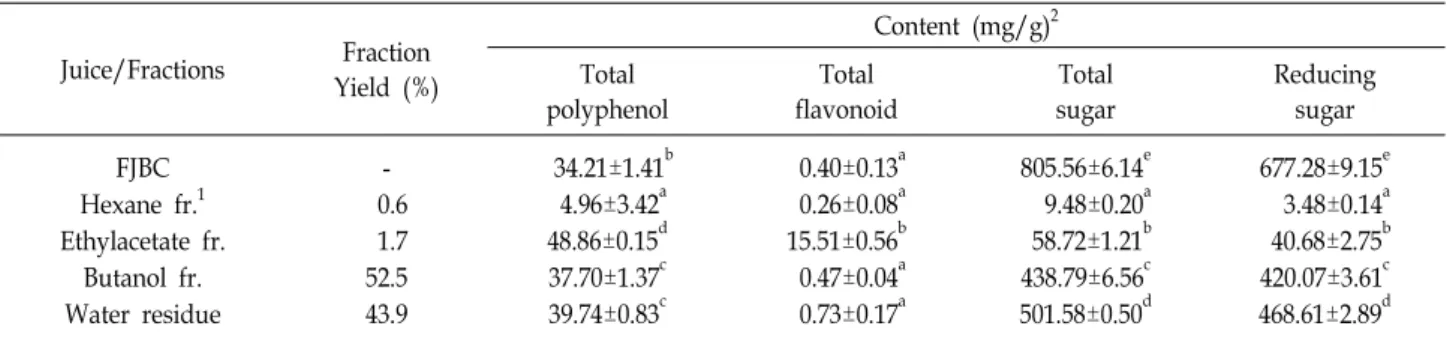
블랙커런트 착즙액 및 이의 분획물의 총 폴리페놀 분석결 과, 착즙액에서 34.21 mg/g의 높은 함량을 나타내었으며, 이 는 통상의 한약재[19] 및 체리[1]보다는 높았으나, 아로니아보 다는 낮은 함량을 보였다[3]. 분획물 중에서는 hexane 분획물 을 제외한 EA 및 butanol 분획물, 물 잔류물에서는 37.70~
48.86 mg/g을 나타내었으며, 특히 분획 수율이 1.7%인 EA 분획에서 가장 높은 함량을 나타내었다(Table 2). 총 플라보노 이드의 경우, 착즙액에서는 0.4 mg/g으로 낮은 함량을 나타내 었으나 EA 분획에서는 15.51 mg/g의 높은 함량을 나타내어, EA 분획은 폴리페놀 및 플라보노이드가 농축되어 있음을 확 인하였다. 기타 분획에서는 0.26~0.73 mg/g의 함량을 나타내 었으며, 물 잔류물> butanol 분획> hexane 분획순으로 나타났 다. 한편 총당 및 환원당 분석 결과, 착즙액은 805.56, 및 677.28 mg/g의 매우 높은 함량을 나타내었으며, 물 잔류물 및 buta- nol 분획에서는 438~501 mg/g의 총당, 420~468 mg/g의 환원 당을 나타내었으며, EA 분획은 이의 1/10 수준의 총당, 환원 당을 포함하고 있었다. 특히 hexane 분획에서는 총당 및 환원 당 함량은 9.48 및 3.48 mg/g을 나타내어 거의 당을 포함하지 않음을 확인하였다(Table 2).
블랙커런트 착즙액 및 이의 분획물의 항산화 활성
다양한 농도의 블랙커런트 착즙액 및 이의 분획물의 항산화 활성 측정 결과, 농도의존적인 DSA, ASA, NSA 및 환원력을 나타내었다(Fig. 1). DSA의 경우 EA 분획> 착즙액> butanol
A B
C D
Fig. 1. Anti-oxidant activities of the fresh juice of black currant (FJBC) and its subsequent organic solvent fractions. (A) DPPH anion scavenging activity, (B) ABTS cation scavenging activity, (C) Nitrite scavenging activity, and (D) Reducing power.
Symbol ●: FJBC, ○: hexane fraction, ▼: ethylacetate fraction, ▽: butanol fraction, ■: water residue of FJBC and □: vitamin C, respectively.
Table 3. Radical scavenging activities (IC50s) of the fresh juice of black currant (FJBC) and its subsequent organic sol- vent fractions
Juice/fractions
Radical scavenging activity: RC50
(μg/ml)
DPPH ABTS Nitrite
FJBC Hexane fr.1 Ethylacetate fr.
Butanol fr.
Water residue
338.9
>500 136.3 387.3
>500
77.8
>500 66.2 169.9 139.8
73.5 617.5 115.5 311.4 139.5
Vitamin C 13.5 4.0 14.9
1fr.: fraction 분획> 물 잔류물 순으로, ASA의 경우 EA 분획= 착즙액> 물
잔류물> butanol 분획 순, 환원력의 경우 착즙액> EA 분획>
물 잔류물> butanol 분획순으로 활성이 나타났으며, hexane 분획물의 DSA, ASA 및 환원력은 0.5 mg/ml 농도까지는 매우 미미한 활성을 나타내었다. 한편 NSA의 경우, 0.1 mg/ml 농 도에서는 착즙액이 가장 우수한 소거능을 나타내었으나, 0.2 mg/ml 농도에서는 EA 분획이 가장 강력한 소거능을 나타내 었다. 0.2 mg/ml 농도에서의 NSA는 EA 분획> 착즙액> 물 잔류물> butanol 분획> hexane 분획물 순으로 나타났다. 전체 적으로 가장 우수한 항산화 활성은 EA 분획에서 확인되었으 며, 추출물 및 분획물의 DSA, ASA 및 NSA에 대한 RC50를 계산한 결과 EA 분획은 136.3, 66.2 및 115.5 μg/ml 값을 나타 내어 가장 강력한 radical 소거능을 나타내었다. 이는 vitamin C가 나타내는 RC50의 각각 1/10, 1/16 및 1/7.7에 해당하는 값으로 블랙커런트가 체리류보다 우수한 항산화력을 나타냄 을 의미한다(Table 3). 최근 혈전 생성에는 염증반응과 산화적 스트레스가 직접 관련되어 있음이 보고되어 있으며[16], 산화 적 스트레스는 fibrinogen의 구조적 변화를 유발하고[3, 4], oxidized-fibrinogen, cysteine-modified fibrinogen의 증가는 다양한 심혈관계 질환과 밀접히 연관되어 있음이 알려져 있다
[16]. 따라서 강력한 항산화력을 나타내는 블랙커런트의 EA 분획은 fibrinogen의 산화적 수식을 저하시켜 항혈전 활성에 기여하리라 예측되었다.
블랙커런트 착즙액 및 이의 분획물의 항응고 활성
블랙커런트 착즙액 및 이의 분획물의 항혈전 활성 평가의 일환으로 시료들의 항응고 활성을 평가하였다. 혈액응고는 다
Table 4. Anti-coagulation activities of the fresh juice of black currant (FJBC) and its subsequent organic solvent fractions
Samples/ Chemicals Concentration (mg/ml)
Anti-coagulation activity2 (x control)
TT PT aPTT
DMSO - 1.0±0.0a 1.0±0.0a 1.0±0.0a
Aspirin
5.0 2.5 1.5
>15.0f 7.2±0.2e 1.8±0.1c
>15.0f
>15.0f 1.8±0.1c
>15.0f 3.9±0.2c 1.7±0.1b
FJBC
5.0 2.5 1.2 0.6
>15.0f 1.6±0.0c 1.2±0.1b 1.0±0.0a
>15.0f
>15.0f 1.1±0.0b 1.0±0.0a
>15.0f 11.5±0.3e
9.6±0.4d 1.8±0.0b
Hexene fr. 1 5.0 1.2±0.0 b 1.0±0.0a 0.9±0.0a
Ethylacetate fr.
5.0 2.5 1.2
>15.0f 3.6±0.1d 1.9±0.1c
>15.0f 5.1±0.1e 1.1±0.0b
>15.0f 1.8±0.2b 1.2±0.1a
Butanol fr.
5.0 2.5 1.2
>15.0f 3.6±0.2d 1.7±0.0c
>15.0f 3.1±0.0d 1.0±0.0a
>15.0f 1.0±0.0a 1.0±0.0a
Water residue 5.0 1.2±0.1b 1.0±0.0a 1.7±0.0b
1fr: fraction. 2Anti- coagulation activity is calculated by divide the clotting time of sample by the clotting time of solvent control (DMSO).
Data are presented as the mean±SD of three determinations. The thrombin time (TT), prothrombin time (PT) and activated partial thromboplastin time (aPTT) of solvent control were 24.0 sec, 18.6 sec and 40.5 sec, respectively. Different letters within a column differ significantly (p<0.05)
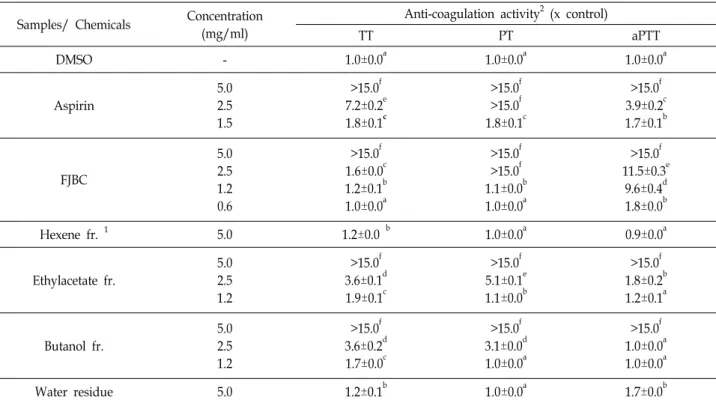
양한 혈액응고인자 및 prothrombin의 cascade 활성화에 의해 최종적으로 thrombin을 활성화시키며, thrombin은 fibri- nogen을 fibrin monomer로 전환시키고, 이후 fibrin mono- mer는 Ca++에 의해 중합되어 혈소판과 내피세포에 결합하게 되며, XIII 인자에 의해 교차 결합된 fibrin polymer를 형성하 는 과정이다[23]. 먼저 활성 대조구인 아스피린은 5 mg/ml 농도에서 TT, PT, aPTT를 모두 15배 이상 연장시켰으며, 1.5 mg/ml 농도에서는 각각 1.8, 1.8, 1.7배 연장효과를 나타내어 우수한 항응고 활성을 나타내었다(Table 4). 블랙커런트 착즙 액은 5 mg/ml 농도에서 TT, PT, aPTT를 모두 15배 이상 연장 시켰으며 2.5 mg/ml 농도에서 PT를 15배 이상 연장하여 아스 피린에 필적하는 강력한 활성을 나타내었다. 특히 내인성 혈 전 생성에 관련되는 aPTT의 경우 1.2 mg/ml 농도에서도 9.6 배 이상의 혈전생성 시간을 연장시켜, 동량의 아스피린보다 더욱 강력한 항응고 활성을 나타내었다. 착즙액의 분획물의 경우 EA 분획 및 butanol 분획은 5 mg/ml 농도에서 TT, PT, aPTT를 모두 15배 이상 연장시켰으며 2.5 mg/ml 농도에서 3,6배의 TT, 3.1~5.1배의 PT, 1.8배의 aPTT 연장을 나타내어 우수한 항응고 활성을 보였다. 이는 통상의 혈액순환 개선활 성이 있다고 알려진 한약재들보다 우수한 활성으로[19], 블랙 커런트가 과도한 혈전 생성을 억제하여 심혈관계 질환의 예방
에 도움이 될 수 있음을 나타내는 최초의 결과이며, 블랙커런 트가 다양한 성분의 항응고 활성성분을 포함하고 있음을 의미 하고 있다.
블랙커런트 착즙액 및 이의 분획물의 혈소판 응집저해 활성 블랙커런트 착즙액 및 이의 분획물의 항혈전 활성 평가를 위해 시료들의 인간 혈소판 응집저해능을 평가하였다. 혈소판 은 혈관 손상보호 및 혈소판 응집과 관련된 다양한 물질을 고농도로 포함하는 cytoplasmic granule을 가지고 있으며, 혈 관내벽의 손상이 나타나는 경우 응집인자들을 분비하고, 내피 세포의 손상으로 노출된 collagen 등과 결합하여 1차 지혈 플 러그를 형성하여 혈전생성을 개시하는 중요한 세포이다, 따라 서 혈소판 응집저해는 혈전 생성을 방지하는 매우 중요한 활 성이다[24]. 먼저 아스피린은 농도 의존적으로 혈소판 응집을 저해하였으며, 0.25 mg/ml농도에서 68.8%, 0.5 mg/ml 농도 에서 35.9%의 응집을 나타내었다. 블랙커런트 착즙액은 농도 의존적인 혈소한 응집저해를 나타낸 바, 1.5 mg/ml 농도에서 는 4.2%의 응집을 나타내었으나 0.3 mg/ml 농도에서는 무첨 가구와 유사한 92.4% 응집도를 나타내어 아스피린보다 약한 활성을 보였다(Table 5, Fig. 2) 반면 블랙커런트 착즙액의 EA 분획 및 butanol 분획에서는 0.25 mg/ml 농도에서 각각 38.4%
Table 5. Platelet aggregation inhibitory activities of the fresh juice of black currant (FJBC) and its subsequent organic solvent fractions Chemicals/Samples (mg/ml) Amplitude (Ω) Slope (Ω/min) Lag time (sec) Area under PAR1 (%)
DMSO Aspirin (0.50) Aspirin (0.25) FJBC (1.50) FJBC (0.75) FJBC (0.30) Hexane fr2. (0.25) Ethylacetate fr.(0.25) Ethylacetate fr.(0.12) Butanol fr. (0.25) Butanol fr. (0.12) Water residue (0.25)
19 8 16
2 16 17 20 8 13 11 16 28
2 1 2 0 2 2 2 1 2 1 2 4
30 57 35 144
78 46 28 44 48 41 36 16
117.6 42.2 80.9 9.5 73.9 108.1 130.9 45.2 74.0 59.8 93.6 218.6
100 35.9 68.8 4.2 32.7 92.4 111.3
38.4 62.9 50.9 79.6 185.9
1PAR: Platelet Aggregation Ratio. 2fr: fraction.
Data are presented as representative result relative of independent three determinations. Amplitude is expressed as ohms by max- imum extent of platelet aggregation, and slope (rate of reaction) is determined by drawing a tangent through the steepest part of curve. Area under is a calculated area in descent drawing during platelet aggregation.
A B C D E F
G H I J K L
Fig. 2. Impedance changes during platelet aggregation after addition of the fresh juice of black currant (FJBC) and its fractions measured by whole blood aggregometer. Platelet aggregation was induced by addition of 2.5 μl of collagen (1 mg/ml) into cuvette containing 50 μl of washed PRP and measured the impedance changes for 12 min. (A) DMSO, (B) aspirin (0.50 mg/ ml), (C) aspirin (0.25 mg/ml), (D) FJBC (1.5 mg/ml), (E) FJBC (0.75 mg/ml), (F) FJBC (0.3 mg/ml), (G) hexane fraction of FJBC (0.25 mg/ml), (H) ethylacetate fraction of FJBC (0.25 mg/ml), (I) ethylacetate fraction of FJBC (0.12 mg/ml), (J) butanol fraction of FJBC (0.25 mg/ml), (K) butanol fraction of FJBC (0.12 mg/ml), and (L) water residue of FJBC (0.25 mg/ml), respectively.
Table 6. Hemolytic activities of the fresh juice of black currant (FJBC) and its subsequent organic solvent fractions against human red blood cell (hRBC)
Chemicals/Parts (mg/ml) Hemolysis against hRBC (%) DMSO
Triton-X 100 (1.0).
Amphotericin B (0.02) FJBC Hexane fr.1 Ethylacetate fr.
Butanol fr.
Water residue.
1.2±1.1a 100±0.1c 96.5±1.2b 0.0±0.9a 6.6±0.7a 2.4±0.4a 7.6±1.0a -0.3±0.8a
1fr: fraction. Data are presented as the mean±SD of three determinations. Hemolytic activity was evaluated using 4% hu- man red blood cell and the relative hemolysis (%) was calcu- lated by following equation. (%) Hemolysis = [(Abs. S–Abs.
C)/(Abs. T–Abs. C)] ×100(For Abs. S, Abs. C and Abs.T, refer the materials and methods). Different letters within a column differ significantly (p<0.05)
및 50.9%의 응집도를 나타내어 아스피린보다 강력한 응집저 해가 나타났으며, 특히 EA 분획은 0.12 mg/ml 농도에서 아스 피린 0.25 mg/ml 농도에 해당하는 혈소판 응집저해능을 나타 내었다. 한편 물 잔류물의 경우 185.9%의 응집도를 보여 오히 려 혈소판 응집 촉진활성이 나타났다. 다양한 농도에서의 혈 소판 응집저해 결과를 바탕으로 50% 응집저해 농도를 계산 한 결과 아스피린은 0.395 mg/ml인 반면, 블랙커런트 착즙액, EA 분획 및 butanol 분획은 각각 0.735, 0.192 및 0.261 mg/ml 로 나타났다. 이러한 결과는 블랙커런트의 EA 분획 및 buta- nol 분획은 강력한 항응고 활성과 함께 혈소판 응집저해능이 우수하여 위장장애 등의 부작용을 나타내는 아스피린을 대치 할 수 있는 항혈전제로 개발 가능함을 제시하고 있다.
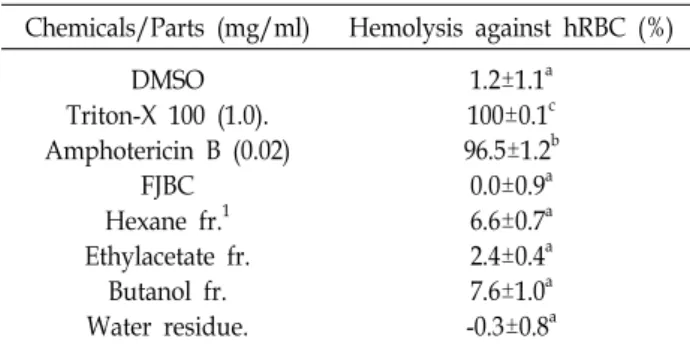
블랙커런트 착즙액 및 이의 분획물의 인간 적혈구 용혈 활성 블랙커런트 착즙액 및 이의 분획물의 세포독성 평가를 위해 인간 적혈구 용혈활성을 측정하였다. 먼저 대조구로 사용된 DMSO는 용혈활성이 없었으며, triton X-100 (1 mg/ml)와 amphotericin B (0.02 mg/ml)는 적혈구를 100% 및 96.5% 이 상 용혈시켜 세포독성을 확인하였다. 반면 블랙커런트의 모든 시료에서는 0.5 mg/ml 농도까지 용혈활성이 나타나지 않았다 (Table 6). 이러한 결과는 황백, 포황, 괄루근, 토사자, 사인 등 을 포함하는 다수의 한약재 추출물들이 강력한 항응고 활성을 나타냄에도 불구하고 0.5 mg/ml 농도에서 65~95%의 인간 적 혈구 용혈활성을 나타내어[19], 항혈전제로의 실제적 사용에 제한이 있음을 고려하면, 블랙커런트는 세포독성이 거의 없는 안전한 항혈전제 소재로 개발 가능함을 제시하고 있다. 상기 의 연구 결과는, 블랙커런트는 강력한 항산화, 항응고, 혈소판 응집저해 활성을 나타내어 신규의 항혈전제로 이용 가능함을
제시하고 있으며, 블랙커런트의 항혈전 활성에 대한 최초의 보고이다.
감사의 글
이 논문(저서)은 2014년도 안동대학교 학술연구조성사업 (연구교수)에 의하여 연구되었음.
References
1. Ahn, S. M., Ryu, H. Y., Kang, D. K., Jung, I. C. and Sohn, H. Y. 2009. Antimicrobial and antioxidant activity of the fruit of Prunus avium L. Kor. J. Microbiol. Biotechnol. 36, 195-200.
2. Benn, T., Kim, B., Park, Y. K., Wegner, C. J., Harness, E., Nam, T. G. and Kim, D. O., Lee, J. S. and Lee, J. Y. 2014.
Polyphenol rich blackcurrant extract prevents inflammation in diet-induced obsess mice. J. Nutr. Biochem. 25, 1019-1025.
3. Bijak, M., Bobrowski, M., Borowiecka, M., Podsedek, A., Golanski, J. and Nowak, P. 2011. Anticoagulant effect of pol- yphenols-rich extracts from black chokeberry and grape seeds. Fitoterapia 82, 811-817.
4. Bijak, M., Nowak, P., Bobrowiecka, M., Ponczek, M., Zbi- kowska, H. and Wacowicz, B. 2012. Protective effects of (-)-epicatechin against nitrative modifications of fibrinogen.
Thrombosis Res. 130, 123-128.
5. Chen, H., Qi, X., He, C., Yin, Z., Fan, D. and Han, G. 2013.
Coagulation imbalance may not contribute to the develop- ment of portal vein thrombosis in patients with cirrhosis.
Thrombosis Res. 131, 173-177.
6. Denev, P., Kratchanova, M., Ciz, M., Lojek, A., Vasicek, O., Nedelcheva, P., Blazheva, D., Toshkova, R., Gardeva, E., Yossifova, L., Hyrsl, P. and Vojtek, L. 2014. Biological activ- ities of selected polyphenol-rich fruits related to immunity and gastrointestinal health. Food Chem. 157, 37-44.
7. Gavrilova, V., Kajdžanoska, M., Gjamovski, V. and Stefova, M. 2011. Separation, characterization and quantification of phenolic compounds in blueberries and red and black cur- rants by HPLC-DAD-ESI-MS. J. Agric. Food Chem. 59, 4009-4018.
8. Ghosh, D., McGhie, T. K., Fisher, D. R. and Joseph, J. A.
2007. Cytoprotective effects of anthocyanins and other phe- nolic fractions of boysenberry and black currant on dop- amine and amyloid β-induced oxidative stress in trans- fected COS-7 cells. J. Sci. Food Agric. 87, 2061-2067.
9. Ghosh, D., McGhie, T. K., Zhang, J., Adaim, A. and Skinner, M. 2006. Effects of anthocyanins and other phenolics of boy- senberry and black currant as inhibitors of oxidative stress and damage to cellular DNA in SH-SY5Y and HL-60 cells.
J. Sci. Food Agric. 86, 678-686.
10. Huebbe, P., Griller, K., de Pascual-Teresa, S., Arkenau, A., Adolphi, B., Portius, S. and Arkenau, C. N. 2012. Effects of black currant-based juice on atherosclerosis-related bio- markers in cultured macrophages and in human subjects
after consumption of a high-energy meal. Br. J. Nutr. 108, 234-244.
11. Jeong, C. H., Jang, C. W., Lee, K. Y., Kim, I. H. and Shim, K. H. 2012. Chemical components and anti-oxidant activities of black currant. Kor. J. Food Preserv. 19, 263-270.
12. Kessler, T., Jansen, B. and Hesse, A. 2002. Effect of black currant-, cranberry- and plum juice consumption on risk factor associated with kidney stone formation. Eur. J. Clin.
Nutr. 56, 1020-1023.
13. Kim, M. S. and Sohn, H. Y. 2014. Anti-thrombosis activity of the aerial parts of Aruncus dioicus var kamtschaticus. J. Life Sci. 24, 515-521.
14. Lala, G., Malik, M., Zhao, C., He, J., Kwon, Y., Giusti, M.
M. and Magnuson, B. A. 2006. Anthocyanin-rich extracts in- hibit multiple biomarkers of colon cancer in rats. Nutr.
Cancer 54, 84-93.
15. Lu, Y. and Foo, Y. 2003. Polyphenolics constituents of black currant seed residue. Food Chem. 80, 71-76.
16. Martinez, M., Weisel, J. W. and Ischiropoulos, H. 2013.
Functional impact of oxidative posttranslational mod- ifications on fibrinogen and fibrin clots. Free Radic. Biol. Med.
65, 411-418.
17. Miller, N. J. and Rice-Evans, C. A. 1997. The relative con- tributions of ascorbic acid and phenolic antioxidants to the total antioxidant activity of orange and apple fruit juices and black currant drink. Food Chem. 60, 331-337.
18. Parkar, S. G., Redgate, E. L., McGhie, T. K. and Hurst, R.
D. 2014. In vitro studies of modulation of pathogenic and probiotic bacterial proliferation and adhesion to intestinal cells by blackcurrant juices. J. Funct. Foods 8, 35-44.
19. Ryu, H. Y., Ahn, S. M., Kim, J. S. and Sohn, H. Y. 2010.
Evaluation of in-vitro anticoagulation activity of 33 different medicinal herbs. J. Life Sci. 20, 922-928.
20. Singleton, V. L., Orthofer, R. and Lamuela-Raventos, R. M.
1999. Analysis of total phenols and other oxidation sub-
strates and antioxidants by means of Folin-Ciocaleau reagent.
Methods Enzymol. 299, 152-178.
21. Seri, S. and D’Alessandro, A. 1997. Blackcurrant seed oil, zinc, and fetal alcohol syndrome. J. Biol. Res. 73, 15-21 22. Strathearn, K. E., Yousef, G. G., Grace, M. H., Roy, S. L.,
Tambe, M. A., Ferruzzi, M. G., Wu, Q. L., Simon, J. E., Lila, M. A. and Rochet, J. C. 2014. Neuroprotective effects of an- thocyanins- and proanthocyanidin-rich extracts in cellular models of parkinson’s disease. Brain Res. 1555, 60-77.
23. Sweeney, J. D., Hoerning, L. A., Behrens, A. N., Novak, E.
and Swank, R. T. 1990. Thrombocytopenia after desmo- pressin but absence of in-vitro hypersensitivity to ristocetin.
Amer. J. Clin. Pathol. 93, 522-525
24. Sweeney, J. D., Hoerning, L. A. and Fitzpatrick, J. E. 1989.
Whole blood aggregation in Von willebrand disease. Amer.
J. Hematol. 32, 190-193.
25. Szachowicz-Petelska, B., Dobrzynska, I., Skrzydlewska, E.
and Figaszewski, Z. 2012. Protective effect of blackcurrant on liver cell membrane of rats intoxicated with ethanol. J.
Memb. Biol. 245, 191-200.
26. Tabart, J., Kevers, C., Pincemail, J., Defraigen, J. O. and Dommes, J. 2006. Antioxidant capacity of black currant var- ies with organ, season, and cultivar. J. Agric. Food Chem. 54, 6271-6276.
27. Valentina, U., Fabcic, J. and Stampar. F. 2007. Sugars, organ- ic acids, phenolic composition and antioxidant activity of sweet cherry (Prunus avium L.). Food Chem. 107, 185-192.
28. Wang, L. Y., Tong, D., Zhang, J. M., Ma, L., Zhang, Y., Zhao, C. and Yan, X. 2013. Study on anti-avian leukosis virus sub- group A activity of anthocyanin from a blackcurrant. J. Food Sci. Biotechnol. 32, 821-827.
29. Yook, C., Seo, M. H., Kim, D. H. and Kim, J. S. 2007. Quality improvement of Campbell early wine by mixing with differ- ent fruits. Kor. J. Food Sci. Technol. 39, 390-399.
초록:블랙커런트의 항산화, 항응고 및 혈소판 응집저해 활성 김미선․손호용*
(안동대학교 식품영양학과)
블랙커런트는 장미목 범의귀과의 낙엽관목으로, 즙이 많은 검은 열매와 잎을 주스, 잼, 젤리, 시럽 등으로 가공 하여 식용하고 있다. 본 연구에서는 블랙커런트(오스트리아산)의 착즙액과 이의 순차적 유기용매 분획물인 hex- ane 분획물, ethylacetate (EA) 분획물, butanol 분획물 및 물 잔류물을 조제하여 각각의 성분 분석, 항산화 활성, 혈전 생성과 관련된 항응고 활성 및 혈소판 응집저해 활성을 평가하였다. 그 결과, 착즙액과 폴리페놀 및 플라보 노이드 고함유 분획인 EA 분획물에서 강력한 DPPH 음이온, ABTS 양이온, nitrite 소거능과 환원력을 확인하였다.
EA 분획의 RC50 (활성 radical을 50% 제거하는 데 소요되는 시료의 양)는 각각 136.3, 66.2 및 115.5 μg/ml 값을 나타내어 vitamin C가 나타내는 RC50의 각각 1/10, 1/16 및 1/7.7에 해당하는 항산화력을 나타내었다. 또한 착즙 액과 이의 EA 분획물, butanol 분획물은 아스피린에 필적하는 강력한 항응고 활성을 나타내었으며, 특히 EA 분획 물과 butanol 분획물은 아스피린보다 우수한 혈소판 응집억제활성을 나타내었다. 혈소판 응집을 50% 저해할 수 있는 아스피린 농도는 0.395 mg/ml인 반면, EA 분획 및 butanol 분획은 각각 0.192 및 0.261 mg/ml로 나타났다.
상기의 활성 분획물은 0.5 mg/ml 농도까지 인간 적혈구에 대한 용혈활성을 나타내지 않았다. 이러한 결과는 블랙 커런트의 강력한 항산화, 항응고, 혈소판 응집저해 활성을 이용한 신규의 항혈전제 개발 및 이용이 가능함을 제시 하고 있다. 본 연구는 블랙커런트의 항혈전 활성에 대한 최초의 보고이다.