• 검색 결과가 없습니다.

Efficient Delivery of Toxoid Antigens using Micro/Nano-carriers

N/A
N/A
Protected

Academic year: 2021

Share "Efficient Delivery of Toxoid Antigens using Micro/Nano-carriers"

Copied!
12
0
0

로드 중.... (전체 텍스트 보기)

전체 글

(1)

Efficient Delivery of Toxoid Antigens using Micro/Nano-carriers

Ga-Young Park

1

, Gna Ahn

1

, Se Hee Lee

1

, Sang Bum Kim

2

, Yang-Hoon Kim

1

* and Ji-Young Ahn

1

*

1

School of Biological Sciences, Chungbuk National University, 1 Chungdae-Ro, Seowon-Gu, Cheongju 28644, Korea

2

Dairy Science Division, National Institute of Animal Science, Rural Development Administration, Cheonan 31000, Korea Received April 4, 2018 /Revised April 25, 2018 /Accepted April 26, 2018

Immunization has been performed for centuries and is generally accepted as a sustainable method of controlling bacteria, viruses, and mediated and infectious diseases. Despite many studies having been performed on animal subjects to demonstrate the importance of toxin immunity, the use of toxoid vac- cines in humans and animals has been limited for a long time. Recently, the development of the tox- oid antigen delivery system has been facilitated using novel nano-medicinal technology. The mi- cro/nano-carrier has been used to improve vaccination coverage as well as reduce vaccine costs. A micro/nano-carrier is a micro/nano-sized material that delivers immune cargo, including recombinant or peptide toxoid antigens. These toxoid antigens are either encapsulated in the interior or displayed on the surface of micro/nano-carriers as a way to protect them from the cellular machinery. In partic- ular, the combination of toxoid antigens and micro/nano-carriers can induce phagocytosis through the specific interactions between GCs and macrophages; thus, the toxoid antigens can be delivered easily into the macrophages. This paper reviews recent achievements of micro/nano-carriers in the field of vaccine delivery systems such as microbial ghost cells (GCs, Bacterial ghost cells and Yeast ghost cells), gene-manipulated outer membrane vesicles (OMVs) and biocompatible, polymer-based nano- particles (NPs, NP-Carrier and NP-Cage). Finally, this review shows various aspects in terms of the hosts’ immune responses.

Key words : Ghost cells (GCs), micro/nano carrier, nanoparticles (NPs), outer membrane vesicles (OMVs), toxoid antigen

*Corresponding authors

*Tel : +82-43-261-2301, Fax : +82-43-264-9600

*E-mail : [email protected] (Ji-Young Ahn)

*Tel : +82-43-261-3575, Fax : +82-43-264-9600

*E-mail : [email protected] (Yang-Hoon Kim)

This is an Open-Access article distributed under the terms of the Creative Commons Attribution Non-Commercial License (http://creativecommons.org/licenses/by-nc/3.0) which permits unrestricted non-commercial use, distribution, and reproduction in any medium, provided the original work is properly cited.

Journal of Life Science 2018 Vol. 28. No. 4. 496~507 DOI : https://doi.org/10.5352/JLS.2018.28.4.496

서 론

인간은 생애를 살아가면서 주변 환경에 존재하는 다양한 생물체와 부딪히며 살아간다. 그 중에는 인간에게 해가 되거 나 피해를 유발하는 병원체들이 존재하며, 일부는 생명을 위 협하기도 한다. 병원체로 인해 유발되는 질병을 미리 예방하 거나 병원체 감염에 대처하기 위해 백신은 지속적으로 연구 개발되고 있다. 백신은 병원체를 약독화 및 무독화 하는 방법 을 이용해 연구되고 있으며, 톡소이드 또한 오랜 기간 연구되 어온 백신 소재 중 하나이다. 톡소이드는 항원성은 유지하나 독성을 제거한 독소 단백질을 말하며 대표적으로는 테타누스 톡소이드나 디프테리아 톡소이드 등이 있다[7, 73]. 초기의 톡 소이드는 독소 단백질에 포름알데히드를 처리하거나 열을 가 함으로써 독성을 감소 또는 제거하였고, 개발이 가속화 되면

서 톡소이드로 활용될 수 있는 항원(이하 톡소이드 항원)을 연구하기 시작하였다[31, 48]. 톡소이드 항원에는 그람 음성세 균의 외막을 구성하고 있는 lipopolysaccharide (LPS)나 그람 양성 세균이 생성하는 독소 단백질의 에피토프 영역, 바이러 스의 외막 단백질 등이 있다[48, 65, 88]. 개발된 톡소이드 항원 은 그 자체만으로도 사용될 수 있으나, 효율성을 높이기 위한 방안이 강구되어 왔다[76, 77,]. 톡소이드 항원이 체내에 존재 하는 방어기작(lysosome, protease 등)에 의해 분해되지 않으 면서 빠른 시간 내에 정확히 표적 세포에 전달되고, 면역 반응 이 유도될 때까지 잔존할 수 있는 방법이 연구되었다[50, 78].

최근에는 보다 효과적인 전달 방안으로 마이크로/나노 운반 체가 주목 받기 시작하였다[36, 82]. 마이크로/나노 운반체는 마이크로/나노 수준의 크기를 가지며 DNA, 단백질 등의 생 체 물질을 운반 할 수 있는 물질로 본 총설에서 규정하였다.

특히, 톡소이드 항원의 전달에 이용되는 마이크로/나노 운반 체의 경우 표지/흡착 등의 용이성 및 생체 내 적합성, 생분해 성 등이 고려되어야 한다[36, 49, 56]. 마이크로/나노 운반체는 미생물을 통해 생산해내거나 미생물 자체를 이용할 수도 있으 며, 다양한 소재의 폴리머를 이용하여 제작할 수 있다[37, 82].

본 총설에서는 톡소이드 항원 전달을 위한 마이크로/나노 운

반체를 미생물 유래의 ghost cells (GCs) 및 그람 음성 세균이

분비하는 outer membrane vesicles (OMVs), 고분자 폴리머로

- Review -

(2)

Table 1. Classification of toxoid antigen delivery system using micro/nano-carrier

Micro/Nano-carrier Classification Additional linkage step for toxoid antigen

GCs BGCs

YGCs

Non-necessary

Necessary (chemical treatment)

OMVs OMVs Non-necessary

NPs NP-carrier

NP-cage Necessary (chemical treatment)

Table 2. Delivery of toxoid antigen using GCs delivery system

Type of GCs Pathogens Antigen Reference

BGCs

Chylamydia trachomatis MOMPs

PmpC [64]

E. coli O157:H7 Shiga toxin (Stx1B, Stx2A)

Intimin

[14]

[52]

Enterotoxigenic E. coli (ETEC)

K88 (serotype K88ab, K88ac) K99

FasA

[51]

FedA FedF F41

[52]

Haemophilus influenzae Streptococcus iniae Hepatitis B virus

Omp26 GAPDH

Hepatitis B core antigen (HBcAg-149)

[74]

[71]

[47]

YGCs

F18

+

E.coli Hepatitis B virus

Polyoma virus

FedF

Hepatitis B surface antigen (HBsAg) U65 (self-aggregating peptide scaffold)

[2]

[84]

[87]

구성된 nanoparticles (NPs)으로 분류하였으며, 각 운반체의 톡소이드 항원 운반 방식 및 이를 적용하여 나타나는 면역반 응에 대하여 서술하였다(Table 1).

본 론

Ghost cells (GCs)

Ghost cell (GCs)는 세포의 형태를 가지고 있으나 분열과 같은 생명 활동을 할 수 없는 세포이다[63]. 톡소이드 항원을 전달하는 수단으로 세포 외피를 이용하는 것이다. 이 과정에 서 세포의 막 단백질 또는 lipopolysaccharide (LPS)와 같이 세포 표면을 구성하는 성분을 제외한 유전물질, 세포 소기관 등을 세포 내부에서 제거하는 과정이 필수적으로 요구된다 [62]. GCs는 기원하는 미생물에 따라 분류할 수 있으며, 크게 원핵세포 생물인 세균에서 유래된 Bacterial Ghost Cells (BGCs)와 진핵세포 생물인 효모에서 유래된 Yeast Ghost Cells (YGCs)으로 나누어진다[40, 63, 70]. GCs의 종류에 따라 톡소이드 항원을 전달하는 방법이 다르다. GCs를 이용하여 다양한 톡소이드 항원의 전달 사례를 세균 및 바이러스 순서 로 정리하였다(Table 2).

Bacterial ghost cells (BGCs)

BGCs는 Escherichia coli, Vibrio cholerae, Mannheimia haemo-

lytica 등과 같은 그람 음성 세균에서 유래한 세포 외피를 의미

한다[25, 26, 43, 62]. 세균 내부의 존재하는 유전물질, 세포 소 기관 등을 제거하기 위하여 단백질 E-매개 용해법(Protein E-mediated lysis)을 이용한다. 단백질 E-매개 용해법은 bac- teriophage ΦX174의 숙주세포 용해법에서 착안되었다[96]. 단 백질 E은 소수성의 막 단백질로써 E. coli 세포의 중앙 또는 분열이 진행되는 polar 부분에 외막과 내막을 관통하는 터널 구조를 형성한다. 세포질과 배양 배지의 삼투압 차이에 의해 세포질 내부 물질들이 터널 밖으로 유출되어 용해된다[93]. 용 해 이후에도 세포 표면의 LPS, lipid A 등의 면역반응을 자극 할 수 있는 구성성분은 남아있어 톡소이드 항원의 면역반응 유도를 강화한다[55, 63].

BGCs를 이용하여 톡소이드 항원을 운반하는 방법은 크게

두 가지 방법으로 나누어진다(Fig. 1A). 첫 번째 방법에서는

톡소이드 항원이 외막 단백질과 함께 발현되어 그람 음성 세

균의 세포 표면으로 표지 된다. 이후에는 단백질 E-매개 용해

법을 이용하여, 세포질 내 유전물질을 제거하는 과정을 거쳐

최종적으로 BGCs가 제작된다[14, 51, 52, 64, 71, 74]. 예를 들

(3)

A

B

Fig. 1. Delivery of toxoid antigen using GCs and induction immune response. (A) Preparation of GCs and toxoid antigen-GCs.

(B) Signaling of dectin-1 on phagocytes by administration of GCs [6].

어, 톡소이드 항원인 Stx2B은 그람 음성 세균의 외막 단백질 중 하나인 Outer membrane protein A (OmpA)와 함께 발현 된다[14]. OmpA는 베타-배럴과 알파-나선이 반복되는 구조를 형성하기 때문에, 톡소이드 항원도 함께 세포 표면으로 표지 된다. 표지된 항원은 유세포 분석기 및 웨스턴 블랏 방법을 이용하여, 표지 여부를 검증한다[29, 51, 90]. 두 번째 방법에서 는 BGCs의 세포질 또는 주변 세포질 내에 톡소이드 항원을 가두어 운반하며, 가두는 방법은 세포 내 단백질을 활용한다 는 점에서 앞서 서술한 표면 표지 방법과 유사하다[47]. 그러나 톡소이드 항원의 발현 위치가 외막이 아닌 내막이나 주변 세

포질 내라는 점이 다르다. 예를 들어 바이러스성 톡소이드 항

원의 C-말단에 L’ 앵커 펩타이드를 융합 발현하여 E. coli 의

내막에 톡소이드 항원이 표지 되도록 유도한다[47]. 이후에는

단백질 E-매개 용해법으로 최종 BGCs를 제작하는 방식을 취

한다. 앞서 서술한 두 가지 방법 이외에 BGCs 자체를 이용하

여 항원을 운반할 수도 있다. BGCs는 그람 음성 세균을 기반

으로 하고 있기 때문에 톡소이드 항원인 LPS, lipid A 등이

이미 존재하고 있다[25, 26, 43, 62]. Salmonella spp., Yershinia

enterocolitica 와 같은 세균성 질병을 유발하는 그람 음성 세균

의 경우에는 BGCs를 제작하여 그 자체를 면역유도제로 활용

(4)

A

B

Fig. 2. Delivery of toxoid antigen using OMVs and induction immune response. (A) A type of OMVs for delivery of toxoid antigen.

(B) Immune response of host cell by administration of OMVs [17].

할 수 있다[15, 46, 89].

Yeast ghost cells (YGCs)

YGCs는 효모의 다양한 종들 중에서 Saccharomyces cer-

evisiae (Baker’s yeast)으로부터 추출한 외피 부분을 의미하며,

2~3 um 크기의 속이 비어 있는 원반 형태이다[42, 70, 95]. S.

cerevisiae 의 세포벽은 만노단백질 및 베타-(1,3)-글루칸, 베타

-(1,6)-글루칸 등으로 구성되어 있으며, YGCs는 베타-(1,3)-글 루칸 영역만을 추출하기 때문에 베타-글루칸 입자(Beta-glu- can particles)라는 명칭으로도 불린다[95]. 연구 초기에는 균 류의 병리학 연구에 초점을 맞추어 효모의 베타-글루칸에 의 한 면역반응 연구에 중점을 두었으나, YGCs가 수평적 유전자 전이를 발생시킬 유전물질이 제거되었다는 점, 베타-글루칸이

어쥬번트로써의 역할을 할 수 있다는 점에 초점이 맞춰지면서 톡소이드 항원 전달 시스템으로써 활발히 연구가 진행되고 있다[22, 24]. S. cerevisiae 내부에 존재하는 유전물질 및 세포 소기관 등을 제거하기 위하여 산/염기성 용액을 반복적으로 처리하며 그로 인해 세포벽에 미세한 구멍이 생기게 된다. 또 한, 세포벽의 가장 바깥 부분 단백질이 벗겨지면서 세포벽의 주요 구성성분인 베타-글루칸 만이 회수된다. 제작된 YGCs는 마지막 단계인 탈수 과정을 거치면서 내부가 수축되는 현상이 나타나, 크기가 기존 효모에 비해 줄어들게 된다[70, .85].

YGCs를 이용한 톡소이드 항원 운반 방법은 크게 1) 화학

물질을 이용하여, YGCs 표면에 톡소이드 항원을 표지하는 방

법[13, 70], 2) 톡소이드 항원을 비어 있는 YGCs 내부로 주입하

는 방법으로 나누어진다[2, 84, 87] (Fig. 1A). 화학 물질을 이용

(5)

한 톡소이드 항원 표지 방법은 베타-글루칸의 작용기 잔기를 활성화시키는 것으로부터 시작되며 NaIO

4

및 1-Cyano-4-di- methylaminopyridinium tetrafluoroborate (CDAP) 등의 화 학 물질을 처리한다[13, 70]. 잔기가 활성화된 YGCs와 톡소이 드 항원을 섞어 반응시킨 후, 공초점 현미경 이미지 분석 및 유세포 분석기를 활용하여 항원의 표지 여부 및 효율을 검증 한다[9, 70]. 반면에 톡소이드 항원을 YGCs 내로 주입하는 방 법은 제작 과정에서 생겨난 미세한 구멍을 통해, 항원을 밀어 넣는 방식이다[2, 84, 87]. YGCs와 수용성의 톡소이드 항원을 함께 혼합하여 내부에 톡소이드 항원이 도입된 형태로 전달되 게 된다.

GCs으로 유도되는 면역 반응

GCs는 LPS 또는 베타-글루칸 등으로 구성되어 있기 때문에 면역 반응을 강화시키는 어쥬번트의 역할을 하는 것으로 알려 져 있다[8, 40]. Salmonella enteritidis 으로부터 제작한 BGCs를 랫트 모델에 어쥬번트 없이 처리 하였을 때, 어쥬번트를 함께 처리한 것과 유사한 IgG 농도가 확인되었다[89]. 이는 BGCs 자체가 충분히 어쥬번트의 역할을 하는 것을 보여준다. YGCs 의 항원 전달에 따른 면역반응 분석 연구에는 세균/바이러스 유래 항원보다는 종양 항원인 ovalbumin (OVA)을 모델 항원 으로 이용한 사례가 많다[8, 22, 40]. Huang H et al. 등은 YGCs 내에 OVA를 주입하여 항원을 전달한 쥐의 T-세포 분열 반응 은 대표적인 어쥬번트인 Aluminum salt (Alum)을 OVA와 함 께 처리한 쥐의 경우보다 최대 약 20000 CPM 까지 증가하였 다[39]. YGCs 활용 시료에서 helper T-세포 반응과 관련된 사 이토카인인 interferon-gamma (IFN-ɣ), interleukin-4 (IL-4), IL-17의 발현 수준이 Alum 활용 시료보다 높았음을 증명하였 다[39]. 이와 같은 반응들은 dectin-1의 신호전이 경로에 의해 강화되는 것으로 보인다[6, 12, 35, 38]. Dectin-1은 대식세포 및 수지상 세포, 호중구와 같은 식세포의 표면에 높은 수준으 로 발현되어 있는 베타-글루칸 수용체로 항진균 면역과 관련 이 있는 패턴 인식 수용체이다[6]. Haibin Huang 등은 저해제 인 latrunculin A의 사용 및 dectin-1 결핍 마우스로의 적용을 통해, YGCs가 dectin-1와 결합하면서 식세포 작용에 의해 수 지상 세포 내로 흡수되고, dectin-1 신호전달 경로가 자극되어 IL-6, IL-2, TNF-α, IL-12p40 등의 사이토카인이 생산되었음을 증명하였다[38]. Dectin-1과 YGCs의 상호작용은 dectin-1의 면역수용체 티로신-기반 활성 모티프인 ‘YXXL’의 티로신의 인산화가 발생하고, 이것이 Spleen tyrosine kinase (Syk) fam- ily의 인산화를 유도하면서 신호전이 과정이 진행된다[35] (Fig 2B).

Outer membrane vesicles (OMVs)

그람 음성 세균은 주변 환경 내에 존재하는 다른 생물체와 세포-세포 상호작용을 하기 위해 OMVs를 분비한다[53].

OMVs는 그람 음성 세균의 외막 및 주변 세포질 일부가 떨어 져 나온 10~300 nm 크기의 소포체로 핵산 및 단백질과 같은 생체 고분자 및 외막의 구성 성분 중 하나인 LPS도 함께 존재 한다[10, 27]. OMVs의 연구 방향은 그람 음성 세균이 수시로 변화하는 환경에 적응하기 위하여 자신의 유전 물질이나 독성 인자 등을 분비하는 기작[57] 및 쿼럼 센싱과 같은 신호전달 기작[61]을 이해하는 데에 초점이 맞춰져 있었으나, 최근에는 OMVs를 항원 또는 약물과 같은 물질들을 운반할 수 있는 운 반체로 활용하기 위한 연구가 진행되고 있다[33, 54, 81].

OMVs를 이용해 톡소이드 항원 운반 방식은 항원의 위치를 OMVs의 표면 또는 주변 세포질과 같은 내부에 따라 나누어진 다. OMVs의 표면에 항원을 표지하기 위하여, 막 표면 노출 지질단백질인 OspA와 항원을 함께 발현한다[75]. 항원을 내 부에 도입 또는 내막으로 표지하기 위하여, 그람 음성 세균의 주변 세포질 영역으로 발현시키거나 막 단백질(OmpA, OmpB, OmpC)의 말단에 함께 발현되도록 한다[5, 20] (Fig. 2A). 그러 나, 항원을 OMVs의 바깥 표면으로 발현 및 표지하는 사례는 매우 드물었으며, 대부분의 경우 OMVs 내부로 항원을 도입하 는 경우가 많았다. OMVs 내부로의 톡소이드 항원 도입하기 위해서는, 막 단백질인 OmpA의 신호 펩타이드 및 주변 세포 질 분비 펩타이드의 N-말단 영역에 Streptococcus pyogenes 의 Streptolysin O 및 SpyCEP과 같은 항원을 융합 발현한 경우가 있다[28]. 앞선 2가지 방법 이외에도 OMVs에 1-ethyl-3-(3-di- methylaminopropyl) carbodiimide (EDAC)와 같은 결합 시약 을 이용하여, Brucella abortus 의 LPS를 표지하고 브루셀라 예 방을 위한 OMVs carrier를 제작한 경우가 있다[81]. Table 3에 서 OMVs를 이용하여 운반한 톡소이드 항원 종류를 세균 및 바이러스 순서로 정리하였다. 톡소이드 항원 단백질을 발현하 는 방법 이외에 OMVs를 획득하는 그람 음성 세균 자체에 면 역 반응을 유도하는 방법이 있으며, Mycobacterium tuberculosis 등과 같은 사례가 있다[72].

OMVs에 의해 유도되는 면역반응

OMVs는 내포작용에 의하여, 표피 세포 내로 유입되며 크

게 대음세포 작용(Macropinocytosis) [91] , 클라트린-매개 내

포작용(Clathrin-mediated endocytois) [16], 카베올린-매개 내

포작용(Caveolin-mediated endocytosis) [66], 지질뗏목-매개

내포작용(lipid raft-mediated endocytosis) [66] 과 같은 4가지

경로가 알려져 있으며, 클라트린-매개 내포작용 및 지질뗏못-

매개 내포작용 경로가 주요 경로이다[45, 68]. Helicobacter pylo-

ri, Haemophilus influenzae, Pseudomonas aeruginosa와 같은 그람

음성 세균에서 생성된 OMVs들이 이용하는 지질뗏못-매개 내

포작용 경로는 콜레스테롤이 풍부한 부분이 세포막이 굽어지

도록 만들며, OMVs를 숙주세포 내로 함입시켜 OMVs 및 내

부 항원들을 이동시킨다[45] (Fig. 2B). OMVs는 단핵구 세포와

결합하여, NF-κB을 활성화시키며 TNF-α, IL-1β, IL-8, IL-10과

(6)

A

B

Fig. 3. Delivery of toxoid antigen using NPs and induction immune response. (A) A type of NPs for delivery of toxoid antigen.

(B) Size-dependent uptake of NPs on phagocytes. The scheme was adapted with modification from the paper (Reto A.

Schwendener) and Copyright has SAGE Publications [79].

같은 사이토카인의 분비를 유도하였다[17].

Nanoparticles (NPs)

Nanoparticles은 1~100 nm의 크기를 가지는 입자를 말하며 금과 은, 철과 같은 금속이나 카본, 하이드로겔 폴리머와 같은 고분자가 nanoparticles의 기반 물질이 될 수 있다. NPs은 나 노미터 크기를 장점으로 바이오칩, 나노센서 등과 같은 디스 플레이, 센싱 분야에서 각광받고 있으며, 나아가 백신 분야에 서도 활용 가능성을 보이고 있다[67, 94]. 백신 분야에서 활용 하는 NPs의 소재는 생체에 적용할 수 있고 분해가 가능해야 하기 때문에 금속보다는 하이드로겔 또는 키토산과 같이 무독 하면서 생체 적합성이 높은 재료가 이용된다[21].

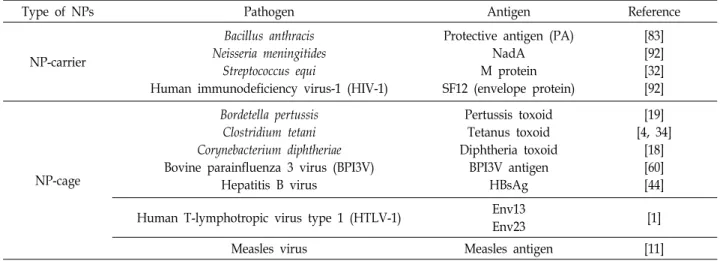
NPs을 활용한 톡소이드 항원 운반 시스템은 크게 2가지로 분류될 수 있다(Fig. 3A). 1) NPs을 제작한 뒤, 톡소이드 항원 단백질을 NPs 표면에 표지 또는 흡착하는 방식인 NP-carrier [30, 83, 92]와 2) 하이드로겔과 같은 고분자 폴리머와 톡소이드 항원 단백질을 함께 섞어 NPs을 제작하거나 표면으로 표지한 이후, 폴리머로 코팅하여 톡소이드 항원이 갇혀있게 되는 방 식인 NP-cage가 있다[18, 34]. NPs을 활용하여 운반한 항원의

종류는 대부분 OVA을 모델 항원으로 이용한 연구에 치중되 어 있으나, 일부 연구에서는 세균 및 바이러스 톡소이드 항원 을 이용한 사례가 있다(Table 4).

NP-carrier

NP-carrier는 기제작한 NP에 톡소이드 항원과 1-ethyl (3-dimethylaminopropyl) carbodiimide (EDC)와 같은 결합 시약을 처리하여, NP와 항원 사이에 공유 결합을 형성시켜 최종 제작한다[30]. 공유 결합 이외에 NP 표면에 비공유 결합 을 통한 흡착 작용을 통해 톡소이드 항원을 고정하는 방법을 사용하는 경우가 있다[92].

NP-cage

NP-cage는 poly (lactide-co-glycolide) (PLGA) 또는 poly-

lactic acid-polyethylene glycol (PLA-PEG)와 같은 생분해성,

생체적합성이 우수한 고분자 폴리머와 톡소이드 항원을 함께

섞는 방식[4, 19, 34, 44, 60]과 기제작한 NP의 표면으로 톡소이

드 항원을 흡착시킨 다음, 또 다른 폴리머 소재로 코팅하는

방식[11, 18]으로 나눌 수 있다. NPs의 구성성분 및 코팅 폴리

(7)

Table 3. Delivery of toxoid antigen using OMVs delivery system

Pathogen Antigen Reference

Acinetobacter baumannii Borrelia burgdorferi Bordetella pertussis Brucella abortus S99 Chlamydia muridaum

Omp22 OspA

Adenylate cyclase toxin (ACT) LPS

HtrA

[41]

[75]

[23]

[81]

[5]

Mycobacterium tuberculosis

ESAT6 Ag85B Rv2660c

[20]

Neisseria meningitidis fHdp

NadA

[75]

[86]

Sterptococcus pyogenes (Group A)

SpyCEP Streptolysin O

Spy0269 [28]

Streptococcus pyogenes (Group B) SAM_1372

Table 4. Delivery of toxoid antigen using NPs delivery system

Type of NPs Pathogen Antigen Reference

NP-carrier

Bacillus anthracis Neisseria meningitides

Streptococcus equi

Human immunodeficiency virus-1 (HIV-1)

Protective antigen (PA) NadA M protein SF12 (envelope protein)

[83]

[92]

[32]

[92]

NP-cage

Bordetella pertussis Clostridium tetani Corynebacterium diphtheriae Bovine parainfluenza 3 virus (BPI3V)

Hepatitis B virus

Pertussis toxoid Tetanus toxoid Diphtheria toxoid

BPI3V antigen HBsAg

[19]

[4, 34]

[18]

[60]

[44]

Human T-lymphotropic virus type 1 (HTLV-1) Env13

Env23 [1]

Measles virus Measles antigen [11]

머의 효과를 검증한 연구 보고들이 있다[4, 18]. 예를 들어, 테 타누스 톡소이드 항원을 혼합한 PLA-PEG 소재의 NP-cage는 톡소이드 백신에 자주 사용되는 알루미늄 어쥬번트 중 하나인 aluminum phosphate의 양을 0.2 mg으로 줄이면서도 기존 테 타누스 톡소이드 백신과 유사한 효과를 보였다[4]. 또한, PLGA 폴리머를 디프테리아 톡소이드 항원과 함께 캡슐화하 여 NP-cage를 제작한 다음, cellobiose로 코팅하여 경구 접종 시 톡소이드 항원을 장까지 운반할 수 있는 개선된 NP-cage를 제작하려는 연구 결과가 있다[18].

NPs에 의해 유도되는 면역반응

NPs은 제작하는 소재 및 제작자의 의도에 따라 크기나 형 태에서 차이가 나며, 세포로의 NPs 흡수율에도 차이를 보였으 며, NPs을 이용하여 전달하는 톡소이드 항원의 흡수율에도 영향을 미친다[3, 94]. NPs의 크기를 50 nm에서 1 um까지, 형태를 구형, 막대형, 디스크형태로 다양화하여 상피 세포에

처리하였을 때, 크기는 작을수록 형태는 막대형의 NPs의 세포 로의 흡수율이 가장 높다는 연구 결과가 있다[3]. 저분자량의 키토산을 이용하여 NP-cage를 제작한 연구 보고에서는 106 kDa의 키토산 NP-cage보다 42 kDa의 저분자 키토산 NP- Cage의 IgG 및 IgA 항체 역가가 더 높았음을 보여주는 연구 결과가 있었다[11, 67]. 이는 NPs의 크기가 세포 흡수율뿐만 아니라 항체 생성에도 영향을 준 것으로 사료된다[11, 30].

NPs의 크기는 흡수율 이외에도 식세포 작용이 나타나는 식세 포의 종류에도 영향을 미치며, 0.5~5 um 크기의 NPs은 대식세 포에 의한 식세포 작용이 주로 나타나나, 그 이하의 작은 크기 (20~200 nm)의 NPs은 대식세포 보다는 수지상 세포에 의한 식세포 작용이 더 선호하여 나타난다[59, 69] (Fig. 3B).

결 론

톡소이드는 앞으로도 연구 및 개발되어야 하며, 지속적으로

(8)

해결해야 하는 문제점들이 있다. 그러한 문제점들 중에서도 접종량을 낮추거나 접종 시기를 늦추는 것, 부작용을 줄이는 것 등이 주로 고려되고 있다. 톡소이드 항원을 효과적으로 체 내 세포에 전달하는 과정은 앞선 문제점들을 해결할 수 있는 방안으로 제시되고 있으며, 그 중에서도 마이크로/나노 운반 체는 작은 크기와 면역 반응의 유도 강화, 높은 변형 용이성 등을 강점으로 효과적인 항원 전달 시스템에 유용한 물질이 다. 마이크로/나노 운반체는 어쥬번트를 줄이면서도 면역 반 응 유도 작용을 유지 또는 향상시켜 항체 역가를 높인다는 여러 연구사례가 존재한다[4, 58, 80]. 그 중에서도 YGCs는 생 체 내에서 안전하고 유전 물질이 존재하지 않으며, 어쥬번트 로의 역할도 할 수 있어 세균성/바이러스성 톡소이드 항원 단백질을 운반하는데 강한 이점이 있다. OMVs의 경우에는 질병을 유발하는 그람 음성 세균 자체의 OMVs를 톡소이드 항원 운반 물질로 이용할 수 있기 때문에 추가적인 변형 과정 이 필요 없는 용이성이 존재한다. 그러나, 마이크로/나노 운반 체를 이용한 톡소이드 항원 전달 또한 지속적으로 연구되어야 하는 부분들이 남아있다. 마이크로/나노 운반체를 이용하여 유도된 IgG 및 IgA 항체 역가 및 일부 사이토카인의 분비량 증가, 어쥬번트 사용량 감소 등에 대하여 연구한 사례들은 많 은 보고가 있으나, 그것에 대한 상세한 기작에 대해서는 규명 되지 않은 경우가 있다. 또한, NPs 및 YGCs을 이용한 항원 운반은 주로 OVA를 이용한 사례가 많으며 세균성, 바이러스 성 톡소이드 항원을 적용한 연구 사례가 많지 않다. 이에 대하 여, 다양한 형태의 항원 적용 연구를 통하여, 마이크로/나노 운반체을 이용한 톡소이드 항원 전달의 효율이 개선되고, 기 작 규명을 통해 문제점 및 톡소이드 백신 부작용의 감소에 기여할 것으로 사료된다.

감사의 글

본 총설은 농촌진흥청 연구사업(과제번호: PJ012568)의 지 원에 의해 이루어진 결과이며, 이에 감사드립니다.

References

1. Amirnasr, M., Fallah Tafti, T., Sankian, M., Rezaei, A. and Tafaghodi, M. 2016. Immunization against HTLV-I with chi- tosan and tri-methylchitosan nanoparticles loaded with re- combinant env23 and env13 antigens of envelope protein gp46. Microb. Pathog. 97, 38-44.

2. Baert, K., De Geest, B. G., De Greve, H., Cox, E. and Devriendt, B. 2016. Duality of beta-glucan microparticles:

antigen carrier and immunostimulants. Int. J. Nanomedicine 11, 2463-2469.

3. Banerjee, A., Qi, J., Gogoi, R., Wong, J. and Mitragotri, S.

2016. Role of nanoparticle size, shape and surface chemistry in oral drug delivery. J. Control. Release 238, 176-185.

4. Bansal, V., Kumar, M., Dalela, M., Brahmne, H. G. and Singh,

H. 2014. Evaluation of synergistic effect of biodegradable polymeric nanoparticles and aluminum based adjuvant for improving vaccine efficacy. Int. J. Pharm. 471, 377-384.

5. Bartolini, E., Ianni, E., Frigimelica, E., Petracca, R., Galli, G., Berlanda Scorza, F., Norais, N., Laera, D., Giusti, F., Pierleoni, A., Donati, M., Cevenini, R., Finco, O., Grandi, G. and Grifantini, R. 2013. Recombinant outer membrane vesicles carrying Chlamydia muridarum HtrA induce antibodies that neutralize chlamydial infection in vitro. J. Extracell.

Vesicles 2, 1-14.

6. Batbayar, S., Lee, D. H. and Kim, H. W. 2012. Immunomo- dulation of fungal beta-glucan in host defense signaling by dectin-1. Biomol. Ther. (Seoul) 20, 433-445.

7. Baxter, D. 2007. Active and passive immunity, vaccine types, excipients and licensing. Occup. Med. (Lond) 57, 552-556.

8. Berner, V. K., duPre, S. A., Redelman, D. and Hunter, K.

W. 2015. Microparticulate beta-glucan vaccine conjugates phagocytized by dendritic cells activate both naive CD4 and CD8 T cells in vitro. Cell Immunol. 298, 104-114.

9. Berner, V. K., Sura, M. E. and Hunter, K. W. J. 2008. Conju- gation of protein antigen to microparticulate beta-glucan from Saccharomyces cerevisiae: a new adjuvant for intra- dermal and oral immunizations. Appl. Microbiol. Biotechnol.

80, 1053-1061.

10. Beveridge, T. J. 1999. Structures of gram-negative cell walls and their derived membrane vesicles. J. Bacteriol. 181, 4725- 4733.

11. Biswas, S., Chattopadhyay, M., Sen, K. K. and Saha, M. K.

2015. Development and characterization of alginate coated low molecular weight chitosan nanoparticles as new carriers for oral vaccine delivery in mice. Carbohydr. Polym. 121, 403- 410.

12. Brown, G. D., Herre, J., Williams, D. L., Willment, J. A., Marshall, A. S. and Gordon, S. 2003. Dectin-1 mediates the biological effects of beta-glucans. J. Exp. Med. 197, 1119-1124.

13. Bystricky, S., Machova, E., Bartek, P., Kolarova, N. and Kogan, G. 2000. Conjugation of yeast mannans with protein employing cyanopyridinium agent (CDAP)--an effective route of antifungal vaccine preparation. Glycoconj. J. 17, 677- 680.

14. Cai, K., Tu, W., Liu, Y., Li, T. and Wang, H. 2015. Novel fusion antigen displayed-bacterial ghosts vaccine candidate against infection of Escherichia coli O157:H7. Sci. Rep. 5, 1-10.

15. Cai, K., Zhang, Y., Yang, B. and Chen, S. 2013. Yersinia en- terocolitica ghost with msbB mutation provides protection and reduces proinflammatory cytokines in mice. Vaccine 31, 334-340.

16. Canas, M. A., Gimenez, R., Fabrega, M. J., Toloza, L., Baldoma, L. and Badia, J. 2016. Outer membrane vesicles from the probiotic escherichia coli nissle 1917 and the com- mensal ECOR12 enter intestinal epithelial cells via cla- thrin-dependent endocytosis and elicit differential effects on DNA damage. PLoS One 11, 1-22.

17. Cecil, J. D., O'Brien-Simpson, N. M., Lenzo, J. C., Holden,

J. A., Singleton, W., Perez-Gonzalez, A., Mansell, A. and

(9)

Reynolds, E. C. 2017. Outer membrane vesicles prime and activate macrophage inflammasomes and cytokine secretion in vitro and in vivo. Front. Immunol. 8, 1-22.

18. Chudina, T., Labyntsev, A., Manoilov, K., Kolybo, D. and Komisarenko, S. 2015. Cellobiose-coated poly(lactide-co- glycolide) particles loaded with diphtheria toxoid for per os immunization. Croat. Med. J. 56, 85-93.

19. Conway, M. A., Madrigal-Estebas, L., McClean, S., Brayden, D. J. and Mills, K. H. 2001. Protection against Bordetella pertussis infection following parenteral or oral immuniza- tion with antigens entrapped in biodegradable particles: ef- fect of formulation and route of immunization on induction of Th1 and Th2 cells. Vaccine 19, 1940-1950.

20. Daleke-Schermerhorn, M. H., Felix, T., Soprova, Z., Ten Hagen-Jongman, C. M., Vikstrom, D., Majlessi, L., Beskers, J., Follmann, F., de Punder, K., van der Wel, N. N., Baumgarten, T., Pham, T. V., Piersma, S. R., Jimenez, C. R., van Ulsen, P., de Gier, J. W., Leclerc, C., Jong, W. S. and Luirink, J. 2014. Decoration of outer membrane vesicles with multiple antigens by using an autotransporter approach.

Appl. Environ. Microbiol. 80, 5854-5865.

21. De Jong, W. H. and Borm, P. J. 2008. Drug delivery and nanoparticles:applications and hazards. Int. J. Nanomedicine 3, 133-149.

22. De Smet, R., Demoor, T., Verschuere, S., Dullaers, M., Ostroff, G. R., Leclercq, G., Allais, L., Pilette, C., Dierendonck, M., De Geest, B. G. and Cuvelier, C. A. 2013. beta-Glucan micro- particles are good candidates for mucosal antigen delivery in oral vaccination. J. Control. Release 172, 671-678.

23. Donato, G. M., Goldsmith, C. S., Paddock, C. D., Eby, J.

C., Gray, M. C. and Hewlett, E. L. 2012. Delivery of Borde- tella pertussis adenylate cyclase toxin to target cells via out- er membrane vesicles. FEBS Lett. 586, 459-465.

24. Driscoll, M., Hansen, R., Ding, C., Cramer, D. E. and Yan, J. 2009. Therapeutic potential of various beta-glucan sources in conjunction with anti-tumor monoclonal antibody in can- cer therapy. Cancer Biol. Ther. 8, 218-225.

25. Ebensen, T., Paukner, S., Link, C., Kudela, P., de Domenico, C., Lubitz, W. and Guzman, C. A. 2004. Bacterial ghosts are an efficient delivery system for DNA vaccines. J. Immunol.

172, 6858-6865.

26. Eko, F. O., Lubitz, W., McMillan, L., Ramey, K., Moore, T.

T., Ananaba, G. A., Lyn, D., Black, C. M. and Igietseme, J. U. 2003. Recombinant Vibrio cholerae ghosts as a delivery vehicle for vaccinating against Chlamydia trachomatis.

Vaccine 21, 1694-1703.

27. Ellis, T. N. and Kuehn, M. J. 2010. Virulence and im- munomodulatory roles of bacterial outer membrane vesicles.

Microbiol. Mol. Biol. Rev. 74, 81-94.

28. Fantappie, L., de Santis, M., Chiarot, E., Carboni, F., Bensi, G., Jousson, O., Margarit, I. and Grandi, G. 2014. Antibody- mediated immunity induced by engineered Escherichia coli OMVs carrying heterologous antigens in their lumen. J.

Extracell. Vesicles 3, 1-14.

29. Felnerova, D., Kudela, P., Bizik, J., Haslberger, A., Hensel, A., Saalmuller, A. and Lubitz, W. 2004. T cell-specific im-

mune response induced by bacterial ghosts. Med. Sci. Monit.

10, BR362-BR370.

30. Fifis, T., Gamvrellis, A., Crimeen-Irwin, B., Pietersz, G. A., Li, J., Mottram, P. L., McKenzie, I. F. and Plebanski, M. 2004.

Size-dependent immunogenicity: therapeutic and protective properties of nano-vaccines against tumors. J. Immunol. 173, 3148-3154.

31. Figueiredo, D., Turcotte, C., Frankel, G., Li, Y., Dolly, O., Wilkin, G., Marriott, D., Fairweather, N. and Dougan, G.

1995. Characterization of recombinant tetanus toxin de- rivatives suitable for vaccine development. Infect. Immun. 63, 3218-3221.

32. Florindo, H. F., Pandit, S., Goncalves, L. M., Alpar, H. O.

and Almeida, A. J. 2008. Streptococcus equi antigens ad- sorbed onto surface modified poly-epsilon-caprolactone mi- crospheres induce humoral and cellular specific immune responses. Vaccine 26, 4168-4177.

33. Gerritzen, M .J. H., Martens, D.E., Wijffels, R.H., van der Pol, L. and Stork, M. 2017. Bioengineering bacterial outer membrane vesicles as vaccine platform. Biotechnol. Adv. 35, 565-574.

34. Ghalavand, M., Saadati, M., Ahmadi, A., Abbasi, E. and Salimian, J. 2018. Immunological evaluation of chitosan nanoparticles loaded with tetanus toxoid. Bratisl Lek Listy 119, 71-74.

35. Goodridge, H. S., Reyes, C. N., Becker, C. A., Katsumoto, T. R., Ma, J., Wolf, A. J., Bose, N., Chan, A.S., Magee, A.S., Danielson, M.E., Weiss, A., Vasilakos, J.P. and Underhill, D.M. 2011. Activation of the innate immune receptor Dectin- 1 upon formation of a 'phagocytic synapse'. Nature 472, 471-475.

36. Gregory, A. E., Titball, R. and Williamson, D. 2013. Vaccine delivery using nanoparticles. Fron. Cell Infect. Microbiol. 3, 1-13.

37. Hajam, I. A., Dar, P. A., Won, G. and Lee, J. H. 2017. Bacterial ghosts as adjuvants: mechanisms and potential. Vet. Res. 48, 1-13.

38. Hernanz-Falcon, P., Joffre, O., Williams, D. L. and Reis e Sousa, C. 2009. Internalization of Dectin-1 terminates in- duction of inflammatory responses. Eur. J. Immunol. 39, 507-513.

39. Huang, H., Ostroff, G. R., Lee, C. K., Specht, C. A. and Levitz, S. M. 2010. Robust stimulation of humoral and cel- lular immune responses following vaccination with anti- gen-loaded beta-glucan particles. MBio. 1, 1-7.

40. Huang, H., Ostroff, G. R., Lee, C. K., Specht, C. A. and Levitz, S. M. 2013. Characterization and optimization of the glucan particle-based vaccine platform. Clin. Vaccine Immunol.

20, 1585-1591.

41. Huang, W., Wang, S., Yao, Y., Xia, Y., Yang, X., Li, K., Sun, P., Liu, C., Sun, W., Bai, H., Chu, X., Li, Y. and Ma, Y. 2016.

Employing Escherichia coli-derived outer membrane vesi- cles as an antigen delivery platform elicits protective im- munity against Acinetobacter baumannii infection. Sci. Rep.

6, 1-12.

42. Hunter, K. W., Jr., Gault, R. A. and Berner, M. D. 2002.

(10)

Preparation of microparticulate beta-glucan from Sacchar- omyces cerevisiae for use in immune potentiation. Lett. Appl.

Microbiol. 35, 267-271.

43. Huter, V., Szostak, M. P., Gampfer, J., Prethaler, S., Wanner, G., Gabor, F. and Lubitz, W. 1999. Bacterial ghosts as drug carrier and targeting vehicles. J. Control. Release 61, 51-63.

44. Jain, A. K., Goyal, A. K., Gupta, P. N., Khatri, K., Mishra, N., Mehta, A., Mangal, S. and Vyas, S. P. 2009. Synthesis, characterization and evaluation of novel triblock copolymer based nanoparticles for vaccine delivery against hepatitis B.

J. Control. Release 136, 161-169.

45. Jan, A. T. 2017. Outer membrane vesicles (OMVs) of gram-negative bacteria: a perspective update. Front.

Microbiol. 8, 1-11.

46. Jawale, C. V., Chaudhari, A. A. and Lee, J. H. 2014.

Generation of a safety enhanced Salmonella Gallinarum ghost using antibiotic resistance free plasmid and its poten- tial as an effective inactivated vaccine candidate against fowl typhoid. Vaccine 32, 1093-1099.

47. Jechlinger, W., Haller, C., Resch, S., Hofmann, A., Szostak, M.P. and Lubitz, W. 2005. Comparative immunogenicity of the hepatitis B virus core 149 antigen displayed on the inner and outer membrane of bacterial ghosts. Vaccine 23, 3609- 3617.

48. Jones, R. G., Liu, Y., Rigsby, P. and Sesardic, D. 2008. An improved method for development of toxoid vaccines and antitoxins. J. Immunol. Methods 337, 42-48.

49. Jorquera, P. A. and Tripp, R. A. 2016. Synthetic biodegrad- able microparticle and nanoparticle vaccines against the res- piratory syncytial virus. Vaccines (Basel). 4, 1-14.

50. Katare, Y. K., Panda, A. K., Lalwani, K., Haque, I. U. and Ali, M. M. 2003. Potentiation of immune response from pol- ymer-entrapped antigen: toward development of single dose tetanus toxoid vaccine. Drug Deliv. 10, 231-238.

51. Kim, C. S., Hur, J., Eo, S. K., Park, S. Y. and Lee, J. H. 2016.

Generation of Salmonella ghost cells expressing fimbrial an- tigens of enterotoxigenic Escherichia coli and evaluation of their antigenicity in a murine model. Can. J. Vet. Res. 80, 40-48.

52. Kim, S. W., Gal, S. W., Lee, J. H., Hah, Y. S., Kim, T. W., Kim, C. W., Kim, I. S. and Kim, S. W. 2017. Immune re- sponses of BALB/c mice orally immunized with Salmonella Typhimurium ghost cells carrying antigens of enter- otoxigenic Escherichia coli. Veterinarski Arhiv. 87, 87-101.

53. Kuehn, M. J. and Kesty, N. C. 2005. Bacterial outer mem- brane vesicles and the host-pathogen interaction. Genes Dev.

19, 2645-55.

54. Kulp, A. and Kuehn, M. J. 2010. Biological functions and biogenesis of secreted bacterial outer membrane vesicles.

Annu. Rev. Microbiol. 64, 163-184.

55. Langemann, T., Koller, V.J., Muhammad, A., Kudela, P., Mayr, U. B. and Lubitz, W. 2010. The Bacterial Ghost plat- form system: production and applications. Bioeng. Bugs 1, 326-336.

56. Li, X., Deng, X., Yuan, M., Xiong, C., Huang, Z., Zhang, Y.

and Jia, W. 2000. In vitro degradation and release profiles

of Poly-DLLactide-Poly (ethylene glycol) microspheres with entrapped proteins. J. Appl. Polym. Sci. 78, 140-148.

57. Lim, S. and Yoon, H. 2015. Roles of outer memrane vesicles (OMVs) in bacterial virulence. J. Bacteriol. Virol. 45, 1-10.

58. Liu, H., Jia, Z., Yang, C., Song, M., Jing, Z., Zhao, Y., Wu, Z., Zhao, L., Wei, D., Yin, Z. and Hong, Z. 2018. Aluminum hydroxide colloid vaccine encapsulated in yeast shells with enhanced humoral and cellular immune responses. Biomate- rials 167, 32-43.

59. Manolova, V., Flace, A., Bauer, M., Schwarz, K., Saudan, P. and Bachmann, M. F. 2008. Nanoparticles target distinct dendritic cell populations according to their size. Eur. J.

Immunol. 38, 1404-1413.

60. Mansoor, F., Earley, B., Cassidy, J. P., Markey, B., Doherty, S. and Welsh, M. D. 2015. Comparing the immune response to a novel intranasal nanoparticle PLGA vaccine and a com- mercial BPI3V vaccine in dairy calves. BMC Vet. Res. 11, 1-11.

61. Mashburn-Warren, L., Howe, J., Garidel, P., Richter, W., Steiniger, F., Roessle, M., Brandenburg, K. and Whiteley, M.

2008. Interaction of quorum signals with outer membrane lipids: insights into prokaryotic membrane vesicle formation.

Mol. Microbiol. 69, 491-502.

62. Mayr, U. B., Haller, C., Haidinger, W., Atrasheuskaya, A., Bukin, E., Lubitz, W. and Ignatyev, G. 2005. Bacterial ghosts as an oral vaccine: a single dose of Escherichia coli O157:H7 bacterial ghosts protects mice against lethal challenge. Infect.

Immun. 73, 4810-4817.

63. Mayr, U. B., Walcher, P., Azimpour, C., Riedmann, E., Haller, C. and Lubitz, W. 2005. Bacterial ghosts as antigen delivery vehicles. Adv. Drug Deliv. Rev. 57, 1381-1391.

64. Montanaro, J., Inic-Kanada, A., Ladurner, A., Stein, E., Belij, S., Bintner, N., Schlacher, S., Schuerer, N., Mayr, U. B., Lubitz, W., Leisch, N. and Barisani-Asenbauer, T. 2015.

Escherichia coli Nissle 1917 bacterial ghosts retain crucial surface properties and express chlamydial antigen: an imag- ing study of a delivery system for the ocular surface. Drug Des. Devel. Ther. 9, 3741-3754.

65. Moyle, P. M. and Toth, I. 2013. Modern subunit vaccines:

development, components, and research opportunities. Chem.

Med. Chem. 8, 360-376.

66. Mulcahy, L. A., Pink, R. C. and Carter, D. R. 2014. Routes and mechanisms of extracellular vesicle uptake. J. Extracell.

Vesicles 3, 1-14.

67. Nagamoto, T., Hattori, Y., Takayama, K. and Maitani, Y.

2004. Novel chitosan particles and chitosan-coated emul- sions inducing immune response via intranasal vaccine delivery. Pharm. Res. 21, 671-674.

68. O'Donoghue, E. J. and Krachler, A. M. 2016. Mechanisms of outer membrane vesicle entry into host cells. Cell Microbiol. 18, 1508-1517.

69. Oh, N. and Park, J. H. 2014. Endocytosis and exocytosis of nanoparticles in mammalian cells. Int. J. Nanomedicine 9 Suppl 1, 51-63.

70. Pan, Y., Li, X., Kang, T., Meng, H., Chen, Z., Yang, L., Wu,

Y., Wei, Y. and Gou, M. 2015. Efficient delivery of antigen

(11)

to DCs using yeast-derived microparticles. Sci. Rep. 5, 1-9.

71. Park, S. J., Lee, S. J., Kim, K. H. and Kim, S. K. 2011. High cell density fed-batch fermentation for the production of re- combinant E. coli K-12 ghost vaccine against streptococcal disease. Biotechnol. Bioprocess Eng. 16, 733-738.

72. Prados-Rosales, R., Carreno, L. J., Batista-Gonzalez, A., Baena, A., Venkataswamy, M. M., Xu, J., Yu, X., Wallstrom, G., Magee, D. M., LaBaer, J., Achkar, J. M., Jacobs, W. R.

Jr., Chan, J., Porcelli, S. A. and Casadevall, A. 2014.

Mycobacterial membrane vesicles administered systemically in mice induce a protective immune response to surface compartments of Mycobacterium tuberculosis. MBio. 5, 1-14.

73. Rappaport, R. S., Bonde, G., McCann, T., Rubin, B. A. and Tint, H. 1974. Development of a purified cholera toxoid. II.

Preparation of a stable, antigenic toxoid by reaction of puri- fied toxin with glutaraldehyde. Infect. Immun. 9, 304-317.

74. Riedmann, E. M., Kyd, J. M., Smith, A. M., Gomez-Gallego, S., Jalava, K., Cripps, A. W. and Lubitz, W. 2003. Construc- tion of recombinant S-layer proteins (rSbsA) and their ex- pression in bacterial ghosts--a delivery system for the non- typeable Haemophilus influenzae antigen Omp26. FEMS Immunol. Med. Microbiol. 37, 185-192.

75. Salverda, M. L., Meinderts, S. M., Hamstra, H. J., Wagemak- ers, A., Hovius, J. W., van der Ark, A., Stork, M. and van der Ley, P. 2016. Surface display of a borrelial lipoprotein on meningococcal outer membrane vesicles. Vaccine 34, 1025- 1033.

76. Sanchez, A., Villamayor, B., Guo, Y., McIver, J. and Alonso, M. J. 1999. Formulation strategies for the stabilization of tet- anus toxoid in poly(lactide-co-glycolide) microspheres. Int.

J. Pharm. 185, 255-266.

77. Schwendeman, S. P., Costantino, H. R., Gupta, R. K., Siber, G. R., Klibanov, A. M. and Langer, R. 1995. Stabilization of tetanus and diphtheria toxoids against moisture-induced aggregation. Proc. Natl. Acad. Sci. USA. 92, 11234-11238.

78. Schwendeman, S. P., Tobio, M., Joworowicz, M., Alonso, M.

J. and Langer, R. 1998. New strategies for the micro- encapsulation of tetanus vaccine. J. Microencapsul. 15, 299- 318.

79. Schwendener, R. A. 2014. Liposomes as vaccine delivery systems: a review of the recent advances. Ther. Adv. Vaccines 2, 159-182.

80. Sharp, F. A., Ruane, D., Claass, B., Creagh, E., Harris, J., Malyala, P., Singh, M., O'Hagan, D. T., Petrilli, V., Tschopp, J., O'Neill, L. A. and Lavelle, E. C. 2009. Uptake of partic- ulate vaccine adjuvants by dendritic cells activates the NALP3 inflammasome. Proc. Natl. Acad. Sci. USA. 106, 870- 875.

81. Siadat, S. D., Vaziri, F., Eftekhary, M., Karbasian, M., Moshiri, A., Aghasadeghi, M. R., Ardestani, M. S., Alitappeh, M. A., Arsang, A., Fateh, A., Peerayeh, S. N. and Bahrmand, A.

R. 2015. Preparation and evaluation of a new lipopolysac- charide-based conjugate as a vaccine candidate for brucel- losis. Osong Public Health Res. Perspect. 6, 9-13.

82. Singh, M. S. and Bhaskar, S. 2014. Nanocarrier-based im- munotherapy in cancer management and research. Immuno-

targets Ther. 3, 121-134.

83. Sloat, B. R., Sandoval, M. A., Hau, A. M., He, Y. and Cui, Z. 2010. Strong antibody responses induced by protein anti- gens conjugated onto the surface of lecithin-based nano- particles. J. Control. Release 141, 93-100.

84. Soares, E., Jesus, S. and Borges, O. 2018. Oral hepatitis B vaccine: chitosan or glucan based delivery systems for effi- cient HBsAg immunization following subcutaneous priming.

Int. J. Pharm. 535, 261-271.

85. Soto, E. R. and Ostroff, G. R. 2008. Characterization of multi- layered nanoparticles encapsulated in yeast cell wall par- ticles for DNA delivery. Bioconjug. Chem. 19, 840-848.

86. Tavano, R., Franzoso, S., Cecchini, P., Cartocci, E., Oriente, F., Arico, B. and Papini, E. 2009. The membrane expression of Neisseria meningitidis adhesin A (NadA) increases the proimmune effects of MenB OMVs on human macrophages, compared with NadA- OMVs, without further stimulating their proinflammatory activity on circulating monocytes. J.

Leukoc Biol. 86, 143-153.

87. Tipper, D. J. and Szomolanyi-Tsuda, E. 2016. Scaffolded an- tigens in yeast cell particle vaccines provide protection against systemic polyoma virus infection. J. Immunol. Res.

2016, 1-15.

88. Vartak, A. and Sucheck, S. J. 2016. Recent advances in sub- unit vaccine carriers. Vaccines (Basel). 4, 1-18.

89. Vinod, N., Oh, S., Kim, S., Choi, C. W., Kim, S. C. and Jung, C. H. 2014. Chemically induced Salmonella enteritidis ghosts as a novel vaccine candidate against virulent challenge in a rat model. Vaccine 32, 3249-3255.

90. Walcher, P., Cui, X., Arrow, J. A., Scobie, S., Molinia, F. C., Cowan, P. E., Lubitz, W. and Duckworth, J. A. 2008.

Bacterial ghosts as a delivery system for zona pellucida-2 fertility control vaccines for brushtail possums (Trichosurus vulpecula). Vaccine 26, 6832-6838.

91. Weiner, A., Mellouk, N., Lopez-Montero, N., Chang, Y. Y., Souque, C., Schmitt, C. and Enninga, J. 2016. Macropinosomes are key players in early shigella invasion and vacuolar es- cape in epithelial cells. PLoS Pathog. 12, 1-24.

92. Wendorf, J., Chesko, J., Kazzaz, J., Ugozzoli, M., Vajdy, M., O'Hagan, D. and Singh, M. 2008. A comparison of anionic nanoparticles and microparticles as vaccine delivery sys- tems. Hum. Vaccin. 4, 44-49.

93. Witte, A., Wanner, G., Sulzner, M. and Lubitz, W. 1992.

Dynamics of PhiX174 protein E-mediated lysis of Escher- ichia coli. Arch. Microbiol. 157, 381-388.

94. Xiang, S. D., Scholzen, A., Minigo, G., David, C., Apostolo- poulos, V., Mottram, P. L. and Plebanski, M. 2006. Pathogen recognition and development of particulate vaccines: does size matter? Methods 40, 1-9.

95. Yan, J., Allendorf, D. J. and Brandley, B. 2005. Yeast whole glucan particle (WGP) beta-glucan in conjunction with anti- tumour monoclonal antibodies to treat cancer. Expert. Opin.

Biol. Ther. 5, 691-702.

96. Young, K. D. and Young, R. 1982. Lytic action of cloned

phi X174 gene E. J. Virol. 44, 993-1002.

(12)

초록:마이크로/나노-운반체를 이용한 톡소이드 항원의 효과적인 전달 방법

박가영

1

․안근아

1

․이세희

1

․김상범

2

․김양훈

1

*․안지영

1

*

(

1

충북대학교 자연과학대학 미생물학과,

2

농촌진흥청 국립축산과학원 낙농과)

톡소이드는 독성은 제거되고 항원성은 유지시킨 독소 단백질로써, 다양한 병원체의 감염 및 질병 예방을 위해 지속적으로 연구 되었다. 그러나, 톡소이드의 활성 감소 및 이와 함께 사용하는 어쥬번트의 부작용 등이 지속적으 로 보고되면서, 면역성은 강화하고 어쥬번트의 사용은 줄일 수 있는 톡소이드 항원 전달 시스템이 필요하게 되었 다. 따라서, 이러한 단점을 개선하고자 최근 새로운 백신과 약물 전달수송을 위해 다양한 분야에서 활용하고 있는 마이크로/나노 운반체를 톡소이드 항원에 도입하고 있다. 이와 같은 마이크로/나노 운반체는 미생물 자체를 이용 하거나 미생물을 통해 생산해 낼 수도 있으며, 더 나아가 다양한 소재의 폴리머를 이용하여 제작할 수 있다. 본 총설에서는 톡소이드 항원 전달을 위한 마이크로/나노 운반체를 미생물 유래의 ghost cells (GCs), 그람 음성 세균 이 분비하는 outer membrane vesicles (OMVs) 및 고분자 폴리머로 구성된 nanoparticles (NPs)으로 분류하였다.

마지막으로 각 운반체에 대한 톡소이드 항원의 전달 방식 및 이를 적용하였을 때 일어나는 면역반응에 대하여

서술하였으며, 이를 통해 향후 톡소이드의 효율 및 부작용이 개선되기를 기대한다.

수치

Table  1.  Classification  of  toxoid  antigen  delivery  system  using  micro/nano-carrier
Fig.  1.  Delivery  of  toxoid  antigen  using  GCs  and  induction  immune  response
Fig.  2.  Delivery  of  toxoid  antigen  using  OMVs  and  induction  immune  response
Fig.  3.  Delivery  of  toxoid  antigen  using  NPs  and  induction  immune  response
+2

참조

관련 문서

In this thesis, we studied the enhancement of the light extraction efficiency in InGaN-based light-emitting diodes (LEDs) patterned with nano structures.. The

Micro- and nano-sized pores were formed on the surface of the alloy using PEO and anodization methods, and the pore shape change according to the Zr

§ Due to the late start of construction and frequent design changes during construction, the completion of the project has been one year delayed. of the project has been

But such emotional depletion, depersonalization, and lowering of personal sense of achievements experienced due to unfair process of promotional reviews

 Often found connected to other molecules on the outsides of cells --- cellular recognition, cell signaling, cell

flexibility required during construction would be the most critical issues.. 401.649 Cost Planning for Construction Projects

In this paper, the crack detection algorithm of micro-electro mechanism systems(MEMS) based grid-type sensor is comprehended for detecting micro cracks using

In this paper, micro optical interferometer consists of sensor form that analyzes optical measurement mechanism of inner surface displacement interferometer and we