대한침구의학회지 제31권 제3호 (2014년 9월) : 35-43 The Acupuncture Vol. 31 No. 3 September 2014 : 35-43 pISSN 1229-1137 eISSN 2287-7797 http://dx.doi.org/10.13045/acupunct.2014041
http://dx.doi.org/10.13045/acupunct.2014041 35
도침요법의 연구동향 고찰※
육동일, 김경민, 전주현, 김영일, 김정호*
대전대학교 한의과대학 침구의학교실
[Abstract]
A Review of Trends for Acupotomy※
Dong Il Yuk,Kyung Min Kim, Ju Hyun Jeon, Young Il Kim and Jung Ho Kim*
Department of Acupuncture & Moxibustion Medicine, College of Korean Medicine, Daejeon University
Objectives : The purpose of this review is to overview and evaluate the current state of the usage of acupotomy.
Methods : Eight electronic databases(Science direct, Pubmed, five Korean databases, CKNI) were searched for relevant articles and data from January 1999 to May 2014.
Results : Thirty-nine articles were included. Acupotomy were used in musculoskeletal diseases(n=34) and other diseases(n=5). Among musculoskeletal diseases, lumbar spine(n=12) neck(n=5) and shoulder(n=3) diseases were mostly often used. Most studies(n=21) had small sample size(under 10 people) and combined with other therapies(acupuncture, herbal medicine, physical therapy, etc.).
Conclusion : Acupotomy appears to be effective and useful for musculoskeletal diseases and some other diseases. But there were a few clinical studies for acupotomy and had many limitations to judge its effectiveness. Further modified studies are required.
Key words : Acupotomy;
Review;
Trends
Received : 2014. 07.09.
Revised : 2014. 09.03.
Accepted : 2014. 09.06.
On-line : 2014. 09.20.
✱ Corresponding author : Department of Acupuncture & Moxibustion Medicine, Cheongju Oriental Hospital of Daejeon University, 4, Yongdam-ro 105beon-gil, Sangdang-gu, Cheongju-si, Chungcheongbuk-do, 360-190, Republic of Korea
Tel : +82-43-229-3700 E-mail : [email protected]
This is an Open-Access article distributed under the terms of the Creative Commons Attribution Non-Commercial License (http://creativecommons.org/licenses/by-nc/3.0) which permits unrestricted non-commercial use, distribution, and reproduction in any medium, provided the original work is properly cited.
The Acupuncture is the Journal of Korean Acupuncture & Moxibustion Medicine Society. (http://www.TheAcupuncture.org) Copyright © 2014 KAMMS. Korean Acupuncture & Moxibustion Medicine Society. All rights reserved.
Review Article
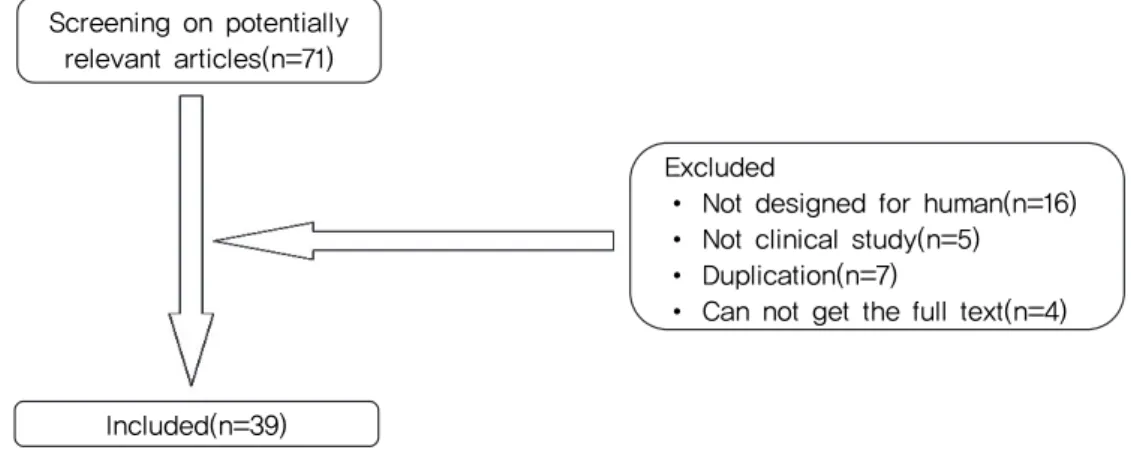
Screening on potentially relevant articles(n=71)
Included(n=39)
Excluded
• Not designed for human(n=16) • Not clinical study(n=5) • Duplication(n=7)
• Can not get the full text(n=4)
Fig. 1. Process of the selecting data
Ⅰ. 서 론
도침요법은 한의학적 침구이론과 현대의학의 수술요법 을 결합하여 만든 신침요법이며 연부조직을 유착박리 하거 나 절개, 혹은 절단하여 연부조직의 손상으로 인한 고질적 동통성 질환을 치료하는 신침요법이다1). 도침요법의 치료 기전은 조직의 유착을 박리하여 원래의 동적 상태로 회복 시켜 주는 동시에 병소 부위를 소통시켜 기혈을 순조롭게 통하게 하고 음양을 조화시켜 동통을 제거하고 기능을 회 복시키는 것이다2).
도침요법의 장점은 다양한 근골격계 영역에 적용이 가능 하고, 특히 누적성 손상이 비교적 오래된 질병에 치료효과 가 현저하다3). 또한 조작방법이 간단하고 조직손상이 적으 며 개방성 수술에 비하여 감염도 잘 일어나지 않으며 치료 시간과 과정 또한 비교적 짧은 편이다2). 이러한 장점을 바 탕으로 침구치료에서 최근 도침요법을 활용한 치료법이 활 발히 이루어지고 있으며 요추 추간판탈출증, 수근관 증후 군 등의 질환과 다발성 골괴사, 후종인대골화증 등의 난치 성 질환에 있어 유의한 효과가 있음이 보고되고 있다4).
그러나 현재 도침요법에 관해서는 몇 가지 보완해야 할 부분이 있다. 첫째로 현재까지 발표된 임상 논문의 정리가 제대로 이루어지지 않아 다양한 적용질환 가운데 보다 자 주 적용되며 높은 치료율을 보이는 질환에 관한 파악이 쉽 지 않다. 두 번째로 난치성 질환을 비롯한 다양한 질환에 사용됨에도 불구하고 도침요법의 적응 질환에 대한 시술방 법의 경향분석이 되어 있지 않다. 셋째로 기존 연구로 Kim5), Ko et al6), Cho et al7) 등이 도침요법 시행 시 부작 용과 예방법, 도침요법 후 나타나는 두통, 도침요법의 감염 관리 등에 대한 고찰을 통하여 도침요법을 사용할 때 주의 해야 할 사항에 관해 연구한 내용은 있지만 임상논문에 대
한 정리는 아직 이루어진 바가 없다.
도침요법이 임상에서 더욱 체계적으로 사용되기 위해서 는 현재까지 도침요법이 사용된 다양한 임상활용의 근거를 살펴 유효성이 높은 질환과 그 효과에 대하여 정리 및 분석 하는 과정이 필요하다.
이에 저자는 1999년부터 2014년 5월까지 국내외 도침 관련 임상논문을 선별하여 도침요법의 응용 질환, 시술 부 위, 병행 치료법, 치료효과 평가방법, 연도별 연구대상의 규모에 따른 분석을 시행하여 도침요법 임상 연구가 앞으 로 나아갈 방향을 모색하고자 하였다.
Ⅱ. 대상 및 방법
1. 연구대상
본 연구는 1999년부터 2014년 5월까지 국내외 도침요법 (acupotomy) 관련 임상례를 분석하기 위해 국가과학기술 전자도서관, 학술연구정보서비스, 한국학술정보, 국회도서 관, DBPIA, Science direct, Pubmed, CKNI의 검색시스 템을 이용하였다. 1999년부터 2014년 5월까지 게재된 논 문을 대상으로 “acupotomy, 침도, 도침, 침도 침술”을 검 색어로 사용하였다.
2. 연구방법
검색된 71편의 논문은 제목과 초록을 확인하였고 미리 정한 기준에 따라 논문을 분석하였다. 논문 선정의 기준과
도침요법의 연구동향 고찰
http://dx.doi.org/10.13045/acupunct.2014041 37
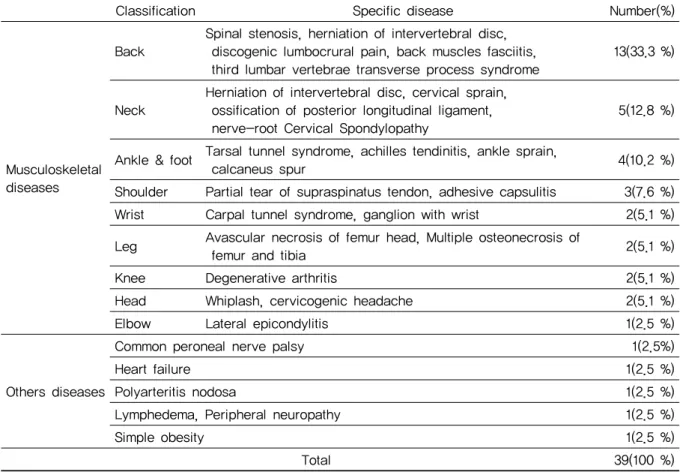
Classification Specific disease Number(%)
Musculoskeletal diseases
Back
Spinal stenosis, herniation of intervertebral disc, discogenic lumbocrural pain, back muscles fasciitis, third lumbar vertebrae transverse process syndrome
13(33.3 %)
Neck
Herniation of intervertebral disc, cervical sprain, ossification of posterior longitudinal ligament, nerve-root Cervical Spondylopathy
5(12.8 %)
Ankle & foot Tarsal tunnel syndrome, achilles tendinitis, ankle sprain,
calcaneus spur 4(10.2 %)
Shoulder Partial tear of supraspinatus tendon, adhesive capsulitis 3(7.6 %) Wrist Carpal tunnel syndrome, ganglion with wrist 2(5.1 %) Leg Avascular necrosis of femur head, Multiple osteonecrosis of
femur and tibia 2(5.1 %)
Knee Degenerative arthritis 2(5.1 %)
Head Whiplash, cervicogenic headache 2(5.1 %)
Elbow Lateral epicondylitis 1(2.5 %)
Others diseases
Common peroneal nerve palsy 1(2.5%)
Heart failure 1(2.5 %)
Polyarteritis nodosa 1(2.5 %)
Lymphedema, Peripheral neuropathy 1(2.5 %)
Simple obesity 1(2.5 %)
Total 39(100 %)
Table 1. Classification Diseases Used Acupotomy 과정은 Fig. 1에 요약하였다.
도침요법의 실제 임상례만 조사하기 위해 부작용에 대한 연구, 감염관리에 대한 연구 등은 포함하지 않았다. 학위논 문에 등재된 논문이 국내 학술지에 다시 등재되었을 때는 중복된 경우로 보아 제외하였으며, 토끼와 같은 동물을 대 상으로 한 실험 논문 및 중국논문 가운데 원문을 구하지 못 한 논문 역시 배제하였다. 2014년 발표한 논문은 온라인 검색 데이터를 기반으로 하였기에 검색이 불가능한 신규 논문에 대한 합산은 포함하지 않았다.
Ⅲ. 결 과
1. 국가 및 응용 질환별 분포
총 39편의 임상 응용 논문을 최종 선정하였으며, 39편의 논문 중 국내 논문이 28편, 중국 논문이 11편이었다. 근골 격계 질환에 대해 다룬 문헌의 수는 34편(87.1 %)이었으 며, 근골격계 이외의 질환은 5편(12.9 %)이었다.
1) 근골격계 질환의 세부 부위별 분류 및 효과
근골격계 질환에서 도침요법이 가장 많이 사용된 부위는 요추부 질환이었고, 34편 중 13편(38.2 %)을 차지하였는 데, 요추부 질환 가운데서도 추간판탈출증이 7편(53.8 %) 으로 높은 비중을 차지하였다. 그 다음으로 경추부 질환이 5편(14.7 %), 발목과 발의 통증이 4편(11.7 %), 어깨 통증 이 3편(8.8 %), 손목, 다리, 두통, 무릎 통증이 각 2편(5.8
%), 팔꿈치 통증이 1편(2.9 %)의 순서였다(Table 1).
2) 기타 질환의 분류
기타 질환은 총비골신경, 비골신경의 마비를 다룬 신경 병증8), 심부전으로 인한 호흡곤란증9), 결절성 다발 동맥 염10), 유방암 수술 후 발생한 림프부종과 말초신경병증11), 비만12)에 대하여 각각 한 편씩의 연구가 보고되었다(Table 1).
2. 질환별 도침요법 시술 부위 분류
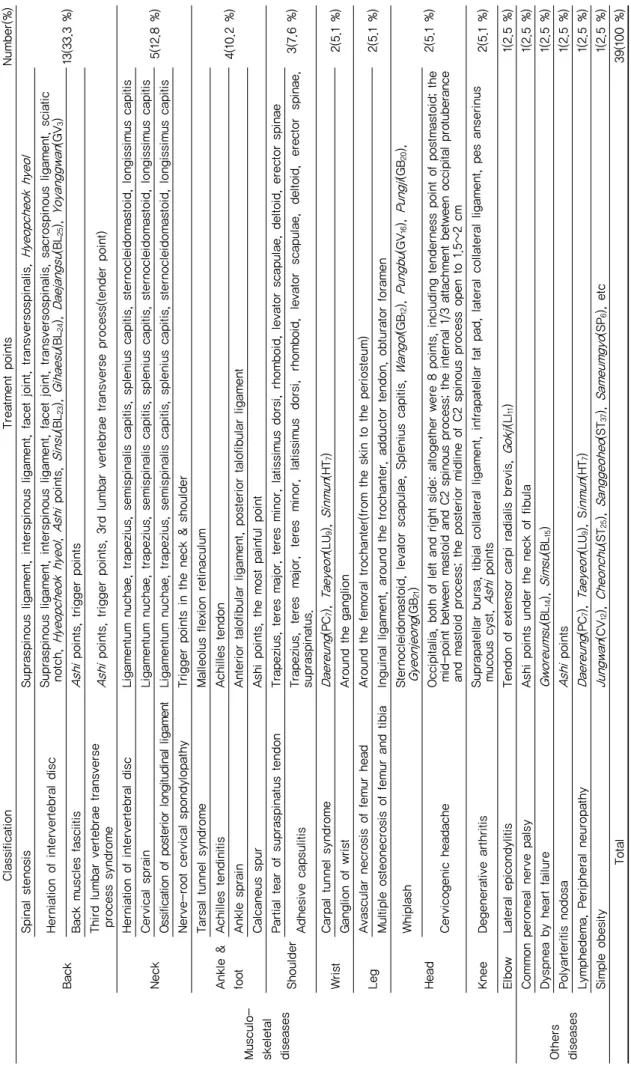
도침요법은 연부조직의 유착을 박리하여 치료효과를 얻
ClassificationTreatment pointsNumb sculo- etal seases
Back
Spinal stenosisSupraspinous ligament, interspinous ligament, facet joint, transversospinalis, Hyeopcheok hyeol 13(33Herniation of intervertebral discSupraspinous ligament, interspinous ligament, facet joint, transversospinalis, sacrospinous ligament, sciatic notch, Hyeopcheok hyeol, Ashi points,Sinsu(BL23),Gihaesu(BL24),Daejangsu(BL25), Yoyanggwan(GV3) Back muscles fasciitisAshi points, trigger points Third lumbar vertebrae transverse process syndromeAshi points, trigger points, 3rd lumbar vertebrae transverse process(tender point) Neck
Herniation of intervertebral discLigamentum nuchae, trapezius, semispinalis capitis, splenius capitis, sternocleidomastoid, longissimus capitis 5(12Cervical sprainLigamentum nuchae, trapezius, semispinalis capitis, splenius capitis, sternocleidomastoid, longissimus capitis Ossification of posterior longitudinal ligamentLigamentum nuchae, trapezius, semispinalis capitis, splenius capitis, sternocleidomastoid, longissimus capitis Nerve-root cervical spondylopathyTrigger points in the neck & shoulder Ankle & foot
Tarsal tunnel syndromeMalleolus flexion retinaculum 4(10Achilles tendinitisAchilles tendon Ankle sprainAnterior talofibular ligament, posterior talofibular ligament Calcaneus spurAshi points, the most painful point ShoulderPartial tear of supraspinatus tendonTrapezius, teres major, teres minor, latissimus dorsi, rhomboid, levator scapulae, deltoid, erector spinae 3(7. Adhesive capsulitisTrapezius,teres major,teres minor,latissimus dorsi,rhomboid, levator scapulae,deltoid,erectorspinae, supraspinatus. Wrist Carpal tunnel syndromeDaereung(PC7),Taeyeon(LU9), Sinmun(HT7) 2(5. Ganglion of wristAround the ganglion LegAvascular necrosis of femur headAround the femoral trochanter(from the skin to the periosteum) 2(5. Multiple osteonecrosis of femur and tibiaInguinal ligament, around the trochanter, adductor tendon, obturator foramen Head
WhiplashSternocleidomastoid, levator scapulae, Splenius capitis, Wangol(GB12),Pungbu(GV16), Pungji(GB20), Gyeonjeong(GB21) 2(5. Cervicogenic headacheOccipitalia, both of left and right side: altogether were 8 points, including tenderness point of postmastoid; the mid-point between mastoid and C2 spinous process; the internal 1/3 attachment between occipital protuberance and mastoid process; the posterior midline of C2 spinous process open to 1.5~2 cm KneeDegenerative arthritisSuprapatellar bursa, tibial collateral ligament, infrapatellar fat pad, lateral collateral ligament, pes anserinus mucous cyst, Ashi points2(5. ElbowLateral epicondylitisTendon of extensor carpi radialis brevis,Gokji(LI11)1(2 hers seases
Common peroneal nerve palsyAshi points under the neck of fibula1(2. Dyspnea by heart failureGworeumsu(BL14),Simsu(BL15)1(2. Polyarteritis nodosaAshi points1(2. Lymphedema, Peripheral neuropathyDaereung(PC7),Taeyeon(LU9), Sinmun(HT7)1(2. Simple obesityJungwan(CV12),Cheonchu(ST25),Sanggeoheo(ST37), Sameumgyo(SP6), etc1(2. otal39(100
Table 2. Classificaton Acupotomy Treatment Points
도침요법의 연구동향 고찰
http://dx.doi.org/10.13045/acupunct.2014041 39
Acupotomy size Disease
Length 50 ㎜, diameter 0.1 ㎜
Herniation of intervertebral disc (cervical), cervical sprain, ossification of posterior longitudinal ligament, tarsal tunnel syndrome, achilles tendinitis, ankle sprain, carpal tunnel syndrome, ganglion of wrist, avascular necrosis of femur head, multiple osteonecrosis of femur and tibia, lateral epicondylitis, whiplash Length 35 ㎜, diameter 0.1 ㎜ Lymphedema, adhesive capsulitis,
partial tear of supraspinatus tendon
Length 80 ㎜, diameter 0.5 ㎜ Spinal stenosis, herniation of intervertebral disc(lumbar) Length 80 ㎜, diameter 1.0 ㎜ Spinal stenosis, herniation of intervertebral disc(lumbar) Length 50 ㎜, diameter 0.5 ㎜ Polyarteritis nodosa
Length 40 ㎜, diameter 0.6 ㎜ Simple obesity
Length 35 ㎜, diameter 0.9 ㎜ Nerve-root cervical spondylopathy Length 30 ㎜, diameter 0.5 ㎜ Osteoarthritis of the knee
Table 3. Size of Acupotomy According to Disease
Treatment Number(%)
Acupotomy only 9(23.0 %)
Acupuncture 25(64.1 %)
Herbal medicine 20(51.2 %)
Physical therapy 15(38.4 %)
Pharmacopuncture therapy 9(23.0 %)
Cupping therapy 8(20.5 %)
Others 2(5.1 %)
Table 4. Combination Treatment with Acupotomy 는 것1)이 기본원리이기 때문에 특정 경혈이 치료점이 되기보 다는 병변부위의 연부조직이 치료점이 되는 경우가 많았다.
또한 특정 혈 자리가 몇몇 논문에서 사용되기도 했지만 이는 혈성에 따른 선택이 아니었으며 병변부위에 위치한 혈 자리 로서 큰 의미를 갖지 않는 것으로 사료된다. 이에 부위별 질 환에 따른 치료점을 정리 및 분류하였다. 질환에 따른 시술 부위는 모두 조사한 논문에 근거하여 서술하였다(Table 2).
3. 질환별 사용 도침 규격
규격이 명시되지 않은 문헌은 배제하였다(Table 3).
4. 치료법 및 평가도구에 관한 정리
1) 치료법에 관한 정리
조사한 모든 문헌을 토대로 하여 도침요법과 그 외에 사
용한 치료법을 정리하였다.
도침요법만을 이용하여 연구한 논문의 수는 9편, 침 치 료를 병행한 논문이 25편, 물리치료 및 운동치료를 병행 한 논문이 15편, 약침치료를 병행한 논문이 9편, 한약치 료를 병행한 논문이 20편, 습식 부항을 병행한 논문이 8편, 기타 뜸 치료, 매선 치료를 병행한 논문이 각각 1편씩 있 었다(Table 4).
2) 평가도구에 관한 정리
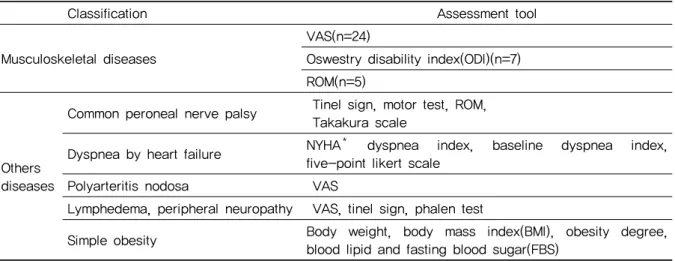
근골격계 관련 논문에서 빈번하게 사용된 평가도구 3가 지와 근골격계 질환이 아닌 신경병증, 심부전, 다발성 동맥 염, 림프부종에 관한 연구에서 사용된 평가도구를 조사하 여 Table 5에 정리하였다. 신경병증, 심부전, 다발성 동맥 염, 림프부종, 비만 등 1회씩만 사용된 평가도구는 모두 나 열하였다. 가장 많이 나타난 평가도구는 시각적 상사 척도 (visual analogue scale, VAS)로 총 24편의 논문에서 사 용하였다. 모든 평가도구는 논문에 명시된 것을 근거로 하 였다(Table 5).
Classification Assessment tool
Musculoskeletal diseases
VAS(n=24)
Oswestry disability index(ODI)(n=7) ROM(n=5)
Others diseases
Common peroneal nerve palsy Tinel sign, motor test, ROM, Takakura scale
Dyspnea by heart failure NYHA* dyspnea index, baseline dyspnea index, five-point likert scale
Polyarteritis nodosa VAS
Lymphedema, peripheral neuropathy VAS, tinel sign, phalen test
Simple obesity Body weight, body mass index(BMI), obesity degree, blood lipid and fasting blood sugar(FBS)
Table 5. The Assessment Tool about the Effect of Acupotomy
5. 발행 연도에 따른 분류
조사한 문헌을 1999년부터 2014년까지 발표 연도에 따 라 분류하였다. 총 39편의 논문 가운데 2012년도에 11편으 로 가장 많은 논문이 발표되었다. 이후 2008년에 10편, 2011년에 8편, 2009년에 4편, 2010년에 2편, 2013년과 2014년에는 각각 1편, 1999년부터 2007년까지는 2편의 논 문이 발표되었다(Fig. 2).
Fig. 2. The annual number of published clinical acupotomy papers
6. 연구대상 수에 따른 분류
조사한 문헌을 대상자의 수에 따라서 분류하였다. 10명 이하를 대상으로 한 논문이 21편으로 가장 많았다. 이 가운 데서 1명을 대상으로 한 논문이 12편으로 높은 비중을 차지 하였다. 10명 초과 30명 이하 논문은 3편, 30명 초과 100명 이하 논문은 9편, 100명 이상을 대상으로 한 논문은 6편으
로 분류되었다(Fig. 3).
Fig. 3. The number of sample size of each clinical acupotomy studies
Ⅳ. 고 찰
도침요법은 한의학의 침법과 서양의학의 수술이 결합된 형태의 새로운 치료법으로, 그 기원은 ≪黃帝內經≫의 구침 중 봉침과 피침에서 찾을 수 있으며, 중국의 주한장 교수에 의하여 개발되어 1987년 중국 전역에 보급되어 활용되는 치료법이며13), 현재는 우리나라에서도 다양한 질환에 사용 되고 있는 치료법이다.
본 연구에서는 1999년부터 2014년 5월까지의 국내외 도침 요법 관련 임상논문을 선별하여 도침요법의 응용 질환, 질 환별 시술 부위, 병행 치료법, 치료효과 평가방법, 연도별 연구대상의 규모에 따른 분석을 시행하여 도침요법의 임상 사용 현황을 분석 및 정리하였으며 결과는 다음과 같다.
도침요법의 연구동향 고찰
http://dx.doi.org/10.13045/acupunct.2014041 41
“Acupotomy”, “도침”, “침도”로 검색된 71편의 논문 가 운데 임상논문 39편을 추출하여 정리하였다. 이 중 국내 논 문이 28편, 중국 논문이 11편이었다. 근골격계 질환에 대해 다룬 문헌의 수는 34편(87.1 %)이었으며, 근골격계 이외의 질환은 5편(12.9 %)이었다.
근골격계 질환 가운데 가장 많이 응용된 질환은 요통으 로 총 13편(38.2 %)이었다. 그 다음으로 경추부 질환이 5편(14.7 %), 발목과 발의 통증이 4편(11.7 %), 어깨 통증 이 3편(8.8 %) 손목, 다리, 두통, 무릎 통증 각 2편(5.8 %), 팔꿈치 통증이 1편(2.9 %)의 순서로 그 뒤를 이었다.
근골격계에 해당하지 않는 질환들은 총 5편의 논문에서 다루었는데, 비골신경마비, 심부전으로 인한 호흡곤란, 결 절성 다발 동맥염, 유방암 수술 후 발생한 림프부종과 말초 신경병증, 비만 등에 대하여 각 1회씩의 논문이 발표되었다.
위 결과를 보면 근골격계 질환에서는 허리, 목, 어깨 부 위의 질환에 대해 도침요법이 많이 사용된 것을 볼 수 있 다. 이는 다른 부위에 비해 상대적으로 연부조직이 두텁게 자리하는 동시에 과부하를 많이 받는 허리14)와 목15), 불안 정한 구조인 어깨16)의 특성상 연부 조직의 손상과 유착이 일어나기가 쉽고 이로 인해 발생한 질환은 도침요법의 적 응증에 가장 부합하기 때문으로 볼 수 있겠다. 그 결과 허리, 목, 어깨 질환에 시행된 도침요법의 결과로 대부분의 환자 에서 유의한 효과를 얻었음을 각 논문에서 보고하였다.
다음으로 질환별로 사용된 도침요법의 치료점에 대하여 조사하였다. 요통과 관련된 요추간판 탈출증17-22)과 척추 관 협착증23,24)에서는 극상인대, 극간인대, 후관절, 협척 혈, 아시혈, 압통점이 주로 사용되었다. 어깨통증과 관련된
동결견4,13), 극상근건 부분파열25)에서는 승모근, 회전근개
근육, 광배근 등의 근복 부위에 주로 사용하였다. 경항통과 관련된 경추간판 탈출증26), 후종인대 골화증27)에서는 경추 부 항인대, 승모근, 경추 기립근이 주로 사용되었다. 이와 같이 허리, 목, 어깨에서는 각각 다른 질환이지만 서로 일 치하는 치료점이 많았다. 이는 조직의 유착을 박리하여 원 래의 동적상태로 회복9)시켜주는 도침요법의 기전에 의해 실제 병변조직에 시술이 주로 이루어지기 때문으로 사료된 다. 기타 소수 증례에서 근건접합부, 건지지대, 인대, 지방 패드 등의 연부조직이 치료점으로 사용되었으나 여러 증례 를 비교해보기가 어려웠다.
병행한 치료법에서는 침 치료를 병행한 연구가 25편 (64.1 %)으로 가장 많았고, 그 다음으로 한약을 병행 치료 한 연구가 20편(51.1 %)이었다. 이 외에 약침, 물리치료, 부항요법, 수기치료 등이 병행해서 쓰였다. 하지만 도침요 법만을 사용한 논문은 9편(23.0 %)이었고, 대조군을 설정 한 논문 역시 10편(25.6 %)에 불과하였다. 또한 각 임상 연
구마다 병행 치료법이 서로 차이를 보여서 도침요법의 치 료 효과를 정확히 파악하기는 어려운 편이었다. 향후 도침 요법의 단독 치료 또는 도침요법 외에 치료에 영향을 미치는 변수들을 일정하게 조절한 논문이 발표되길 기대해 본다.
각 논문에서 사용된 평가 도구들을 조사하였는데, 요통, 어깨통증, 경항통과 관련해서는 VAS가 공통으로 가장 많 이 사용되었다. 하지만 나머지 질환들에서는 보고된 문헌 의 수가 적어 일관성 있는 평가 결과라고 확정 짓기는 힘들 었다. 향후 질환에 대한 도침요법의 다양한 임상보고가 많 이 이루어지고 각각의 질환에 따른 적절한 평가도구가 설 정된 연구가 이루어지기를 기대해 본다.
발표 연도별로 분류해보면 2012년에 11편(28.2 %)으로 가장 많은 논문이 발표되었다. 이후 2008년 10편(25.6 %), 2011년에 8편(20.5 %)의, 2009년에 4편(10.2 %), 2010년 에 2편(5.1 %), 2013년과 2014년에는 각각 1편(2.5 %), 1999년부터 2007년까지는 8년간 2편(5.1 %)의 논문이 발 표되었다. 이를 보면 최근 들어 도침요법에 관한 논문의 수 가 감소하는 것을 볼 수 있다. 이러한 경향은 중국과 국내 논문에서 약간의 차이를 보이는데 국내에서는 도침요법에 관한 논문 자체가 감소하고 있으나, 중국에서는 사람을 대 상으로 한 논문만이 감소하고 있다. 중국에서는 2012년 이 후 동물을 대상으로 하여 Guo C et al28) 등이 많은 논문을 현재도 발표하고 있다. 앞으로 국내에서도 도침요법에 대 한 더욱 많은 수의 논문이 발표되길 기대해본다.
마지막으로 대상자의 수에 따라 발표된 문헌을 분류하였 다. 10명 이하의 논문이 21편(53.8 %)으로 가장 많았고 이 중에 1명을 대상으로 한 논문이 12편(57.1 %)으로 높은 비 중을 차지하였다. 중국에서는 Liang XH et al29), Wen YL et al30) 등이 대부분이 50명 이상의 대상자를 하였으나 국 내에서는 대부분이 10명 이하를 대상자로 하여 논문을 발 표하였다. 소수 표본수를 대상으로 한 임상연구에 대해서 는 유효성을 평가하기가 어려운 부분이 많으므로 추후 국 내에서도 보다 많은 대상자를 상대로 한 연구 보고를 기대 해본다.
여러 논문 가운데 도침요법으로 배수혈을 자극하여 내장 질환을 치료한 Kim et al9)의 논문과 비만에 도침요법을 사 용한 Chen M et al12)의 논문은 근골격계 질환 외에 여러 내장질환 및 대사질환에도 도침요법이 사용되는 예를 보여 준 데에 의미가 있다고 할 수 있겠다.
이상으로 1999년부터 2014년까지 국내외에서 활용한 도 침요법의 임상 응용에 대해 살펴보았다. 본 논문을 통하여 향후 더욱 체계적이며 일관성 있는 임상연구가 이루어지고 그 결과를 바탕으로 보다 유효성 있게 도침요법을 사용하 게 되길 기대해 본다. 또한 본 논문을 통해 도침요법이 근
거중심의학에 기반을 두어 더욱 성장할 수 있기를 바란다.
Ⅴ. 결 론
1999년부터 2014년 5월까지 국내외 도침요법의 임상 응 용에 대해 39편의 논문을 분석하여 아래와 같은 결론을 얻 었다.
1. 근골격계 질환에 대한 논문이 34편(87.1 %), 비근골 격계 질환에 대한 논문이 5편(12.9 %)이었다.
2. 근골격계 질환에 대한 논문 가운데 허리, 목, 어깨 부 위에 도침요법을 사용한 논문이 총 21편(53.8 %)으로 높은 비중을 차지하였다.
3. 근골격계 질환 가운데 높은 비중을 차지하는 허리에 서는 극간인대, 협척혈, 후관절이, 목에서는 항인대, 경추에서는 승모근을 비롯한 경추부 근육이, 어깨에 서는 승모근, 회전근개근육, 광배근 등의 근육들이 도침요법의 치료점으로 사용되었으며 공통으로 아시 혈과 압통점 또한 치료점으로 사용되었다.
4. 침 치료를 병행한 논문이 25편(64.1 %)으로 가장 많 았고, 도침요법만을 사용한 논문은 9편(23.0 %)이었 다. 10명 이하를 대상으로 한 논문이 21편(53.8 %)으 로 가장 많았으며, 치료 효과는 VAS를 이용한 평가 가 24편(61.5 %)으로 가장 많았다.
5. 도침요법에 관한 임상연구가 가장 활발히 이루어진 해는 2012년으로, 총 11편(28.2 %)이 발표되었다. 또 10명 이하의 대상자를 통해 이루어진 연구가 21편 (53.8 %)으로 가장 많은 비중을 차지하였다.
Ⅵ. References
1. Lim NR, Kim SC, Jang EH et al. Case study of oriental medicine treatment with acupotomy therapy of the carpal tunnel syndrome. The Journal of Korean Acupuncture & Moxibustion Society. 2008 ; 25(4) : 163-70.
2. The Institute of Korean Acupotomy Medicine. Ac- upotomy. Seoul : Jeongdam. 2003 : 81-2, 87, 111, 113, 127.
3. Zhu HZ. Acupotomy. Beijing : Chinese Medicine
Publishing Company. 1992 : 9-42.
4. Yuk DI, Song IN, Ko MK et al. Five cases of frozen shoulder patients treated by acupotomy combined with oriental medical treatments. The Journal of Korean Acupuncture & Moxibustion Medicine Society. 2012 ; 29(5) : 167-76.
5. Kim SC. Clinical characteristics of poor responders to acupotomy and safety pretreatment manage- ment. The Journal of Korean Acupuncture &
Moxibustion Society. 2008 ; 25(4) : 117-25.
6. Ko MK, Kim JH, Hong KE. The study on post acupotomy headache. The Journal of Korean Acupuncture & Moxibustion Society. 2010 ; 27(2) : 89-95.
7. Cho KH, Ki W, Yuk DI, Sung IS, Kim MJ, Hong KE. The study on the infection control of acu- potomy. The Acupuncture. 2013 ; 30(4) : 181-7.
8. Kim SH, Park MY, Lee SM, Lee SK, Lim JY, Kim SC. The case report of common peroneal nerve palsy treated with musculoskeletal ultrasound- guided acupotomy therapy. The Journal of Korean Acupuncture & Moxibustion Medicine Society.
2012 ; 29(5) : 177-85.
9. Kim MJ, Hong KE. A case report of congestive heart failure treated with acupotomy therapy.
The Journal of Korean Acupuncture & Moxi- bustion Society. 2009 ; 26(2) : 207-12.
10. Lee ES, Kam CW, Youn HM et al. Case report of polyarteritis nodosa treated with oriental treat- ments including acupotomy. The Journal of Korean Acupuncture & Moxibustion Medicine Society. 2012 ; 29(3) : 129-37.
11. Jang EH, Kim SY, Kim HS, Kim SC. Acupotomy and venesection in upper limb lymphedema and peripheral neuropathy following breast cancer surgery. The J of Korean Institute of Pharmaco- puncture. 2009 ; 12(4) : 119-27.
12. Chen M, Shi XY, Xu B et al. Clinical observation on acupotomy for treatment of simple obesity.
Chinese Acupuncture & Moxibustion. 2011 ; 31(6) : 539-42.
13. Kim YM, Hong KE. The clinical study on the effect of acupotomy in shoulder disease. The Journal of Korean Acupuncture & Moxibustion
도침요법의 연구동향 고찰
http://dx.doi.org/10.13045/acupunct.2014041 43
Society. 2008 ; 25(4) : 141-8.
14. Oh MS, Gwak JM. The clinical study on the effect of Chuna therapy for patients with lumbar disc herniation. The J of the Institute of Oriental Medicine, Daejeon University. 1998 ; 14(1) : 21-30.
15. Mun MS, Kim I, Han IH. A clinical study of cervical spondylosis. The J of Korean Orthopaedic Association. 1973 ; 8(1) : 29-35.
16. The Korean Orthopaedic Association. Orthopaedic.
Seoul : Choisinuihaksa. 1982 : 314.
17. Sung IS, Yuk DI, Song DH, Kim MJ, Hong KE.
Case study of with Dochim(刀鍼) & Gwanchim(管 鍼) therapy combined with Korean medicine treatment of herniated lumbar intervertebral disc patients. The Journal of Korean Acupuncture &
Moxibustion Society. 2011 ; 28(5) : 153-9.
18. Jang EH, Kim SC, Lim NR et al. Case study of oriental medicine treatment with acupotomy therapy of the herniated lumbar intervertebral disc patient. The Journal of Korean Acupuncture
& Moxibustion Society. 2008 ; 25(4) : 171-81.
19. Yun JY, Kim DH, Kim HW et al. The clinical effects of acupuncture and acupotomy therapy for HIVD. The Journal of Korean Acupuncture &
Moxibustion Society. 2010 ; 27(4) : 85-97.
20. Kwak BM, Hong KE. Four case of HIVD-lumbar spine patient treated with acupotomy. The Journal of Korean Acupuncture & Moxibustion Society. 2008 ; 25(4) : 149-56.
21. Lee GM, Kim DH, Kim HW et al. The study on the effect of acupotomy in lumbar HIVD. The Journal of Korean Acupuncture & Moxibustion Society.
2008 ; 25(4) : 183-90.
22. Park SW, Kim SS, Kim JY, Kim SH, Lee GM. The comparative study of effects between acupotomy and its cotreatment with spine decompression therapy on HIVD patients. The Journal of Korean Acupuncture & Moxibustion Medine Society. 2012 ; 29(3) : 29-39.
23. Jung KY, Sur YC, Jang WS et al. Study and three cases report for lumbar spinal stenosis treatment using a combination of acupotomy and existing treatments. Korean J Oriental Physiology &
Pathology. 2012 ; 26(1) : 120-7.
24. Yuk DI, Sung IS, Song DH, Kim MJ, Hong KE.
Clinical study of lumbar spine stenosis treated by using acupotomy combined with oriental medical treatments. Journal of Pharmacopuncture. 2013 ; 16(3) : 46-51.
25. Kim HS, Heo WY, Hyun MK, Kim JS, Gang IA.
Four case of partial tear of supraspinatus tendon treated by acupotomy combined oriental medical treatments. The Acupuncture. 2014 ; 31(1) : 167-76.
26. Kim EK, Kim HW, Lee GH, Lee GM. The clinical study on effects of acupotomy therapy in patients with cervical herniated intervertebral disc. The Journal of Korean Acupuncture & Moxibustion Society. 2009 ; 26(1) : 67-79.
27. Park SW, Kim SS, Yang SB, Lee GM. The clinical effects of acupotomy for ossification of the posterior longitudinal ligament. The Journal of Korean Acupuncture & Moxibustion Society. 2011 ; 28(4) : 127-35.
28. Guo C, Liu N, Li X et al. Effect of acupotomy on nitric oxide synthase and beta-endorphin in third lumbar vertebrae transverse process syndrome model rats. J Tradit Chin Med. 2014 ; 34(2) : 194-8.
29. Liang XH, Zhang XG, Xu GT, Wei WY. Com- bination of canales sacralis drop with acupotomy dissolution in treatment of discogenic lumbocrural pain. J of Zhejiang University. 2011 ; 40(1) : 90-3.
30. Wen YL, He C, Huang M, Liang XS. Observation on therapeutic effect of the third lumbar trans- verse process syndrome treated with acupotomy and blood pricking therapy. Chinese Acupuncture
& Moxibustion. 2012 ; 32(4) : 345-8.