DOI: https://doi.org/10.7473/EC.2020.55.1.26
Preparation of Silica-Filled SBR Compounds with Low Rolling Resistance by Wet Masterbatch
Jae-Kyoung Yang, Wonhyeong Park, Changseok Ryu, Sun Jung Kim, Doil Kim, and Gon Seo
†Mirae Scientific Instruments Inc., 10, Cheomdanventure-ro 16th, Buk-gu, Gwangju 61009, Republic of Korea
(Received November 14, 2019, Revised December 11, 2019, Accepted December 20, 2019)
Abstract: The physical properties of silica-filled SBR compounds (WSBR) prepared using silica-SBR wet masterbatches (WMB) were systematically investigated to understand the effect of the surface treatment of silica on the reinforcement per- formance of SBR. Treatment of silica with bis(triethoxysilylpropyl)tetrasulfide (TESPT) in the liquid phase, followed by mixing with an SBR solution and recovery by water stripping, easily produced silica-SBR WMB. However, insufficient sur- face treatment in terms of the amount and stability of the incorporated TESPT led to considerable silica loss and inevitable TESPT elution. Pretreatment of silica in the gas phase with TESPT and another organic material that enabled the formation of organic networks among the silica particles on the surface provided hydrophobated silica, which could be used to pro- duce silica-SBR WMB, in high yields of above 99%. The amount and type of organic material incorporated into silica greatly influenced the cure characteristics, processability, and tensile and dynamic properties of the WSBR compounds. The TESPT and organic material stably incorporated into silica increased their viscosity, while the organic networks dispersed on the silica surface were highly beneficial for reducing their rolling resistance. Excessive dosing of TESTP induced low viscosity and a high modulus. The presence of connection bonds formed by the reaction of glycidyloxy groups with amine groups on the silica surface resulted in physical entanglement of the rubber chains with the bonds in the WSBR compounds, leading to low rolling resistance without sacrificing the mechanical properties. Mixing of the hydrophobated silica with a rubber solution in the liquid phase improved the silica dispersion of WSBR compounds, as confirmed by their low Payne effect, and preservation of the low modulus enhanced the degree of entanglement.
Keywords: wet masterbatch, SBR, silica, rolling resistance
Introduction
Urgent demands by society for both the reduction of carbon dioxide emissions and saving of fossil oil resources have steadily strengthened the regulation of fuel efficiency of cars.
Although carbon black has been a powerful reinforcing filler of SBR compounds traditionally used in the preparation of the tread rubber of passenger car tires for a long time, it has been replaced by silica to improve fuel efficiency.
1The coupling of silica particles with rubber chains by forming covalent bonds through coupling agents significantly improves the mechanical properties of silica-filled SBR compounds and reduces their rolling resistance applicable to commercial tires.
2The synthesis of SBR with an appropriate functional group,
3,4the development of effective coupling agents with high reinforcing performance,
2,5and the use of a dual filler system composed of carbon black and silica,
6,7have been studied to improve the performance of
tires.
Since hydrophilic silica has totally conflicting surface properties to hydrophobic rubber, SBR is generally mixed with silica in an internal mixer under high shear stress accompanied with coupling agents, cure accelerators, activators, and expan- sion oil.
8The mixing of rubber compounds in a dried state, called the dry masterbatch (DMB) method, is carefully operated to minimize the deterioration of rubber due to the elevation of temperature induced by attrition. However, the direct mixing of carbon black with emulsion SBR in liquid phase facilitates the preparation of carbon black-filled emulsion SBR compounds with the wet masterbatch (WMB) method.
9The hydrophobicity of carbon black promotes its coagulation with rubber and mixing them in liquid phase strengthens their interfacial inter- action without deteriorating rubber. Water stripping using hot water easily separates WMB from organic solvent and water layers, recovering carbon black-SBR WMB. Fully functionalized and dispersed silica also facilitates the preparation of silica- SBR WMB by mixing hydrophobated silica and emulsion
†
Corresponding author E-mail: [email protected]
SBR, simplifying the compounding process for tire application.
10In contrast to emulsion SBR, solution SBR used in the manu- facture of passenger car tires is dissolved in an organic solvent, and thus the hydrophobation of silica is a prerequisite to enhance the interaction between rubber and silica and to prevent silica aggregation during the mixing and recovery of silica-SBR WMB.
11Since the interaction between silica and rubber greatly affects the mechanical and dynamic properties of silica-filled SBR compounds, high dispersion of silica is essential to obtain improved physical properties because of the necessity for a sufficient interface between rubber and silica.
12The surf ace treatment of silica with alkoxysilanes such as 3-mercapto- propyltriethoxy silane and octyltriethoxy silane enhances its hydrophobicity and results in better reinforcing performance by improving the dispersion of silica in rubber.
13,14The organic moieties incorporated in the silica surface suppress silica flocculation during mixing and cure and lower rolling resistance by reducing the irreversible breakage of silica aggregates.
Furthermore, the hydrophobated silica particles do not tend to aggregate in organic solvent, minimizing silica loss during the recovery process of WMB. The silane-treated silica prepared by Behn Meyer Europe GmbH showed high feasibility for the preparation of silica-filled SBR compounds applicable to the tread rubber of passenger car tires.
15The silica-NR WMB prepared using silicas treated with Si-747 silane with long arms facilitated the preparation of silica-filled NR compounds with low rolling resistance due to appropriate interaction between rubber and silica.
16Bis-(triethoxysilylpropyl) tetrasulfide (TESPT) is a typical coupling agent that has been successfully used in silica-filled rubber compounds.
17Its ethoxy groups react with the hydroxyl groups of silica and its sulfide groups with the double bonds of rubber, respectively, producing covalent bonds that combine silica and rubber and improve their tensile properties. The incorporation of TESPT into silica also makes its surface hydrophobic, so TESPT-treated silica shows high feasibility for application as a raw material for the preparation of silica-SBR WMB. However, the surface treatment of silica by TESPT in the preparation of silica-SBR WMB should be carefully optimized to obtain adequate hydrophobicity of silica and proper mobility of TESPT, because the TESPT added to rubber works as a lubricant as well as coupling agent.
18Instead of the addition of TESPT to rubber during mixing, SBR compounds reinforced with silica pretreated by TESPT exhibited improved properties, especially both wet traction and
rolling resistance.
19TESPT incorporated in silica connects silica particles and produces organic networks on their surfaces.
The physical entanglement of rubber chains with the networks dispersed on the silica surface reduces irreversible deformation under dynamics stress, resulting in better dynamic properties.
The reaction of 3-aminopropyltriethoxy silane (AP)-incorporated silica with bisphenol A diglycidyl ether (BG) also forms organic networks composed of amine groups of AP and glycidyl group of BG (APBG).
20The change in the molar ratio of BG to AP in the surface treatment alters the surface state of silica in terms of the exposed functional groups and the concentration of APBG connecting bonds. The reduction of surface hydroxyl groups of APBG silica suppresses silica flocculation in SBR compounds and the entanglement of rubber chains with the connecting bonds improves both tensile and dynamic properties.
Methylene diphenyl diisocyanate forms organic networks among neighboring silica particles with urethane linkage and the organic networks provide adequate hydrophobicity and rein- forcement of SBR by entanglement.
21The silica-SBR WMB preparation method can be classified by the way silica is treated in the aspects of the species and amount of modifier incorporated and recovery method of WMB. Scheme 1 shows the classification of WMB preparation methods. In the treatment methods classified by types I and II, TESPT reacts with silica in liquid phase, followed by mixing with SBR solution. WMB particles are recovered by water stripping in type I, and by evaporation in type II. In the treatment of type III, silica-SBR WMB is prepared by direct mixing of pretreated silica with SBR solution followed by evaporation of solvent from a dense dough of WMB. The temperature of silica treatment and the amount of modifiers influence the state of silica-SBR WMB. The exposure of silica to water in water stripping or the stirring of silica suspension in organic solvent may induce the aggregation of silica particles.
In addition, the species and type of organic material incorpo- rated in silica greatly influence the interaction between rubber and silica and the dispersion of silica in rubber. Therefore, the
Scheme 1. Preparation method of silica-SBR WMB.
method of treating silica with organic material in the prepa- ration of silica-SBR WMB is very important to obtain high performance silica-filled SBR compounds.
In this study, we prepared several silica-SBR WMBs by varying the species and amounts of organic modifier in the silica treatment method, and the recovery methods of WMB.
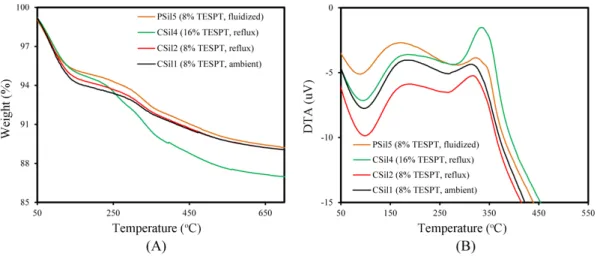
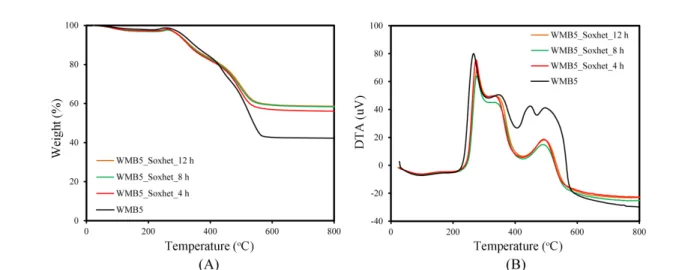
Silica was modified with TESPT in liquid phase by stirring at ambient temperature and refluxing in toluene, while the treatment of silica in gas phase was also tried. The successive reaction of AP-incorporated silica with BG in toluene provided pretreated silicas containing APBG connecting bonds on their surface and the successive reaction of amine groups of di- aminohexane (AM) with glycidyloxy groups of (3-glycidyl- oxypropyl)trimethoxysilane (GP) and amine groups in gas phase produced GPAM connecting bonds. The state and amount of organic material incorporated in silica and silica-SBR WMB were investigated from their TG/DTA curves. The partial extraction of rubber from silica-SBR WMB using a Soxhlet apparatus enabled the comparison of incorporated states of TESPT in silica according to their preparation methods.
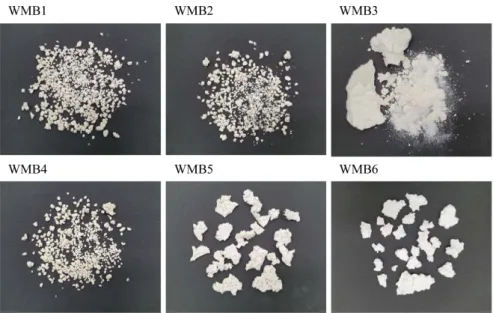
22The treatment of silica with TESPT in liquid phase following by mixing facilitated the preparation of silica-SBR WMB, but a considerable amount of silica loss was inevitable. In contrast, the treatment of silica either in gas or liquid phase followed by mixing with SBR solution and evaporation effectively produced silica-SBR WMB with high silica yield. The silica treatment method with organic materials greatly affected the physical properties of silica-filled SBR compounds (WSBR) prepared using silica-SBR WMB because the state and amount of organic material dispersed in silica determined the inter-
action between rubber and silica. The silica-SBR WMB pre- pared with pretreated silicas containing either APBG or GPAM connecting bonds might enhance the entanglement of rubber with the bonds and suppress irreversible deformation, resulting in low rolling resistance without sacrificing mechanical pro- perties.
Experimental
1. Preparation of silica-SBR WMB
Various silica-SBR WMB were prepared by varying the silica treatment method, the species and amount of organic material incorporated in silica, and their recovery method.
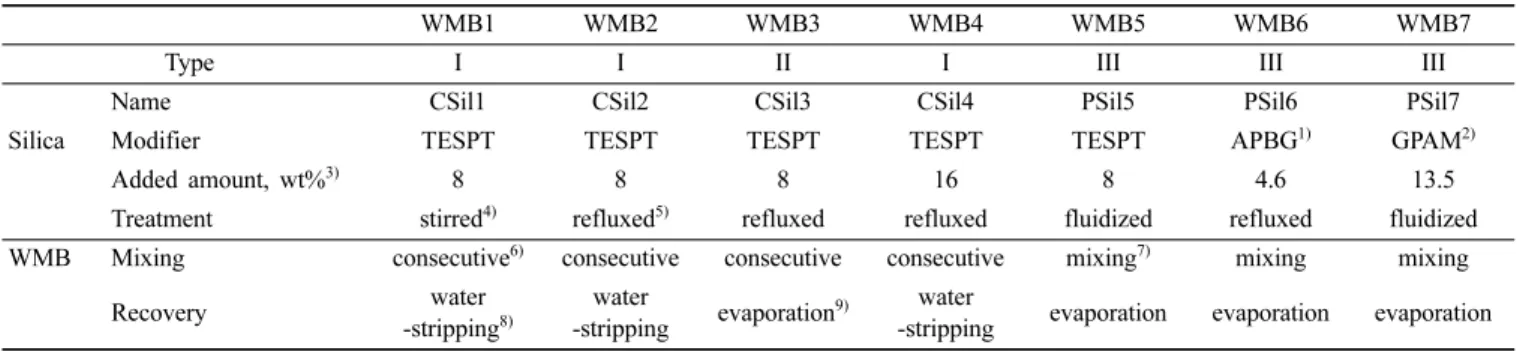
Table 1 summarizes the preparation methods of silica-SBR WMB. The silicas prepared by consecutive mixing with TESPT were named CSilx, while those prepared by pretreatment with various organic material named PSilx, where x denoted the serial number of silicas. In a consecutive mixing process precipitated silica (Oriental Silica Co., Tokusil 195) was added to n-heptane (SK Global Chemical Co., Ltd.) solution of TESPT (Dow Corning) charged in a 5000 mL continuous stirred tank reactor (CSTR) and subsequently stirred at 1000 rpm for 2 h. CSil1 was treated at ambient temperature, and CSil2-CSil4 were heated at 110
oC for refluxing. After the treatment of silica with TESPT, SBR (Kumho Petrochemical Co., 5251H) solution dissolved in n-heptane was added and stirred f urther f or 1 h. The water stripping method was used in the recovery of WMB1, WMB2, and WMB4 f rom the suspension of CSil1, CSil2, and CSil4 silicas, respectively.
Table 1. Preparation of Silica-SBR WMB
WMB1 WMB2 WMB3 WMB4 WMB5 WMB6 WMB7
Type I I II I III III III
Name CSil1 CSil2 CSil3 CSil4 PSil5 PSil6 PSil7
Silica Modifier TESPT TESPT TESPT TESPT TESPT APBG
1)GPAM
2)Added amount, wt%
3)8 8 8 16 8 4.6 13.5
Treatment stirred
4)refluxed
5)refluxed refluxed fluidized refluxed fluidized WMB Mixing consecutive
6)consecutive consecutive consecutive mixing
7)mixing mixing
Recovery water
-stripping
8)water
-stripping evaporation
9)water
-stripping evaporation evaporation evaporation
1)
3-aminopropyltrimethoxysilane (AP)-bisphenol A diglycidyl ether (BG)
2)
3-glycidyloxypropyltrimethoxy silane (GP)-diaminohexane (AM) with small molecular promotors
3)
per T195 silica of 100 g
4)
ambient temperature
5)
at 110
oC
6)
surface treatment of silica followed by mixing with SBR solution
7)
mixing of pretreated silica with SBR solution
8)
recovery of WMB by pouring to boiled water
9)
recovery of WMB by evaporation of solvent
Boiled water was poured into the suspension and collected particles of WMB settled at the bottom. In contrast, WMB-3 was recovered by evaporation of solvent from the dense suspension of SBR and CSil3. Since sampling of CSil1-CSil4 from the CSTR was very difficult, their samples for characteri- zation were prepared separately in a round-bottomed flask with a condenser attached.
PSil5 was prepared by injection of TESPT solution dissolved in ethanol (Daejung Chemical & Metals Co.) in a fluidized bed reactor at 90
oC followed by drying at 130
oC for 8 h in an oven.
The organic material incorporated in PSil6 was AP and BG. In the preparation of APBG50 silica with equivalent moles of amine and glycidyl groups, the incorporation of AP (Dow Corning) to silica and subsequent reaction with BG (KER 828, Kumho P&B Chemical Inc.) were carried out in toluene by refluxing. On the other hand, PSil7 was a commercial networked silica manufactured by Mirae Scientific Instruments Inc. using a fluidized bed reactor. The organic materials used in the formation of networks on it were GP (Dow Corning) and AM (Invista), but it also contained small amounts of undisclosed promotors. The total amount of organic materials incorporated in it was 13.5%. Pretreated silicas, PSil5-PSil7, were directly added to SBR solution dissolved in n-heptane and stirred at ambient temperature for 1 h. Their WMBs were recovered by evaporation. The recovered silica-SBR WMB, regardless of preparation method, was dried in an oven at 60
oC for 12 h.
2. Preparation of silica-filled SBR compounds
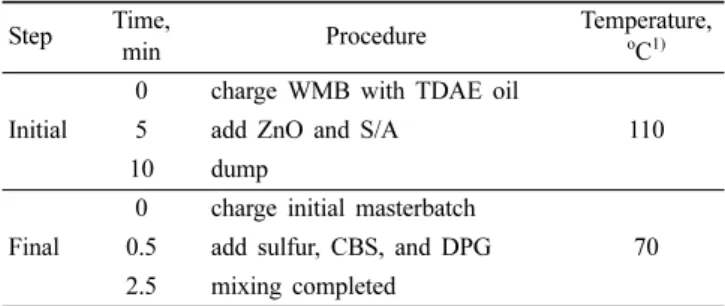
Silica-filled SBR (WSBR) compounds were prepared by mixing silica-SBR WMB with additives such as sulfur, accelerators, activators, and expansion oil following the procedure described in Table 2. In the first step of initial mixing, WMB was charged
in an internal mixer (Mirae Scientific Instruments Inc., 300 cm
3) set at 110
oC accompanied with TDAE expansion oil (Kukdong Oil & Chemial Co.). After 5 min mixing, activators such as zinc oxide (ZnO, Daewon Co.) and stearic acid (S/A, Duksan Pure Chemical Co.) were added. Initial mixing products were dumped after 10 min mixing. The initial mixing product was charged in the internal mixer set at 70
oC for final mixing.
After 0.5 min mixing, insoluble sulfur (S, Miwon Chemical Co.) and accelerators such as N-cyclobenzyl sulfenamide (CBS, Miwon Chemical Co.) and diphenylguanidine (DPG, Kumho Petrochemical Co.) were added. The final mixing was completed after further mixing for 2.5 min. Final compounds were milled for 11 cycles with a two-roll mill at 20 rpm (C.W.
Brabender Inc.; Model PM-300, #138-B).
The silica content of WSBR compounds was adjusted to 85.3 ± 0.3 phr with a specific gravity of 1.201 ± 0.003. Since the silica loss of CSil1, CSil2, and CSil4 was considerable, high reinforcing silica Ultrasil 7000GR (Evonik, abbreviated as GR herewith) was supplemented by being accompanied with an appropriate amount of TESPT in the preparation of WSBR1, WSBR2 and WSBR4. The silica loss in the preparation of silica-SBR WMB from CSil3 was too high, and thus the pre- paration of corresponding WSBR was abandoned. Table 3 lists Table 2. Mixing Procedure of Silica-filled WSBR Compounds
Step Time,
min Procedure Temperature,
o
C
1)Initial
0 charge WMB with TDAE oil
110 5 add ZnO and S/A
10 dump
Final
0 charge initial masterbatch
70 0.5 add sulfur, CBS, and DPG
2.5 mixing completed
1)