제 2 회 첨단 사이언스 교육 허브 개발(EDISON) 나노물리 경진대회
Lithium atoms adsorbed on graphene
ChanRan Kim
Department of Physics and Graphene Research Institute(GRI), Sejong University, Seoul 143-747, Korea E-mail: [email protected]
We investigate special arrangements of lithium atoms adsorbed on graphene. By changing adsorption sites and increasing number of atoms, adsorption of lithium atoms on (3x3) graphene is investigated using the density functional theory (DFT) calculations. In this study, three kinds of adsorption sites are considered, such as top, bridge and hollow sites.
INTRODUCTION
Graphene is a carbon allotrope which is a single planar sheet of sp2 hybridized carbon atoms with strong bonding. Graphene is one of most spotlighted material because of its various interesting physical and chemical characteristics.
There are many researches about adsorptions atoms on a graphene surface to control the band gap. Among them, we investigate adsorbed lithium atoms, which is the most strongly binding atom among all alkali-metals [1].
CALCULATIONS METHODS
In this study, we have performed density functional theory (DFT) calculations within generalized gradient approximation (GGA) for exchange-correlation (xc) functional.
We use SIESTA package based on density functional theory on the EDISON web site [2] to obtain the atomic and electronic structure of lithium atoms adsorbed on graphene.
The (3x3) unit cell of graphene is used in our calculations with a vacuum region of about 18 Å.
Some lithium atoms are adsorbed on a graphene sheet. All atomic coordinates are fully relaxed until the forces are less than 0.025 eV/Å. For the Brillouin-zone integration, a (9x9x1) grid is used in the Monkhost-Pack scheme.
RESULTS & DISCUSSIONS
From the previous work [3], it was known that lithium atom adsorbed on hollow site of graphene is the most stable. Also, binding energy of Li atoms on graphene was found to increase with decreasing adatom density [4].
In our study, we investigate special arrangements of lithium atoms adsorbed on graphene. First, we study adsorption geometries of lithium atoms on a single layer graphene using DFT calculations for comparison with previous studies. Several adsorption sites including hollow, bridge, and top positions are considered.
Especially, we focus on the adsorption of a number of Li atoms on specified positions of graphene having a (3×3) surface unit cell. We find that some special arrangements of Li atoms on graphene are more stable than the repetitive arrangement of Li atoms which are adsorbed on hollow sites of graphene.
Increasing the number of lithium atoms and changing the adsorption sites of Li atoms, we investigate the electronic and atomic structure of Li atoms on graphene.
First, the adsorption of only one Li atom on graphene is investigated. We consider three kinds of adsorption sites, such as hollow (H), bridge (B), and top (T) sites as shown in Fig.1. Position on a carbon atom in graphene is called as top site, while that on carbon bond which connects carbon atoms is called as bridge site. The center of hexagonal carbon ring is called as hollow site.
Fig. 1. Hollow (H), Bridge (B), and Top (T) sites of graphene.
80 278
제 2 회 첨단 사이언스 교육 허브 개발(EDISON) 나노물리 경진대회
(a)
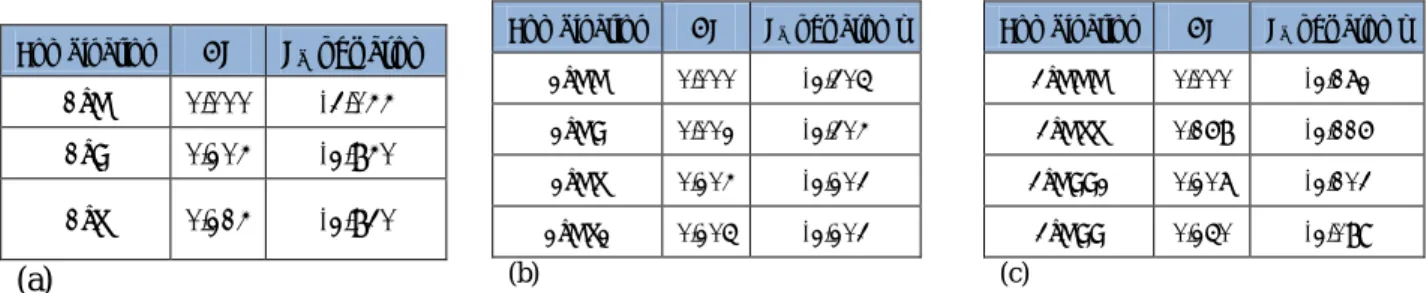
Combination ΔE Eb per atoms 2_HH 0.000 -2.305 2_HB 0.002 -2.304 2_HT 0.204 -2.203 2_HT2 0.205 -2.203 (b)
Combination ΔE Eb per atoms 3_HHH 0.000 -2.172
3_HTT 0.168 -2.116 3_HBB2 0.207 -2.103 3_HBB 0.250 -2.089 (c)
Table 1. Energy differences (ΔE) compared to the most stable sites and binding energy (Eb) of Li atom with graphene (Combination represents the number of adsorption Li atoms and adsorption sites.)
Depending on the position of top and bridge sites on a graphene, there are many configurations.
For example, two types of configurations of 2_HT (1 Li atom on hollow site and 1 Li atom on top site) and 3_HBB (1 Li atom on hollow site and 2 Li atoms on hollow site) are shown in Fig. 2, where we consider two kinds of different adsorption combination of HT and HBB.
Fig. 2. Initial positions of (a) 2_HT, (b) 2_HT2, (c) 3_HBB, and (d) 3_HBB2
(
total G Li)
b
E E n E
E = n 1 − − ×
(1) We calculate binding energy of lithium atoms on graphene using the equation (1), where Eb
means binding energy and n is the number of Li atoms. The total energies of Li/Graphene system, the (3x3) graphene, and a lithium atom are represented by Etotal, EG, and ELi, respectively.
Depending on the adsorption site of Li atoms, the binding energy per atom is different as it was found in the previous work [3]. Our calculations show that the binding energies of Li atom on the bridge and top sites are almost the same, as shown in Table 1(a). When Li atom is adsorbed on
hollow site, Li atom has stronger interaction with graphene compared to other cases. Similarly, different binding energies are shown in Table 1(b) and Table 1(c), depending on the combination of Li adsorption sites. From our calculation results, we confirm that the hollow site is the most stable adsorption site regardless of the number of Li atoms.
In the case of 2_HB, the Li atom initially located on bridge site is moved to hollow site after relaxation which is more stable site than other sites, as shown in Fig. 3 and Fig. 4. So the binding energies per atom of 2_HH and 2_HB have similar energy values (see Table 1(b)).
Fig. 3. Initial position of 2_HB
.
Fig. 4. Final position of 2_HB Combination ΔE Eb per atom
1_H 0.000 -3.044
1_B 0.204 -2.840
1_T 0.214 -2.830
81 279
제 2 회 첨단 사이언스 교육 허브 개발(EDISON) 나노물리 경진대회
Fig. 6. Top and side view of Li atoms on the hollow site of graphene. The C and Li atoms are represented by brown and green balls, respectively. (a) and (d) are the top and side views when a Li atom is adsorbed on a graphene. (b) and (e) are the top and side views when 2 Li atoms are adsorbed on a graphene. (c) and (f) are the top and side views when 3 Li atoms are adsorbed on a graphene.
Fig. 5. Final position of 3_HBB2
Li atoms on hollow sites do not move on xy plane in all combinations except for the combination of 3_HBB2 (Fig. 5). To figure out the reason of this, we calculate the energy of 3 Li atoms at the same position except for graphene in each case. Our calculations show that the energy of 3 Li atoms of 3_HBB2 is lowest than others.
Another interesting point is that the equilateral triangle is formed by the Li atoms.
As we can see in Table 1, when the number of Li atoms on graphene is lower, the binding is stronger. By increasing the number of Li atoms, the distance between Li atoms become closer.
Closer Li atoms have repulsive interaction with neighboring Li atoms. Then, the binding energy with graphene is decreased. That is, smaller
number of Li atoms on (3x3) graphene is less influenced by neighboring Li atoms.
Fig. 6 shows some figurations of Li atoms which are adsorbed on the hollow site of graphene.
Increasing the number of lithium atoms, the xy plane of graphene becomes more flat (see Fig. 6 (d), (e), (f)) due to weak interaction between graphene and Li atoms.
Fig. 7. Energy bands structure of (a) 1_B, (b) 1_H, and (c) 1_T
In Fig. 7, it is shown that the gap opening is different depending on the different adsorption sites. The gap opening of 1_B is larger than others.
That is, depending on adsorption sites, the gap opening can be controlled.
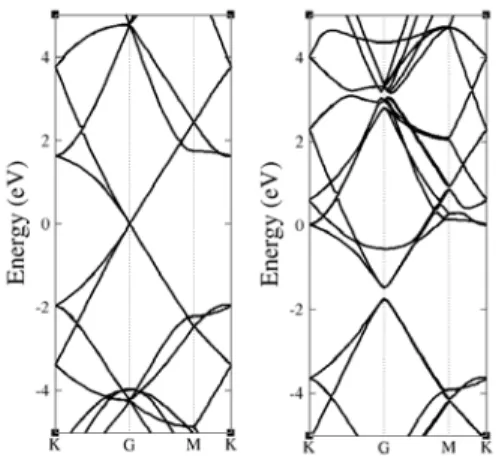
The band structure of graphene is shown in the Fig. 8(a). Compared to it, the linear energy bands are shifted below the Fermi level by adsorption of Li atoms on graphene due to charge transfer
82 280
제 2 회 첨단 사이언스 교육 허브 개발(EDISON) 나노물리 경진대회
between Li atoms and graphene. Note that the 3_HHH configuration gives the largest gap opening in our calculations, as shown in Fig. 8(b).
Fig, 8. Energy bands of (a) graphene and (b) 3_HHH
CONCLUSION
We investigated special arrangements of lithium atoms adsorbed on graphene. As a result, the hollow site is the most stable position regardless of the number of lithium atoms. When smaller number of Li atom is adsorbed on (3x3) graphene, there is more repulsive interaction between graphene and Li atoms. We found that depending on adsorption sites, the gap opening can be controlled.
ACKNOWLEDGEMENT
This research was supported by EDISON Program through the National Research Foundation of Korea (NRF) funded by the Ministry of Education, Science and Technology (2012M3C1A6035305).
REFERENCES
[1] K. Rytkönen, J. Akola, and M. Manninen,, Phys. Rev. B 69 205404 (2004).
[2] http://nano.edison.re.kr/
[3] K. T. Chan, et al., Phys. Rev. B 77, 235430 (2008).
[4] D. Krepel and O. Hod, Surf. Sci. 605, 1633 (2011).
83 281