International Journal of High-Rise Buildings March 2021, Vol 10, No 1, 63-71
https://doi.org/10.21022/IJHRB.2021.10.1.63
International Journal of
High-Rise Buildings
www.ctbuh-korea.org/ijhrb/index.php
Comparative Study on the Development Trends of High-rise Buildings Above 200 Meters in China, the USA and the UAE
Jiaqi Qu
1, Zhendong Wang
1,2†, and Peng Du
1,31Council on Tall Buildings and Urban Habitat, CTBUH, Chicago, IL
2College of Architecture and Urban Planning, Tongji University, China
3College of Architecture, Texas Tech University, USA
Abstract
Since 2006, the number of completed high-rise buildings over 200 meters have increased rapidly. Although there were some short-term cyclical troughs, the overall trend has still been growing. No longer constrained by technological limits, the development of high-rise buildings now depends on cooperation and compromise between social, economic, and political factors. This article extracts statistical data from the Council on Tall Buildings and Urban Habitat (CTBUH) to focus on the completion of high-rise buildings of 200 meters and above over the past 20 years from 2000 to 2019. Similarities and differences in the number, distribution, and function of high-rise buildings are analyzed, The paper also compares the impact of different political and economic environments on the development trends of high-rise buildings in China, the United States and the UAE.
Keywords: Construction, Development, High-rise buildings, Political environments, Economic environments
1. Introduction
With recent breakthroughs of construction and vertical transportation technology, the maximum achievable height of high-rise buildings and the number of high-rise buildings are both continuously rising. Since the completion of the Burj Khalifa in Dubai in 2010, the record of the tallest building in the world has not been broken. The number of high-rise buildings above 200 meters completed in the world in 2019 was for first time in seven years, less than the number completed in the previous year, after seven years of continuous growth. In April 2020, China, the country with largest number of high-rise buildings in the past 15 years, issued strict height control regulations on new high-rise projects. In the USA and the UAE, the completion rate of high-rise buildings above 200 meters has increased significantly in 2018 and 2019, and many high-rise buildings are currently under construction. The tradeoff between economic and social development of various countries and cities, as well as their unique cultural and political backgrounds, affect the development of high-rise buildings. This article selects high-rise buildings 200 meters and higher as the research subject, and analyzes the current and future development trend of high-rise buildings in major countries with respect to their economies and planning policies.
Note: High-rise buildings above 150 meters and 200 meters above are similar in terms of building functions
and regional distribution and have similar data characteristics.
The data characteristics of high-rise buildings above 250 meters are different from that of shorter high-rise buildings, but their limited number is not fully representative of the high-rise building industry. Based on the above two points, the high-rise buildings 200 meters and taller are selected as the sample data.
2. Overview of High-rise Buildings Worldwide
According to CTBUH data, as of May 2020, there were a total of 1,627 buildings over 200 meters in the world.
The three countries with the greatest number of high-rise buildings were: China with 758, the USA with 210, and the UAE with 119. Figure 1 shows the number of buildings 200 meters and taller built each year globally, as well as in China, the USA and the UAE specifically. The number of high-rise buildings built in China rose rapidly from 2012 to 2016 (on average, at a rate of 40 percent per year).
In recent years, the number of completed high-rise buildings has shown a stable or even decreasing trend. In the USA, the number of high-rise building started to increase rapidly in 2015 and reached its peak in the last two years, 2018 and 2019 (14 high-rise buildings 200 meters and taller in both 2018 and 2019, 1.75 times the 2017 total).
The UAE began its rapid growth in 2004 and began to decline after reaching the peak of construction (15 buildings) in 2010. Globally, high-rise buildings have shown steady growth over the past 20 years. More and more countries have high-rise buildings.
The cumulative percentage of buildings above 200
†Corresponding author: Zhendong Wang
Tel: +86 13816783858, E-mail: [email protected]
meters by country are shown in Figure 2. Although China has built more high-rise buildings than other countries in the past 24 years, it only surpassed that of the USA in 2007 in terms of cumulative numbers, as the country with the most high-rise buildings above 200 meters in the world.
At the present, most of high-rise buildings above 200 meters are office buildings (see Figure 3). When the height rises above 300 meters, mixed-use buildings become the majority. It can be reasoned that when a building reaches a certain height, it is difficult to for it to play a single function. Instead, it acts more like a community and a microcosm of a city.
3. Current status of high-rise buildings in China
Since 1996, China has been the country to build the greatest number of high-rise buildings above 200 meters
each year. And after a leap in 2013 (39 completions) and 2014 (68 completions), high-rise buildings over 200 meters built in China each year stabilized at more than 60, accounting for 46 and 66 percent of the world total in each of those years, respectively. While the number of high-rise buildings above 200 meters is increasing rapidly each year, China's national GDP growth rate slowed significantly after 2011. This phenomenon cannot be explained simply by the “Skyscraper Index”. According to statistics from CTBUH, the average construction period for high- rise buildings above 200 meters in China is about four to five years. Comparing the absolute increase in GDP with the number of high-rise buildings over 200 meters completed five years later (see Figure 4), the correlation coefficient between the two is 0.85, indicating positive correlation.
The slowdown in China's GDP growth is the inevitable result of China's overall development stage. The growth in number of high-rise buildings reflects China's economic Figure 1. Number of high-rise buildings above 200 meters completed each year. (Source: CTBUH)
Figure 2. The cumulative percentage of high-rise buildings above 200 meters in the global. (Source: CTBUH)
Comparative study on the development trends of high-rise buildings above 200 meters in China, the USA and the UAE 65
conditions at the time of the start of construction of these buildings.
Note: In 1999, Andrew Lawrence, an analyst at Deutsche Bank Securities in Hong Kong, discovered that economic recessions or stock market depressions often occur just prior to, or just after the completion of new high-rise buildings, and proposed the concept of the
“Skyscraper Index”. Loose government policies and an optimistic attitude towards the economy often encourage the construction of large projects. However, when the bubble caused by over-investment and speculation is about to endanger the economy, the policy often turns to austerity in response to the crisis, making the completion of the skyscraper a prelude to policy and economic changes.
The leap in the number of high-rise buildings completed
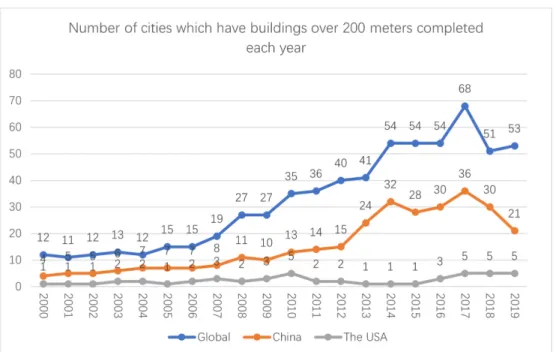
in China is not just accomplished by a few individual cities. Before 2013, only 15 cities at most had buildings above 200 meters completed each year. In 2013, this number increased to 24 cities, and in 2014, 32 cities completed at least one building above 200 meters (see Figure 5). As of 2019, 66 cities in China have high-rise buildings above 200 meters, compared with 26 cities in the USA, reflecting the geographical diversity.
As mentioned in Economic Drivers: Skyscrapers in China (Barr and Luo, 2017), although big cities have more high-rise buildings than that of small cities in general in China, the number of high-rise buildings in a city is not completely proportional to the city’s GDP or population. Moreover, “small cities” relatively have more high-rise buildings. This is because high-rise buildings are constructed with the expectation of revitalizing the Figure 3. High-rise buildings above 200 meters and 300 meters in proportion by function. (Source: CTBUH)
Figure 4. Comparison of China's GDP growth and the number of high-rise buildings above 200 meters completed after 5 year. (Source: CTBUH; China National Bureau of Statistics)
real estate industry, in order to promote overall economic development. In addition, competition and imitation between cities have promoted this phenomenon. A significant amount of high-rise buildings in China are not only used to satisfy market demands and generate economic returns, but are also affected by factors such as urban landscape and government performance. In addition to directly controlling the building height through laws and regulations affecting absolute height, floor area ratio, and aviation height restrictions, the government also restricts developers through economic tools, such as offering additional develop- ment rights to those developers that support urban infrastructure. Due to changes in the “height limit”, many projects in China have to reduce their height, including a few already under construction. In April 2020, China’s
“Notice of the National Development and Reform Com-
mission of the Ministry of Housing and Urban-Rural Development on Further Strengthening the Control of City and Building Features” more clearly stated that
“generally no new buildings over 500 meters should be built” and that it would “strictly restrict new buildings over 250 meters.” It can be predicted that the height and number of high-rise buildings in China will further decline in the long run, as the government plays a pivotal role in the development of high-rise buildings in China.
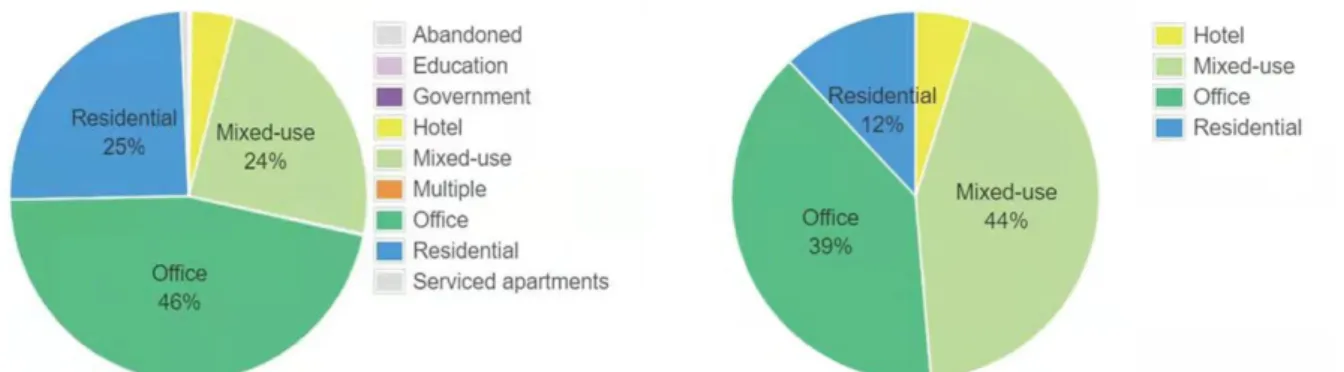
Comparing the function of high-rise buildings above 200 meters completed between 2000-2009 and 2010- 2019 in China (see Figure 6), the proportion of office- only buildings increased from 38 to 56 percent, and the proportion of residential-only buildings reduced from 27 to 8 percent. The increase in office buildings shows that China's demand for office space continue to increase, and Figure 5. The number of cities in China and the USA that have buildings over 200 meters completed each year, 2000 to 2019 (Source: CTBUH)
Figure 6. Comparison of 2000-2009 and 2010-2019 high-rise buildings above 200 meters completed in China by function.
(Source: CTBUH)
Comparative study on the development trends of high-rise buildings above 200 meters in China, the USA and the UAE 67
that developers are generally optimistic about economic development. Very few 200-meter-plus buidlings are solely residential buildings in China. One factor is the guidance of urban planning regulations, and the other is economic considerations. For example, the Chinese fire code requires that buildings above 100 meters need to have additional refuge floors, which will increase the shared area of each unit and sales price, making the project less attractive in the market. Moreover, many cities in China have restrictions on the number of transactions and transcation prices for residential real estate. Nevertheless, it should be noted that in terms of the overall construction of new buildings, including low-rise, 74 percent are residential buildings, which is much more than the 3 percent share of office buildings (China National Bureau of Statistics, 2020).
4. Current status of high-rise buildings in the USA
As the birthplace of skyscrapers, the USA has the longest history of skyscraper development. The first high- rise building over 200 meters, the Metropolitan Life Tower (213 meters), was built in the USA as early as 1909.
Although high-rise buildings showed a prosperous trend in the decade from 1982 to 1992, with a total of 68 buildings over 200 meters completed, the USA did not maintain as fast a construction pace as China did in the 2000s. Domestically, with 14 buildings, the USA has the greatest number of completions over 200 meters in 2018 and 2019. With regards to geographical diversity, as of 2019, New York City accounted for 38.8 percent of the USA’s high-rise buildings over 200 meters, followed by Chicago with 14.8 percent, Houston with 7.2 percent, and
Los Angeles with 5.7 percent. A total of 26 cities in the USA have buildings above 200 meters.
In general, the development of high-rise buildings in the USA started early and has maintained a stable and cyclical development trend for a long time. Looking back at the entire development process of high-rise buildings in the USA, the government has less direct intervention, and mainly uses economic methods, to which developers respond with obvious periodicity. For example, in the 1980s, many new office spaces entered the USA market, raising the vacancy rate of office buildings. The office vacancy rate in Lower Manhattan, New York City, increased from 5.1 percent in 1980 to 17.6 percent in 1990 (Fainstein, 2001). After "Black Monday" in 1987, followed by the real estate bubble burst in the 1990s, the development of high-rise buildings bottomed. In response, the New York government provided preferential tax benefits for converting office buildings to residential buildings, and offered incentives to new technology companies to stimulate demand for office space, thereby improving the real estate market environment (Fainstein, 2001). In the 21st century, loan interest rates began to decline significantly.
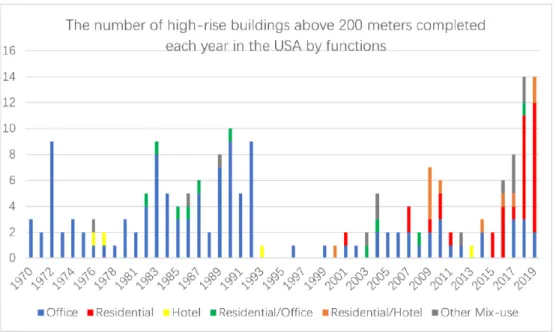
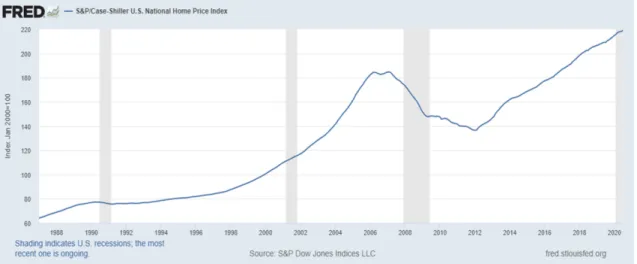
The fixed interest rate of 30-year mortgage loans went from 8.05 percent in 2000 to 5.83 percent in 2003 and 3.66 percent in 2012, the lowest in history. Each interest rate cut corresponds to a peak in the number of high-rise buildings completion five years after (see Figure 7). Low interest rates increase the return on housing investment and stimulate investment confidence, which contribute to the increase in residential buildings’ proportion of newly- built high-rise buildings. Looking at the S&P US housing price index (see Figure 8), the growth of housing prices gradually accelerated from 1991 to 2006, which further
Figure 7. The number of high-rise buildings above 200 meters completed each year in the USA, by function. (Source:
CTBUH)
promoted the enthusiasm of developers to invest in housing. A large number of high-rise residential projects were constructed afterwards.
Unlike China, the proportion of newly-built office-only buildings above 200 meters’ height, compared to the total of newly-built buildings above 200 meters in the USA, decreased from 46 percent in 2000-2009 to 26 percent in 2010-2019, while newly-built high-rise residential buildings surged from 14 to 48 percent during the same periods (see Figure 9). In 2000, the USA ushered the first residential- only high-rise building above 200 meters, the Trump Tower, (compared to the first residential-only building above 200 meters in the world, which was built in Hong Kong in 1993). Meanwhile, the function of high-rise buildings began to gradually shift more to residential use.
Although in recent years, much more high-rise residential buildings were completed, office-only high-rise buildings still dominate in terms of total proportion. Today, 66 percent of all high-rise buildings above 200 meters in the
USA are office buildings. The newly-built high-rise residential buildings can be recognized as a balance and supplement to the large number of office buildings. On the other hand, high-rise buildings above 200 meters in China are at the stage of combining office, residential and mixed-use functions, which is similar to the functional proportions of high-rise buildings built in the first decade of the 21st century in the USA.
5. Current status of high-rise buildings in the UAE
The UAE completed the Burj Khalifa in 2010, which remains the tallest building in the world. And 2010 was the year when the UAE built the largest number of buildings over 200 meters (15 buildings). Different from the geographical diversity in China, most high-rise buildings in the UAE are in Dubai. As of 2019, Dubai has 91 high-rise buildings over 200 meters, accounting for 76 Figure 8. USA S&P US House Price Index. (based on 100 in January 2000) (Source: Federal Reserve Economic Data)
Figure 9. Comparison of 2000-2009 and 2010-2019 high-rise buildings above 200 meters completed in USA by function.
(Source: CTBUH)
Comparative study on the development trends of high-rise buildings above 200 meters in China, the USA and the UAE 69
percent of the 117 such buildings in the UAE. Four cities in the UAE have buildings above 200 meters. Abu Dhabi had a few high-rise buildings completed between 2009 and 2017. However, when Abu Dhabi had a low number of high-rise buildings completed in 2018 and 2019, Dubai had a peak in completions, second only to 2010 (12 buildings), recording 10 high-rise buildings above 200 meters completed in 2018, and nine in 2019.
Comparing the number of completed buildings with population growth (see Figure 10), the high-rise building growth trend in the UAE is four years behind population growth, with a similar overall trend. Some 49 percent of the high-rise buildings above 200 meters in the UAE are residential buildings. However, these residences are not prepared for native populations. On the contrary, the rapid increase in population is due to the labor attracted by the rise of building construction and other related industries.
This hypothesis can also be confirmed by the gender ratio of the population. In 2010, the proportion of males reached the highest ratio in history, accounting for 74.8 percent of the UAE’s total population. In 2019, 69.3 percent of the population is male in the UAE. According to statistics in 2005, 88.4 percent of the UAE’s population was immigrants, ranking first in the world, comparing to China’s immigrant level, accounting for 0.071 percent of the total population, which is the world’s lowest proportion (The World Bank, 2020). At the same time, more than 35 percent of the UAE's entire real estate investment in 2018 came from abroad (Dubai Land Department, 2019). All these factors reflect that the high- rise buildings in the UAE are not primarily intended for the native population, but are more used to attract foreign investment.
Another impetus for building high-rise buildings in the UAE is the premium brought by its signature. In the statistics of the 100 tallest buildings in the world in 2019, 85 percent of the UAE projects (17 out of 20 UAE
projects) had more than 10 percent of their upper heights on the top unoccupiable, compared with 45 percent in China and 46 percent in the USA (CTBUH, 2020). This also reflects that the UAE projects are more inclined to increase the unit price through unique project height characteristics, in order to obtain the greatest economic return. Practicality is not the most highly rated factor for tall building investors in the UAE. At the same time, the city of Dubai is divided into several central areas. Developers’
awareness of competition has further promoted building height and iconic characters (Safarik et al. 2018). However, such a strategy has limited potential for price increases in the long run. Since 2004, the real estate industry in Dubai has flourished. The success of many high-rise buildings has driven the real estate price index of the entire UAE to increase in a short period. However, the financial crisis and crude oil prices caused prices to drop sharply after 2008, returning to high levels only in 2014 (see Figure 11). After the obvious growth, although the number of completed high-rise buildings over 200 meters reached a peak again in 2018 and 2019, the UAE residential asset price index is still gradually falling. There are not enough residents or investors to consume the rapid growth of supply, which has inevitably caused prices to fall.
6. Summary of the Current Status and Future Trends of High-rise Buildings
With the needs of urbanization and benefits for pro- fessionals offered by major cities in China, urban popu- lation will continually grow. In addition, many central areas in big cities need to be reshaped and improved, where the original residents need to be properly resettled.
Meanwhile, many high-rise projects are currently under construction. Moreover, during this year's epidemic situation, China has been affected for a relatively short period, and the Chinese government has increased its infrastructure Figure 10. The number of buildings above 200 meters completed each year and population growth rate in the UAE.
(Source: CTBUH; The World Bank)
budget. Considering all these factors, the number of newly built high-rise buildings in China will not drop significantly. However, the height will not exceed that of current China's tallest building, Shanghai Tower (632 meters), or even more than 500 meters. Although the height of buildings under construction will not change, the number of newly established high-rise buildings above 250 meters will decrease due to the restrictive policies. Both the government and developers need to establish the unique characteristics of the projects from some other aspect than height in order to improve com- petitiveness, which will also promote the rethinking and progression of China's high-rise building industry.
The United States has a long history of high-rise buildings, with obviously periodic development swings. The overall economic situation in the United States affects prices of, and the investment confidence in high-rise buildings, which in turn affects the number and types of projects.
Since the economic crisis in 2008, the USA has experienced a long economic boom. But this year's epidemic and de- globalization have affected investments and projects widely. The USA economy has been hit hard in the short term, and it will take time to recover, which will inevitably affect the number of new high-rise buildings. Coupled with the implementation of working from home caused by the epidemic, residents' demand for living in city centers, close to their offices, has decreased, which has caused the value of land in urban centers to decline in the short term.
However, these economic factors do not hinder the accumulation of years of practical experience and user feedback on high-rise buildings in USA. There are many valuable experiences of urban planning and high-rise building design that can be deployed in the future.
The UAE for many years sought to reduce its depen- dence on the oil market by increasing foreign trade transactions, infrastructure construction, and international tourism. This has indeed boosted GDP and attracted many foreigners. However, in the long run, the single industrial structure and population composition of the
UAE make its economic situation insufficiently resilient.
High-rise buildings should serve growing demand, and thus be a reflection of prosperity. However, if high-rise buildings themselves become the main force of economic development to attract tourism and investment, they will appear to be insufficient and cannot sustainably support growth. For example, the infrastructure construction of Dubai has not caught up with the needs of many high-rise buildings, which lack sufficient nearby medical and education facilities, public transportation, and other community facilities. Various types of restrictive policies adopted by China also suppress developers and local governments from blindly pursuing short-term interest. Only by building sustainable cities can the long-term interests of the whole society be maximized.
High-rise buildings involve a lot of capital investment, with long project cycles, and iconic characteristics, which are destined to be affected by many aspects such as society, the economy, and government policies. Interest groups from different parties should work closely with each other to avoid policy amplification effects. For example, in China, policy implementation is often aggressively interpreted, causing overcorrection results. The lagging economic adjustments, such as the obvious cyclical develop- ment of high-rise buildings in the USA, due to the scope of supply and demand turbulence, is relatively large. The ignorance of the fundamental needs of societal development, such as the development of overall industries in the UAE, is clearly lagging behind the pace of the real estate industry.
Comprehensive consideration of various factors and joint development of various interest groups can promote the sustainable development of high-rise buildings in all these economies.
Reference
Barr, J. & Luo, J. (2017). Economic Drivers: Skyscrapers in China. Chicago: Council on Tall Building and Urban Figure 11. UAE residential property price index. (100 base in 2010) (Source: CEIC)
Comparative study on the development trends of high-rise buildings above 200 meters in China, the USA and the UAE 71
Habitat.
CEIC (2020). CEIC Data. [online]Available at: http:// www.
Ceicdata.com/
China National Bureau of Statistics (2020). National Data.
[online] Available at: https:// data.stats.gov.cn/
CTBUH (2020). The Skyscraper Center. [online] Available at: http:// skyscrapercenter.com/
Dubai Land Department (2019). Annual Report Real Estate Sector Performance 2019.
Fainstein, S. (2001). The City Builders: Property Development
in New York and London, 1980-2000. 2nd ed. University Press of Kansa.
Federal Reserve Economic Data (2020). S&P Dow Jones Indices. [online] Available at: fred.stlouisfed.org/
Safarik, D., Ursini, S., & Wood, A. (2018). “The Tall, Polycentric City: Dubai and the Future of Vertical Urbanism.” CTBUH Journal, 2018 Issue IV, 20-29 The World Bank (2020). The World Bank Data. [online]
Available at: https:// www.worldbank.org/