give much anxiety and stress to patients. To solve this prob- lem, a variety of stress reduction protocols and intravenous conscious sedation (IVS) methods have been developed1,2. Among these, IVS using midazolam (MDZ) has been used widely in medical areas, including the dental department, be- cause MDZ affects the vital signs minimally, easily imparts the adequate calming effect, causes intraoperative amnesia, and provides quick recovery time due to the short half-life of this medicine3,4.
Although MDZ is a relatively safe medication, side ef- fects such as respiratory depression can occur and recovery time after surgery may increase when overdose is injected5,6. Therefore, the clinic, in which the surgeon is responsible for the whole process of sedation because the anesthesiolo-
I. Introduction
The fear about dental treatment is relatively high, and mi- nor oral surgeries such as surgical extraction of third molar
Ho Lee
Department of Oral and Maxillofacial Surgery, Section of Dentistry, SMG- SNU Boramae Medical Center, 20 Boramae-ro 5-gil, Dongjak-gu, Seoul 07061, Korea
TEL: +82-2-870-2496 FAX: +82-2-831-0714 E-mail: [email protected]
ORCID: http://orcid.org/0000-0002-0413-2954
This is an open-access article distributed under the terms of the Creative Commons Attribution Non-Commercial License (http://creativecommons.org/
licenses/by-nc/4.0/), which permits unrestricted non-commercial use, distribution, and reproduction in any medium, provided the original work is properly cited.
CC
Risk factor analysis of additional administration of sedative agent and patient dissatisfaction in intravenous conscious sedation using midazolam
for third molar extraction
Dong-Whan Shin1, Jin-Yong Cho2, Yoon-Sic Han3, Hye-Young Sim4, Hee-Sun Kim4, Da-Un Jung4, Ho Lee3
1Department of Oral and Maxillofacial Surgery, Dankook University Jukjeon Dental Hospital, Yongin,
2Department of Oral and Maxillofacial Surgery, Gachon University Gil Medical Center, Incheon,
3Department of Oral and Maxillofacial Surgery, Section of Dentistry, SMG-SNU Boramae Medical Center,
4Section of Dentistry, SMG-SNU Boramae Medical Center, Seoul, Korea
Abstract(J Korean Assoc Oral Maxillofac Surg 2017;43:229-238)
Objectives: The primary purpose of this study was to investigate the factors related with additional administration of sedative agent during intrave- nous conscious sedation (IVS) using midazolam (MDZ). The secondary purpose was to analyze the factors affecting patient satisfaction.
Materials and Methods: Clinical data for 124 patients who had undergone surgical extraction of mandibular third molar under IVS using MDZ were retrospectively investigated in this case-control study. The initial dose of MDZ was determined by body mass index (BMI) and weight. In the case of insufficient sedation at the beginning of surgery, additional doses were injected. During surgery, peripheral oxygen saturation, bispectral index score (BIS), heart rate, and blood pressure were monitored and recorded. The predictor variables were sex, age, BMI, sleeping time ratio, dental anxiety, Pederson scale, and initial dose of MDZ. The outcome variables were additional administration of MDZ, observer’s assessment of alertness/sedation, intraoperative amnesia, and patient satisfaction. Descriptive statistics were computed, and the P-value was set at 0.05.
Results: Most patients had an adequate level of sedation with only the initial dose of MDZ and were satisfied with the treatment under sedation; how- ever, 19 patients needed additional administration, and 13 patients were unsatisfied. In multivariable logistic analysis, lower age (odds ratio [OR], 0.825;
P=0.005) and higher dental anxiety (OR, 5.744; P=0.003) were related to additional administration; lower intraoperative amnesia (OR, 0.228; P=0.002) and higher BIS right before MDZ administration (OR, 1.379; P=0.029) had relevance to patient dissatisfaction.
Conclusion: The preoperative consideration of age and dental anxiety is necessary for appropriate dose determination of MDZ in the minor oral sur- gery under IVS. The amnesia about the procedure affects patient satisfaction positively.
Key words: Midazolam, Conscious sedation, Drug dosage calculation, Patient satisfaction, Third molar
[paper submitted 2017. 3. 24 / revised 2017. 5. 10 / accepted 2017. 5. 26]
Copyright © 2017 The Korean Association of Oral and Maxillofacial Surgeons. All rights reserved.
tion of no allergic response through a skin test, a 1 g prophy- lactic antibiotics (Yamatetan Injection; Jeil Pharmaceutical, Seoul, Korea) was injected. Each patient’s peripheral oxygen saturation (SpO2), bispectral index score (BIS), heart rate, and noninvasive blood pressure (NIBP) were monitored during the whole sedation procedure. A 30 mg opioid an- algesic (Pethidine HCl Injection; Bio & Chemical R&D, Seoul, Korea) was given for 30 seconds. The main sedative agent MDZ (Midazolam Injection; Bukwang Pharmaceuti- cal, Seoul, Korea) was administered at the speed of 200 mg/
h using an infusion pump (Syramed uSP 6000 syringe pump;
Arcomed AG, Regensdorf, Switzerland) intravenously after the dose was determined according to body mass index (BMI) and weight. On the basis of BMI, patients were categorized as underweight (BMI <18.00 kg/m2), normal weight (BMI 18.00-24.99 kg/m2), or overweight (BMI ≥25.00 kg/m2);
according to this categorization, MDZ of 0.05 mg/kg was administered for underweight patient, 0.06 mg/kg for normal weight patient, or 0.07 mg/kg for overweight patient. Five minutes after the MDZ administration, the surgeon verified the slurred speech and drooping eyes of the patient, and per- formed the routine surgical aseptic draping. The surgery be- gan 5 minutes after the injection of the local anesthetic agent (Lidocaine HCl 2% injection 1:100,000 epinephrine; Huons, Seoul, Korea). If the patient responded readily to his or her name being spoken in a normal tone and complained of great anxiety around the beginning of surgery, these signs were regarded as insufficient sedation, and an additional dose of 1 mg MDZ was administered at the same speed of the initial dosage. If the sedation was still insufficient 5 minutes after additional administration, the second additional administra- tion of MDZ was carried out. If it was still insufficient, the same procedure was repeated, with the maximum number of additional administrations limited to four. On the contrary, if SpO2 decreased below 95 and the patient did not respond after mild prodding or shaking, these signs were regarded as excessive sedation, and the surgeon awakened the patient by giving painful trapezius squeeze. In case this procedure had no effect, a 0.2 mg flumazenil (Flunil Injection; Bukwang Pharmaceutical) was administered for 15 seconds. If there was no effect after 1 minute, an additional 0.1 mg of flumaze- nil was administered. If this also did not work, the cardiovas- cular resuscitation procedure was initiated. The patient was discharged after the confirmation of having 9 points of the Aldrete post-anesthesia recovery score7. The whole sedation protocol was controlled by one operating team, and all sur- geries were performed randomly by one of the two surgeons gist is not resident, may prefer to inject a relatively low dose
only once for safety. However, if the degree of sedation is insufficient, the operation cannot be performed normally, and additional medication needs to be administered during the operation. This causes increase of total operation time and dissatisfaction of both operator and patient. However, to date, there is a lack of research on the factors involved in the administration of additional medications due to insufficient sedation after initial dose, and what contributes to patient sat- isfaction.
In this study, we revealed factors related to additional ad- ministration of MDZ in the cases of insufficient sedation after initial dose. In addition, factors related to patient satisfaction were also analyzed. The ultimate goal of this study was to provide the guideline for adequate sedation with the mini- mum dose of MDZ.
II. Materials and Methods
This study was approved by the Institutional Review Board of SMG-SNU Boramae Medical Center, Seoul, Korea (IRB No. 26-2014-139), and followed the Declaration of Helsinki on medical protocol and ethics. This is a case-control study that compared the case group with insufficient sedation to the control group with adequate sedation after infusion of only the initial dose of MDZ, and that compared the case group with dissatisfaction to the control group with satisfaction with the treatment under conscious sedation. The inclusion crite- ria were patients with American Society of Anesthesiology (ASA) physical status I, who have received surgical extrac- tion of both lower third molars with or without simple extrac- tion of upper third molars under IVS using MDZ in SMG- SNU Boramae Medical Center from August 2013 through July 2016. The exclusion criteria were patients with systemic diseases of ASA physical status II to V, renal or hepatic dis- eases that can affect the metabolism of MDZ, medications having the effect on cytochrome P 450 enzymes or gamma- aminobutyric acid receptors, histories of the recent use of sedatives, no presence of pericoronitis around the impacted third molar, or surgical cases with a total time of more than one hour.
1. Sedation protocol and clinical setting
The crystalloid solution (Plasma Solution A; CJ Health Care, Seoul, Korea) was administered through an 18-gauge intravenous line at a speed of 100 mL/h. After the confirma-
of injection of the local anesthetic agent (T2), the moment 20 minutes after local anesthesia (T3), and the time of the first stitch (T4).
3. Statistical analysis
Pearson’s chi-square tests or Fisher’s exact tests for cat- egorical variables and Student’s t-tests for continuous vari- ables were conducted. Multivariable logistic regression tests were performed to identify factors related to additional ad- ministration of MDZ and patient satisfaction. A goodness-of- fit test and model selection were executed using the Hosmer- Lemeshow goodness-of-fit test and the Akaike information criterion. All statistical analyses were performed using the IBM SPSS Statistics ver. 20.0 (IBM Co., Armonk, NY, USA), and probabilities less than 0.05 were considered to be statisti- cally significant.
III. Results
1. General characteristics
One hundred and twenty four patients were enrolled and analyzed. Among these, 19 patients (15.3%) had additional administration of MDZ. Of these 19 patients, 10 patients (8.1%) were medicated with additional administration once, 7 patients (5.6%) twice, and 2 patients (1.6%) three times.
Thirteen patients (10.5%) were unsatisfied with the treatment under sedation. Two patients (0.8%) were very dissatisfied or dissatisfied with the operation under sedation, and 11 patients (8.9%) was neither dissatisfied nor satisfied.
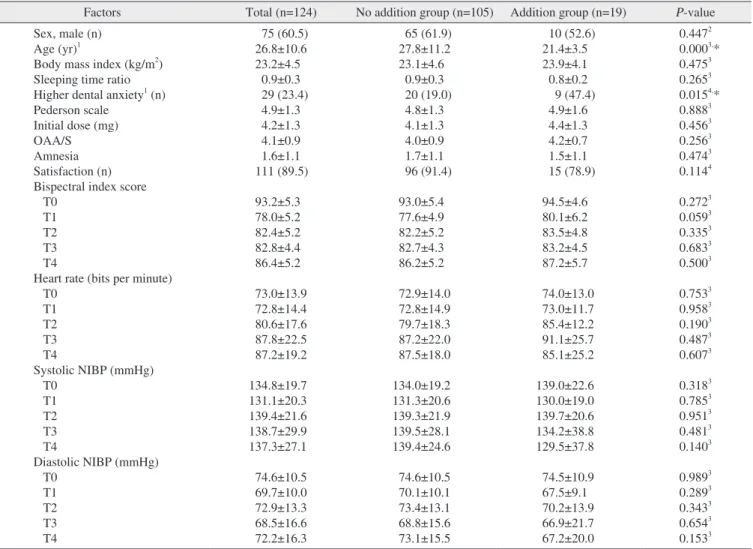
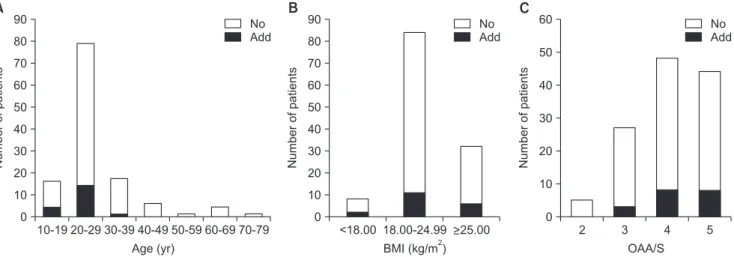
The general characteristics of no addition group and ad- dition group are summarized in Table 1, Fig. 1, and Fig. 2.
There were 75 men (60.5%) and 49 women (39.5%). The youngest patients were 13-year-old boy and girl, and the old- est was a 72-year-old man, with the mean age of 26.8±10.6 years. The mean height of patients was 1.68±0.09 m (range, 1.52-1.86 m), and the mean weight was 66.1±15.7 kg (range, 39.0-140.0 kg). The mean BMI was 23.2±4.5 kg/m2 (range, 15.8-42.7 kg/m2). The mean sleep ratio was 0.9±0.3 (range, 0.3-2.0). The mean DAS was 11.2±2.8 (range, 5-20), and twenty-nine patients (23.4%) had the higher dental anxiety.
The mean Pederson scale was 4.9±1.3 (range, 3-9). The mean initial dose was 4.2±1.3 mg (range, 1.0-9.8 mg). The mean OAA/S was 4.1±0.9 (range, 2-5). The mean intraop- erative amnesia score was 1.6±1.1 (range, 0-3); amnesia regarding the injection of local anesthesia was recorded in with at least five years of clinical experience as specialists in
oral and maxillofacial surgery.
2. Variables
The predictor variables were sex, age, BMI, sleeping time ratio, dental anxiety score (DAS), Pederson scale8, and initial dose of MDZ. BMI was calculated in weight (kg) divided by the square of the height (m). The information about sleep- ing time was acquired by asking the patient. The sleeping time ratio was defined as the ratio of the amount of sleep the night before the operation to the average amount of sleep in patient’s daily life. DAS was collected by a questionnaire9. DAS was categorized into one of two groups: lower dental anxiety, 4 to 12 points; higher dental anxiety, over 12 points.
Pederson scale was calculated in panoramic radiograph by one independent investigator, and the average of both man- dibular third molars was used as the final value.
The outcome variables were whether the additional MDZ was administered, observer’s assessment of alertness/sedation scale (OAA/S)10, the level of amnesia with the operation, pa- tient satisfaction, SpO2, BIS, heart rate, systolic and diastolic NIBP. OAA/S was recorded in the range of 0 to 5 points on the moment 20 minutes after local anesthesia. For informa- tion of amnesia, the patient was asked about whether the patient remembered three moments within the whole sedation procedure; injection of local anesthesia, a certain point in the operation itself, and the comment of the operator signaling the start of suturing. If the patient remembered each moment, each amnesia point was recorded as 0, and if not, the point was recorded as 1. The total amnesia score was the sum of each point. Immediately after being asked about amnesia, the patient was also asked about the degree of satisfaction; very dissatisfied, dissatisfied, moderate, satisfied, or very satisfied.
Each rating was converted to a point, from 1 to 5. This scale was categorized into one of the two groups; dissatisfaction (from 1 to 3 points) or satisfaction (4 or more points). BIS was recorded with an electroencephalographic sensor (BIS Quatro Sensor; Covidien, Mansfield, MA, USA) attached to the forehead of the patient using an electroencephalographic monitoring system (BIS Vista Monitoring System; Aspect Medical Systems, Norwood, MA, USA). SpO2, BIS, heart rate, systolic and diastolic NIBP were monitored continuous- ly during the operation, and the records of five moments of each procedure were extracted and used for statistical analy- sis; the moment right before MDZ administration (T0), the moment 5 minutes after MDZ administration (T1), the time
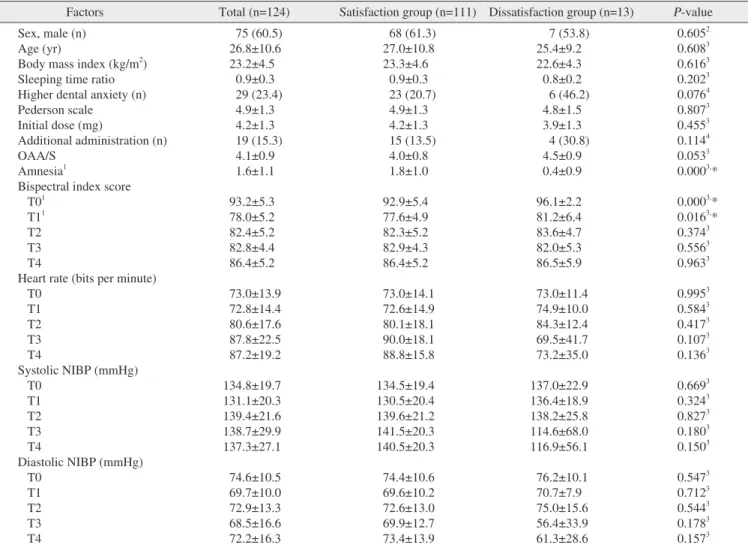
131.1±20.3, 139.4±21.6, 138.7±29.9, and 137.3±27.1 mmHg on each moment. The mean diastolic NIBP was 74.6±10.5, 69.7±10.0, 72.9±13.3, 68.5±16.6, and 72.2±16.3 on each mo- ment. Of 124 total patients, no patients needed flumazenil administration or cardiopulmonary resuscitation in cases of over-sedation. The factors related with patient satisfaction are summarized in Table 2.
2. Factors related with additional administration and patient dissatisfaction
Lower age and higher dental anxiety were related with additional administration of MDZ in multivariable logistic 75 patients (60.5%), a certain point of operation itself in 64
patients (51.6%), and the signal of the start of suturing in 57 patients (46.0%). SpO2 levels of all patients were main- tained over 96% during the whole procedure, and there were no patients with respiratory complications. The mean BIS values were 93.2±5.3 on T0 (range, 77-99), 78.0±5.2 on T1 (range, 66-97), 82.4±5.2 on T2 (range, 66-95), 82.8±4.4 on T3 (range, 73-95), and 86.4±5.2 on T4 (range, 75-97). The patient with a BIS of 97 on T1 had been treated with three additional MDZ doses for sufficient sedation. The mean heart rate was 73.0±13.9, 72.8±14.4, 80.6±17.6, 87.8±22.5, and 87.2±19.2 bits per minutes on each moment from T0 to T4, respectively. The mean systolic NIBP was 134.8±19.7,
Table 1. Description of factors in cases stratified by the necessity of additional administration of midazolam during surgical extraction of third molars
Factors Total (n=124) No addition group (n=105) Addition group (n=19) P-value Sex, male (n)
Age (yr)1
Body mass index (kg/m2) Sleeping time ratio Higher dental anxiety1 (n) Pederson scale
Initial dose (mg) OAA/S Amnesia Satisfaction (n) Bispectral index score T0
T1 T2 T3 T4
Heart rate (bits per minute) T0
T1 T2 T3 T4
Systolic NIBP (mmHg) T0
T1 T2 T3 T4
Diastolic NIBP (mmHg) T0
T1 T2 T3 T4
75 (60.5) 26.8±10.6 23.2±4.5
0.9±0.3 29 (23.4) 4.9±1.3 4.2±1.3 4.1±0.9 1.6±1.1 111 (89.5) 93.2±5.3 78.0±5.2 82.4±5.2 82.8±4.4 86.4±5.2 73.0±13.9 72.8±14.4 80.6±17.6 87.8±22.5 87.2±19.2 134.8±19.7 131.1±20.3 139.4±21.6 138.7±29.9 137.3±27.1 74.6±10.5 69.7±10.0 72.9±13.3 68.5±16.6 72.2±16.3
65 (61.9) 27.8±11.2 23.1±4.6
0.9±0.3 20 (19.0) 4.8±1.3 4.1±1.3 4.0±0.9 1.7±1.1 96 (91.4) 93.0±5.4 77.6±4.9 82.2±5.2 82.7±4.3 86.2±5.2 72.9±14.0 72.8±14.9 79.7±18.3 87.2±22.0 87.5±18.0 134.0±19.2 131.3±20.6 139.3±21.9 139.5±28.1 139.4±24.6 74.6±10.5 70.1±10.1 73.4±13.1 68.8±15.6 73.1±15.5
10 (52.6) 21.4±3.5 23.9±4.1 0.8±0.2 9 (47.4) 4.9±1.6 4.4±1.3 4.2±0.7 1.5±1.1 15 (78.9) 94.5±4.6 80.1±6.2 83.5±4.8 83.2±4.5 87.2±5.7 74.0±13.0 73.0±11.7 85.4±12.2 91.1±25.7 85.1±25.2 139.0±22.6 130.0±19.0 139.7±20.6 134.2±38.8 129.5±37.8 74.5±10.9 67.5±9.1 70.2±13.9 66.9±21.7 67.2±20.0
0.4472 0.0003,* 0.4753 0.2653 0.0154,* 0.8883 0.4563 0.2563 0.4743 0.1144 0.2723 0.0593 0.3353 0.6833 0.5003 0.7533 0.9583 0.1903 0.4873 0.6073 0.3183 0.7853 0.9513 0.4813 0.1403 0.9893 0.2893 0.3433 0.6543 0.1533 (OAA/S: observer’s assessment of alertness/sedation, T0: the moment right before midazolam administration, T1: the moment 5 minutes after midazolam administration, T2: the time of injection of the local anesthetic agent, T3: the moment 20 minutes after local anesthesia, T4: the time of the first stitch, NIBP: noninvasive blood pressure)
1Post-hoc power analysis: Age, 0.997; Higher dental anxiety, 0.729. 2Chi-square test, 3Student’s t-test, 4Fisher’s exact test.
*P<0.05.
Values are presented as number (%) or mean±standard deviation.
Dong-Whan Shin et al: Risk factor analysis of additional administration of sedative agent and patient dissatisfaction in intravenous conscious sedation using midazolam for third molar extraction. J Korean Assoc Oral Maxillofac Surg 2017
10-19 20-29 30-39 40-49 50-59 60-69 70-79 0
90 80 70 60 50 40 30 20 10
Numberofpatients
Age (yr)
A
<18.00 18.00-24.99 >25.00 0
90 80 70 60 50 40 30 20 10
Numberofpatients
BMI (kg/m )2
B
2 3 4 5
0 60
50
40
30
20
10
Numberofpatients
OAA/S
C
No Add
No Add
No Add
Fig. 1. Comparison of several variables in cases stratified by the necessity of addition administration of midazolam during surgical extrac- tion of third molars. A. Comparison according to the age. B. Comparison according to body mass index (BMI). C. Comparison according to observer’s assessment of alertness/sedation (OAA/S). (No: no addition group, Add: addition group)
Dong-Whan Shin et al: Risk factor analysis of additional administration of sedative agent and patient dissatisfaction in intravenous conscious sedation using midazolam for third molar extraction. J Korean Assoc Oral Maxillofac Surg 2017
T0 T1 T2 T3 T4
70 100
95
90
85
80
75
BIS
A
No Add
T0 T1 T2 T3 T4
50 120
110
100
90
80
70
Heartrate(bitsperminute) 60
B
No Add
T0 T1 T2 T3 T4
90 180 170 160 150 140 130 120 110 100
SystolicNIBP(mmHg)
C
No Add
T0 T1 T2 T3 T4
40 90
80
70
60
NIBPDiastolic(mmHg) 50
D
No Add
Fig. 2. Comparison of BIS and vital signs in cases stratified by the necessity of addition administration of midazolam during surgical ex- traction of third molars. Values are presented as mean±standard deviation. A. Comparison according to the mean bispectral index score (BIS). B. Comparison according to the mean heart rate. C. Comparison according to the mean systolic NIBP. D. Comparison according to the mean diastolic noninvasive blood pressure (NIBP). (T0: the moment right before midazolam administration, T1: the moment 5 minutes after midazolam administration, T2: the time of injection of the local anesthetic agent, T3: the moment 20 minutes after local anesthesia, T4: the time of the first stitch, No: no addition group, Add: addition group)
Dong-Whan Shin et al: Risk factor analysis of additional administration of sedative agent and patient dissatisfaction in intravenous conscious sedation using midazolam for third molar extraction. J Korean Assoc Oral Maxillofac Surg 2017
regression analysis.(Table 3) On the basis of odds ratio, the need for additional doses decreased by 1.21 times as the age of patient increased by 1 year (P=0.005). In the presence of higher dental anxiety, the need for addition increased 5.74 times over lower dental anxiety (P=0.003).
To further elucidate the relationship of age and additional administration, we performed statistical analysis of all vari- ables for younger and older age groups. The cut-off-value for age was 22.5 years.(Fig. 3. A) Four variables showed a significant difference between groups; the younger age group had more additional administration, higher BIS on T2, lower diastolic NIBP on T0 and T1.(Table 4)
Lower intraoperative amnesia and Higher BIS on T0 were
Table 2. Description of factors in cases stratified by the satisfaction or dissatisfaction during surgical extraction of third molars Factors Total (n=124) Satisfaction group (n=111) Dissatisfaction group (n=13) P-value Sex, male (n)
Age (yr)
Body mass index (kg/m2) Sleeping time ratio Higher dental anxiety (n) Pederson scale
Initial dose (mg)
Additional administration (n) OAA/S
Amnesia1
Bispectral index score T01
T11 T2 T3 T4
Heart rate (bits per minute) T0
T1 T2 T3 T4
Systolic NIBP (mmHg) T0
T1 T2 T3 T4
Diastolic NIBP (mmHg) T0
T1 T2 T3 T4
75 (60.5) 26.8±10.6 23.2±4.5
0.9±0.3 29 (23.4) 4.9±1.3 4.2±1.3 19 (15.3) 4.1±0.9 1.6±1.1 93.2±5.3 78.0±5.2 82.4±5.2 82.8±4.4 86.4±5.2 73.0±13.9 72.8±14.4 80.6±17.6 87.8±22.5 87.2±19.2 134.8±19.7 131.1±20.3 139.4±21.6 138.7±29.9 137.3±27.1 74.6±10.5 69.7±10.0 72.9±13.3 68.5±16.6 72.2±16.3
68 (61.3) 27.0±10.8 23.3±4.6
0.9±0.3 23 (20.7) 4.9±1.3 4.2±1.3 15 (13.5) 4.0±0.8 1.8±1.0 92.9±5.4 77.6±4.9 82.3±5.2 82.9±4.3 86.4±5.2 73.0±14.1 72.6±14.9 80.1±18.1 90.0±18.1 88.8±15.8 134.5±19.4 130.5±20.4 139.6±21.2 141.5±20.3 140.5±20.3 74.4±10.6 69.6±10.2 72.6±13.0 69.9±12.7 73.4±13.9
7 (53.8) 25.4±9.2 22.6±4.3 0.8±0.2 6 (46.2) 4.8±1.5 3.9±1.3 4 (30.8) 4.5±0.9 0.4±0.9 96.1±2.2 81.2±6.4 83.6±4.7 82.0±5.3 86.5±5.9 73.0±11.4 74.9±10.0 84.3±12.4 69.5±41.7 73.2±35.0 137.0±22.9 136.4±18.9 138.2±25.8 114.6±68.0 116.9±56.1 76.2±10.1 70.7±7.9 75.0±15.6 56.4±33.9 61.3±28.6
0.6052 0.6083 0.6163 0.2023 0.0764 0.8073 0.4553 0.1144 0.0533 0.0003,* 0.0003,* 0.0163,* 0.3743 0.5563 0.9633 0.9953 0.5843 0.4173 0.1073 0.1363 0.6693 0.3243 0.8273 0.1803 0.1503 0.5473 0.7123 0.5443 0.1783 0.1573 (OAA/S: observer’s assessment of alertness/sedation, T0: the moment right before midazolam administration, T1: the moment 5 minutes after midazolam administration, T2: the time of injection of the local anesthetic agent, T3: the moment 20 minutes after local anesthesia, T4: the time of the first stitch, NIBP: noninvasive blood pressure)
1Post-hoc power analysis: Amnesia, 0.998; Bispectral index score T0, 0.974; Bispectral index score T1, 0.446. 2Chi-square test, 3Student’s t-test,
4Fisher’s exact test.
*P<0.05.
Values are presented as number (%) or mean±standard deviation.
Dong-Whan Shin et al: Risk factor analysis of additional administration of sedative agent and patient dissatisfaction in intravenous conscious sedation using midazolam for third molar extraction. J Korean Assoc Oral Maxillofac Surg 2017
Table 3. Results of multivariable logistic regression analysis for factors affecting the necessity of additional administration of mid- azolam during surgical extraction of third molars1
Risk factors OR (95% CI) P-value
Age
Higher dental anxiety 0.825 (0.722-0.943)
5.744 (1.812-18.208) 0.005*
0.003*
(OR: odds ratio, CI: confidence interval)
1Hosmer-Lemeshow goodness-of-fit test: P=0.606, Akaike information criterion=92.451.
*P<0.05.
Dong-Whan Shin et al: Risk factor analysis of additional administration of sedative agent and patient dissatisfaction in intravenous conscious sedation using midazolam for third molar extraction. J Korean Assoc Oral Maxillofac Surg 2017
related with dissatisfaction of patient in the multivariable logistic regression analysis.(Table 5) On the basis of odds ratio, dissatisfaction decreased by 4.39 times as the degree of amnesia increased by 1 point (P=0.002). In addition, dissatis- faction increased by 1.38 times as BIS on T0 increased by 1 (P=0.029). The cut-off-value for BIS on T0 was 95.5.(Fig. 3.
B)
IV. Discussion
IVS using MDZ helps patients have comfortable treat- ment and surgeons concentrate on the operations. However, there are occasionally cases that require additional dosing of sedative during surgery due to the lack of sedation. In an
Fig. 3. Receiver operating characteristics curve obtained by multivariable logistic regression. A. The cut-off-value for age was 22.5 years with an area-under-curve of 0.741 (P=0.001). It was determined according to the Youden index with sensitivity of 64.8% and specificity of 73.7%. B. The cut-off-value for bispectral index score on T0 was 95.5 with an area-under-curve of 0.673 (P=0.043). It was determined ac- cording to the Youden index with sensitivity of 76.9% and specificity of 59.2%. (T0: the moment right before midazolam administration) Dong-Whan Shin et al: Risk factor analysis of additional administration of sedative agent and patient dissatisfaction in intravenous conscious sedation using midazolam for third molar extraction. J Korean Assoc Oral Maxillofac Surg 2017
0 0.2 0.4 0.6 0.8
0 1.0
0.8
0.6
0.4
0.2
Sensitivity
1.0
A
1-Specificity
0 0.2 0.4 0.6 0.8
0 1.0
0.8
0.6
0.4
0.2
Sensitivity
1.0
B
1-Specificity
Table 4. Factors showing statistically significant differences between younger and older age groups during surgical extraction of third mo- lars
Factors Total (n=124) Younger age group
(<22.5 yr)1 (n=51) Older age group
(≥22.5 yr)1 (n=73) P-value Additional administration (n)
Bispectral index score T2
Diastolic NIBP (mmHg) T0
T1
19 (15.3) 82.4±5.2 74.6±10.5 69.7±10.0
14 (27.5) 83.8±5.8 71.6±9.6 66.4±8.8
5 (6.8) 81.5±4.5 76.6±10.7 72.0±10.2
0.0022,* 0.0203,* 0.0093,* 0.0023,* (T0: the moment right before midazolam administration, T1: the moment 5 minutes after midazolam administration, T2: the time of injection of the local anesthetic agent, NIBP: noninvasive blood pressure)
1Cut-off-value was determined according to the Youden index (sensitivity 64.8%, specificity 73.7%). 2Chi-square test, 3Student’s t-test.
*P<0.05.
Values are presented as number (%) or mean±standard deviation.
Dong-Whan Shin et al: Risk factor analysis of additional administration of sedative agent and patient dissatisfaction in intravenous conscious sedation using midazolam for third molar extraction. J Korean Assoc Oral Maxillofac Surg 2017
Table 5. Results of multivariable logistic regression analysis for factors affecting the dissatisfaction during surgical extraction of third molars1
Risk factors OR (95% CI) P-value
Amnesia
Bispectral index score T0
0.228 (0.088-0.589) 1.379 (1.033-1.840)
0.002*
0.029*
(OR: odds ratio, CI: confidence interval, T0: the moment right before midazolam administration)
1Hosmer-Lemeshow goodness-of-fit test: P=0.060, Akaike information criterion=55.725.
*P<0.05.
Dong-Whan Shin et al: Risk factor analysis of additional administration of sedative agent and patient dissatisfaction in intravenous conscious sedation using midazolam for third molar extraction. J Korean Assoc Oral Maxillofac Surg 2017
outpatient setting where an anesthesiologist does not reside, additional dosing puts a lot of pressure on surgeons because it might increase the complication of sedative itself and re- covery time after sedation treatment. Therefore, from the surgeon’s point of view, it is helpful to identify factors related to the need for extra doses before initiation of treatment. Ulti- mately, one of the major purposes of sedation is to satisfy the patient with the whole process of treatment. Thus, from the patient's point of view, it is helpful to identify factors related to patient satisfaction with the sedation treatment. In this study, several factors affecting addition of sedative dose and satisfaction of patient were analyzed. These factors have not been studied previously in the areas of oral and maxillofacial surgery.
In the previous studies, the initial doses of MDZ varied from 0.03 to 0.1 mg/kg, and the methods of sedation were also diverse, for example, titration until the emergency of signs like ptosis or slurred speech, continuous administration of small doses after initial doses, or dose control by patients themselves11-14. In this study, the authors have designed the sedation protocol as the initial slow administration of the customized dose combined by an additional dose as neces- sary under the surgeon’s decision. In most previous studies, the initial doses were adjusted by the body weight only; how- ever, several other factors were also related to the adequate doses. Among these, higher BMI cases needed more doses of sedative agents and showed shorter recovery time than lower BMI cases15,16. Moreover, in overweight patients, the blood concentrations of sedatives were lower than in normal or un- derweight patients because of the high central and peripheral volumes of distribution; therefore, a longer time for sedatives to reach the blood concentration was needed for sufficient se- dations17. On the basis of these studies, the authors designed the sedation protocol that determined the initial dose accord- ing to three ranges of BMI18. In the cases of severe over- weight patients with concomitant systemic diseases like fatty liver, the clearances of MDZ could be affected and the dose reduction was essential19. Therefore, the patients with these kinds of systemic diseases were excluded in this study.
The adequate levels of sedation were observed in most patients of this study; however, 19 patients (15.3%) had ad- ditional administration of MDZ because of insufficient seda- tion. Among them, 9 patients had the additional administra- tion more than once. Additional administration was related with the lower age; in other words, decreasing age needed more dosages. This could be a result of increased metabolism or decreased sensitivity to the sedatives in the younger pa-
tient. Czwornog and Austin20 also reported that patients with low age and female gender needed a greater dose of MDZ for adequate sedation. Although there were no direct relationship between sex and additional administration of MDZ in the present study, OAA/S of women was larger than men (4.3±0.7 vs. 3.9±0.9; P=0.028), which proved the relation between sex and the level of consciousness. Higher dental anxiety was related to additional administration. Seto et al.21 also reported that the dose of sedative agents increased with increasing fear of the dental treatment. In addition, women showed higher dental anxiety than men in this study (36.7% vs. 14.7%;
P=0.005). Taken together these factors, for sedation of young women patient with higher dental anxiety, increasing the ini- tial dose or early administration of additional dose may help reduce the delay of operation due to waiting time for onset of effect of additional sedatives. Furthermore, with decreasing age, BIS on T2 increased in this study. The time of additional administration was around the start of operation after the in- jection of the local anesthesia, therefore, BIS during local an- esthesia may be an indirect reference for determining whether to administer additional doses.
The subjective factors, such as the postoperative satisfac- tion, are also important for evaluating the adequacy of seda- tion. In this study, the average satisfaction score was 4.5±0.8 on a five-point scale, and 89.5% of patients were very satis- fied or satisfied with the treatment under sedation. Amnesia during the operation and BIS on T0 affected satisfaction significantly. High level of amnesia resulted in high satisfac- tion of patients. Intraoperative amnesia is the marked char- acteristics of MDZ compared with other sedatives12. In the present study the mean amnesia point was 1.6±1.1 on a three- point scale. Zacharias et al.14 reported that 70% of patients experienced amnesia using the continuous infusion of MDZ.
Meanwhile, Levitzky et al.22 reported that old age was related with high satisfaction; however, there was no significant re- lationship between these two factors in this study. High BIS on T0 may reflect the high nervousness about the surgery. It implies that preoperative relaxation therapy is as important as sedation procedure itself23.
There have been several methods measuring the state of consciousness during sedation. Among these, BIS based on electroencephalogram has been used frequently24,25. The state of consciousness reading BIS under 60 is regarded as the general anesthesia, from 61 to 70 as deep or moderate sedation, and from 71 to 90 as light or moderate sedation26-28. In this study, BIS was also used to evaluate the level of con- sciousness. Bower et al.29 reported that 82 of BIS value was
adequate for the endoscopy. Therefore, the authors set the tar- get value of BIS as 80, and actually values of BIS maintained around 80 through all operational procedures. Other than the objective methods like BIS, subjective methods like OAA/S or Ramsay score based on observation of operators have been used10. Chisholm et al.26 reported that the OAA/S and Ram- say scores showed a similar tendency and had the positive relationship with BIS. In this study, the target value of OAA/
S was 4, and this goal was achieved in most patients.
This case-control study had several limitations. First, there may have been performance bias. Although the sedation protocol and clinical setting have been established, not all extraction procedures of the two surgeons could be fully stan- dardized. Second, confounding bias may have influenced the results. Although the data were controlled via multivariable logistic regression analysis after data collection, there may be other confounding factors that were not collected, such as exact total operation time, the presence of temporomandibu- lar joint disorder, the amount of maximum mouth opening, elasticity of facial skin. Third, there may have been informa- tion bias. In this study, only previous medical records were used. Thus, errors that occurred at the time these records were made could not be detected. Fourth, there may have been over-interpretation. Since this study was a case-control study, the odds ratio was presented instead of the relative risk. In addition, the rate of additional administration of MDZ was 15.3%, and dissatisfaction rate was 10.5%, which was comparatively high. Thus, this study provides a weaker ba- sis for causality than a cohort study does. Consequently, the odds ratio calculated in this study was predicted to be higher than the actual relative risk. Fifth, for more accurate respira- tory monitoring, measurement of end tidal pressure of carbon dioxide using capnography was required rather than SpO2, although there were no patients with respiratory depression in this study. Further research using capnography is needed.
Finally, the operation using an electric drill or saw, such as block bone graft, might need higher intensity of sedation and larger additional dose than surgical tooth extraction. Further research is needed on the sedation treatment of more aggres- sive surgery.
V. Conclusion
Multivariable logistic regression analysis showed that lower age and higher dental anxiety were meaningfully asso- ciated with additional administration of MDZ, and that higher intraoperative amnesia and lower BIS on T0 were meaning-
fully associated with patient satisfaction. For the sufficient sedation of young or anxious patients, surgeons should con- sider the possibility of using an additional dosage of MDZ or modifying the methods to determine the adequate initial dose. Drugs that induce amnesia, such as MDZ, help improve patient satisfaction with treatment; therefore surgeons can consider these drugs when choosing a sedative agent.
Conflict of Interest
No potential conflict of interest relevant to this article was reported.
ORCID
Dong-Whan Shin, http://orcid.org/0000-0002-1792-2023 Jin-Yong Cho, http://orcid.org/0000-0001-7945-3923 Yoon-Sic Han, http://orcid.org/0000-0001-8060-5330 Hye-Young Sim, http://orcid.org/0000-0002-3338-4245 Hee-Sun Kim, http://orcid.org/0000-0002-1445-6565 Da-Un Jung, http://orcid.org/0000-0002-0278-5476 Ho Lee, http://orcid.org/0000-0002-0413-2954
References
1. Van der Bijl P, Roelofse JA, Joubert JJ, Breytenbach HS. Intra- venous midazolam in oral surgery. Int J Oral Maxillofac Surg 1987;16:325-32.
2. Rodgers SF, Rodgers MS. Safety of intravenous sedation admin- istered by the operating oral surgeon: the second 7 years of office practice. J Oral Maxillofac Surg 2011;69:2525-9.
3. Dundee JW, Halliday NJ, Harper KW, Brogden RN. Midazolam. A review of its pharmacological properties and therapeutic use. Drugs 1984;28:519-43.
4. Agostoni M, Fanti L, Arcidiacono PG, Gemma M, Strini G, Torri G, et al. Midazolam and pethidine versus propofol and fentanyl patient controlled sedation/analgesia for upper gastrointestinal tract ultrasound endoscopy: a prospective randomized controlled trial.
Dig Liver Dis 2007;39:1024-9.
5. Ryu DS, Lee DW, Choi SC, Oh IH. Sedation protocol using dex- medetomidine for third molar extraction. J Oral Maxillofac Surg 2016;74:926.e1-7.
6. Sharma VK, Nguyen CC, Crowell MD, Lieberman DA, de Garmo P, Fleischer DE. A national study of cardiopulmonary unplanned events after GI endoscopy. Gastrointest Endosc 2007;66:27-34.
7. Aldrete JA. Modifications to the postanesthesia score for use in ambulatory surgery. J Perianesth Nurs 1998;13:148-55.
8. Koerner KR. The removal of impacted third molars. Principles and procedures. Dent Clin North Am 1994;38:255-78.
9. Corah NL. Development of a dental anxiety scale. J Dent Res 1969;48:596.
10. Chernik DA, Gillings D, Laine H, Hendler J, Silver JM, Davidson AB, et al. Validity and reliability of the Observer's Assessment of Alertness/Sedation Scale: study with intravenous midazolam. J Clin Psychopharmacol 1990;10:244-51.
11. Göktay O, Satilmiş T, Garip H, Gönül O, Göker K. A comparison of the effects of midazolam/fentanyl and midazolam/tramadol for
conscious intravenous sedation during third molar extraction. J Oral Maxillofac Surg 2011;69:1594-9.
12. Ustün Y, Gündüz M, Erdoğan O, Benlidayi ME. Dexmedetomidine versus midazolam in outpatient third molar surgery. J Oral Maxil- lofac Surg 2006;64:1353-8.
13. Moore PA, Finder RL, Jackson DL. Multidrug intravenous seda- tion: determinants of the sedative dose of midazolam. Oral Surg Oral Med Oral Pathol Oral Radiol Endod 1997;84:5-10.
14. Zacharias M, Hunter KM, Luyk NH. Patient-controlled sedation using midazolam. Br J Oral Maxillofac Surg 1994;32:168-73.
15. Jirapinyo P, Abu Dayyeh BK, Thompson CC. Conscious sedation for upper endoscopy in the gastric bypass patient: prevalence of cardiopulmonary adverse events and predictors of sedation require- ment. Dig Dis Sci 2014;59:2173-7.
16. Maeda S, Tomayasu Y, Higuchi H, Ishii-Maruhama M, Yamane A, Yabuki A, et al. Independent factors affecting recovery time after sedation in patients with intellectual disabilities. Open Dent J 2015;9:146-9.
17. Brill MJ, van Rongen A, Houwink AP, Burggraaf J, van Ramshorst B, Wiezer RJ, et al. Midazolam pharmacokinetics in morbidly obese patients following semi-simultaneous oral and intravenous administration: a comparison with healthy volunteers. Clin Phar- macokinet 2014;53:931-41.
18. Cillo JE Jr, Finn R. Correlation and comparison of body mass index on hemodynamics in hypertensive and normotensive pa- tients undergoing intravenous sedation. J Oral Maxillofac Surg 2006;64:583-8.
19. Moretto M, Kupski C, Mottin CC, Repetto G, Garcia Toneto M, Rizzolli J, et al. Hepatic steatosis in patients undergoing bariatric surgery and its relationship to body mass index and co-morbidities.
Obes Surg 2003;13:622-4.
20. Czwornog J, Austin GL. Body mass index, age, and gender affect prep quality, sedation use, and procedure time during screening
colonoscopy. Dig Dis Sci 2013;58:3127-33.
21. Seto M, Furuta H, Sakamoto Y, Kikuta T. Sedative methods used during extraction of wisdom teeth in patients with a high level of dental anxiety. J Korean Assoc Oral Maxillofac Surg 2011;37:241- 22. Levitzky BE, Lopez R, Dumot JA, Vargo JJ. Moderate sedation 4.
for elective upper endoscopy with balanced propofol versus fen- tanyl and midazolam alone: a randomized clinical trial. Endoscopy 2012;44:13-20.
23. Diercke K, Bürger GD, Bermejo JL, Lux CJ, Brunner M. The man- agement of dental anxiety and impact of psychosomatic factors on dentistry: is recent scientific research translated into German dental practices? J Health Psychol 2013;18:1519-28.
24. Liu J, Singh H, White PF. Electroencephalogram bispectral analy- sis predicts the depth of midazolam-induced sedation. Anesthesiol- ogy 1996;84:64-9.
25. Sleigh JW, Andrzejowski J, Steyn-Ross A, Steyn-Ross M. The bispectral index: a measure of depth of sleep? Anesth Analg 1999;88:659-61.
26. Chisholm CJ, Zurica J, Mironov D, Sciacca RR, Ornstein E, Heyer EJ. Comparison of electrophysiologic monitors with clinical as- sessment of level of sedation. Mayo Clin Proc 2006;81:46-52.
27. Shah P, Manley G, Craig D. Bispectral index (BIS) monitoring of intravenous sedation for dental treatment. SAAD Dig 2014;30:7- 28. Munoz Garcia J, Vidal Marcos AV, Restoy Lozano A, Gasco 11.
Garcia C. Utility of bispectral index monitoring during intrave- nous sedation in the dental office. Int J Oral Maxillofac Implants 2012;27:375-82.
29. Bower AL, Ripepi A, Dilger J, Boparai N, Brody FJ, Ponsky JL.
Bispectral index monitoring of sedation during endoscopy. Gastro- intest Endosc 2000;52:192-6.