uation of difficulty in surgical extraction. The Pell-Gregory classification2 was reported in 1933 and has been widely cited in oral and maxillofacial surgery articles. The classifica- tion establishes nine groups of impacted lower third molars using level of impaction and ramal relationship but does not consider angulation of impacted teeth as included in the Ped- erson scale, another prominent measure. The usefulness of Pell-Gregory classification has been questioned, and García et al.2 maintained that the classification is not reliable for ex- traction difficulty prediction, even in vertical impaction.
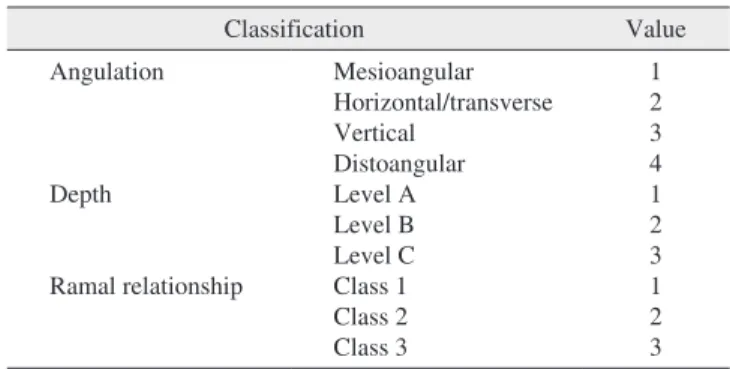
Winter’s classification3, another system of impacted lower third molar classification, sorts impacted lower molars ac- cording to axis angulation as mesioangular, vertical, horizon- tal, and distoangular impactions. The Pederson index predicts surgical extraction difficulty using both Pell-Gregory clas- sification and Winter’s classification. Unlike Pell-Gregory classification, the Pederson index4 includes angulation factor, although some studies and analyses have concluded that it is not a reliable test for predicting surgical difficulty of third molar surgery and should not be employed as a sole instru- ment for preoperative assessment of difficulty4-6.
Because these prediction methods consider only the posi- tion of teeth in radiographs and exclude factors of age, body
I. Introduction
Surgical extraction of an impacted mandibular third molar is common, and an impacted third molar is one of the most investigated topics in oral and maxillofacial surgery. Extrac- tion in these cases can result in sequelae and complications including pain, swelling, infection, and nerve injury, because the procedure requires incision, bone removal, tooth sepa- ration, and closure1. The procedure can be difficult for the patient and challenging for the surgeon if proper evaluation of the impacted tooth is not performed before extraction. It is essential to thoroughly evaluate extraction difficulty and to fully inform the patient of the potential challenges.
Several methods have been proposed for preoperative eval- Kyeong-Lok Park
Department of Dentistry, Kosin University College of Medicine, 262 Gamcheon- ro, Seo-gu, Busan 49267, Korea
TEL: +82-51-990-5150 FAX: +82-51-990-3029 E-mail: [email protected]
ORCID: http://orcid.org/0000-0003-1283-5665
This is an open-access article distributed under the terms of the Creative Commons Attribution Non-Commercial License (http://creativecommons.org/licenses/by-nc/4.0/), which permits unrestricted non-commercial use, distribution, and reproduction in any medium, provided the original work is properly cited.
CC
Which factors are associated with difficult surgical extraction of impacted lower third molars?
Kyeong-Lok Park
Department of Dentistry, Kosin University College of Medicine, Busan, Korea
Abstract(J Korean Assoc Oral Maxillofac Surg 2016;42:251-258)
Objectives: The aim of this retrospective study was to investigate factors associated with increased difficulty in the surgical extraction of impacted lower third molars and to improve identification of difficult cases.
Materials and Methods: A total of 680 patients who required 762 surgical extractions of impacted lower third molars from 2009 to 2014 were en- rolled in the study. Demographic factors, clinical factors, radiographic factors, surgical extraction difficulty, and presumed causes of difficulty were collected. Data were statistically analyzed using IBM SPSS Statistics version 23.
Results: Age, sex, depth of impaction, and blurred radiographic image influenced difficulty in surgical extraction. The position of the impacted tooth influenced surgical difficulty, especially when it was accompanied by other factors.
Conclusion: It is challenging to design a reliable and practical instrument to predict difficulty in surgical extraction of impacted lower third molars. To identify very difficult cases, root investigation using computed tomography is advised when impacted tooth position suggests difficult extraction.
Key words: Third molar, Mandible, Impaction, Tooth extraction, Difficulty
[paper submitted 2016. 5. 30 / revised 1st 2016. 8. 21, 2nd 2016. 9. 27 / accepted 2016. 10. 6]
Copyright Ⓒ 2016 The Korean Association of Oral and Maxillofacial Surgeons. All rights reserved.
one oral and maxillofacial surgeon. Demographic data of age, sex, and tooth position and operator characteristics (specialist or general dentist) were extracted from clinical records.
The level of extraction difficulty was investigated based on the operator’s subjective grade on a five-point difficulty scale, and the cases were classified into 3 groups, ‘not diffi- cult’ (1-3), ‘moderately difficult’ (4), and ‘very difficult’ (5).
The presumed causes of difficulty were depth of impaction, relation to the second molar, relation to the mandibular canal, angulation, large and/or bulbous root, widely divergent roots, and ankylosis. Bulbous root7 refers to a complete root that is thicker in the middle than in the neck and does not separate.
If the periodontal ligament space was too narrow to use sharp instruments like explorer and root tip picker, the tooth was regarded as ankylosed.
Using panoramic views, image haziness, relation to the mandibular canal, Pell-Gregory classification (Table 1), Win- ter’s classification, and Pederson index (Table 2) were evalu- ated. If the radiographic image did not exhibit well-defined roots and periodontal ligament space that appeared to fade or blend into bone, the image was regarded as blurred.
2) Data analysis and statistics
Data were statistically analyzed using IBM SPSS Statistics version 23 for Windows (IBM Co., Armonk, NY, USA), and mass index (BMI), root morphology, bone quality, and prox-
imity to mandibular canal, which affect surgical extraction difficulty, surgeons can experience difficulties outside of the classifications and index system.
In this study, level of difficulty, presumed causes of diffi- culty, demographic factors, clinical factors, and radiographic findings were assessed, compared, and analyzed in order to identify very difficult surgical extraction cases.
II. Materials and Methods
1. Materials
The objects were impacted mandibular third molars that were extracted from 2009 to 2014 in the Department of Den- tistry at Kosin University Gospel Hospital (Busan, Korea).
The patient number list was obtained using KCD (Korean Standard Classification of Disease) code. The cases without panoramic images were excluded. The medical records of each case were reviewed. If the record reported ‘unevent- ful,’ ‘easy,’ ‘not difficult,’ or nothing about difficulty, the case was assigned to the ‘not difficult group.’ If the medical record said ‘a little difficult,’ ‘somewhat difficult,’ or ‘mod- erately difficult,’ the case was sorted into the ‘moderately difficult group.’ If the case was noted as ‘very difficult’ or
‘extremely difficult,’ it was classified into the ‘very difficult group.’ The cases whose medical records included nothing about the causes of extraction difficulty were excluded.
This retrospective study included 680 patients and 762 im- pacted mandibular third molars, which were extracted by two oral and maxillofacial surgeons and three general dentists.
This study protocol was approved by the Institutional Re- view Board of Kosin University Gospel Hospital (KUGH- 2015-10-023).
2. Methods
1) Variables
Panoramic images and clinical records were assessed by
Table 1. The Pell-Gregory classification Level A
Level B Level C Class 1 Class 2 Class 3
The occlusal plane of the third molar is as high as that of the second molar.
The occlusal plane of the third tooth is below the occlusal plane and above the cervical line of the second molar.
The occlusal plane of the third molar is below the cervical line of the second molar.
The space between the ramus and the second molar is larger than the mesiodistal diameter of the second molar.
The space between the ramus and the second molar is smaller than the mesiodistal diameter of the third molar.
There is no space between the ramus and the second molar.
Kyeong-Lok Park: Which factors are associated with difficult surgical extraction of impacted lower third molars? J Korean Assoc Oral Maxillofac Surg 2016
Table 2. Pederson index
Classification Value
Angulation
Depth
Ramal relationship
Mesioangular Horizontal/transverse Vertical
Distoangular Level A Level B Level C Class 1 Class 2 Class 3
1 2 3 4 1 2 3 1 2 3 Levels A, B, C and Classes 1, 2, 3 have the same respective meanings in the Pell-Gregory classification. Minimally difficult: 3-4, moderately difficult: 5-6, very difficult: 7-10.
Kyeong-Lok Park: Which factors are associated with difficult surgical extraction of impacted lower third molars? J Korean Assoc Oral Maxillofac Surg 2016
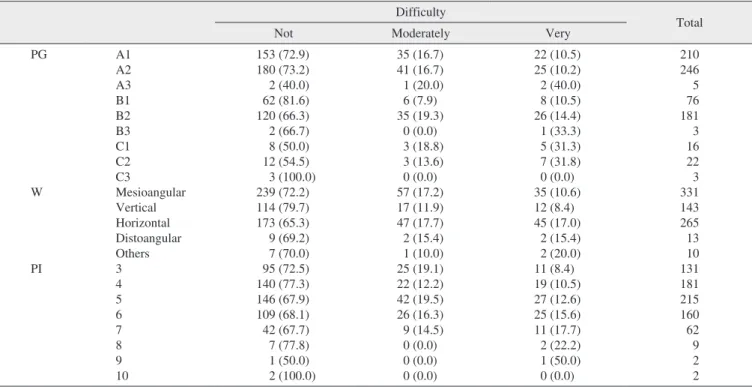
Using Winter’s classification, horizontal impaction was the most difficult and showed the largest frequency of difficult extractions.(Table 6)
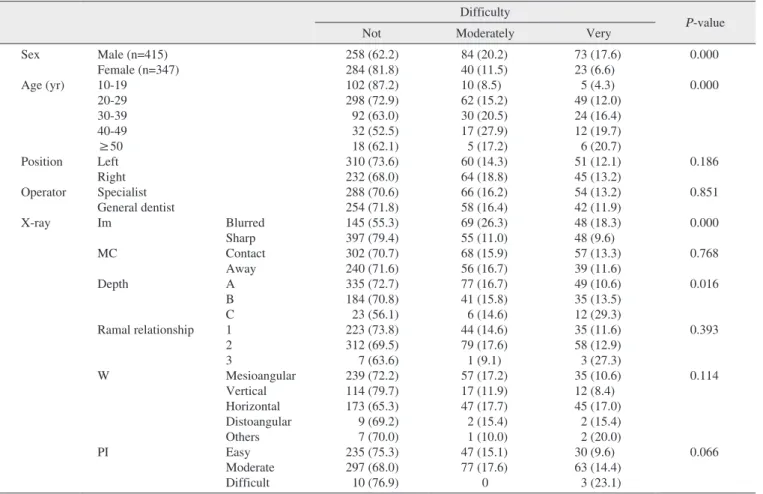
With regard to demographic factors, it was easier to extract impacted lower third molars in younger patients and in wom- en than in older patients and men (P=0.000). However, tooth position (right or left) was not associated with extraction dif- ficulty (P=0.186).(Table 7)
Whether or not the operator was a specialist did not influ- ence difficulty (P=0.851).(Table 7) But the teeth that special- ists extracted had higher Pederson index (P=0.041) and more presumed causes of difficult extraction (P=0.000).(Table 8)
On radiographic findings, teeth that had blurred image haz- iness (P=0.000) or lower level of impaction (P=0.016) were statistically associated with more difficult extraction. Rela- tionship to mandibular canal (P=0.768), ramal relationship (P=0.393), Winter’s classification (P=0.114), and Pederson index (P=0.066) were not associated with difficulty.(Table 7) the P-value to indicate significance was set at 0.05. Associa-
tions among demographic data (sex, age, and tooth location), operator characteristics, level of extraction difficulty, pre- sumed causes of difficulty, and radiographic findings were assessed through the chi-square test. Differences in means among groups according to presumed difficulty cause were tested through independent t-test or ANOVA.
III. Results
The demographic data are shown in Table 3.
Among 762 extractions, 542 were not difficult (71.1%), 124 were moderately difficult (16.3%), and 96 were very dif- ficult (12.6%). The distribution of difficulties by operators is shown in Table 4, and the proportion of difficulty groups was different among operators (P=0.000).
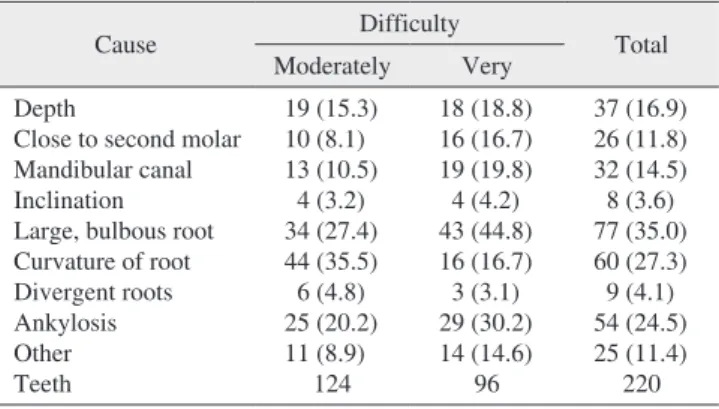
Presumed causes of difficult extraction in order of frequen- cy were large and/or bulbous root, root curvature, and anky- losis. There were 103 position-related causes and 200 root- related causes. The average number of causes in moderately- difficult cases was 1.34, while that of very-difficult cases was 1.69.(Table 5)
Using Pell-Gregory classification, B2 had the highest fre- quency and relatively high probability of difficult extraction.
Table 3. Distributions of age, position, and sex
Position Age (yr)
Total
10-19 20-29 30-39 40-49 50-59 60-69 70-79
Right (n=341) Left (n=421) Total (n=762)
Male Female Male Female Male Female
21 38 25 33 46 71
95 75 120 119 215 194
42 24 52 28 94 52
20 11 22 8 42 19
8 5 6 4 14 9
2 0 1 2 3 2
0 0 1 0 1 0
188 153 227 194 415 347 Values are presented as number of patients.
Kyeong-Lok Park: Which factors are associated with difficult surgical extraction of impacted lower third molars? J Korean Assoc Oral Maxillofac Surg 2016
Table 4. Distribution of difficulties by operator
Doctor Difficulty
Total P-value
Not Moderately Very
A B C D E
263 (68.7) 25 (100.0) 100 (83.3) 141 (63.8) 13 (100.0)
66 (17.2) 0 4 (3.3) 54 (24.4)
0
54 (14.1) 0 16 (13.3) 26 (11.8)
0
383 25 120 221 13
0.000
Values are presented as number (%) or total number.
Doctors A and B: specialists, Doctors C, D, and E: general practitioners.
Kyeong-Lok Park: Which factors are associated with difficult surgical extraction of impacted lower third molars? J Korean Assoc Oral Maxillofac Surg 2016
Table 5. The prevalence of presumed causes of difficult extrac- tion
Cause Difficulty
Total Moderately Very
Depth
Close to second molar Mandibular canal Inclination Large, bulbous root Curvature of root Divergent roots Ankylosis Other Teeth
19 (15.3) 10 (8.1) 13 (10.5)
4 (3.2) 34 (27.4) 44 (35.5) 6 (4.8) 25 (20.2) 11 (8.9)
124
18 (18.8) 16 (16.7) 19 (19.8) 4 (4.2) 43 (44.8) 16 (16.7) 3 (3.1) 29 (30.2) 14 (14.6)
96
37 (16.9) 26 (11.8) 32 (14.5) 8 (3.6) 77 (35.0) 60 (27.3) 9 (4.1) 54 (24.5) 25 (11.4)
220 Values are presented as number (%) or total number.
Kyeong-Lok Park: Which factors are associated with difficult surgical extraction of impacted lower third molars? J Korean Assoc Oral Maxillofac Surg 2016
the result of referring difficult cases to specialists. If this had been a randomized trial, the results could have been different.
For general practitioners, there was no difference in Ped- erson index among 3 difficulty groups; however, this index increased according to difficulty for specialists. The average of number of presumed causes of difficult extraction in the moderately difficult group was almost equal to that of very difficult group in general practitioners. However, in special- ists, this average increased markedly from 1.52 to 2.19 in the very difficult group. These findings indicate that the anatomic condition of an impacted tooth does not influence the dif- ficulty experienced by general practitioners, but does affect that of specialists. Inexperience rather than anatomy might be the main cause of difficult extraction for general practitio- ners.
After extraction, the operator judged the level of difficulty and the likely causes of the difficulty in extraction. The fre- quency order of causes was large and/or bulbous root, root curvature, and ankylosis, all of which are related to roots. Be- cause root-related causes were twice as numerous as position- related causes, it seems clear that classification methods of impacted lower third molars and difficulty predicting indices that only consider position will not be reliable.
In the very difficult group, the number of root curvatures
IV. Discussion
Most research on the difficulty of surgical extraction of impacted mandibular third molars has included demographic, clinical, and anatomical factors, with various results reported.
Among the demographic factors evaluated in this study, it was easier to extract impacted lower third molars in younger patients. Patient age has a demonstrated effect on the dif- ficulty reported by operators, in agreement with previous studies8-11. The relevance of age to difficulty is likely attribut- able to the fact that it is easiest to surgically extract impacted lower third molar with roots formed from 1/3 to 2/3, and bone hardness and ankylosis increase with age.
In this study, operators experienced more difficulty when they extracted the impacted mandibular third molars of men than of women. This coincides with the results of other re- search that found that sex influences extraction difficulty9,12. The large sizes of the crown and roots of men’s third molars might explain the difference.
Whether or not the operator was a specialist did not make a difference in difficulty. However, in third molars that were extracted by specialists, the averages of Pederson index and number of presumed causes of difficult extraction were higher than in those of general practitioners. This might be
Table 6. Pell-Gregory classification, Winter’s classification, Pederson index, and extraction difficulty Difficulty
Total
Not Moderately Very
PG
W
PI
A1 A2 A3 B1 B2 B3 C1 C2 C3
Mesioangular Vertical Horizontal Distoangular Others 3 4 5 6 7 8 9 10
153 (72.9) 180 (73.2) 2 (40.0) 62 (81.6) 120 (66.3) 2 (66.7) 8 (50.0) 12 (54.5) 3 (100.0) 239 (72.2) 114 (79.7) 173 (65.3) 9 (69.2) 7 (70.0) 95 (72.5) 140 (77.3) 146 (67.9) 109 (68.1) 42 (67.7) 7 (77.8) 1 (50.0) 2 (100.0)
35 (16.7) 41 (16.7) 1 (20.0) 6 (7.9) 35 (19.3)
0 (0.0) 3 (18.8) 3 (13.6) 0 (0.0) 57 (17.2) 17 (11.9) 47 (17.7) 2 (15.4) 1 (10.0) 25 (19.1) 22 (12.2) 42 (19.5) 26 (16.3) 9 (14.5) 0 (0.0) 0 (0.0) 0 (0.0)
22 (10.5) 25 (10.2) 2 (40.0) 8 (10.5) 26 (14.4) 1 (33.3) 5 (31.3) 7 (31.8) 0 (0.0) 35 (10.6) 12 (8.4) 45 (17.0)
2 (15.4) 2 (20.0) 11 (8.4) 19 (10.5) 27 (12.6) 25 (15.6) 11 (17.7) 2 (22.2) 1 (50.0) 0 (0.0)
210 246 5 76 181 3 16 22 3 331 143 265 13 10 131 181 215 160 62 9 2 2 (PG: Pell-Gregory classification, W: Winter’s classification, PI: Pederson index)
Values are presented as number (%) or total number.
Kyeong-Lok Park: Which factors are associated with difficult surgical extraction of impacted lower third molars? J Korean Assoc Oral Maxillofac Surg 2016
nied a close relationship to the second molar, deep impaction was accompanied by ankylosis, ankylosis was accompanied by a close relationship to the second molar, deep impaction accompanied widely divergent roots, and ankylosis accom- panied large and/or bulbous root were very difficult rather decreased, and those of large and/or bulbous root and ankylo-
sis increased. Large and/or bulbous root and ankylosis seem to greatly impact the difficulty of extraction. Increase in the number of presumed causes increased the perceived difficulty by the operator. Cases in which deep impaction accompa-
Table 7. The relationships between extraction difficulty and demographic and radiographic variables Difficulty
P-value
Not Moderately Very
Sex Age (yr)
Position Operator X-ray
Male (n=415) Female (n=347) 10-19
20-29 30-39 40-49
≥50 Left Right Specialist General dentist Im
MC Depth
Ramal relationship W
PI
Blurred Sharp Contact Away A B C 1 2 3
Mesioangular Vertical Horizontal Distoangular Others Easy Moderate Difficult
258 (62.2) 284 (81.8) 102 (87.2) 298 (72.9) 92 (63.0) 32 (52.5) 18 (62.1) 310 (73.6) 232 (68.0) 288 (70.6) 254 (71.8) 145 (55.3) 397 (79.4) 302 (70.7) 240 (71.6) 335 (72.7) 184 (70.8) 23 (56.1) 223 (73.8) 312 (69.5) 7 (63.6) 239 (72.2) 114 (79.7) 173 (65.3) 9 (69.2) 7 (70.0) 235 (75.3) 297 (68.0) 10 (76.9)
84 (20.2) 40 (11.5) 10 (8.5) 62 (15.2) 30 (20.5) 17 (27.9) 5 (17.2) 60 (14.3) 64 (18.8) 66 (16.2) 58 (16.4) 69 (26.3) 55 (11.0) 68 (15.9) 56 (16.7) 77 (16.7) 41 (15.8) 6 (14.6) 44 (14.6) 79 (17.6) 1 (9.1) 57 (17.2) 17 (11.9) 47 (17.7) 2 (15.4) 1 (10.0) 47 (15.1) 77 (17.6)
0
73 (17.6) 23 (6.6)
5 (4.3) 49 (12.0) 24 (16.4) 12 (19.7) 6 (20.7) 51 (12.1) 45 (13.2) 54 (13.2) 42 (11.9) 48 (18.3) 48 (9.6) 57 (13.3) 39 (11.6) 49 (10.6) 35 (13.5) 12 (29.3) 35 (11.6) 58 (12.9) 3 (27.3) 35 (10.6) 12 (8.4) 45 (17.0)
2 (15.4) 2 (20.0) 30 (9.6) 63 (14.4)
3 (23.1)
0.000 0.000
0.186 0.851 0.000 0.768 0.016 0.393 0.114
0.066
(Im: sharpness of image, MC: mandibular canal, A: high occlusal level, B: moderate occlusal level, C: deep occlusal level, 1: sufficient space in ramal relationship, 2: reduced space in ramal relationship, 3: no space in ramal relationship, W: Winter’s classification, PI: Pederson index) Values are presented as number (%).
Kyeong-Lok Park: Which factors are associated with difficult surgical extraction of impacted lower third molars? J Korean Assoc Oral Maxillofac Surg 2016
Table 8. Comparison of specialists’ Pederson indexes and number of presumed causes of difficult extraction with those of general practi- tioners
Operator Difficulty No. of patients Pederson index No. of causes1
Specialist
General practitioner
Not Moderately Very Total Not Moderately Very Total
288 66 54 408 254 58 42 354
4.83±1.399 4.67±1.269 5.57±1.159 4.90±1.373 4.79±1.167 4.90±1.119 4.64±1.322 4.79±1.177
0.00±0.000 1.52±0.662 2.19±0.913 0.53±0.948 0.00±0.000 1.14±0.605 1.05±0.539 0.31±0.583
1Number of presumed causes of difficult extraction.
Values are presented as number or mean±standard deviation.
In two-way ANOVA of Pederson index, P-value of operator was 0.041, and P-value of interaction term of operator and difficulty was 0.002. In two- way ANOVA in number of causes, P-values of operator, difficulty, and interaction term of operator and difficulty were all 0.000.
Kyeong-Lok Park: Which factors are associated with difficult surgical extraction of impacted lower third molars? J Korean Assoc Oral Maxillofac Surg 2016
each class. Classification based on tooth position alone does not predict difficulty very well, and other causes, especially root-related causes, should be considered for a more robust prediction.
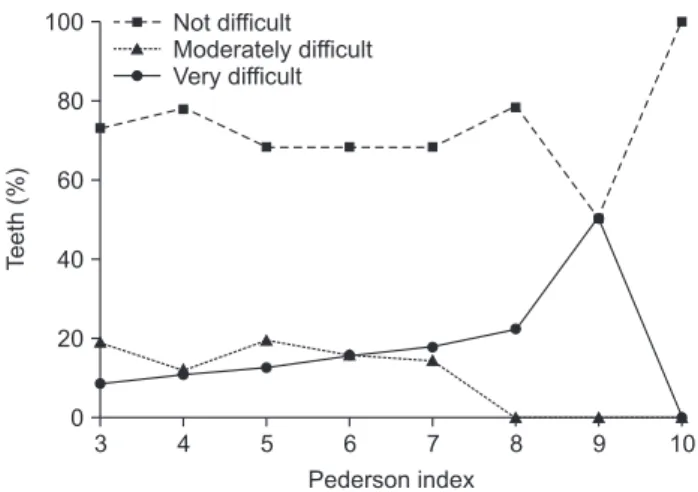
The Pederson index score was not proportional to difficulty in the moderately difficult group, but it was directly propor- tional to difficulty in the very difficult group.(Table 6, Fig.
1) This suggests that tooth position has a considerable effect on difficulty only when there are a large number of presumed causes. When the Pederson index score is low, other causes, except position-related causes, might not impact extraction difficulty. However, the operator should investigate the rela- tion to the second molar, relation to the mandibular canal, root form, and ankylosis in order to distinguish very difficult cases when the index score is high. This confirms the study of Akadiri et al.6, which posited that the Pederson index should not be employed as a sole instrument for preoperative than moderately difficult. When deep impaction or ankylosis
accompanied other causes, difficult surgical extraction was more likely.
Among radiographic variables, close relationship with the mandibular canal was not associated with difficult surgical extraction (P=0.768), although it is known that a close rela- tionship with the mandibular canal can complicate surgical extraction. This proximity becomes a problem only when a root fracture develops in the vicinity of the canal. A small percentage of such root fractures seems to be the reason why close relationship with the mandibular canal was not statisti- cally associated with difficult surgical extraction.
According to Pell-Gregory classification, the probabil- ity order of difficult extractions was C2, B2, and B3. Pell- Gregory classification sorts impacted lower third molars ac- cording to depth of impaction and ramal relation. This study considered the two factors separately and demonstrated that depth of impaction was statistically associated with extrac- tion difficulty, while ramal relation has no association. This affirms the claim of Akadiri et al.13 that depth of impaction is the singular most important determinant of surgical difficulty, and that operators do not consider it difficult to develop flaps, reduce bone, or separate teeth in the ramal area.
Using Winter’s classification, the probability order of dif- ficult extraction was horizontal, distoangular, mesioangular, and vertical impactions. This runs counter to the Pederson index, which regards vertical impaction as more difficult than mesioangular and horizontal impactions. This might be one reason to question the reliability of the Pederson index.
According to Pell-Gregory classification and Winter’s clas- sification, there was no difference between the probability of moderately difficult cases and that of very difficult cases in
A B
Fig. 2. Two types of radiographic images. A. A panoramic image that shows blurred root image and indistinct border. B. A panoramic im- age that shows relatively clear root anatomy and sharp border.
Kyeong-Lok Park: Which factors are associated with difficult surgical extraction of impacted lower third molars? J Korean Assoc Oral Maxillofac Surg 2016 Fig. 1. Difficulty group distribution in Pederson index.
Kyeong-Lok Park: Which factors are associated with difficult surgical extraction of impacted lower third molars? J Korean Assoc Oral Maxillofac Surg 2016
3 4 5 6 7 8 9
100
80
60
40
20
0
Teeth(%)
10 Pederson index
Not difficult Moderately difficult Very difficult
or bulbous root, ankylosis, and deep impaction had a strong effect on determination of very difficult cases. It is therefore important to evaluate root-related factors when position-relat- ed factors suggest difficult extraction. Cone-beam computed tomography is frequently used in dentistry and shows root anatomy more reliably than panoramic imaging22. Therefore, in cases with a high Pederson index (8-10), deep impaction, or blurred images, root-related factors using computed to- mography are useful in predicting very difficult extraction.
Conflict of Interest
No potential conflict of interest relevant to this article was reported.
References
1. Hwang JK, Kim KW. Complications of impacted third molar ex- traction: retrospective study. J Korean Assoc Oral Maxillofac Surg 2010;36:119-24.
2. García AG, Sampedro FG, Rey JG, Vila PG, Martin MS. Pell- Gregory classification is unreliable as a predictor of difficulty in extracting impacted lower third molars. Br J Oral Maxillofac Surg 2000;38:585-7.
3. Cortell-Ballester I, Almendros-Marqués N, Berini-Aytés L, Gay- Escoda C. Validation of a computer-assisted system on classifying lower third molars. Med Oral Patol Oral Cir Bucal 2011;16:e68-73.
4. Diniz-Freitas M, Lago-Méndez L, Gude-Sampedro F, Somoza- Martin JM, Gándara-Rey JM, García-García A. Pederson scale fails to predict how difficult it will be to extract lower third molars.
Br J Oral Maxillofac Surg 2007;45:23-6.
5. Bali A, Bali D, Sharma A, Verma G. Is Pederson index a true pre- dictive difficulty index for impacted mandibular third molar sur- gery? A meta-analysis. J Maxillofac Oral Surg 2013;12:359-64.
6. Akadiri OA, Fasola AO, Arotiba JT. Evaluation of Pederson index as an instrument for predicting difficulty of third molar surgical extraction. Niger Postgrad Med J 2009;16:105-8.
7. Yuasa H, Kawai T, Sugiura M. Classification of surgical difficulty in extracting impacted third molars. Br J Oral Maxillofac Surg 2002;40:26-31.
8. Obimakinde O, Okoje V, Ijarogbe OA, Obimakinde A. Role of patients' demographic characteristics and spatial orientation in predicting operative difficulty of impacted mandibular third molar.
Ann Med Health Sci Res 2013;3:81-4.
9. Renton T, Smeeton N, McGurk M. Factors predictive of difficulty of mandibular third molar surgery. Br Dent J 2001;190:607-10.
10. Gbotolorun OM, Arotiba GT, Ladeinde AL. Assessment of factors associated with surgical difficulty in impacted mandibular third molar extraction. J Oral Maxillofac Surg 2007;65:1977-83.
11. Akadiri OA, Obiechina AE. Assessment of difficulty in third molar surgery: a systematic review. J Oral Maxillofac Surg 2009;67:771- 12. Susarla SM, Dodson TB. Estimating third molar extraction dif-4.
ficulty: a comparison of subjective and objective factors. J Oral Maxillofac Surg 2005;63:427-34.
13. Akadiri OA, Obiechina AE, Arotiba JT, Fasola AO. Relative im- pact of patient characteristics and radiographic variables on the dif- ficulty of removing impacted mandibular third molars. J Contemp Dent Pract 2008;9:51-8.
14. Vanarsdall RL. Ectopically positioned and unerupted teeth. In:
assessment of difficulty in third molar surgery.
This study investigated the association between blurred panorama images and extraction difficulty.(Fig. 2) The result was that blurred images were relevant to extraction difficulty.
Radiography of an ankylosed tooth does not show a well- defined root or periodontal ligament space, which appears to fade into bone14. In the absence of ankylosis, blurred images can result when the object drops out of the focal trough or the roots are overlapped with one another. It is assumed that large and/or bulbous roots and widely divergent roots are such cases and can increase extraction difficulty.
There are many factors that influence difficulty in surgical extraction of impacted mandibular third molars. Age, BMI, body surface area, ethnicity, operator experience, method, number of extracted teeth, depth of impaction, ramal rela- tion, angulation of tooth, development of root, root curvature, relationship to the mandibular canal, width of root, patient anxiety, and other factors are thought to impact extraction difficulty, although there is disagreement among researchers about their relative impacts8-13,15-18.
The existing Pell-Gregory classification, Winter’s classifi- cation, and Pederson index have proven unreliable, and new- ly developed classifications and difficulty prediction methods are overly complex or unreliable7,19-21. The presence of many factors and disagreement among researchers make it very challenging to design a new practical and reliable predictor of surgical extraction difficulty.
In this study, the distribution of difficulty groups by opera- tor showed significant differences.(Table 4) This could be the result of different operator’s criterion of difficulty and/or pro- portion of difficult extractions. All cases of two operators (one specialist and one general practitioner) were classified into the not difficult group by the criteria for classification. This might be a limit of the retrospective study. However, it does not seem problematic, because the proportion of their cases was very small (5.0%), and the objective of this study was to identify impactful factors not the ratio of difficult extractions.
There are many factors that are not objective or quantifi- able in a surgical extraction difficulty study. Therefore, some researchers15,18 have used subjective methods in their stud- ies. In this retrospective study, the subjective decision of the operator was used as a variable. Additional studies are neces- sary to verify the findings of this study.
V. Conclusion
In this study, several causes of difficulty such as large and/
Fonseca RJ, ed. Oral and maxillofacial surgery volume 1. Philadel- phia: W.B. Saunders; 2000:289-90.
15. Carvalho RW, do Egito Vasconcelos BC. Assessment of factors as- sociated with surgical difficulty during removal of impacted lower third molars. J Oral Maxillofac Surg 2011;69:2714-21.
16. Mahdey HM, Arora S, Wei M. Prevalence and difficulty index associated with the 3(rd) mandibular molar impaction among ma- laysian ethnicities: a clinico-radiographic study. J Clin Diagn Res 2015;9:ZC65-8.
17. Aznar-Arasa L, Figueiredo R, Valmaseda-Castellón E, Gay-Escoda C. Patient anxiety and surgical difficulty in impacted lower third molar extractions: a prospective cohort study. Int J Oral Maxillofac Surg 2014;43:1131-6.
18. Susarla SM, Dodson TB. Risk factors for third molar extraction
difficulty. J Oral Maxillofac Surg 2004;62:1363-71.
19. Roy I, Baliga SD, Louis A, Rao S. Importance of clinical and ra- diological parameters in assessment of surgical difficulty in remov- al of impacted mandibular 3rd molars: a new index. J Maxillofac Oral Surg 2015;14:745-9.
20. Juodzbalys G, Daugela P. Mandibular third molar impaction: re- view of literature and a proposal of a classification. J Oral Maxil- lofac Res 2013;4:e1.
21. Susarla SM, Dodson TB. Predicting third molar surgery operative time: a validated model. J Oral Maxillofac Surg 2013;71:5-13.
22. Suomalainen A, Ventä I, Mattila M, Turtola L, Vehmas T, Peltola JS. Reliability of CBCT and other radiographic methods in preop- erative evaluation of lower third molars. Oral Surg Oral Med Oral Pathol Oral Radiol Endod 2010;109:276-84.