Printed in the Republic of Korea
리제강 고리의 형태에 미치는 전해질의 효과
한미애·전상호·강영진*
강원대학교 환경학과 및 과학교육학부 (2008. 5. 29 접수)
Effect of Electrolyte on the Shapes of Liesegang Rings
Mi-Ae Han, Sang-Ho Jun, and Youngjin Kang*
Department of Environmental Science & Division of Science Education, Kangwon National University, Chuncheon 200-701, Korea
(Received May 29, 2008)
요 약. 본 연구에서는 구과상암 형성의 원리로 알려진 리제강 현상 중 은이온을 내부전해질로 하고, 할로겐이온
을 외부전해질로 하였을 때 농도 및 온도의 변화에 따라 리제강 고리의 형태가 어떻게 나타나는지를 조사하였다. 내 부전해질의 농도가 0.01 M일 때 보다 0.02 M에서 리제강 고리가 크게 나타남을 확인하였다. 또한 Gelatin의 온도 에 대한 관찰 결과, 30oC일 때는 선명한 리제강 고리를 볼 수 있었으나 40oC에서는 고리가 빠르게 형성되는 반면 고리의 형태가 선명하지 않았다. 일정 조건에서 내부전해질에 외부전해질을 넣는 방식에 따라 조사한 결과, 외부전해 질을 나누어서 넣어줄 경우에는 리제강 고리가 선명하게 형성되었으나 한꺼번에 넣은 경우에는 고리의 반지름은 크 고 불분명하며 개수는 적게 나타났다. 이러한 결과는 화산암내에서 겔이 냉각될 경우, 방사상 형태의 구과상암 형성 원리는 냉각속도나 점성도 뿐만 아니라 침전되는 물질의 용해도곱 상수와 관련하여 젤에 포함된 화학성분과 외부에 서 관입되는 성분에 의해서도 영향을 받는다는 것을 보여준다.
주제어: 리제강 고리, 내부 전해질, 외부전해질, 용해도곱 상수, 매질
ABSTRACT. This study describes how the shape of Liesegang rings differ depending on the concentration of internal and external electrolytes and the temperature, known as the principle of spherulitic rock formation. We disclose the chemical aspect of the Liesegang phenomenon. The sizes of Liesegang rings are larger for a concentration of internal electrolyte of 0.02 M than for 0.01 M. In addition, according to observation at gelatin temperature of 30oC and 40oC, the shapes of Liesegang rings were clearer at 30oC but the rings formed faster at 40oC. When external electrolyte was added to the internal electrolyte under the same condition, adding a calculated amount of external electrolyte was added little by little, caused the Liesegang rings to form clearly, but if the same amount of external electrolyte was added all at once, the radii of the rings were larger but the boundaries were less clear and there were fewer rings. Regarding the principle that gel is cooled inside volcanic rock and forms radial spherulitic rock, the results of this experiment show that, in addition to cooling rate and viscosity, there may be other causal factors such as chemical substances contained in the gel or intruding from outside that alter the solubility product constant of precipitating substances.
Keywords: Leisegang Ring, Inner Electrolyte, Outer Electrolyte, Solubility Product, Medium
INTRODUCTION
Various beautiful shapes of spherulitic rhyolites, which are rare in general, are produced in the form
of a vein in the Cheongsong area (located southeast of Seoul). The spherulitic rhyolites are mainly divided into simple spherulites and multiple spheru- lites: the former do not grow after the 1st stage
growth and the latter grow continuously through multiple stages.
Oh et al. reported that the multiple spherulites in the northern part of Mt. Juwang in Cheongsong were formed due to Liesegang ring formation and diffusion by cooling rate difference: Rose-type (Fig. 1a) and innominate-type (Fig. 1b) radial sim- ple spherulites are formed by the same principle in the generation of Liesegang rings with relatively slow supercooling.1 They further reported that dahlia-type (Fig. 1c) and sunflower-type (Fig. 1d) with multiple layered spherulites are formed by the repetition of relatively fast supercooling.
Orbicular structure is completed by alternate lay- ers of dark and bright that converges to a center core which is composed of some minerals or of captures. This structure generates concentric circles or radial pattern which gives in a concentric sphere, which are the characteristics of most of the orbicu- lar rocks. The structure is called orbicular rocks.
Here, ‘the structure or precipitation form making multiple concentric circles’ is called a cyclic precip- itation reaction, and is called an annual ring reac- tion or Liesegang ring.
We can observe the formation of annual rings in chemical reactions; such reactions are called cyclic precipitation reactions. If the conditions are suit-
able, all precipitation reactions can happen as cyclic reactions.2
Jun and Han investigated on the various cyclic precipitation reactions of insoluble salts at room temperature, and reported that the shapes of the insoluble salt Liesegang rings are correlated with the solubility product and that Liesegang rings are formed more precisely and quickly when the con- stant is small.2 This study aimed to examine how the shape of insoluble salt Liesegang rings differs according to the concentration of internal electro- lyte and temperature.
The Liesegang rings are formed in the course of formation of spherulitic rhyolites. These rings can indicate the environmental and chemical condi- tions (e.g., the chemical components, temperature and concentration) on the days through the widths and gaps between two rings as well as color. Spher- ulitic rhyolites with the same color and shape often show the wide gaps between two rings and distinct and/or vague shapes of rings. This result has been rationalized as being due to differences in the inter- nal electrolyte.3 However, the systematic studies of the formation of rings from a chemical point of view remain scarce. Our interest in the mechanistic study of ring formation has prompted us to investi- gate the effect of the internal electrolyte on the shape of Liesegang rings. This study aims to exam- ine how the shape of insoluble salt Liesegang rings differs according to the concentration of internal electrolyte and temperature.
EXPERIMENTAL
The principle of Liesegang rings, used to explain the formation of orbicular and spherulitic rocks, was reported first by Liesegang.4 In Liesegang’s experiment, if silver nitrate solution is dropped into the center of gelatin gel containing potassium dichromate, and a round silver dichromate layer forms by the diffusion of the silver nitrate solution;
for the formation of this layer, the dichromate ele- ment moves from the outside of the layer to the inside. As a result, even if silver nitrate is diffused later, a layer without silver dichromate occurs and Fig. 1. Variety of spherulitic rhyolites in Cheongsong area.
(a) Rose type, (b) Innominate type, (c) Dahlia type, and (d) Sunflower type.
the silver dichromate in the outer layer again moves to the precipitated area. Lofgren also confirmed that such formation of radial spherulitic minerals by super cooling happens inside volcanic rocks.5 In addition, when the gel is cooled for 45 minutes, radial precipitation does not appear, instead, one concentric silver dichromate precipitate and a bright band is formed around. This result is due to the vis- cosity of the gel. As the viscosity of gel increases, only a precipitation front is formed and diffusion current is not. However, further 60 minutes’ cool- ing gives increased viscosity of the gel, leading to forming the annual ring shape in Liesegang rings as shown in Fig. 1. Several researchers recognized that such Liesegang rings are similar to orbicular structure observed in rocks.6,7,8
To be formed Liesegang rings, the solubility product constant of the ionic crystal of the two elec- trolytes in which the precipitation reaction takes place should be the same as or larger than the solu- bility product constant of the insoluble salt. In addi- tion, the concentrations of substances added externally should be higher than the solubilities of the reaction products of the two electrolytes.9
In the reaction that forms Liesegang rings, exter- nal electrolyte diffuses into the medium containing internal electrolyte and the internal electrolyte dif- fuses in the opposite direction; a reaction takes place on the boundary where the two electrolytes meet. The reaction product remains as a sol in the colloidal phase together with the waste products.
The reaction boundary known as the sol front moves forward, leaving sol and waste products behind. If the concentration reaches the level char- acteristic of sol, sudden flocculation takes place dis- solving sol particles and making a supersaturated solution of sol. The flocculation area spreads quickly until the flocculation front reaches the sol front.
During this period, because flocculation is not affected by the concentration of external electro- lyte, the sol front moves independently of floccula- tion and the sol area starts from the point where flocculation stopped. When the concentration of the sol reaches a specific level, flocculation again takes place and other cyclic rings are formed.10
In the experiment on the formation of Liesegang rings, silver nitrate was used as the internal electro- lyte. This followed the report that when heavy metal ions such as silver ions (Ag+) and lead ions (Pb2+) are contained in internal electrolyte they pre- vents fungal growth and enable long-term preserva- tion and observation.9
For the medium in this experiment, we used a 2%
gelatin solution in which Liesegang rings appear clearly, with tested concentrations of internal elec- trolyte of 0.01 M and 0.02 M. For the temperature change, we prepared internal electrolyte at room temperature (23oC). After 12 hours when its viscos- ity became suitable for adding and diffusing exter- nal electrolyte, the external electrolyte was added and formation of Liesegang ring was tested in a constant-temperature water tank at 30oC and 40oC. The amount of external electrolyte added was equal to the internal electrolyte in moles, calculated from the concentration of internal electrolyte. (Amount of external electrolyte = formula weight × moles according to reaction method × n, where n is the number of anions in the external electrolyte consti- tuting 1 insoluble salt) The diffusion rate was com- pared using the radii formed in the same period of time.
RESULTS AND DISCUSSION
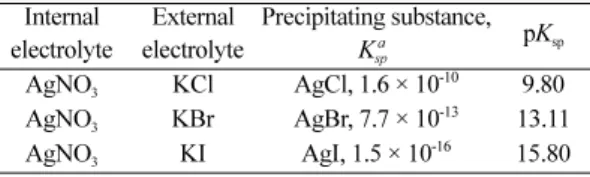
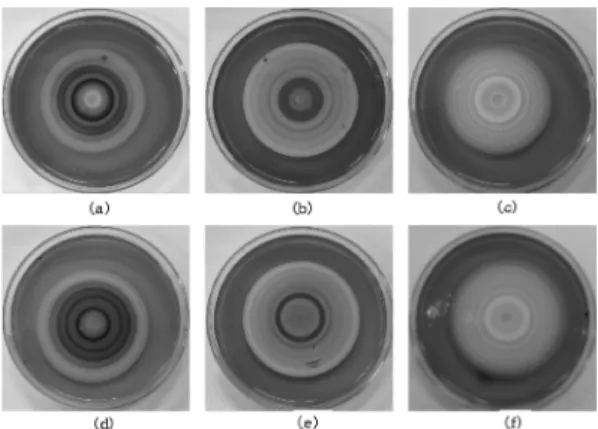
Gelatin was used as the medium, and four types of insoluble salt with different solubility product constants were selected. The experiments were con- ducted at 30oC by changing the concentration of internal electrolyte to 0.01 M and 0.02 M as listed in Table 1 and their results were shown in Fig. 2. (i) When silver and halogen ions were used as the internal electrolyte and external electrolytes, respec-
Table 1. Ksp and pKsp of precipitating substances depending on internal and external electrolytes
Internal electrolyte
External electrolyte
Precipitating substance,
Kspa pKsp
AgNO3 KCl AgCl, 1.6 × 10⁻¹⁰ 9.80 AgNO3 KBr AgBr, 7.7 × 10⁻¹³ 13.11 AgNO3 KI AgI, 1.5 × 10⁻¹⁶ 15.80
areference 11.
tively, the largest and clearest Liesegang rings of AgCl were obtained. This result is attributed to the solubility of electrolytes: AgCl is more soluble than other silver halides. Therefore, the precipitation reaction in AgCl becomes slowed down, leading to much clearer and larger ring formation than in AgBr and in AgI. However, AgI with the smallest solubility product constant had the more elaborated shape of ring. (ii) When the temperature was remained constant at 30oC, the radii of Liesegang rings gradually increased as the concentration of electrolyte increases.
In order to understand how the shapes of Lieseg- ang rings change according to temperature, we compared the shapes of Liesegang rings formed at 40oC after controlling for the concentrations of internal and external electrolyte. According to the results of the experiment (see Fig. 3), under the same concentration, the speed of ring formation hardly changed despite the change in temperature.
This is probably because the difference between 30oC and 40oC is small if converted to absolute tem- perature, so it did not cause a significant difference in speed. The shapes of Liesegang rings were less clear at 40oC than at 30oC, but the rings grew larger and faster at 40oC than at 30oC. This is understood:
at high temperatures, the fluidity of gel is high and thus rings are formed fast but their shape is not maintained clearly.
In the experiments above, the exact number of moles of external electrolyte was calculated and a constant portion was added every day. Here, how- ever, we examined how the shapes of Liesegang rings changed if external electrolyte was added all at once. In the results of the experiment in Fig. 4, when external electrolyte was added all at once, the shapes of the rings were not clear because a large amount of external electrolyte diffused at once.
Thus, gradual cyclic reaction is desirable for observ- ing Liesegang ring reaction.
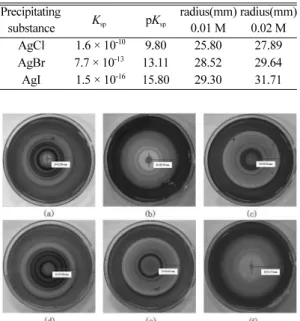
Table 2 compares radii when 0.01 M or 0.02 M Fig. 2. Formation of Liesegang rings with changing the
electrolyte concentration at 30oC. (a) 0.01 M AgCl, (b) 0.01 M AgBr, (c) 0.01 M AgI, (d) 0.02 M AgCl, (e) 0.02 M AgBr, and (f) 0.02 M AgI.
Fig. 3. Formation of Liesegang rings with changing the electrolyte concentration at 40oC. (a) 0.01 M AgCl, (b) 0.01 M AgBr, (c) 0.01 M AgI, (d) 0.02 M AgCl, (e) 0.02 M AgBr, and (f) 0.02 M AgI.
Fig. 4. Shapes of Liesegang rings when external electrolyte is added all at once at 30oC. (a) 0.01 M AgCl, (b) 0.01 M AgBr, (c) 0.01 M AgI, (d) 0.02 M AgCl, (e) 0.02 M AgBr, and (f) 0.02 M AgI.
internal electrolyte was added at 30oC and the same moles of external electrolyte containing halogen ions was added.
According to the results of the analysis based on Fig. 6, the radii of Liesegang rings were larger
when pKsp was large, and the proportional correla- tion between pKsp and the radii of rings was clearer when the concentration of internal electrolyte was 0.02 M than when it was 0.01 M. The correlation between the solubility product constant and the radii of Liesegang rings are presented in Fig. 6.
CONCLUSION
The results of our observations are as follows:
i) The Liesegang rings were larger at high elec- trolyte concentration. We believe that, at high con- centrations, forming insoluble salt is larger and therefore external electrolyte diffuses more.
ii) Liesegang rings were clearer at 30oC than at 40oC but formed slightly more slowly. iii) When a large amount of external electrolyte was added all at once, the radii of rings were larger but there were fewer rings and their boundaries were unclear.
This study examined cyclic precipitation accord- ing to the type of insoluble salt and changes in the Liesegang phenomenon according to the tempera- ture and the concentration of gel-state medium like gelatin. The results are relevant to annual ring reac- tions observed in rhyolites and other rocks in nature.
In general, the color of annual ring in spherulitic rock is determined by the precipitation which is generated by the reaction of anion in internal elec- trolyte and cation in external electrolyte through the medium of magma. Therefore, the color of precipi- tation informs what precipitation is produced, and what heavy metal ion is included. For example, bright yellow color of the rocks represents AgBr or AgI precipitation in the rocks. Well-resolved annual ring provides a clear evidence of the outer environ- ment that gives conditions for rock forming- low temperature with high concentrations of internal and external electrolytes.
Regarding the principle that gel cools inside vol- canic rock and forms radial spherulitic rock, our results show that not only cooling rate and viscos- ity but also chemical substances contained in the gel and those intruding rocks from outside in the aspect of solubility product constant may affect this process. In addition, our results are relevant to the Table 2. Comparison of the radii of Liesegang rings at 30oC
Precipitating
substance Ksp pKsp radius(mm) 0.01 M
radius(mm) 0.02 M AgCl 1.6 × 10⁻¹⁰ 9.80 25.80 27.89 AgBr 7.7 × 10⁻¹³ 13.11 28.52 29.64 AgI 1.5 × 10⁻¹⁶ 15.80 29.30 31.71
Fig. 5. Comparison of the radii of Liesegang rings by changing the concentration of electrolyte and pKsp at 30oC.
(a) 0.01 M AgCl, d = 25.80 mm, (b) 0.01 M AgBr, d = 29.30 mm, (c) 0.01 M AgI, d = 28.52 mm, (d) 0.02M AgCl, d = 27.89 mm, (e) 0.02 M AgBr, d = 29.64 mm, and (f) 0.02 M AgI, d = 31.71 mm.
Fig. 6. Diagram showing the radii of Liesegang rings by changing the concentration of electrolyte at 30oC.
environment during cooling or the possibility of the inflow of chemical substances that can be inferred from the viscosity of magma or the color and state of rhyolites. The diffusion of two electrolytes is possible only when the gel-state medium is semi- solid and does not flow, but is not too hard.
REFERENCES
1. Oh, C. W.; Kim, S. W.; Hwang, S. K.; Son, C. W.; Kim, C. S.; Kim, H. S. J. Petrol. Soc. Korea 2004, 13, 103.
2. Dee, G. T. Phys. Rev. Lett. 1986, 57, 275.
3. Carl, J. D.; Amstutz, G. C. Geol. Soc. Am. 1958, 69, 1467.
4. Liesegang, R. E., Naturwiss Wochenscher, 1896, 353.
5. Lofgren, G. Am. J. Sci. 1974, 274, 243.
6. Erdmannsdorffer, O. H., Grundlagen der Petrography, Stuttgart, Ferdinand Enke, 1924, p327.
7. LeVan, M. E.; Ross, J. J. Phys. Chem. 1987, 6300.
8. Leveson, D. J. Rev. Bull. Geol. Soc. Am. 1963, 74, 1015.
9. Young, D. A. Colloid & Polymer Sci. 2000, 5, 1435.
10. Jun, S. H.; Han, M. A. Econ. Environ. Geol. 2007, 40, 491.
11. Harris, D. C. Quantitative Chemical Analysis 5th Ed.:
Freeman, New York, 1999.