Korean J Gastroenterol Vol. 74 No. 2, 115-118 https://doi.org/10.4166/kjg.2019.74.2.115 pISSN 1598-9992 eISSN 2233-6869
CASE REPORT
Korean J Gastroenterol, Vol. 74 No. 2, August 2019 www.kjg.or.kr
젊은 성인에서 심한 운동 후 횡문근융해와 허혈성 장염이 병발된 1예
차세린1, 권보성2, 홍누리3, 박종설4, 변신규5, 최석채6, 김용성6,7
원광대학교 산본병원 내과1, 응급의학과2, 방사선과3, 서울특별시 보라매병원 내과4, 원광대학교 스포츠과학부5, 원광대학교 의과대학 원광소화기질환연구소6, 좋은숨내과7
Ischemic Colitis Associated with Rhabdomyolysis and Heat Stroke after an Intense Exercise in Young Adult
Serin Cha1, Bo Sung Kwon2, Nurhee Hong3, Jong Seol Park4, Sin Kyu Byun5, Suck Chei Choi6 and Yong Sung Kim6,7
Departments of Internal Medicine1, Emergent Medicine2 and Radiology3, Wonkwang University Sanbon Hospital, Gunpo; Department of Internal Medicine, SMG-SNU Boramae Medical Center4, Seoul; Division of Sports Science, Wonkwang University5; Wonkwang Digestive Disease Research Institute, Wonkwang University School of Medicine6, Iksan; Good Breath Clinic7, Gunpo, Korea
Ischemic colitis primarily affects the elderly with underlying disease, but it rarely occurs in young adults with risk factors, such as coagulopathy or vascular disorder. Moreover, it is extremely rare in the very young without risk factors. This paper presents a patient with ischemic colitis associated with heat stroke and rhabdomyolysis after intense exercise under high-temperature conditions. A 20-year-old man presented with mental deterioration after a vigorous soccer game for more than 30 minutes in sweltering weather.
He also presented with hematochezia with abdominal pain. The laboratory tests revealed the following: AST 515 U/L, ALT 269 U/L, creatine kinase 23,181 U/L, BUN 29.1 mg/dL, creatinine 1.55 mg/dL, and red blood cell >50/high-power field in urine analysis.
Sigmoidoscopy showed ischemic changes at the rectum and rectosigmoid junction. A diagnosis of ischemic colitis and rhabdomyolysis was made, and the patient recovered after conservative and fluid therapy. This case showed that a diagnosis of ischemic colitis should be considered in patients who present with abdominal pain and bloody diarrhea after intense exercise, and appropriate treatment should be initiated immediately. (Korean J Gastroenterol 2019;74:115-118)
Key Words: Colitis, ischemic; Exercise; Rhabdomyolysis; Young adult
Received April 3, 2019. Revised April 30, 2019. Accepted May 7, 2019.
CC This is an open access article distributed under the terms of the Creative Commons Attribution Non-Commercial License (http://creativecommons.org/licenses/
by-nc/4.0) which permits unrestricted non-commercial use, distribution, and reproduction in any medium, provided the original work is properly cited.
Copyright © 2019. Korean Society of Gastroenterology.
교신저자: 최석채, 54538, 익산시 익산대로 460, 원광대학교 의과대학 원광소화기질환연구소
Correspondence to: Suck Chei Choi, Wonkwang Digestive Disease Research Institute, Wonkwang University School of Medicine, 460 Iksan-daero, Iksan 54538, Korea.
Tel: +82-63-859-2670, Fax: +82-63-855-2025, E-mail: [email protected], ORCID: https://orcid.org/0000-0003-1338-3306 Financial support: This work supported by Wonkwang University 2019 (SCC).
Conflict of interest: None.
INTRODUCTION
Ischemic colitis (IC) is an inflammatory condition of the large intestine that results from reduced blood flow. The con- dition typically occurs in elderly patients with comorbid car- diovascular disease and diabetes mellitus.1 Conditions that
can decrease the circulation of blood flow are also associated with IC.1,2 IC is rarely reported in young individuals; however, hypercoagulability, thrombophilia sickle cell disease, cocaine or metanephrines abuse, or hypovolemia due to environ- mental causes, such as vigorous physical exercise or heat, could be predisposing factors for IC in young patients.3,4
116 차세린 등. 젊은 성인에서 발생한 운동 유발성 허혈성 장염
The Korean Journal of Gastroenterology
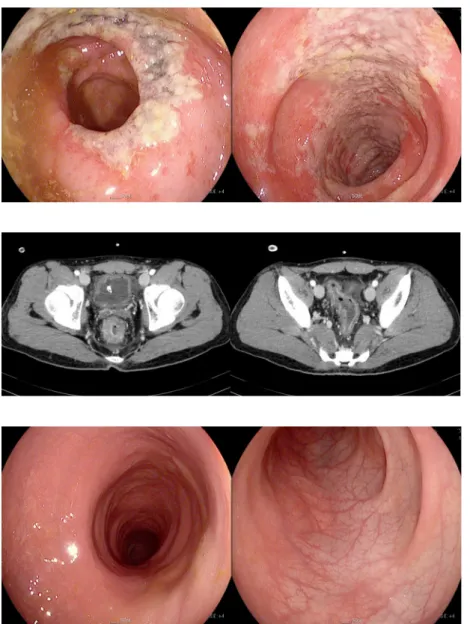
Fig. 1. Sigmoidoscopy taken on the second day of hospitalization revealed necrosis in the rectum and rectosigmoid junctional colonic mucosa.
Fig. 2. Abdominal computed tomography taken on the third day of hospitalization revealed mild wall thickening along with the rectum and rectosigmoid junction to the splenic flexure colon with irregular mucosal enhancement at the rectum and rectosigmoid junction.
Fig. 3. Follow-up sigmoidoscopy performed after 6 weeks revealed a normal appearance of colonic mucosa.
Extreme exercise, such as long-distance running or triathlon competitions, can cause a range of gastrointestinal symp- toms, including intestinal ischemia in 20% to 50% of cases.4,5 This paper presents a case of acute IC accompanied by rhab- domyolysis in a young man after heat stroke caused by vigo- rous physical exercise under extreme-temperature conditions.
CASE REPORT
A 20-year-old man presented to the emergency department with mental deterioration. The patient had played vigorous soccer for more than 30 minutes in sweltering weather and felt dizziness with nausea during the resting time. He was found unconscious in the street, having passed out on his way home. His medical records showed that he had had a
problem with urination at night since a car accident at the age of four and had been on medication since then; no other specific medical records were known. At the time of admission, his vital signs were as follows: body temperature, 39.5℃;
blood pressure, 120/70 mmHg; heart rate, 132 beats per minute; and respiratory rate, 28 breaths per minute. The initial laboratory findings revealed the following: white blood cell 16,400/μL, hemoglobin 14.4 g/dL, hematocrit 42%, AST 36 U/L, ALT 26 U/L, BUN 20.7 mg/dL, creatinine 1.76 mg/dL, creatine kinase 421 U/L, and uric acid 11.1 mg/dL. He re- gained consciousness quickly after admission, but the high fever (39.5℃) persisted, accompanied by violent and irritable behavior. Based on the laboratory findings and clinical manifes- tation, he was diagnosed initially with heat stroke and was treated by cooling with an ice bag and fluid replacement. On
Cha S, et al. Exercise-induced Ischemic Colitis in Young Adult 117
Vol. 74 No. 2, August 2019
the second day of hospitalization, his body temperature stabi- lized at 37.4℃, and the laboratory tests revealed AST 515 U/L, ALT 269 U/L, creatine kinase 23,181 U/L, BUN 29.1 mg/dL, creatinine 1.55 mg/dL, and red blood cell >50/high-power field in urine analysis. In addition, he presented with hematochezia and abdominal pain.
The sigmoidoscopy showed necrosis of the mucosa at the rectum and rectosigmoid junction (Fig. 1). The abdominal CT on the third day of hospitalization revealed mild wall thicken- ing along the rectum and rectosigmoid junction to the splenic flexure area with irregular mucosal enhancement at the rec- tum and rectosigmoid junction (Fig. 2).
A diagnosis of IC and rhabdomyolysis was made. The pa- tient was treated with conservative and fluid therapy; his symptoms improved gradually and the laboratory findings were normalized. The follow-up sigmoidoscopy performed six weeks later revealed a completely normal colonic muco- sa (Fig. 3).
Written informed consent was obtained from the patient who participated in this study.
DISCUSSION
IC is the most common form of intestinal ischemia, occur- ring mainly in elderly patients; however, it also occurs in young adults with no underlying disease, albeit rarely. One Japanese study reported that 15% of IC occurred in the young age group between 20 to 45 years.6 This study showed that the smoking habit and hyperuricemia are associated with IC in young adults.6
IC was reported to occur in young adults after extreme ex- ercise (e.g., marathon running, triathlon competition, etc.) ac- companied by dehydration, high temperature, and exhaustion.4 The patient showed sudden mental deterioration after extreme exercise performed in hot weather, indicating heat stroke, and it could be one of the factors leading to IC. The increased sympathetic and decreased vagal activity during exercise caus- es a decrease in splanchnic blood flow and increased muscle blood flow.7 Ischemia of the visceral organ can occur if exercise is too intense and prolonged or is superimposed by hyper- thermia, dehydration, and alterations in blood viscosity.4,8 The patient’s symptoms were accompanied by heat stroke and rhabdomyolysis, which has never been reported. Visceral blood flows can be decreased significantly during and after exercise
by up to 80%.9,10 Studies with transcutaneous Doppler ultra- sound revealed a 43% decrease in visceral blood flow immedi- ately after treadmill exercise (speed 5 km/h, gradient 20%, dura- tion 15 minutes) and up to 50% after submaximal cycling.11,12 This decrease in visceral flow occurred irrespective of their exercise capacity or training status.10 Drugs, such as non-ster- oidal anti-inflammatory drugs and the oral contraceptive pill, also might be a risk factor for IC associated with exercise.8,13
The typical symptoms of IC after exercise are vomiting, ab- dominal pain, diarrhea, and hematochezia.4,8,13-15 In addition to IC, a range of gastrointestinal (GI) symptoms, including nau- sea, regurgitation, belching, epigastric discomfort, diarrhea, urge to defecate, GI cramps, and flatulence, are associated with exercise, and women appear to be commonly affected.5,7,14,15 The frequency of GI symptoms tends to in- crease in marathon running and triathlons compared to sports, such as cycling, rowing, and swimming.7,15,16 A pre- vious study of long-distance runners reported a range of GI injuries on endoscopy, such as gastritis, esophagitis, gastric ulcer, and multiple erosions at the splenic flexure.17 The fol- lowing study showed that ranitidine prophylaxis is effective in preventing gastric mucosal injury and GI bleeding in runners.5
Generally, in most cases of IC after extreme exercise, the individuals usually recover without sequelae.1,13 On the other hand, some cases experienced more severe complications, including colonic infarction, peritonitis, perforation, sepsis leading to laparotomy, and hemicolectomy.4,8
A very rare case of exercise-associated IC accompanied by rhabdomyolysis was encountered. Overall, a diagnosis of IC should be considered in patients who present with abdominal pain and bloody diarrhea after intense exercise, and appro- priate treatment should be initiated immediately.
REFERENCES
1. Brandt LJ, Feuerstadt P, Longstreth GF, Boley SJ, American College of Gastroenterology. ACG clinical guideline: epidemiol- ogy, risk factors, patterns of presentation, diagnosis, and man- agement of colon ischemia (CI). Am J Gastroenterol 2015;110:
18-44.
2. Yoon BW, Park JS, Woo YS, et al. Severe ischemic colitis from gas- tric ulcer bleeding-induced shock in patient with end stage renal disease receiving hemodialysis. Korean J Helicobacter Up Gastrointest Res 2016;16:165-168.
3. Sanchez LD, Tracy JA, Berkoff D, Pedrosa I. Ischemic colitis in
118 차세린 등. 젊은 성인에서 발생한 운동 유발성 허혈성 장염
The Korean Journal of Gastroenterology marathon runners: a case-based review. J Emerg Med 2006;
30:321-326.
4. Moses FM. Exercise-associated intestinal ischemia. Curr Sports Med Rep 2005;4:91-95.
5. Choi SJ, Kim YS, Chae JR, et al. Effects of ranitidine for exercise induced gastric mucosal changes and bleeding. World J Gastroenterol 2006;12:2579-2583.
6. Kimura T, Shinji A, Horiuchi A, et al. Clinical characteristics of young-onset ischemic colitis. Dig Dis Sci 2012;57:1652-1659.
7. Brouns F, Beckers E. Is the gut an athletic organ? Digestion, ab- sorption and exercise. Sports Med 1993;15:242-257.
8. Cohen DC, Winstanley A, Engledow A, Windsor AC, Skipworth JR.
Marathon-induced ischemic colitis: why running is not always good for you. Am J Emerg Med 2009;27:255.e5-e7.
9. Rowell LB. Human cardiovascular adjustments to exercise and thermal stress. Physiol Rev 1974;54:75-159.
10. Clausen JP. Effect of physical training on cardiovascular adjust- ments to exercise in man. Physiol Rev 1977;57:779-815.
11. Qamar MI, Read AE. Effects of exercise on mesenteric blood flow
in man. Gut 1987;28:583-587.
12. Perko MJ, Nielsen HB, Skak C, Clemmesen JO, Schroeder TV, Secher NH. Mesenteric, coeliac and splanchnic blood flow in hu- mans during exercise. J Physiol 1998;513(Pt 3):907-913.
13. Lucas W, Schroy PC 3rd. Reversible ischemic colitis in a high en- durance athlete. Am J Gastroenterol 1998;93:2231-2234.
14. Moses FM. The effect of exercise on the gastrointestinal tract.
Sports Med 1990;9:159-172.
15. de Oliveira EP, Burini RC. The impact of physical exercise on the gastrointestinal tract. Curr Opin Clin Nutr Metab Care 2009;12:
533-538.
16. Peters HP, van Schelven FW, Verstappen PA, et al. Gastro- intestinal problems as a function of carbohydrate supplements and mode of exercise. Med Sci Sports Exerc 1993;25:
1211-1224.
17. Choi SC, Choi SJ, Kim JA, et al. The role of gastrointestinal endos- copy in long-distance runners with gastrointestinal symptoms.
Eur J Gastroenterol Hepatol 2001;13:1089-1094.