ISSN: 2233-601X (Print) ISSN: 2093-6516 (Online)
Departments of
1Child & Adolescent Psychiatry and
2Neurology, Northwestern University Feinberg School of Medicine,
3Statistical Expert,
4
Department of Thoracic Surgery, Marmara University School of Medicine
†This article has been presented as a poster at 22nd Annual Meeting of the Asian Society for Cardiovascular and Thoracic Surgery.
Received: July 21, 2014, Revised: November 3, 2014, Accepted: November 5, 2014, Published online: April 5, 2015
Corresponding author: A. Tugba Bahadir, Department of Child & Adolescent Psychiatry, Marmara University School of Medicine, Istanbul, Fevzi Cakmak Mah., Mimar Sinan Cad., No: 41, 34899, Ust Kaynarca, Pendik, Istanbul, Turkey
(Tel) 90-216-625-4545/1635 (Fax) 90-533-425-5888 (E-mail) [email protected]
C
The Korean Society for Thoracic and Cardiovascular Surgery. 2015. All right reserved.
CC
This is an open access article distributed under the terms of the Creative Commons Attribution Non-Commercial License (http://creative- commons.org/licenses/by-nc/3.0) which permits unrestricted non-commercial use, distribution, and reproduction in any medium, provided the original work is properly cited.
Validity and Reliability of the Turkish Version of the Nuss Questionnaire Modified for Adults
A. Tugba Bahadir, M.D.
1, Pinar Kuru, M.D.
2, Ceyda Afacan, M.A.
3, Nezih Onur Ermerak, M.D.
4, Korkut Bostanci, M.D.
4, Mustafa Yuksel, M.D.
4Background: Pectus excavatum (PE) is the most common chest wall deformity. The Nuss Questionnaire modified for Adults (NQmA) is a disease-specific health-related quality of life assessment tool for patients with pectus deformities. The aim of this study is to adapt the NQmA into Turkish. Methods: Two hundred and sixty-five pa- tients with PE were participated, with an age range of 14 to 29 years. All patients underwent a physical examina- tion and had not undergone corrective surgery. The Turkish version of the NQmA was completed by patients and their parents. Results: The content validity index based on expert opinions was 91% for the patient questionnaire and 96% for the parent questionnaire. The Cronbach’s alpha value for the NQmA was found to be 0.805 for the patient questionnaire and 0.800 for the parent questionnaire. Exploratory factor analysis was used to assess con- struct validity. Two factors explained 51.1% of the total variance in the patient questionnaire (psychosocial:
31.145%, Cronbach’s alpha=0.818; physical: 19.955%, Cronbach’s alpha=0.862). In the parent questionnaire, two fac- tors explained 51.422% of the total variance (psychosocial: 26.097%, Cronbach’s alpha=0.743; physical: 25.325%, Cronbach’s alpha=0.827). Construct validity was confirmed by confirmatory factor analysis. Conclusion: The Turkish version of the NQmA was found to be valid and reliable for the assessment of quality of life in patients with PE.
Key words: 1. Funnel chest 2. Quality of life 3. Psychometrics 4. Validation studies
INTRODUCTION
Pectus excavatum (PE), also known as funnel chest, is the most common chest wall deformity, characterized by inward displacement of the sternum and the costal cartilages. PE oc- curs in males three to five times more often than in females, with an incidence of one case in every 400 to 1,000 births [1,2]. Physical limitations and/or psychosocial distress can be
observed in patients with PE and may result in a decreased quality of life [3]. The physical limitations caused by PE are mostly cardiopulmonary restrictions resulting in fatigue, ex- ercise intolerance, shortness of breath, palpitations, and chest discomfort or pain [4]. The psychosocial problems associated with PE are mostly characterized by low self-esteem and avoidance of social and physical activities due to the appear- ance of the chest [5].
http://dx.doi.org/10.5090/kjtcs.2015.48.2.112
Minimally invasive repair of PE, developed by Donald Nuss in 1987, is the current surgical approach for the correc- tion of PE. Nuss et al. [6] published their 10-year experiences in 1998. Since that time, minimally invasive repair has most- ly replaced the Ravitch procedure, because minimally in- vasive repair involves shorter operations and minimal surgical scarring [7]. However, Kang et al. [8] reported in 2012 that long-term satisfaction was not related to the operation type, but instead was related to the completeness of the correction and the absence of recurrence.
The primary aim of medical care is to increase the pa- tient’s quality of life, which includes physical and psychoso- cial well-being. The Nuss Questionnaire was first published and validated by Lawson et al. [9] in 2003 as a dis- ease-specific tool for the evaluation of quality of life in pe- diatric patients with PE. Krasopoulos et al. [10] modified the questionnaire for adults. Improvements in physical and psy- chosocial well-being, with a better quality of life, have been reported after the minimally invasive repair of PE [5,9-13].
In the present study we aimed to evaluate the validity and the reliability of the Turkish version of the Nuss Questionnaire modified for Adults (NQmA).
METHODS
Patients with PE (age range, 14 to 29 years) were recruited from the Thoracic Surgery Clinic of Marmara University Hospital. Patients with any previous thoracic surgery history or complex deformities were excluded. This study was ap- proved by the Clinical Research Ethics Committee of the Marmara University School of Medicine. Informed consent was obtained from each participant. All patients underwent a physical examination, and posteroanterior and lateral chest ra- diographs were obtained. The Turkish version of the NQmA was used to assess the patients’ quality of life. Patients and their parents completed the questionnaires.
The two-step Nuss Questionnaire for pediatric patients and their parents is used to assess the disease-specific quality of life of patients with pectus deformities. Child and parent ver- sions of the questionnaire were first published and validated by Lawson et al. [9]. The Nuss Questionnaire was modified for adult patients by Krasopoulos et al. [10], and the scoring
of the first three questions was reversed.
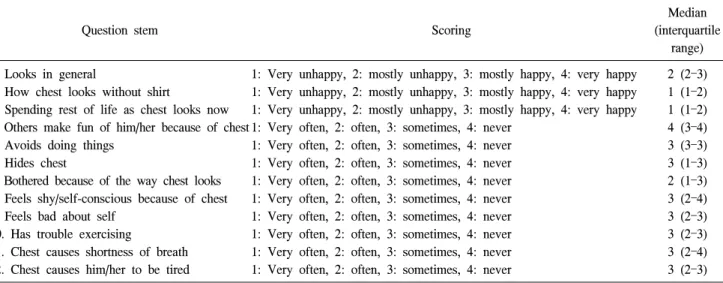
The patient and parent questionnaires were translated into Turkish. Fourteen experts working with chest wall deformities and/or quality of life reviewed the parent and patient versions of the questionnaire for the suitability and comprehensibility of the items. The patient form of the NQmA included 12 items and the parent form included 13 items. Each item re- ceived a score between 1 and 4, with higher scores indicating a better quality of life (Tables 1, 2).
1) Statistical analysis
The AMOS ver. 6.0 (AMOS Development Co., SPSS Inc., Chicago, IL, USA) and SPSS ver. 15.0 (SPSS Inc., Chicago, IL, USA) software packages were used for statistical analysis.
The content validity ratio and content validity index were used to examine the validity of the content based on the as- sessment of experts. Content validity means that the items in the test appropriately sample the content domain. The content validity ratio is used to determine whether specific test items should be retained or deleted. The content validity index is the mean of the content validity ratios of the remaining items in the test [14]. Cronbach’s alpha was calculated to assess the reliability of the overall questionnaire, as well as to assess its physical and psychosocial components individually. Cron- bach’s alpha is a number between 0 and 1 [15] that measures internal consistency and reliability [16]. Internal consistency indicates the degree to which test items all measure the same concept [15]. In order to evaluate the contribution of each item to the questionnaire, item-total correlation coefficients and Cronbach’s alpha values if item deleted were also calculated. Exploratory factor analysis (EFA) was used to as- sess construct validity. EFA is used to reduce the amount of data by grouping related items together [16]. The Kaiser- Meyer-Olkin measure of sampling adequacy is a number be- tween 0 and 1 that measures the adequacy of the data in terms of the sample size. Bartlett’s test of sphericity, which is a prerequisite for EFA, demonstrates whether the data have a multivariate distribution. Eigenvalues are used to decide the number of factors included in EFA [17], and each eigenvalue accounts for a certain percentage of the variance [18].
Confirmatory factor analysis (CFA) was used to confirm the
construct validity. CFA is employed to determine whether the
Table 1. Patient form of the Nuss Questionnaire modified for Adults and the median and interquartile range results for each question stem
Question stem Scoring
Median (interquartile
range) 1. Looks in general 1: Very unhappy, 2: mostly unhappy, 3: mostly happy, 4: very happy 2 (2–3) 2. How chest looks without shirt 1: Very unhappy, 2: mostly unhappy, 3: mostly happy, 4: very happy 1 (1–2) 3. Spending rest of life as chest looks now 1: Very unhappy, 2: mostly unhappy, 3: mostly happy, 4: very happy 1 (1–2) 4. Others make fun of him/her because of chest 1: Very often, 2: often, 3: sometimes, 4: never 4 (3–4)
5. Avoids doing things 1: Very often, 2: often, 3: sometimes, 4: never 3 (3–3)
6. Hides chest 1: Very often, 2: often, 3: sometimes, 4: never 3 (1–3)
7. Bothered because of the way chest looks 1: Very often, 2: often, 3: sometimes, 4: never 2 (1–3) 8. Feels shy/self-conscious because of chest 1: Very often, 2: often, 3: sometimes, 4: never 3 (2–4) 9. Feels bad about self 1: Very often, 2: often, 3: sometimes, 4: never 3 (2–3) 10. Has trouble exercising 1: Very often, 2: often, 3: sometimes, 4: never 3 (2–3) 11. Chest causes shortness of breath 1: Very often, 2: often, 3: sometimes, 4: never 3 (2–4) 12. Chest causes him/her to be tired 1: Very often, 2: often, 3: sometimes, 4: never 3 (2–3)
Table 2. Parent form of the Nuss Questionnaire modified for Adults and the median and interquartile range results for each question stem
Question stems Scoring Median
(interquartile range)
1. Irritable 1: Very often, 2: often, 3: sometimes, 4: never 3 (3–3)
2. Frustrated 1: Very often, 2: often, 3: sometimes, 4: never 3 (2.5–3)
3. Sad/depressed 1: Very often, 2: often, 3: sometimes, 4: never 3 (3–3)
4. Restless 1: Very often, 2: often, 3: sometimes, 4: never 3 (3–4)
5. Isolated 1: Very often, 2: often, 3: sometimes, 4: never 4 (3–4)
7. Reluctant to be in public while wearing bathing clothes that would show the chest
1: Very often, 2: often, 3: sometimes, 4: never 3 (1–4)
8. How often parent is concerned about effects of the deformity on patient’s life
1: Very often, 2: often, 3: sometimes, 4: never 3 (1–3)
9. Have trouble exercising 1: Very often, 2: often, 3: sometimes, 4: never 3 (3–4) 10. Have chest pain 1: Very often, 2: often, 3: sometimes, 4: never 3 (3–4) 11. Have shortness of breath 1: Very often, 2: often, 3: sometimes, 4: never 3 (3–4)
12. Feel tired 1: Very often, 2: often, 3: sometimes, 4: never 3 (2–3)
factor structure indicated by EFA is represented in the data or not [18], and fit indices are used to confirm the CFA model [17]. The fit indices that we evaluated were the root mean square error of approximation, the goodness of fit index, the comparative fit index, the standardized root mean square er- ror, and the chi-square/degrees of freedom test. Spearman correlation analysis was carried out to compare the physical and psychosocial component scores of the patient and the pa- rent questionnaires. For all analyses, p<0.05 was considered to indicate significance.
RESULTS
A total of 265 patients with PE participated to the study,
of whom 233 (87.9%) were male and 32 (12.1%) were
female. The mean age of the patients was 18.83±3.84 years
(range, 14 to 29 years). Eighty-six (32.5%) of the patients
had at least one associated disease or anomaly, and 21 pa-
tients (7.9%) had scoliosis. Symmetric deformities were ob-
served in 176 (69%) of the patients, and the others had
asymmetric deformities. A total of 265 patient and parent
questionnaires were completed.
Table 3. Internal consistency of the patient questionnaire
Question stem Scale mean if
item deleted
Scale variance if item deleted
Corrected item-total correlation
Cronbach’s alpha if item deleted
1. Looks in general 27.97 31.321 0.413 0.794
2. How chest looks without shirt 28.74 31.822 0.497 0.789
3. Spending rest of life as chest looks now 28.88 32.993 0.398 0.796
4. Others make fun of him/her because of chest 26.81 33.192 0.278 0.804
5. Avoids doing things 27.35 31.349 0.463 0.790
6. Hides chest 27.75 28.637 0.550 0.781
7. Bothered because of the way chest looks 27.96 28.684 0.628 0.773
8. Feels shy/self-conscious because of chest 27.36 29.382 0.516 0.784
9. Feels bad about self 27.49 30.645 0.513 0.785
10. Has trouble exercising 27.56 30.634 0.390 0.798
11. Chest causes shortness of breath 27.38 31.259 0.382 0.798
12. Chest causes him/her to be tired 27.42 30.941 0.413 0.795
Table 4. Internal consistency of the parent questionnaire
Question stem Scale mean if
item deleted
Scale variance if item deleted
Corrected item-total correlation
Cronbach’s alpha if item deleted
1. Irritable 29.22 25.997 0.457 0.784
2. Frustrated 29.37 26.718 0.466 0.785
3. Sad/depressed 29.17 25.356 0.620 0.770
4. Restless 29.11 25.851 0.507 0.780
5. Isolated 28.89 26.086 0.388 0.792
7. Reluctant to be in public while wearing bathing clothes that would show the chest
29.46 25.265 0.322 0.807
8. How often parent is concerned about effects of the deformity on patient’s life
29.80 25.223 0.413 0.790
9. Have trouble exercising 29.19 24.951 0.541 0.775
10. Have chest pain 28.78 26.692 0.471 0.784
11. Have shortness of breath 28.98 26.212 0.474 0.783
12. Feel tired 29.38 24.509 0.537 0.775
1) Expert opinions and content validity
We asked 14 experts for their opinions. The expected mini- mum content validity ratio for 14 experts was 51% [14].
Content validity ratios were provided for all items, and were between 57% and 100% in both of the questionnaires. The content validity index of the expert opinions was 91% for the patient questionnaire and 96% for the parent questionnaire.
The content validity indices were 79% or higher for all of the items in both of the patient and the parent questionnaires [19].
2) Reliability and construct validity
(1) Patient questionnaire: The Cronbach’s alpha value of
the 12 items in the patient questionnaire was 0.805, indicat- ing that it was reliable. The item-total correlation coefficients of items in the patient questionnaire were between 0.28 and 0.63 (Table 3). No increase in the Cronbach’s alpha value was observed if any item was deleted.
(2) Parent questionnaire: Items were excluded from the questionnaire if they met the following criteria: (1) an item-total correlation coefficient <0.40, (2) a factor loading
<0.40 [16], (3) if deleting the factor increased the
Cronbach’s alpha value, and (4) if an item did not load on
the expected factor. The sixth and thirteenth items were de-
leted based on all the above criteria. These question stems
were ‘made fun of him/her’ and ‘have problems gaining
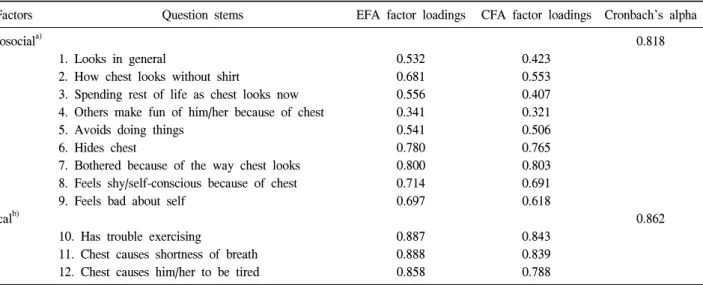
Table 5. Exploratory and confirmatory factor analysis for the patient questionnaire
Factors Question stems EFA factor loadings CFA factor loadings Cronbach’s alpha
Psychosocial
a)0.818
1. Looks in general 0.532 0.423
2. How chest looks without shirt 0.681 0.553
3. Spending rest of life as chest looks now 0.556 0.407 4. Others make fun of him/her because of chest 0.341 0.321
5. Avoids doing things 0.541 0.506
6. Hides chest 0.780 0.765
7. Bothered because of the way chest looks 0.800 0.803
8. Feels shy/self-conscious because of chest 0.714 0.691
9. Feels bad about self 0.697 0.618
Physical
b)0.862
10. Has trouble exercising 0.887 0.843
11. Chest causes shortness of breath 0.888 0.839
12. Chest causes him/her to be tired 0.858 0.788
EFA, exploratory factor analysis; CFA, confirmatory factor analysis; AVE, average variance extracted.
a)
Eigenvalues=3.962; EFA variance explained=31.145%; AVE for CFA=88.6%.
b)Eigenvalues=2.170; EFA variance explained=19.955%;
AVE for CFA=94.3%.
weight.’ After two items deleted, the Cronbach’s alpha value and item-total correlation coefficients were calculated and the factor structure was examined. The Cronbach’s alpha value of the remaining 11 items in the parent questionnaire was 0.800.
The item-total correlation coefficients of the questionnaire were between 0.32 and 0.62 (Table 4).
3) Exploratory factor analysis
(1) Patient questionnaire: EFA was conducted to assess the construct validity of the questionnaire, using the Varimax rotation method. In the EFA procedure, the parameters were grouped into two factors with eigenvalues >1. Two factors explained 51.1% of the total variance (Table 5). According to the Kaiser-Meyer-Olkin measure of sample adequacy, which was 0.812 (>0.80), the sample size was adequate. According to the Bartlett’s test, the hypothesis was accepted that the correlation matrix was not an identity matrix (Bartlett’s test, p=0.000 [<0.05]) [16]. Items 1–9 were included in the psy- chosocial component and items 10–12 were included in the physical component; factor loadings ranged from 0.341 to 0.888.
(2) Parent questionnaire: In the parent questionnaire, the parameters were similarly grouped into two factors with ei- genvalues >1. Two factors explained 51.422% of the total var-
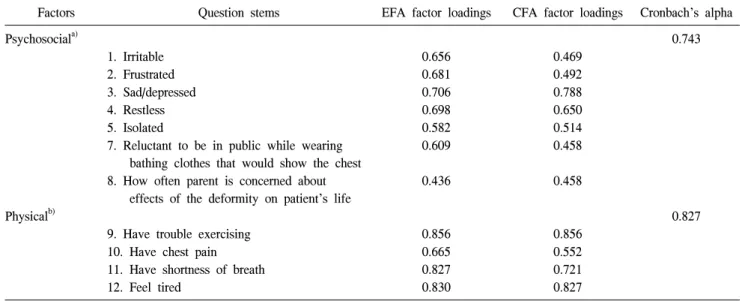
iance (Kaiser-Meyer-Olkin measure=0.815 [>0.80], Bartlett’s test p=0.000 [<0.05]) (Table 6). According to the EFA, items 1–8 were included in the psychosocial component and items 9–12 were included in the physical component; the fac- tor loadings ranged from 0.436 to 0.856.
4) Confirmatory factor analysis
(1) Patient questionnaire: CFA was used to confirm the two-factor structure revealed in the EFA. According to CFA, the standardized regression weights ranged from 0.32 to 0.84 (Fig. 1), and the t-tests indicated statistical significance.
(2) Parent questionnaire: According to CFA, the stand- ardized regression weights ranged from 0.46 to 0.86 (Fig. 2), and the t-tests indicated statistical significance. According to the fit indices for both the patient and the parent ques- tionnaires, the two-factor (psychosocial and physical) model demonstrated good fit (Table 7). Modification indices be- tween covariance errors >20 were allowed to correlate (Figs.
1, 2) [20]. As a result, the fit of the model improved for both questionnaires. CFA confirmed the construct validity of the factors that were obtained for both the patient and the pa- rent questionnaires.
The physical and psychosocial components were correlated
between the patient and the parent questionnaires (Table 8).
Table 6. Exploratory and confirmatory factor analysis for the parent questionnaire
Factors Question stems EFA factor loadings CFA factor loadings Cronbach’s alpha
Psychosocial
a)0.743
1. Irritable 0.656 0.469
2. Frustrated 0.681 0.492
3. Sad/depressed 0.706 0.788
4. Restless 0.698 0.650
5. Isolated 0.582 0.514
7. Reluctant to be in public while wearing bathing clothes that would show the chest
0.609 0.458
8. How often parent is concerned about effects of the deformity on patient’s life
0.436 0.458
Physical
b)0.827
9. Have trouble exercising 0.856 0.856
10. Have chest pain 0.665 0.552
11. Have shortness of breath 0.827 0.721
12. Feel tired 0.830 0.827
EFA, exploratory factor analysis; CFA, confirmatory factor analysis; AVE, average variance extracted.
a)