© 2018 Korean Breast Cancer Society. All rights reserved. http://ejbc.kr | pISSN 1738-6756
INTRODUCTION
Cancer remains the most important health issue of the day.
It is estimated that more than 26 million people will be diag- nosed with cancer, resulting in 13 millions death in 2030 [1].
Cancer frequency is increasing by 1% to 2% per year in al- most every country in the world. Breast cancer (BC) accounts for approximately 30% of female cancers in the United States and approximately 25% of all cancers worldwide. The risk of devoloping BC during her lifetime is an estimated 10% to 12.8% [1,2] .
Biological factors primarily associated with BC are the estro- gen receptor (ER), progesterone receptor (PR), human epider- mal growth factor receptor 2 (HER2), and proliferation. Triple- negative breast cancer (TNBC) is characterized by ER, PR, and HER2 expression deficiency. Studies aimed at finding a tumor marker specific for BC have been continuing for many years.
However, no biochemical or immunochemical substance that
can be quantified has been determined yet [3].
The main methods used in BC therapy are surgery, radio- therapy, chemotherapy, hormone therapy, and targeted thera- py [4]. The most important goal of developing any effective cancer treatment method must be the exclusive destruction of tumor cells while preventing cancer recurrence. Immuno- therapy is a new generation treatment method developed to overcome side effects of conventional treatments while in- creasing effectiveness by providing tumor-specific treatment via targeting of tumor cells with antigen differences [5].
Owing to the weak antigenicity of antigenic structures in cancer cells, cancerous cells cannot be detected via immuno- surveillance or eliminated by immunocytes, which allows the tumor to develop unhindered [6].
Immunotherapy is an approach that stimulates immune system cells and renders them more effective. In addition to supporting the immune sysrem, the wider goal of immuno- therapy is to allow immune system cells to recognize tumor antigens more effectively and specifically attack and destroy cancer cells [7].
GENERAL APPROACHES ON VACCINE DEVELOPMENT AGAINST BREAST CANCER
Peptide-based vaccines
In order to develop an effective therapeutic vaccine against BC, self-antigens of breast tumor cells that serve as tumor tar- gets are used. The HER2 protein, specific for both trastuzum-
Current Approaches in Development of Immunotherapeutic Vaccines for Breast Cancer
Adil Allahverdiyev, Gamze Tari, Melahat Bagirova, Emrah Sefik Abamor
Department of Bioengineering, Faculty of Chemical and Metallurgical Engineering, Yildiz Technical University, Istanbul, Turkey REVIEW ARTICLE
Cancer is the leading cause of death worldwide. In developed as well as developing countries, breast cancer is the most common cancer found among women. Currently, treatment of breast can- cer consists mainly of surgery, chemotherapy, hormone therapy, and radiotherapy. In recent years, because of increased under- standing of the therapeutic potential of immunotherapy in cancer prevention, cancer vaccines have gained importance. Here, we
review various immunotherapeutic breast cancer vaccines in- cluding peptide-based vaccines, whole tumor cell vaccines, gene-based vaccines, and dendritic cell vaccines. We also dis- cuss novel nanotechnology-based approaches to improving breast cancer vaccine efficiency.
Key Words: Breast neoplasms, Immunology, Immunotherapy, Vaccines
Correspondence to: Adil Allahverdiyev https://orcid.org/0000-0002-7031-5986
Department of Bioengineering, Faculty of Chemical and Metallurgical Engineering, Yildiz Technical University Davutpasa Campus, Davutpasa Street No. 127, 34210 Esenler, Istanbul, Turkey
Tel: +90-212-383-46-39, Fax: +90-212-383-46-25 E-mail: [email protected]
This research was supported by Scientific Researches and Project
Coordinatorship of Yildiz Technical University, Istanbul, Turkey with project support num bers FYL-2017-3202 and 2015-07-04-KAP04.
Received: May 31, 2018 Accepted: August 27, 2018
Cancer
ab and pertuzumab monoclonal antibodies, was the first anti- gen to be identified as a target for BC immunotherapy. HER2, carbohydrate antigens (such as carcinoembryonic antigen), and Mucin-1 (MUC-1) are the most commonly studied BC antigens for the purpose of vaccine formulation. However, an- tibody response to HER2 and MUC-1 antigens in BC patients is very low. Peptide vaccines have been used mostly with the granulocyte macrophage colony stimulating factor (GM-CSF) cytokine adjuvant to enhance efficacy [8].
Of the different combinations that may target MUC1 tumor associated antigen (TAA), the BLP25 MUC1 lipopeptide-con- taining mixture has been used against BC, in addition to che- motherapy and showed an increase in CD8+ T responses.
Currently, the possibility of using the MUC1 antigen in vac- cine formulation is being tested in many clinical trials.
Bacille Calmette-Guérin (BCG) conjugated with MUC1 antigen and human interleukin-2 (IL-2) vaccine caused an in- crease in the cytotoxic T lymphocyte (CTL) response in mouse models [8]. This vaccination approach has been shown to be more effective than the formulation containing the poly- inosinicpolycytidylic (poly-IC) stabilized with poly-lysine and carboxymethylcellulose (poly-ICLC) adjuvant [9].
Adjuvants and helper peptides have been used to improve the clinical efficacy of peptide vaccines. An example of this approach is study conducted by Dillon et al. [10], using the major histocompatibility complex class I-restricted BC-asso- ciated and Toll-like receptor 3 agonist poly-ICLC adjuvant .
Mittendorf et al. [11] demonstrated the efficacy of the HER2/neu derived peptide GP2 with nine amino acids (654–
662: IISAVVGIL) peptide vaccine in preventing tumor recur- rence, when GP2 is used together with the GM-CSF adjuvant.
Torres-García et al. [12] evaluated parasite-derived immu- nomodulatory 18-amino acid (aa) GK-1 peptide adjuvant in vivo and reported an enhanced inhibitory effect on invasive BC and its metastasis to lungs.
Currently, NeuVax (Galena Biopharma, San Ramon, USA), and Pan-T-cell epitope+a neolactoseries antigen Lewis Y+the ganglioside GD2 mimicking carbohydrate peptide containing vaccine P10s-PADRE (AmbioPharm Inc., North Augusta, USA), are being evaluated in clinical trials for use against BC.
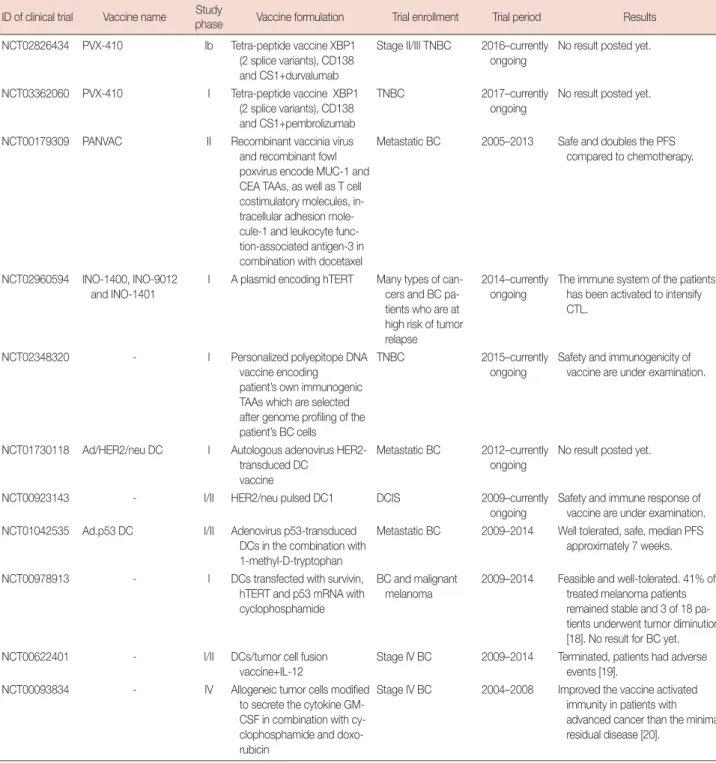
Furhter examples of clinical trials on peptide vaccines are shown in Table 1 [10,13-19].
Whole-cell vaccines
Vaccine platforms based on direct application of whole tu- mor cells or cell extracts to the patient, as an alternative to an- tigen-specific vaccination with peptide or protein subgroups, are direct polyvalent immunization strategies [20]. Whole-cell tumor vaccines present multiple and unknown cancer anti-
gens in contrast to epitope-specific vaccines. However, ac- cording to current research these vaccines are poorly immu- nogenic [21].
Whole-cell tumor vaccines are prepared by irradiating allo- geneic or autologous cancer cells or cell lysates, which inhibits their ability to replicate inside the patient following vaccina- tion [22]. Irradiating cancer cells enhances tumor recognition by CTLs and antigen-presenting cells [23].
Certain modifications have been made in order to increase vaccine immunogenicity. The GVAX (Aduro Biotech, Berkeley, USA) vaccine includes irradiated allogeneic tumor cell lines which are modified to secrete the cytokine GM-CSF [24]. The potency of the GM-CSF secreting whole cell BC vaccine can be enhanced by using chemotherapeutic agents.
Huang et al. [25] added IL-2 cytokine and blocked immuno- suppressive anionic phospholipid phosphatidylserine in the whole cell cancer vaccine to increase its efficiency. An increase in the tumor-specific cytotoxicity response and interferon (IFN)-γ cytokine release has been observed in vaccinated mice. Convit et al. [26] prepared a vaccine formulation in- cluding whole-tumor cells, formalin, and BCG adjuvant to improve vaccine immunogenicity and proved the tolerability, safety, and nontoxicity of the formulation based on the results of animal research. The results of this study indicated an over- all survival of 60% in humans. The vaccine formulation re- sulted in a lower tumor growth rate and boosted immune cell activation in the mouse model. Promising results in the term of a decrease in the infiltration of suppressor cells and im- proved immune memory have been observed [27].
Immunotherapy with vascular endothelial growth factor receptor 2 (VEGFR2) model antigen showed great potential as a tumor vaccine. Researchers irradiated the adenovirus en- coding VEGFR2 (AdVEGFR2)-infected whole cancer cell vaccine-based immunotherapy to improve its efficacy. The re- sults of this study indicate that angiogenesis inhibition, CTL activation and increased expression of the high mobility group box 1 (HMGB1) and 70 kilodalton heat shock proteins in AdVEGFR2-infected cells may be used as an effective strat- egy in cancer immunotherapy [28].
MDA-MB-231 cell line has been used as a whole tumor cell vaccine in a stage IV BC clinical trial. This cell line is an HLA- A21, HER2/neu1 allogeneic BC cell line, which was genetically modified to express the costimulatory molecule CD80 (B7-1).
This formulation was used with GM-CSF and BCG adjuvant, resulting in a costimulatory signal and improved antigen pre- sentation capability in patient T cells. It has been proved that the vaccine formulation is safe and feasible [29]. Furhter ex- amples of clinical trials on whole cell vaccines are shown in Table 1.
Table 1. Clinical trials on breast cancer vaccines ID of clinical trial Vaccine name Study
phase Vaccine formulation Trial enrollment Trial period Results NCT00925548 Stimuvax (tecemotide,
L-BLP25) - STRIDE (Stimulating Immune Response In a Vari- able Breast Cancer)
III L-BLP25 MUC1 lipopeptide- containing mixture
ER+ and/or PR+, inoperable locally advance, recurren, or metastatic BC
2009–2010 Permanently terminated due to clinical signs and symptoms of BC after investigational new drug application for tecemotide.
ABCSG-34 Stimuvax (tecemotide, L-BLP25)
II L-BLP25 MUC1 lipopeptide- containing mixture
Preoperative treatment of women with primary BC
2012–2017 In 2017 San Antonio Breast Cancer Symposium; 93.2% of patients in the neoadjuvant chemotherapy group resulted in high-risk Endopredict score which is related to residual cancer burden. In the neoadjuvant endocrine therapy group, 44% of patients have a low Endopredict score and 39% of patients have a high Endopredict score.
- - I MUC1- KLH
conjugation+QS-21 adjuvant
High risk BC without evidence of disease
1995–1996 Increased antibody response, no significant effect on T cell re- sponse, some recurrences and side effects [13].
- - III Oxidized mannan-conjugated
MUC-1
Postmenopausal women treated sur- gically with or with- out local radiation for stage II ER+
breast carcinoma
1997–2006 60% reccurence rate in the control group following 12–15 years in ER+ patients, while it has been reported to be quite low (12%) in the vaccinated group [14].
NCT01479244 NeuVax (nelipepimut-s) III E75-GM-CSF conjugation Disease-free, node+
BC
2011–2016 Increased CTL responses, DFS time is 85.7%, prolonged median time to recurrence [15,16].
NCT01570036 NeuVax (nelipepimut-s) II E75-GM-CSF conjugation in combination with herceptin
HER2 IHC1+/2+ and node+ BC
2012–currently ongoing
No result posted yet.
NCT02297698 NeuVax (nelipepimut-s) II E75-GM-CSF conjugation in combination with trastuzum- ab
High-risk, HER2+ or node+ BC
2014–currently ongoing
No result posted yet.
NCT01390064 P10s-PADRE I Pan-T-cell epitope and a neolactoseries antigen Lewis Y (LeY) and the
ganglioside GD2 mimicking carbohydrate peptide (CMP)+MONTANIDE™ ISA 51 VG adjuvant
Stage IV BC 2011–currently ongoing
Well-tolerated, induces functional proapoptotic antibodies, provide potential clinical benefit [17].
NCT02229084 P10s-PADRE (Chemovax)
I/II P10s-PADRE with chemotherapy,
MONTANIDE™ ISA 51 VG adjuvant or chemotherapy and adjuvant
Stage I, II or III ER+
BC
2014–currently ongoing
No result posted yet.
NCT02938442 P10s-PADRE (Chemovax)
II P10s-PADRE with MONTANIDE™ ISA 51 VG
TNBC 2016–currently
ongoing
No result posted yet.
NCT01532960 Breast 41 I 9 Major histocompatibility complex (MHC) class I-re- stricted BC-associated pep- tides (from MAGE-A1, -A3, and -A10, CEA, NY-ESO-1, and HER2 proteins) with TLR3 agonist poly-ICLC adjuvant
Stage I–IV BC 2012–2015 High peptide specific CTL respons- es, no dose-limiting toxicity.
Terminated due to lack of ELIspot responses [10].
(Continued to the next page)
ID of clinical trial Vaccine name Study
phase Vaccine formulation Trial enrollment Trial period Results NCT02826434 PVX-410 Ib Tetra-peptide vaccine XBP1
(2 splice variants), CD138 and CS1+durvalumab
Stage II/III TNBC 2016–currently ongoing
No result posted yet.
NCT03362060 PVX-410 I Tetra-peptide vaccine XBP1 (2 splice variants), CD138 and CS1+pembrolizumab
TNBC 2017–currently
ongoing
No result posted yet.
NCT00179309 PANVAC II Recombinant vaccinia virus and recombinant fowl poxvirus encode MUC-1 and CEA TAAs, as well as T cell costimulatory molecules, in- tracellular adhesion mole- cule-1 and leukocyte func- tion-associated antigen-3 in combination with docetaxel
Metastatic BC 2005–2013 Safe and doubles the PFS compared to chemotherapy.
NCT02960594 INO-1400, INO-9012 and INO-1401
I A plasmid encoding hTERT Many types of can- cers and BC pa- tients who are at high risk of tumor relapse
2014–currently ongoing
The immune system of the patients has been activated to intensify CTL.
NCT02348320 - I Personalized polyepitope DNA
vaccine encoding patient’s own immunogenic TAAs which are selected after genome profiling of the patient’s BC cells
TNBC 2015–currently
ongoing
Safety and immunogenicity of vaccine are under examination.
NCT01730118 Ad/HER2/neu DC I Autologous adenovirus HER2- transduced DC
vaccine
Metastatic BC 2012–currently ongoing
No result posted yet.
NCT00923143 - I/II HER2/neu pulsed DC1 DCIS 2009–currently
ongoing
Safety and immune response of vaccine are under examination.
NCT01042535 Ad.p53 DC I/II Adenovirus p53-transduced DCs in the combination with 1-methyl-D-tryptophan
Metastatic BC 2009–2014 Well tolerated, safe, median PFS approximately 7 weeks.
NCT00978913 - I DCs transfected with survivin, hTERT and p53 mRNA with cyclophosphamide
BC and malignant melanoma
2009–2014 Feasible and well-tolerated. 41% of treated melanoma patients remained stable and 3 of 18 pa- tients underwent tumor diminution [18]. No result for BC yet.
NCT00622401 - I/II DCs/tumor cell fusion
vaccine+IL-12
Stage IV BC 2009–2014 Terminated, patients had adverse events [19].
NCT00093834 - IV Allogeneic tumor cells modified to secrete the cytokine GM- CSF in combination with cy- clophosphamide and doxo- rubicin
Stage IV BC 2004–2008 Improved the vaccine activated immunity in patients with advanced cancer than the minimal residual disease [20].
MUC1=Mucin-1; ER=estrogen receptor; PR=progesterone receptor; BC=breast cancer; KLH=keyhole limpet hemocyanin; GM-CSF=granulocyte macrophage colony stimulating factor; CTL=cytotoxic T lymphocyte; DFS=disease-free survival; HER2=human epidermal growth factor receptor 2; IHC=immunohistochemistry;
TNBC=triple-negative breast cancer; CEA=carcinoembryonic antigen; TLR3=Toll-like receptor 3; poly-ICLC=carboxymethylcellulose, polyinosinic-polycytidylic acid, and poly-L-lysine double-stranded RNA; TAA=tumor associated antigen; DC=dendritic cell; hTERT=human telomerase reverse transcriptase; DCIS=ductal carcinoma in situ; PFS=progression-free survival; IL-12=interleukin 12.
Table 1. Continued
Although using tumor cell antigens has improved the effi- cacy of these applications, the inability of recognition of im- munocompetent agents, which are suppressed by tumor cells,
to recognize the immunogens may be one of the greatest rea- sons underlying the inability of these vaccine formulations to achieve the desired activity.
Gene-based vaccines
In recent years, innovative gene-based vaccines have also been developed for use in treating BC. Recombinant viral vec- tor vaccines based on New York Vaccinia, modified virus of Ankara (MVA) and canarypox virus have been designed to express TAAs such as HER2, p53, and MUC1, and have been generally tested in clinical trials involving metastatic BC pa- tients [30].
Kwilas et al. [31] designed a poxviral-based cancer vaccine using MVA including the Twist transgene and a triad of co- stimulatory molecules (B7-1, intercellular adhesion molecule 1, lymphocyte function-associated antigen 3) and evaluated its efficiency in metastatic BC and prostate cancer models. They targeted the Twist transcription factor which plays an impor- tant role in metastasis, poor prognosis, and drug resistance, and observed both CD4+ and CD8+ Twist-specific T-cell re- sponses in vivo.
Although these viral vaccines produce highly potent CTL responses to encoded TAAs, they pose a risk in clinical prac- tice because of the potential for inducing strong immunity to the viral construct and, in some cases, neutralizing antibodies.
In addition, a major issue preventing intensive use of the viral vector-based vaccines is the high level of immune response to viral antigens as compared to coded antigens. A similar issue exists in adenovirus-based vaccines. Elimination of certain high immunogenic motifs such as the E1a and E2b genes may attenuate antibody neutralization after vaccination [32].
However, development of DNA vaccines has afforded a new perspective to cancer immunotherapy. The approval of OnceptTM (Merial, Duluth, USA), a plasmid coding for human tyrosi- nase, by Food and Drug Administration for canine melanoma proved the importance of DNA vaccines in 2010 [33].
Nazarkina et al. [34] designed a polyepitope DNA vaccine encoding immunogenic peptides of HER2 and mammaglo- bin-1 tumor antigens and optimized its delivery to dendritic cell (DC). It was demonstrated that secretion of IL-6 from DNA vaccine transfected DC, indicating DC maturation, and has great capacity to induce an immune response. Furhter ex- amples of clinical trials on whole cell vaccines are shown in Table 1.
Although promising results have been obtained using re- combinant vaccines in BC immunotherapy, a major risk asso- ciated with the use of these vaccine formulations is the possi- bility of oncogene activation and stimulation of cancer, as well as the possibility that genetic material in the vaccine may fuse with the genome of healthy cells in the patient.
Dendritic cell-based vaccines
One of the most important approaches developed for treat-
ing BC is the DC-based immunotherapeutic vaccine. DC- mediated vaccine development approaches against BC are based on preparing synthetic peptides in accordance with the structure of antigens on BC cells, and obtaining immunogenic antigens by killing autologous or allogeneic BC cells using various means such as gamma irradiation, chemical sensitiza- tion, treatment with chemotherapeutic drugs or freez-thaw- based techniques and loading the isolated antigens in vitro to DCs. In addition, tumor cells may be fused with DCs using polyethylene glycol (PEG) or electrofusion technology, there- by providing tumor antigen presence on DCs [35].
Her2/neu and MUC1 are peptide antigens that are widely used in DC vaccines are. Lapuleucel-T (APC8024), overex- pressing HER2 peptide, which has been developed for use in cancer patients and tested in phase I clinical trials, is obtained via the recombinant fusion protein BA7072 in DCs of periph- eral blood mononuclear cells (PBMC) origin in vitro [36]. This fusion protein is a product of the conjugation of intracellular and extracellular domains of HER2 with the GM-CSF adju- vant. This study proved the safety and anti-HER2 effect of Lapuleucel-T. It also indicated that this formulation may cause less side effects compared to Sipuleucel-T vaccine [36].
However, since such vaccination approaches can only be used in BC patients overexpressing HER2 or MUC-1 pep- tides, their efficacy for use in other types of BC that do not ex- press these peptides or do not have a specific antigen, such as TNBC, is considered to be insufficient.
Additionally, certain studies using genetically modified DCs have been reported. Sakai et al. [37] used recombinant adeno- virus-transduced bone marrow-derived DCs (BMDCs) en- coding neuroproteins in the vaccination of the BALB-neuT BC mouse models. The vaccine has shown positive results such as specific anti-neu antibody production, improved in- terferon gamma release, and delayed carcinoma development in mice. However, this study is valid only for HER2/neu-ex- pressing BCs and is considered to be inadequate for other BC cell.
Other studies involve the use of all tumor antigens in order to remove limitations caused by utilizing single or multiple antigens in DC-based immunotherapeutic approaches. These studies are based on the fusion of tumor cells and DCs (PEG and electrofusion), or loading of tumor cells into DCs using various techniques for obtaining antigens (gamma irradiation, treatment with chemotherapeutic drugs, and so forth).
In one such study, Gong et al. [38] demonstrated that lysis of cancer cells may be achieved by evaluating in vitro CTL re- sponse of hybrid cells formed via performing PBMC-based DC-tumor cell fusion PEG. In 2007, Koido et al. [39] per- formed PEG-mediated fusion with DCs of MCF-7 and BT-20
tumor cells and estimated the efficacy of this vaccine both in vitro and in a mouse model in vivo. Although in vitro studies have shown high CTL responses, the main disadvantage of this study is that the vaccine prepared using human BC cell lines, was tested only in mouse cancer models. This prevents achievement of reliable results. Bird et al. tested PEG fusion- based DC vaccines in dog models in two different studies in 2008 and 2010. The former involved the fusion of DCs with allogeneic cancer cells [40] whereas the latter involved fusion with autologous cancer cells [41]. Effective CTL responses were not observed in these studies. It is proposed that DC vaccines based on PEG fusion are different from DC function and antigen presentation, and that vaccine based on such for- mula may suppress immune responses by activating the Treg cells.
Interest in electrofusion technology in the production of DC-based vaccines has increased recently owing to its useful- nuss in avoiding toxic effects of PEG fusion as well as increas- ing the efficiency of fusion. Zhang et al. [42] performed the fusion of DCs with MCF-7 BC cell line using an electrofusion device. Analysis of the immune system-stimulating effect of in vitro generated hybrid cells, determined that, in addition to high T lymphocyte proliferation and cytokine release re- sponses, MCF-7-specific CTL responses could also be ob- tained. However, research has indicated that DC-based vac- cines generated by allogeneic tumor cells in this manner, may only be useful for vaccination protocols on an experimental basis.
In another study, autologous BC cells were electrofused to autologous DCs, where it was reported that formulations in which other products of the fusion mixture were used, dem- onstrated a more effective immunostimulatory effect than the ones using purified hybrid cells [43]. Zhang et al. [44] per- formed electrofusion of PBMC-derived DCs with MDA- MB-231 cell lines, evaluated in vitro T cell proliferation, IL-12 and IFN-γ release, and tumor-specific CTL responses, and re- ported more effective responses compared to control groups.
The results of this study showed that fusion with of DCs with whole BC cells produced an effective cancer specific anti- tumor T cell response in vitro, which made such a procedure a promising candidate for use in adoptive immunotherapy.
Studies indicate that immunotherapeutic dendritic/cancer cell fusion hybrids may inhibit the induction of CTL responses due to soluble factors derived from tumor cells and that the formation of immunosuppressive regulatory T cells is sup- ported [45].
Isolation of antigens from cancer cells, used as an antigen source, to be loaded to DCs can be achieved in a similar man- ner as Neidhardt-Berard et al. [46], who performed MCF-7
cell line culturing in serum-free medium and gamma irradia- tion and HCC1806 cell line anti-Fas monoclonal antibody, CH11 and cycloheximide desensitization in the form of kill- ing. The researchers tested in vitro CTL responses and IFN-γ cytokine release by loading the antigens to DCs and enabling those with T lymphocytes. While this approach demonstrated the efficacy of stimulating immunosystem cells, it also empha- sized that different methods of antigen isolation may be nec- essary since the killing methods used, did not demonstrate similar levels of efficacy in all BC cells. In a study conducted by Saito et al. [47], T47D and Hs578T cell lines were been killed using betulinic acid. The researchers induced CTL for- mation by culturing the tumor lysates with DCs and T lym- phocytes. Cyclin B1-MUC1- and survivin-specific CTL re- sponses were determined in vitro. However, betulinic acid kill- ing is not a commonly reported technique in the literature.
Delirezh et al. [48] determined the immunostimulatory ef- ficacy of DCs loaded with gamma γ irradiation killed human autologous BC cells in vitro. Antigen-loaded DCs were cul- tured with autologous T lymphocytes from patients, resulting in high T cell proliferation and IFN-γ cytokine production re- sponse. Individual-specific CTL response emphasizes the im- portance of autologous cell use in the vaccine protocol. How- ever, the gamma irradiation based killing method is not effec- tive in killing every cancer cell.
The freeze-thaw method, which causes instantaneous tem- perature changes in the cell leading to isolate of whole anti- gens, is a method that has been proved reliable for many. This method is often used in anticancer studies because of the low number of antigens identified on cancer cells and the ability to release certain idiotypic epitopes or antigens, which are prod- ucts of mutational events occurring throughout the tumori- genic process in the cancerous cells [49].
The heat shock soluble proteins obtained by the freeze-thaw method increased antigen presentation and expression of help- er stimulating molecules in DCs [50]. As an example of this method, the in vitro and in vivo immunotherapeutic efficacy of a vaccine formulation prepared by loading freeze-thawed anti- gens of BC cells onto DCs was evaluated by Delirezh et al. [51].
The study concluded that both CD4+ and CD8+ T lympho- cyte-mediated immunity was acquired in vitro.
Another immunotherapeutic approach in the treatment of BC is a vaccination involving loading of DCs with antigens of cancer stem cells, which are the main factors that cause inade- quacies in traditional treatments. Although only a few studies using this approach have been reported, it may be beneficial both in preventing recurrence as well as metastasis of cancer stem cells, and in providing immunosuppression by perma- nent memory cells in case the resting cancer stem cells be-
come active.
Nguyen et al. [52] assessed the specificity of DCs developed to overcome cancer stem cells both in vitro and in vivo. 4T1 tumor cells from BALB/c females were developed using the verapamil-resistance selection method and their antigens collected via freeze-thaw method were loaded onto mouse BMDCs. This improved vaccine formulation stimulated breast cancer stem cell (BCSC)-specific CTL responses in in vitro studies. Improvements were also observed in tumor size, as indicated by a decrease in the tumor size of the treated group in vivo in tumor-induced Balb/c mouse models of BCSC tumors. These results demonstrated that DCs may be used in cancer stem cells as well as in the treatment of drug- resistant cancer cells.
Following demonstration of the importance of DC vaccines in BC immunotherapy in both in vitro and in vivo studies, clinical trials in this field as well as studies on DC vaccines have increased dramatically. Detailed explanations of these studies are presented in Table 1.
Nanotechnology on breast cancer vaccines
Recent developments in the field of nanotechnology show a great promise in providing solutions to the insufficiencies cur- rently affecting the development of effective vaccines against BC. Nanoparticles (NPs) confer many advantages to vaccine technology such as increased circulation time, immunogenic- ity, biocompatibility and solubility of hydrophobic antigens, controlled as well as targeted release and protection of peptide antigens from enzymatic degradation. Nanosized particles in the 10–50 nm are able to easily reach DCs in the lymphatic system. Also, larger NPs are mostly captured by macrophages.
Thus nano-designed vaccine formulations can boost immune system components much more effectively [53].
Polymer-peptide conjugates are one of the most common nano delivery systems used in vaccine development. Razazan et al. [54] conjugated GP2, a HER2/neu-derived peptide, to distearoylphosphoethanolamine-N-(maleimide[polyethylene glycol]-2000) micelles. Next, the peptide, including micelle, was inserted into liposomes composed of (dimyristoylphos- phatidylcholine [DMPC], dimyristoylphosphoglycerol [DMPG]) phospholipids, and fusogenic lipid dioleoyl phos- phatidylethanolamine (DOPE) containing monophosphoryl lipid A (MPL) adjuvant (DMPC-DMPG-DOPE-MPL-GP2).
The researchers have evaluated the immune response of BALB/C mice immunized with the vaccine formulation.
Liposome-DOPE-MPL-GP2 vaccine formulation produced the high level of IFN-γ release and increased CTL responses.
The prophylactic effect of liposome-DOPE-MPL-GP2 was determined as a mean tumor growth delay of 92.22%.
Similarly, Arab et al. [55] prepared E75 antigene attached liposomes consisting of distearoylphosphocholine/distearoyl- phosphoglycerol/cholesterol (Chol)/DOPE nanovaccine to improve immunogenicity of the peptide and evaluated im- mune responses in vaccinated mice. The results of this study indicated that the vaccine formulation had dramatically in- creased the CTL response. The significantly prolonged surviv- al time was indicated as a mean tumor growth delay of 72.4%.
Another nano carrying system for peptide vaccines was de- signed as the AE36 HER2/neu-derived peptide with or with- out the CpG adjuvant. The AE36 peptide was encapsulated in liposomes and its prophylactic and therapeutic effects were evaluated using mouse models. The liposomal formulations significantly increased the antitumor immune function of AE36 in both treatment and prophylaxis [56].
Alipour Talesh et al. [57] designed a cationic nanoliposome carrier system composed of 1,2-dioleoyl-3-trimethylammoni- um propane-cholesterol for vaccine formulation including natural multi-epitope HER2/neu-derived P5 peptide and poly-IC immunoadjuvant. The release of IFN-γ was higher in the vaccinated mouse group than in the control group. It was also observed that the nanovaccine formulation produced 2.7 times higher tumor growth delay in vaccinated mice.
A liposomal formulation composed of DMPC:DMPG:
Chol:DOPE, encapsulated P5 and loaded MPL was used as a vaccine against BC on BALB/c mouse models. Enzyme-linked immunosorbent assay, cytotoxicity and intracellular cytokine assays, which followed immunization demonstrated that this formulation was unable to induce either CTL or CD4 T cell responses. Researchers concluded that using anionic conven- tional liposomes had resulted in a low uptake by DCs because of their negative surface charge [58].
Jalali et al. [59] evaluated the effecacy of four different multi-epitope HER2/neu peptide antigens (p5, p453, p373, and p1209) encapsulated in liposome-polycation-DNA (LPD) NPs for the induction of immune response in TUBO tumor mouse models. Two of the four tested peptides (p5 and p435)- LPD NPs caused higher IFN-γ release and cytotoxic responses in comparison with the control groups. Fifty percent of the mice that had been vaccinated with the p5-LPD and p435- LPD formulations remained tumor free for 80 days after era- diation of existing tumors. It was shown that 45% of NPs re- mained at the injection site after 24 hours, leading to a higher circulation time for the vaccine. The results of this study indi- cated that p5 and p435 peptides together with the nano deliv- ery design had enhanced antigen-specific immunity.
Glaffig et al. [60] combined the tumor-associated MUC1 glycopeptide with the immunostimulating T-cell epitope P2 from tetanus toxoid, coupled to a dendrimer-like hyper-
branched polyglycerol (hbPG) composed of azido-terminated triethyleneglycol acyl spacer and alkyne-functionalized hbPG- polymers. This structure led to improved water solubility of the vaccine formulation. A significant induction of immune response was observed in mouse models especially for the recognizing the human tumor cell (MCF-7) by IgG antibodies.
Nanodelivery systems are not only used in peptide antigen vaccines, but also in delivering gene-based vaccines. An ex- ample of such formulation is the lipid/calcium/phosphate NP- based mRNA vaccine encoding tumor antigen MUC1 com- bined with immune checkpoint blocker anti-CTLA-4 (CTL- associated protein 4) monoclonal antibody. Here, the re- searchers demonstrated that the nanovaccine formulation dramatically improved the anticancer immune response com- pared to the vaccine alone or monoclonal antibody alone, in TNBC mouse model [61].
Alginic acid-coated chitosan nanoparticles (A.C.NPs) have been used as oral delivery carriers for the legumain DNA vac- cine to overcome its lack of efficiency in clinical application.
Degradation of the vaccine in an acidic environment was evaluated in vitro and better protection of DNA vaccine via A.C.NPs has been proved by agarose gel electrophoresis. The antitumor effect of A.C.NPs-legumain DNA vaccine in BC mouse models was demonstrated by the lower tumor growth ratio and improved T lymphocyte responses [62].
Jadidi-Niaragh et al. [63], aiming to overcome the inefficacy of conventional DC-based BC vaccines caused by the immu- nosuppressive microenvironment of the tumor, used the vac- cine in combination with CD73-specific small interfering RNA (siRNA)-loaded chitosan-lactate NPs. CD73-specific siRNA to decrease CD73 expression in tumor cells caused by its association with immunosuppression by adenosine, tumor- associated macrophages, regulatory T (Treg) and myeloid-de- rived suppressor cells. It augmented CTL responses, increased T cell proliferation and release of IFN-γ and IL-17, and en- hanced the antitumor response. The results of this study indi- cated that 57% (4 of 7) of vaccinated mice showed significant- ly prolonged survival time with complete tumor remission.
Iranpour et al. [64] tested the ability of DCs, loaded with BC cell lysate in combination with three different poly-lactic- co-glycolic acid (PLGA) NP formulations, to induce antigen release, DC maturation, and T lymphocyte responses through these cells. It was shown that PLGA-NPs increased antigen presentation on DCs resulting in a higher amount of IFN-γ and IL-12 immunocytokine release from T lymphocytes. Kokate et al. [65] designed CpG-PLGA-NP-Tag (CpG-oligodeoxynu- cleotide [ODN]-coated tumor antigen [Tag] encapsulating NP) and evaluated the efficacy of this formulation ex vivo and in vivo. It was demonstrated that CpG-NP-Tag NPs were ac-
tively captured and presented by DCs. In vivo results showed a decrease not only in tumor size but also in angiogenesis, in addition to which an improved cytotoxic response was ob- served.
Unlike conventional approaches which use immunogen molecules in nanocarrier system, Campbell et al. [66] only encapsulated an endogenous protein derived from HMGB1 as an adjuvant in the NP. Hp91 peptide was packaged inside PLGA-NPs and its effectiveness in combination with HER2 antigen was evaluated. It was shown that Hp91-PLGA-NPs stimulated DCs and improved CTL and cytokine responses, compared to free HER2 peptide in vitro. In vivo results dem- onstrated that mice vaccinated with Hp91-PLGA-NPs and HER2 stayed tumor-free for a longer time, than mice vacci- nated only with HER2.
Hartmann et al. [67] used cationic nanohydrogel particles to carry MUC1 antigen and CpG-ODN adjuvant in order to improve antitumor responses. They demonstrated that anti- gene loaded cationic nanohydrogel particles were immuno- logically neutral when used alone. By contrast, when the de- sign NPs were loaded with MUC1 and CpG-ODN adjuvant, expression of co-stimulatory molecules and T cell prolifera- tion were significantly boosted in vitro. Augmented antibody responses against MUC1 were also observed following in vivo vaccination of Balb/c mice.
Virus-like particles (VLPs) are some of the most intelligent nanotools with a great ability to encapsulate materials and chemically modify the external surface. VLP-based nanosys- tems are used for targeted delivery and controlled release of vaccine formulations in many types of infections and cancers [68]. Optimal nano-size, particulate nature and adjuvant ac- tivity of VLPs impart a great power to enhance strong im- mune responses to these particles [69].
Palladini et al. [70] developed a high-density display of HER2 antigene on the surface of VLPs and evaluated its pro- phylactic and therapeutic effects on mice. It was shown that the vaccine formulation overcomes B-cell tolerance and stim- ulates anti-HER2 IgG production. Fifty percent of the mice which were vaccinated with the HER2-VLP formulation sur- vived without tumor growth for 1 year. The HER2-VLP vac- cine has shown a promise in the prevention of tumor growth as also for the treatment of HER2+ BC.
Another approach using VLPs on BC immunotherapy was aimed at neutralizing relapse, metastatic progression and therapeutic resistance caused by BCSC. The cystine-glutamate antiporter protein xCT (SLC7A11) plays an important role for BCSC function. Bolli et al. [69] developed a vaccine formula- tion to target the xCT protein using a virus-like particle nano- system (AX09-0M6), and proved its effectiveness in produc-
ing anti-xCT IgG2 antibodies and inhibiting tumor growth and pulmonary metastases (~42%) in mouse models.
Patel et al. [71] designed influenza VLPs modified to ex- press BC HER2 converted to a glycosylphosphatidylinositol (GPI)-anchored form. A high level of T helper cell 1 and T helper cell 2 type anti-HER2 antibody response and protec- tion against HER2-expressing tumor challenge in mouse models were because of GPIHER-2-VLP vaccination.
CONCLUSION
Studies on immunotherapy have increased dramatically fol- lowing the realization of the importance of cancer vaccines in overcoming the disadvantages of traditional therapies and provoking long-lasting protective antitumor immunity. Pep- tide-based vaccines, whole tumor cell vaccines, genetic-based vaccines and DC vaccines, are being evaluated for the use against BC, in both preclinical and clinical studies. Although the results of these vaccine studies show enhanced antitumor responses, it appears that some improvements may be needed owing to low immunogenicity of tumor antigens, genomic fu- sion risk of recombinant vaccines, absence of usable active ad- juvants and the risk of uncontrolled vaccine release. It is known that even the weakest antigen, when used in combina- tion with a suitable adjuvant, may produce stronger immune responses than the most immunogenic molecule acting alone.
Therefore, development of new generation vaccine adjuvants may be essential. Additionally, each patient may have different BC phenotype because of the heterogenicity of this cancer.
Accordingly, development of patient-specific vaccines may be very important. Immune tolerance and suppression pathways in the tumor microenvironment are also issues that need to be considered. Combining vaccines with other therapeutic agents as well as other antitumor immunity enhancing ap- proaches may lead to better in-clinic responses. Furthermore, recent developments in nanothecnology show great promise as tools that may be used in developing effective immuno- therapeutic vaccines for BC. Nanotechnology enables con- trolled release and targeted therapy, which are properties re- quired to improve the efficacy of many types of BC vaccines.
Efforts to develop an effective vaccine against BC may lead to improved antitumor clinical outcomes and therapeutic sup- port for women fighting BC worldwide.
CONFLICT OF INTEREST
The authors declare that they have no competing interests.
REFERENCES
1. American Cancer Society. Cancer Facts & Figures 2018. Atlanta:
American Cancer Society; 2018.
2. Ferlay J, Soerjomataram I, Ervik M, Dikshit R, Eser S, Mathers C, et al.
GLOBACAN 2012 v1.0. Cancer ıncidence and mortality worldwide:
IARC CancerBase No. 11. International Agency for Research on Can- cer. http://globocan.iarc.fr. Accessed May 30th, 2018.
3. Goldhirsch A, Winer EP, Coates AS, Gelber RD, Piccart-Gebhart M, Thürlimann B, et al. Personalizing the treatment of women with early breast cancer: highlights of the St Gallen International Expert Consen- sus on the Primary Therapy of Early Breast Cancer 2013. Ann Oncol 2013;24:2206-23.
4. Pham PV. Breast Cancer Stem Cells & Therapy Resistance. Cham:
Springer International Publishing; 2015.
5. Yang Y. Cancer immunotherapy: harnessing the immune system to battle cancer. J Clin Invest 2015;125:3335-7.
6. Abbas AK, Lichman AH, Pillai S. Basic Immunology: Functions and Disorders of the Immune System. 5th ed. St. Louis: Elsevier; 2015.
7. Alatrash G, Jakher H, Stafford PD, Mittendorf EA. Cancer immuno- therapies, their safety and toxicity. Expert Opin Drug Saf 2013;12:631- 45.
8. Chung MA, Luo Y, O’Donnell M, Rodriguez C, Heber W, Sharma S, et al. Development and preclinical evaluation of a Bacillus Calmette- Guérin-MUC1-based novel breast cancer vaccine. Cancer Res 2003;63:
1280-7.
9. Reichenbach DK, Finn OJ. Early in vivo signaling profiles in MUC1- specific CD4(+) T cells responding to two different MUC1-targeting vaccines in two different microenvironments. Oncoimmunology 2013;
2:e23429.
10. Dillon PM, Petroni GR, Smolkin ME, Brenin DR, Chianese-Bullock KA, Smith KT, et al. A pilot study of the immunogenicity of a 9-peptide breast cancer vaccine plus poly-ICLC in early stage breast cancer. J Immunother Cancer 2017;5:92.
11. Mittendorf EA, Ardavanis A, Litton JK, Shumway NM, Hale DF, Murray JL, et al. Primary analysis of a prospective, randomized, single- blinded phase II trial evaluating the HER2 peptide GP2 vaccine in breast cancer patients to prevent recurrence. Oncotarget 2016;7:66192- 201.
12. Torres-García D, Pérez-Torres A, Manoutcharian K, Orbe U, Servín- Blanco R, Fragoso G, et al. GK-1 peptide reduces tumor growth, de- creases metastatic burden, and increases survival in a murine breast cancer model. Vaccine 2017;35:5653-61.
13. Gilewski T, Adluri S, Ragupathi G, Zhang S, Yao TJ, Panageas K, et al.
Vaccination of high-risk breast cancer patients with mucin-1 (MUC1) keyhole limpet hemocyanin conjugate plus QS-21. Clin Cancer Res 2000;6:1693-701.
14. Vassilaros S, Tsibanis A, Tsikkinis A, Pietersz GA, McKenzie IF, Apostolopoulos V. Up to 15-year clinical follow-up of a pilot Phase III immunotherapy study in stage II breast cancer patients using oxidized mannan-MUC1. Immunotherapy 2013;5:1177-82.
15. Peoples GE, Gurney JM, Hueman MT, Woll MM, Ryan GB, Storrer CE, et al. Clinical trial results of a HER2/neu (E75) vaccine to prevent recur- rence in high-risk breast cancer patients. J Clin Oncol 2005;23:7536-45.
16. Clifton GT, Peoples GE, Mittendorf EA. The development and use of
the E75 (HER2 369-377) peptide vaccine. Future Oncol 2016;12:1321- 9.
17. Hutchins LF, Makhoul I, Emanuel PD, Pennisi A, Siegel ER, Jousheghany F, et al. Targeting tumor-associated carbohydrate antigens: a phase I study of a carbohydrate mimetic-peptide vaccine in stage IV breast can- cer subjects. Oncotarget 2017;8:99161-78.
18. Borch TH, Engell-Noerregaard L, Zeeberg Iversen T, Ellebaek E, Met Ö, Hansen M, et al. mRNA-transfected dendritic cell vaccine in combina- tion with metronomic cyclophosphamide as treatment for patients with advanced malignant melanoma. Oncoimmunology 2016;5:e1207842.
19. Qi CJ, Ning YL, Han YS, Min HY, Ye H, Zhu YL, et al. Autologous den- dritic cell vaccine for estrogen receptor (ER)/progestin receptor (PR) double-negative breast cancer. Cancer Immunol Immunother 2012;61:
1415-24.
20. Emens LA, Armstrong D, Biedrzycki B, Davidson N, Davis-Sproul J, Fetting J, et al. A phase I vaccine safety and chemotherapy dose-finding trial of an allogeneic GM-CSF-secreting breast cancer vaccine given in a specifically timed sequence with immunomodulatory doses of cyclo- phosphamide and doxorubicin. Hum Gene Ther 2004;15:313-37.
21. Srivatsan S, Patel JM, Bozeman EN, Imasuen IE, He S, Daniels D, et al.
Allogeneic tumor cell vaccines: the promise and limitations in clinical trials. Hum Vaccin Immunother 2014;10:52-63.
22. Deacon DH, Hogan KT, Swanson EM, Chianese-Bullock KA, Denlinger CE, Czarkowski AR, et al. The use of gamma-irradiation and ultravio- let-irradiation in the preparation of human melanoma cells for use in autologous whole-cell vaccines. BMC Cancer 2008;8:360.
23. Sharma A, Bode B, Wenger RH, Lehmann K, Sartori AA, Moch H, et al. Gamma-radiation promotes immunological recognition of cancer cells through increased expression of cancer-testis antigens in vitro and in vivo. PLoS One 2011;6:e28217.
24. Simons JW, Sacks N. Granulocyte-macrophage colony-stimulating factor-transduced allogeneic cancer cellular immunotherapy: the GVAX vaccine for prostate cancer. Urol Oncol 2006;24:419-24.
25. Huang X, Ye D, Thorpe PE. Enhancing the potency of a whole-cell breast cancer vaccine in mice with an antibody-IL-2 immunocytokine that targets exposed phosphatidylserine. Vaccine 2011;29:4785-93.
26. Convit J, Montesinos H, Oviedo H, Romero G, Maccarone B, Essenfeld E, et al. Autologous tumor lysate/Bacillus Calmette-Guérin immuno- therapy as an adjuvant to conventional breast cancer therapy. Clin Transl Oncol 2015;17:884-7.
27. Godoy-Calderón MJ, Salazar V, González-Marcano E, Convit AF.
Autologous tumor cells/bacillus Calmette-Guérin/formalin-based novel breast cancer vaccine induces an immune antitumor response.
Oncotarget 2018;9:20222-38.
28. Yan HX, Cheng P, Wei HY, Shen GB, Fu LX, Ni J, et al. Active immuno- therapy for mouse breast cancer with irradiated whole-cell vaccine ex- pressing VEGFR2. Oncol Rep 2013;29:1510-6.
29. Dols A, Smith JW 2nd, Meijer SL, Fox BA, Hu HM, Walker E, et al.
Vaccination of women with metastatic breast cancer, using a costimula- tory gene (CD80)-modified, HLA-A2-matched, allogeneic, breast can- cer cell line: clinical and immunological results. Hum Gene Ther 2003;14:1117-23.
30. Guo C, Manjili MH, Subjeck JR, Sarkar D, Fisher PB, Wang XY. Thera- peutic cancer vaccines: past, present, and future. Adv Cancer Res 2013;
119:421-75.
31. Kwilas AR, Ardiani A, Dirmeier U, Wottawah C, Schlom J, Hodge JW.
A poxviral-based cancer vaccine the transcription factor twist inhibits primary tumor growth and metastases in a model of metastatic breast cancer and improves survival in a spontaneous prostate cancer model.
Oncotarget 2015;6:28194-210.
32. Larocca C, Schlom J. Viral vector-based therapeutic cancer vaccines.
Cancer J 2011;17:359-71.
33. Bergman PJ. Cancer immunotherapy. Top Companion Anim Med 2009;24:130-6.
34. Nazarkina ZhK, Khar’kova MV, Antonets DV, Morozkin ES, Bazhan SI, Karpenko LI, et al. Design of polyepitope DNA vaccine against breast carcinoma cells and analysis of its expression in dendritic cells. Bull Exp Biol Med 2016;160:486-90.
35. Gelao L, Criscitiello C, Esposito A, De Laurentiis M, Fumagalli L, Locatelli MA, et al. Dendritic cell-based vaccines: clinical applications in breast cancer. Immunotherapy 2014;6:349-60.
36. Peethambaram PP, Melisko ME, Rinn KJ, Alberts SR, Provost NM, Jones LA, et al. A phase I trial of immunotherapy with lapuleucel-T (APC8024) in patients with refractory metastatic tumors that express HER-2/neu. Clin Cancer Res 2009;15:5937-44.
37. Sakai Y, Morrison BJ, Burke JD, Park JM, Terabe M, Janik JE, et al.
Vaccination by genetically modified dendritic cells expressing a trun- cated neu oncogene prevents development of breast cancer in trans- genic mice. Cancer Res 2004;64:8022-8.
38. Gong J, Avigan D, Chen D, Wu Z, Koido S, Kashiwaba M, et al. Activation of antitumor cytotoxic T lymphocytes by fusions of human dendritic cells and breast carcinoma cells. Proc Natl Acad Sci U S A 2000;97:
2715-8.
39. Koido S, Tanaka Y, Tajiri H, Gong J. Generation and functional assess- ment of antigen-specific T cells stimulated by fusions of dendritic cells and allogeneic breast cancer cells. Vaccine 2007;25:2610-9.
40. Bird RC, Deinnocentes P, Lenz S, Thacker EE, Curiel DT, Smith BF. An allogeneic hybrid-cell fusion vaccine against canine mammary cancer.
Vet Immunol Immunopathol 2008;123:289-304.
41. Bird RC, Deinnocentes P, Church Bird AE, van Ginkel FW, Lindquist J, Smith BF. An autologous dendritic cell canine mammary tumor hybrid-cell fusion vaccine. Cancer Immunol Immunother 2011;60:87- 97.
42. Zhang Y, Ma B, Zhou Y, Zhang M, Qiu X, Sui Y, et al. Dendritic cells fused with allogeneic breast cancer cell line induce tumor antigen-spe- cific CTL responses against autologous breast cancer cells. Breast Cancer Res Treat 2007;105:277-86.
43. Zhang Y, Luo W, Wang Y, Liu Y, Zheng L. Purified dendritic cell-tumor fusion hybrids supplemented with non-adherent dendritic cells frac- tion are superior activators of antitumor immunity. PLoS One 2014;9:
e86772.
44. Zhang P, Yi S, Li X, Liu R, Jiang H, Huang Z, et al. Preparation of triple- negative breast cancer vaccine through electrofusion with day-3 den- dritic cells. PLoS One 2014;9:e102197.
45. Koido S, Homma S, Hara E, Mitsunaga M, Namiki Y, Takahara A, et al.
In vitro generation of cytotoxic and regulatory T cells by fusions of human dendritic cells and hepatocellular carcinoma cells. J Transl Med 2008;6:51.
46. Neidhardt-Berard EM, Berard F, Banchereau J, Palucka AK. Dendritic cells loaded with killed breast cancer cells induce differentiation of
tumor-specific cytotoxic T lymphocytes. Breast Cancer Res 2004;6:
R322-8.
47. Saito H, Dubsky P, Dantin C, Finn OJ, Banchereau J, Palucka AK. Cross- priming of cyclin B1, MUC-1 and survivin-specific CD8+ T cells by dendritic cells loaded with killed allogeneic breast cancer cells. Breast Cancer Res 2006;8:R65.
48. Delirezh N, Moazzeni SM, Shokri F, Shokrgozar MA, Atri M, Kokhaei P.
Autologous dendritic cells loaded with apoptotic tumor cells induce T cell-mediated immune responses against breast cancer in vitro. Cell Immunol 2009;257:23-31.
49. Herr W, Ranieri E, Olson W, Zarour H, Gesualdo L, Storkus WJ. Mature dendritic cells pulsed with freeze-thaw cell lysates define an effective in vitro vaccine designed to elicit EBV-specific CD4(+) and CD8(+) T lymphocyte responses. Blood 2000;96:1857-64.
50. Gao Y, Chen X, Gao W, Yang Y, Ma H, Ren X. A new purification meth- od for enhancing the immunogenicity of heat shock protein 70-peptide complexes. Oncol Rep 2012;28:1977-83.
51. Delirezh N, Moazzeni SM, Shokri F, Shokrgozar MA, Atri M, Karbassian H. In vitro analysis of T cell responses induced by breast tumor cell ly- sate pulsed with autologous dendritic cells. Adv Biosci Biotechnol 2012;3:126-36.
52. Nguyen ST, Nguyen HL, Pham VQ, Nguyen GT, Tran CD, Phan NK, et al. Targeting specificity of dendritic cells on breast cancer stem cells: in vitro and in vivo evaluations. Onco Targets Ther 2015;8:323-34.
53. Kakwere H, Ingham ES, Allen R, Mahakian LM, Tam SM, Zhang H, et al. Toward personalized peptide-based cancer nanovaccines: a facile and versatile synthetic approach. Bioconjug Chem 2017;28:2756-71.
54. Razazan A, Behravan J, Arab A, Barati N, Arabi L, Gholizadeh Z, et al.
Conjugated nanoliposome with the HER2/neu-derived peptide GP2 as an effective vaccine against breast cancer in mice xenograft model.
PLoS One 2017;12:e0185099.
55. Arab A, Behravan J, Razazan A, Gholizadeh Z, Nikpoor AR, Barati N, et al. A nano-liposome vaccine carrying E75, a HER-2/neu-derived peptide, exhibits significant antitumour activity in mice. J Drug Target 2018;26:365-72.
56. Barati N, Nikpoor AR, Razazan A, Mosaffa F, Badiee A, Arab A, et al.
Nanoliposomes carrying HER2/neu-derived peptide AE36 with CpG-ODN exhibit therapeutic and prophylactic activities in a mice TUBO model of breast cancer. Immunol Lett 2017;190:108-17.
57. Alipour Talesh G, Ebrahimi Z, Badiee A, Mansourian M, Attar H, Arabi L, et al. Poly (I:C)-DOTAP cationic nanoliposome containing multi- epitope HER2-derived peptide promotes vaccine-elicited anti-tumor immunity in a murine model. Immunol Lett 2016;176:57-64.
58. Shariat S, Badiee A, Amir Jalali S, Mansourian M, Alireza Mortazavi S, Reza Jaafari M. Preparation and characterization of different liposomal formulations containing P5 HER2/neu-derived peptide and evaluation of their immunological responses and antitumor effects. Iran J Basic Med Sci 2015;18:506-13.
59. Jalali SA, Sankian M, Tavakkol-Afshari J, Jaafari MR. Induction of
tumor-specific immunity by multi-epitope rat HER2/neu-derived pep- tides encapsulated in LPD nanoparticles. Nanomedicine 2012;8:692- 701.
60. Glaffig M, Palitzsch B, Hartmann S, Schüll C, Nuhn L, Gerlitzki B, et al.
A fully synthetic glycopeptide antitumor vaccine based on multiple antigen presentation on a hyperbranched polymer. Chemistry 2014;20:
4232-6.
61. Liu L, Wang Y, Miao L, Liu Q, Musetti S, Li J, et al. Combination immu- notherapy of MUC1 mRNA nano-vaccine and CTLA-4 blockade effectively inhibits growth of triple negative breast cancer. Mol Ther 2018;26:45-55.
62. Liu Z, Lv D, Liu S, Gong J, Wang D, Xiong M, et al. Alginic acid-coated chitosan nanoparticles loaded with legumain DNA vaccine: effect against breast cancer in mice. PLoS One 2013;8:e60190.
63. Jadidi-Niaragh F, Atyabi F, Rastegari A, Kheshtchin N, Arab S, Hassannia H, et al. CD73 specific siRNA loaded chitosan lactate nanoparticles potentiate the antitumor effect of a dendritic cell vaccine in 4T1 breast cancer bearing mice. J Control Release 2017;246:46-59.
64. Iranpour S, Nejati V, Delirezh N, Biparva P, Shirian S. Enhanced stimu- lation of anti-breast cancer T cells responses by dendritic cells loaded with poly lactic-co-glycolic acid (PLGA) nanoparticle encapsulated tumor antigens. J Exp Clin Cancer Res 2016;35:168.
65. Kokate RA, Chaudhary P, Sun X, Thamake SI, Maji S, Chib R, et al.
Rationalizing the use of functionalized poly-lactic-co-glycolic acid nanoparticles for dendritic cell-based targeted anticancer therapy.
Nanomedicine (Lond) 2016;11:479-94.
66. Campbell DF, Saenz R, Bharati IS, Seible D, Zhang L, Esener S, et al.
Enhanced anti-tumor immune responses and delay of tumor develop- ment in human epidermal growth factor receptor 2 mice immunized with an immunostimulatory peptide in poly(D,L-lactic-co-glycolic) acid nanoparticles. Breast Cancer Res 2015;17:48.
67. Hartmann S, Nuhn L, Palitzsch B, Glaffig M, Stergiou N, Gerlitzki B, et al. CpG-loaded multifunctional cationic nanohydrogel particles as self-adjuvanting glycopeptide antitumor vaccines. Adv Healthc Mater 2015;4:522-7.
68. Roldão A, Mellado MC, Castilho LR, Carrondo MJ, Alves PM. Virus-like particles in vaccine development. Expert Rev Vaccines 2010;9:1149-76.
69. Bolli E, O’Rourke JP, Conti L, Lanzardo S, Rolih V, Christen JM, et al. A virus-like-particle immunotherapy targeting epitope-specific anti-xCT expressed on cancer stem cell inhibits the progression of metastatic cancer in vivo. Oncoimmunology 2017;7:e1408746.
70. Palladini A, Thrane S, Janitzek CM, Pihl J, Clemmensen SB, de Jongh WA, et al. Virus-like particle display of HER2 induces potent anti-can- cer responses. Oncoimmunology 2018;7:e1408749.
71. Patel JM, Vartabedian VF, Kim MC, He S, Kang SM, Selvaraj P. Influenza virus-like particles engineered by protein transfer with tumor-associat- ed antigens induces protective antitumor immunity. Biotechnol Bioeng 2015;112:1102-10.