The Impact of Obesity on the Use of a Totally Laparoscopic Distal Gastrectomy in Patients with Gastric Cancer
Eiji Oki, Yoshihisa Sakaguchi1, Kippei Ohgaki1, Hiroshi Saeki, Yoshiki Chinen1, Kazuhito Minami1, Yasuo Sakamoto1, Yasushi Toh1, Testuya Kusumoto2, Takeshi Okamura1, and Yoshihiko Maehara
Department of Surgery and Science, Graduate School of Medical Sciences, Kyushu University, Fukuoka, 1Department of Gastroenterological Surgery, National Kyushu Cancer Center, Fukuoka, 2Department of Gastroenterological Surgery, National Beppu Medical Center, Beppu, Japan
Purpose: Since a patient’s obesity can affect the mortality and morbidity of the surgery, less drastic surgeries may have a major benefit for obese individuals. This study evaluated the feasibility of performing a totally laparoscopic distal gastrectomy, with intracorporeal anas- tomosis, in obese patients suffering from gastric cancer.
Materials and Methods: This was a retrospective analysis of the 138 patients, who underwent a totally laparoscopic distal gastrectomy from April 2005 to March 2009, at the National Kyushu Cancer Center. The body mass index of 20 patients was ≥25, and in 118 pa- tients, it was <25 kg/m2.
Results: The mean values of body mass index in the 2 groups were 27.3±2.2 and 21.4±2.3. Hypertension was significantly more frequent in the obese patients than in the non-obese patients. The intraoperative blood loss, duration of surgery, post-operative compli- cation rate, post-operative hospital stay, and a number of retrieved lymph nodes were not significantly different between the two groups.
Conclusions: Intracorporeal anastomosis seemed to have a benefit for obese individuals. Totally laparoscopic gastrectomy is, therefore, considered to be a safe and an effective modality for obese patients.
Key Words: Laparoscopy; Gastrectomy; Stomach neoplasms; Obesity; Body mass index
Correspondence to: Eiji Oki
Department of Surgery and Science, Graduate School of Medical Sciences, Kyushu University, 3-1-1, Maidashi, Higashi-ku, Fukuoka 812-8582, Japan
Tel: +81-92-642-5466, 5468, Fax: +81-92-642-5482 E-mail: [email protected]
Received March 2, 2012 Revised May 7, 2012 Accepted May 7, 2012
Copyrights © 2012 by The Korean Gastric Cancer Association www.jgc-online.org
This is an open-access article distributed under the terms of the Creative Commons Attribution Non-Commercial License (http://creativecommons.org/
licenses/by-nc/3.0) which permits unrestricted noncommercial use, distribution, and reproduction in any medium, provided the original work is properly cited.
Introduction
In Japan, laparoscopy-assisted gastrectomy and lymph node dissection with curative intent have been recommended and prac- ticed for the treatment of early gastric cancers since the first report in 1994 of a laparoscopy-assisted distal gastrectomy (LADG) with a Billroth I anastomosis for a patient with gastric cancer.(1) Obesity is associated with the mortality and morbidity of a gastrectomy in open surgery.(2-5) Obesity might increase the rate of intra-
operative or post-operative complications. Therefore, less invasive surgery, such as an LADG, may have a greater impact in the obese patients by reducing the rate of complications, length of the hospital stay, and permitting a more rapid return to physical activities. There have been a few studies that have investigated the impact of obesity on laparoscopy-assisted distal gastrectomy.(6-8) These reports have shown technical difficulties and a longer duration of surgery in the obese patients.
A totally laparoscopic distal gastrectomy (TLDG) is defined as a method used to perform both the resection and anastomosis intracorporeally with a laparoscopic technique. TLDG has several advantages over LADG including smaller wounds, less invasiveness, and a greater chance of a secure ablation.(9) However, the intro- duction of TLDG for all people still remains controversial, since it is generally believed that the time required for a TLDG is longer and the surgical procedure is more difficult than for a LADG. This
study compared the factors associated with the outcome of a TLDG in obese patients and non-obese patients to elucidate the safety and advantages for the obese patients.
Materials and Methods
1. Patients
One hundred thirty-eight patients underwent a TLDG for gas- tric cancer in the National Kyushu Cancer Center in Japan between April 2005 and March 2009. A TLDG was performed in patients with T1N0M and T2N0M0 gastric cancer regardless of their gen- der, age, body mass index (BMI) or comorbidities. The patients were divided into two groups, consisting of obese and non-obese patients, according to the obesity criteria recommended by the Ja- pan Society of Obesity. The BMI in the non-obese group was <25.0 (n=118); in the obese group, the BMI was ≥25.0 (n=20). The
concurrent diseases, duration of surgery, blood loss, hospital stay and post-operative morbidity were compared in the two groups.
Information was collected from the medical records and anesthesia records including age, gender, duration of surgery, estimated blood loss, blood test data, lung function tests, pathological findings and post-operative complications or parenteral nutritional support.
2. Surgical procedures
The distal gastrectomy and lymph node dissection were per- formed according to the guideline of the Japanese Gastric Cancer Association.(10) The patient was placed under general anesthesia in the supine position. A 12-mm trocar was inserted in the umbili- cal region using a cut-down method. A laparoscope was inserted through the trocar and the liver was pulled up using a Penrose drain and a J-shaped retractor.(11) The detailed surgical procedure of the TLDG was reported previously.(9,11) The distal stomach
Table 1. Clinicopathologic characteristics of patients who underent totally laparoscopic distal gastrectomy
Characteristic BMI≥25 (n=20) BMI<25 (n=118) P-value
Mean age (yr) Gender BMI VC
%FEV*
Hematological data ASA†
Stage
Extent of lymph node resection Type of reconstruction Concurrent disease
M F
Hemoglobin (g/dl) Protein (g/dl) Albumin (g/dl) 1
2 3 Ia Ib II IIIa D1+a, b D2 Billroth I Roux-en Y Hypertension Respiratory disease Cardiovascular disease Diabetes mellitus Liver disease Operation history
63.5±11.1 12 (60)
8 (40) 27.3±2.2 3,223.2±865.2
75.1±9.6 13.8±1.9 7.15±0.64 4.26±0.33 5 (25.0) 14 (70.0) 1 (5.0) 14 (70.0)
4 (20.0) 1 (5.0) 1 (5.0) 16 (80.0)
4 (20.0) 16 (80.0) 4 (20.0) 8 (40.0) 2 (10.0) 2 (10.0) 4 (20.0)
0 2 (10.0)
63.4±11.2 63 (53.4) 55 (46.6) 21.4±2.3 3,310±825.4
76.0±9.6 13.5±1.5 7.16±0.48 4.31±0.36 53 (44.9) 54 (45.7) 11 (9.3) 96 (81.3) 14 (11.9) 6 (5.1) 2 (1.7) 83 (70.3) 35 (29.7) 98 (83.1) 20 (16.9) 22 (18.6) 14 (11.9) 10 (8.5) 13 (11.0)
6 (5.1) 6 (5.1)
0.845 0.583
<0.001 0.729 0.918 0.431 0.983 0.603 0.128
0.661
0.374
0.743 0.038 0.809 0.822 0.258 0.302 0.933 Values are presented as mean±standard deviation or n (%). BMI = body mass index; M = male; F = female; VC = vital capacity. *The ratio of the forced expiratory volume in one second. †American Society of Anesthesiologists physical status .
was removed and reconstructed using the Billroth I or Roux-en Y method. Billroth I reconstruction was performed with a delta- shaped anastomosis(12) and Roux-en Y reconstruction was also performed using a linear stapler.(13) Both anastomoses were com- pleted intracorporeally.
3. Definitions of complications
Intraoperative complications were defined as conditions that required either an open conversion or additional procedures to the planned surgery for any reason. Post-operative minor complica- tions were defined as any abdominal finding during the post- operative course not requiring medication or a systemic compli- cation requiring pharmacologic treatment. Major post-operative complications were defined as any complication requiring surgical or radiological intervention.
4. Statistical analysis
The statistical analysis was performed using the JMP 7 software package (SAS Institute Inc., Cary, NC, USA). All values are ex- pressed as the means±standard deviation. The Chi-square test and Fisher’s exact test were used for the statistical analysis.
Results
1. Clinicopathological findings
The characteristics of the 138 patients are summarized in Table 1.
The mean values of BMI in the 2 groups were 27.3±2.2 and 21.4
±2.3, respectively, for obese and non-obese patients. The gender and age, stage of gastric cancer, extent of lymph node dissection and type of reconstruction were not significantly different between the two groups. In addition, the vital capacity and the ratio of the forced expiratory volume in one second, the hemoglobin and the albumin levels were not significantly different in two groups. A severe comorbidity (American Society of Anesthesiologists class 3) was present in 11 patients in the non-obese group and one patient in the obese group. Table 1 shows the pre-operative concurrent diseases in both groups. The most frequent concurrent disease in both groups was hypertension, and the incidence of hypertension was significantly more frequent in the obese patients than in the non-obese patients.
2. Surgical and peri-operative outcomes and post- operative complications
No significant differences were observed regarding the opera- tion time, estimated blood loss, number of retrieved lymph nodes,
Table 2. Surgical outcomes of totally laparoscopic distal gastrectomy Characteristic BMI≥25
(n=20) BMI<25
(n=118) P-value Operation time (min) 321.9±61.6 322.0±74.7 0.79 Estimated blood loss (g) 146.5±189.7 114.6±130.6 0.60 Time to resumed oral intake (d) 3.55±1.09 3.42±0.94 0.92 Retrieved lymph nodes 30.8±16.2 32.7±15.0 0.43
CRP (mg/dl)* 4.01±3.50 3.50±4.18 0.21
Post-operative hospital stay (d) 14.4±4.8 16.6±16.4 0.88 Values are presented as mean±standard deviation. BMI = body mass index; CRP = C-reactive protain. *7 days after operation.
Table 3. Intra-operative complications Characteristic BMI≥25
(n=20) BMI<25
(n=118) P-value
Open conversion 1 (5.0) 1 (0.8)
Bleeding 1 (5.0) 7 (5.9)
Re-anastomosis 0 1 (0.8)
Total 1 (5.0) 8 (6.8) 0.767
Values are presented as n (%). BMI = body mass index.
Table 4. Post-operative complications
Characteristic BMI≥25
(n=20) BMI<25 (n=118) P-
value Minor complication
Wound infection 1 (5.0) 10 (8.5) 0.574
Cholecystitis 0 1 (0.8) 0.575
Leakage of lymph 0 1 (0.8) 0.575
Arrhythmia 0 1 (0.8) 0.575
Delirium 1 (5.0) 0 0.048
Total 2 (10.0) 13* (11.0) 0.892
Major complication
Leakage or intra-abdominal fluid
collection 0 3 (2.5) 0.329
Leakage of pancreatic juice 0 3 (2.5) 0.329
Liver infarction 0 1 (0.8) 0.575
Colon injury 0 1 (0.8) 0.575
Anastomosis bleeding 0 1 (0.8) 0.575
Ileus 0 3 (2.5) 0.329
Total 0 12* (10.2) 0.135
Values are presented as n (%). BMI = body mass index. *Duplicated cases were included.
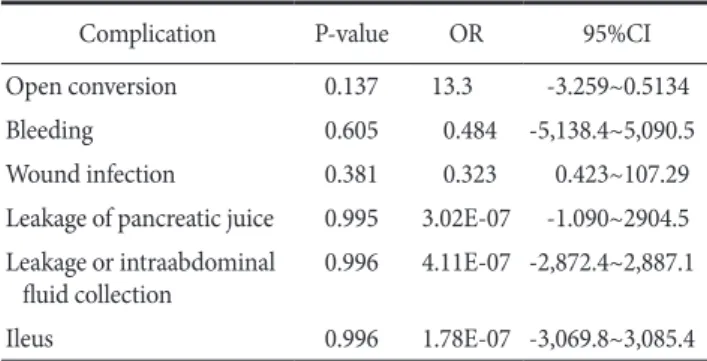
the value of C-reactive protein 7 days after the operation and post- operative hospital stay (Table 2) between the two groups. Table 3 and 4 summarize the peri-operative complications in univariate analysis. Each group had one conversion case from a laparoscopic gastrectomy to an open gastrectomy. Unexpected bleeding oc- curred in 8 cases. Post-operative complications were categorized into minor or major complications. No significant differences were noted between the two groups in the incidence of major complica- tions such as anastomotic leakage, anastomotic bleeding and colon injury. Six major factors associated with peri- or post-operative complications were selected for the multivariate analysis. None of the factors significantly increased in the high BMI cases (Table 5).
Discussion
A laparoscopic distal gastrectomy (LDG) is generally used for the treatment of gastric cancer, since this type of surgery has dem- onstrated benefits over open surgery.(1,14) Many surgeons expected that the laparoscopic approach for gastric surgery would improve the morbidity and mortality for high risk patients in comparison to open surgery. However, the advantages for high risk patients, such as the obese, elderly and patients with low respiratory function are still controversial. Some previous studies have suggested that there is no difference in the post-operative morbidity and mortality be- tween obese and non-obese patients associated with LDG for gas- tric cancer.(6-8,15,16) However, a longer duration of surgery and more difficult operations have been reported for obese patients.(7,8) Recently, a TLDG has been used for the treatment of gastric cancer.(9,17,18) TLDG is a method in which both the resection and anastomosis are performed intracorporeally using laparoscopic procedures. Previous studies have shown favorable results with TLDG and demonstrated this approach with lymph node dissection
to be technically feasible, and it is thus considered to be an effective surgical modality for gastric cancer without a high morbidity rate.
In this report, we retrospectively compared the factors associated with the outcome of a TLDG in obese patients and non-obese pa- tients to elucidate the safety and advantages for the obese patients.
We found no significant differences between the two groups in terms of the duration of surgery, bleeding and post-operative com- plications.
The most important problem resulting from the laparoscopic surgery for obese patient was anastomosis. The anastomosis is per- formed in the abdominal cavity in TLDG, and excessive torsion is not applied to the remnant stomach and duodenum. Therefore, no extension of the wound or minilaparotomy is usually necessary.
This made the anastomois simple and easy. Therefore, anastomo- sis-related complications are rarely observed. Wound infections may be more frequent in obese patients.(19,20) The risk for wound infection also decreases following the TLDG procedure because of the smaller wound.
In open surgery, it has been reported that the number of retrieved lymph nodes for gastrectomy with D2 resection was not affected by obesity.(21) On the other hand, another report showed that the num- ber of examined lymph nodes was affected by obesity.(22) Laparo- scopic surgery has advantages for minute surgical procedures, such as lymph node dissection, however it is controversial whether the number of retrieved lymph nodes is influenced by obesity or not when using this procedure.(6,15) In our investigation, the duration of surgery and the number of retrieved lymph nodes was not dif- ferent between obese and non-obese patients. The average number of retrieved lymph nodes in obese patients was 30.8±16.2 and that in non obese patients were 32.7±15.0. Laparoscopic surgery there- fore seems to be more suitable for lymph node dissection because of the magnification of the field of vision, even for obese patients.
In conclusion, the TLDG is therefore considered to be a safe and effective procedure for obese patients since there were no dif- ferences in the duration of surgery, estimated blood loss, and rate of complications, in spite of the difference in the patients’ background.
This method can therefore be recommended as a standard treat- ment for obese patients.
References
1. Kitano S, Iso Y, Moriyama M, Sugimachi K. Laparoscopy-as- sisted Billroth I gastrectomy. Surg Laparosc Endosc 1994;4:146- 148.
Table 5. Multivariate analysis of complications for high BMI
Complication P-value OR 95%CI
Open conversion 0.137 13.3 -3.259~0.5134
Bleeding 0.605 0.484 -5,138.4~5,090.5
Wound infection 0.381 0.323 0.423~107.29
Leakage of pancreatic juice 0.995 3.02E-07 -1.090~2904.5 Leakage or intraabdominal
fluid collection 0.996 4.11E-07 -2,872.4~2,887.1
Ileus 0.996 1.78E-07 -3,069.8~3,085.4
BMI = body mass index; OR = odds ratio; CI = confidence interval.
2. Bittner R, Butters M, Ulrich M, Uppenbrink S, Beger HG. Total gastrectomy. Updated operative mortality and long-term sur- vival with particular reference to patients older than 70 years of age. Ann Surg 1996;224:37-42.
3. Eguchi T, Fujii M, Takayama T. Mortality for gastric cancer in elderly patients. J Surg Oncol 2003;84:132-136.
4. Mochiki E, Ohno T, Kamiyama Y, Aihara R, Nakabayashi T, Asao T, et al. Laparoscopy-assisted gastrectomy for early gastric cancer in young and elderly patients. World J Surg 2005;29:1585-1591.
5. Wu CW, Hsieh MC, Lo SS, Wang LS, Hsu WH, Lui WY, et al.
Morbidity and mortality after radical gastrectomy for patients with carcinoma of the stomach. J Am Coll Surg 1995;181:26- 32.
6. Yamada H, Kojima K, Inokuchi M, Kawano T, Sugihara K.
Effect of obesity on technical feasibility and postoperative out- comes of laparoscopy-assisted distal gastrectomy--comparison with open distal gastrectomy. J Gastrointest Surg 2008;12:997- 1004.
7. Yasuda K, Inomata M, Shiraishi N, Izumi K, Ishikawa K, Kitano S. Laparoscopy-assisted distal gastrectomy for early gastric cancer in obese and nonobese patients. Surg Endosc 2004;18:1253-1256.
8. Noshiro H, Shimizu S, Nagai E, Ohuchida K, Tanaka M.
Laparoscopy-assisted distal gastrectomy for early gastric can- cer: is it beneficial for patients of heavier weight? Ann Surg 2003;238:680-685.
9. Ikeda O, Sakaguchi Y, Aoki Y, Harimoto N, Taomoto J, Masuda T, et al. Advantages of totally laparoscopic distal gastrectomy over laparoscopically assisted distal gastrectomy for gastric cancer. Surg Endosc 2009;23:2374-2379.
10. Japanese Gastric Cancer Association, eds. Japanese Classifica- tion of Gastric Carcinoma 13th edition (Japanese). Tokyo:
Kanehara publishing, 1999.
11. Sakaguchi Y, Ikeda O, Toh Y, Aoki Y, Harimoto N, Taomoto J, et al. New technique for the retraction of the liver in laparo- scopic gastrectomy. Surg Endosc 2008;22:2532-2534.
12. Kanaya S, Gomi T, Momoi H, Tamaki N, Isobe H, Katayama T, et al. Delta-shaped anastomosis in totally laparoscopic Billroth
I gastrectomy: new technique of intraabdominal gastroduode- nostomy. J Am Coll Surg 2002;195:284-287.
13. Takaori K, Nomura E, Mabuchi H, Lee SW, Agui T, Miyamoto Y, et al. A secure technique of intracorporeal Roux-Y recon- struction after laparoscopic distal gastrectomy. Am J Surg 2005;189:178-183.
14. Kitano S, Shiraishi N, Fujii K, Yasuda K, Inomata M, Adachi Y.
A randomized controlled trial comparing open vs laparoscopy- assisted distal gastrectomy for the treatment of early gastric cancer: an interim report. Surgery 2002;131:S306-311.
15. Kim KH, Kim MC, Jung GJ, Kim HH. The impact of obesity on LADG for early gastric cancer. Gastric Cancer 2006;9:303- 307.
16. Lee HJ, Kim HH, Kim MC, Ryu SY, Kim W, Song KY, et al; Ko- rean Laparoscopic Gastrointestinal Surgery Study Group. The impact of a high body mass index on laparoscopy assisted gas- trectomy for gastric cancer. Surg Endosc 2009;23:2473-2479.
17. Guzman EA, Pigazzi A, Lee B, Soriano PA, Nelson RA, Ben- jamin Paz I, et al. Totally laparoscopic gastric resection with extended lymphadenectomy for gastric adenocarcinoma. Ann Surg Oncol 2009;16:2218-2223.
18. Huscher CG, Mingoli A, Sgarzini G, Brachini G, Binda B, Di Paola M, et al. Totally laparoscopic total and subtotal gastrec- tomy with extended lymph node dissection for early and ad- vanced gastric cancer: early and long-term results of a 100-pa- tient series. Am J Surg 2007;194:839-844.
19. Barber GR, Miransky J, Brown AE, Coit DG, Lewis FM, Thaler HT, et al. Direct observations of surgical wound infections at a comprehensive cancer center. Arch Surg 1995;130:1042-1047.
20. Tsukada K, Miyazaki T, Kato H, Masuda N, Fukuchi M, Fukai Y, et al. Body fat accumulation and postoperative complications after abdominal surgery. Am Surg 2004;70:347-351.
21. Gretschel S, Christoph F, Bembenek A, Estevez-Schwarz L, Schneider U, Schlag PM. Body mass index does not affect sys- tematic D2 lymph node dissection and postoperative morbid- ity in gastric cancer patients. Ann Surg Oncol 2003;10:363-368.
22. Lee JH, Paik YH, Lee JS, Ryu KW, Kim CG, Park SR, et al. Ab- dominal shape of gastric cancer patients influences short-term surgical outcomes. Ann Surg Oncol 2007;14:1288-1294.