Background and Purpose The literature indicates that obstructive sleep apnea (OSA) in- creases the risk of ischemic stroke. However, the causal relationship between OSA and isch- emic stroke is not well established. This study examined whether preexisting OSA symptoms affect the onset of acute ischemic stroke.
Methods We investigated consecutive patients who were admitted with acute ischemic stroke, using a standardized protocol including the Berlin Questionnaire on symptoms of OSA prior to stroke. The collected stroke data included the time of the stroke onset, risk factors, and etiologic subtypes. The association between preceding OSA symptoms and wake-up stroke (WUS) was assessed using multivariate logistic regression analysis.
Results We identified 260 subjects with acute ischemic strokes with a definite onset time, of which 25.8% were WUS. The presence of preexisting witnessed or self-recognized sleep apnea was the only risk factor for WUS (adjusted odds ratio=2.055, 95% confidence interval=1.035–
4.083, p=0.040).
Conclusions Preexisting symptoms suggestive of OSA were associated with the occurrence of WUS. This suggests that OSA contributes to ischemic stroke not only as a predisposing risk fac- tor but also as a triggering factor. Treating OSA might therefore be beneficial in preventing stroke, particularly that occurring during sleep.
Key Words obstructive sleep apnea, wake-up stroke, questionnaires.
Increased Risk of Ischemic Stroke during Sleep in Apneic Patients
INTRODUCTION
Obstructive sleep apnea (OSA) is a recently identified risk factor for stroke, which is impor- tant since the condition is both highly prevalent and treatable. The recent revised stroke prevention guideline provided new recommendations for secondary stroke prevention as well as commenting on sleep apnea.1 However, it remains unclear whether the relationship between OSA and stroke is causative or merely a correlation. The association between OSA and stroke is often explained by the sharing of common comorbid conditions such as hy- pertension, diabetes mellitus, dyslipidemia, obesity, and atrial fibrillation, which are well- established stroke risk factors. Although more recent studies showed that OSA is an indepen- dent risk factor for stroke,2,3 these studies were not designed to identify the pathophysiologic mechanism linking OSA to stroke. Moreover, whether treating OSA decreases the risk of incident stroke also needs remains to be clarified.4
If OSA is a direct triggering factor for stroke, stroke might occur more frequently during sleep in people with OSA. Stroke occurring during sleep or wake-up stroke (WUS) report- edly constitute 13.5–38.9% of cases of ischemic stroke.5-13 Patients who wake up with stroke symptoms are often not eligible for thrombolytic therapy, since administering IV tissue Jin Soo Kima
Seongheon Kima Seung Hwan Leea Hee Young Leeb Seo-Young Leea Kyoung Bin Imc
a Department of Neurology,
Gangwon Comprehensive Stroke Center, Kangwon National University
School of Medicine,
Kangwon National University Hospital, Chuncheon, Korea
b Center for Preventive Medicine and Public Health, Seoul National University Bundang Hospital, Seongnam, Korea
c UIHC Sleep Disorders Center, Clinical Neurology and Psychiatry, The University of Iowa, Iowa, USA
pISSN 1738-6586 / eISSN 2005-5013 / J Clin Neurol 2018;14(2):174-178 / https://doi.org/10.3988/jcn.2018.14.2.174
Received June 16, 2017 Revised October 31, 2017 Accepted October 31, 2017 Correspondence Seo-Young Lee, MD, PhD Department of Neurology, Gangwon Comprehensive Stroke Center, Kangwon National University School of Medicine,
Kangwon National University Hospital, 156 Baengnyeong-ro,
Chuncheon 24289, Korea Tel +82-33-258-2431 Fax +82-33-258-2103
E-mail [email protected]
cc This is an Open Access article distributed under the terms of the Creative Commons Attribution Non-Com- mercial License (http://creativecommons.org/licenses/by-nc/4.0) which permits unrestricted non-commercial use, distribution, and reproduction in any medium, provided the original work is properly cited.
JCN
Open Access ORIGINAL ARTICLEKim JS et al.
JCN
plasminogen activator is restricted to 4.5 hours following the onset of stroke symptoms. Some studies found that WUS patients had a greater initial stroke severity and were more likely to experience a poor outcome,5,9 while many studies have found that risk-factor profiles do not differ significantly between WUS and non-WUS. There are several reports of dyslipidemia being more frequent in WUS.13-15 Lower blood pressure was suggested as a risk factor for WUS,11 but this finding has not been replicated in other studies. Four12,15-17 of six11-13,15-17 studies that assessed OSA as a stroke risk factor found that habitual snoring or a higher apnea-hypopnea in- dex in poststroke polysomnography (PSG) was more fre- quent among WUS patients (Supplementary Table 1 in the online-only Data Supplement). However, poststroke PSG cannot be used to diagnose preexisting OSA due to the high prevalence of new-onset OSA following acute stroke. Based on the above-mentioned considerations, the present study examined whether preexisting symptoms of OSA are associ- ated with the occurrence of WUS.
METHODS
We consecutively evaluated adult patients who were admit- ted with acute ischemic stroke in Gangwon Comprehensive Stroke Center (CSC) in Kangwon National University Hos- pital between December 1, 2013 and April 30, 2015. Gang- won CSC is 1 of 11 regional CSCs in South Korea, and it covers the Gangwon province. This center was established in 2009 with support from the Ministry of Health and Welfare.
We included patients with acute ischemic stroke present- ing via the emergency room (ER) within 7 days from the stroke onset. Patients were excluded if they had experienced a transient ischemic attack and hemorrhagic stroke. We also excluded those in whom the ischemic stroke occurred dur- ing hospitalization or if the patient was admitted via an out- patient clinic, since the intake interview could be standard- ized only when the patient initially presented to the ER. We used a standardized protocol to collect clinical information associated with stroke, laboratory findings, and preexisting symptoms of OSA. Patients or their caregivers were asked to provide a careful description of the situation and timing of stroke onset. The strokes were classified into WUS and non- WUS based on the time of stroke onset, where WUS was defined as the symptoms being recognized upon awakening by a witness or by the patient, and non-WUS was defined as the symptoms being recognized while performing daily ac- tivities. The strokes were categorized into the following sub- types using the Trial of Org 10172 in Acute Stroke Treatment (TOAST) criteria: large-artery atherosclerosis, cardioembo- lism, small-vessel occlusion, other determined etiology, and
undetermined etiology. The routine workup for acute isch- emic stroke was performed using brain CT, MRI, carotid ul- trasonography, and transthoracic echocardiography. Selected patients underwent 24-hour Holter monitoring and trans- esophageal echocardiography when embolic infarction was strongly suggested and the source could not be found using the aforementioned routine tests.
The presence of OSA symptoms prior to the stroke was assessed by applying the Korean version of the Berlin Ques- tionnaire18 to either the patient or caregiver. All question- naires were administered by a single interviewer affiliated to Gangwon CSC while being blinded to clinical information, including the stroke onset time. This questionnaire compris- es 11 questions grouped into 3 categories. Category 1 consists of five questions covering snoring, witnessed or self-recog- nized apnea, and the frequency of such events. Category 2 consists of four questions on daytime sleepiness; we modified the question “Have you ever fallen asleep while driving?” to
“Have you had trouble staying awake while driving, eating meals, or engaging in social activity?” because most of the patients answered “I don’t drive” in our pilot study. Category 3 consists of two questions concerning blood pressure and body mass index (BMI). Patients were considered to be at a high risk of sleep apnea when they conformed with at least two symptom categories.19
Statistical analysis was used to compare the demographic and clinical variables between WUS and non-WUS patients.
The chi-square test or Fisher’s exact test was used for categor- ical variables, while the independent t-test was used for con- tinuous variables including age, cholesterol, and BMI. Mul- tivariate logistic regression analysis was used to assess the association between witnessed or self-recognized sleep apnea and WUS. The model was adjusted for potential confound- ers including sex, age, history of prior stroke, hypertension, diabetes mellitus, smoking, hypercholesterolemia, and atrial fibrillation. We did not include obesity in the model due to the presence of a prior strong correlation with sleep apnea and BMI not differing significantly between WUS and non- WUS patients. For multivariate analysis, age was categorized to three groups of <60, 60–75, and >75 years, while hyper- cholesterolemia was considered to be present when total cho- lesterol was higher than 240 mg/dL.
The Statistical Package for Social Sciences (version 21 for Windows, IBM Corp., Armonk, NY, USA) was used for the sta- tistical analyses. All reported p values are two-tailed, with p<
0.05 defining the presence of statistical significance.
The study was approved by the Institutional Review Board of Kangwon National University Hospital (KNUH-2016-03- 007-001).
Risk of Stroke During Sleep in Apneic Patients
JCN
RESULTS
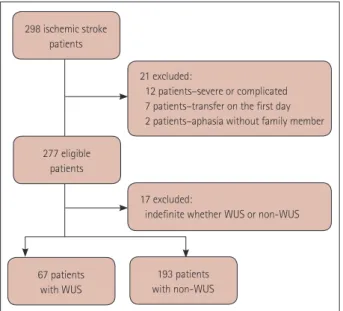
In total, 298 patients with acute ischemic stroke met the in- clusion criteria. We could not obtain answered questionnaires for 21 patients because 12 had severe medical complications, 7 were transferred to other hospitals on the day of admission, and 2 patients had severe aphasia and no caregiver. Seven- teen of the remaining 277 patients were excluded because the stroke onset could not be categorized into either WUS or non-WUS. Finally 260 patients were included in the final analysis: 67 (25.8%) in the WUS group and 193 (74.2%) in the non-WUS group (Fig. 1). The informants for the Berlin Ques- tionnaire were the patients in 81 (31.2%) cases, cosleepers in 67 (25.8%) cases, and other family members in 112 (43.1%) cases. There were positive replies to Category 1 questions on snoring and apnea in 83 (31.9%) patients, to Category 2 questions on excessive daytime sleepiness in 21 (8.1%) pa- tients, and to Category 3 questions on obesity and hyperten- sion in 150 (57.7%) patients. Overall, 59 (22.7%) patients were considered at a high risk of sleep apnea based on the number of positive signs/symptoms in the different categories.
The clinical characteristics of the WUS and non-WUS patients are compared in Table 1. Witnessed or self-recog- nized sleep apnea was significantly more common in WUS
Table 1. Clinical characteristics according to the time of stroke onset
Characteristics Total (n=260) WUS (n=67) non-WUS (n=193) p
Demographic variables
Sex, male 152 (58.5) 39 (58.2) 113 (58.5) 0.961
Age (year) 71.6±11.5 71.4±12.6 71.7±11.2 0.847
Stroke risk factors
Prior stroke 53 (20.4) 13 (19.4) 40 (20.7) 0.817
Hypertension 153 (58.8) 40 (59.7) 113 (58.5) 0.869
Diabetes mellitus 82 (31.5) 25 (37.3) 57 (29.5) 0.238
Smoking 86 (33.1) 25 (37.3) 61 (31.6) 0.392
Total cholesterol (mg/dL) 176.7±42.1 181.2±41.1 175.2±42.4 0.312
Atrial fibrillation 47 (18.1) 7 (10.4) 40 (20.7) 0.060
Body mass index (kg/m2) 23.9±3.50 24.0±3.47 23.8±3.51 0.650
Etiology based on TOAST classification
Large-artery atherosclerosis 136 (52.3) 38 (56.7) 98 (50.8) 0.402
Cardioembolism 63 (24.2) 11 (16.4) 52 (26.9) 0.083
Small-vessel occlusion 40 (15.4) 10 (14.9) 30 (15.5) 0.904
Other determined etiology 7 (2.7) 3 (4.5) 4 (2.1) 0.295
Undetermined etiology 14 (5.4) 5 (7.5) 9 (4.7) 0.382
Symptoms suggesting sleep breathing disorder †
Snoring 137 (52.7) 37 (55.2) 100 (51.8) 0.630
Sleep apnea 51 (19.6) 19 (28.3) 32 (16.6) 0.036*
Severity of stroke
NIHSS score 3 [1–5.75] 4 [2–9] 2 [1–4.5] 0.013*
Questionnaire informant
Cosleepers 67 (25.8) 15 (22.4) 52 (26.9) 0.463
Data are mean±standard deviation, n (%), or median [interquartile range] values.
*p<0.05, †Snoring, at least once a month; sleep apnea, witnessed or self-recognized sleep apnea at least once a month.
NIHSS: National Institute of Health Stroke Scale, TOAST: Trial of Org 10172 in Acute Stroke Treatment, WUS: wake-up stroke.
298 ischemic stroke patients
277 eligible patients
67 patients with WUS
193 patients with non-WUS 21 excluded:
12 patients–severe or complicated 7 patients–transfer on the first day 2 patients–aphasia without family member
17 excluded:
indefinite whether WUS or non-WUS
Fig. 1. Study subjects. WUS: wake-up stroke.
Kim JS et al.
JCN
patients than in non-WUS patients (28.3% versus 16.6%, p=
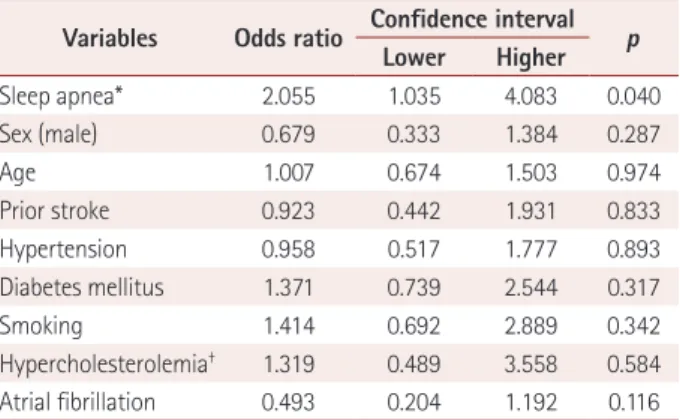
0.036). However, the snoring and risk categorization for sleep apnea based on the Berlin Questionnaire did not differ signifi- cantly between these two groups. Atrial fibrillation was mar- ginally more frequent in non-WUS than in WUS (20.7% ver- sus 10.4%, p=0.060). The National Institute of Health Stroke Scale (NIHSS) scores at admission were more severe in WUS than in non-WUS (median=4 [interquartile range=2–9] versus 2 [1–4.5], p=0.013). None of the other demographic or stroke risk factors differed significantly between the two groups. Mul- tivariate analysis confirmed that only sleep apnea was signifi- cantly associated with WUS (odds ratio=2.055, 95% confi- dence interval=1.035– 4.083, p=0.040) (Table 2).
DISCUSSION
We found that sleep apnea prior to stroke was associated with WUS. This suggests that OSA not only influences chronic changes that predispose patients to stroke but also produces more acute changes directly resulting in stroke. Treating OSA might therefore be beneficial in preventing stroke, even in el- derly patients with long-standing disease. Plausible mecha- nisms for OSA-associated ischemic stroke include the imme- diate effect of hypoxia, decreased cerebral blood flow, and the paradoxical embolism induced by apnea events, plaque disruption associated with vibration, and hypercoagulability that have been noted in OSA patients.20,21
Our finding that the incidence of stroke while awake was higher in those with atrial fibrillation supports the traditional idea that embolic stroke is more likely to occur while active.22 In agreement with a few previous studies, the initial NIHSS score at admission was higher in WUS than in non-WUS.
This could be due to not only the delay in detecting and treat- ing stroke, but also being in a worse condition such as de- creased systemic blood pressure or lower cerebral blood flow,
or hypercoagulability during sleep.23-25 The association be- tween OSA and WUS is more meaningful in this regard.
Our study was subject to some limitations. The study had a cross-sectional design and the questionnaire was the only way to identify the presence of OSA symptoms preceding the onset of stroke, because poststroke PSG does not indicate preexisting OSA. Classifying a high versus a low risk of sleep apnea based on the category scores of the Berlin Question- naire was reported to have low validity in the elderly, mainly due to hypertension being highly prevalent and the difficul- ty of assessing sleepiness in the elderly. Simply using Cate- gory 1 on snoring and apnea was more valid than using a high/low classification,26 supporting our results that WUS was associated with the presence of apnea rather than a high-risk classification. Witnessed sleep apnea had a high specificity and low sensitivity for significant OSA confirmed by PSG, whereas snoring had a high sensitivity and relatively low speci- ficity.27
Despite the validity issues, the prevalence of OSA symp- toms in our study was comparable to the prevalence of PSG- confirmed OSA in a previous study performed in Korea.28 While our study was conducted in a single center, Kangwon National University Hospital is a teaching hospital that pro- vides advanced specialty care and has a large catchment area that encompasses the province with easy access for patients.
We therefore consider the data from a model to be less biased.
However, the findings of this study need to be confirmed in larger-scale prospective cohort studies that apply PSG to evaluate underlying OSA and long-term follow-up in order to detect the occurrence of stroke and stroke onset time.
In conclusion, preexisting symptoms of OSA were associ- ated with the occurrence of WUS. This result has highly prac- tical implications for preventing WUS and provides insight into the mechanism underlying how OSA influences the in- cidence of stroke.
Supplementary Materials
The online-only Data Supplement is available with this arti- cle at https://doi.org/10.3988/jcn.2018.14.2.174.
Conflicts of Interest
The authors have no financial conflicts of interest.
Acknowledgements
This study was supported by 2016 Research Grant from Kangwon Nation- al University (No. 520160371).
We are indebted to Hye-Yeon Jang, RN of Gangwon CSC for interview- ing patients or caregivers, to Yeong-Kwon Park, PhD of Gangwon CSC for collecting data and managing database, and Rachel Maurer, MD of UIHC Sleep Disorders Center for preparation of manuscript.
Table 2. Odds ratios and confidence intervals for wake-up stroke in the multivariate analysis
Variables Odds ratio Confidence interval Lower Higher p
Sleep apnea* 2.055 1.035 4.083 0.040
Sex (male) 0.679 0.333 1.384 0.287
Age 1.007 0.674 1.503 0.974
Prior stroke 0.923 0.442 1.931 0.833
Hypertension 0.958 0.517 1.777 0.893
Diabetes mellitus 1.371 0.739 2.544 0.317
Smoking 1.414 0.692 2.889 0.342
Hypercholesterolemia† 1.319 0.489 3.558 0.584 Atrial fibrillation 0.493 0.204 1.192 0.116
*Witnessed or self-recognized sleep apnea at least once a month, †Total cholesterol higher than 240 mg/dL.
Risk of Stroke During Sleep in Apneic Patients
JCN
REFERENCES
1. Kernan WN, Ovbiagele B, Black HR, Bravata DM, Chimowitz MI, Ezekowitz MD, et al. Guidelines for the prevention of stroke in patients with stroke and transient ischemic attack: a guideline for healthcare professionals from the American Heart Association/American Stroke Association. Stroke 2014;45:2160-2236.
2. Yaggi HK, Concato J, Kernan WN, Lichtman JH, Brass LM, Mohs- enin V. Obstructive sleep apnea as a risk factor for stroke and death.
N Engl J Med 2005;353:2034-2041.
3. Redline S, Yenokyan G, Gottlieb DJ, Shahar E, O’Connor GT, Resnick HE, et al. Obstructive sleep apnea-hypopnea and incident stroke: the sleep heart health study. Am J Respir Crit Care Med 2010;182:269-277.
4. Kim Y, Koo YS, Lee HY, Lee SY. Can continuous positive airway pressure reduce the risk of stroke in obstructive sleep apnea patients?
A systematic review and meta-analysis. PLoS One 2016;11:e0146317.
5. Mackey J, Kleindorfer D, Sucharew H, Moomaw CJ, Kissela BM, Al- well K, et al. Population-based study of wake-up strokes. Neurology 2011;76:1662-1667.
6. Spengos K, Tsivgoulis G, Manios E, Synetou M, Vassilopoulou S, Za- kopoulos N, et al. Stroke etiology is associated with symptom onset during sleep. Sleep 2005;28:233-238.
7. Nadeau JO, Fang J, Kapral MK, Silver FL, Hill MD; Registry of the Canadian Stroke Network. Outcome after stroke upon awakening.
Can J Neurol Sci 2005;32:232-236.
8. Silva GS, Lima FO, Camargo EC, Smith WS, Singhal AB, Greer DM, et al. Wake-up stroke: clinical and neuroimaging characteristics. Cerebro- vasc Dis 2010;29:336-342.
9. Kim BJ, Lee SH, Shin CW, Ryu WS, Kim CK, Yoon BW. Ischemic stroke during sleep: its association with worse early functional out- come. Stroke 2011;42:1901-1906.
10. Moradiya Y, Janjua N. Presentation and outcomes of “wake-up strokes”
in a large randomized stroke trial: analysis of data from the Interna- tional Stroke Trial. J Stroke Cerebrovasc Dis 2013;22:e286-e292.
11. Bassetti C, Aldrich M. Night time versus daytime transient ischaemic attack and ischaemic stroke: a prospective study of 110 patients. J Neurol Neurosurg Psychiatry 1999;67:463-467.
12. Hsieh SW, Lai CL, Liu CK, Hsieh CF, Hsu CY. Obstructive sleep ap- nea linked to wake-up strokes. J Neurol 2012;259:1433-1439.
13. Tanimoto A, Mehndiratta P, Koo BB. Characteristics of wake-up stroke.
J Stroke Cerebrovasc Dis 2014;23:1296-1299.
14. Kim TJ, Ko SB, Jeong HG, Lee JS, Kim CK, Kim Y, et al. Nocturnal desaturation in the stroke unit is associated with wake-up ischemic stroke. Stroke 2016;47:1748-1753.
15. Šiarnik P, Kollár B, Čarnická Z, Šurda P, Klobučníková K, Sýkora M, et al. Association of sleep disordered breathing with wake-up acute isch- emic stroke: a full polysomnographic study. J Clin Sleep Med 2016;12:
549-554.
16. Martínez García MA, Galiano Blancart R, Cabero Salt L, Soler Cata- luña JJ, Escamilla T, Román Sánchez P. [Prevalence of sleep-disor- dered breathing in patients with acute ischemic stroke: influence of onset time of stroke]. Arch Bronconeumol 2004;40:196-202.
17. Palomäki H, Partinen M, Juvela S, Kaste M. Snoring as a risk factor for sleep-related brain infarction. Stroke 1989;20:1311-1315.
18. Kang K, Park KS, Kim JE, Kim SW, Kim YT, Kim JS, et al. Usefulness of the Berlin Questionnaire to identify patients at high risk for ob- structive sleep apnea: a population-based door-to-door study. Sleep Breath 2013;17:803-810.
19. Netzer NC, Stoohs RA, Netzer CM, Clark K, Strohl KP. Using the Ber- lin Questionnaire to identify patients at risk for the sleep apnea syn- drome. Ann Intern Med 1999;131:485-491.
20. Dyken ME, Im KB. Obstructive sleep apnea and stroke. Chest 2009;
136:1668-1677.
21. Yaggi H, Mohsenin V. Obstructive sleep apnoea and stroke. Lancet Neurol 2004;3:333-342.
22. Chaturvedi S, Adams HP Jr, Woolson RF. Circadian variation in isch- emic stroke subtypes. Stroke 1999;30:1792-1795.
23. Hastings MH, Reddy AB, Maywood ES. A clockwork web: circadian timing in brain and periphery, in health and disease. Nat Rev Neuro- sci 2003;4:649-661.
24. Zoccoli G, Walker AM, Lenzi P, Franzini C. The cerebral circulation during sleep: regulation mechanisms and functional implications.
Sleep Med Rev 2002;6:443-455.
25. Bridges AB, McLaren M, Scott NA, Pringle TH, McNeill GP, Belch JJ.
Circadian variation of tissue plasminogen activator and its inhibitor, von Willebrand factor antigen, and prostacyclin stimulating factor in men with ischaemic heart disease. Br Heart J 1993;69:121-124.
26. Sforza E, Chouchou F, Pichot V, Herrmann F, Barthélémy JC, Roche F.
Is the Berlin questionnaire a useful tool to diagnose obstructive sleep apnea in the elderly? Sleep Med 2011;12:142-146.
27. Bliwise DL, Nekich JC, Dement WC. Relative validity of self-reported snoring as a symptom of sleep apnea in a sleep clinic population. Chest 1991;99:600-608.
28. Kim J, In K, Kim J, You S, Kang K, Shim J, et al. Prevalence of sleep- disordered breathing in middle-aged Korean men and women. Am J Respir Crit Care Med 2004;170:1108-1113.