© 2013 The Korean Academy of Medical Sciences.
This is an Open Access article distributed under the terms of the Creative Commons Attribution Non-Commercial License (http://creativecommons.org/licenses/by-nc/3.0) which permits unrestricted non-commercial use, distribution, and reproduction in any medium, provided the original work is properly cited.
pISSN 1011-8934 eISSN 1598-6357
Association of the Catechol-o-Methyltransferase Gene Polymorphisms with Korean Autism Spectrum Disorders
This study evaluated the family-based genetic association between autism spectrum disorders (ASDs) and 5 single-nucleotide polymorphisms (SNPs) in the catechol-o- methyltransferase gene (COMT), which was found among 151 Korean ASDs family trios (dominant model Z = 2.598, P = 0.009, PFDR= 0.045). We found a statistically significant allele transmission or association in terms of the rs6269 SNP in the ASDs trios. Moreover, in the haplotype analysis, the haplotypes with rs6269 demonstrated significant evidence of an association with ASDs (additive model rs6269-rs4818-rs4680-rs769224 haplotype P = 0.004, PFDR= 0.040). Thus, an association may exist between the variants of the COMT gene and the occurrence of ASDs in Koreans.
Key Words: Autism Spectrum Disorders (ASD); Polymorphisms, Single Nucleotide (SNPs);
Catechol-O-Methyltransferase Gene (COMT); Family-Based Association Study Hee Jeong Yoo,1 In Hee Cho,2
Mira Park,3 So Young Yang,4 and Soon Ae Kim5
1Department of Psychiatry, Seoul National University Bundang Hospital, Seongnam; 2Department of Psychiatry, Gachon University Gil Medical Center, Incheon; 3Department of Preventive Medicine, School of Medicine, Eulji University, Daejeon;
4Department of Pharmacology, Chungnam National University College of Pharmacy, Daejeon;
5Department of Pharmacology, School of Medicine, Eulji University, Daejeon, Korea
Received: 28 January 2013 Accepted: 16 July 2013 Address for Correspondence:
Soon Ae Kim, MD
Department of Pharmacology, School of Medicine, Eulji University, 77 Gyeryong-ro 771 beon-gil, Jung-gu, Daejeon 301-746, Korea
Tel: +82.42-259-1677, Fax: +82.42-259-1679 E-mail: [email protected]
This work was supported by the National Research Foundation of Korea (NRF) grant funded by the Korea government (MEST) (2010-0007583). This work was also supported by the Korea Healthcare Technology R&D project, Ministry of Health &
Welfare, Republic of Korea (grant number A120029). Mira Park was supported by Basic Science Research Program through the National Research Foundation of Korea (NRF) funded by the Ministry of Education, Science and Technology (2011-0004376).
http://dx.doi.org/10.3346/jkms.2013.28.9.1403 • J Korean Med Sci 2013; 28: 1403-1406
BRIEF COMMUNICATION
Psychiatry & Psychology
The dopaminergic system is known to affect a wide range of be- haviors and brain functions. Catechol-o-methyltransferase (CO- MT) has been implicated as playing a role in a variety of psychi- atric symptoms and diseases, including phobic anxiety, obses- sive-compulsive disorder, schizophrenia, and attention-deficit hyperactivity disorder (1, 2). Presuming that autism spectrum disorders (ASDs) are associated with a high level of anxiety, ge- netic overlap with schizophrenia, and a high level of sexual dif- ference, it can be hypothesized that COMT may be one of the contributing factors in the pathogenesis of ASDs (2, 3). Of the several single nucleotide polymorphisms (SNPs) of COMT, rs4680 is a common and well-known normal variant. Chen et al. (4) revealed that rs4680 significantly affects the protein abun- dance and enzyme activity in postmortem human prefrontal cortex tissue.
Based on this concept, several studies investigating the ge- netic association between COMT polymorphisms and ASDs have been conducted. Although James et al. (5) reported a ge- netic association with polymorphism rs4680 in a case-controll-
ed setting, some family-based association tests failed to identify a linkage/association with this SNP (6, 7). In this study, we con- ducted an association study by using some other common SNPs of the COMT gene in Korean families with ASDs to confirm the genetic association with different populations.
This study was performed with 151 Korean complete ASDs trios comprising patients with ASDs (age, 79.9 ± 35.6 months;
male, 86.1%; patients with autism, 87.4%; patients with perva- sive developmental disorder not otherwise specified, 13.5%;
and patients with Asperger’s disorder, 1.6%) and their biological parents. The ASDs probands were diagnosed using the Korean version of Autism Diagnostic Interview-Revised (ADI-R) and the Korean version of the Autism Diagnostic Observation Sche- dule (ADOS), together with an evaluation conducted by 2 board- certified child psychiatrists. The subject ascertainment and di- agnostic methods used have been previously described (8). The study protocol was approved by the institutional review board of Eulji University (IRB No. EU 08-06).
Genomic DNA from blood samples was prepared using a G-
Yoo HJ, et al. • COMT Gene Polymorphism and Korean ASDs
1404 http://jkms.org http://dx.doi.org/10.3346/jkms.2013.28.9.1403 spin Genomic DNA Extraction Kit (Intron, Daejeon, Korea). The
structures of the candidate genes were determined using the Entrez SNP database (http://www.ncbi.nlm.nih.gov/) and a publicly available genotype database for Asian populations from the International HapMap Project (http://www.hapmap.
org). The SNPs located in the coding region and 5´ and 3´ re- gions were selected (minor allele frequencies of greater than 0.05 in the Chinese and Japanese populations). Five SNPs in the COMT gene (rs6269, rs4818, rs4680, rs769224, and rs165728) were selected for the study and genotyped using the Golden- GateTM Assay (Illumina, San Diego, CA, USA).
The Mendelian inheritance error and Hardy-Weinberg equi- librium for each pair of SNPs were evaluated with the transmis- sion disequilibrium test (TDT) method in Haploview v3.2 (http:
//www.broad.mit.edu/mpg/haploview). Family-based associa- tion tests for each individual polymorphism and haplotype were performed using the Family-based Association Test (FBAT) pro - gram package (v2.0.2). HBAT, the haplotype version of the FBAT program, was used to identify haplotypes with a greater than 5%
frequency of association with ASDs. Haplotype tests were per- formed using permutations (n = 100,000 cycles) with the HBAT, Monte Carlo option. A quantitative transmission disequilibri- um test was also performed with the FBAT. For the quantitative behavioral scales, we explored 3 domain scores (qualitative ab- normalities in reciprocal social interaction; qualitative abnor- malities in communication; and restricted, repetitive, and ste- reotypical pattern of behavior) and 12 subdomain scores listed in the ADI-R (9). Both single-marker and haplotype testing were carried out for the affection status and each quantitative trait.
The power calculation for the association test and samples was
performed using the TDT for discrete traits, available at the Ge- netic Power Calculator web site (http://pngu.mgh.harvard.edu/
~purcell/gpc/). A P value of less than 0.05 was considered sta- tistically significant. We applied the false-discovery rate (FDR) procedure, which was proposed by Benjamini and Hochberg (10) for handling multiple comparison problems. FDR correc- tions were performed separately for single markers and haplo- types. FDR-corrected P values (PFDR) of less than 0.05 were con- sidered to be significant.
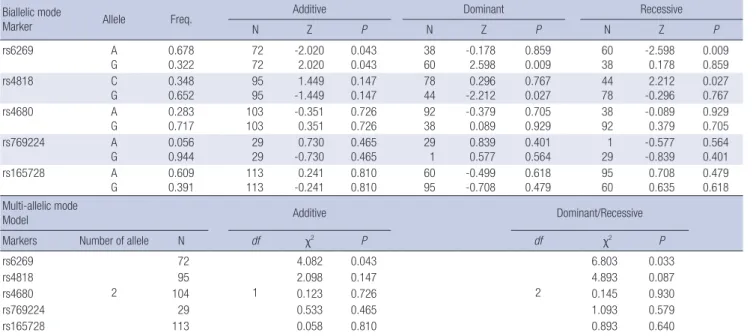
In the linkage disequilibrium test for each pair of markers, the 5 SNPs were in weak-to-strong linkage disequilibrium with respect to one another (0.49 < D´ < 1.00). In the biallelic mode, we obtained statistically significant results for the rs6269 poly- morphism in the additive and dominant/recessive models (G allele, additive: Z = 2.020, P = 0.043, PFDR= 0.215; dominant:
Z = 2.598, P = 0.009, PFDR= 0.045). In the multiallelic mode, no statistically significant results were obtained for rs6269 in the additive and dominant models, after multiple-testing correc- tion (additive: df = 1, P = 0.043, PFDR= 0.215; dominant: df = 2, P = 0.033, PFDR= 0.165) (Table 1).
Significant P values were observed for some haplotypes con- taining markers for COMT. A total of 16 haplotypes were ob- served with the 5 SNPs, and haplotypes with a frequency of greater than 0.05 were selected. We conducted haplotype anal- yses by using the sliding windows methods to identify specific haplotypes that were significant in the multiallelic mode. The haplotypes, including the rs6269 SNP, revealed statistically sig- nificant associations in the additive models (rs6269-rs4818 ha- plo type: P = 0.011, PFDR= 0.055; rs6269-rs4818-rs4680 haplo- type: P = 0.026, PFDR= 0.087; rs6269-rs4818-rs4680-rs769224 ha-
Table 1. FBAT analyses of markers of COMT gene in possible mode and models Biallelic mode
Marker Allele Freq. Additive Dominant Recessive
N Z P N Z P N Z P
rs6269 A
G 0.678
0.322 72
72 -2.020
2.020 0.043
0.043 38
60 -0.178
2.598 0.859
0.009 60
38 -2.598
0.178 0.009 0.859
rs4818 C
G
0.348 0.652
95 95
1.449 -1.449
0.147 0.147
78 44
0.296 -2.212
0.767 0.027
44 78
2.212 -0.296
0.027 0.767
rs4680 A
G 0.283
0.717 103
103 -0.351
0.351 0.726
0.726 92
38 -0.379
0.089 0.705
0.929 38
92 -0.089
0.379 0.929 0.705
rs769224 A
G 0.056
0.944 29
29 0.730
-0.730 0.465
0.465 29
1 0.839
0.577 0.401
0.564 1
29 -0.577
-0.839 0.564 0.401
rs165728 A
G
0.609 0.391
113 113
0.241 -0.241
0.810 0.810
60 95
-0.499 -0.708
0.618 0.479
95 60
0.708 0.635
0.479 0.618 Multi-allelic mode
Model Additive Dominant/Recessive
Markers Number of allele N df χ2 P df χ2 P
rs6269
2
72
1
4.082 0.043
2
6.803 0.033
rs4818 95 2.098 0.147 4.893 0.087
rs4680 104 0.123 0.726 0.145 0.930
rs769224 29 0.533 0.465 1.093 0.579
rs165728 113 0.058 0.810 0.893 0.640
Trait affection; offset 0.000; specifying minimum number of informative families 0; mininum frequency 0.050; The Z and χ2 tests produced by “FBAT” are large sample tests, based on the number of informative families (N). df, degree of freedom; χ2, χ2 statistic.
Yoo HJ, et al. • COMT Gene Polymorphism and Korean ASDs
http://jkms.org 1405
http://dx.doi.org/10.3346/jkms.2013.28.9.1403
plotype: P = 0.004, PFDR= 0.040; rs6269-rs4818-rs4680-rs769224- rs165728 haplotype: P = 0.044, PFDR= 0.110). Moreover, we could confirm the results for these haplotypes in the biallelic mode as well. The haplotype formed by 4 SNPs (rs6269 [A], rs4818 [G], rs4680 [G], and rs769224 [A]) revealed consistent statistically significant associations according to the additive (Z = -2.784, P = 0.005, PFDR= 0.025) and the dominant (Z = -2.677, P = 0.007, PFDR= 0.035) models.
In the quantitative trait analysis using the ADI-R diagnostic algorithm scores, no significant results were observed with the rs6269 SNP. However, significant associations were observed between rs4680 and the BV total scores (qualitative abnormali- ties in communication trait for verbal subjects) in the dominant/
recessive models (df = 2, P = 0.038). rs165728 was associated with the A1 trait (failure to use nonverbal behaviors to regulate social interaction; additive: df = 1, P = 0.032), and rs4818 was associated with the C2 (apparent compulsive adherence to non- functional routines or rituals; additive: df = 1, P = 0.037) and C4 (preoccupations with parts of objects or nonfunctional elements of material; additive: df = 1, P = 0.023) traits. In addition, the rs6269-rs4818-rs4680-rs769224 haplotypes were associated with the B4 trait (lack of varied spontaneous make-believe or social imitative play; additive: df = 7, P = 0.041; dominant: df = 7, P = 0.034), although these quantitative trait analysis results lost sig- nificance after applying FDR correction. In the power calcula- tion for the markers, we employed the additive model with high- risk allele frequency, a D´ value of 1, and a prevalence of 0.006.
In the TDT module, the values of power were 0.078 and 0.515, respectively.
This family-based association study supports a possible as- sociation between rs6269 and other SNPs in the linkage dis- equilibrium (LD) region of the COMT gene for ASDs-affected Korean individuals. Although several studies have described the association between rs6269 and cognitive functions as well as several disorders such as schizophrenia and major depres- sive disorder, to the best of our knowledge, this study is the first to report an association between rs6269 and ASDs (11, 12). Be- cause the shorter form of the COMT transcript may be regulat- ed by a distal P2 promoter region in which rs6269 is located (13), rs6269 might be involved in gene expression regulation.
The effects of rs4680 on COMT have been extensively studied in typical and neuropsychiatric populations. From the quanti- tative trait analysis in this study, it was revealed that rs4680 has a marginally significant association with the ADI-R-listed quali- tative abnormalities in communication trait for verbal subjects.
James et al. (5) reported the association between ASDs and rs4680, with a 1.74-fold increased susceptibility. The case con- trol analysis with our sample and the published Korean control population did not indicate a significant association (14) (data not shown). These results may be a consequence of ethnic dif- ferences, because the Asian and Caucasian populations have
different minor allele frequencies.
In this study, only ADI-R diagnostic algorithms were used to analyze the quantitative traits of the samples. Although we ob- served some relevance between SNPs in COMT and specific traits, the rs6269 SNP did not have any association with the quan- titative traits. Therefore, it might be helpful to use other quanti- tative traits of ASDs, assessed using biological or psychological tools for quantitative trait analysis. In addition, although we se- lected common SNPs of the population to get more informative families for this family-based analysis, this selection had some limitations in covering all of the COMT variants. Although the rs6269 SNP was associated with ASDs in the Koreans in this study, the analysis involved a relatively small sample and show- ed deficits in power with the power analysis. For the quantita- tive trait test, it would appear that the sample size did not confer enough power to the analysis performed. Moreover, the signifi- cant associations did not survive after multiple-testing correc- tions. Therefore, this study needs to be replicated and verified with a larger sample size and other ethnic groups that have enou- gh clinical data on the cognitive and executive functions for an effective quantitative trait analysis. In addition, for the hypothe- sized “common disease/rare variant model,” a genetic analysis needs to be conducted with several rare variants of the gene (15).
REFERENCES
1. Tunbridge EM, Harrison PJ. Importance of the COMT gene for sex dif- ferences in brain function and predisposition to psychiatric disorders.
Curr Top Behav Neurosci 2011; 8: 119-40.
2. Gadow KD, Roohi J, DeVincent CJ, Kirsch S, Hatchwell E. Association of COMT (Val158Met) and BDNF (Val66Met) gene polymorphisms with anxiety, ADHD and tics in children with autism spectrum disorder. J Au- tism Dev Disord 2009; 39: 1542-51.
3. Rzhetsky A, Wajngurt D, Park N, Zheng T. Probing genetic overlap among complex human phenotypes. Proc Natl Acad Sci U S A 2007; 104: 11694-9.
4. Chen J, Lipska BK, Halim N, Ma QD, Matsumoto M, Melhem S, Kola- chana BS, Hyde TM, Herman MM, Apud J, et al. Functional analysis of genetic variation in catechol-O-methyltransferase (COMT): effects on mRNA, protein, and enzyme activity in postmortem human brain. Am J Hum Genet 2004; 75: 807-21.
5. James SJ, Melnyk S, Jernigan S, Cleves MA, Halsted CH, Wong DH, Cut- ler P, Bock K, Boris M, Bradstreet JJ, et al. Metabolic endophenotype and related genotypes are associated with oxidative stress in children with autism. Am J Med Genet B Neuropsychiatr Genet 2006; 141B: 947-56.
6. Yirmiya N, Pilowsky T, Nemanov L, Arbelle S, Feinsilver T, Fried I, Eb- stein RP. Evidence for an association with the serotonin transporter pro- moter region polymorphism and autism. Am J Med Genet 2001; 105:
381-6.
7. Anderson BM, Schnetz-Boutaud N, Bartlett J, Wright HH, Abramson RK, Cuccaro ML, Gilbert JR, Pericak-Vance MA, Haines JL. Examina- tion of association to autism of common genetic variationin genes relat- ed to dopamine. Autism Res 2008; 1: 364-9.
8. Yang SY, Cho SC, Yoo HJ, Cho IH, Park M, Kim BN, Kim JW, Shin MS,
Yoo HJ, et al. • COMT Gene Polymorphism and Korean ASDs
1406 http://jkms.org http://dx.doi.org/10.3346/jkms.2013.28.9.1403 Park TW, Son JW, et al. Association study between single nucleotide poly-
morphisms in promoter region of AVPR1A and Korean autism spectrum disorders. Neurosci Lett 2010; 479: 197-200.
9. Lord C, Rutter M, Le Couteur A. Autism Diagnostic Interview-Revised: a revised version of a diagnostic interview for caregivers of individuals with possible pervasive developmental disorders. J Autism Dev Disord 1994;
24: 659-85.
10. Benjamini Y, Hochberg Y. Controlling the false discovery rate: a practi- cal and powerful approach to multiple testing. J R Stat Soc Ser B (Meth- odological) 1995; 57: 289-300.
11. Kocabas NA, Faghel C, Barreto M, Kasper S, Linotte S, Mendlewicz J, Noro M, Oswald P, Souery D, Zohar J, et al. The impact of catechol-O- methyltransferase SNPs and haplotypes on treatment response pheno- types in major depressive disorder: a case-control association study. Int Clin Psychopharmacol 2010; 25: 218-27.
12. Shifman S, Bronstein M, Sternfeld M, Pisanté-Shalom A, Lev-Lehman E, Weizman A, Reznik I, Spivak B, Grisaru N, Karp L, et al. A highly signifi- cant association between a COMT haplotype and schizophrenia. Am J Hum Genet 2002; 71: 1296-302.
13. Zhang J, Ji Y, Moon I, Pelleymounter LL, Ezequel Salavaggione O, Wu Y, Jenkins GD, Batzler AJ, Schaid DJ, Weinshilboum RM. Catechol O-methyl- transferase pharmacogenomics: human liver genotype-phenotype corre- lation and proximal promoter studies. Pharmacogenet Genomics 2009;
19: 577-87.
14. Lee SG, Joo Y, Kim B, Chung S, Kim HL, Lee I, Choi B, Kim C, Song K.
Association of Ala72Ser polymorphism with COMT enzyme activity and the risk of schizophrenia in Koreans. Hum Genet 2005; 116: 319-28.
15. Buxbaum JD. Multiple rare variants in the etiology of autism spectrum disorders. Dialogues Clin Neurosci 2009; 11: 35-43.