The Pressure to Publish More and the Scope of Predatory Publishing Activities
This article overviews unethical publishing practices in connection with the pressure to publish more. Both open-access and subscription publishing models can be abused by
‘predatory’ authors, editors, and publishing outlets. Relevant examples of ‘prolific’ scholars are viewed through the prism of the violation of ethical authorship in established journals and indiscriminately boosting publication records elsewhere. The instances of ethical transgressions by brokering editorial agencies and agents, operating predominantly in non- Anglophone countries, are presented to raise awareness of predatory activities. The scheme of predatory publishing activities is presented, and several measures are proposed to tackle the issue of predatory publishing. The awareness campaigns by professional societies, consultations with information facilitators, implementation of the criteria of best target journals, and crediting of scholars with use of integrative citation metrics, such as the h-index, are believed to make a difference.
Keywords: Predatory Publishing; Open Access; Authorship; Professional Societies; Citation Metrics; Best Target Journals
Armen Yuri Gasparyan,1 Bekaidar Nurmashev,2 Alexander A. Voronov,3 Alexey N. Gerasimov,4 Anna M. Koroleva,5 and George D. Kitas1,6
1Departments of Rheumatology and Research and Development, Dudley Group NHS Foundation Trust (Teaching Trust of the University of Birmingham, UK), Russells Hall Hospital, Dudley, West Midlands, UK; 2South Kazakhstan State Pharmaceutical Academy, Shymkent, Kazakhstan; 3Department of Marketing and Trade Deals, Kuban State University, Krasnodar, Russian Federation; 4Department of Statistics and Econometrics, Stavropol State Agrarian University, Stavropol, Russian Federation;
5Department of Economics and Organization of Production, Industrial University of Tyumen, Tyumen, Russian Federation; 6Arthritis Research UK Epidemiology Unit, University of Manchester, Manchester, UK
Received: 19 August 2016 Accepted: 13 September 2016 Address for Correspondence:
Armen Yuri Gasparyan, MD
Departments of Rheumatology and Research and Development, Dudley Group NHS Foundation Trust (Teaching Trust of the University of Birmingham, UK), Russells Hall Hospital, Dudley DY1 2HQ, West Midlands, UK
E-mail: [email protected]
https://doi.org/10.3346/jkms.2016.31.12.1874 • J Korean Med Sci 2016; 31: 1874-1878
WHY SCHOLARS PUBLISH ARTICLES?
There are many reasons for publishing journal articles in our times. Scholarly articles are primarily required for career advancement and international recognition that can be reflected in values of several citation metrics (1,2). At the time of launching the first scientific journal Philosophical Transactions of the Royal Society in 1665, the main rea- son of publishing scholarly works (letters) was to distribute information among profes- sionals, encourage formal discussion, and archive all related accounts for future gener- ations. Such an idealistic approach to the scholarly communication at the time of lim- ited opportunities for publishing and absence of citation metrics has facilitated pre- serving scientific wisdom, influenced scientific and technological progress, and left an enduring legacy of professional journal publishing. All top academic journals are now embracing that approach and serving platforms for scholarly communication. Most authors and readers take that for granted.
With the expanding opportunities for communication and a changing publishing landscape, the value of well-preserved journal articles is paradoxically much less ap- preciated than it was centuries ago. In fact, evidence suggests that the vast majority of abstracts (65%-79%) presented at congresses of professional societies never transform into full articles and do not influence the scientific discourse (3-5). Although biblio- graphic databases of Elsevier and Thomson Reuters are expanding coverage of confer- ence proceedings and abstracts fulfilling certain quality criteria, such items are not counted as complete reports and are not recommended for citing (6). Given numerous deficiencies in reporting, even systematic reviews presented in the form of abstracts cannot be considered as reliable evidence-based accounts (7). Low rates of publishing full articles, which are based on congress abstracts, can be partly explained by the au- thors’ indiscretion and their academic institutions’ ‘soft’ policies towards publication activity. The uncertainties in distinguishing the quality and importance of abstracts
and full articles form a ground for flawed crediting schemes, acknowledging any type of publication. In such an environment, numerous ‘predatory’ congresses have emerged, providing am- ple opportunities for publishing abstracts for a fee without any selective approach and no chance of indexing by prestigious bibliographic databases (8).
ARTIFICIALLY BOOSTING PUBLICATION RECORDS
Unfortunately, academic advancement in most countries is currently dependent on the number rather than quality of schol- arly works (9). In an attempt to boost publication records and get academic degrees and titles, some authors embark on ei- ther listing their names in solid research articles without fulfill- ing the authorship criteria or producing ‘wasteful,’ redundant items, just filling space in journals without any scientific pur- pose. A recent MEDLINE-based analysis revealed a highly ques- tionable practice of publishing more than 1 research paper per 10 working days by some world-renowned authors (10). Such a prolific publication activity results in hundreds, if not thousands of articles recorded by scholars who often hold influential aca- demic posts, head journal editorial boards, and abundantly publish in their own journals that serve as hubs for evidence accumulation.
Another instance of artificially boosting publication records was recently discussed on Jeffrey Beall’s blog (11). He analyzed the case of an author with hundreds of editorials and redundant letters which were indexed by MEDLINE. The author pointed to a number of issues related to a wide variety of academic dis- ciplines in the form of short (2-3 paragraphs) notes. None of these notes contained any rational or new point, being merely a recapitulation of already published facts. The same author also gained ‘fame’ for actively contributing to predatory journals by submitting his notes and heading editorial boards.
SCOPE OF PREDATORY PUBLISHING ACTIVITIES The digitization of publishing creates almost unlimited oppor- tunities for streamlining the distribution of scholarly ideas, comments, research data and overviews through the journals of established and start-up open-access publishers (12). Publi- cation activity of any individual in any corner of the world can be now realized without the amount of effort required 2-3 de- cades ago. The emerged ‘cascading’ schemes allow manuscripts, rejected by established and high-impact journals, to find their home in gold open-access periodicals of the same or other pub- lishers with lower rank and/or lower submission rates. In a des- perate attempt to attract manuscripts and make a profit, many start-up open-access publishers launch a large series of jour- nals with ambitious titles, such as “International…,” “World…,”
“European,” “American…,” “Science…,” which mimic those of established ones but add no value, receive no approval of pres- tigious professional societies, and only damage reputation of contributing authors and editorial board members. Both the cascading schemes and new open-access journals of unprofes- sional publishers often undermine the importance of basic eth- ical norms, peer review, and research reporting validation. The speed of publication in journals that circumvent ethical barriers is largely dependent on open-access charges, which is viewed by J. Beall as the main factor corrupting the publishing market (13).
On his blog (https://scholarlyoa.com/), J. Beall blacklisted English predatory journals exploiting gold open access and phi- shing articles of inexperienced authors from poor research en- vironments, who are concerned with the quantity rather than the quality of their publications. These authors, their research facilitators and grant funders are to be blamed for prioritizing any ‘international’ English publication regardless of the index- ing and archiving prospects.
Some predatory publishers have managed to get indexing by Web of Science and Scopus, and attracted numerous experi- enced authors willing to pay for indexed and widely visible arti- cles. The subsequent dramatic increase in the volumes of these journals, however, was not followed by proportionate expand- ing of the reviewers’ bank. The most relevant example is the Life Science Journal that lost its indexing status in 2014 after years of overly ‘productive’ publishing. Likewise, the Asian Pacific Jour- nal of Cancer Prevention with its latest impact factor of 2.515 and 1,385 annual publication record (Journal Citation Reports®, Thomson Reuters, 2014) lost Web of Science coverage and re- lated impact factor in 2015.
The number of predatory publishers and standalone journals blacklisted by J. Beall in 2016 stands at 923 (only 18 in 2011) and 882 (126 in 2013), respectively (14). Few prolific publishers with hundreds of ethical journals, such as Dove Medical Press (New Zealand) and Multidisciplinary Digital Publishing Institute (MD- PI, China), which were initially categorized as predatory by J.
Beall, were delisted from his blog after providing compelling evidence of adhering to the established ethical standards. How- ever, the list still includes Frontiers and Kowsar Publishing with numerous indexed journals that claim to adhere to the recom- mendations of the Committee on Publication Ethics (COPE).
Predatory journals have diverse professional and geographi- cal coverage. Multidisciplinary, research-intensive and rapidly developing disciplines with prospects of producing numerous articles are viewed as ‘cash cows’ by predatory publishers. The emerging scientific powers and low-income countries prioritiz- ing international publications and incentivizing their authors for any English article are primarily targeted (15,16).
An analysis of the development trend of a large sample of predatory open-access journals, which were listed on J. Beall’s
blog, revealed a rapid increase of the volume of articles from 53,000 in 2010 to 420,000 in 2014 (17). Interestingly, engineer- ing, biomedicine and social sciences were the most active dis- ciplines in terms of contributing predatory articles. Of 262 iden- tified corresponding authors, 34.7% represented India, 16.4%
were from Africa, and 9.2% from North America.
In a desperate attempt to add English publications to their CVs, non-native English-speaking authors may plagiarize or commit other forms of misconduct (18,19). The instances of translating Chinese publications and republishing them in Eng- lish indexed journals have come to the fore recently (20). Bro- kering editorial agencies and individual agents, exploiting the pressure on unscrupulous Chinese researchers and academics to publish more, sell authorship and manipulate with author names in the by-lines of manuscripts accepted by prestigious journals (21). Brokering agencies are also actively operating in other countries with rapidly increasing volumes of publications, and particularly in Iran and Russia, where articles in high-ranked periodicals are offered for a fee (22,23).
Predatory publishing practices can take different forms and involve non-English open-access and subscription journals as well (24). Non-English journals escape blacklisting because most Anglophone experts do not read and do not analyze con- tents of these journals. In contrast to English predatory journals, non-English ones rarely solicit articles by generating spam invi- tations, and often publish submissions from ‘friendly’ organiza-
tions and individual agents. Single issues of such non-English predatory journals may accommodate many articles from ‘frien- dly’ institutions with ‘reviewer comments’ written and present- ed by authors themselves, with decoratively posting submis- sion and acceptance dates in the article footnotes.
TACKLING THE ISSUE OF PREDATORY PUBLISHING
Predatory publishing activities are here to stay as long as there is a pressure to publish more. Research and academic institu- tions crediting their faculty and fellows for prolific activities perpetuate the vicious circle of generating poor and inconclu- sive research data, redundant reviews, and pointless letters (25).
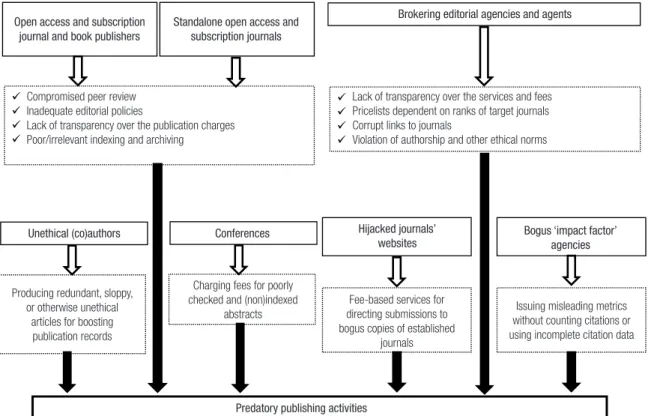
Scientific authors’ unawareness of what constitutes predatory activity and haphazard targeting of scholarly journals contrib- ute to the flourishing of poor quality, useless, and unethical journals. The scope of predatory activities is diverse, and all those involved in scientific communications can be dragged into such activities (Fig. 1).
Fortunately, several professional societies have launched a campaign against questionable open-access publishers and journals by referring to J. Beall’s list and increasing awareness of unethical publishers among new scholars (26,27). In 2015, glob- al associations of editors and publishers, such as the COPE and the Open Access Scholarly Publishers Association (OASPA),
Fig. 1. Scope of predatory publishing activities.
Fig. 1. Scope of predatory publishing activities
Predatory publishing activities
Lack of transparency over the services and fees
Pricelists dependent on ranks of target journals
Corrupt links to journals
Violation of authorship and other ethical norms Brokering editorial agencies and agents
Unethical (co)authors
Producing redundant, sloppy, or otherwise unethical articles for boosting publication records
Conferences
Charging fees for poorly checked and
(non)indexed abstracts
Hijacked journals’
websites
Fee-based services for directing submissions to bogus copies of established journals
Bogus ‘impact factor’
agencies
Issuing misleading metrics without counting citations or using incomplete citation data Standalone open
access and subscription journals Open access and
subscription journal and book publishers
Compromised peer review
Inadequate editorial policies
Lack of transparency over the publication charges
Poor/irrelevant indexing and archiving Open access and subscription
journal and book publishers
Standalone open access and subscription journals
Compromised peer review Inadequate editorial policies
Lack of transparency over the publication charges Poor/irrelevant indexing and archiving
Lack of transparency over the services and fees Pricelists dependent on ranks of target journals Corrupt links to journals
Violation of authorship and other ethical norms
Unethical (co)authors Conferences Hijacked journals’
websites Bogus ‘impact factor’
agencies
Producing redundant, sloppy, or otherwise unethical
articles for boosting publication records
Charging fees for poorly checked and (non)indexed
abstracts
Fee-based services for directing submissions to bogus copies of established
journals
Predatory publishing activities
Issuing misleading metrics without counting citations or using incomplete citation data Brokering editorial agencies and agents
have formed a coalition and initiated the “Think. Check. Sub- mit” (TCS) campaign to help researchers assess the credentials of publishers and choose trusted journals for their research (http://thinkchecksubmit.org/). The TCS campaign offers a simple checklist of questions to help authors, and particularly those from non-Anglophone countries, identify reputable jour- nals, which are endorsed by peers, have transparent editorial policies, relevant indexing and adhere to the ethical guidance of the global editorial associations. Additionally, a group of soft- ware specialists, researchers and publishers developed a digital platform to match English manuscript titles and abstracts with relevant and trusted journals (https://www.journalguide.com/).
Finally, experts from various professional backgrounds have publicized statements on the ‘pollution’ of the scientific evidence accumulation (28,29) and proposed criteria of best target jour- nals, which may sideline outlets with unethical publishing mo- dels (30,31).
The role of librarians or information facilitators with a broad- er look at publishers and the quality of their journals is becom- ing critical in our times (32). Their knowledge and expertise may help other stakeholders of scientific communications to choose a limited number of best references for reading, submit- ting manuscripts and citing, regardless of their access modes (33).
Research administrators who implement standards for re- search evaluation based on a combination of scientometric in- dicators can play their role in publicizing good research in peri- odicals with wide readership, high citation rates and endorse- ments from peers and minimize chances of artificially boosting publication records. At present, among numerous indicators for evaluation of an individual’s research productivity and im- pact, the h-index with its integrative approach to the number of articles and their citations in Scopus and Web of Science stands out as the most appropriate tool. That index has been used glo- bally for more than a decade and proved to be a reliable indica- tor for authors with a long-standing career (34,35). The choice of a bibliographic database for recording the h-index depends on the indexing status of journals in a given discipline, pecu- liarities of research environments and regional priorities, with Scopus viewed as the most comprehensive platform for authors from Europe and non-Anglophone countries (36). Apparently, the h-index has its inherent limitations that should be taken into account for evaluating performance of early career researchers and those with a large number of multi-authored and self-cited articles (37,38). As showcased in an analysis of the Nobel laure- ates’ research performance, the h-index cannot be a proxy met- ric for assessing the innovativeness and scientific quality of arti- cles (39). Additionally, the journal h-index, among other cita- tion metrics, can help identify best journals with established traditions, wide visibility, and high citation rates and prevent submissions to predatory outlets that lose in the citation com-
petition.
Prestigious abstract and citation databases, such as Scopus and Web of Science, still index a number of open-access and subscription journals that are not transparent over the peer re- view and publication charges. Indexers of these prestigious da- tabases, who are concerned with the ‘pollution’ of their plat- forms, regularly consult J.Beall’s list, take into account their us- ers’ complaints, and delist journals embarking on various trans- gressions. For that reason, authors and research evaluators alike are advised to visit the updated list of indexed journals prior to publishing and crediting (40).
Many professional societies across the world publish period- icals in English and other languages that serve interests of rele- vant communities regardless of the indexing status and citation counts. Prestige of these periodicals is dependent on the use of published articles, which can be assessed by downloads, shar- ing on social media, and positive points received from the sur- veyed membership. Incentivizing professional society mem- bers for contributing to their journals can be an additional de- fensive measure against predatory journals (41).
Efforts aimed at improving skills for scholarly writing in Eng- lish and local languages, systematically searching through bib- liographic databases, and raising awareness of predatory activi- ties are urgently needed in countries, where brokering editorial agencies and agents have streamlined flows of most manuscripts to predatory outlets and hindered science growth (15). Strength- ening the positions of regional and local professional societies and encouraging their members to publish in local journals can be also viewed as a step away from predatory media.
DISCLOSURE
The authors have no potential conflicts of interest to disclose.
AUTHOR CONTRIBUTION
Conception: Gasparyan AY, Nurmashev B, Kitas GD. Design of the Figure: Voronov AA, Gerasimov AN. Support with reference selection: Koroleva AM, Kitas GD. Writing 1st draft: Gasparyan AY. Revision: Gasparyan AY, Nurmashev B, Voronov AA, Gera- simov AN, Koroleva AM, Kitas GD. Final approval and respon- sibility for the whole article: all authors.
ORCID
Armen Yuri Gasparyan http://orcid.org/0000-0001-8749-6018 Alexander A. Voronov http://orcid.org/0000-0001-8505-7345 Alexey N. Gerasimov http://orcid.org/0000-0002-1244-4755 Anna M. Koroleva http://orcid.org/0000-0003-3893-6392 George D. Kitas http://orcid.org/0000-0002-0828-6176
REFERENCES
1. Rallison SP. What are Journals for? Ann R Coll Surg Engl 2015; 97: 89-91.
2. Wester K. Why Publish? World Neurosurg 2016; 91: 616-7.
3. Olive A, Cifuentes I, Roca J. The fate of abstracts: without publication, sci- ence is dead. J Rheumatol 2004; 31: 1007.
4. Yilmaz S, Kalyoncu U, Cinar M, Karadag O, Koca SS, Simsek I, Erdem H, Pay S, Dinc A. Features and publication rates of scientific abstracts pre- sented at a rheumatology congress--EULAR 2008. Bull Hosp Jt Dis (2013) 2013; 71: 124-7.
5. Allart E, Beaucamp F, Tiffreau V, Thevenon A. Fate of abstracts presented at the 2008 European Congress of Physical and Rehabilitation Medicine.
Eur J Phys Rehabil Med 2015; 51: 469-75.
6. Gasparyan AY, Yessirkepov M, Voronov AA, Gerasimov AN, Kostyukova EI, Kitas GD. Preserving the integrity of citations and references by all stakeholders of science communication. J Korean Med Sci 2015; 30:
1545-52.
7. Hopewell S, Boutron I, Altman DG, Ravaud P. Deficiencies in the publica- tion and reporting of the results of systematic reviews presented at scien- tific medical conferences. J Clin Epidemiol 2015; 68: 1488-95.
8. Bowman JD. Predatory publishing, questionable peer review, and fraud- ulent conferences. Am J Pharm Educ 2014; 78: 176.
9. Abdollahi M, Gasparyan AY, Saeidnia S. The urge to publish more and its consequences. Daru 2014; 22: 53.
10. Wager E, Singhvi S, Kleinert S. Too much of a good thing? An observa- tional study of prolific authors. PeerJ 2015; 3: e1154.
11. Scholarly Open Access.Thai researcher has hundreds of publications. Ex- cept … [Internet]. Available at https://scholarlyoa.com/2016/06/16/thai- researcher-has-hundreds-of-publications-except/ [accessed on 16 Au- gust 2016].
12. Gasparyan AY, Ayvazyan L, Kitas GD. Open access: changing global sci- ence publishing. Croat Med J 2013; 54: 403-6.
13. Beall J. Best practices for scholarly authors in the age of predatory jour- nals. Ann R Coll Surg Engl 2016; 98: 77-9.
14. Scholarly Open Access. Beall’s list of predatory publishers 2016 [Internet].
Available at https://scholarlyoa.com/2016/01/05/bealls-list-of-predato- ry-publishers-2016/ [accessed on 16 August 2016].
15. Yessirkepov M, Nurmashev B, Anartayeva M. A Scopus-based analysis of publication activity in Kazakhstan from 2010 to 2015: positive trends, concerns, and possible solutions. J Korean Med Sci 2015; 30: 1915-9.
16. Clark J, Smith R. Firm action needed on predatory journals. BMJ 2015;
350: h210.
17. Shen C, Björk BC. ‘Predatory’ open access: a longitudinal study of article volumes and market characteristics. BMC Med 2015; 13: 230.
18. Jansen PA, Forget PM. Predatory publishers and plagiarism prevention.
Science 2012; 336: 1380.
19. Rezaeian M. Disadvantages of publishing biomedical research articles in English for non-native speakers of English. Epidemiol Health 2015; 37:
e2015021.
20. Carafoli E. Scientific misconduct: the dark side of science. Rend Lincei Sci
Fis Nat 2015; 26: 369-82.
21. Hvistendahl M. China’s publication bazaar. Science 2013; 342: 1035-9.
22. Ataie-Ashtiani B. Curbing Iran’s academic misconduct. Science 2016; 351:
1273-4.
23. Gershman M, Kuznetsova T. The future of Russian science through the prism of public policy. Foresight 2016; 18: 320-39.
24. Gasparyan AY, Yessirkepov M, Diyanova SN, Kitas GD. Publishing ethics and predatory practices: a dilemma for all stakeholders of science com- munication. J Korean Med Sci 2015; 30: 1010-6.
25. Sarewitz D. The pressure to publish pushes down quality. Nature 2016;
533: 147.
26. Bradley-Springer L. Predatory publishing and you. J Assoc Nurses AIDS Care 2015; 26: 219-21.
27. Kearney MH; INANE Predatory Publishing Practices Collaborative. Pred- atory publishing: what authors need to know. Res Nurs Health 2015; 38:
1-3.
28. Gasparyan AY, Yessirkepov M, Voronov AA, Gorin SV, Koroleva AM, Kitas GD. Statement on publication ethics for editors and publishers. J Korean Med Sci 2016; 31: 1351-4.
29. Christopher MM, Young KM. Awareness of “predatory” open-access journals among prospective veterinary and medical authors attending scientific writing workshops. Front Vet Sci 2015; 2: 22.
30. Gasparyan AY. Choosing the target journal: do authors need a compre- hensive approach? J Korean Med Sci 2013; 28: 1117-9.
31. Sharman A. Where to publish. Ann R Coll Surg Engl 2015; 97: 329-32.
32. Walden RR. For medical literature expertise, ask a librarian. Acad Med 2016; 91: 1040.
33. Berger M, Cirasella J. Beyond Beall’s list: better understanding predatory publishers. Coll Res Libr News 2015; 76: 132-5.
34. Bornmann L, Marx W, Gasparyan AY, Kitas GD. Diversity, value and limi- tations of the journal impact factor and alternative metrics. Rheumatol Int 2012; 32: 1861-7.
35. Walker B, Alavifard S, Roberts S, Lanes A, Ramsay T, Boet S. Inter-rater re- liability of h-index scores calculated by Web of Science and Scopus for clinical epidemiology scientists. Health Info Libr J 2016; 33: 140-9.
36. Gasparyan AY, Ayvazyan L, Kitas GD. Multidisciplinary bibliographic da- tabases. J Korean Med Sci 2013; 28: 1270-5.
37. Habibzadeh F, Yadollahie M. Read the articles; don’t count them. Arch Iran Med 2009; 12: 302-3.
38. Gaster N, Gaster M. A critical assessment of the h-index. BioEssays 2012;
34: 830-2.
39. Patel VM, Ashrafian H, Almoudaris A, Makanjuola J, Bucciarelli-Ducci C, Darzi A, Athanasiou T. Measuring academic performance for healthcare researchers with the H index: which search tool should be used? Med Princ Pract 2013; 22: 178-83.
40. Scopus.com. Titles indexed in Scopus: check before you publish [Inter- net]. Available at https://blog.scopus.com/posts/titles-indexed-in-sco- pus-check-before-you-publish [accessed on 16 August 2016].
41. Publish or perish. Nature 2010; 467: 252.