Development and Validation of the Korean Version of Hand-Foot Skin Reaction and Quality of Life Questionnaire (HF-QoL-K)
Given the growing number of cancer patients and the resulting increase in the administration of chemotherapeutic agents, convenient and effective methods for measuring the symptoms and quality of life associated with the hand-foot syndrome (HFS) are needed. Therefore, the aim of this study was to develop and validate the Korean version of the hand-foot skin reaction and quality of life questionnaire (HF-QoL-K), comprising a 20-item symptom domain and an 18-item daily activity domain. After we developed the HF-QoL-K, 209 Korean patients with gynecologic cancer who were undergoing chemotherapeutic agents relating the HFS were asked to fill in the
questionnaire. The content validity, internal consistency reliability, and test-retest reliability were evaluated. The internal validity index, Cronbach’s alpha coefficient, and intra-class correlation coefficient of the HF-QoL-K were 0.90, 0.958, and 0.825 (95% confidence interval [CI], 0.774-0.865), respectively. The scatter plot (Pearson correlation coefficient, 0.826) and the Bland-Altman plot for test-retest reliability were also acceptable. The HF- QoL-K instrument is a valid and reliable questionnaire for the measurement of the symptoms and quality of life in Korean cancer patients suffering HFS.
Keywords: Hand-Foot Syndrome; Quality of Life; Questionnaires; Validation; Gynecologic Cancer; Chemotherapy
Se Hyun Nam,1* Hyun Jin Choi,2* Woo Dae Kang,3 Seok Mo Kim,3 Myong Cheol Lim,4 Sang-Yoon Park,4 Jung-Sup Kim,5 Byoung-Gie Kim,2 Duk-Soo Bae,2 Jeong-won Lee,2 Tae-Joong Kim,2 and Taejong Song1
1Department of Obstetrics and Gynecology, Kangbuk Samsung Hospital, Sungkyunkwan University School of Medicine, Seoul, Korea; 2Department of Obstetrics and Gynecology, Samsung Medical Center, Sungkyunkwan University School of Medicine, Seoul, Korea; 3Department of Obstetrics and Gynecology, Chonnam National University Hwasun Hospital, Chonnam National University Medical School, Hwasun, Korea; 4Gynecologic Cancer Branch and Center for Uterine Cancer, Research Institute and Hospital, National Cancer Center, Goyang, Korea; 5Korean Language and Literature, Kyung Hee University, Seoul, Korea
* Se Hyun Nam and Hyun Jin Choi contributed equally to this work.
Received: 23 June 2016 Accepted: 21 August 2016 Address for Correspondence:
Taejong Song, MD
Department of Obstetrics and Gynecology, Kangbuk Samsung Hospital, Sungkyunkwan University School of Medicine, 29, Saemunan-ro, Jongno-gu, Seoul 03181, Korea E-mail: [email protected]
https://doi.org/10.3346/jkms.2016.31.12.1969 • J Korean Med Sci 2016; 31: 1969-1975
INTRODUCTION
Hand-foot syndrome (HFS) is a relatively frequent (7.3%-63%) dermatologic toxic reaction to certain anti-cancer chemothera- peutic agents (1,2). Patients with HFS usually present with a spectrum of symptoms ranging from burning, tingling, and skin erythema to pain, edema, and ulcerations in the extremities.
The lesions can interfere considerably with even the simplest daily activities, such as walking or gripping objects (3). The drugs associated with HFS are not only chemotherapeutic agents (5- fluorouracil, pegylated liposomal doxorubicin, paclitaxel, doce- taxel, doxorubicin, and capecitabine), but also emerging target therapies such as multikinase inhibitors (MKI; sorafenib, pazo- panib, regorafenib, axitinib, and sunitinib) (4).
Most treatment recommendations for the management of HFS are based on case reports, case series, and personal experi- ence rather than on the data from randomized controlled trials
(5). One of the reasons for this is the lack of validated question- naires for use in clinical trials to aid the early recognition of the symptoms, to assess the effectiveness of agents for the treatment of HFS within clinical studies, and to evaluate the impact of these treatments on HFS-associated patients’ health-related quality of life. In 2015, Anderson et al. (6) developed the hand- foot skin reaction and quality of life (HF-QoL) questionnaire, which simultaneously measured the extent of HFS symptoms and their effects on daily activities. However, the HF-QoL in- strument has not yet been translated into the Korean language.
Given the growing number of cancer patients and the resulting increase in the administration of chemotherapeutic agents, con- venient and effective methods for measuring the symptoms and quality of life associated with HFS are required. Therefore, the aim of this study was to develop and validate the Korean version of this instrument (HF-QoL-K) in cancer patients.
MATERIALS AND METHODS Participants
The present study was performed at 4 institutions between Au- gust 2015 and March 2016 (Chonnam National University Hwa- sun Hospital, Hwasun; Kangbuk Samsung Hospital, Seoul; Na- tional Cancer Center, Goyang; Samsung Medical Center, Seoul, Korea). Participants were recruited from the Department of Obstetrics and Gynecology of each institution and were includ- ed consecutively.
The inclusion criteria were as follows: 1) patients were diag- nosed with gynecologic cancers such as cervical, endometrial, uterine corpus, vulvar, vaginal, ovarian, fallopian, and primary peritoneal cancer; 2) patients receiving chemotherapy includ- ing 5-fluorouracil, pegylated liposomal doxorubicin, paclitaxel, docetaxel, and doxorubicin; 3) patients aged 18 years or older;
and 4) patients able to speak and understand Korean. Patients who were not able to understand the questionnaire or refused to participate were thus excluded from the study. The institution- al review boards of each participating institution approved the study, and all participants provided written informed consent.
Original HF-QoL questionnaire
The HF-QoL instrument comprised of a 20-item symptom do- main and an 18-item daily activity domain (6). Each item was rated on a 5-point scale from 0 (not at all) to 4 (always or extreme- ly). Therefore, the maximum possible score for HF-QoL was 152 points, with higher scores indicating worse quality of life or great- er symptom burden.
Procedure
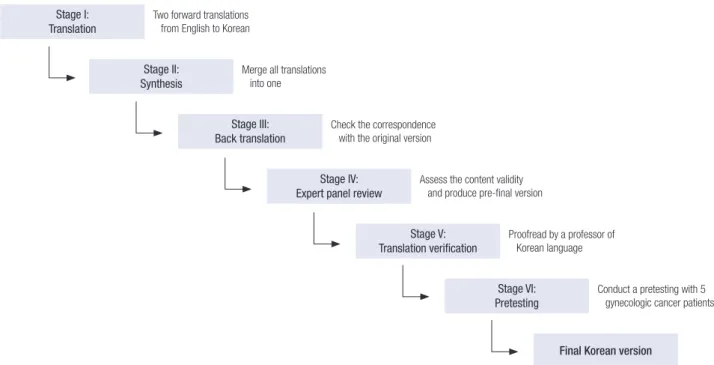
We obtained permission from Roger T. Anderson on Septem- ber 4th, 2015 to use the questionnaire that he developed (6), and two forward translations from English to Korean were per- formed by two independent translators who spoke English as a first language and were fluent in the idioms and colloquial terms in Korean (Fig. 1). A meeting was convened between the trans- lators and another person who was not involved in the transla- tion procedures to obtain a unified Korean version of the two forward translations. Subsequently, an independent translator (a Korean-American with a medical degree) back translated the unified version of the questionnaire. The backward translations were then reviewed again by the two bilingual authors of this article. At the commencement of the present study, we orga- nized a panel of five experts to assess the content validity for each item on the Korean version of the HF-QoL and confirmed that the internal validity index was ≥ 0.90. This pre-final ver- sion was proofread by a J.S. Kim (Professor of Korean language and literature at the Kyung Hee University) to check for spelling, grammar, and formatting mistakes. A pretesting of the Korean version of HF-QoL was performed on five gynecologic cancer patients with HFS, at the Kangbuk Samsung Hospital between September 2015 and October 2015. Any misunderstandings were not reported. Therefore, this version of the questionnaire was finalized.
The final version of the HF-QoL-K was presented to the par- ticipants using an interviewer-assisted self-report questionnaire at the hospital (Supplementary Fig. 1). In order to assess the test-retest reliability, the same questionnaire was given to the same patients after 3 weeks.
Fig. 1. The translation and the linguistic validation process (The six stages involved in the translation of the original English HF-QOL into Korean one).
Final Korean version Stage I:
Translation
Two forward translations from English to Korean
Stage II:
Synthesis
Merge all translations into one
Stage III:
Back translation
Check the correspondence with the original version
Stage IV:
Expert panel review
Assess the content validity and produce pre-final version
Stage V:
Translation verification Proofread by a professor of Korean language
Stage VI:
Pretesting Conduct a pretesting with 5 gynecologic cancer patients
Data analysis
Because the required sample size for testing the reliability and validity of a measuring tool is generally 5 times the number of the items in the tool (7), the sample size calculated for the HF- QoL-K (38 items) was 190 subjects. When a 10% dropout rate was included in this calculation, the final sample size was de- termined to be 209 subjects.
All statistical analysis was performed using the SPSS software version 18.0 (SPSS Inc., Chicago, IL, USA) and STATA software version 13.1 (Stata, College Station, TX, USA) to test the validity and reliability of the HF-QoL-K. Qualitative data were presented as the frequency (percentage). In case of quantitative variables, after checking for the normality of the data, mean ± standard devia- tion and median (interquartile range [IQR]) were used to de- scribe normal and non-normal distribution, respectively. The validity was assessed by the content validity, which was deter- mined using the internal validity index. Reliability was assessed by the internal consistency reliability and test-retest reliability.
Internal consistency reliability was determined using the Cron- bach alpha coefficient. Test-retest reliability was determined us- ing the intra-class correlation coefficient (ICC), the Bland-Alt-
man plot, and scatter plot. All reported P values were two-sided, and P values < 0.05 were considered statistically significant.
Ethics statement
The study protocol was approved by the institutional review board of the Kangbuk Samsung Hospital (IRB No. KBSMC 2015- 10-049). Informed consent was waived by the board.
RESULTS
Patient characteristics
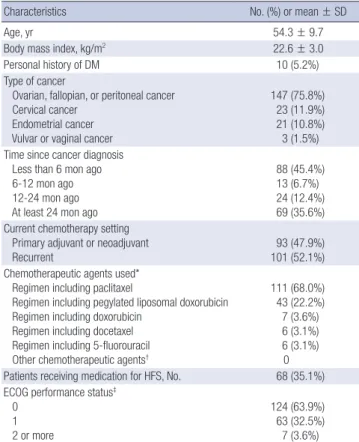
During the study period, 209 gynecologic cancer patients un- dergoing chemotherapy relating HFS, were invited to partici- pate in the present study. After the exclusion of 15 patients who did not provide HF-QoL-K data at baseline or at 3 weeks, the fi- nal study population was 194 patients. The demographic and clinical characteristics of these 194 patients are listed in Table 1.
The mean age and body mass index were 54.3 ± 9.7 years and 22.6 ± 3.0 kg/m2, respectively. While ovarian, fallopian, or peri- toneal cancers constituted 75.8% (n = 147) of the study popula- tion, cervical and endometrial cancers constituted 11.9% (n = 23) and 10.8% (n = 21) of the population, respectively. Ninety-three (47.9%) patients were receiving primary adjuvant or neoadju- vant chemotherapy at the time of study, while 101 (52.1%) pa- tients were receiving chemotherapy for recurrent cancer. Among the 194 patients, 68% of the patients were treated using chemo- therapy that mainly included paclitaxel, whereas 22.2%, 3.6%, 3.1%, and 3.1% of the patients were treated with pegylated lipo- somal doxorubicin, doxorubicin, docetaxel, and 5-fluorouracil, respectively. At the time of study, only 68 (35.1%) patients re- ceived medications (gabapentin, pregabalin or duloxetine hy- drochloride) for HFS.
Validity and reliability of HF-QoL-K
The median total score for the HF-QoL-K was 22 (IQR, 11-40) at Table 1. Demographic and clinical characteristics of the study population (n = 194)
Characteristics No. (%) or mean ± SD
Age, yr 54.3 ± 9.7
Body mass index, kg/m2 22.6 ± 3.0
Personal history of DM 10 (5.2%)
Type of cancer
Ovarian, fallopian, or peritoneal cancer Cervical cancer
Endometrial cancer Vulvar or vaginal cancer
147 (75.8%) 23 (11.9%) 21 (10.8%) 3 (1.5%) Time since cancer diagnosis
Less than 6 mon ago 6-12 mon ago 12-24 mon ago At least 24 mon ago
88 (45.4%) 13 (6.7%) 24 (12.4%) 69 (35.6%) Current chemotherapy setting
Primary adjuvant or neoadjuvant
Recurrent 93 (47.9%)
101 (52.1%) Chemotherapeutic agents used*
Regimen including paclitaxel
Regimen including pegylated liposomal doxorubicin Regimen including doxorubicin
Regimen including docetaxel Regimen including 5-fluorouracil Other chemotherapeutic agents†
111 (68.0%) 43 (22.2%) 7 (3.6%) 6 (3.1%) 6 (3.1%) 0 Patients receiving medication for HFS, No. 68 (35.1%) ECOG performance status‡
0 1 2 or more
124 (63.9%) 63 (32.5%) 7 (3.6%) SD = standard deviation, DM = diabetes mellitus, HFS = hand-foot syndrome, ECOG = Eastern Cooperative Oncology Group.
*This is a multiple choice question; †Other chemotherapy regimens included capecita- bine and multikinase inhibitors (particularly sorafenib, pazopanib, regorafenib, axitinib and sunitinib); ‡The ECOG Performance Status Scale are widely used methods of as- sessing the functional status of cancer patients (16).
Table 2. The HF-QoL-K domain characteristics
Domains No. of items
First assess- ment score
(IQR)
Second assessment
score (IQR) Cron- bach’s
alpha
ICC (95% CI) Symptom*
Foot Hand
20 10 10
6 (2-12) 3 (1-6) 3 (1-7)
6 (3-13) 3 (1-6) 3 (1-7)
0.911 0.856 0.822
0.837 (0.790-0.875) 0.814 (0.760-0.857) 0.817 (0.764-0.859) Daily activity† 18 14 (7-28) 16 (8-30) 0.970 0.789 (0.729-0.837) Total‡ 38 22 (11-40) 22 (12-40) 0.958 0.825 (0.774-0.865) Data are expressed as number, median (IQR) or median (95% CI), as appropriate.
HF-QoL-K = Korean version of the hand-foot skin reaction and quality of life, ICC = intra- class correlation coefficient, IQR = interquartile range, CI = confidence interval.
*Symptom domain consists of 20 items having a score range of 0-80. A higher score indicates more symptom burden; †Daily activity domain consists of 18 items having a score range of 0-72. A higher score indicates more disability; ‡The complete HF-QoL- K questionnaire consists of 38 items. The maximum score that can be achieved on HF-QoL-K is 152 points, with higher scores indicating more severe forms of the hand- foot syndrome.
the first assessment (Table 2); the median score for symptom domain was 6 (IQR, 2-12), and the median score for daily activ- ity domain was 14 (IQR, 7-28). The Cronbach alpha coefficient for consistency was 0.958 for the HF-QoL-K, suggesting a high internal consistency. The Cronbach alpha coefficients for the symptom domain, foot subdomain, hand subdomain, and dai- ly activity domain of the HF-QoL-K were 0.911, 0.856, 0.822, and 0.970, respectively. The ICC for the test-retest analysis was 0.825 (95% confidence interval [CI], 0.774-0.865) for the HF-QoL-K,
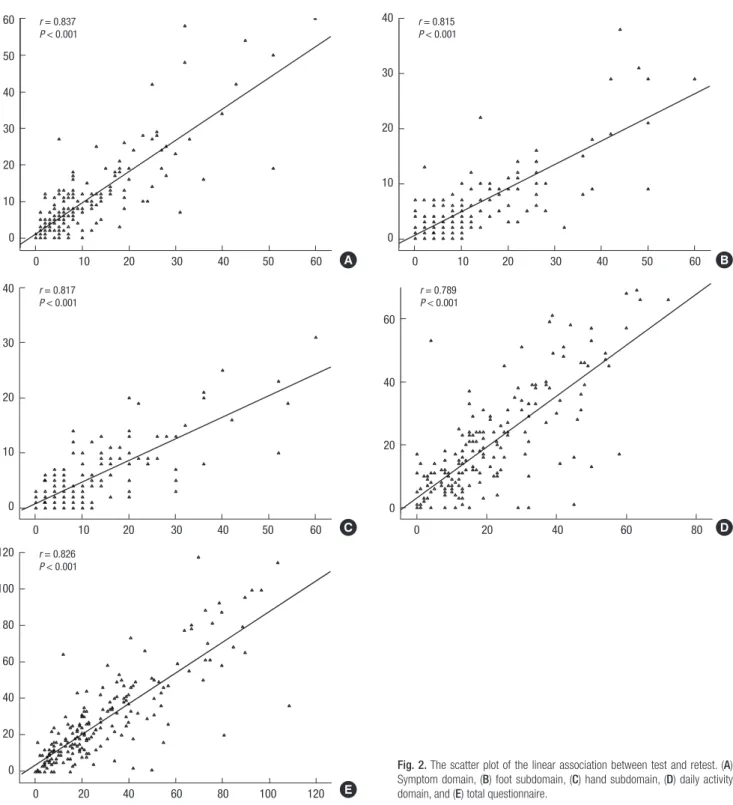
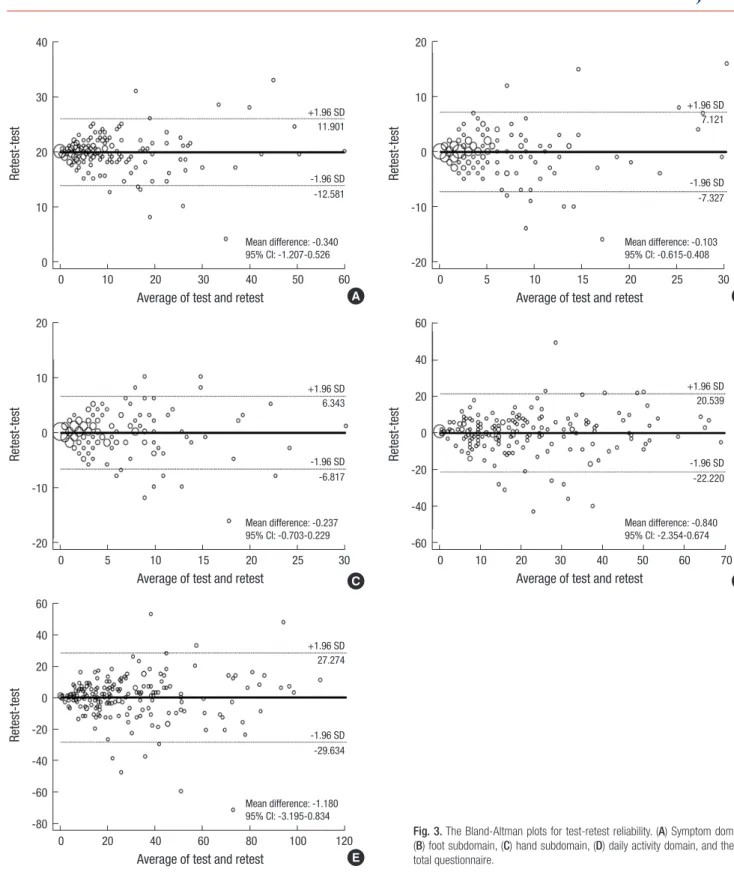
which suggested a strong correlation between the two. The ICC for the symptoms and daily activity domain were 0.789 (95% CI, 0.729-0.837) and 0.837 (95% CI, 0.790-0.875), respectively. The scatter plots of the linear association between the test and retest are shown in Fig. 2. The Pearson correlation coefficients for the scatter plots were high, ranging between 0.789 for the daily ac- tivity domain and 0.837 for the symptom domain. The Bland- Altman plots for measuring the agreement with the repeated measures are shown in Fig. 3. The mean difference between the
Fig. 2. The scatter plot of the linear association between test and retest. (A) Symptom domain, (B) foot subdomain, (C) hand subdomain, (D) daily activity domain, and (E) total questionnaire.
0 10 20 30 40 50 60 60
50
40
30
20
10
0
r = 0.837 P < 0.001
0 10 20 30 40 50 60 40
30
20
10
0
r = 0.817 P < 0.001
0 20 40 60 80 100 120
120
100
80
60
40
20
0
r = 0.826 P < 0.001
0 20 40 60 80
60
40
20
0
r = 0.789 P < 0.001
0 10 20 30 40 50 60 40
30
20
10
0
r = 0.815 P < 0.001
A
C
E
B
D
test and the retest total scores was -1.180 (95% CI, -3.195-0.834);
and the upper and lower limits were 27.274 and -29.634.
DISCUSSION
The aim of the present study was to produce the Korean version of the HF-QoL by translation and cultural modifications. Owing
to the growing number of cancer patients (8,9) and the result- ing increase in the administration of chemotherapeutic agents, developing or introducing a scale with HFS for the measure- ment of the symptoms and quality of life has become crucial.
Therefore, the development and validation of the Korean ver- sion of the HF-QoL was required. In the present study, we con- firmed that the Korean version of the questionnaire showed a
Fig. 3. The Bland-Altman plots for test-retest reliability. (A) Symptom domain, (B) foot subdomain, (C) hand subdomain, (D) daily activity domain, and the (E) total questionnaire.
Retest-test
Average of test and retest
0 5 10 15 20 25 30 20
10
0
-10
-20
+1.96 SD
-1.96 SD -6.817
Mean difference: -0.237 95% CI: -0.703-0.229
6.343
Retest-test
Average of test and retest
0 10 20 30 40 50 60 70 60
40
20
0
-20
-40
-60
+1.96 SD
-1.96 SD -22.220
Mean difference: -0.840 95% CI: -2.354-0.674
20.539
Retest-test
Average of test and retest
0 10 20 30 40 50 60 40
30
20
10
0
+1.96 SD
-1.96 SD -12.581
Mean difference: -0.340 95% CI: -1.207-0.526
11.901
Retest-test
Average of test and retest
0 5 10 15 20 25 30 20
10
0
-10
-20
+1.96 SD
-1.96 SD -7.327
Mean difference: -0.103 95% CI: -0.615-0.408
7.121
Retest-test
Average of test and retest
0 20 40 60 80 100 120
60 40 20 0 -20 -40 -60 -80
+1.96 SD
-1.96 SD -29.634
Mean difference: -1.180 95% CI: -3.195-0.834
27.274
A B
C D
E
similar reliability and validity to the original version of the HF- QoL.
HFS, referred to as hand-foot skin reaction, palmar-plantar erythrodysesthesia, chemotherapy-associated acral erythema, and the Burgdorf reaction, constitutes a spectrum of diseases with varying clinical appearances and pathogenesis (10). Two different types of HFS are found at either end of this spectrum, representing the extremities: chemotherapy-related HFS and MKI-related HFS (10). While chemotherapy-related HFS is more diffuse, MKI-related HFS is localized at the pressure points (5).
Before the commencement of the drug regimen for any cancer therapy that is associated with HFS, the patient should be thor- oughly informed on what to do in the event that symptoms of HFS appear. In patients with skin disease affecting the hands and feet, dermatological treatment is imperative. The only rec- ommended management techniques for HFS are the discon- tinuation or dose modification of treatment (11). Cold compres- ses, application of emollients, topical corticosteroids or dimeth- ylsulfoxide have been used, but with no definitive results (12).
Oral or topical pyridoxine (vitamin B6) has been successful in some instances (13).
Although oncologists have evaluated on symptoms of HFS according to the National Cancer Institute-Common Terminol- ogy Criteria for Adverse Events (NCI-CTCAE) grading system (14), the NCI-CTCAE reports were made from the physician’s perspective and thus might not fully capture the patient’s HFS symptom burden. Before the commencement of this study, two validated questionnaires that measured the symptoms and qual- ity of life of HFS were available (6,15). We chose to translate the HF-QoL questionnaire to the Korean language instead of trans- lating the HFS-14. The reason for this was that the HFS-14 (15) solely assesses the functional implications of HFS, including pain, but not the wider symptom burden associated with the condition, while the HF-QoL assesses both. Moreover, the HF- QoL instrument could provide more information about the HFS to the clinician, as compared to the HFS-14, because the HF- QoL instrument had two distinct domains (symptom domain and daily activity domain) and two specific subdomains (foot subdomain and hand subdomain).
Compared to the original HF-QoL, few minor modifications were applied to HF-QoL-K during the translation process. First, a subdomain term was changed from “hands or fingers” to “hands.”
Second, 18 items in the daily activity domain were not subclas- sified into specific subdomains for developing a more intuitive and concise questionnaire, although daily activity domain had four subdomains in the original HF-QoL. Third, the term “sen- sitive to pressure” in question 4 of the foot and hand domains was translated as “feel painful when touched” in Korean. Fourth, the term “fork” in question 10 of the daily activity domain was translated as “spoon and chopstick” in Korean, because the un- dertone of a given word can be quite different in different cul-
tures. Lastly, the term “downhearted and sad” in question 17 of daily activity domain was translated as “tired and sad.” We be- lieve that these modifications in the HF-QoL-K reflect the Kore- an culture and communication style used with the patients in Korea.
There were several limitations to the present study. First, the main limitation of this study is that it was only conducted in gy- necologic cancer patients. Second, patients who were treated with MKIs were not included, because the therapeutic role of MKIs was not proved in gynecologic cancers. Therefore, further studies are required to determine the effectiveness of the HF- QoL-K instrument for the assessment of other conditions and therapies. Third, the correlation between patient-reported out- come (HF-QoL) and physician-rated outcome (NCI-CTCAE) was not assessed in this study. However, each scale demonstrat- ed excellent measurement properties and discriminated be- tween HF-QoL score and NCI-CTCAE grade with large effect sizes in the original version (English language) of the HF-QoL by Anderson et al. (6). Meanwhile, the strength of this study is that the questionnaire was translated with a rigorous procedure, which includes permission acquisition from the original devel- oper, translation verification by a professor of Korean language, and pretesting before the start of the field-testing. The compre- hensive and rigorous translation procedure ensured that the Ko- rean version of HF-QoL was scientific and convincing.
In conclusion, the final Korean version of the HF-QoL showed adequate reliability and validity among Korean cancer patients with HFS. Therefore, this version will be a useful instru- ment in the clinical trials investigating chemotherapy-induced HFS and/or potential neuroprotective agents in Korean cancer patients. Further research is warranted to investigate the non- gynecologic cancer and chemotherapy regimens by using the HF-QoL-K.
ACKNOWLEDGMENT
We thank Dr. Roger T. Anderson (University of Virginia School of Medicine, VA, USA) for his permission to translate the HF- QoL into Korean. We also thank the participants who cooperat- ed willingly.
DISCLOSURE
The authors have no potential conflicts of interest to disclose.
AUTHOR CONTRIBUTION
Conception and design of the study: Nam SH, Kim SM, Park SY, Kim BG, Bae DS, Lee JW, Song T. Acquisition of data: Nam SH, Choi HJ, Kang WD, Lim MC, Kim JS, Kim TJ. Manuscript prepa- ration: Nam SH, Choi HJ, Song T. Statistical analysis and inter-
pretation of data: Nam SH, Kang WD, Lim MC, Kim TJ. Manu- script approval: all authors.
ORCID
Se Hyun Nam http://orcid.org/0000-0001-6438-3555 Hyun Jin Choi http://orcid.org/0000-0003-4058-9094 Woo Dae Kang http://orcid.org/0000-0002-3952-9724 Seok Mo Kim http://orcid.org/0000-0003-2318-0334 Myong Cheol Lim http://orcid.org/0000-0001-8964-7158 Sang-Yoon Park http://orcid.org/0000-0001-8325-6009 Jung-Sup Kim http://orcid.org/0000-0003-1660-8419 Byoung-Gie Kim http://orcid.org/0000-0002-0572-8450 Duk-Soo Bae http://orcid.org/0000-0003-0016-1704 Jeong-won Lee http://orcid.org/0000-0002-6945-0398 Tae-Joong Kim http://orcid.org/0000-0002-9693-9164 Taejong Song http://orcid.org/0000-0003-0288-1254 REFERENCES
1. Clark AS, Vahdat LT. Chemotherapy-induced palmar-plantar erythrodys- esthesia syndrome: etiology and emerging therapies. Support Cancer Ther 2004; 1: 213-8.
2. Chen M, Zhang L, Wang Q, Shen J. Pyridoxine for prevention of hand-foot syndrome caused by chemotherapy: a systematic review. PLoS One 2013;
8: e72245.
3. Autier J, Escudier B, Wechsler J, Spatz A, Robert C. Prospective study of the cutaneous adverse effects of sorafenib, a novel multikinase inhibitor.
Arch Dermatol 2008; 144: 886-92.
4. Macedo LT, Lima JP, dos Santos LV, Sasse AD. Prevention strategies for chemotherapy-induced hand-foot syndrome: a systematic review and meta-analysis of prospective randomised trials. Support Care Cancer 2014; 22: 1585-93.
5. Lacouture ME, Wu S, Robert C, Atkins MB, Kong HH, Guitart J, Garbe C, Hauschild A, Puzanov I, Alexandrescu DT, et al. Evolving strategies for the
management of hand-foot skin reaction associated with the multitarget- ed kinase inhibitors sorafenib and sunitinib. Oncologist 2008; 13: 1001-11.
6. Anderson RT, Keating KN, Doll HA, Camacho F. The hand-foot skin reac- tion and quality of life questionnaire: an assessment tool for oncology. On- cologist 2015; 20: 831-8.
7. Floyd FJ, Widaman KF. Factor analysis in the development and refinement of clinical assessment instruments. Psychol Assess 1995; 7: 286-99.
8. Oh CM, Won YJ, Jung KW, Kong HJ, Cho H, Lee JK, Lee DH, Lee KH; Com- munity of Population-Based Regional Cancer Registries. Cancer statistics in Korea: incidence, mortality, survival, and prevalence in 2013. Cancer Res Treat 2016; 48: 436-50.
9. Son M, Yun JW. Cancer mortality projections in Korea up to 2032. J Kore- an Med Sci 2016; 31: 892-901.
10. Degen A, Alter M, Schenck F, Satzger I, Völker B, Kapp A, Gutzmer R. The hand-foot-syndrome associated with medical tumor therapy - classifica- tion and management. J Dtsch Dermatol Ges 2010; 8: 652-61.
11. Nagore E, Insa A, Sanmartín O. Antineoplastic therapy-induced palmar plantar erythrodysesthesia (‘hand-foot’) syndrome. Incidence, recogni- tion and management. Am J Clin Dermatol 2000; 1: 225-34.
12. Webster-Gandy JD, How C, Harrold K. Palmar-plantar erythrodysesthesia (PPE): a literature review with commentary on experience in a cancer centre. Eur J Oncol Nurs 2007; 11: 238-46.
13. Farr KP, Safwat A. Palmar-plantar erythrodysesthesia associated with che- motherapy and its treatment. Case Rep Oncol 2011; 4: 229-35.
14. U.S. Department of Health and Human Services, National Institutes of Health, National Cancer Institute, Division of Cancer Treatment and Di- agnosis. Cancer therapy evaluation program (CTEP): common terminol- ogy criteria for adverse events, version 3.0. March 31, 2003. Available at http://ctep.cancer.gov [accessed on 9 August 2006].
15. Sibaud V, Dalenc F, Chevreau C, Roché H, Delord JP, Mourey L, Lacaze JL, Rahhali N, Taïeb C. HFS-14, a specific quality of life scale developed for patients suffering from hand-foot syndrome. Oncologist 2011; 16: 1469- 78.
16. Oken MM, Creech RH, Tormey DC, Horton J, Davis TE, McFadden ET, Carbone PP. Toxicity and response criteria of the Eastern Cooperative Oncology Group. Am J Clin Oncol 1982; 5: 649-55.
Nam SH, et al. • The Korean Version of the Hand-Foot Skin Reaction Questionnaire
Supplementary Fig. 1. The final Korean version of the hand-foot skin reaction and quality of life questionnaire (HF-QoL-K).