Original Article
Received: Nov 10, 2016; Revised: Nov 23, 2016; Accepted: Nov 24, 2016 Correspondence to: Hong Seok Shin
Department of Urology, Catholic University of Daegu School of Medicine, 33 Duryugongwon-ro 17-gil, Nam-gu, Daegu 42472, Korea.
Tel: +82-53-650-4673, Fax: +82-53-626-5301, E-mail: [email protected]
Effect of Testosterone Replacement Therapy on Cognitive Performance and Depression in Men with Testosterone Deficiency Syndrome
Hyun Jin Jung, Hong Seok Shin
Department of Urology, Catholic University of Daegu School of Medicine, Daegu, Korea
Purpose: We aimed to evaluate the effect of testosterone replacement therapy (TRT) on cognitive function and depression in men with testosterone deficiency syndrome.
Materials and Methods: We carried out a prospective, placebo-controlled trial involving 106 men with total testosterone levels
<3.3 ng/mL and symptoms of hypogonadism. Based on whether the patients received TRT (injection with 1,000 mg testosterone undecanoate) or a placebo (advice to modify lifestyle), the study population was divided into a TRT group (n=54) and a control group (n=52).
Results: The age among patients in the TRT and control groups was 56.7±12.6 years and 57.8±11.4 years, respectively (p>
0.05). At baseline, no significant differences between the TRT and control groups were noted regarding serum testosterone or prostate-specific antigen levels, or regarding the scores for aging symptoms (Aging Males’ Symptoms scale), erectile function (5-item International Index of Erectile Function questionnaire), cognitive function (Korean Mini-Mental State Examination), and depression (Beck Depression Inventory). At 8 months after intervention total serum testosterone levels and erectile function scores had significantly increased (p<0.05), whereas the scores for aging symptoms and depression had significantly decreased (p<0.05) in the TRT group; no significant improvement in any parameters was noted for the control group. Notably, significant improvement in cognitive function was noted among patients with cognitive impairment at baseline (cognitive function score
<25) who received TRT.
Conclusions: TRT may be considered in men with testosterone deficiency syndrome if low testosterone levels are associated with depression or cognitive impairment.
Key Words: Cognition; Depression; Testosterone
https://doi.org/10.5534/wjmh.2016.34.3.194
www.wjmh.org
INTRODUCTION
The prevalence of low levels of total serum testosterone is approximately 20% in individuals younger than 50 years, and 50% in those younger than 80 years [1]. Testos- terone deficiency syndrome (TDS) represents a clinical and biochemical syndrome associated with advancing age, and is characterized by a total level of serum testoster- one below the reference range calculated based on the levels noted among healthy adult men. TDS may have ad- verse effects on the function of multiple organ systems.
Common symptoms of TDS include low libido, decreased vitality, fatigue, mood changes, insomnia, anemia, flush- es, erectile dysfunction, decreased muscle mass, increased visceral body fat, ejaculatory dysfunction, and loss of con- centration [2]. Low testosterone levels have also been as- sociated with impaired quality of life due to symptoms such as depression and cognitive impairment [3], as well as poorer sense of psychological well-being [4] and sub- syndromal levels of depression and anxiety in otherwise healthy older men [5]. Testosterone replacement therapy (TRT) is a widely-used treatment for men with TDS, with well documented beneficial effects on libido, energy lev- els, bone density, strength, and muscle mass [6]. While a meta-analysis has suggested that TRT may improve de- pression scores [7], reports regarding the beneficial effects of TRT on quality of life and depressive mood have not been consistent across trials [8]. Lower levels of testoster- one appear to affect spatial abilities, verbal abilities and cognitive function [9]. Reports regarding the effects of TRT on cognitive function and memory scores have described mixed results [10,11]. In the present study, we investigated the efficacy and safety of TRT in patients with TDS, as well as its effect on cognitive performance and depression.
MATERIALS AND METHODS
The present study was conducted as a prospective, place- bo-controlled study. The study protocol was approved by the Institutional Review Board of Daegu Catholic University Medicine Center and all participants provided informed consent. TDS patients aged >40 years were re- cruited between April and December 2011. TDS was defined as a total serum testosterone level of <3.3 ng/mL, with
symptoms of hypogonadism. The exclusion criteria were:
prostate cancer; suspicion of prostate cancer based on ele- vated levels of serum prostate-specific antigen (PSA, >4.0 ng/mL), and a digital rectal examination; high value (>20) of the self-reported International Prostate Symptom Score;
and comorbid pathologies including decreased liver func- tion, chronic renal insufficiency requiring hemodialysis, and severe cardiovascular co-morbidities such as acute my- ocardial infarction. Use of concomitant medication involv- ing alpha adrenergic blockers, 5-alpha reductase inhibitors, and phosphodiesterase type 5 inhibitors, which can influ- ence urination and the function of sexual hormones, was not permitted during the study.
A total of 106 patients (mean age, 55.8 years; age range, 42∼67 years) with TDS were enrolled in the study. The blood sampling for the measurement of serum total testos- terone was performed between 9:00 AM and 11:00 AM.
The study population was divided into two groups accord- ing to whether the patients received TRT (TRT group, n=54) or a placebo (control group, n=52). TRT was per- formed in the form of several injections of 1,000 mg testos- terone undecanoate. The patients from the TRT group were injected upon enrollment, at 8 weeks, and then ev- ery 3 months; these patients also received recommenda- tions for lifestyle modification. The patients from the con- trol group received recommendations to change their life- style, but did not undergo any treatment with injections.
The study outcomes were evaluated in terms of efficacy and safety of the TRT treatment. The parameters describing efficacy were the total serum testosterone levels (measured between 09:00 AM and 11:00 AM) and the change in the scores for Aging Males’ Symptoms (AMS) and 5-item Interna- tional Index of Erectile Function questionnaire (IIEF-5), which were monitored at baseline and at the 8-month fol- low-up to calculate the body mass index (BMI). To assess the condition of the prostate, the following evaluations were performed at baseline and at the 8-month follow-up:
measurement of PSA levels, uroflowmetry, digital rectal examination, and transrectal ultrasound to assess prostate volume.
Cognitive function was assessed at baseline and at the 8-month follow-up using the Korean Mini-Mental State Examination (K-MMSE), which represents an established instrument to screen for cognitive impairment or dementia
Table 1. Baseline characteristics of patients with testosterone deficiency syndrome
Parameter TRT group
(n=54) Control group (n=52) p-value
Age (yr) 56.7±12.6 57.8±11.4 0.180
BMI (kg/m2) 26.2±2.0 26.3±3.1 0.291
PSA (ng/mL) 0.8±1.3 0.9±1.2 0.967
Prostate volume (mL) 23.8±8.8 22.9±7.2 0.447 Hemoglobin (g/dL) 12.7±1.1 12.4±1.3 0.498 Hematocrit (%) 36.8±3.4 36.6±4.1 0.346 Qmax (mL/s) 14.2±5.6 14.1±6.1 0.659
PVR (mL) 14.9±10.6 14.6±9.5 0.766
Total testosterone
(ng/mL) 2.5±0.6 2.6±0.7 0.841
IIEF-5 score 20.7±4.8 20.6±4.3 0.646
AMS scale 41.4±9.7 39.6±7.4 0.361
BDI score 26.6±4.2 27.2±5.3 0.272
K-MMSE score 24.8±4.4 23.9±4.6 0.395 Values are presented as mean±standard deviation.
TRT: testosterone replacement therapy, BMI: body mass index, PSA: prostate-specific antigen, Qmax: maximal urinary flow rate, PVR: postvoid residual volume, IIEF-5: 5-item version of the International Index of Erectile Function ques-
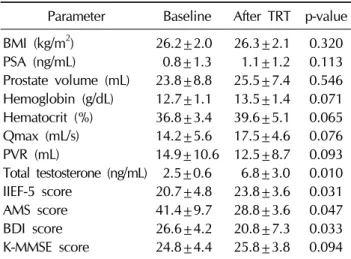
Table 2. Clinical parameters of patients with testosterone deficiency syndrome who received TRT (n=54)
Parameter Baseline After TRT p-value BMI (kg/m2) 26.2±2.0 26.3±2.1 0.320
PSA (ng/mL) 0.8±1.3 1.1±1.2 0.113
Prostate volume (mL) 23.8±8.8 25.5±7.4 0.546 Hemoglobin (g/dL) 12.7±1.1 13.5±1.4 0.071 Hematocrit (%) 36.8±3.4 39.6±5.1 0.065 Qmax (mL/s) 14.2±5.6 17.5±4.6 0.076
PVR (mL) 14.9±10.6 12.5±8.7 0.093
Total testosterone (ng/mL) 2.5±0.6 6.8±3.0 0.010 IIEF-5 score 20.7±4.8 23.8±3.6 0.031
AMS score 41.4±9.7 28.8±3.6 0.047
BDI score 26.6±4.2 20.8±7.3 0.033
K-MMSE score 24.8±4.4 25.8±3.8 0.094 Values are presented as mean±standard deviation.
TRT: testosterone replacement therapy, BMI: body mass index, PSA: prostate-specific antigen, Qmax: maximal urinary flow rate, PVR: postvoid residual volume, IIEF-5: 5-item version of the International Index of Erectile Function ques- in a community setting [12].
Depression was assessed at baseline and at the 8-month follow-up using the 21-item Beck Depression Inventory (BDI), which is one of the most popular measures of de- pressive symptoms worldwide [13].
Sample size calculations were conducted using G*Power version 3.1 (Düsseldorf University, Düsseldorf, Germany).
For a significance level of 0.05 and statistical power of 80%, the minimal sample size necessary to observe an ef- fect was calculated to be 92. Statistical analysis was per- formed using the Korean version of PASW Statistics ver.
18.0 (IBM Co., Armonk, NY, USA). Data regarding the TRT and control groups was compared using Student’s t-test and the Mann-Whitney U-test. Baseline and fol- low-up values of continuous variables were compared us- ing the paired t-test. Statistical significance was set at a p-value of <0.05.
RESULTS
Among the 106 patients enrolled, 54 received TRT and were included in the TRT group (age, 56.7±12.6 years), while 52 received the placebo treatment and were in- cluded in the control group (age, 57.8±11.4 years). At baseline, there were no statistically significant differences between the TRT and control groups regarding BMI, PSA levels, prostate volume, maximal urinary flow rate, post- void residual volume, total serum testosterone levels, or scores of IIEF-5, AMS, BDI, and K-MMSE (Table 1). The baseline testosterone levels in the TRT and control groups were 2.5±0.6 ng/mL and 2.6±0.7 ng/mL, respectively, whereas the baseline BDI scores were 26.6±4.2 and 27.2±5.3, respectively. The baseline K-MMSE scores in the TRT and control groups were 24.8±4.4 and 23.9±
4.6, respectively.
At the 8-month follow-up, patients in the TRT group showed significantly higher levels of total serum testoster- one and IIEF-5 scores compared to the baseline values.
The patients in the TRT group also showed significantly lower AMS and BDI scores compared to the baseline val-
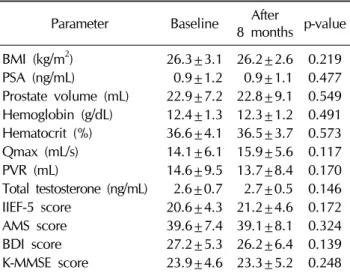
www.wjmh.org Table 3. Clinical parameters of patients with testosterone
deficiency syndrome who did not undergo testosterone re- placement therapy (control group, n=52)
Parameter Baseline After
8 months p-value BMI (kg/m2) 26.3±3.1 26.2±2.6 0.219
PSA (ng/mL) 0.9±1.2 0.9±1.1 0.477
Prostate volume (mL) 22.9±7.2 22.8±9.1 0.549 Hemoglobin (g/dL) 12.4±1.3 12.3±1.2 0.491 Hematocrit (%) 36.6±4.1 36.5±3.7 0.573 Qmax (mL/s) 14.1±6.1 15.9±5.6 0.117
PVR (mL) 14.6±9.5 13.7±8.4 0.170
Total testosterone (ng/mL) 2.6±0.7 2.7±0.5 0.146 IIEF-5 score 20.6±4.3 21.2±4.6 0.172
AMS score 39.6±7.4 39.1±8.1 0.324
BDI score 27.2±5.3 26.2±6.4 0.139
K-MMSE score 23.9±4.6 23.3±5.2 0.248 BMI: body mass index, PSA: prostate-specific antigen, Qmax:
maximal urinary flow rate, PVR: postvoid residual volume, IIEF-5: 5-item version of the International Index of Erectile Function questionnaire, AMS: Aging Males’ Symptoms, BDI: Beck Depression Inventory, K-MMSE: Korean Mini- Mental State Examination.
Fig. 2. Overview of K-MMSE scores for patients with testosterone deficiency syndrome, stratified according to whether they re- ceived testosterone replacement therapy (TRT group, n=13) or a placebo (control group, n=12). Only data for patients with cog- nitive impairment at baseline (K-MMSE score <25) are given. At 8 months after intervention, the K-MMSE scores improved signifi- cantly (*) in the TRT group but not in the control group. *p<0.05 compared with baseline values. K-MMSE: Korean Mini-Mental State Examination.
Fig. 1. Changes in clinical parameters at 8 months after interven- tion with either testosterone replacement therapy (TRT group, n=54) or placebo (control group, n=52) in patients with testos- terone deficiency syndrome. At 8 months after intervention, the improvement in total testosterone levels, IIEF-5 score, AMS score, and BDI score was significantly higher (*) in the TRT group than in the control group. *p<0.05 compared with control group.
Qmax: maximal urinary flow rate, PVR: postvoid residual volume, IIEF-5: 5-item version of the International Index of Erectile Function questionnaire, AMS: Aging Males’ Symptoms, BDI: Beck Depression Inventory, K-MMSE: Korean Mini-Mental State Examination.
ues (Table 2). No statistically significant differences be- tween baseline and follow-up values were observed re- garding BMI, PSA levels, prostate volume, maximal uri- nary flow rate, and postvoid residual volume in the TRT group. No significant differences between baseline and follow-up values were observed regarding serum testos- terone levels or scores for AMS, IIEF-5, BDI, and K-MMSE in the control group (Table 3). At 8 months after inter- vention, the improvement in total testosterone levels, IIEF-5 score, AMS score, and BDI score was significantly higher for the TRT group than for the control group (Fig. 1).
While the overall K-MMSE scores did not significantly in- crease over the baseline values in either group, significant improvement was noted for patients with cognitive im- pairment (K-MMSE scores <25) who received TRT (Fig. 2).
There were few serious adverse events, and the in- cidence of such events did not differ significantly between the TRT and control groups. Prostate biopsy was per- formed in 3 patients who showed PSA levels >4 ng/mL af- ter TRT, but no carcinoma was noted. No participant expe- rienced an increase in hematocrit levels to >54%. No car- diovascular events, including stroke, myocardial in- farction, or unstable angina were reported in either group.
DISCUSSION
The effect of testosterone administration on cognitive function and depression in hypogonadal men is believed to be related to the enhancement of brain perfusion, which is supported by the fact that there are androgen re- ceptors in the brain, suggesting that steroid hormones play a role in neuronal function. Zitzmann et al [14] used 18F-deoxyglucose positron emission tomography to study cerebral glucose metabolism during a standardized men- tal rotation task in six hypogonadal men. All patients per- formed the test before and during TRT. While receiving TRT, four of six patients exhibited improved visuospatial performance, which corresponded with enhanced cere- bral glucose metabolism during the test. Azad et al [15]
used single photon emission computed tomography and showed that, after 3∼5 weeks of TRT, cerebral perfusion was increased in the midbrain and the superior frontal gy- rus in seven men with hypogonadism. After 12∼14 weeks, increased perfusion was still observed in the mid- brain as well as in the midcingulate gyrus.
In the present study, TDS patients who received TRT showed significant improvement in cognitive function on- ly if mild cognitive impairment was present at baseline (K-MMSE score <25).
Mild cognitive impairment is believed to be associated with increased risk of developing Alzheimer’s disease, as an estimated 6% to 25% individuals with mild cognitive impairment will develop Alzheimer’s disease compared with a conversion rate of 0.2% to 3.9% in the general pop- ulation [16].
The effects of TRT in men with mild cognitive impair- ment or Alzheimer’s disease have been evaluated in small placebo-controlled trials. For example, Cherrier et al [17]
evaluated a sample of 32 subjects, which included 17 men with mild cognitive impairment and 15 with Alzheimer’s disease. At the 6-week follow-up, patients who received TRT showed significantly better scores regarding spatial memory, constructional abilities, and verbal memory compared to those noted in the placebo group. Taken to- gether, these results suggest that TRT has a beneficial effect on cognitive function.
higher depression scores among TDS patients compared to those noted in the general population. In the present study, patients who received TRT showed significantly im- proved BDI scores at 8 months after the intervention, which supports previous reports that TRT improved mood and well-being, and reduced fatigue and irritability in hy- pogonadal men [18,19]. The study by Pope et al [20] in- volved men with depression refractory to standard anti- depressants, and found that TRT lowered the Hamilton Depression score, which is a standard indicator of depression. Since it has been well-documented that de- pression tends to increase as testosterone levels decrease [21], it is highly likely that TRT improved symptoms of de- pression by increasing testosterone levels.
The present study has several limitations related to the fact that we did not evaluate the levels of free or bio- available testosterone, the assessment of cognitive func- tion did not consider specific types of skills (spatial, verbal, visual, etc.), and the follow-up was relatively short. Large- scale studies with long-term follow-up are warranted to fully characterize the effect of TRT on cognitive function and depression.
CONCLUSIONS
TRT effectively improved total serum testosterone lev- els as well as IIEF-5, AMS, and BDI scores in men with TDS, suggesting that TRT may indeed improve some as- pects of depression and cognitive ability in such patients.
Therefore, TRT may be considered for men presenting with depression or cognitive impairment in addition to low testosterone levels.
ACKNOWLEDGEMENTS
This study was supported by young scientist research grants from the Korean Society for Sexual Medicine and Andrology (2011).
CONFLICT OF INTEREST
No potential conflict of interest relevant to this article
www.wjmh.org
REFERENCES
1. Shores MM, Matsumoto AM, Sloan KL, Kivlahan DR. Low serum testosterone and mortality in male veterans. Arch Intern Med 2006;166:1660-5.
2. Schroeder ET, Zheng L, Ong MD, Martinez C, Flores C, Stewart Y, et al. Effects of androgen therapy on adipose tis- sue and metabolism in older men. J Clin Endocrinol Metab 2004;89:4863-72.
3. Moffat SD, Zonderman AB, Metter EJ, Blackman MR, Harman SM, Resnick SM. Longitudinal assessment of serum free tes- tosterone concentration predicts memory performance and cognitive status in elderly men. J Clin Endocrinol Metab 2002;87:5001-7.
4. Finas D, Bals-Pratsch M, Sandmann J, Eichenauer R, Jocham D, Diedrich K, et al. Quality of life in elderly men with an- drogen deficiency. Andrologia 2006;38:48-53.
5. Berglund LH, Prytz HS, Perski A, Svartberg J. Testosterone levels and psychological health status in men from a general population: the Tromsø study. Aging Male 2011;14:37-41.
6. Gruenewald DA, Matsumoto AM. Testosterone supplemen- tation therapy for older men: potential benefits and risks. J Am Geriatr Soc 2003;51:101-15; discussion 115.
7. Zarrouf FA, Artz S, Griffith J, Sirbu C, Kommor M. Testoster- one and depression: systematic review and meta-analysis. J Psychiatr Pract 2009;15:289-305.
8. Seidman SN, Spatz E, Rizzo C, Roose SP. Testosterone re- placement therapy for hypogonadal men with major depres- sive disorder: a randomized, placebo-controlled clinical trial.
J Clin Psychiatry 2001;62:406-12.
9. Muller M, Aleman A, Grobbee DE, de Haan EH, van der Schouw YT. Endogenous sex hormone levels and cognitive function in aging men: is there an optimal level? Neurology 2005;64:866-71.
10. Cherrier MM, Craft S, Matsumoto AH. Cognitive changes associated with supplementation of testosterone or dihy- drotestosterone in mildly hypogonadal men: a preliminary
report. J Androl 2003;24:568-76.
11. Kenny AM, Bellantonio S, Gruman CA, Acosta RD, Prestwood KM. Effects of transdermal testosterone on cognitive func- tion and health perception in older men with low bio- available testosterone levels. J Gerontol A Biol Sci Med Sci 2002;57:M321-5.
12. Kang Y, Na DL, Hahn S. A validity study on the Korean Mini-Mental State Examination (K-MMSE) in dementia patients.
J Korean Neurol Assoc 1997;15:300-8.
13. McDowell I. Measuring health: a guide to rating scales and questionnaires. 3rd ed. New York: Oxford University Press, Inc.; 2006.
14. Zitzmann M, Weckesser M, Schober O, Nieschlag E. Changes in cerebral glucose metabolism and visuospatial capability in hypogonadal males under testosterone substitution ther- apy. Exp Clin Endocrinol Diabetes 2001;109:302-4.
15. Azad N, Pitale S, Barnes WE, Friedman N. Testosterone treatment enhances regional brain perfusion in hypogonadal men. J Clin Endocrinol Metab 2003;88:3064-8.
16. Petersen RC, Doody R, Kurz A, Mohs RC, Morris JC, Rabins PV, et al. Current concepts in mild cognitive impairment.
Arch Neurol 2001;58:1985-92.
17. Cherrier MM, Matsumoto AM, Amory JK, Asthana S, Bremner W, Peskind ER, et al. Testosterone improves spatial memory in men with Alzheimer disease and mild cognitive impairment. Neurology 2005;64:2063-8.
18. Lunenfeld B, Nieschlag E. Testosterone therapy in the aging male. Aging Male 2007;10:139-53.
19. Morley JE. Testosterone replacement in older men and women.
J Gend Specif Med 2001;4:49-53.
20. Pope HG Jr, Cohane GH, Kanayama G, Siegel AJ, Hudson JI. Testosterone gel supplementation for men with refractory depression: a randomized, placebo-controlled trial. Am J Psychiatry 2003;160:105-11.
21. Barrett-Connor E, Von Mühlen DG, Kritz-Silverstein D. Bio- available testosterone and depressed mood in older men:
the Rancho Bernardo Study. J Clin Endocrinol Metab 1999;
84:573-7.