Rituximab and ESHAP as Second-line Therapy for Relapsed or Primary Refractory Diffuse Large B Cell Lymphoma:
The Experience of a Single Center in Korea
Ock Bae Ko1, Shin Kim1, Dae Ho Lee1, Sang We Kim1, Jooryung Huh2 and Cheolwon Suh1 Departments of 1Internal Medicine and 2Pathology, Asan Medical Center,
University of Ulsan College of Medicine, Seoul, Korea
Background: The remission status prior to autologous stem cell transplantation (ASCT) influences the transplantation outcome in patients with relapsed or primary refractory diffuse large B cell lymphoma (DLBCL), a complete response (CR) generally being more favorable than a partial response (PR). This study investigated whether the addition of rituximab to the ESHAP chemotherapy regimen (R-ESHAP) could improve the CR rate in patients with relapsed or primary refractory DLBCL.
Methods: Retrospective analysis was performed with DLBCL registry data.
Results: Sixteen patients who had previously received one course of chemotherapy were administered R-ESHAP (median 3 cycles; range 1∼6). The overall response rate of 75% (CR=50%; PR=25%), was significantly better than that achieved with ESHAP alone in 13 historical controls (31%; P=0.027). The toxicity was tolerable, with two febrile neutropenia episodes in 51 treatment cycles. Seven of the 12 responders to R-ESHAP underwent ASCT with BEAM. After a median follow-up of 17 months, the median survival endpoints have not been reached.
Conclusion: R-ESHAP appears to induce high CR rates in relapsed or refractory DLBCL with acceptable toxicity. (Korean J Hematol 2007;42:309-316.)
Key Words: Rituximab, ESHAP, Salvage chemotherapy, DLBCL
309 접수:2007년 8월 17일, 수정:2007년 9월 8일
승인:2007년 9월 15일
교신저자 : 서철원, 서울시 송파구 풍납2동 388-1
138-736, 울산대학교 의과대학 서울아산병원 내과
Tel: 02-3010-3209, Fax: 02-3010-6961 E-mail: [email protected]
Correspondence : Cheolwon Suh, M.D.
Department of Internal Medicine, Asan Medical Center, University of Ulsan College of Medicine, 388-1, Pungnap 2- dong, Songpa-gu, Seoul 138-736, Korea
Pel: +82-2-3010-3209, Fax: +82-2-3010-6961 E-mail: [email protected]
INTRODUCTION
Approximately half of patients with aggressive B cell non-Hodgkin's lymphoma (NHL) treated with standard anthracycline-based chemotherapy regimens either fail to achieve a complete response (CR) or re- lapse after attaining CR.1,2) Recent advances in the treatment for diffuse large B-cell lymphoma (DLBCL), particularly the addition of rituximab
(MabTheraⓇ) a chimeric anti-CD20 immunoglob- ulin G1 monoclonal antibody to CHOP chemothe- rapy (cyclophosphamide, doxorubicin, vincristine, and prednisone) have significantly improved outcomes.3) However, a proportion of patients still relapse or are refractory to treatment.
Second-line chemotherapy for patients with aggre- ssive NHL has historically involved platinum-contain- ing regimens such as dexamethasone, cisplatin, and
cytarabine (DHAP) and etoposide, methylpredniso- lone, high- dose cytarabine, and cisplatin (ESHAP).4,5) These salvage regimens are rarely curative and the prognosis for patients with relapsed aggressive NHL remains poor.6) Rituximab has been shown to have single-agent activity in patients with relapsed or re- fractory DLBCL, with an overall response (OR) rate of 31%.7) Rituximab is also believed to act in synergy with chemotherapy and adding rituximab to the ifos- famidecarboplatinetoposide (ICE) chemotherapy regimen has been shown to induce very high CR rates (53%) in patients with relapsed or refractory DLBCL.8)
High-dose chemotherapy with autologous stem cell transplantation (ASCT) is a promising therapeutic op- tion for patients with relapsed or primary refractory NHL providing that CR or partial response (PR) is attained with second-line salvage therapy.9) The out- come following ASCT appears to be significantly in- fluenced by the remission status of the disease at the time of transplantation. Patients who undergo trans- plantation while in CR have better long-term pro- gression-free survival (PFS) than patients who under- go transplantation while in PR.10) This observation may indicate that the response to second-line chemo- therapy is a reflection of the chemosensitivity of the lymphoma. Alternatively, in chemosensitive patients, the efficacy of high-dose therapy may be dependent on tumor burden, such that improving the response to existing second-line regimens may improve the out- come of high-dose therapy.8)
The improved outcomes observed after ASCT in pa- tients with refractory or relapsed DLBCL in CR have made the attainment of a CR the goal of salvage therapy. At present, however, there is no gold stand- ard salvage treatment for patients with refractory or relapsed DLBCL and the question remains as to which is the ideal chemotherapy regimen to use.6)
ESHAP is an effective and dose-intense regimen capable of mobilizing peripheral blood progenitor cells with minimal toxicity.5,11,12) The OR rate for ESHAP in patients with relapsed or primary re- fractory DLBCL has been reported to be approx- imately 60∼70%, with a CR rate of 20∼40%.5,11) Given the improved response rates observed when
combining rituximab with CHOP or ICE, the primary end-point of current study was to investigate whether the addition of rituximab to ESHAP (R-ESHAP) would increase the CR rate of transplant-eligible pa- tients with relapsed or primary refractory DLBCL.
MATERIALS AND METHODS 1. Patients
Patients aged ≥15 years who attended the Asan Medical Center between June 2002 and July 2005 and who had DLBCL according to the World Health Organization classification13) that had relapsed or was refractory to a single induction regimen were eligible for inclusion. Patients were required to have con- firmation of CD20-positive DLBCL. All biopsy speci- mens were reviewed by the same pathologist (JH). All patients underwent pretreatment staging studies that included computed tomography (CT) of the chest, ab- domen, and pelvis; [18F]-fluorodeoxyglucose positron emission tomography (PET); and a bilateral bone marrow aspiration smear and biopsies. Patients were required to have normal cardiac, renal, and hepatic functions. Patients were ineligible if they had central nervous system involvement; positive serologic test findings for HIV; active hepatitis B or C; previous cancer for which the disease-free duration was less than 5 years, excluding basal cell carcinoma, cuta- neous squamous cell carcinoma, or carcinoma in situ of the cervix, for which they received curative treat- ment; or any other illness that would preclude the safe administration of R-ESHAP. The second-line age-adjusted International Prognostic Index (sAAIPI) score was determined for each patient prior to ini- tiation of second-line therapy. The Institutional Review Board of Asan Medical Center approved this study and all patients gave written informed consent before enrollment.
2. R-ESHAP treatment
Rituximab (375mg/m2) was administered on Day 1 of each cycle according to standard prescribing guide- lines following the administration of oral acet- aminophen (650mg) and intravenous pheniramine
(45.5mg). The ESHAP regimen comprised etoposide (40mg/m2, Days 1∼4), methylprednisolone (500mg, Days 1∼5), cytarabine (2g/m2, Day 5), and cisplatin (25mg/m2, Days 1∼4), using the original dosing sched- ule with modifications.5,11) Cycles were repeated every 4 weeks, provided that the absolute neutrophil count (ANC) was at least 1.5×10⁹/L and the platelet count was 75×109/L. A maximum of 6 cycles of RESHAP was planned for patients unless a CR or PR was ach- ieved after 2 cycles, in which case ASCT was offered in conjunction with a third cycle (see below).
3. Assessment of response and toxicity
Response was assessed 1 week before the third cy- cle of R-ESHAP by CT of the chest, abdomen, and pelvis and by PET. Bone marrow biopsies were re- peated only if the results were abnormal before treatment. Response to R-ESHAP was assessed using the International Working Group criteria,14) taking in- to consideration the results of nuclear imaging studies:
a CR was defined if nuclear imaging revealed no evi- dence of disease. Toxicity was graded according to the National Cancer Institute Common Toxicity Criteria (version 3.0).
4. Autologous stem cell transplantation
ASCT was offered to patients who achieved a CR or PR after 2 cycles of R-ESHAP. ASCT procedures were performed as previously described.15) Briefly, peripheral blood progenitor cells (PBPCs) were mobi- lized with the third cycle of R-ESHAP chemotherapy.
All patients received daily subcutaneous lenograstim 10μg/kg starting on the day after completion of R-ESHAP chemotherapy and continuing until the last leukapheresis. Numbers of circulating hematopoietic progenitor cells (HPCs) were monitored daily using a Sysmex SE9000 hematology analyzer, and the results were used to determine the initiation date for PBPC collection.16) PBPC harvest was started on the day HPC levels reached ≥5/mm3, following the nadir. The target for PBPC collection was 5×10⁶ CD34-positive cells/kg.
The combination carmustine, etoposide, cytarabine, and melphalan (BEAM) regimen was used for
high-dose chemotherapy,17) during which patients were cared for in a single room, with reverse isolation strictly maintained to prevent infectious complications.
All patients received lenograstim (5μg/kg subcuta- neously) once daily, beginning the day after stem cell infusion and continuing until the ANC exceeded 1.0×10⁹/L for 2 consecutive days.
5. Historical control group
The control group comprised patients with re- lapsed/ primary refractory DLBCL who underwent standard salvage ESHAP chemotherapy at the Asan Medical Center between May 2001 and August 2005.
6. Follow up
Evaluation of lymphoma status was performed ev- ery 3 months for 2 years following completion of R-ESAHP or ESHAP treatment and then every 6 months for at least a further 3 years. Overall survival (OS) and PFS were measured from the initiation of R-ESHAP or ESHAP chemotherapy until last fol- low-up or death, and until the time of disease pro- gression, respectively.
7. Statistical methods
All continuous variables were analyzed using the Mann Whitney test. Proportions were compared us- ing the Chi-squared test or Fisher's exact test, as appropriate. Survival was estimated using the product
limit method according to Kaplan and Meier and were compared using the log-rank test. Statistical analysis was performed with SPSS for Windows ver- sion 12.0 (SPSS Inc., Chicago, IL, USA) and sig- nificance levels were two-sided at the 5% level.
RESULTS 1. Patient characteristics
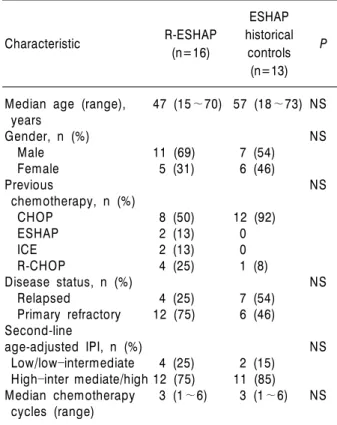
Sixteen patients were treated with R-ESHAP as second-line salvage chemotherapy and were available for analysis. Patient characteristics are shown in Table 1. All patients had been exposed to only one chemo- therapy regimen prior to R-ESHAP. The patients who had received ESHAP and ICE were assessed by the
Response
No. of patients (%) R-ESHAP P
(n=16) ESHAP historical controls (n=13) Complete response 8 (50) 2 (15)
0.077 Partial response 4 (25) 2 (15)
Stable disease 0 2 (15)
Progression 4 (25) 7 (54)
Overall response 12 (75) 4 (31) 0.027 Table 2. Response to R-ESHAP compared with ESHAP historical controls
Characteristic R-ESHAP
(n=16)
ESHAP historical
controls (n=13)
P
Median age (range), years
Gender, n (%) Male Female Previous
chemotherapy, n (%) CHOP
ESHAP ICE R-CHOP
Disease status, n (%) Relapsed
Primary refractory Second-line
age-adjusted IPI, n (%) Low/lowintermediate Highinter mediate/high Median chemotherapy cycles (range)
47 (15∼70)
11 (69) 5 (31)
8 (50) 2 (13) 2 (13) 4 (25) 4 (25) 12 (75)
4 (25) 12 (75) 3 (1∼6)
57 (18∼73)
7 (54) 6 (46)
12 (92) 0 0 1 (8) 7 (54) 6 (46)
2 (15) 11 (85) 3 (1∼6)
NS NS
NS
NS
NS
NS
Abbreviations: NS, not significant; IPI, International Prog- Nostic Index.
Table 1. Patient characteristics
treating physician as having a significant tumor bur- den and a poor prognosis. Four patients had relapsed after an initial CR with previous chemotherapy and twelve patients were classified as being primary re- fractory after failing to respond to first-line chemotherapy.
There were no significant differences in patient characteristics between the R-ESHAP group and a historical control group of 13 patients with DLBCL who had been treated with ESHAP while in relapsed or primary refractory status (Table 1). The distri- bution of patients in the sAAIPI categories was sim- ilar in the two groups. There was no statistically sig- nificant difference in the median time between first- and second-line treatment for the RESHAP group (153.5 days; range, 21∼2, 853 days) and the histor- ical ESHAP group (197 days; range, 23∼1, 180 days).
In total, 51 cycles of R-ESHAP were delivered and were included in the assessment of toxicity. The me-
dian number of cycles per patient was 3 (range, 1∼
6). Five patients declined ASCT and were administered
≥4 cycles of R-ESHAP.
2. Response to therapy
Eight of the 16 R-ESHAP-treated patients (50%) achieved a CR, with no evidence of disease detectable on the CT and PET-CT scans. Four patients (25%) attained a PR. The OR rate was 75% (Table 2). In contrast, only 4 of 13 historical control patients re- sponded to ESHAP, resulting in an OR rate of 30.8%
(CR 15.4%; PR 15.4%). Patients treated with R-ESHAP showed a marginally better response than those treated with ESHAP, when the response catego- ries (CR, PR, stable disease and progressive disease) were analyzed together (P=0.077) or when CR rates alone were compared (P=0.051). However, the OR rate of R-ESHAP was statistically significantly better than that of ESHAP (75% [95% confidence interval (CI), 54∼96%] vs 30.8% [95% CI, 6∼56%]; P= 0.027).
Seven (5 CR and 2 PR) of the 12 responding pa- tients underwent mobilization and collection of PBPCs with the third cycle of R-ESHAP. A median of 10.8×10⁶ (range, 4.9∼52.6×10⁶) CD34-positive cells/kg was collected in a median of 3 leukapheresis sessions (range, 2∼5 sessions). No patient failed to at- tain adequate collection of PBPCs with R-ESHAP.
After high-dose chemotherapy with BEAM followed by ASCT, the median time to neutrophil engraftment
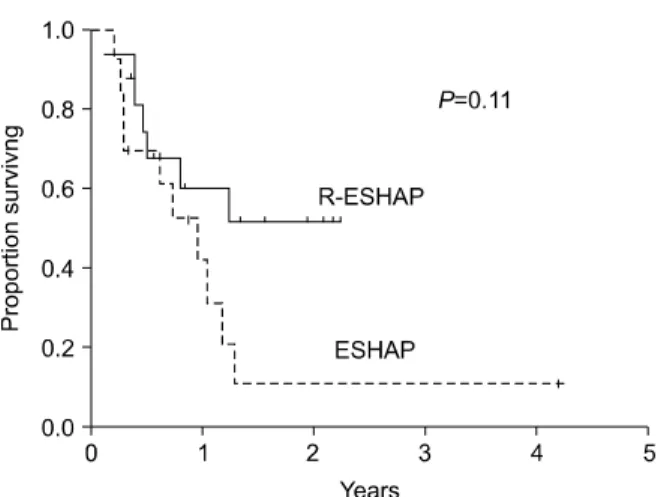
Fig. 1. Overall survival of patients treated with R-ESHAP or ESHAP.
Fig. 2. Progression-free survival of patients treated with R-ESHAP or ESHAP.
Toxicity
No. (%) of cycles R-ESHAP
(51 cycles) ESHAP historical controls (36 cycles) Neutropenia
Febrile neutropenia Thrombocytopenia Documented infection Azotemia
2 (4) 2 (4) 3 (6) 1 (2) 0
2 (6) 1 (3) 3 (8) 1 (3) 0
Toxicity was graded according to the National Cancer Institute common toxicity criteria, version 3.0.
Table 3. Incidences of grade 3 or 4 toxicities (ANC ≥0.5×10⁹/L) was 10 days (range, 8∼11
days). The median time for platelet recovery to ≥ 20×109/L was 15 days (range, 7∼20 days). There were no ASCT-related deaths. With a median post- transplantation follow-up of 17 months for surviving patients, the median PFS and OS have not been reached. Comparative analysis between the R-ESHAP and ESHAP groups was not meaningful as only 1 of the 4 historical control patients who responded to ESHAP underwent ASCT. The 2-year OS rate of R-ESHAP- treated patients was numerically greater than that of ESHAP-treated patients; however, the difference was not statistically significant (51% vs.
10%, P=0.11) (Fig. 1). The 2-year PFS was improved in the R-ESHAP compared with the ESHAP group, although the difference was not statistically significant (52% vs. 16%, P=0.10) (Fig. 2).
Of the 5 patients who declined ASCT, 2 relapsed after 3 and 12 months, respectively, following com- pletion of RESHAP therapy and subsequently died of the disease. The remaining 3 patients were still in CR at the time of writing this report after 2, 10, and 12 months, respectively, following completion of R- ESHAP.
3. Toxicity
Complete blood counts and toxicity assessments relat- ing to the previous cycle of R-ESHAP were performed immediately before the next schedule of chemo- therapy, it was therefore not possible to evaluate
blood cell nadirs. Neutropenia (grade 3/4) occurred in 2 cycles and thrombocytopenia (grade 3∼4) oc- curred in 3 cycles. Febrile neutropenia developed in 2 cycles and Escherichia coli bacteremia occurred in 1 cycle; these conditions resolved with appropriate anti- biotic treatment, guided by sensitivity testing. There was no delay of planned chemotherapy schedules due to cytopenia or infection episodes. No other serious adverse events were reported. The toxicity of ESHAP in the historical control population was also minimal (Table 3).
DISCUSSION
The goal of second-line salvage chemotherapy for relapsed or primary refractory DLBCL is the in- duction of response, preferably CR. Achieving a re- sponse is clinically significant because, although
ASCT is the most curative treatment modality for re- lapsed and primary refractory DLBCL, its benefits are generally restricted to patients with chemo- sensitive disease.9,18) It has been reported that trans- plantation is associated with better outcomes in pa- tients with CR than in patients with PR.19,20) The CR rates of the commonly used second-line regimens ESHAP,5,11) DHAP,4) and ICE19) are approximately 20
∼40%, and no single regimen appears superior, al- though studies directly comparing these regimens have not been performed.
Rituximab, when used as a single-agent, has been shown to induce response in 31% of patients with re- lapsed or primary refractory DLBCL.7) However, it is believed to sensitize tumor cells to the effects of che- motherapy21-23) and when added to CHOP regimens, rituximab significantly increases the CR rate, com- pared with CHOP alone, in elderly patients with pre- viously untreated DLBCL.3) In the present study, the addition of rituximab to ESHAP was associated with a significant increase in the CR rate compared with ESHAP alone (50% vs. 15%) in patients with relapsed or primary refractory DLBCL. As the R-ESHAP- and ESHAP-treated patients were similar with respect to disease status and sAAIPI, it is likely that despite the small sample size, the difference in outcome can be at- tributed to the treatment modality. We believe that the results reflect an effect of rituximab in potentiating chemotherapy sensitivity, thereby improving the qual- ity of response. To our knowledge, only one other study has compared R-ESHAP with ESHAP as a sal- vage therapy for relapsed aggressive NHL.24) In that study patients (predominantly with DLBCL) treated with a median of 3 cycles of R-ESHAP achieved CR and OR rates of 28% and 56%, respectively, compared with 11% and 45%, respectively, for patients treated with ESHAP alone, although the differences in re- sponse between treatment regimens did not reach stat- istical significance. In addition, an early analysis of another small study has shown R-ESHAP to be well tol- erated as a salvage therapy for patients with re- lapsed/refractory aggressive NHL.25) Recently, Kewal- ramani and colleagues reported that rituximab in com- bination with ICE (RICE) was particularly beneficial
in patients with relapsed disease; the CR rate in pa- tients treated with RICE was 65% compared with 34%
in patients treated with ICE.8) In addition, the CR rate (53%) in patients with highintermediate-or high-risk disease was the same as in patients with low-or lowintermediate-risk disease, suggesting that adding rituximab to ICE might overcome the un- favorable sAAIPI risk factors. The authors com- mented that the basis for this observation was unclear, and that these results should be confirmed in a larger cohort of patients. We were unable to evaluate these factors in detail in the current study due to the limi- tation of small sample size.
An important consideration with regard to improv- ing the CR rate in patients with primary refractory or relapsed DLBCL is whether this leads to improved outcomes following ASCT. Although both OS and PFS were better with R-ESHAP than with ESHAP, the differences were not statistically significantly dif- ferent, possibly due to the small sample size. Further- more, the fact that only 1 patient in the ESHAP group underwent ASCT precluded analysis of the sur- vival data.
R-ESHAP was well tolerated in this study, with negligible serious toxicity. Febrile neutropenia oc- curred in only 2 of 51 cycles administered and resolved with appropriate treatment. There were no episodes of azotemia in the current study. Our data also suggest that RESHAP is appropriate for the mobilization and collection of autologous PBPCs.
The current study was based on a retrospective comparative analysis of two relatively small samples;
however, all diagnostic and therapeutic procedures were performed in a strictly controlled manner at a single institution, which allowed for a meaningful comparison. The results suggest that the addition of rituximab to ESHAP improves both response rates and response quality, especially CR rates. R-ESHAP is well tolerated and provides the basis for optimal mobi- lization and collection of autologous PBPCs in pa- tients with relapsed or refractory DLBCL.
ACKNOWLEDGEMENTS
We thank the nursing staff of Ward 84 of the Asan Medical Center for their skillful care of lymphoma patients. We are grateful to the house staff at the Department of Internal Medicine for their excellent cooperation and we acknowledge the patients for their dedicated participation in this clinical trial.
요 약
배경: 자가 조혈모세포 이식 전 관해 상태는 재발 혹 은 1차 불응 미만형 대 B 세포 림프종(DLBCL) 환자의 이식 후 경과에 영향을 끼쳐, 일반적으로 완전 반응의 경우가 부분 반응의 경우보다 양호하다. 이 연구는 ESHAP 복합 요법에 Rituximab을 추가(R-ESHAP)하 여 재발 혹은 1차 불응 DLBCL 환자의 완전 반응률을 향상시킬 수 있는지 보고자 하였다.
방법: DLBCL 환자 등록 자료를 근거로 후향적 분석 을 하였다.
결과: 한 가지 화학 요법 치료를 받은 적이 있는 16 명의 환자에게 R-ESHAP이 1∼6주기(중앙치 3주기) 시행되었다. 전체 반응률은 75% (완전 반응 50%, 부분 반응 25%)로 이는 ESHAP만 투여 받은 대조군의 31%
에 비해 우월하였다(P=0.027). 독성은 허용할 만하였 으며, 51치료 주기 중 2건의 발열 호중구 감소증이 있 었다. R-ESHAP의 반응군 12예 중 7명이 BEAM 요법 의 자가 조혈모세포 이식술을 시행받았다. 중앙 추적 기간 17개월에 중앙 생존 기간들에 도달하지 않았다.
결론: R-ESHAP은 재발 혹은 1차 불응 DLBCL에서 높은 완전 반응률을 보이고, 독성은 허용할 만하였다.
REFERENCES
1) Fisher RI, Gaynor ER, Dahlberg S, et al. Comparison of a standard regimen (CHOP) with three intensive chemotherapy regimens for advanced non-Hodgkin's lymphoma. N Engl J Med 1993;328:1002-6.
2) Gordon LI, Harrington D, Andersen J, et al. Com- parison of a second-generation combination chemo- the- rapeutic regimen (m-BACOD) with a standard regimen (CHOP) for advanced diffuse non-Hodgkin's lymphoma. N Engl J Med 1992;327:1342-9.
3) Coiffier B, Lepage E, Briere J, et al. CHOP chemo- therapy plus rituximab compared with CHOP alone
in elderly patients with diffuse large-B-cell lymphoma.
N Engl J Med 2002;346:235-42.
4) Velasquez WS, Cabanillas F, Salvador P, et al.
Effective salvage therapy for lymphoma with cispla- tin in combination with high-dose Ara-C and dex- amethasone (DHAP). Blood 1988;71:117-22.
5) Velasquez WS, McLaughlin P, Tucker S, et al.
ESHAP an effective chemotherapy regimen in re- fractory and relapsing lymphoma: a 4-year follow-up study. J Clin Oncol 1994;12:1169-76.
6) Gisselbrecht C, Mounier N. Improving second-line therapy in aggressive non-Hodgkin's lymphoma.
Semin Oncol 2004;31(2 Suppl):12-6.
7) Coiffier B, Haioun C, Ketterer N, et al. Rituximab (anti-CD20 monoclonal antibody) for the treatment of patients with relapsing or refractory aggressive lymphoma: a multicenter phase II study. Blood 1998;92:1927-32.
8) Kewalramani T, Zelenetz AD, Nimer SD, et al.
Rituximab and ICE as second-line therapy before autologous stem cell transplantation for relapsed or primary refractory diffuse large B-cell lymphoma.
Blood 2004;103:3684-8.
9) Philip T, Guglielmi C, Hagenbeek A, et al. Autologous bone marrow transplantation as compared with sal- vage chemotherapy in relapses of chemotherapy- sensitive non-Hodgkin's lymphoma. N Engl J Med 1995;333:1540-5.
10) Prince HM, Imrie K, Crump M, et al. The role of intensive therapy and autologous blood and marrow transplantation for chemotherapy-sensitive relapsed and primary refractory non-Hodgkin's lymphoma:
identification of major prognostic groups. Br J Haematol 1996;92:880-9.
11) Choi CW, Paek CW, Seo JH, et al. ESHAP salvage therapy for relapsed or refractory non-Hodgkin's lymphoma. J Korean Med Sci 2002;17:621-4.
12) Lee JL, Kim S, Kim SW, et al. ESHAP plus G-CSF as an effective peripheral blood progenitor cell mobi- lization regimen in pretreated non-Hodgkin's lym- phoma: comparison with high-dose cyclophosphamide plus G-CSF. Bone Marrow Transplant 2005;35:
449-54.
13) Harris NL, Jaffe ES, Diebold J, et al. World Health Organization Classification of neoplastic diseases of the hematopoietic and lymphoid tissues: report of the Clinical Advisory Committee meeting Airlie House, Virginia, November 1997. J Clin Oncol 1999;
17:3835-49.
14) Cheson BD, Horning SJ, Coiffier B, et al. Report of an international workshop to standardize response
criteria for non-Hodgkin's lymphomas: NCI Sponsor- ed International Working Group. J Clin Oncol 1999;
17:1244.
15) Kim S, Kim HJ, Park JS, et al. Prospective random- ized comparative observation of single vs split-dose lenograstim to mobilize peripheral blood progenitor cells following chemotherapy in patients with multi- ple myeloma or non-Hodgkin's lymphoma. Ann Hematol 2005;84:742-7.
16) Suh C, Kim S, Kim SH, et al. Initiation of peripheral blood progenitor cell harvest based on peripheral blood hematopoietic progenitor cell counts enum- erated by the Sysmex SE9000. Transfusion 2004;
44:1762-8.
17) Caballero MD, Rubio V, Rifon J, et al. BEAM che- motherapy followed by autologous stem cell support in lymphoma patients: analysis of efficacy, toxicity and prognostic factors. Bone Marrow Transplant 1997;20:451-8.
18) Caballero MD, Perez-Simon JA, Iriondo A, et al.
High-dose therapy in diffuse large cell lymphoma:
results and prognostic factors in 452 patients from the GEL-TAMO Spanish Cooperative Group. Ann Oncol 2003;14:140-51.
19) Moskowitz CH, Bertino JR, Glassman JR, et al.
Ifosfamide, carboplatin, and etoposide: a highly ef- fective cytoreduction and peripheral-blood progeni- tor-cell mobilization regimen for transplant eligible patients with non-Hodgkin's lymphoma. J Clin
Oncol 1999;17:3776-85.
20) Vose JM, Zhang MJ, Rowlings PA, et al. Autologous transplantation for diffuse aggressive non-Hodgkin's lymphoma in patients never achieving remission: a report from the Autologous Blood and Marrow Transplant Registry. J Clin Oncol 2001;19:406-13.
21) Demidem A, Lam T, Alas S, Hariharan K, Hanna N, Bonavida B. Chimeric anti-CD20 (IDEC-C2B8) mon- oclonal antibody sensitizes a B cell lymphoma cell line to cell killing by cytotoxic drugs. Cancer Biother Radiopharm 1997;12:177-86.
22) Alas S, Ng CP, Bonavida B. Rituximab modifies the cisplatinmitochondrial signaling pathway, resulting in apoptosis in cisplatin-resistant non-Hodgkin's lymphoma. Clin Cancer Res 2002;8:836-45.
23) Emmanouilides C, Jazirehi AR, Bonavida B. Rituxi- mab-mediated sensitization of B-non-Hodgkin's lym- phoma (NHL) to cytotoxicity induced by paclitaxel, gemcitabine, and vinorelbine. Cancer Biother Radio- pharm 2002;17:621-30.
24) Arnold C, Cuthbert R, Morris TCM, Kettle P, Jones F, Drake M. Rituximab-ESHAP as salvage therapy in relapsed aggressive B cell lymphoma [abstract].
Haematologica 2005;90(2 Suppl):Abstract 1146.
25) Piliotis E, Mangel J, Buckstein R, Imrie K, Spaner D, Reis M. A Phase II trial of rituximab plus ESHAP as salvage chemotherapy in relapsed/refractory aggre- ssive histology Non-Hodgkin's Lymphoma [abstract].
Blood 2003;102(11):Abstract 4875.