Introduction
Glaucoma is characterized by typical glaucomatous optic neuropathy associated with progressive visual field (VF)
defect.1 It is one of the leading cause of blindness that affect more than 70 million people worldwide,2 and is expected to increase to 111.8 million in 2040.3 Previous landmark randomized clinical trials have proven that lowering in- traocular pressure (IOP) can reduce the rates of glaucoma progression.4-7 Glaucoma treatment has been evolved with the development of novel agents to lower IOP in an efficient and safe manner. There is no doubt that prostaglandin an- alogues (PGA) are one of the powerful drugs that enabled medical treatment for IOP lowering, which previously could
한국인 원발개방각녹내장 환자에서 무보존제 라타노프로스트 점안제의 효능 및 내약성 분석
Efficacy and Patient Tolerability of Preservative-free Latanoprost in Korean Primary Open Angle Glaucoma Patients
김용우, 이승찬, 위서영, 박은우
Yong Woo Kim, MD, Seung Chan Lee, MD, Seoyoung Wy, MD, Eunoo Bak, MD
서울대학교병원 안과
Department of Ophthalmology, Seoul National University Hospital, Seoul, Korea
Purpose: To investigate the efficacy and patient tolerability of preservative-free (PF) latanoprost in Korean primary open-angle glaucoma (POAG) patients.
Methods: Sixty six eyes of 35 patients who were first diagnosed with POAG and usesd PF-latanoprost as the first treatment for intraocular pressure (IOP) lowering and other 35 eyes of 19 patients who switched their medication from preserved latanoprost to PF latanoprost were retrospectively chart reviewed. The IOP prior to the use of PF latanoprost were compared with those from post-treatment 1, 3, and 6 months, respectively. Subjective ocular symptoms reported by the patients were monitored at each visit.
Results: As a first IOP lowering treatment, IOP significantly decreased from 16.2 ± 3.0 mmHg (n = 66) to 13.2 ± 2.8 mmHg at post-treatment 1 month (n = 61, p < 0.001), 11.8 ± 2.5 mmHg at 3 months (n = 20, p < 0.001), and 13.2 ± 2.6 mmHg at 6 months (n = 41, p < 0.001), respectively. When switched from preserved latanoprost, IOP did not change compared to the baseline (n = 35, 13.3 ± 1.9 mmHg), at post-treatment 1 month (n = 13, 12.7 ± 1.4 mmHg, p = 0.23), 3 months (n = 22, 12.7 ± 2.0 mmHg, p = 0.24), and 6 months (n = 29, 12.6 ± 1.8 mmHg, p = 0.14), respectively. Four eyes (4.0%) had to change their medication due to ocular side effects (conjunctival discharge, blurred vision, and dryness), but the rest of the eyes were able to maintain the PF latanoprost. Four eyes (11.4%) reported improved stinging sensation after switch from preserved latanoprost to PF latanoprost.
Conclusion: PF latanoprost showed satisfactory and comparable IOP lowering effect compared to preserved latanoprost in Korean POAG patients.
Although less than 6% of eyes complained of various ocular symptoms, 11.4% of eyes reported improvement of stinging sensation when switched from preserved eye-drops.
Key words: Preservative-free; Latanoprost; Primary open angle Glaucoma; Efficacy; Patient tolerability
Received: 2020. 4. 20. Revised: 2020. 5. 22.
Accepted: 2020. 6. 7.
Corresponding Author: Yong Woo Kim, MD
Department of Ophthalmology, Seoul National University Hospital,
#101 Daehak-ro, Jongno-gu, Seoul 03080, Korea Tel: +82-2-2072-5272, Fax: +82-2-741-3187 E-mail: [email protected]
not be adequately treated with topical agents. With its first introduction of latanoprost in 1996, PGA has been the first choice and first-line therapy for glaucoma in many coun- tries. The Korean glaucoma society recently reported the treatment patterns for glaucoma in Korea, and have shown that PGA alone was the most common treatment method used in 43.5% of the study population.8 This may be due to the 1) outstanding IOP lowering effect that can yield 20-40% decrease of IOP, 2) convenience achieved by a once-daily application, 3) IOP lowering effect at night time, and 4) relatively less systemic side-effects.
Benzalkonium chloride (BAK) is the most common used preservatives for topical eye drops.9 It is a quaternary am- monium compound that can lyse cell membranes as a deter- gent, and thus kill the microorganisms. The concentration of BAK can vary with the type of medication (from 0.004%
to 0.02%) but PGA is likely to have greater concentrations (0.02%) than others. This is due to the need of BAK as a solubilizing agent for PGA, which is highly lipophilic. High concentrations of BAK in PGA can cause BAK toxicity and its use is associated with signs and symptoms of ocular surface disease (OSD).10 This led to the clinical demand for the use of preservative-free (PF) topical agents for the man- agement of glaucoma.
In 2011, the first PF latanoprost formulation (Monoprost®; Laboratoires Théa, ClermontFerrand, France) has been made available. Since then, evidences are growing in terms of the efficiency and safety for PF latanoprost in Europe, showing comparable IOP lowering effect and better tol- erability profiles.11,12 Unfortunately, however, there being no sufficient clinical outcome of PF latanoprost in Korea.
Therefore, the present study aimed to investigate the effi- cacy and patient tolerability of Monoprost® (Laboratoires Théa) in Korean primary open angle glaucoma (POAG) patients.
Materials and Methods
This was a single-center, retrospective, non-interventional study conducted from March 2019 to April 2020. The pres- ent study included 101 eyes of 54 POAG patients who visit-
ed Glaucoma Clinic at Seoul National University Hospital and prescribed to apply PF latanoprost (Monoprost®, Labo- ratoires Théa) once daily. The subjects were excluded if the subject did not visit the glaucoma clinic until 6 months after the prescription or if the subjects have used glaucoma med- ication other than preserved latanoprost (Xalatan®, Pfizer Ltd., NY, USA) prior to the prescription of PF latanoprost (Monoprost®, Laboratoires Théa).
POAG was diagnosed according to the following criteria:
the presence of typical glaucomatous optic disc changes such as focal notching and thinning, retinal nerve fiber layer (RNFL) defects on red-free RNFL photography, glau- comatous VF defect, open angle as confirmed by gonios- copy, and absence of any secondary cause of glaucomatous optic neuropathy. Glaucomatous VF defect was defined as 1) three or more abnormal points with a probability of p <
0.05, of which at least one point had a pattern deviation of p < 0.01, or 2) a pattern standard deviation of p < 0.05, or 3) glaucoma hemifield test values outside the normal limits.
Medical records were retrospectively reviewed and follow- ing data were collected: demographic data including age, gender, glaucoma type (normal-tension glaucoma [NTG, baseline IOP < 21 mmHg] vs. high-tension glaucoma base- line IOP ≥ 22 mmHg]), IOP measured by Goldmann appla- nation tonometry at baseline, 1, 3, and 6 months after the application of PF-latanoprost, RNFL thickness (measured by spectral-domain optical coherence tomography [Cirrus HD-OCT, Carl Zeiss Meditec, Dublin, CA, USA]), and VF parameters including mean deviation (MD), pattern stand- ard deviation, and VF index from Humphrey C 24-2 SI- TA-standard VF (Carl Zeiss Meditec). The glaucoma stage was classified to mild (MD > -6 dB), moderate (-12 dB <
MD < -6 dB), or advanced (MD < -12 dB) based on the MD of VF.
Subjective ocular symptoms, including conjunctival hy- peremia, conjunctival discharge, eyelid pigmentation, pru- ritus, burning/stinging, blurred vision, sticky eye sensation, dryness sensation, and foreign body sensation, reported by the patients were monitored at each visit. The prevalence of ocular side-effects and the number of patients who failed to tolerate the use of PF latanoprost were investigated.
The IOP at each visit were compared using student t-test, and the categorical variables were compared using a chi- square test. Data analysis was performed using the R soft- ware (R version 3.6.2., available at: http://www.r-project.
org; accessed April 2020). Except where stated otherwise, the data are presented as the mean ± standard deviation, and the level of statistical significance was set at p < 0.05.
The study protocol adhered to the tenets of the Declaration of Helsinki and was approved by the Institutional Review Board (IRB) of the Seoul National University Hospital (IRB Number: H-2004-247-1122).
Results
Among the 101 eyes of 54 POAG patients, 66 eyes of 35 patients were first diagnosed with POAG and PF-latano- prost was used as the first treatment for IOP lowering. The rest of 35 eyes of 19 patients switched their medication from preserved latanoprost to PF latanoprost. The demographics of the patients are provided in Tables 1 and 2. The average
age of patients who first diagnosed with POAG was 70.4
± 12.0 years. The proportion of NTG was 86.4%, and the baseline IOP before the IOP lowering treatment was 16.2
± 3.0 mmHg. The baseline average RNFL thickness was 70.9 ± 11.7 µm and the average MD of VF was -8.16 ± 7.63 dB. The proportion of mild, moderate, and advanced glau- coma was 49.2%, 25.4%, and 25.4%, respectively (Table 1).
The average age of patients who switched their medication from preserved latanoprost to PF latanoprost was 58.2 ± 11.6 years. All of the patients were NTG (early glaucoma, 60.0%; moderate glaucoma, 20%; advanced glaucoma, 20%). The IOP at the time of medication switch was 13.3 ± 1.9 mmHg. The average RNFL thickness was 72.5 ± 13.1 µm and the average MD of VF was -6.37 ± 7.30 dB (Table 2).
For the patients who first diagnosed with POAG, the IOP significantly decreased from 16.2 ± 3.0 mmHg (n = 66) to 13.2 ± 2.8 mmHg at post-treatment 1 month (n = 61, p <
0.001), 11.8 ± 2.5 mmHg at 3 months (n = 20, p < 0.001), and 13.2 ± 2.6 mmHg at 6 months (n = 41, p < 0.001), respectively (Fig. 1). The average percent reduction of IOP
Table 1. Demographics of POAG patients with first treatment of PF latanoprost
Characteristic Value (n = 66)
Age (years) 70.4 ± 12.0
Sex (female) 36 (54.5)
Glaucoma type
Normal-tension glaucoma 57 (86.4) High-tension glaucoma 9 (13.6)
Baseline IOP (mmHg) 16.2 ± 3.0
RNFL thickness (µm) 70.9 ± 11.7
Glaucoma stage
Early 31 (49.2)
Moderate 16 (25.4)
Advanced 16 (25.4)
MD (dB) -8.16 ± 7.63
PSD (dB) 6.01 ± 3.79
VFI (%) 77.7 ± 24.2
Values are presented as mean ± standard deviation or number (%).
POAG = primary open angle glaucoma; PF = preservative-free;
IOP = intraocular pressure; RNFL = retinal nerve fiber layer;
MD = mean deviation; PSD = pattern standard deviation; VFI = visual field index.
Table 2. Demographics of POAG patients who switched from pre- served latanoprost
Characteristic Value (n = 35)
Age (years) 58.2 ± 11.6
Sex (female) 13 (37.1)
Glaucoma type
Normal-tension glaucoma 35 (100)
High-tension glaucoma 0
Baseline IOP (mmHg) 13.3 ± 1.9
RNFL thickness (µm) 72.5 ± 13.1
Glaucoma stage
Early 21 (60.0)
Moderate 7 (20.0)
Advanced 7 (20.0)
MD (dB) -6.37 ± 7.30
PSD (dB) 5.90 ± 4.34
VFI (%) 83.2 ± 21.8
Values are presented as mean ± standard deviation or number (%).
POAG = primary open angle glaucoma; IOP = intraocular pressure; RNFL = retinal nerve fiber layer; MD = mean deviation; PSD = pattern standard deviation; VFI = visual field index.
Figure 2. Intraocular pressure (IOP) lowering effect of Monoprost® when switched from Xalatan®. There were no significant differences in IOP, compared to the baseline (n = 35, 13.3 ± 1.9 mmHg), at post-treatment 1 month (n = 13, 12.7 ± 1.4 mmHg, p = 0.23), 3 months (n = 22, 12.7 ± 2.0 mmHg, p = 0.24), and 6 months (n = 29, 12.6 ± 1.8 mmHg, p = 0.14), respectively.
Figure 1. Intraocular pressure (IOP) lowering effect of Monoprost® as a first treatment. IOP significantly decreased from 16.2 ± 3.0 mmHg (n = 66) to 13.2 ± 2.8 mmHg at post-treatment 1 month (n = 61, p < 0.001), 11.8 ± 2.5 mmHg at 3 months (n = 20, p < 0.001), and 13.2 ± 2.6 mmHg at 6 months (n = 41, p < 0.001), respectively.
at post-treatment 1 month was 18.0 ± 14.8% (range: -6.3 to 61.1%). Six eyes (9.1%) changed their medication due to insufficient IOP lowering effect compared to the baseline.
Two eyes (3.0 %) added glaucoma medication at post-treat- ment 6 months due to insufficient IOP lowering effect.
For the patients who switched their medication from pre- served latanoprost, there were no significant differences in IOP, compared to the baseline (n = 35, 13.3 ± 1.9 mmHg), at post-treatment 1 month (n = 13, 12.7 ± 1.4 mmHg, p = 0.23), 3 months (n = 22, 12.7 ± 2.0 mmHg, p = 0.24), and 6 months (n = 29, 12.6 ± 1.8 mmHg, p = 0.14), respectively (Fig. 2).
None of the patients changed to other medication due to the insufficient IOP lowering effect.
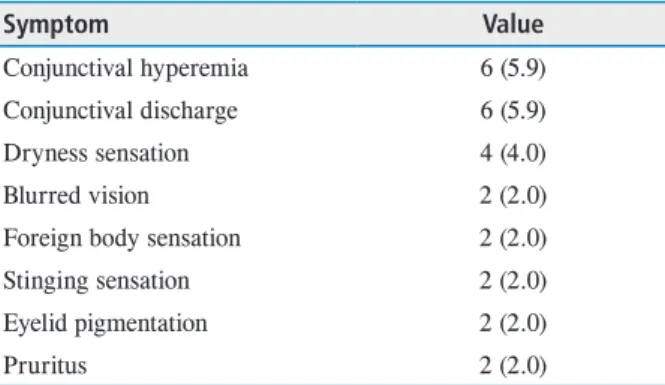
The type of ocular symptoms reported by the patients were as follows: conjunctival hyperemia (n = 6, 5.9%); con- junctival discharge (n = 6, 5.9%); dryness sensation (n = 4, 4.0%); blurred vision (n = 2, 2.0%); foreign body sensation (n = 2, 2.0%); stinging sensation (n = 2, 2.0%); eyelid pig- mentation (n = 2, 2.0%); and pruritus (n = 2, 2.0%) (Table 3).
Four eyes (4.0%) had to change their medication due to ocular side effects (conjunctival discharge, blurred vision, and dryness), but the rest of the eyes were able to maintain the PF latanoprost. Four eyes (11.4%) reported improved stinging sensation after switch from preserved latanoprost to PF latanoprost. There were no reported serious systemic adverse events.
Discussion
The present study investigated the efficacy and patient tol- erability of PF latanoprost (Monoprost®, Laboratoires Théa) in Korean POAG patients. Data have demonstrated that PF latanoprost have shown comparable IOP lowering effect until 6 months of its use. The percentage of IOP reduction reached to 18.0% at post-treatment 1 month from the study population consisting primarily of NTG. In addition, PF latanoprost exhibited comparable IOP lowering effect when switched from preserved latanoprost, with improvement of stinging sensation in 11.4% of patients.
The IOP lowering effect of PF latanoprost have been con- firmed from several studies from Europe. Rouland et al.13 have shown non-inferiority of IOP lowering effect between PF latanoprost (Monoprost®, n = 213) and preserve latano- prost (Xalatan®, n = 189) via prospective, international, mul- ticenter, randomized, investigator-masked, parallel-group trial. In their study, moderate to severe conjunctival hy- peremia was less frequent and the global subjective ocular symptom score was significantly lower on PF latanoprost than preserved latanoprost. Aptel et al.14 also demonstrated similar overall diurnal IOP reduction rates between PF and preserved latanoprost which was measured at 08:00, 12:00, 16:00, and 20:00. The biggest difference was at 08:00, with absolute IOP values of 16.2 ± 2.9 mmHg (preserved) versus 16.6 ± 2.2 mmHg (PF) (difference of 0.5 ± 2.5 mmHg). Econ- omou et al.15 conducted a 12-month real-life study assessing the efficacy and local tolerance between PF and preserved latanoprost from 721 patients. In this study, IOP lowering effect was similar between PF and preserved latanoprost.
However, ocular signs and symptoms improved after switching to PF latanoprost, with significant decrease in the prevalence of conjunctival hyperemia. The present study also has demonstrated comparable IOP lowering effect between PF and preserved latanoprost. The present study, however, included the POAG patients with lower baseline IOP (16.2 ± 3.0 mmHg) compared to previous studies in Europe (mostly greater than 20 mmHg).13,14 Nevertheless, the present study confirmed that PF latanoprost has also satisfactory IOP lowering effect in NTG eyes.
Table 3. Patient reported ocular symptoms during study period
Symptom Value
Conjunctival hyperemia 6 (5.9)
Conjunctival discharge 6 (5.9)
Dryness sensation 4 (4.0)
Blurred vision 2 (2.0)
Foreign body sensation 2 (2.0)
Stinging sensation 2 (2.0)
Eyelid pigmentation 2 (2.0)
Pruritus 2 (2.0)
Values are presented as number (%).
The present study has following limitations. First, due to the retrospective design, the patients did not come up with the same intervals, resulting in a different number of eyes at each follow-up period. This may have biased the IOP low- ering effect. Second, it was hard to evaluate and compare ocular signs between PF and preserved latanoprost due to the retrospective design. Only the patient reported ocular symptoms were able to collect from medical chart review. It is therefore in need to conduct more objective comparative trials to assess ocular signs including conjunctival hyper- emia and corneal punctate erosions between the two eye- drops. From the findings that four eyes (4.0%) had to change their medication due to ocular side effects (conjunctival discharge, blurred vision, and dryness), PF latanoprost also should be prescribed carefully and any side-effects need to be monitored with care.
In conclusion, the PF latanoprost (Monoprost®) showed satisfactory and comparable IOP lowering effect compared to preserved latanoprost in Korean POAG patients. Al- though some patients reported ocular symptoms including conjunctival hyperemia and discharge, most of (> 95%) patients were able to maintain their medication and some reported improvement of stinging sensation when switched from preserved eye-drops.
Conflicts of Interest
No conflicting relationship exists for any author.
References
1. Jonas JB, Aung T, Bourne RR, et al. Glaucoma. Lancet 2017;390:2183-93.
2. Quigley HA, Broman AT. The number of people with glaucoma worldwide in 2010 and 2020. Br J Ophthalmol 2006;90:262-7.
3. Tham YC, Li X, Wong TY, et al. Global prevalence of glaucoma and projections of glaucoma burden through 2040: a systematic review and meta-analysis. Ophthalmol- ogy 2014;121:2081-90.
4. Collaborative Normal-Tension Glaucoma Study Group.
The effectiveness of intraocular pressure reduction in the treatment of normal-tension glaucoma. Am J Ophthalmol 1998;126:498-505.
5. Collaborative Normal-Tension Glaucoma Study Group.
Comparison of glaucomatous progression between un- treated patients with normal-tension glaucoma and patients with therapeutically reduced intraocular pressures. Am J Ophthalmol 1998;126:487-97.
6. Kass MA, Heuer DK, Higginbotham EJ, et al. The Ocular Hypertension Treatment Study: a randomized trial deter- mines that topical ocular hypotensive medication delays or prevents the onset of primary open-angle glaucoma. Arch Ophthalmol 2002;120:701-13; discussion 829-30.
7. Anderson DR, Normal Tension Glaucoma Study. Collab- orative normal tension glaucoma study. Curr Opin Oph- thalmol 2003;14:86-90.
8. Kim CY, Park KH, Ahn J, et al. Treatment patterns and medication adherence of patients with glaucoma in South Korea. Br J Ophthalmol 2017;101:801-7.
9. Steven DW, Alaghband P, Lim KS. Preservatives in glau- coma medication. Br J Ophthalmol 2018;102:1497-503.
10. Anwar Z, Wellik SR, Galor A. Glaucoma therapy and ocular surface disease: current literature and recommenda- tions. Curr Opin Ophthalmol 2013;24:136-43.
11. Sanford M. Preservative-free latanoprost eye drops in pa- tients with primary open-angle glaucoma/ocular hyperten- sion. Clin Drug Investig 2014;34:521-8.
12. Misiuk-Hojlo M, Pomorska M, Mulak M, et al. The RE- LIEF study: Tolerability and efficacy of preservative-free latanoprost in the treatment of glaucoma or ocular hyper- tension. Eur J Ophthalmol 2019;29:210-5.
13. Rouland JF, Traverso CE, Stalmans I, et al. Efficacy and safety of preservative-free latanoprost eyedrops, compared with BAK-preserved latanoprost in patients with ocular hypertension or glaucoma. Br J Ophthalmol 2013;97:196- 200.
14. Aptel F, Choudhry R, Stalmans I. Preservative-free versus preserved latanoprost eye drops in patients with open-an- gle glaucoma or ocular hypertension. Curr Med Res Opin 2016;32:1457-63.
15. Economou MA, Laukeland HK, Grabska-Liberek I, Rou- land JF. Better tolerance of preservative-free latanoprost compared to preserved glaucoma eye drops: the 12-month real-life FREE study. Clin Ophthalmol 2018;12:2399-407.
국문초록
한국인 원발개방각녹내장 환자에서 무보존제 라타노프로스트 점안제의 효능 및 내약성 분석
목적: 한국인 일차개방각녹내장 환자에서 무보존제 라타노프로스트 점안액의 안압하강 효능과 점안 후 환자들이 호소하는 안구 증상에 대해 보고하고자 한다.
대상과 방법: 이전 녹내장 치료 병력 없이 무보존제 라타노프로스트 점안액을 처음 처방받은 환자 35명 66안과 보존제가 첨가된 라타노프로스트 점안액 사용 중 무보존제 라타노프로스트 점안액으로 변경한 19명 35안의 의무기록을 후향적으로 분석하였다.
무보존제 라타노프로스트 점안액 처방 전 안압과 처방 1, 3, 6개월 후 안압을 비교 분석하였다. 무보존제 라타노프로스트 점안액 사용 후 환자가 호소하는 안구 증상에 대해 조사하였다.
결과: 무보존제 라타노프로스트 점안액을 처음 처방받은 환자의 안압은 16.2 ± 3.0 mmHg (n=66)에서 처방 1개월 후 13.2 ± 2.8 mmHg (n=61, p<0.001), 3개월 후 11.8 ± 2.5 mmHg (n=20, p<0.001), 그리고 6개월 후 13.2 ± 2.6 mmHg (n=41, p<0.001)으로 유의하게 감소하였다. 보존제가 첨가된 라타노프로스트에서 무보존제 라타노프로스트로 변경한 환자의 안압은 13.3 ± 1.9 mmHg (n=35)에서 변경 1개월 후 12.7 ± 1.4 mmHg (n=13, p=0.23), 3개월 후 12.7 ± 2.0 mmHg (n=22, p=0.24), 그리고 6개월 후 12.6
± 1.8 mmHg (n=29, p=0.14)으로 변경 전과 유의한 차이가 없었다. 환자들은 무보존제 라타노프로스트 사용 후 결막 충혈과 분비물(5.9%), 건조감(4.0%), 뿌옇게 보임(2.0%), 이물감(2.0%), 따가움(2.0%), 안검색소침착(2.0%), 가려움(2.0%) 등의 증상을 호소하였으나 무보존제 라타노프로스트 점안액으로 변경한 환자의 11.4%에서 따가운 증상의 호전을 보였다.
결론: 무보존제 라타노프로스트 점안액은 보존제가 첨가된 라타노프로스트 점안액과 비교할 만한 안압하강 효과를 보였다. 비록 6% 미만의 눈에서 다양한 안구 불편 증상을 호소하였으나, 보존제가 첨가된 라타노프로스트 점안액에서 무보존제 점안액으로 변경한 눈의 11.4%에서 따가움 증상의 호전을 보였다.