ABSTRACT
Background: The optimal treatment for superior labral tear from anterior to posterior (SLAP) lesions is controversial. Thus, we aimed to investigate the national surgical trends in isolated SLAP repair in Korea.
Methods: We analyzed a nationwide database from the Korean Health Insurance Review and Assessment Service from 2008 to 2017. We investigated the trends in SLAP repair by time, sex, age, and the type of health care institution.
Results: From 2008 to 2017, 27,850 isolated SLAP repairs were identified. Age-adjusted incidence rate of isolated SLAP repair increased by 692% from 1.07/100,000 in 2008 to 8.48/100,000 in 2012 (P = 0.005). However, the incidence rate declined significantly after 2012 (P = 0.032) and was 5.28/100,000 in 2017. Sex-specific incidence rate of isolated SLAP repair was 2.3 times higher in men than in women. The decline since 2012 was most evident in patients aged ≥ 40 years (P = 0.01); however, the incidence rates of isolated SLAP repair during the study period were similar between patients aged ≥ 40 years and those aged <
40 years. Moreover, hospitals with 30–100 beds had the greatest change in the number of isolated SLAP repair cases.
Conclusion: In Korea, the incidence of isolated SLAP repair increased dramatically until 2012; since then, it has declined. Although the decrease in isolated SLAP repair later in the study was evident in those aged ≥ 40 years, the incidence rate was still relatively high in patients aged ≥ 40 years.
Keywords: Superior Labral Tear from Anterior to Posterior; Surgery; Trends; Epidemiology
INTRODUCTION
Superior labral tear from anterior to posterior (SLAP) lesions have been recognized as a cause of shoulder pain since the mid-1980s.1 These lesions were classified into four types by Snyder et al.2 Among the four types of SLAP lesions, type II SLAP could be treated by arthroscopic SLAP repair.3 Arthroscopic isolated SLAP repair could result in improved clinical outcomes in young patients with a history of a traumatic event.4,5 However, several studies have shown suboptimal outcomes after SLAP repair and an increasing risk of complications such as stiffness, chondral injuries, and need for revision surgery.6,7 Although patient age and prior
Original Article
Received: Feb 29, 2020 Accepted: Jul 9, 2020 Address for Correspondence:
Bong-Gun Lee, MD, PhD Department of Orthopedic Surgery, Hanyang University College of Medicine, 222 Wangsimni-ro, Seongdong-gu, Seoul 04763, Korea.
E-mail: [email protected]
© 2020 The Korean Academy of Medical Sciences.
This is an Open Access article distributed under the terms of the Creative Commons Attribution Non-Commercial License (https://
creativecommons.org/licenses/by-nc/4.0/) which permits unrestricted non-commercial use, distribution, and reproduction in any medium, provided the original work is properly cited.
ORCID iDs Young-Hoon Jo
https://orcid.org/0000-0002-4299-2496 Hyun-Keun Oh
https://orcid.org/0000-0002-4260-1088 Soo-Young Jeong
https://orcid.org/0000-0002-4513-0461 Bong-Gun Lee
https://orcid.org/0000-0002-4003-5529 Disclosure
The authors have no potential conflicts of interest to disclose.
Author Contributions
Conceptualization: Jo YH, Lee BG. Data curation: Jo YH, Jeong SY. Formal analysis:
Jo YH. Investigation: Jo YH. Methodology: Jo YH. Supervision: Lee BG. Validation: Lee BG.
Young-Hoon Jo ,1 Hyun-Keun Oh ,2 Soo-Young Jeong ,3 and Bong-Gun Lee 3
1Department of Orthopedic Surgery, Hanyang University Guri Hospital, Guri, Korea
2Department of Orthopedic Surgery, Base Orthopedic Clinic, Seoul, Korea
3Department of Orthopedic Surgery, Hanyang University College of Medicine, Seoul, Korea
National Trends in the Repair of Isolated Superior Labral Tear from Anterior to Posterior in Korea
Musculoskeletal Disorders,
Rehabilitation & Sports
Medicine
Writing - original draft: Jo YH, Lee BG. Writing - review & editing: Jo YH, Oh HK, Jeong SY, Lee BG.
level of function play important roles in guiding surgical management, the indication for isolated SLAP repair remains unclear.
Because of the lack of consensus regarding the optimal treatment of SLAP lesions, the trends in SLAP repair showed a changing pattern over time. In the United States, while the incidence of SLAP repair showed an increasing trend before 2010,8,9 a decreasing trend has been reported in more recent studies.10,11 In addition, although suboptimal outcomes and complications were reported for SLAP repair in older patients,12,13 the incidence of SLAP repair in patients aged ≥ 40 years was shown to be similar to that in younger, more active patients.9 Surprisingly, SLAP repair was performed in several patients aged > 80 years.8 Understanding the epidemiology is important for clarifying the indications of SLAP repair and educating orthopedic surgeons about the optimal treatment of SLAP lesions.
Nevertheless, with the exception of the United States, few epidemiologic studies on SLAP repair exist worldwide.8-11
Thus, this study aimed to investigate the national surgical trends in isolated SLAP repair in Korea by analyzing nationwide data acquired from the Korean Health Insurance Review and Assessment Service (HIRA) database. We examined the trends in SLAP repair by time, sex, age, and the type of healthcare institution. Our hypotheses were as follows. First, the incidence of SLAP repair would show a decreasing trend more recently in Korea. Second, the decreasing trend would be more evident in older patients.
METHODS
Data source
In this cross-sectional epidemiology study, the authors analyzed nationwide data obtained from the HIRA database. In Korea, the National Health Insurance covers 100% of the population, including 97% of health insurance and 3% of medical aid.14 All healthcare providers submit claims data for inpatient and outpatient management, including diagnostic codes (classified according to the International Classification of Diseases, 10th revision [ICD-10]), procedure codes, and demographic information, to the HIRA to request reimbursement for medical costs from the National Health Insurance service. Hence, medical data of almost all outpatients or hospitalized patients in Korea are prospectively recorded in the HIRA database.
Data collection
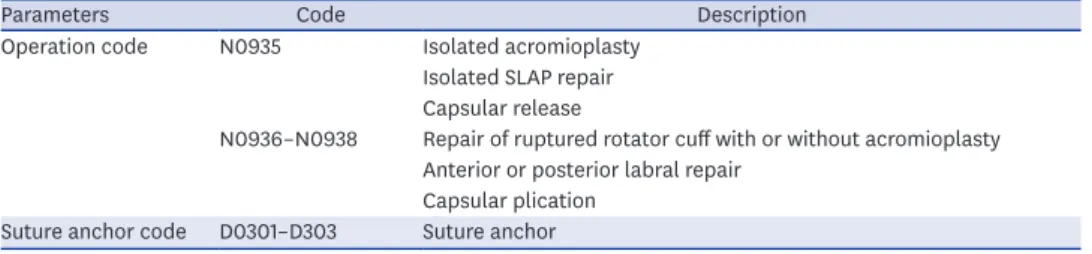
We studied patients who underwent isolated SLAP repair from 2008 to 2017. Although ICD-10 codes S434, M411, and S4610 could be used as diagnostic codes for SLAP lesion,14 there was no clear diagnostic ICD-10 code for isolated SLAP lesion during the study period. Therefore, identifying isolated SLAP repair using a diagnostic code was insufficient because other diagnostic codes were possibly entered in numerous isolated SLAP repair cases. Consequently, we identified patients who had isolated SLAP repair using procedure codes. In Korea, the operation code for isolated SLAP repair is N0935. However, N0935 was also entered for patients who received isolated acromioplasty or capsular release (Table 1). As a suture anchor is not used in both isolated acromioplasty and capsular release, the authors excluded patients who had isolated acromioplasty and capsular release by identifying patients with the code N0935 and the suture anchor code (D0301–D0303) (Table 1). Subsequently, among the remaining patients, we further excluded those with the procedure code for biceps tenodesis (N0941, N0942, N0931), thereby ultimately identifying the patients who received isolated SLAP repair.
We examined the patient data to identify the year of surgery, age, sex, and type of healthcare institution. In Korea, health care institutions are classified as clinics, hospitals, general hospitals, and tertiary hospitals. The classification criteria are based on inpatient bed size for clinics (< 30 beds), hospitals (30 to < 100 beds), and general hospitals (≥ 100 beds), and tertiary hospitals are defined as general hospitals that are approved to provide most types of advanced medical care and treat severely ill patients with a minimum of 20 departments.14 We investigated the trends in age-adjusted and sex-specific incidence rates of isolated SLAP repair by year. Because a systematic review of SLAP repair included several studies that reported higher failure and complication rates in patients aged ≥ 40 years,7 we also examined such trends by dividing the patients into two groups according to age, i.e., ≥ 40 years and < 40 years. Lastly, we examined the trends in isolated SLAP repair by the type of healthcare institution.
Statistical analysis
We calculated age-adjusted and sex-specific incidence rates per 100,000 persons with isolated SLAP repair using the 2010 United States population as the standard population.15 Estimated year-specific, age-specific, and sex-specific populations were obtained from the Statistics Korea website (http://www.kosis.kr). The annual percentage changes (APCs) in the age-adjusted incidence rates of isolated SLAP repair from 2008 to 2017 were calculated using joinpoint regression analysis (Joinpoint Regression Program, version 4.3.1.0; National Cancer Institute, Bethesda, MD, USA).14,16 All other data sets were analyzed using SAS statistical software version 9.13 (SAS Institute, Cary, NC, USA). Univariate analysis was conducted using t-test. Statistical significance was set at P < 0.05.
Ethics statement
The study protocol was exempted for review by the Institutional Review Board of the Hanyang University Hospital (HYUH 2018-05-022) in accordance with the exemption criteria.
RESULTS
From 2008 to 2017, 27,850 isolated SLAP repairs (27,324 patients) were performed in Korea.
The number of isolated SLAP repair cases increased greatly from 486 in 2008 to 4,165 in 2012. However, a decreasing trend was noted since 2012; the number decreased to 2,540 in 2017. Similarly, age-adjusted incidence rate of isolated SLAP repair increased by 692% from 1.07/100,000 in 2008 to 8.48/100,000 in 2012, which decreased to 5.28/100,000 in 2017 (Table 2 and Fig. 1). Joinpoint regression analysis revealed a transition of APC of age-adjusted incidence rate around the year 2012. The mean APC from 2008 to 2012 was 46.8% (95% confidence interval [CI], 19.3%, 79.6%), which was statistically significant with the incidence of isolated SLAP repair increasing each year (P = 0.005), whereas that from 2012 to 2017 was −10.1% (95%
CI, −18.1%, −1.3%), which was significant with the incidence decreasing (P = 0.032).
Table 1. Procedure codes used in the analysis
Parameters Code Description
Operation code N0935 Isolated acromioplasty Isolated SLAP repair Capsular release
N0936–N0938 Repair of ruptured rotator cuff with or without acromioplasty Anterior or posterior labral repair
Capsular plication Suture anchor code D0301–D303 Suture anchor SLAP = superior labral tear from anterior to posterior.
Of the overall cohort, 19,430 (69.8%) and 8,420 (30.2%) were men and women, respectively.
Sex-specific age-adjusted incidence rate was 2.32 times higher in men than in women;
however, both groups showed similar increasing trends until 2012 and decreasing trends thereafter (Fig. 2). The mean age of the patients who underwent SLAP repair was 40.0 ± 12.9 years. The mean age for men was significantly lower (37.2 ± 12.9 years) than that for women (46.4 ± 10.3 years) (P < 0.001). Moreover, in men, the age group-specific incidence rate was highest in the 30–39 year age group (12.32/100,000), which was followed by the 40–49 year age group (11.97/100,000) and the 20–29 year age group (9.39/100,000) (Fig. 3). The age group-specific incidence in women was highest in the 40–49 year age group (8.87/100,000), which was followed by the 50–59 year age group (5.86/100,000) and the 30–39 year age group (3.16/100,000) (Fig. 3).
Among patients aged ≥ 40 years, the incidence of isolated SLAP repair increased significantly from 2008 to 2012 (APC, 48.7%; 95% CI, 23.4%, 79.1%; P = 0.003) and declined significantly after 2012 (APC, −11.5%; 95% CI, −18.5%, −3.9%; P = 0.01) (Fig. 4). Among patients aged
< 40 years, the incidence of isolated SLAP repair increased significantly from 2008 to 2012 (APC, 44.6%; 95% CI, 13.6%, 84.0%; P = 0.01) and decreased slightly after 2012; however, the decrease was not statistically significant (APC, −8.5%; 95% CI, −18.1%, 2.4%; P = 0.10) (Fig. 4).
Table 2. Number of cases and age-adjusted rates (per 100,000 persons) of isolated SLAP repair from 2008 to 2017
Years No. of cases Age-adjusted incidence ratesa
Total Men Women Total Men Women
2008 486 355 131 1.07 1.52 0.59
2009 1,503 1,090 413 3.15 4.46 1.74
2010 2,369 1,660 709 4.87 6.66 2.93
2011 3,063 2,124 939 6.24 8.49 3.82
2012 3,990 2,677 1,313 8.48 11.56 5.16
2013 4,165 2,896 1,269 8.12 10.74 5.27
2014 3,625 2,560 1,065 7.38 10.28 4.23
2015 3,352 2,361 991 6.90 9.62 3.93
2016 2,757 1,940 817 5.72 7.99 3.24
2017 2,540 1,767 773 5.28 7.33 3.05
Overall 27,850 19,430 8,420 - - -
SLAP = superior labral tear from anterior to posterior.
aUnited States population in 2010 as the control.
2012–2017 APC = −10.1%*
0 1 2 3 4 5 6 7 8 9
2008 2009 2010 2011 2012 2013 2014 2015 2016 2017
Rate (per 100,000)
Year Total
2008–2012 APC = 46.8%*
Fig. 1. Age-adjusted incidence rates per 100,000 persons of isolated SLAP repair.
SLAP = superior labral tear from anterior to posterior, APC = annual percentage change.
*P < 0.05.
Year
Men Women
0 2 4 6 8 10 12 14
2008 2009 2010 2011 2012 2013 2014 2015 2016 2017
Rate (per 100,000)
2012–2017 APC = −9.4%* 2008–2012
APC = 45.2%*
2008–2012 APC = 50.7%*
2012–2017 APC = −12.0%*
Fig. 2. Sex-specific age-adjusted incidence rates per 100,000 persons of isolated SLAP repair.
SLAP = superior labral tear from anterior to posterior, APC = annual percentage change.
*P < 0.05.
0 2 4 6 8 10 12
14 Men Women
Age group, yr
Rate (/100,000 people per year)
10–19 20–29 30–39 40–49 50–59 60–69 ≥ 70
Fig. 3. Sex-specific incidence rates per 100,000 persons of isolated SLAP repair by age group from 2008 to 2017.
SLAP = superior labral tear from anterior to posterior.
0 1 2 3 4 5 6 7 8 9 10
2008 2009 2010 2011 2012 2013 2014 2015 2016 2017
Rate (per 100,000)
Year
< 40 ≥ 40 2008–2012
APC = 48.7%*
2012–2017 APC = −11.5%*
2008–2012 APC = 44.6%*
2012–2017 APC = −8.5%
Fig. 4. Incidence of isolated SLAP repair in the < 40 years and ≥ 40 years age groups.
SLAP = superior labral tear from anterior to posterior, APC = annual percentage change.
*P < 0.05.
Furthermore, the incidence of isolated SLAP repair increased from 2008 to 2012 in all healthcare institutions and showed a decreasing trend since 2012 (Fig. 5). The rate of change was greatest in hospitals with 30-100 beds, with the number of surgeries increasing by 18.5- fold, i.e., from 172 cases in 2008 to 3,178 cases in 2012, but decreasing to 1,800 cases in 2017.
The average age of patients by type of healthcare institution was highest in hospitals with 30-100 beds (40.8 years), which was followed by general hospitals (40.4 years), clinics (38.0 years), and tertiary hospitals (36.9 years).
DISCUSSION
This study evaluated the trends in isolated SLAP repair in Korea over the past 10 years.
Interestingly, there was a sharp growth during the first half of the study period but a decrease in the later half. The decreasing trend in the later half was particularly evident in patients aged ≥ 40 years. Although both men and women showed a similar trend, i.e., an initial increase followed by a decrease, a discrepancy between sexes in the most affected age groups was observed. Moreover, trends according to the type of healthcare institution showed a rapid increase in the incidence of isolated SLAP repair, especially in hospitals with 30–100 beds; however, a sharp decline in the past 5 years was found.
Controversies regarding the optimal treatment of SLAP lesions still exist. Several authors reported a significant improvement in functional capacity and pain relief after isolated SLAP repair.4,5,17 The initial increase in the incidence of SLAP repair may be attributed to advances in imaging technologies and the development of arthroscopic surgical techniques and instruments.18 Nonetheless, more recent studies reported persistent pain, stiffness, chondral injuries, and low rates of return to sports after SLAP repair.6,19-21 In 2009, Boileau et al.22 reported for the first time that a greater proportion of patients after biceps tenodesis were satisfied than after SLAP repair in a heterogeneous population. Recent studies showed that proportion of patients managed with biceps tenodesis has increased in frequency, whereas SLAP repair has decreased in frequency.10,11 Furthermore, satisfactory clinical outcomes have been reported for non-operative intervention as the primary treatment of SLAP lesions.23,24
0 500 1,000 1,500 2,000 2,500 3,000 3,500 4,000 4,500
Tertiary hospital General hospital Hospital Clinic
No. of cases
2008 2009 2010 2011 2012 2013 2014 2015 2016 2017 Year
Fig. 5. Total isolated SLAP repair cases according to the type of healthcare institution from 2008 to 2017.
SLAP = superior labral tear from anterior to posterior.
Because biceps tenodesis and non-operative intervention have gained popularity for the management of SLAP lesions, the incidence of SLAP repair in Korea is believed to have decreased since 2012. An increasing frequency of SLAP repairs was also reported in the United States before 20106,8,9; however, a decreasing trend was noted in more recent studies.10,11,25 Several studies showed no significant difference in clinical outcomes after a SLAP repair between patients older than 40 years and those younger than 40 years.26,27 However, using a systematic review, Erickson et al.7 reported that decreased patient satisfaction and increasing complications including stiffness and reoperations, occur at higher rates as the patient age increases in patients aged 40 and over. Provencher et al.12 also reported that old age is associated with a higher chance of failure after SLAP repairs. These findings contributed to the significant decreasing trend in isolated SLAP repair in patients aged ≥ 40 years after 2012.
Consistent with other studies, this study also showed that men had more than twice the incidence of isolated SLAP repair than women.8,9 Moreover, the average age of men at the time of SLAP repair was considerably lower than that of women. This difference may be attributed to the large number of SLAP tears related to sports activities in young men.28,29 However, the incidence of SLAP repair in patients aged ≥ 40 years was similar to that of patients aged < 40 years in this study (Fig. 4), which indicates a relatively higher number of SLAP repairs in older populations than the authors expected. These results could be observed not only in Korea but also in the United States.9 For the management of SLAP tear, SLAP repair is preferred for younger patients, while biceps tenodesis or tentomy is preferred for older patients.25 Franceschi et al.30 stated that SLAP repair has no advantage in patients over the age of 50 years with rotator cuff tear and that rotator cuff repair with biceps tenotomy showed better clinical outcomes. In addition, SLAP repair in older patients may cause complications, including stiffness, persistent pain, and need for revision surgery. Therefore, proper education about the surgical indications for SLAP lesions is necessary.
This study demonstrated that the incidence of SLAP repairs, especially in hospitals with 30–100 beds, increased greatly but subsequently declined (Fig. 5). The number of healthcare institutions performing shoulder surgeries in Korea has increased dramatically especially in hospitals with 30–100 beds.14 Most rotator cuff surgeries in Korea were performed by arthroscopy, and many of these operations were performed in relatively small hospitals such as hospitals with 30-100 beds because of low morbidity and mortality.14 Similarly, the majority of SLAP repairs were performed by arthroscopy; thus, they are often performed in small hospitals. However, the authors are concerned about the fact that the average age is highest for patients at hospitals with 30–100 beds where SLAP repairs are performed most frequently. Careful attention must be paid to overtreatment of SLAP lesions in older patients.
While this study has the advantages of using a large sample size, using a nationwide database, and analyzing trends over 10 years, several limitations exist. First, an exclusive surgical code for SLAP repair does not exist in Korea. Isolated acromioplasty, isolated SLAP repair, and capsular release are all included in a single code: N0935 (Table 1). However, as both isolated acromioplasty and capsular release does not use a suture anchor, we were able to identify isolated SLAP repair cases. Second, although it was possible to identify patients treated with isolated SLAP repair, those who received another procedure concurrently with SLAP repair were not identifed. In Korea, a higher operation code (N0936–N0938) is entered for patients who are treated with a rotator cuff repair or an anterior labral repair simultaneously with SLAP repair. Thus, this study was only able to analyze the trend in
isolated SLAP repairs. Third, HIRA data did not include any information about the clinical outcomes of SLAP repair. Consequently, we were not able to investigate how the increases or decreases in SLAP repair correlate with the clinical outcomes of SLAP repair. Lastly, some code errors in a large database are possible.
The incidence of SLAP repair in Korea increased dramatically until 2012; since then, the incidence has declined. The decreasing trend was especially evident in patients aged ≥ 40 years; however, the incidence rate remained relatively high in patients aged ≥ 40 years. In addition, with the high frequency of SLAP repairs in small hospitals and the relatively old age of patients, the optimal surgical indications for SLAP repair need to be established.
REFERENCES
1. Andrews JR, Carson WG Jr, McLeod WD. Glenoid labrum tears related to the long head of the biceps. Am J Sports Med 1985;13(5):337-41.
PUBMED | CROSSREF
2. Snyder SJ, Karzel RP, Del Pizzo W, Ferkel RD, Friedman MJ. SLAP lesions of the shoulder. Arthroscopy 1990;6(4):274-9.
PUBMED | CROSSREF
3. Snyder SJ, Banas MP, Karzel RP. An analysis of 140 injuries to the superior glenoid labrum. J Shoulder Elbow Surg 1995;4(4):243-8.
PUBMED | CROSSREF
4. Rhee YG, Lee DH, Lim CT. Unstable isolated SLAP lesion: clinical presentation and outcome of arthroscopic fixation. Arthroscopy 2005;21(9):1099.
PUBMED | CROSSREF
5. Kim SH, Ha KI, Kim SH, Choi HJ. Results of arthroscopic treatment of superior labral lesions. J Bone Joint Surg Am 2002;84(6):981-5.
PUBMED | CROSSREF
6. Weber SC, Martin DF, Seiler JG 3rd, Harrast JJ. Superior labrum anterior and posterior lesions of the shoulder: incidence rates, complications, and outcomes as reported by American Board of Orthopedic Surgery. Part II candidates. Am J Sports Med 2012;40(7):1538-43.
PUBMED | CROSSREF
7. Erickson J, Lavery K, Monica J, Gatt C, Dhawan A. Surgical treatment of symptomatic superior labrum anterior-posterior tears in patients older than 40 years: a systematic review. Am J Sports Med 2015;43(5):1274-82.
PUBMED | CROSSREF
8. Onyekwelu I, Khatib O, Zuckerman JD, Rokito AS, Kwon YW. The rising incidence of arthroscopic superior labrum anterior and posterior (SLAP) repairs. J Shoulder Elbow Surg 2012;21(6):728-31.
PUBMED | CROSSREF
9. Zhang AL, Kreulen C, Ngo SS, Hame SL, Wang JC, Gamradt SC. Demographic trends in arthroscopic SLAP repair in the United States. Am J Sports Med 2012;40(5):1144-7.
PUBMED | CROSSREF
10. Cvetanovich GL, Gowd AK, Agarwalla A, Forsythe B, Romeo AA, Verma NN. Trends in the management of isolated SLAP tears in the United States. Orthop J Sports Med 2019;7(3):2325967119833997.
PUBMED | CROSSREF
11. Erickson BJ, Jain A, Abrams GD, Nicholson GP, Cole BJ, Romeo AA, et al. SLAP lesions: trends in treatment. Arthroscopy 2016;32(6):976-81.
PUBMED | CROSSREF
12. Provencher MT, McCormick F, Dewing C, McIntire S, Solomon D. A prospective analysis of 179 type 2 superior labrum anterior and posterior repairs: outcomes and factors associated with success and failure.
Am J Sports Med 2013;41(4):880-6.
PUBMED | CROSSREF
13. Nashikkar PS, Rhee SM, Desai CV, Oh JH. Is anatomical healing essential for better clinical outcome in type II SLAP repair? Clinico-radiological outcome after type II SLAP repair. Clin Orthop Surg 2018;10(3):358-67.
PUBMED | CROSSREF
14. Jo YH, Lee KH, Kim SJ, Kim J, Lee BG. National trends in surgery for rotator cuff disease in Korea. J Korean Med Sci 2017;32(2):357-64.
PUBMED | CROSSREF
15. Jo YH, Lee BG, Kim HS, Kim JH, Lee CH, Kim SJ, et al. Incidence and seasonal variation of distal radius fractures in Korea: a population-based study. J Korean Med Sci 2018;33(7):e48.
PUBMED | CROSSREF
16. Martinez-Huedo MA, Jiménez-García R, Mora-Zamorano E, Hernández-Barrera V, Villanueva-Martinez M, Lopez-de-Andres A. Trends in incidence of proximal humerus fractures, surgical procedures and outcomes among elderly hospitalized patients with and without type 2 diabetes in Spain (2001–2013).
BMC Musculoskelet Disord 2017;18(1):522.
PUBMED | CROSSREF
17. Friel NA, Karas V, Slabaugh MA, Cole BJ. Outcomes of type II superior labrum, anterior to posterior (SLAP) repair: prospective evaluation at a minimum two-year follow-up. J Shoulder Elbow Surg 2010;19(6):859-67.
PUBMED | CROSSREF
18. Bencardino JT, Beltran J, Rosenberg ZS, Rokito A, Schmahmann S, Mota J, et al. Superior labrum anterior- posterior lesions: diagnosis with MR arthrography of the shoulder. Radiology 2000;214(1):267-71.
PUBMED | CROSSREF
19. Gorantla K, Gill C, Wright RW. The outcome of type II SLAP repair: a systematic review. Arthroscopy 2010;26(4):537-45.
PUBMED | CROSSREF
20. Katz LM, Hsu S, Miller SL, Richmond JC, Khetia E, Kohli N, et al. Poor outcomes after SLAP repair:
descriptive analysis and prognosis. Arthroscopy 2009;25(8):849-55.
PUBMED | CROSSREF
21. Brockmeier SF, Voos JE, Williams RJ 3rd, Altchek DW, Cordasco FA, Allen AA, et al. Outcomes after arthroscopic repair of type-II SLAP lesions. J Bone Joint Surg Am 2009;91(7):1595-603.
PUBMED | CROSSREF
22. Boileau P, Parratte S, Chuinard C, Roussanne Y, Shia D, Bicknell R. Arthroscopic treatment of isolated type II SLAP lesions: biceps tenodesis as an alternative to reinsertion. Am J Sports Med 2009;37(5):929-36.
PUBMED | CROSSREF
23. Edwards SL, Lee JA, Bell JE, Packer JD, Ahmad CS, Levine WN, et al. Nonoperative treatment of superior labrum anterior posterior tears: improvements in pain, function, and quality of life. Am J Sports Med 2010;38(7):1456-61.
PUBMED | CROSSREF
24. Shin SJ, Lee J, Jeon YS, Ko YW, Kim RG. Clinical outcomes of non-operative treatment for patients presenting SLAP lesions in diagnostic provocative tests and MR arthrography. Knee Surg Sports Traumatol Arthrosc 2017;25(10):3296-302.
PUBMED | CROSSREF
25. Patterson BM, Creighton RA, Spang JT, Roberson JR, Kamath GV. Surgical trends in the treatment of superior labrum anterior and posterior lesions of the shoulder: analysis of data from the American Board of Orthopaedic Surgery certification examination database. Am J Sports Med 2014;42(8):1904-10.
PUBMED | CROSSREF
26. Neri BR, Vollmer EA, Kvitne RS. Isolated type II superior labral anterior posterior lesions: age-related outcome of arthroscopic fixation. Am J Sports Med 2009;37(5):937-42.
PUBMED | CROSSREF
27. Alpert JM, Wuerz TH, O'Donnell TF, Carroll KM, Brucker NN, Gill TJ. The effect of age on the outcomes of arthroscopic repair of type II superior labral anterior and posterior lesions. Am J Sports Med 2010;38(11):2299-303.
PUBMED | CROSSREF
28. Pradhan RL, Itoi E, Hatakeyama Y, Urayama M, Sato K. Superior labral strain during the throwing motion. A cadaveric study. Am J Sports Med 2001;29(4):488-92.
PUBMED | CROSSREF
29. Yeh ML, Lintner D, Luo ZP. Stress distribution in the superior labrum during throwing motion. Am J Sports Med 2005;33(3):395-401.
PUBMED | CROSSREF
30. Franceschi F, Longo UG, Ruzzini L, Rizzello G, Maffulli N, Denaro V. No advantages in repairing a type II superior labrum anterior and posterior (SLAP) lesion when associated with rotator cuff repair in patients over age 50: a randomized controlled trial. Am J Sports Med 2008;36(2):247-53.
PUBMED | CROSSREF