https://doi.org/10.4174/astr.2017.92.1.9 Annals of Surgical Treatment and Research
A comparison of postoperative pain after conventional open thyroidectomy and single-incision, gasless,
endoscopic transaxillary thyroidectomy: a single institute prospective study
Jung Bong Kang*, Eun Young Kim*, Yong Lai Park, Chan Heun Park, Ji-Sup Yun
Department of Surgery, Kangbuk Samsung Hospital, Sungkyunkwan University School of Medicine, Seoul, Korea
INTRODUCTION
The incidence of thyroid cancer has increased during the last few decades [1,2]. Various techniques for thyroid surgery have been introduced focusing on better cosmetic outcomes, less postoperative pain, and improved quality of life. Such as endoscopic breast approach, endoscopic and robotic bilateral axillo breast approach, endoscopic and robotic transaxillary approach, and endoscopic and robotic facelift approach are intro duced instead of conventional open thyroidectomy through cervical approach [3]. Among the various techniques, tran
saxillary thyroidectomy has been widely used in the last several years. The endoscopic transaxillary approach used by Ikeda in 2000 [4] has several benefits; a wide operation field with the same surgical view as open surgery, and, ready accessibility to the thyrothymic ligament, facilitating neck node dissection in the central compartment. The feasibility and oncologic safety of singleincision, gasless, endoscopic transaxillary thyroidectomy (SET) in patients with papillary thyroid carcinoma has been proved by other articles [57]. Disadvantages of SET seem to include more postoperative pain due to a larger plane of tissue dissection compared to conventional open thyroidectomy. This Purpose: The aim of this study was to compare postoperative pain between singleincision, gasless, endoscopic tran
saxillary thyroidectomy (SET), and conventional open thyroidectomy.
Methods: From March to December 2015, patients with thyroid disease underwent total thyroidectomy or lobectomy.
Patient’s clinical and pathological characteristics, postoperative pain score using visual analog scale (VAS) were compared between the 2 groups. The primary endpoint was postoperative pain evaluated by VAS score and postoperative analgesic use. Operation time and length of postoperative hospital stay were secondary outcome measures.
Results: Conventional, open cervical surgery was performed on 30 patients (group O) and SET was performed on 27 pa
tients (group E). Pain scores in shoulder area, which is the ipsilateral side of the tumor location at 1 hour and 24 hours after surgery, were higher in group E patients (P < 0.05). Pain scores 7 days after surgery did not differ between the 2 groups according to the locations (P < 0.05).
Conclusion: In conclusion, endocrine surgeons should be concerned about immediate higher postoperative pain scores in patients who undergo SET.
[Ann Surg Treat Res 2017;92(1):9-14]
Key Words: Carcinoma, Postoperative pain, Thyroid neoplasms
Reviewed January February March April May June July August September October November December
Received June 7, 2016, Revised August 22, 2016, Accepted August 31, 2016
Corresponding Author: Ji-Sup Yun
Department of Surgery, Kangbuk Samsung Hospital, Sungkyunkwan University School of Medicine, 29 Saemunan-ro, Jongno-gu, Seoul 03181, Korea
Tel: +82-2-2001-1730, Fax: +82-2-2001-1883 E-mail: [email protected]
*Jung Bong Kang and Eun Young Kim contributed equally to this study as co- first authors.
Copyright ⓒ 2017, the Korean Surgical Society
cc Annals of Surgical Treatment and Research is an Open Access Journal. All articles are distributed under the terms of the Creative Commons Attribution Non- Commercial License (http://creativecommons.org/licenses/by-nc/4.0/) which permits unrestricted non-commercial use, distribution, and reproduction in any medium, provided the original work is properly cited.
influences patient decision when choosing a type of surgery. In fact, many patients choose conventional open thyroidectomy over SET due to concerns regarding postoperative pain. How
ever, only a few studies have assessed pain indirectly based on analgesic dose or directly based on visual analogue scale (VAS) pain scores [8,9]. Therefore, we conducted a prospective obser
va tional study comparing postoperative pain after SET and open cervical total thyroidectomy to give accurate and unbiased information about SET to patients. We also assessed pain scores according to different locations that might be influenced by surgical position such as central neck, lateral neck, clavicle area, and site of operation. To observe whether there is postoperative difference between the two methods after a significant amount of time, we assessed pain scores over time.
METHODS
Study subjects
From March to December 2015, we enrolled patients aged 18 years or older who underwent total thyroidectomy at the Department of Surgery in Kangbuk Samsung Hospital. Cases with lateral neck node metastases or distant metastasis that required modified radical neck dissection, bilateral central neck node metastases on preoperative ultrasonography (USG), combined with other operation, and intentional resection of recurrent laryngeal nerve (RLN) invasion were excluded.
Open cervical thyroidectomy was performed on 30 patients.
Endoscopic thyroidectomy was performed on 27 patients.
Preoperative diagnosis of a thyroid tumor was based on fine
needle aspiration cytology and high resolution USG. All operations were conducted by a single surgeon.
Postoperative pain was measured using the VAS at 1 hour, 24 hours, and 7 days after operation. VAS was graded from 0 to 10.
VAS was measured at 7 different sites; central neck, lateral neck (ipsilateral and contralateral side to tumor location), clavicular area (ipsilateral and contralateral side to tumor location), anterior chest, site of operation (cervical neck area or axillary area), upper arm (ipsilateral and contralateral side to tumor location), shoulder (ipsilateral and contralateral side to tumor location), and headache. For management of pain, intravenous analgesics such as nonsteroidal antiinflammatory drugs or opioids were injected as needed. Patients were eligible for discharge when they had no symptoms of complications such as hypocalcemia, or postoperative seroma.
Operative methods
Endoscopic procedure
The patient was placed in a supine position with a pillow under the neck for extension. The arm on the lesion side was raised above the head and held parallel to the midline extending from the hyoid bone and to the sternal notch. A
5 to 6cm vertical skin incision was made in the lateral side of the pectoralis major muscle at the axilla. The route to the anterior neck area was dissected through the anterior surface of pectoralis major muscle, using an electric cautery under direct vision, until the sternocleidomastoid (SCM) muscle was exposed. The dissection was made from the sternal notch toward the hyoid bone, to minimize bleeding and injury of the flap. Once the clavicular and sternal heads of SCM muscle were exposed, a right angle retractor or cuda retractor (with light source attached) was placed in the space between the SCM branches. The exposed strap muscle was dissected laterally, and then the omohyoid muscle was pushed below the strap muscle.
A Chung’s retractor was inserted through the axilla to create working space.
A 12mm port was fixed 1–2 mm from the uppermost margin of the axillary incision, then a 45degree rigid endoscope was inserted through the port. Under endoscopic guidance, the trachea was visualized parallel to the operation field, and the thyroid gland was exposed. The upper pole of the thyroid was drawn downward, and the superior thyroid vessels were individually ligated using the harmonic scalpel, to avoid injury to the external branch of the superior laryngeal nerve. The lower pole was dissected to the thyrothymic ligament, and then the inferior thyroid vessels were dissected. The thyroid gland was retracted medially using an endoscopic grasper, and the carotid sheath was sharply dissected using an endoscopic dissector to trace the RLN. The middle thyroid vein was then ligated. The RLN adjacent to Berry’s ligament was protected by covering it with gauze. The entire cervical course of the RLN was then traced, and the inferior thyroid vein, located 1 cm superior to RLN, was ligated. The ipsilateral side of the thyroid gland was then dissected from the trachea.
To avoid bleeding and adhesion, Tisseel fibrin sealant (Dalim, Seoul, Korea) and HyFence (CHA Bio & Diostech, Seoul, Korea) were applied to the detachment sites of the thyroid gland, trachea, and SCM muscle. Fluid collected in cervical area level V was removed using a suction catheter. A 200mL drain was inserted to the detachment site of the thyroid gland and fixed at 2 cm distal from the inferior margin of the wound. The subcutaneous fascia was closed with absorbable Vicryl sutures (Vicryl 40, Ethicon, Johnson & Johnson, Somerville, NJ, USA) and the subcuticular layer was closed with 50 Maxon sutures (Covidien Pty. Ltd., Melbourne, Australia). The skin was closed with a 3M steri strip (3M, St. Paul, MN, USA).
Open procedure
The patient was placed in a supine position with the neck extended. A 6 to 8cm transverse skin incision was made two fingers above the sternal notch and a subplatysmal flap dissection was performed from the hyoid bone to the sternal notch. A vertical incision was made on the midline of the
strap muscle to expose the thyroid gland. A bilateral total thyroidectomy, central compartment neck dissection, and wound closure were performed in the same manner as the endoscopic procedure.
Data collection
The primary endpoint was postoperative pain evaluated by VAS score and postoperative analgesic use. Collected data included patient demographics, clinicopathologic characteristics, and perioperative outcomes including operation time, length of hospital stay, total dose of analgesics, and VAS pain score.
Statistical analysis
Characteristics of groups O and E were compared using the Student ttest for continuous variables and the Pearson chi
square test for categorical variables. For comparison of pain during postoperative period between the 2 groups, we used repeated measure analysis of variance test. Means and standard errors are shown in the tables. Differences between groups were considered significant at P < 0.05. All statistical analyses were performed using SPSS ver. 12.0 (SPSS Inc., Chicago, IL, USA).
RESULTS
Clinicopathologic characteristics
From March to December 2015, 57 patients (40 female and 17 male) were recruited for the study. Of these patients, 30 underwent conventional open thyroidectomy (group O) and 27 underwent SET (group E). Baseline demographic and clinical data for the 2 groups of patients are shown in Table 1.
The 2 groups did not differ significantly in terms of clinical characteristics, or pathologic features except age, body mass index (BMI) and operation time (P < 0.001). The mean operation time in group O was 98.50 ± 32.301 minutes compared with 134.86 ± 19.142 minutes in group E, a statistically significant difference of 36 minutes shorter (P = 0.001). Group E patients were younger and BMI was lower in Group E (P = 0.001).
Postoperative pain assessment
The mean number of analgesic doses after surgery is shown in Table 2. Patients in group O tended to receive more total doses of analgesics within the first 24 hours than 24 hours after surgery, but the difference was not statistically significant.
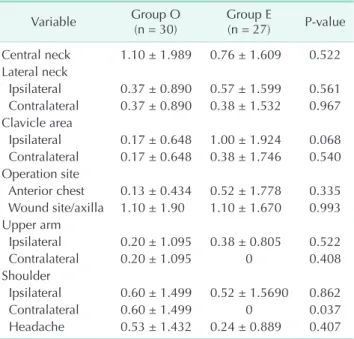
The mean postoperative pain scores on 1 hour, 24 hours, and 7 days after surgery are listed in Tables 3–5. Pain scores 1 hour
Table 1. Clinicopathologic characteristics of patients in groups O and E
Characteristic Group O (n = 30) Group E (n = 27) P-value
Age (yr) 0.001
Mean ± SE 50.00 ± 12.567 37.62 ± 10.264
Range 30–74 20–55
Sex 0.078
Female 19 (63.3) 21 (77.7)
Male 11 (36.7) 6 (22.3)
Body mass index (kg/m2) 25.47 ± 4.097 21.37 ± 3.320 <0.001
Pathologic diagnosis 0.607
Papillary thyroid carcinoma 22 20
Benign 8 7
Operation time (min) 98.50 ± 32.301 134.86 ± 19.142 <0.001
Postoperative hospital stay (day) 2.73 ± 0.640 2.90 ± 1.136 0.536
Values are presented as number (%) or mean ± standard error (SE) unless otherwise indicated.
Group O, conventional open thyroidectomy; group E, single-incision, gasless, endoscopic transaxillary thyroidectomy.
Table 2. The mean number and amount of analgesic doses after surgery
Analgesic dose after surgery Group O (n = 30) Group E (n = 27) P-value
No. of analgesic used < 24 hr 0.73 ± 0.740 0.52 ± 0.680 0.309
No. of analgesic used > 24 hr 0.13 ± 0.346 0.05 ± 0.218 0.284
Amount of analgesic used < 24 hr (mg) 61. 84 ± 19.308 52.78 ± 8.333 0.574
Amount of analgesic used > 24 hr (mg) 58.33 ± 14.443 50.02 ± 0.110 0.681
Values are presented as mean ± standard error.
Group O, conventional open thyroidectomy; group E, single-incision, gasless, endoscopic transaxillary thyroidectomy.
after surgery did not differ between the 2 groups according to the locations except the shoulder (Table 3). Group E patients showed more pain in the shoulder, which is ipsilateral side of
tumor location (P = 0.035). Pain scores 24 hours after surgery did not differ between the 2 groups according to the locations except central neck and shoulder (Table 4). Group E patients showed more pain in the shoulder, which is ipsilateral side of tumor location but less pain in the central neck area compared to group O (P < 0.05). Pain scores 7 days after surgery did not differ between the 2 groups according to the locations (Table 5).
DISCUSSION
Thyroid cancer is known for its good prognosis and also its reduced postoperative complications due to improvement of surgical skills and instruments. Recently, various techniques for thyroid surgery have been focused on better cosmetic results, oncologic safety, and cost issues. Since Gagner [10]
first reported endoscopic subtotal parathyroidectomy in 1996, various approaches for endoscopic thyroidectomy have been examined. The advantages of endoscopic procedure include better magnification of the cervical anatomy, lower incidence of postoperative hypesthesia or paresthesia in the neck, less discomfort while swallowing, and improved cosmesis [8,11,12].
Conventional open thyroidectomy by cervical incision often results in discomfort, pain, and hyperesthesia in the cervical area. Several studies reported comparisons of postoperative pain between transaxillary endoscopic thyroidectomy and conventional open thyroidectomy and the results showed no difference between the 2 groups [9,13]. So, this study was Table 3. Postoperative pain score using visual analogue
scale on 1 hour after surgery
Variable Group O
(n = 30) Group E
(n = 27) P-value Central neck 3.60 ± 3.255 2.90 ± 2.931 0.438 Lateral neck
Ipsilateral side 2.03 ± 2.684 3.19 ± 3.060 0.159 Contralateral side 1.70 ± 2.395 1.10 ± 2.095 0.344 Clavicle area
Ipsilateral 0.43 ± 1.478 1.67 ± 2.745 0.071 Contralateral 0.43 ± 1.478 0.81 ± 1.806 0.418 Operation site
Anterior chest 0.33 ± 1.028 0.52 ± 1.123 0.534 Wound site/axilla 6.03 ± 3.045 5.90 ± 2.879 0.880 Upper arm
Ipsilateral 0 1.00 ± 2.49 0.081
Contralateral 0 0.10 ± 0.436 0.329
Shoulder
Ipsilateral 0 0.67 ± 1.354 0.035
Contralateral 0 0.10 ± 0.436 0.329
Headache 1.20 ± 2.722 0.52 ± 1.030 0.222 Values are presented as mean ± standard error.
Group O, conventional open thyroidectomy; group E, single- incision, gasless, endoscopic transaxillary thyroidectomy.
Table 4. Postoperative pain score using visual analogue scale on postoperative day 1
Variable Group O
(n = 30) Group E
(n = 27) P-value Central neck 3.43 ± 2.192 1.10 ± 1.609 <0.001 Lateral neck
Ipsilateral 1.40 ± 2.415 1.43 ± 2.336 0.967 Contralateral 1.33 ± 2.426 0.57 ± 1.832 0.208 Clavicle area
Ipsilateral 0.40 ± 1.102 1.19 ± 2.294 0.155 Contralateral 0.40 ± 1.102 0.52 ± 1.721 0.755 Operation site
Anterior chest 0.33 ± 1.093 0.67 ± 1.494 0.362 Wound site/axilla 2.97 ± 2.220 4.43 ± 2.675 0.039 Upper arm
Ipsilateral 0.03 ± 0.183 0.29 ± 1.102 0.310 Contralateral 0.03 ± 0.183 0.05 ± 0.218 0.801 Shoulder
Ipsilateral 0.20 ± 0.805 1.10 ± 1.670 0.031 Contralateral 0.20 ± 0.805 0.19 ± 0.680 0.965 Headache 0.43 ± 0.935 1.48 ± 2.542 0.085 Values are presented as mean ± standard error.
Group O, conventional open thyroidectomy; group E, single- incision, gasless, endoscopic transaxillary thyroidectomy.
Table 5. Postoperative pain score using visual analogue scale on postoperative day 7
Variable Group O
(n = 30) Group E
(n = 27) P-value Central neck 1.10 ± 1.989 0.76 ± 1.609 0.522 Lateral neck
Ipsilateral 0.37 ± 0.890 0.57 ± 1.599 0.561 Contralateral 0.37 ± 0.890 0.38 ± 1.532 0.967 Clavicle area
Ipsilateral 0.17 ± 0.648 1.00 ± 1.924 0.068 Contralateral 0.17 ± 0.648 0.38 ± 1.746 0.540 Operation site
Anterior chest 0.13 ± 0.434 0.52 ± 1.778 0.335 Wound site/axilla 1.10 ± 1.90 1.10 ± 1.670 0.993 Upper arm
Ipsilateral 0.20 ± 1.095 0.38 ± 0.805 0.522
Contralateral 0.20 ± 1.095 0 0.408
Shoulder
Ipsilateral 0.60 ± 1.499 0.52 ± 1.5690 0.862
Contralateral 0.60 ± 1.499 0 0.037
Headache 0.53 ± 1.432 0.24 ± 0.889 0.407 Values are presented as mean ± standard error.
Group O, conventional open thyroidectomy; group E, single- incision, gasless, endoscopic transaxillary thyroidectomy.
designed to compare postoperative pain after SET and open cervical total thyroidectomy.
In the postoperative period, the postoperative VAS 1 hour, 24 hours, and 7 days after surgery, and IV analgesic use showed no statistically significant difference except on a few locations (Tables 2–5).
Postoperative pain on shoulder ipsilateral to tumor location tends to be higher at 1 hour and 24 hours after surgery.
However, this is due to prolonged raised positioning of the arm during operation and was resolved completely 7 days after surgery. Also, postoperative pain on cervical neck area during the first 24 hours after surgery showed more pain (3.43 ± 2.192 vs. 1.10 ± 1.670) (Table 4).
Our results are consistent with previously reported results.
Ikeda et al. [6,11,14] mentioned that mild postoperative pain and discomfort occurred in patients who underwent transaxillary endoscopic thyroidectomy. This is due to the large space needed for flap formation during a transaxillary approach.
The route to the anterior neck area was dissected through the anterior surface of the pectoralis major muscle, using an electric cautery under direct vision, until the SCM muscle was exposed. The flap dissection was made from the sternal notch toward the hyoid bone, making available operation space. The width of the dissected flap is more than 3 times wider than that of conventional open thyroidectomy. The pain caused by transaxillary thyroidectomy would be more severe. Also, the patient’s arm is raised during entire operation time, which might cause pain in axilla [15].
Lee et al. [8] also compared postoperative pain levels between open versus transaxillary robotic thyroidectomy. Postoperative pain levels and complications were comparable in the 2 groups although robotic group showed distinct advantages including very good to excellent cosmetic results, reduced postoperative neck discomfort, and fewer adverse swallowing symptoms.
They assume several reasons for these results. First, the different nerve distribution due to different incision sites could cause these results. Second, it is characterized by no midline dissection of the strap muscle and reduced traction over the paraesophageal area, which might play a valuable role in preventing postoperative swallowing and pain.
Our other concern was operative time. Our study found SET to have an approximately 40 minutes longer operative time, which was statistically significant. Longer operative time may translate to more stretching of the wound, and subsequently more postoperative pain. Other studies also found that the gasless transaxillary technique was more timeconsuming [5,7,16]. However, we consider it likely that operative time will gradually decrease as we gain more experience.
This study had several limitations. First, our sample size was relatively small, suggesting that a larger study may be needed to better define the postoperative pain outcomes after transaxillary endoscopic thyroidectomy. Second, it was not a randomized double blind study. However, the postoperative pain assessment was somewhat blinded as all scoring was performed by the attending nurse who was unaware of the ongoing study.
Our results showed that there was no difference in post
operative pain between the 2 groups over time. This result would alert and change the views about SET for the pa tients who are planned for surgery. It will provide valuable infor ma
tion on deciding type of surgery for the patients. In conclusion, endocrine surgeons should be concerned with immediate higher postoperative pain scores in patients who undergo SET.
CONFLICTS OF INTEREST
No potential conflict of interest relevant to this article was reported.
1. Won YJ, Sung J, Jung KW, Kong HJ, Park S, Shin HR, et al. Nationwide cancer inci
dence in Korea, 20032005. Cancer Res Treat 2009;41:12231.
2. Davies L, Welch HG. Increasing incidence of thyroid cancer in the United States, 19732002. JAMA 2006;295:21647.
3. Berber E, Bernet V, Fahey TJ 3rd, Kebebew E, Shaha A, Stack BC Jr, et al. American Thyroid Association statement on remote
access thyroid surgery. Thyroid 2016;26:
3317.
4. Ikeda Y, Takami H, Sasaki Y, Kan S, Niimi M. Endoscopic resection of thyroid tu mors by the axillary approach. J Cardiovasc Surg (Torino) 2000;41:7912.
5. Jeong JJ, Kang SW, Yun JS, Sung TY, Lee SC, Lee YS, et al. Comparative study of endoscopic thyroidectomy versus con ven
tional open thyroidectomy in papillary thyroid microcarcinoma (PTMC) patients.
J Surg Oncol 2009;100:47780.
6. Ikeda Y, Takami H, Sasaki Y, Takayama J, Niimi M, Kan S. Clinical benefits in endo scopic thyroidectomy by the axillary approach. J Am Coll Surg 2003;196:18995.
7. Kang SW, Jeong JJ, Yun JS, Sung TY, Lee SC, Lee YS, et al. Gasless endoscopic thy
roidectomy using transaxillary approach;
surgical outcome of 581 patients. Endocr J 2009;56:3619.
8. Lee J, Nah KY, Kim RM, Ahn YH, Soh EY, Chung WY. Differences in postoperative
REFERENCES
outcomes, function, and cosmesis: open versus robotic thyroidectomy. Surg Endosc 2010;24:318694.
9. Ryu HR, Lee J, Park JH, Kang SW, Jeong JJ, Hong JY, et al. A comparison of post
operative pain after conventional open thyroidectomy and transaxillary single
incision robotic thyroidectomy: a pro
spective study. Ann Surg Oncol 2013;20:
227984.
10. Gagner M. Endoscopic subtotal para thy
roi dectomy in patients with pri mary hyper parathyroidism. Br J Surg 1996;83:
875.
11. Ikeda Y, Takami H, Sasaki Y, Takayama J,
Kurihara H. Are there significant bene fits of minimally invasive endo scopic thy roi
dectomy? World J Surg 2004;28:10758.
12. Takami H, Ikeda Y. Total endoscopic thy
roi dectomy. Asian J Surg 2003;26:825.
13. Tae K, Ji YB, Cho SH, Lee SH, Kim DS, Kim TW. Early surgical outcomes of robotic thyroidectomy by a gasless unilateral axillobreast or axillary approach for papi
llary thyroid carcinoma: 2 years' expe ri
ence. Head Neck 2012;34:61725.
14. Ikeda Y, Takami H, Sasaki Y, Takayama J, Niimi M, Kan S. Comparative study of thyroidectomies. Endoscopic surgery versus conventional open surgery. Surg
Endosc 2002;16:17415.
15. Koh YW, Park JH, Kim JW, Lee SW, Choi EC. Endoscopic hemithyroidectomy with prophylactic ipsilateral central neck dis
sec tion via an unilateral axillobreast ap
proach without gas insufflation for unila
teral micropapillary thyroid car ci noma:
preliminary report. Surg Endosc 2010;24:
18897.
16. Kang SW, Jeong JJ, Nam KH, Chang HS, Chung WY, Park CS. Robotassisted endo
scopic thyroidectomy for thyroid malig
nancies using a gasless transaxillary ap
proach. J Am Coll Surg 2009;209:e17.