ISSN 2234-3806 • eISSN 2234-3814
270 www.annlabmed.org https://doi.org/10.3343/alm.2020.40.3.270 Ann Lab Med 2020;40:270-273
https://doi.org/10.3343/alm.2020.40.3.270
Letter to the Editor
Clinical Microbiology
First Two Cases of Infected Aortic Aneurysm Caused by Non-Vaccine Streptococcus pneumoniae Serotype 23A
Risako Kakuta , M.D., Ph.D.1, Ryuichi Nakano , Ph.D.2, Hisakazu Yano , M.D., Ph.D.2, Daiki Ozawa , M.D., Ph.D.1, Nobuo Ohta , M.D., Ph.D.3, Takayuki Matsuoka , M.D., Ph.D.4, Naotaka Motoyoshi , M.D., Ph.D.5,
Shunsuke Kawamoto , M.D., Ph.D.4, Yoshikatsu Saiki , M.D., Ph.D.5, Yukio Katori , M.D., Ph.D.1, and Mitsuo Kaku , M.D., Ph.D.6,7
1Department of Otolaryngology-Head and Neck Surgery, Tohoku University Graduate School of Medicine, Sendai, Miyagi, Japan; 2Department of Microbiology and Infectious Diseases, Nara Medical University, Kashihara, Nara, Japan; 3Division of Otolaryngology, Tohoku Medical and Pharmaceutical University, Sendai, Miyagi, Japan; 4Division of Cardiovascular Surgery, Tohoku Medical and Pharmaceutical University, Sendai, Miyagi, Japan; 5Division of Cardiovascular Surgery, Tohoku University Graduate School of Medicine, Sendai, Miyagi, Japan; 6Department of Infectious Diseases, Internal Medicine, Tohoku University Graduate School of Medicine, Sendai, Miyagi, Japan; 7Division of Infectious Diseases and Infection Control, Faculty of Medicine, Tohoku Medical and Pharmaceutical University, Sendai, Miyagi, Japan
Dear Editor,
Infected aortic aneurysm (IAA) is an uncommon, but life-threat- ening condition. Identification of the causative pathogen is es- sential for accurate diagnosis and effective treatment. However, 14–40% of IAA cases are culture-negative [1]. IAA due to Strep- tococcus pneumoniae is rare, and reports of the involvement of S. pneumoniae capsular serotypes and sequence types (STs) in IAA are even rarer [2-5]. We identified S. pneumoniae from cul- ture-negative IAA by genetic analysis. To the best of our knowl- edge, as of 2019, only 59 cases of pneumococcal IAA have been reported in France, the United Kingdom (UK), the Nether- lands, Germany, Switzerland, Belgium, Denmark, the United States (USA), Canada, Chile, Japan, Hong Kong, Korea, and Austria since 1977 [2-5]. In the previous cases of IAA due to S.
pneumoniae, capsular serotype analysis was reported only for seven: 10A and 23F in the UK, 4 and 8 in Denmark, 19F in Hong Kong, 4 in Belgium, and 23 in USA [2-5]. We report the first two cases of culture-negative IAA due to non-vaccine S.
pneumoniae serotype 23A, ST338. The study protocol was ap- proved by the Institutional Ethics Committees of Tohoku Univer- sity, Sendai, Japan (No. 2018-1-456).
Case 1 was of a 68-year-old female treated in 2017 for three aneurysms in the thoracic aorta. Case 2 was of a 70-year-old male treated in 2014 for a ruptured pararenal aortic aneurysm. In- formed consent was obtained from the patient in case 1, and in case 2, research information has been disclosed in accordance with the ethical guidelines for Medical and Health Research In- volving Human Subjects established by the Japanese Ministry of Health, Labor and Welfare (https://www.mhlw.go.jp/stf/sei- sakunitsuite/bunya/hokabunya/kenkyujigyou/i-kenkyu/index.
html). Both patients had no history of disease-causing immune deficiency or pneumococcal vaccination and underwent surgi- cal treatment. In case 1, the two larger aneurysms were re- sected during staged surgeries. In case 2, the aneurysm rup- tured, leading to abscess formation in the anterior cavity of the iliopsoas muscle, and left renal artery was reconstructed owing
Received: July 25, 2019
Revision received: September 19, 2019 Accepted: November 12, 2019
Corresponding author: Risako Kakuta, M.D., Ph.D.
Department of Otolaryngology-Head and Neck Surgery, Tohoku University Graduate School of Medicine, 1-1 Seiryomachi, Aoba-ku, Sendai 980-8574, Japan
Tel: +81-22-717-7304, Fax: +81-22-717-7307 E-mail: [email protected]
© Korean Society for Laboratory Medicine
This is an Open Access article distributed under the terms of the Creative Commons Attribution Non-Commercial License (http://creativecommons.org/licenses/by-nc/4.0) which permits unrestricted non-commercial use, distribution, and reproduction in any medium, provided the original work is properly cited.
1 / 1 CROSSMARK_logo_3_Test
2017-03-16 https://crossmark-cdn.crossref.org/widget/v2.0/logos/CROSSMARK_Color_square.svg
Kakuta R, et al.
Infected aortic aneurysm due to 23A-Pneumococci
https://doi.org/10.3343/alm.2020.40.3.270 www.annlabmed.org 271
to occlusion.
As the blood and tissue cultures were negative in both cases, 16S ribosomal RNA gene analysis of tissue was performed as described previously [1]. In both cases, the sequence similarity was the highest with S. pneumoniae, and species identification was further confirmed by amplification of the lytA region, which is specific to S. pneumoniae [6]. In case 1, S. pneumoniae was
identified in two separate aneurysms. Oral antibiotics were pre- scribed for both patients at discharge, and no recurrence has been reported.
The serotype of the S. pneumoniae isolated from each patient was identified as 23A following the US Centers for Disease Con- trol and Prevention protocols for conventional PCR (https://www.
cdc.gov/streplab/pneumococcus/resources.html) [7]. Multilocus
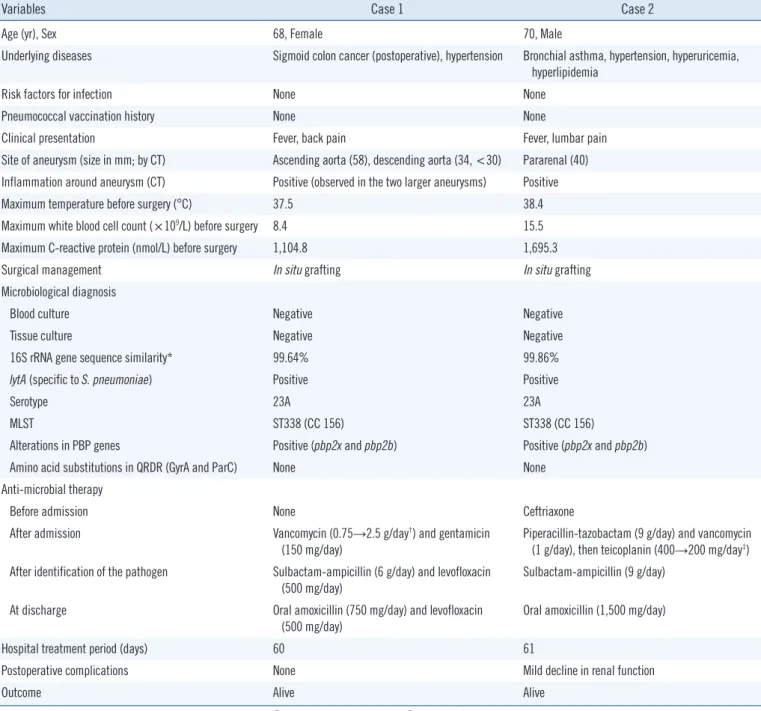
Table 1. Clinical and molecular characteristics of two cases with Streptococcus pneumoniae-infected aortic aneurysms
Variables Case 1 Case 2
Age (yr), Sex 68, Female 70, Male
Underlying diseases Sigmoid colon cancer (postoperative), hypertension Bronchial asthma, hypertension, hyperuricemia, hyperlipidemia
Risk factors for infection None None
Pneumococcal vaccination history None None
Clinical presentation Fever, back pain Fever, lumbar pain
Site of aneurysm (size in mm; by CT) Ascending aorta (58), descending aorta (34, <30) Pararenal (40) Inflammation around aneurysm (CT) Positive (observed in the two larger aneurysms) Positive
Maximum temperature before surgery (°C) 37.5 38.4
Maximum white blood cell count (×109/L) before surgery 8.4 15.5
Maximum C-reactive protein (nmol/L) before surgery 1,104.8 1,695.3
Surgical management In situ grafting In situ grafting
Microbiological diagnosis
Blood culture Negative Negative
Tissue culture Negative Negative
16S rRNA gene sequence similarity* 99.64% 99.86%
lytA (specific to S. pneumoniae) Positive Positive
Serotype 23A 23A
MLST ST338 (CC 156) ST338 (CC 156)
Alterations in PBP genes Positive (pbp2x and pbp2b) Positive (pbp2x and pbp2b)
Amino acid substitutions in QRDR (GyrA and ParC) None None
Anti-microbial therapy
Before admission None Ceftriaxone
After admission Vancomycin (0.75→2.5 g/day†) and gentamicin
(150 mg/day)
Piperacillin-tazobactam (9 g/day) and vancomycin (1 g/day), then teicoplanin (400→200 mg/day‡) After identification of the pathogen Sulbactam-ampicillin (6 g/day) and levofloxacin
(500 mg/day) Sulbactam-ampicillin (9 g/day)
At discharge Oral amoxicillin (750 mg/day) and levofloxacin
(500 mg/day)
Oral amoxicillin (1,500 mg/day)
Hospital treatment period (days) 60 61
Postoperative complications None Mild decline in renal function
Outcome Alive Alive
*Compared with S. pneumoniae type strains NCTC 7465T (case 1) and ATCC 33400T (case 2); †Vancomycin started at 0.75 g/day and increased to 2.5 g/day;
‡Teicoplanin started at 400 mg/day and decreased to 200 mg/day.
Abbreviations: rRNA, ribosomal RNA; CC, clonal complex; CT, computed tomography; MLST, multilocus sequence typing; QRDR, quinolone resistance-de- termining region; ST, sequence type; PBP, penicillin binding protein; NCTC, National Collection of Type Cultures; ATCC, American Type Culture Collection.
Kakuta R, et al.
Infected aortic aneurysm due to 23A-Pneumococci
272 www.annlabmed.org https://doi.org/10.3343/alm.2020.40.3.270 sequence typing (MLST) analysis was performed according to
the S. pneumoniae MLST Database (https://pubmlst.org/spneu- moniae/); in both cases, S. pneumoniae was identified as ST338, clonal complex 156. Alterations in pbp2x and pbp2b, genes encoding penicillin-binding protein that mediate β-lactam resistance in S. pneumoniae, were identified in both cases [8].
Mutations in the quinolone resistance-determining region of gyrA and parC, which are important determinants of levofloxacin resistance [9], were not detected in either case. The clinical and molecular characteristics of both cases are detailed in Table 1.
In Japan, the 7-valent pneumococcal conjugate vaccine (PCV7) was introduced for children younger than five yrs in 2010 and was replaced with PCV13 in 2013. In 2014, the 23-valent pneu- mococcal polysaccharide vaccine was introduced for vaccina- tion in adults over 65 years. Depending on the effect of vaccina- tion, reduced carriage and incidence of invasive pneumococcal disease (IPD) and increased prevalence of non-vaccine sero- types (NVTs) in IPD cases have been reported [10]. According to recent Japanese surveillance studies, the proportion of IPD cases attributed to serotype 23A (an NVT) has been increasing since the introduction of PCVs [10]. More than 90% of 23A iso- lates from adult IPD cases showed alterations in pbp2x and pbp2b, and approximately a half of them were reported as ST338, similar to the isolates in the current cases. Genetic analysis of the isolates in our cases indicated susceptible to levofloxacin, as reported in previous IPD cases in Japan [10]. Although the cur- rent cases were successfully treated, the isolates were NVTs and harbored pbp2x alterations, making them resistant to cephems.
As cephem antibiotics are used frequently in Japan, there is a concern that antibiotic selection pressure will lead to an increase in the proportion of drug-resistant isolates. Moreover, with the introduction of PCVs, there is also a concern regarding the rela- tive increase in NVTs and drug-resistant isolates.
In conclusion, we identified 23A S. pneumoniae, ST338, in culture-negative IAA for the first time in two independent cases, raising the concern that NVT and drug-resistant pneumococci may exist in culture-negative IAA cases. Further epidemiological studies and investigation of preventive measures for IPD, in- cluding IAA, are required.
AUTHOR CONTRIBUTIONS
RK wrote the manuscript; TM, NM, SK, and YS treated patients and collected samples; RK, RN, HY, and DO conducted the laboratory work, described the associated process, and inter- preted the results; NO, YK, and MK contributed to the writing of
the manuscript.
CONFLICTS OF INTEREST
No potential conflicts of interest relevant to this article were re- ported.
RESEARCH FUNDING
None declared.
ORCID
Risako Kakuta https://orcid.org/0000-0002-4594-908X Ryuichi Nakano https://orcid.org/0000-0003-2086-2591 Hisakazu Yano https://orcid.org/0000-0003-2085-7194 Daiki Ozawa https://orcid.org/0000-0003-2099-0198 Nobuo Ohta https://orcid.org/0000-0002-2821-6976 Takayuki Matsuoka https://orcid.org/0000-0002-7658-4829 Naotaka Motoyoshi https://orcid.org/0000-0002-6950-1343 Shunsuke Kawamoto https://orcid.org/0000-0001-8748-3567 Yoshikatsu Saiki https://orcid.org/0000-0003-0959-7133 Yukio Katori https://orcid.org/0000-0003-1963-5551 Mitsuo Kaku https://orcid.org/0000-0002-3714-8100
REFERENCES
1. Kakuta R, Yano H, Kanamori H, Shimizu T, Gu Y, Hatta M, et al. Helico- bacter cinaedi infection of abdominal aortic aneurysm, Japan. Emerg Infect Dis 2014;20:1942-5.
2. Nijs A, Vandekerkhof J, Cartuyvels R, Magerman K, Mewis A, Peeters V, et al. Streptococcus pneumoniae-infected aneurysm extending from a persistent lobar pneumonia: case report and review of the literature. Eur J Clin Microbiol Infect Dis 2002;21:389-92.
3. Watura K, Katsimihas M, Williams M. Streptococcus pneumoniae my- cotic aneurysm with contiguous vertebral discitis treated by endovascular aortic repair and antibiotics. BMJ Case Rep 2013;2013:bcr2012008499.
4. Chan JF, Hwang GY, Lamb S, Chan GS, So JC, Leung SS, et al. Pneu- mococcal native aortic valve endocarditis with mycotic abdominal aortic aneurysm, paraspinal and iliopsoas abscesses and pneumonia reveal- ing a multiple myeloma. J Med Microbiol 2011;60:851-5.
5. Sintler M, Howell N, Mahmood A, Vohra RK. Ruptured inflammatory aortic aneurysm with aortoenteric fistula and infected with Streptococ- cus pneumoniae: a review of the literature. Indian J Surg 2008;70:138- 41.
6. Ubukata K, Asahi Y, Yamane A, Konno M. Combinational detection of autolysin and penicillin-binding protein 2B genes of Streptococcus pneumoniae by PCR. J Clin Microbiol 1996;34:592-6.
7. da Gloria Carvalho M, Pimenta FC, Jackson D, Roundtree A, Ahmad Y, Millar EV, et al. Revisiting pneumococcal carriage by use of broth en- richment and PCR techniques for enhanced detection of carriage and serotypes. J Clin Microbiol 2010;48:1611-8.
Kakuta R, et al.
Infected aortic aneurysm due to 23A-Pneumococci
https://doi.org/10.3343/alm.2020.40.3.270 www.annlabmed.org 273
8. Ubukata K, Chiba N, Hasegawa K, Kobayashi R, Iwata S, Sunakawa K.
Antibiotic susceptibility in relation to penicillin-binding protein genes and serotype distribution of Streptococcus pneumoniae strains respon- sible for meningitis in Japan, 1999 to 2002. Antimicrob Agents Che- mother 2004;48:1488-94.
9. Takeuchi N, Ohkusu M, Hoshino T, Naito S, Takaya A, Yamamoto T, et al. Emergence of quinolone-resistant strains in Streptococcus pneu-
moniae isolated from paediatric patients since the approval of oral fluo- roquinolones in Japan. J Infect Chemother 2017;23:218-23.
10. Ubukata K, Takata M, Morozumi M, Chiba N, Wajima T, Hanada S, et al. Effects of pneumococcal conjugate vaccine on genotypic penicillin resistance and serotype changes, Japan, 2010–2017. Emerg Infect Dis 2018;24:2010-20.