• 검색 결과가 없습니다.

국민건강보험 일산병원 재활의학과

N/A
N/A
Protected

Academic year: 2021

Share "국민건강보험 일산병원 재활의학과"

Copied!
5
0
0

로드 중.... (전체 텍스트 보기)

전체 글

(1)

접수일 : 2018 년 5 월 24 일 , 게재승인일 : 2018 년 7 월 24 일 책임저자 : 전하라 , 경기도 고양시 일산동구 일산로 100

10444, 국민건강보험 일산병원 재활의학과

Tel: 031-900-0970, Fax: 031-900-0343 E-mail: [email protected]

대상포진 환자에서 복벽의 가성탈장으로 나타난 운동 마비

증례 보고

국민건강보험 일산병원 재활의학과

1

, 연세대학교 의과대학 재활의학교실

2

이상윤1ㆍ김성우1ㆍ김형섭1ㆍ김현수2ㆍ전하라1

Segmental Motor Paresis Presenting

with Abdominal Wall Pseudohernia due to Herpes Zoster

Case Report

Sang Yoon Lee, M.D.

1

, Seong Woo Kim, M.D.

1

, Hyoung Seop Kim, M.D.

1

, Hyeon Su Kim, M.D.

2

and Ha Ra Jeon, M.D.

1

1

Department of Physical Medicine and Rehabilitation, National Health Insurance Service Ilsan Hospital, Goyang,

2

Department of Rehabilitation Medicine and Research Institute, Yonsei University College of Medicine, Seoul, Korea

Herpes zoster is characterized by vesicular eruption and rash of the skin in the affected dermatomes. Sensory symptoms such as pain and hypesthesia are often accompanied in patients with herpes zoster. While motor paralysis is uncommon, abdominal paralysis can result in rare complications such as abdominal wall pseudohernia. In the present report, we discuss the case of a 62 year-old man who presented with abdominal wall protrusion after herpes zoster infection involving the right T10-T12 dermatomes. Magnetic resonance imaging findings were not specifically correlated with abdominal wall protrusion.

Needle electromyography revealed abnormal spontaneous activity in the right paraspinal muscles at the T10-T12 levels, rectus abdominis, and external oblique muscles. Dermatomal somatosensory evoked potentials (SEPs) exhibited prolonged latency in the right T10 and T12 dermatomes. These findings suggest that herpes zoster infection can affect both motor and sensory nerves. (Clinical Pain 2018;17:98-102)

Key Words: Herpes zoster, Pseudohernia, Paralysis

INTRODUCTION

Herpes zoster is caused by the reactivation of a vari- cella-zoster virus (VZV), affecting 10∼20% of the general population.

1

Following resolution of the primary infection, the VZV may remain latent in the dorsal root ganglia, cra- nial nerves, or autonomic ganglia. Reactivation of the virus may then lead to herpes zoster in older adults or im- munocompromised patients.

Herpes zoster is characterized by cutaneously distributed vesicles and rash in the affected dermatomes, which are of- ten accompanied by sensory symptoms such as neuropathic pain and hypoesthesia. Although uncommon, motor seg-

mental paralysis occurs in approximately 0.5% to 5.0% of patients with herpes zoster, affecting the muscles of the head, trunk, upper and lower limbs, bladder, and colon.

2

While cutaneous herpes zoster is common in the lower thoracic dermatomes, clinically significant motor paralysis is rare.

3

However, abnormal eletromyographic (EMG) find- ings have previously been reported in a patient with thora- cic herpes zoster, suggesting that motor involvement may be greater than previously suggested.

4

Paresis in the lower thoracic region causes abdominal muscle weakness in pa- tients with herpes zoster, which can lead to abdominal wall protrusion or pseudoherniation.

5-7

The present report discusses the clinical presentation and

neurophysiologic findings of a patient who presented with

abdominal wall pseudohernia caused by thoracic herpes

zoster infection. This report was approved by by the ethics

committee of our institution.

(2)

Fig. 2. (A) No abnormal signal in- tensities were observed on T2- weighted magnetic resonance im- ages of the thoracic spine. (B) T2-weighted magnetic resonance images of the lumbar spine revealed bulging discs at multiple levels without abnormal signal intensity.

Fig. 1. An abdominal wall protrusion was observed at the right flank, accompanied by a herpetic rash within the right T10-T12 dermatomes.

CASE REPORT

A 62-year-old man with a history of hypertension, dia- betes mellitus, and dyslipidemia presented to our Physical Medicine and Rehabilitation outpatient clinic with right ab- dominal wall protrusion. Four weeks prior to visiting the Physical Medicine and Rehabilitation clinic, he had visited the Department of Family Medicine for the treatment of a characteristic herpetic rash, hyperesthesia and pain within the right T10-12 dermatomes. He was diagnosed with her- pes zoster infection and prescribed medicines such as fam- ciclovir, pregabalin, acetaminophen and tramadol. One week after the onset of the rash and pain, he noticed an abdominal wall protrusion in the area of the herpetic rash.

He reported no gastrointestinal symptoms, and abdominal ultrasound findings were normal. As the abdominal pro- trusion remained unchanged, he was referred to the Physical Medicine and Rehabilitation clinic.

Physical examination revealed that the herpetic rash and pain gradually improved, although an abdominal wall pro- trusion was observed in the right T10-T12 area (Fig. 1).

The abdominal bulge became more prominent with cough- ing or standing. Hypesthesia and herpetic rash occurred within the same dermatome. Magnetic resonance imaging (MRI), nerve conduction study (NCS), needle EMG, and dermatomal somatosensory evoked potential (SEP) analy- ses were performed. MRI of the thoracic and lumbar spine revealed multilevel asymmetric bulging of lumbar discs, as well as left foarminal stenosis at the L5/S1 level (Fig. 2).

There was no correlation between MRI findings and ab-

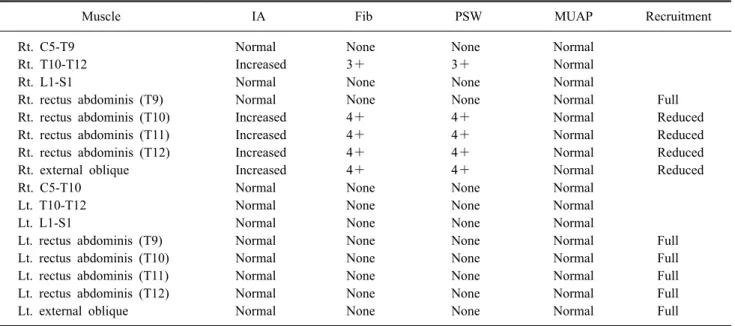
dominal wall protrusion. NCS showed normal findings, however needle EMG revealed abnormal spontaneous ac- tivity (e.g., positive sharp waves and fibrillations at rest) in the right paraspinal muscles at the T10-T12 levels, rec- tus abdominis, and external oblique muscles (Table 1, 2).

Needle EMG also revealed a decreased recruitment pattern

in the right rectus abdominis and abdominal external obli-

que muscles (Table 2). Dermatomal SEPs were recorded

from the scalp and following stimulation of the bilateral

T8, T10, T12, and L2 dermatomes. The results of these

analyses revealed prolonged latency in the right T10 and

(3)

Table 2. Needle Electromyography

Muscle IA Fib PSW MUAP Recruitment

Rt. C5-T9 Normal None None Normal

Rt. T10-T12 Increased 3+ 3+ Normal

Rt. L1-S1 Normal None None Normal

Rt. rectus abdominis (T9) Normal None None Normal Full

Rt. rectus abdominis (T10) Increased 4+ 4+ Normal Reduced

Rt. rectus abdominis (T11) Increased 4+ 4+ Normal Reduced

Rt. rectus abdominis (T12) Increased 4+ 4+ Normal Reduced

Rt. external oblique Increased 4+ 4+ Normal Reduced

Rt. C5-T10 Normal None None Normal

Lt. T10-T12 Normal None None Normal

Lt. L1-S1 Normal None None Normal

Lt. rectus abdominis (T9) Normal None None Normal Full

Lt. rectus abdominis (T10) Normal None None Normal Full

Lt. rectus abdominis (T11) Normal None None Normal Full

Lt. rectus abdominis (T12) Normal None None Normal Full

Lt. external oblique Normal None None Normal Full

IA: insertional activity, Fib: fibrillation, PSW: positive sharp wave, MUAP: motor unit action potential.

Table 1. Nerve Conduction Study

Nerve Stimulation

site

Recording site

Onset

latency (ms) Amplitude* Distance (cm)

Conduction velocity (m/s) Motor

Rt. median Wrist APB 4.0 19.7 23.0 58.9

Elbow APB 7.9 18.3

Rt. ulnar Wrist ADM 2.9 13.0 22.0 64.7

Elbow ADM 6.3 11.7

Lt. peroneal Ankle EDB 3.5 8.1 30.0 50.8

Knee EDB 9.4 7.7

Lt. tibial Ankle AH 5.2 16.2 33.0 48.5

Knee AH 12.0 15.2

Sensory

Rt. median Wrist 3

rd

finger 3.3 42.8

Rt. ulnar Wrist 5

th

finger 2.8 33.8

Lt. peroneal Ankle Ankle 1.8 22.1

Lt. sural Calf Ankle 1.5 23.4

Rt: right, Lt: left, APB: abductor pollicis brevis, ADM: adductor digit minimi, EDB: extensor digitorum brevis, AH: abductor hallucis.

*Amplitudes are measured in mV (motor) and μV (sensory).

T12 dermatomes (Table 3).

The patient underwent physical therapy to strengthen the abdominal muscles and recover the abdominal wall protrusion. Ten weeks after the onset of symptoms, the ab- dominal protrusion had resolved, and the patient became asymptomatic.

DISCUSSION

Segmental abdominal muscle weakness is a rare com-

plication following herpes zoster infection. Indeed, the in-

cidence of abdominal paralysis has been reported between

0∼6% in patients with herpes zoster, more frequently af-

(4)

Table 3. P1 Latencies of Somatosensory Evoked Potential Study

Latency (ms)

Right Left

T8 dermatome 27.6 27.2

T10 dermatome 38.1 27.7

T12 dermatome 33.7 28.6

L2 dermatome 33.6 32.4

Tibial nerve 41.1 40.8

fecting middle-aged and older adults.

3

The incidence of muscle weakness appears to be related to the the severity of symptoms and immunocompromising conditions such as diabetes mellitus.

8

Abdominal muscle paresis can cause abdominal wall protrusion, which requires differential di- agnosis from various diseases, such as tumors of the ab- dominal wall, intra-abdominal diseases, diabetic mono- neuropathy, intercostal nerve injuries, spinal cord or root injury, and infectious diseases. Pathophysiologically, mo- tor paresis due to herpes zoster infection is considered to occur due to the spreading of inflammation from the dor- sal root ganglion to the anterior horn or anterior nerve roots.

9

In previous cases presenting with upper extremity pa- resis due to herpes zoster, MRI analysis revealed involve- ment of the anterior and posterior horn, anterior and poste- rior roots, and brachial plexus.

3

There were few reports to evaluate MRI to correlate abdominal wall protrusion and MRI findings such as inflammation of thoracic nerve roots.

10

In this case, we evaluate MRI to find out abnormal- ity correlating abdominal wall paralysis. Howevere, we ob- served no MRI abnormalities related to abdominal wall protrusion. EMG is useful for evaluating the involvement of the abdominal and paraspinal muscles. In the present case, we observed abnormal spontaneous activity and de- creased recruitment patterns in the right external oblique and rectus abdomonis muscles, indicative of axonotmesis in the anterior rami from the T10 to T12 spinal nerves.

Abnormal spontaneous activity in the paraspinal muscles revealed that the posterior rami of the spinal nerves had also been affected. These findings suggested that the lesion was located proximal to the anteior and posterior rami.

Dermatomal SEPs revealed prolonged latency in the right T10 and T12 dermatomes, indicating that the sensory fibers

had also been affected.

The overall prognosis of paresis due to herpes zoster in- fection is generally good. According to a previous study, 79.3% of patients with abdominal paresis had fully recov- ered within 1 year of onset, with a mean recovery time of 4.9 months.

3

In another study, 75% of patients had fully or almost fully recovered within 1 year.

2

In accordance with these findings, our patient exhibited complete recov- ery of abdominal paresis within 3 months after the onset of herpes zoster symptoms. He became asymptomatic and his abdominal wall became symmetric.

Segmental motor weakness presenting with abdominal wall pseudohernia is a rare complication of herpes zoster infection. Because the condition is reversible and is asso- ciated with good prognosis, it is important to recognize such complications in order to avoid unnesseccary proce- dures or surgery.

REFERENCES

1. ZuckermanVincent KD, Davis LS. Unilateral abdominal distention following herpes zoster outbreak. Arch Dermatol 1998; 134: 1168-1169

2. Thomas JE, Howard FM. Segmental zoster paresis--a dis- ease profile. Neurology 1972; 22: 459-466

3. Chernev I, Dado D. Segmental zoster abdominal paresis (zoster pseudohernia): a review of the literature. PM R 2013; 5: 786-790

4. Cioni R, Giannini F, Passero S, Paradiso C, Rossi S, Fimiani M, et al. An electromyographic evaluation of mo- tor complications in thoracic herpes zoster. Electromyogr Clin Neurophysiol 1994; 34: 125-128

5. Zuckerman R, Siegel T. Abdominal-wall pseudohernia sec- ondary to herpes zoster. Hernia 2001; 5: 99-100

6. Tashiro S, Akaboshi K, Kobayashi Y, Mori T, Nagata M, Liu M. Herpes zoster-induced trunk muscle paresis present- ing with abdominal wall pseudohernia, scoliosis, and gait disturbance and its rehabilitation: a case report. Arch Phys Med Rehabil 2010; 91 : 321-325

7. Ruiz Junior FB, Shinosaki JS, Marques Junior W, Ferreira MS. Abdominal wall protrusion following herpes zoster.

Rev Soc Bras Med Trop 2007; 40: 234-235

8. Mitsutake A, Sasaki T, Hideyama T, Sato T, Katsumata J,

Seki T, et al. Paraspinal muscle involvement in herpes zos-

ter-induced abdominal wall pseudohernia revealed by elec-

trophysiological and radiological studies. J Neurol Sci

2018; 385: 89-91

(5)

9. Denny-Brown D, Adams RD, Fitzgerald PJ. Pathologic features of herpes zoster: a note on "geniculate herpes".

Arch Neur Psych 1944; 51: 216-231

10. Miranda-Merchak A, García N, Vallejo R, Varela C. MRI

findings of postherpetic abdominal wall pseudohernia: A

case report. Clin Imaging 2018; 50: 109-112 

수치

Fig.  1.  An  abdominal  wall  protrusion  was  observed  at  the  right  flank,  accompanied  by  a  herpetic  rash  within  the  right  T10-T12  dermatomes.
Table  1.  Nerve  Conduction  Study
Table  3.  P1  Latencies  of  Somatosensory  Evoked  Potential  Study Latency  (ms) Right Left T8  dermatome 27.6 27.2 T10  dermatome 38.1 27.7 T12  dermatome 33.7 28.6 L2  dermatome 33.6 32.4 Tibial  nerve 41.1 40.8

참조

관련 문서

Biliary obstruction, hypercalcemia, hyperlipidemia, immunosuppressive drugs, viral infection (CMV, Herpes Zoster, adenovirus, mumps, mycoplasma and viral hepatitis), and

Axial MDCT scan shows protrusion of small bowel (arrow) through a defect in right lateral abdominal wall.. Coronal volume-rendered image depicts hernia sac containing small bowel

Jae-Min Song et al: Mandibular osteonecrosis following herpes zoster infection in the mandibular branch of the trigeminal nerve: a case report and literature review..

Common complications include infection, abdominal wall injury, bowel herniation, bleeding, haematoma, seroma, lymphoedema, pulmonary embolism, and deep vein thrombosis..

The most common causes of facial paralysis in children was Bell's palsy (104 patients, 66.2%), followed by infection, including herpes zoster oticus and otitis media (23

We describe here a case of Mycobacterium abscessus exit site infection with abdominal wall abscess formation that was associated with CAPD, which

Also, this is the first case involving Grey Turner’s and Cullen’s signs induced by spontaneous hemorrhage of the abdominal wall after coughing. When encountering Grey Turner’s

In conclusion, when patients under treatment for acute infection report sudden urinary retention, the possibility of voiding dys- function caused by herpes zoster needs to