Herpes zoster is caused by the varicella zoster virus. Following natural infection or immunization the virus remains latent in the sensory dorsal root ganglion cells and be- gins to replicate at some later time, traveling down the sensory nerve into the skin. The clinical manifestations are characterized by several groups of painful vesicles situated unilaterally within the distribution of the cranial or spinal sensory nerve1. Bilateral involvement and recurrence are rare, and zosters involving two widely separated regions at one time are even rarer2.
The phenomenon of zoster occurring in two noncontiguous, widely separated der- matomes has been referred to as zoster du- plex unilateralis or bilateralis, depending whether one half or both halves of the body are involved3. In Korea a case of zoster duplex unilateralis has been reported3 but zoster duplex bilateralis not yet.
We report that a rare case of herpes zoster involving noncontiguous dual der- matomes on the both halves of the body that named zoster duplex bilateralis.
CASE REPORT
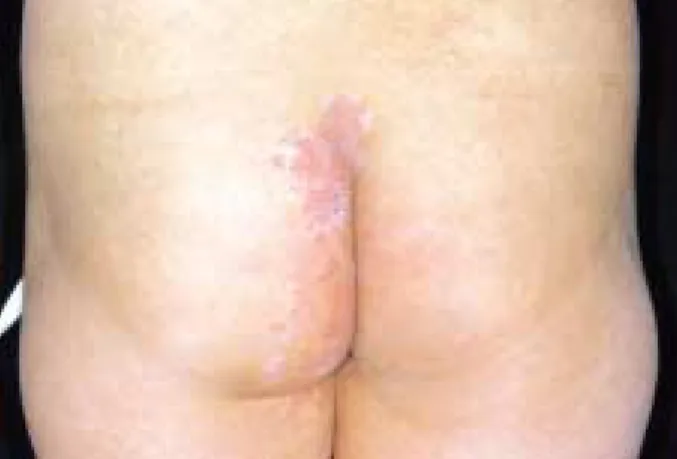
A 22-year-old woman was referred to our department from internal medicine because of painful vesicles for 2 days. She had been treated with chemotherapy for acute leukemia for 2 years and under complete remission state. Also she had been treated with digoxin and fluconazole for congestive heart failure and chronic disseminated can- didiasis. Two days ago, several grouped erythematous papulovesicular eruptions de- veloped with intermittent prickling pain on the right side of the anterior chest and upper back showing a band-like arrangement(right L7 dermatome, Fig. 1, 2), and the following day similar lesions with pain were also found on the left buttock(left S3 der- matome, Fig. 3).
Laboratory examinations including com- plete blood cell counts, routine urinalysis, liver function test, a test for VDRL and Chest PA were negative or within normal limits. Bone marrow examination showed no
A Case of Zoster Duplex Bilateralis
Bong Ju Shin, M.D., Joo Hyun Shim, M.D., Seong Jun Seo, M.D., Chang Kwun Hong, M.D.
Department of Dermatology, College of Medicine, Chung-Ang University, Seoul, Korea Herpes zoster involving noncontiguous dual dermatomes is very rare in both immunocompetent and immunocompromised persons. This unique presentation has been referred to as zoster duplex unilat- eralis or bilateralis, depending whether one or both halves of the body are involved.
A 22-year-old woman, who had been treated for acute leukemia, congestive heart failure and chron- ic disseminated candidiasis, was referred to our department for painful papulovesicular eruptions on the right side of the anterior chest and upper back for 2 days, and the left buttock for 1 day. Tzanck smear revealed multinucleated giant cells with intranuclear inclusion bodies. We report a rare case of zoster duplex bilateralis.
(Ann Dermatol 14(1) 59-61, 2002).
Key Words : Zoster duplex
Received June 4, 2001.
Accepted for publication September 15, 2001.
Reprint request to : Bong Ju Shin, M.D., Department of Dermatology, Chung Ang University,
65-207 Hangangro-3-ka, Yongsan-ku, Seoul, 140-757, Korea
Tel. (02)-748-9573, Fax. (02)-6359-9573
59
blast. Hepatobiliary ultrasonography and echocardiography revealed multiple hypoe- choic nodular lesions in liver and spleen, which were consistent with chronic dissemi- nated candidiasis, and moderate left ven- tricular dysfunction.
Tzanck smear was done at the vesicles of left buttock(Fig. 4) and microscopic exam showed multinucleated giant cells with in- tranuclear inclusion bodies.
She was treated with oral administration of famcyclovir 750 mg/day for 7 days, and skin lesions and pain subsided without complications.
DISCUSSION
Herpes zoster is a relatively common dis- ease and characterized by several groups of painful vesicles with characteristic distribution of unilateral dermatomes1. The incidence rate is slightly different in Korean literature;
Kim et al4 reported 0.79% in dermatologic outpatients; Kim et al5, 0.38%; Chun et al6, 1.7%; Yang et al7, 0.64%; Hong et al8, 2.84%; Kim et al9, 1.23%. Most of the skin lesions are in unilateral involvement 60 BJ Shin, et al.
Annals of Dermatology Vol. 14, No. 1, January 2002
Fig. 1. The right side of the chest showed painful grouped vesicles on the erythematous base.
Fig. 2. Painful grouped erythematous papulovesicular eruptions on the right side of the upper back had a band-like arrangement.
Fig. 3. Painful grouped papules and vesicles on the erythematous base developed on the left buttock.
Fig. 4. Tzanck smear from the left buttock revealed multinucleated giant cells with intranuclear inclusion bodies. (Wright stain; ×400)
characteristically and the dermatomes most frequently affected are thoracic. Bilateral involvement is rare and the incidence is be- low 0.5%10. Moreover, zoster occurring in noncontiguous dual dermatomes is very rare. On the review of the medical literature of the last 3 decades, there have only been 7 cases reported, two in an immunocompetent person3,11, three in older persons on oral steroids for chronic illnesses12,13,14, and two in children with cancer (1 with lym- phoma and 1 with leukemia)14,15. Varicella- zoster virus involving noncontiguous der- matomes is distinct from disseminated vari- cella-zoster virus infection that occurs in immunosuppressed renal transplant patients.
The phenomenon of zoster occurring in two noncontiguous dermatomes has been referred to as zoster duplex unilateralis or bilateralis, depending whether one half or both halves of the body are involved3. Vu et al15 reported a case of herpes zoster in seven disparate dermatomes and suggested the term zoster multiplex when more than three noncon- tiguous dermatomes are involved.
In Korean literature, Lee et al2 reported a case of bilateral zoster occurring in the der- matomes of the left T2 and the right T5, and Jung et al3 reported a case of zoster du- plex unilateralis that involved the unilateral dermatomes of V1-2 and L1-2, and had no history of malignancy, immunosuppressive agents and any other immunocompromised diseases.
Patients with malignancy, especially Hodgkin’s disease and leukemia, are five times more likely to develop zoster than their age-matched counterparts1. Other pa- tients who also have a higher incidence of zoster include patients with deficient im- mune systems, such as individuals who are immunosuppressed for organ transplantation, by connective tissue disease, and by the agents such as corticosteroids1. The clinical appearance of these patients is usually identical to typical zoster, but the lesions may be more ulcerative and necrotic and may scar more severely1.
In our patient she had the history of acute leukemia and skin lesions of character-
istic painful vesicles involved two noncon- tiguous dermatomes on both halves of the body. Biopsy couldn’t be done because of pa- tient’s refusal, but the diagnosis of zoster du- plex bilateralis was made in the basis of the characteristic clinical features and Tzanck smear. We speculate that she was under immunocompromised state that led to have defective cellular immune response and de- velop zoster duplex bilateralis. She was suc- cessfully treated with antiviral agent without complication.
REFERENCES
1. Odom RB, James WD, Berger TG: Viral diseases.
In: Andrews’ diseases of the skin. 9th ed., W.B.
Saunders Co., Philadelphia, 2000, pp486-491.
2. Lee SY, Choi YS, Yu HJ, Son SJ: A case of bilater- al herpes zoster. Kor J Dermatol 32:1119-1122, 1994.
3. Jung GD, Won JY, Choi YH, Jeon YM, Song ES:
A case of zoster duplex unilateralis. Kor J Dermatol 38:1569-1571, 2000.
4. Kim YP, Seo JI, Kang JB: Clinical observation of herpes zoster during a 10-year-period. Kor J Der- matol 18:65-79, 1980.
5. Buechner SA, Rufli T: Atrophoderma of Pasini and Pierini. Clinical and histopathological findings and antibodies to Borrelia burdorferi in thirty-four pa- tients. J Am Acad Dermatol 30:441-446, 1994.
6. Chun IK, Lee JJ, Won YH, Kim YP: Clinical study on relation between herpes zoster and underlying diseases. Kor J Dermatol 26:356-365, 1988.
7. Jablonska A, Szczepanski A: Atrophoderma Pasini- Pierini: Is it an entity? Dermatologica 125:226, 1962.
8. Hong JH, Kye YC, Kim SN, Lee SY: A clinical study on herpes zoster in inpatients during a 3-year- period. Kor J Dermatol 32:583-590, 1994.
9. Kim SY, Cho BH, Kim JH: A 5-year clinical study on herpes zoster (1990-1994). Kor J Dermatol 35:
266-272, 1997.
10. Burgoon CF, Burgoon JS, Baldridge GD: The natur- al history of herpes zoster. JAMA 164:265-269, 1957.
11. Cousin GC, Ferguson MM: Bilateral shingles. Br Dent J 160:189, 1986.
12. Hill PA, Lamey PJ: Oral herpes zoster with con-
A Case of Zoster Duplex Bilateralis 61
tralateral skin involvement. Br Dent J 161:217-218, 1986.
13. Lewis RJ, Mitchell JC: Systemic lupus erythemato- sus, miliary tuberculosis, and bilateral herpes zoster occurring in a Chinese woman. Arch Dermatol 104:562, 1971.
14. Takayama M, Takayama N, Hachimori K: Restric- tion endonuclease analysis of viral DNA from a pa- tient with bilateral zoster lesions. J Infect Dis 157:392-393, 1988.
15. Vu AQ, Radonich MA, Heald PW: Herpes zoster in seven disparate dermatomes(zoster multiplex): Re- port of a case and review of the literature. J Am Acad Dermatol 40:868-869, 1999.
62 BJ Shin, et al.
Annals of Dermatology Vol. 14, No. 1, January 2002