• 검색 결과가 없습니다.

06973, 중앙대학교병원 재활의학과

N/A
N/A
Protected

Academic year: 2021

Share "06973, 중앙대학교병원 재활의학과"

Copied!
5
0
0

로드 중.... (전체 텍스트 보기)

전체 글

(1)

https://doi.org/10.35827/cp.2020.19.2.124

접수일 : 2020 년 7 월 28 일 , 게재승인일 : 2020 년 8 월 14 일 책임저자 : 강시현 , 서울시 동작구 흑석로 102

06973, 중앙대학교병원 재활의학과

Tel: 02-6299-1865, Fax: 02-6298-1866 E-mail: [email protected]

대상포진후 상완신경총병증으로 진단된 편측 상지의 통증과 위약

중앙대학교병원 재활의학과

조준모ㆍ강시현ㆍ서경묵ㆍ김돈규ㆍ김두환ㆍ신현이

Pain and Weakness on Unilateral Upper Extremity Diagnosed as Brachial Plexopathy after Herpes Zoster Infection

Junmo Cho, M.D., Si Hyun Kang, M.D., Ph.D., Kyung Mook Seo, M.D., Ph.D., Don-Kyu Kim, M.D., Ph.D., Du Hwan Kim, M.D., Ph.D. and Hyun Iee Shin, M.D.

Department of Physical Medicine & Rehabilitation, Chung-Ang University College of Medicine, Seoul, Korea

Motor paralysis is a less common neurologic complication of herpes zoster. Until now, a few cases have been reported, and most of these cases showed brachial plexopathy involving one or two segments. We report a patient with pain and weakness on upper extremity diagnosed as brachial plexopathy after herpes zoster infection. An 88-year-old female patient complained not only tingling sense, pain, and swelling on right whole arm, but also weakness on this right upper extremity.

On physical examination, weakness is seen in right shoulder abductionㆍshoulder flexionㆍelbow flexionㆍelbow extensionㆍ wrist extension (grade 4), finger flexionㆍfinger abductionㆍfinger extensionㆍfinger DIP flexion (grade 3). In electrodiagnostic study and magnetic resonance imaging study, she was diagnosed as the brachial plexopathy, whole branch involved. This is the only case of post-herpetic brachial plexopathy involving whole branch in domestic. (Clinical Pain 2020;19:124-128) Key Words: Brachial plexus neuropathy, Herpes zoster, Electrodiagnosis

INTRODUCTION

Herpes zoster is an infectious disease characterized by vesicobullous skin eruptions in a dermatomal distribution and neurological complication.

1

After primary varicella in- fection, the virus is latent in the ganglia of sensory cranial nerves and spinal dorsal root ganglia.

In elderly and in immunocompromised individuals, Varicella-zoster virus (VZV) reactivates and travels along the sensory nerves to the skin, causing the distinctive pro- dromal pain followed by eruption of the rash.

2

The most common neurologic complication of herpes zoster is chronic pain, and motor paralysis is a less common complication.

3

Until now, a few cases have been reported about motor pa- ralysis as brachial plexopathy after herpes zoster infection.

4,5

Most of these cases showed brachial plexopathy involving

one or two segments, and in this case report we report a patient with brachial plexopathy involving whole branch confirmed by needle electromyography and magnetic reso- nance imaging study.

CASE REPORT

An 88-year-old female patient visited the hospital with bullous skin lesion in neck, right whole arm. She com- plained tingling sense, pain, and swelling on the involved area. Under diagnosis of Herpes zoster, she took the an- ti-viral agents, famciclovir (FAMVIR Tab 250 mg;

Novartis Korea., Seoul, Korea). Three days later, the bul- lous skin lesion in hands proceeded to the proximal part of the body, and pain of right upper extremity was aggravated. She was admitted in the neurology department and her symptoms were improved with proper medication (intravenous methylprednisolone 250 mg [SALON INJ;

Hanlim Pharm Co., Ltd., Seoul, Korea] 2 days, intravenous

aciclovir [ZOYLEX INJ 250 mg/10 ml; Korea United

Pharm. INC., Seoul, Korea] per 8 hours 7 days, and famci-

clovir [FAMVIR Tab 250 mg; Novartis Korea., Seoul,

(2)

Fig. 1. Chronic scar change of bullous skin lesion in right upper extremity two months after the onset of Herpes zoster infection. 

Table 1. Nerve Conduction Study

Nerve Recording Stimulation

Right Left

Latency

a)

(ms) Amp.

b)

CV

(m/s)

Latency

a)

(ms) Amp.

b)

CV

(m/s)

Motor                

Axillary Deltoid Erb’s 2.76 6.50 2.71 7.30

Musculocutaneous Biceps Erb’s 3.59 6.60 3.85 7.10

Median APB Wrist 4.17 5.20 4.48 5.00

  Elbow 8.54 4.10 43.40 8.85 4.90 45.70

  Axillary 13.65 2.60 41.10

Ulnar ADM Wrist 2.50 8.00 2.81 7.70

  Elbow 6.98 5.80 42.40 6.35 6.50 56.50

  Axillary 12.71 5.10 43.60

Radial EIP Wrist 1.67 2.10 1.88 2.40

  Elbow 5.78 1.30 38.90 4.69 1.80 53.30

  Axillary 10.57 1.10 43.80 8.59 1.40 51.20

Sensory

Median Thumb Wrist 3.59 2.40 3.13 12.00

  3rd digit Wrist 3.70 6.20 3.85 6.30

  Palm Wrist 1.77 2.00 1.93 5.30

Ulnar 5th digit Wrist 2.60 6.10 2.50 10.20

Superficial radial Thumb Wrist 1.67 2.10 2.08 12.10

Snuff box Wrist 1.04 9.80 1.67 17.30

LAC 1.77 6.80 1.56 15.60

MAC 2.76 4.00 2.19 12.50

Amp: amplitude, CV: conduction velocity, APB: abductor pollicis brevis, ADM: abductor digiti minimi, EIP: extensor indicis proprius, LAC: lateral antebrachial cutaneous, MAC: medial antebrachial cutaneous.

a)

All motor and sensory latencies are onset latencies.

b)
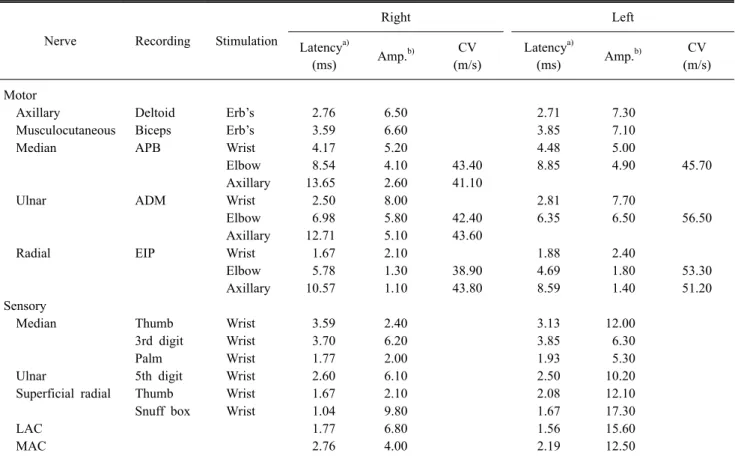
Amplitudes are measured in millivolt (mV, motor) and in microvolt (μV, sensory).

Korea] per 8 hours 5 days). Two months later, pain was much improved and the skin lesion was changed to chronic scar (Fig. 1). However, she was referred for electro- diagnostic study through the orthopedics because she showed not only still remaining chronic pain but also weakness on this right upper extremity. On physical exami- nation, muscle power on shoulder abductionㆍshoulder flexionㆍelbow flexion was grade 4, elbow extension was grade 4, wrist extension was grade 4, finger flexion was grade 3, finger abduction was grade 3, finger extension was grade 3, and finger DIP flexion was grade 3. DIP joint of the right hand also showed mild contracture. She per- formed fine motor tasks with mild tremor and had diffi- culties in fine motor control. She also had tingling sensa- tion and hypoesthesia on this whole arm.

To evaluate this weakness developed type, we performed

(3)

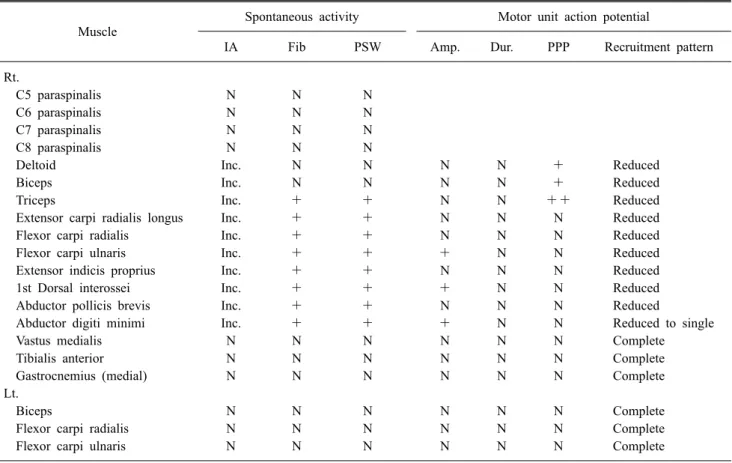
Table 2. Needle Electromyography

Muscle Spontaneous activity Motor unit action potential

IA Fib PSW Amp. Dur. PPP Recruitment pattern

Rt.

C5 paraspinalis N N N

C6 paraspinalis N N N

C7 paraspinalis N N N

C8 paraspinalis N N N

Deltoid Inc. N N N N + Reduced

Biceps Inc. N N N N + Reduced

Triceps Inc. + + N N ++ Reduced

Extensor carpi radialis longus Inc. + + N N N Reduced

Flexor carpi radialis Inc. + + N N N Reduced

Flexor carpi ulnaris Inc. + + + N N Reduced

Extensor indicis proprius Inc. + + N N N Reduced

1st Dorsal interossei Inc. + + + N N Reduced

Abductor pollicis brevis Inc. + + N N N Reduced

Abductor digiti minimi Inc. + + + N N Reduced to single

Vastus medialis N N N N N N Complete

Tibialis anterior N N N N N N Complete

Gastrocnemius (medial) N N N N N N Complete

Lt.

Biceps N N N N N N Complete

Flexor carpi radialis N N N N N N Complete

Flexor carpi ulnaris N N N N N N Complete

IA: insertional activity, Fib: fibrillation, PSW: positive sharp wave, Amp.: amplitude, Dur.: duration, PPP: polyphasic pattern, N: nor- mal, Inc.: increased.

Fig. 2. Three consecutive T2 coronal fat suppression images on brachial plexus MRI enhance showed diffuse swelling and mild en- hancement of the C5 to T1 nerve roots and the whole trunk levels of right brachial plexus near scalene muscles area.

electrodiagnostic study (Table 1, 2). In motor nerve con- duction study, conduction velocity of median, ulnar and ra- dial nerve was decreased. Amplitude of sensory responses was decreased in median, ulnar, superficial radial, lateral antebrachial cutaneous and medial antebrachial cutaneous nerve. Needle electromyography showed abnormal sponta-

neous activities in the muscles innovated from axillary,

musculocutaneous, median, ulnar, and radial nerves. On

volition, the muscles innovated from axillary, musculocuta-

neous, median, ulnar, and radial nerves showed reduced in-

terference pattern except abductor digiti minimi muscle

showed discrete interference pattern.

(4)

In result the clinical symptoms, physical examination and eletromyography, she was diagnosed as the brachial plexopathy, all motor and sensory branch involved, after herpes zoster infection. We performed magnetic resonance imaging (MRI) study, and it showed diffuse swelling of en- tire right brachial plexus (near scalene muscles area) (Fig.

2). The patient was enrolled to the physical therapy (strengthening exercise, stretching exercise, pully exercise, superdynamic training, and fluidotherapy) and continued medication (Pregabalin, Acetaminophen/Tramadol). After one month of rehabilitation, pain was improved from ini- tially visual analog scale (VAS) scores 5∼6 to 2∼3 and also sensory symptoms were much improved. On physical examination after one month of rehabilitation, muscle pow- er on upper extremity was improved to generally grade 4∼5.

DISCUSSION

Severe herpes zoster infection could cause not only skin lesion/sensory symptom but also motor weakness.

Peripheral motor neuropathy, called segmental zoster pa- resis, is an unusual complication (2.5%∼9.4%).

3

The mo- tor deficit is likely to be due to an extension of viral in- fection from the dorsal root ganglion to the anterior motor roots.

6

The latency between the rash and the development of weakness has been reported to range from one day to four months.

7

In this case, the latency between the rash and the development of right upper extremity weakness was two months, so there was no significant difference from the previous reports.

It is known that skin lesions C5 to C7 are most fre- quently affected in cases of brachial plexopathy caused by herpes zoster,

8

and the lesion of the motor weakness is as- sociated with the skin segment of the accompanying lesion.

3

However, the lesion of motor weakness may also develop in a different segment where skin lesions affected.

9

In this case, at the time of weakness onset, dermatomes of the patient’s remaining skin lesions appeared to correspond to C6 and C7, and the patient subjectively complained of distal upper extremity weakness more severely. The elec- trodiagnostic study was performed and more proximal seg- ment involvement, such as deltoid and biceps muscle, was identified. The limitation of this study was that additional electrodiagnostic study on proximal muscles was not done because of poor cooperation of the patient due to pain and

follow-up study was not done afterwards. To complement this limitation, the MRI study was performed for further evaluation, and brachial plexopathy involving the whole branch was diagnosed. In previous domestic reports, post- herpetic brachial plexopathy involved one or two spinal nerves.

4,5

This is the only case of post-herpetic brachial plexopathy involving whole branch.

The prognosis of motor weakness by herpes zoster is usually good, and it is known that 55∼75% of patients who have experienced a motor weakness show almost com- plete muscle recovery.

10

In this patient, the motor power improved after one month of rehabilitation and follow-up examination is needed to confirm the recovery.

Although Ismail et al.

6

reported a case of brachial plex- opathy that involved whole branch, this case is the first do- mestic reported case of whole branch involving brachial plexopathy after herpes zoster infection. Accurate diagnosis with electrodiagnostic study and imaging study, and proper management with medication and rehabilitation program would be needed to improve the motor weakness and pain.

REFERENCES

1. Sibel Eyigor, Berrin Durmaz, Hale Karapolat. Monoparesis with complex regional pain syndrome–like symptoms due to brachial plexopathy caused by the varicella zoster virus:

a case report. Arch Phys Med Rehabil 2006; 87: 1653-1655 2. Priya Sampathkumar, Lisa A. Drage, David P. Martin.

Herpes zoster (shingles) and postherpetic neuralgia. Mayo Clin Proc 2009; 84: 274-280

3. Tashiro S, Akaboshi K, Kobayashi Y, Mori T, Nagata M, Liu M. Herpes zoster-induced trunk muscle paresis present- ing with abdominal wall pseudohernia, scoliosis, and gait disturbance and its rehabilitation: a case report. Arch Phys Med Rehabil 2010; 91: 321-325

4. Seok H, Lee KH, Park JS, Lee SH. Zoster paresis of the shoulder: brachial plexopathy due to herpes zoster. Arch Phys Med Rehabil 2003; 5: 106-110

5. Kim HJ, Lee JY, Lee DY, Ki YJ, Bang HJ. A case of post-herpetic brachial plexopathy affecting multiple segments. J Korean EMG Electrodiagn Med 2010; 12, 121-126

6. Ismail A, Rao DG, Sharrack B. Pure motor Herpes Zoster induced brachial plexopathy. J Neurol 2009; 256: 1343-1345 7. Cockerell OC, Ormerod IE. Focal weakness following her- pes zoster. J Neurol Neurosurg Psychiatry 1993; 56:

1001-1003

(5)

8. Yoleri O, Olmez N, Oztura I, Sengül I, Günaydin R, Memiş A. Segmental zoster paresis of the upper extremity: a case report. Arch Phys Med Rehabil 2005; 86: 1492-1494 9. Alshekhlee A, Tay E, Buczek M, Shakir ZA, Katirji B.

Herpes zoster with motor involvement: discordance be- tween the distribution of skin rash and localization of pe-

ripheral nervous system dysfunction. J Clin Neuromuscul Dis 2011; 12: 153-157

10. Mondelli M, Romano C, Rossi S, Cioni R. Herpes zoster

of the head and limbs: electroneuromyographic and clinical

findings in 158 consecutive cases. Arch Phys Med Rehabil

2002; 83: 1215-1221

수치

Table 1. Nerve Conduction Study
Table 2. Needle Electromyography

참조

관련 문서

A Study on the Relationships among Perception about Patient Safety Culture, Patient Safety Competence, and Safety Nursing Activities of

○ In the case of returning students who have not applied for return to school after paying tuition fees, it is written only in the temporary attendance register as a student on

“We should pay attention that Iran has not provided any country with a military base and this fact that we cooperate with Russia, as an ally, on the regional

In a prospective 2-year study by Kaandorp et al with 154 patients (adults and children), 21% of cases resulted in poor patient outcome (death or severe functional deterioration),

 대상포진(herpes zoster, shingles)은 바이러스가 감각 신경절(sensory ganglia)에 잠복해 있다가 재활성화로 인하여

OM images of porcelain fused to Ni-Cr alloy composite extracted from a dental patient after about four years usage (shown only metal portion which was

Conclusion: These results suggest that old patient who expressed typically intoxicated symptoms, lower GCS and blood pressure, shown acidosis in gas analysis,

Depending on Tennis Forehand Stroke with elbow pain and without elbow pain Kinematic Analysis of