• 검색 결과가 없습니다.

Association between Drinking Behaviors and Periodontal Status in Adults by Age Group

N/A
N/A
Protected

Academic year: 2021

Share "Association between Drinking Behaviors and Periodontal Status in Adults by Age Group"

Copied!
8
0
0

로드 중.... (전체 텍스트 보기)

전체 글

(1)

RESEARCH ARTICLE

Received: April 10, 2017, Revised: April 27, 2017, Accepted: May 25, 2017 ISSN 1598-4478 (Print) / ISSN 2233-7679 (Online)

Correspondence to: Su-Hyun Hwang

Department of Dental Hygiene, Choonhae College of Health Sciences, 9 Daehak-gil, Ungchon-myeon, Ulju-gun, Ulsan 44965, Korea Tel: +82-52-270-0296, Fax: +82-52-270-0239, E-mail: [email protected]

Copyright © 2017 by Journal of Dental Hygiene Science

Association between Drinking Behaviors and Periodontal Status in Adults by Age Group

Ji-Su Yu and Su-Hyun Hwang 1†

Department of Dental Hygiene, Gumi University, Gumi 39213,

1

Department of Dental Hygiene, Choonhae College of Health Sciences, Ulsan 44965, Korea

The purpose of this study was to determine the association between drinking behaviors and the need for periodontal treatment. The data of 5,995 adults from the 2012 Korea National Health and Nutrition Examination Survey were categorized into young adulthood (19∼39 years), middle age (40∼64 years), and old age (≥65 years) and analyzed. Chi-square test was performed to determine those who needed periodontal treatment by the respondents’ general characteristics and drinking behaviors, and logistic regression analysis was carried out to determine the impact of each drinking behavior on the need for periodontal treatment. The results of this study have confirmed that alcohol intake is a factor adversely affecting periodontal status; therefore, patients should know the fact that excessive alcohol intake and increased frequency of drinking may affect the prevalence rate of periodontal diseases. Moreover, moderate-drinking programs that can reinforce prevention of drinking so that dental hygienists can provide good oral health care should be developed. A systematic oral health promotion program should be introduced for constant prevention with the objective of activating oral health education that focused on middle-aged and young-adult people in pursuit of healthy aging society.

Key Words: Alcohol drinking, Periodontal index

Introduction

Recently, chronic diseases such as obesity, diabetes, dental caries, and periodontal disease are drastically increasing, as healthy lifestyles have not been properly established due to rapid social and cultural changes.

According to the 2010 National Oral Health Survey, the prevalence of periodontal disease for Korean adults aged 30 and above was 42.4% in 2007, 40.0% in 2008, 36.2%

in 2009, and 28.0% in 2010 1) . Periodontal disease is a chronic inflammatory disease involving damage of perio- dontal tissues caused by a biofilm formed on the surface of the teeth and the host response against bacteria, which eventually leads to the loss of tooth. The prevalence of periodontal disease is gradually increasing due to insu- fficient oral health care, smoking, and aging 2) . In addition, periodontal disease is very common in adults, and app-

roximately 35% of Korean adults are affected based on the

report by the Korean Academy of Periodontal Science 3) .

As periodontal disease can cause various complications

and deteriorate the quality of life, its active management is

needed 4) . According to the 2009 and 2010 National Oral

Health Survey, not only sociodemographic but also

lifestyle factors including smoking, drinking, obesity, and

exercise are closely associated with the risk factors of

periodontal disease 1,5) . Among these, smoking and drinking

are known to be some of the major factors leading to

periodontal disease, and it has been reported that drinkers

have higher frequency and severity of chronic periodontal

disease than nondrinkers 6) . Furthermore, periodontal

disease reduces the quality of life associated with oral

health in daily life, increases medical costs, and reduces

productivity. It is also a major oral disease affecting the

incidence of systemic disease such as cardiovascular

(2)

disease and diabetes 7-9) . In particular, adulthood in which one begins to face health problems is a period when dental caries and periodontal disease started and progress based on an individual’s ability to manage their oral health. Oral care is critical in this period as lack of efforts for dental care or practicing wrong oral care may lead to tooth loss 10) . According to the 2012 Korea National Health and Nu- trition Examination Survey (KNHANES), the prevalence of periodontal disease was 26.2% in the age group 40∼49 and 34.7% in the age group 50∼59, showing that the prevalence of periodontal disease is higher in adults and increases upon aging 11) . As the quality of life is associated with adult health and periodontal status, an individual’s oral health care is important 12) . Moreover, health manage- ment is very crucial during adulthood as this affects their health status when they get older 13) . Hence, preven- tion-oriented and comprehensive oral health care must be practiced regularly during adulthood, a stage prior to the elderly stage, and preparation for increasing quantitative life expectancy as well as qualitative life satisfaction in the aging society is required by analyzing periodontal disease factors that reduce the quality of life associated with oral health. However, although oral hygiene management is important in adulthood, studies on the association between periodontal diseases and drinking, a major preferred behavior in adults, are still lacking. Therefore, in this study, adults were divided into young adulthood (19∼39 years), middle age (40∼64 years), and old age (≥65 years) using data from the National Health and Nutrition Examination Survey, and their drinking behaviors associ- ated with periodontal treatment were analyzed. Thus, we provide basic data needed to develop tools for preventive oral health care in the future.

Materials and Methods

1. Study participants

In this study, statistics with credibility that represent the nation regarding the national health status, health be- havior, and the status of food and nutrition intake were derived. In addition, data from the National Health and Nutrition Examination Survey, which were obtained to be used as basic data for the development of health promoting

programs and public health policies, were used for this study. The 3rd year (2012) raw data of the 5th KNHANES conducted between January and December 2012 were used. The subjects were 5,995 adults aged 19 years and above who participated in all health surveys and exami- nations. The age group 19∼39 years was classified as young adulthood, 40∼64 years as middle age, and 65 years and above as old age for the analysis. Our study was approved by the institutional review board (IRB no. P01 – 201703-22-001) of public institution appointed by the Ministry of Health and Welfare.

2. Study tools

The independent variables for analyzing the association between drinking and periodontal health were the general characteristics of subjects including sex, age, education, and income level as well as oral health-related life style situations, including the number of tooth brushing and usage of oral hygiene products. The frequency, amount, and problem-related drinking were examined as variables associated with drinking behavior. The subjects were divided into nondrinkers, those who drink once or fewer in a month, and those who drink twice or more a month, based on the frequency of drinking. The amount of drinking at a time was divided into 1∼2, 3∼6, and 7 glasses or more of drink. For the problem-related drinking, the alcohol use disorders identification test (AUDIT) was used to divide the subjects into two groups: those with scores 0∼7 were classified as average drinkers and those with scores 8∼15 were classified as problem drinkers 14) . For periodontal health status, periodontal tissue test results using a scale of 0∼4 were used to divide the subjects into two groups: those who do not need periodontal treatment (those who need plaque control on the tooth surface) and those who need periodontal treatment (those who need scaling periodontal disease treatment).

3. Analytical methods

The general characteristics of the study subjects were

analyzed using the frequency and fraction derived from a

complex sample frequency analysis. To analyze the diffe-

rences in periodontal status based on the general charac-

teristics and drinking behavior of study subjects, the

(3)

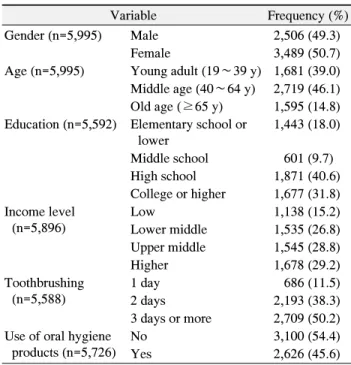
Table 1. General Characteristics of Subjects

Variable Frequency (%)

Gender (n=5,995) Male 2,506 (49.3)

Female 3,489 (50.7)

Age (n=5,995) Young adult (19∼39 y) 1,681 (39.0) Middle age (40∼64 y) 2,719 (46.1) Old age (≥65 y) 1,595 (14.8) Education (n=5,592) Elementary school or

lower

1,443 (18.0)

Middle school 601 (9.7)

High school 1,871 (40.6)

College or higher 1,677 (31.8) Income level

(n=5,896)

Low 1,138 (15.2)

Lower middle 1,535 (26.8) Upper middle 1,545 (28.8)

Higher 1,678 (29.2)

Toothbrushing (n=5,588)

1 day 686 (11.5)

2 days 2,193 (38.3)

3 days or more 2,709 (50.2) Use of oral hygiene

products (n=5,726)

No 3,100 (54.4)

Yes 2,626 (45.6)

Values are presented as unweighted n (weight %).

chi-square test was used. A multiple logistic regression analysis was conducted to analyze the effects of drinking behavior on periodontal status and the statistical signi- ficance was set at p<0.05. PASW Statistics ver. 18.0 (IBM Co., Armonk, NY, USA) was used for all the analyses.

Results

1. General characteristics of study subjects

General characteristics of study subjects are shown in Table 1. Among the subjects, 50.7% were female and 49.3% were male. Regarding age distribution, 39.0% was young adulthood (19∼39 years), 46.1% middle age (40∼

64 years), and 14.8% old age (≥65 years). High school degree was the highest educational level for 40.6%, followed by college degree or higher for 31.8%, elementary school degree or lower for 18.0%, and middle school degree for 9.7%. Regarding income level, 29.2%

had high, 28.8%, medium-high, 26.8%, medium-low, and 15.2%, low, income levels. The highest number of times of tooth brushing a day were three times or more, for 50.2%, followed by twice for 38.3%, and once or less for

11.5%. A total of 54.4% responded that they do not use oral hygiene products, which was higher than 45.6% of those who use them.

2. Need for periodontal treatment according to general characteristics by age group

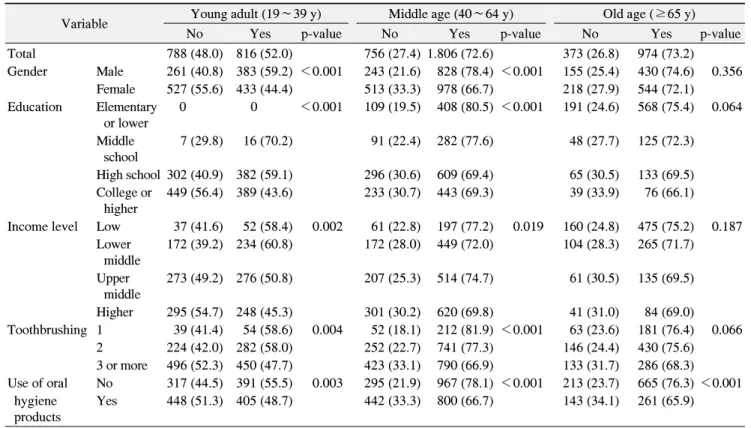
The need for periodontal treatment based on the general characteristics by age group is shown in Table 2. In young adulthood (19∼39 years), men who required the treatment were 59.2%, which was higher than 44.4% of women. For educational level, middle school degree showed 70.2%.

For income level, 58.4% was low and 60.8% medium-low.

This demonstrates that the need for periodontal treatment decreases as educational and income levels increase. For the number of tooth brushing, those who brush once or more were 58.6%, those who brush twice were 58.0%, and those who brush 3 times or more were 47.7%. Those who do not use oral hygiene products were 55.5%, showing a stronger need for periodontal treatment than 48.7% of those who use them (p<0.01). In middle age (40∼64 years), men were 78.4%, which was higher than 66.7% of women. For educational level, elementary school degree was 80.5%, and in income level, low was 77.2%, showing that the need for periodontal treatment decreases as education and income levels increase. For the number of tooth brushing, those who brush once or more were 81.9%, those who brush twice were 77.3%, and those who brush 3 times or more were 66.9%. Those who do not use oral hygiene products were 78.1%, showing a stronger need for periodontal treatment than 66.7% of those who use them (p<0.05). In old age (≥65 years), the need for periodontal treatment did not show significant results based on sex, educational level, income level, and the number of tooth brushing (p>0.05). Those who do not use oral hygiene products were 76.3%, showing a stronger need for periodontal treatment than 65.9% of those who use them (p<0.01).

3. Need for periodontal treatment based on the drinking behavior by age group

The need for periodontal treatment based on the

drinking behavior by age group is shown in Table 3. In

young adulthood (19∼39 years), based on the yearly

(4)

Table 3. Drinking Behaviors according to General Characteristics by Age Group

Variable Young adult (19∼39 y) Middle age (40∼64 y) Old age (≥65 y)

No Yes p-value No Yes p-value No Yes p-value

Drinking frequency (mo)

Never 106 (52.7) 96 (47.3) 0.045 126 (31.4) 262 (68.6) <0.001 77 (29.0) 177 (71.0) 0.265

≤1 285 (52.3) 260 (47.7) 246 (28.8) 490 (71.2) 71 (25.8) 220 (74.2)

≥2 339 (44.6) 400 (55.4) 261 (24.4) 770 (75.6) 90 (23.4) 260 (76.6)

Drinking quantity (glass/d)

1∼2 180 (54.1) 164 (45.9) 0.009 245 (30.4) 485 (69.6) <0.001 98 (25.1) 288 (74.9) 0.506

3∼6 266 (51.0) 255 (49.0) 185 (25.3) 469 (74.7) 44 (20.5) 148 (79.5)

7 or over 178 (40.7) 241 (59.3) 77 (20.6) 306 (79.4) 19 (31.2) 44 (68.8) Problematic

drinking

No 494 (51.0) 482 (49.0) 0.140 491 (30.1) 1,006 (69.9) <0.001 192 (26.3) 518 (73.7) 0.573

Yes 236 (44.2) 272 (55.8) 141 (21.1) 514 (78.9) 45 (23.8) 136 (76.2)

Values are presented as unweighted n (weight %).

The data was analyzed by chi-squared test.

Table 2. Periodontal Treatment according to General Characteristics by Age Group

Variable Young adult (19∼39 y) Middle age (40∼64 y) Old age (≥65 y)

No Yes p-value No Yes p-value No Yes p-value

Total 788 (48.0) 816 (52.0) 756 (27.4) 1.806 (72.6) 373 (26.8) 974 (73.2)

Gender Male 261 (40.8) 383 (59.2) <0.001 243 (21.6) 828 (78.4) <0.001 155 (25.4) 430 (74.6) 0.356 Female 527 (55.6) 433 (44.4) 513 (33.3) 978 (66.7) 218 (27.9) 544 (72.1) Education Elementary

or lower

0 0 <0.001 109 (19.5) 408 (80.5) <0.001 191 (24.6) 568 (75.4) 0.064

Middle school

7 (29.8) 16 (70.2) 91 (22.4) 282 (77.6) 48 (27.7) 125 (72.3)

High school 302 (40.9) 382 (59.1) 296 (30.6) 609 (69.4) 65 (30.5) 133 (69.5) College or

higher

449 (56.4) 389 (43.6) 233 (30.7) 443 (69.3) 39 (33.9) 76 (66.1)

Income level Low 37 (41.6) 52 (58.4) 0.002 61 (22.8) 197 (77.2) 0.019 160 (24.8) 475 (75.2) 0.187 Lower

middle

172 (39.2) 234 (60.8) 172 (28.0) 449 (72.0) 104 (28.3) 265 (71.7)

Upper middle

273 (49.2) 276 (50.8) 207 (25.3) 514 (74.7) 61 (30.5) 135 (69.5)

Higher 295 (54.7) 248 (45.3) 301 (30.2) 620 (69.8) 41 (31.0) 84 (69.0) Toothbrushing 1 39 (41.4) 54 (58.6) 0.004 52 (18.1) 212 (81.9) <0.001 63 (23.6) 181 (76.4) 0.066

2 224 (42.0) 282 (58.0) 252 (22.7) 741 (77.3) 146 (24.4) 430 (75.6)

3 or more 496 (52.3) 450 (47.7) 423 (33.1) 790 (66.9) 133 (31.7) 286 (68.3) Use of oral No 317 (44.5) 391 (55.5) 0.003 295 (21.9) 967 (78.1) <0.001 213 (23.7) 665 (76.3) <0.001 hygiene

products

Yes 448 (51.3) 405 (48.7) 442 (33.3) 800 (66.7) 143 (34.1) 261 (65.9)

Values are presented as unweighted n (weight %).

The data was analyzed by chi-squared test.

drinking frequency, 55.4% subjects drank twice or more a month, and 47.7% drank once or less a month, and those who do not drink were 47.3%. For the amount of drinking at a time, those who drink seven glasses or more were the highest with 59.3%, and the need for periodontal treatment tended to decrease as the amount of drinking decreased (p<0.05). In middle age (40∼64 years), those whose

yearly drinking frequency was two or higher were 75.6%

and those whose drinking amount was seven glasses or

more were 79.4%, which were higher than those of other

groups. The need for periodontal treatment tended to

decrease when the frequency and amount of drinking were

low. Problem drinkers were 78.9% and average drinkers

were 69.9%, showing a stronger need for periodontal

(5)

treatment in problem drinkers (p<0.01). In old age (≥65 years), the need for periodontal treatment based on the yearly drinking frequency, amount of drinking at a time, and the presence of problem drinking did not show significant difference (p>0.05).

4. The effects of drinking behavior by age group on the need for periodontal treatment

The results of multiple logistic regression analysis con- ducted in order to examine the effects of drinking behavior (yearly drinking frequency, amount of drinking at a time, problem-related drinking) are shown in Table 4. After adjusting the sex, educational level, income level, number of tooth brushing, and usage of oral hygiene products, those who drink seven glasses or more at a time showed an increased need for periodontal treatment by 1.55 times compared to those who drink 1∼2 glasses in young adulthood (19∼39 years) (p<0.05). In middle age (40∼

64 years), those whose yearly drinking frequency was two or higher showed an increased need for periodontal treatment by 1.464 times compared to nondrinkers; those who drink seven glasses or more at a time showed an increase by 1.656 times compared to those who drink 1∼2 glasses; problem drinkers showed an increase by 1.575 times compared to average drinkers (p<0.05). However, in old age, each drinking behavior did not show a significant effect on the need for periodontal treatment (p>0.05).

Discussion

Lifestyle habits such as smoking and drinking are frequently observed in adults who have high morbidity of periodontal disease. As age increases, dental caries and periodontal disease developed in school age are accu- mulated, which can still occur and develop in adulthood.

Hence, dental caries and periodontal disease are becoming the major causes of tooth loss 15) . Especially for adults, periodontal disease can induce or maintain a chronic inflammation state systemically, and various complications may deteriorate the quality of life for an extended time without the active management of periodontal disease 5) .

Therefore, understanding the cause of periodontal disease Tab

le 4. A sso cia tio n betw e e n t he Pre sen ce o f Per io d o n ta l T reatm e n ts an d D ri nk in g Be havi o rs b y Age G rou p Va ri ab le Y oung adu lt (1 9 ∼ 39 y ) Mi dd le ag e (4 0 ∼ 64 y ) Ol d ag e (≥ 65 y ) Ad ju st ed OR

a

(95 % CI) p- valu e Adj us te d O R

a

(95% C I) p- va lue Ad ju st ed OR

a

(9 5% CI) p- va lue D rinkin g f re que ncy (m o) N ev er 1.00 0 1.0 00 1. 000 ≤ 1 1.03 0 ( 0.68 5 ∼ 1. 548 ) 0.88 8 1.1 88 ( 0.8 35 ∼ 1.69 1) 0.3 35 1.189 (0 .733 ∼ 1.9 28) 0.4 82 ≥ 2 1.37 1 ( 0.96 0 ∼ 1. 957 ) 0.08 2 1.4 64 ( 1.0 54 ∼ 2.03 3) 0.0 23 1.258 (0 .788 ∼ 2.0 07) 0.3 34 D rinkin g qu antity (g lass /d ) 1 ∼ 2 1.00 0 1.0 00 1. 000 3 ∼ 6 1.02 4 ( 0.73 5 ∼ 1. 426 ) 0.88 8 1.2 55 ( 0.9 29 ∼ 1.69 4) 0.1 38 1.262 (0 .725 ∼ 2.1 96) 0.4 09 7 o r o ver 1.55 2 ( 1.07 9 ∼ 2. 233 ) 0.01 8 1.6 56 ( 1.2 04 ∼ 2.27 8) 0.0 02 0.667 (0 .293 ∼ 1.5 20) 0.3 33 Pr oble m atic d rin king N o 1.00 0 1.0 00 1.000 Y es 1.24 4 ( 0.96 7 ∼ 1. 602 ) 0.08 9 1.5 75 ( 1.2 15 ∼ 2.04 2) 0.0 01 1.064 (0 .652 ∼ 1.7 38) 0.8 03 O R : od da ratio , CI: con fid enc e inte rv al. The d ata w as a naly zed by m ultivariab le log is tic re gress io n.

a

A dju ste d O R ta king acc oun t fo r g end er , edu catio n, inc om e, f re qu enc y of too th br ushin g, use o f o ra l hyg iene pr odu cts.

(6)

is crucial. Furthermore, alcohol comes in direct contact with the mouth upon drinking, and hence it is highly probable that oral tissues can be negatively affected by drinking 16) . Taking this into account, further studies are needed in this field. Therefore, in this study, we examined the association between periodontal disease and drinking, which is a natural and common habit in middle-aged adults in Korea, using the data from the 2012 KNHANES and hoping to encourage people to quit drinking or cutting down their alcohol intake in order to prevent periodontal disease. It is worth noting that we divided adults into young adulthood (19∼39 years), middle age (40∼64 years), and old age (≥65 years) for the analysis. The drinking behavior associated with periodontal treatment was analyzed for each age group, and we found that preventive tools for oral health are required for the pre- paration of aging society. Our study shows that higher level of drinking behavior (yearly drinking frequency, drinking amount at a time, problem drinking) increases the need for periodontal treatment (p<0.05). It shows that in young adulthood and middle age, those who drink seven glasses or more at a time have increased need for peri- odontal treatment compared to those who drink 1∼2 glasses (p<0.05), suggesting that the amount and fre- quency of drinking affect periodontal disease. This is in line with the study by Han et al. 17) in periodontal status based on the health behavior, which showed that the periodontal status differed depending on the frequency and amount of drinking. In our study, the prevalence of periodontal disease was significantly higher in men than in women (p<0.01). This is in line with the study result by Jang and Nam 18) showing that periodontal disease is high in men. In addition, according to the data from the KNHANES, the prevalence of periodontal disease was 10.8% in the age group 30∼39 years, 26.2% in 40∼49 years, 34.7% in 50∼59 years, 36.4% in 60∼69 years, and 44.0% in 70 years and older 11) . This shows that the pre- valence of periodontal disease in Korean adults is increa- sing upon aging 11) . In this study, in young adulthood (19∼

39 years) and middle age (40∼64 years), the need for periodontal treatment decreased as the frequency and amount of drinking were lower. The middle age (40∼64 years), especially, had higher drinking frequency than

young adulthood (19∼39 years), and those who drink seven glasses or more at a time accounted for a high percentage, which shows an increase in the need for periodontal treatment. Moreover, the need for periodontal treatment was high in problem-related drinking (p<0.01).

This indicates that middle-aged individuals (40∼64 years) are more highly exposed to the risk factors of periodontal disease. Education targeting the middle age group (40∼64 years) that encourages them to quit drinking or cutting down the amount of drinking is required.

Periodontal disease very frequently occurs in adults, and its potential risk factors that include age, educational level, sex, economic status, smoking, drinking, hypertension, stress, and social adaptability have been previously reported 19) . Regarding the educational level, one of the potential risk factors of periodontal disease, the need for periodontal treatment tended to decrease as the education and income levels increased in young adulthood and middle age. This is in line with the study by Kim et al. 20) interpreting that people with lower education lack knowledge in oral healthcare or awareness for prevention, neglecting their morbidity of oral disease. Thus, preparing preventive measures for periodontal disease in conside- ration of educational level and low-income class and reducing the gap between each group are extremely needed. In addition, Kanzler et al. 21) argued that peri- odontal tissue disease can be highly developed in alcohol addicts as their oral condition is far worse than that of non-addicts. Our study also showed that problem drinkers had an increased need for periodontal treatment by 1.58 times compared to average drinkers (p<0.05). In a study by Jang and Nam 18) , drinking had significant association with periodontal disease, and a study by Machuca et al. 22) showed that constant intake of alcohol components can lead to rapid spread of inflammation in the presence of an existing infection of gum.

In this study, the need for periodontal treatment in

young adulthood (19∼39 years) and middle age (40∼64

years) increased by 1.464, 1.656, and 1.575 times in

drinkers with the yearly drinking frequency of two or

higher than nondrinkers, those who drink seven glasses or

more at a time than those who drink 1∼2 glasses, and in

(7)

problem drinkers than average drinkers (p<0.05), respectively. In addition, the association between drinking and periodontal disease showed mostly high values in the drinker group 16) . Although the negative effects of drinking on health are widely known, drinking habits are still high in Korea. These results show that drinking is a negative factor for periodontal health status. To maintain oral health, we need to remind patients that excessive drinking and increased frequency of drinking can negatively affect periodontal disease, and moderation-in-drinking programs need to be developed to strengthen the prevention of drinking. Furthermore, to activate oral health education centered on middle-aged adults that can help prepare healthy aging society, a consistent oral health impro- vement program needs to be introduced as a preventive measure.

The limitation of this study is that elucidating the cause-and-effect relationships between periodontal disease and related factors was limited as it was designed as a cross-sectional study. However, the significance of our study is the division of adults in Korea by age using the data from the National Health and Nutrition Examination Survey, which represents the national population, and examined the association between drinking and perio- dontal disease. Further studies with a wider selection of study subjects as well as studies investigating different factors other than those used in our study are required.

Development of programs and education to reinforce the prevention of drinking are also needed.

References

1. Ministry of Health and Welfare: The Korean National Oral Health Survey 2010 summary report. Ministry of Health and Welfare, Sejong, p.475, 2010.

2. Burt B: Position paper: epidemiology of periodontal diseases.

J Periodontal 76: 1406-1419, 2005.

3. Korean Council for Periodontology Professor: Periodon- tology, 2nd ed. Koonja, Seoul, pp.80-94, 296-318, 1996.

4. Kim J, Ahn ES: Association of periodontal status with health lifestyle in adults. J Dent Hyg Sci 15: 83-89, 2015.

5. Won JH, Ha MN: An association of periodontitis and diabetes. J Dent Hyg Sci 14: 107-113, 2014.

6. Yoon JS, Kim JB, Paik DI, Moon HS: The effect of cigarette smoking, drinking and frequency of daily toothbrushing on periodontal status in workers. J Korean Acad Oral Health 26:

197-207, 2002.

7. Field AE, Coakley EH, Must A, et al.: Impact of overweight on the risk of developing common chronic diseases during a 10-year period. Arch Intern Med 161: 1581-1586, 2001.

8. Kim JW, Kwon HJ, Lee SG, Choi YH: The relationship between periodontal disease and the prevalence of cardi- ovascular diseases. J Korean Acad Oral Health 31: 387-395, 2007.

9. Baek HJ, Choi YH, Lee SG, Song KB, Kwon HJ: The association of metabolic syndrome and periodontitis in Korean adult population. J Korean Acad Oral Health 34:

338-345, 2010.

10. Shin MS, Hwang MY, Kim SK: Relationship of oral health awareness to oral health indexes among adults. J Dent Hyg Sci 12: 607-616, 2012.

11. Korea Centers for Disease Control and Prevention: The Fifth Korea National Health and Nutrition Examination Survey (KNHANES V-3), 2012. Korea Centers for Disease Control and Prevention, Sejong, pp.22-30, 2012.

12. Moon BA, Jeong SR, Jang JY, Kim KY: Health-related quality of life by oral health behavior and oral health status for the middle-aged people. J Korean Soc Dent Hyg 15:

197-204, 2015.

13. Britton A, Shipley M, Singh-Manoux A, Marmot MG:

Successful aging: the contribution of early-life and midlife risk factors. J Am Geriatr Soc 56: 1098-1105, 2008.

14. Babor TF, Higgins-Biddle JC, Saunders JB, Monteiro MG:

AUDIT, The alcohol use disorders identification test: guide- lines for use in primary care. 2nd ed. World Health Orga- nization, Geneva, 2001. 40 p.

15. Kim JB, Choi YJ, Moon HS, et al.: Public oral health. 2nd ed.

Komoonsa, Seoul, pp.256-263, 1997.

16. Lee SM, Kim KY, Kim J: Analysis of the relationship between systemic health status and periodontal disease in Korean adults-survey study of the fifth Korea national health and nutrition examination. Korean J Oral Maxillofac Pathol 39: 447-456, 2015.

17. Han GS, Bae KH, Lee MJ, Choi JS: Evaluation of periodontal

status according to sociodemographic and health behavior

characteristics. J Dent Hyg Sci 8: 395-401, 2008.

(8)

18. Jang JY, Nam YS: Analysis of factors related to the dental caries and periodontal diseases of the elderly. J Korean Soc Dent Hyg 12: 1173-1182, 2012.

19. Beck J, Garcia R, Heiss G, Vokonas PS, Offenbacher S:

Periodontal disease and cardiovascular disease. J Periodontol 67(10 Suppl): 1123-1137, 1996.

20. Kim HJ, Park CM, Woo KH, Lee ES, Lee JR, Ha EK: A study on oral health status and factors related with oral health among industrial workers. J Korean Public Health Assoc 28:

158-167, 2002.

21. Kranzler HR, Babor TF, Goldstein L, Gold J: Dental pathology and alcohol-related indicators in an outpatient clinic sample. Community Dent Oral Epidemiol 18: 204-207, 1990.

22. Machuca G, Rosales I, Lacalle JR, Machuca C, Bullón P:

Effect of cigarette smoking on periodontal status of healthy

young adults. J Periodontol 71: 73-78, 2000.

수치

Table  1.  General  Characteristics  of  Subjects
Table  3.  Drinking  Behaviors  according  to  General  Characteristics  by  Age  Group

참조

관련 문서

Study of diabetes and the nutrition education and awareness of nutrition labels in Korean adults: Using data from the fifth Korea National Health and Nutrition Examination

Oxidative injury and inflamma- tory periodontal disease: The challenge of anti-oxidants to free radicals and reactive oxygen species.. The role of oxygen and

Factors associated with hypertension control in Korean adults: The fifth Korea National Health and Nutrition Examination Survey (KNHANES V-2).. Association of stress

So, this research was done for evaluating the usefulness of Periodontal age 「 index 」 by using 「 Periodontal age index 」 to examine subjective consciousness on

In other words, pomegranate extract has an effect of inhibiting the progression of alveolar bone loss due to periodontal inflammation by reducing the expression of COX-1 and

Effects of phase I periodontal treatment on gingival crevicular fluid levels of matrix metalloproteinase-3 and tissue inhibitor of metalloproteinase-1.

Periodontal ligament cells were embedded in acellular dermal matrix(Alloderm Ⓡ ). Roots of unextracted teeth were classified into the positive control group, in

Oral Health Educational Diagnosis of Dental Hygienist