123
Received:April 7, 2014, Revised (1st) May 27, 2014, (2nd) May 28, 2014, Accepted:May 28, 2014
Corresponding to:Hyang Sun Lee, Department of Rheumatology, Wonju Severance Christian Hospital, Yonsei University Wonju College of Medicine, 20 Ilsan-ro, Wonju 220-701, Korea. E-mail:[email protected]
pISSN: 2093-940X, eISSN: 2233-4718
Copyright ⓒ 2015 by The Korean College of Rheumatology. All rights reserved.
This is a Free Access article, which permits unrestricted non-commerical use, distribution, and reproduction in any medium, provided the original work is properly cited.
Case Report
Journal of Rheumatic Diseases Vol. 22, No. 2, April, 2015 http://dx.doi.org/10.4078/jrd.2015.22.2.123
Idiopathic Retroperitoneal Fibrosis Associated with
Rheumatoid Arthritis in a Patient with Concomitant Chronic B Viral Hepatitis
Hyang Sun Lee1, Jeong Eun Park2, Seoung Wan Nam2, Kwang Yong Shim3, Taeyoung Kang1
Departments of 1Rheumatology, 2Internal Medicine, and 3Haemato-Oncology, Wonju Severance Christian Hospital, Yonsei University Wonju College of Medicine, Wonju, Korea
Retroperitoneal fibrosis (RPF) is a rare, progressive disease characterized by chronic non specific inflammation of the retroperitoneum. Although the pathogenesis of idiopathic retroperitoneal fibrosis (IRF) remains unclear, IRF has been reported in association with autoimmune disorders. However, few cases of IRF associated with rheumatoid arthritis (RA) have been reported. We experienced a rare case of IRF in a patient with RA and chronic B viral hepatitis. A 39-year-old Korean man with RA and hepatitis B was referred to our hospital due to left hydronephrosis. An abdominal computed tomography (CT) scan and magnetic resonance imaging (MRI) showed a diffuse infiltrating retroperitoneal mass around the abdominal aorta and left ureter. The patient underwent intraureteral stent insertion and was treated with corticosteroid. Three months later, the follow up abdominal CT showed that the retroperitoneal mass had decreased in size. Herein, we report the first case of coexistent IRF, RA, and chronic B viral hepatitis with a literature review. (J Rheum Dis 2015;22:123-126)
Key Words. Retroperitoneal fibrosis, Rheumatoid arthritis, Chronic Hepatitis B , Steroid
INTRODUCTION
Retroperitoneal fibrosis (RPF) is a rare characterized by chronic inflammation and marked fibrosis of retro- peritoneal tissue, leading to the entrapment of the ureter or other abdominal organs [1,2]. About two-thirds of cas- es of RPF are idiopathic, whereas others occur secondary to infection, malignancy, surgery, exposure to radiation, or to the administration of certain drugs. The patho- genesis of idiopathic retroperitoneal fibrosis (IRF) re- mains unclear, although occasionally it is associated with autoimmune disorders [1,2].
Here, we describe a case of idiopathic RPF associated with seronegative rheumatoid arthritis in a patient with chronic B viral hepatitis. To our knowledge, this is the first reported case of coexistent IRF, rheumatoid arthritis, and chronic B viral hepatitis.
CASE REPORT
A 39-year-old Korean male was referred to our hospital for suspected left hydronephrosis incidentally discovered by abdominal ultrasound during routine checkup. He had been diagnosed with hepatitis B at the age of 13, and had also been treated for 3 years with bucillamine, low dose oral steroid (4 mg/d of triamcinolone), and nonsteroidal anti-inflammatory drugs for seronegative rheumatoid arthritis. He was a non-smoker and had no history of as- bestos exposure.
On physical examination, blood pressure was 119/81 mmHg, heart rate was regular at 90 beats/min, and body temperature was 36.5oC. Cardiac, respiratory, and neuro- logical examinations revealed no abnormalities. His ab- domen was soft and flat without tenderness. Swelling and tenderness of the right wrist were observed on joint
Hyang Sun Lee et al.
124 J Rheum Dis Vol. 22, No. 2, April, 2015
Figure 2. (A) The lesion reveals a fibrous proliferation with broad anatomizing bands of collagen. Occasionally lymphoid ag- gregates are noted (arrow) (H&E, ×40). (B) Fibrous proliferation with sclerotic collagen bands (H&E, ×200).
Figure 1. (A) Abdominal computed tomography shows a diffuse infiltrating soft tissue mass (about 5.0×2.5×10.3 cm sized) ex- tending from the lower abdominal aorta to the level of the iliac bifurcation and left ureteral obstruction (arrow). (B) Atrophic change on left kidney (arrowhead).
examination. Laboratory studies returned; white blood cell count 7,330 cells/mm3, hemoglobin level 13.9 g/dL, platelet count 232,000 cells/mm3, erythrocyte sed- imentation rate (ESR) 11 mm/h, serum C-reactive pro- tein (CRP) concentration 0.25 mg/dL, and serum crea- tinine 1.28 mg/dL. Anti-nuclear antibody (Ab), rheuma- toid factor, anti-cyclic citrullinated peptide (anti-CCP), HLA-B27, human immunodeficiency virus (HIV) Ab and anti-neutrophil cytoplasmic antibodies were negative, and immunoglobulin G4 was 450 mg/L (within the nor- mal range). Serum C3/C4/CH50 levels were 108.7 mg/dL, 40.3 mg/dL, and 50.4 U/mL, respectively (within their normal ranges). Tumor marker levels, including CA 19-9 and carcinoembryonic antigen, were also within their normal ranges. His Ab profile for hepatitis B virus
(HBV) was as follows: HBsAg(+), HBsAb(−), hepatitis C virus Ab(−), and his HBV-DNA copy number was 3,567.7 copy/mL. Serum alanine aminotransferase (ALT), serum aspartate aminotransferase (AST), and transaminase levels were normal.
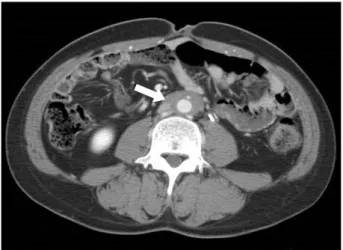
Computed tomography (CT) (Figure 1) and magnetic resonance imaging of the abdomen revealed a diffuse in- filtrating soft tissue mass (approximately 5.0×2.5×10.3 cm in size) extending from the lower abdominal aorta to the level of the iliac bifurcation, left ureteral obstruction, and atrophic change on the left kidney. A double-J stent was inserted into the left renal pelvis and a surgical biopsy was conducted on the soft tissue mass, which was later confirmed to be composed of dense collagenous fibrosis without neoplastic cells (Figure 2). Prophylactic lam-
The Patient with Coexisting RPF, RA and Chronic B Viral Hepatitis
www.jrd.or.kr 125
Figure 3. The retroperitoneal mass was decreased at the fol- low-up abdominal computed tomography (arrow).
ivudine (100 mg daily) was started immediately. Two weeks after, oral high-dose corticosteroid therapy (pred- nisolone 1 mg/kg/d) was started. Three months later, a follow-up abdominal CT scan revealed the retroperitoneal mass had reduced in size (Figure 3). The corticosteroid was then tapered to 10 mg/d over 3 months and maintained. Laboratory findings did not change sig- nificantly over follow-up. In addition, during follow-up, serum ALT, AST, and HBV viral load were monitored 1 or 2 monthly from the initiation of corticosteroid therapy.
An abdominal CT scan has been performed every 3 months.
DISCUSSION
Here, we describe a rare case IRF in a patient with rheu- matoid arthritis and chronic hepatitis B. Although, we are not in a position to explain the pathological association between these diseases, this report describes our experi- ence of one case. IRF has been reported in association with autoimmune disorders, but only a small number of reports have been issued on concurrent IRF and rheuma- toid arthritis [1,3-8]. Furthermore, to the best of our knowledge, this is the first reported case of coexistent IRF, RA, and chronic B viral hepatitis.
RPF is a fibro-inflammatory disorder, whereas the pathogenesis of IRF remains unclear. Pathologically, IRF exhibits fibrous and inflammatory components [2,8].
The leading pathogenic theory suggests that IRF is the consequence of local inflammatory reactions to antigens present in aortic atherosclerotic plaque. However, IRF is also known to develop in patients with no evidence of ad-
vanced atherosclerosis [2,8,9], as was found in our patient.
IRF could also be a manifestation of a systemic auto- immune disorder since IRF patients often present with constitutional symptoms, high acute-phase reactant lev- els, positivity for autoantibodies, and associated auto- immune diseases, such as, autoimmune thyroiditis or systemic vasculitis [3,8,9]. In addition, IRF is significantly associated with the presence of the HLA-DRB1*03 allele, which has been linked to a wide range of autoimmune dis- eases, including type I diabetes mellitus and systemic lu- pus erythematosus [9]. The molecular mechanisms un- derlying the development of IRF are unclear, although it has been suggested environmental factors play a role in its development [2]. For example, cigarette smoking and occupational exposure to asbestos are known risk factors, whereas microbial agents, such as, Mycobacterium tuber- culosis may also act as disease triggers. On the other hand, the pathogenetic roles of viruses remain to be determined [2]. Although a small number of reports have been issued on RPF in patients with a viral infection (one with HIV [10] and one with hepatitis C-related cryoglobulinemia [11]).
The common presentations of IRF are lower back, flank, and/or abdominal pain. Acute or chronic renal failure sec- ondary to ureteral obstruction is the most common and serious complications. About 50% of patients exhibit sys- temic symptoms, which include malaise, fever, anorexia, weight loss, and night sweats, quickly resolve after ini- tiating glucocorticoid therapy [1,2].
Acute phase reactants, such as, ESR and CRP, are ele- vated in one-half to two-thirds of IRF patients. However, ESR and CRP lack diagnostic sensitivity and specificity and cannot be used to monitor the status of RPF [1,2,12,13]. Pelkmans et al. [12] reported that patients with IRF who have elevated ESR and CRP levels are more symptomatic at presentation, that is, they seem to experi- ence more pain and discomfort at similar mass thicknesses.
In our case, baseline ESR and CRP levels were normal, and the patient did not complain of typical symptoms, such as, lower back, flank, or abdominal pain.
The goals of IRF treatment are; symptom relief, to de- crease the size of the retroperitoneal mass, to reduce ure- teral obstruction, to preserve renal function, and to pre- vent disease progression and relapse. Glucocorticoid therapy with or without urological intervention is the most effective treatment for idiopathic RPF. There is no standard regimen of glucocorticoid therapy, but the initial daily dose of prednisone 30 to 60 mg (medium to high
Hyang Sun Lee et al.
126 J Rheum Dis Vol. 22, No. 2, April, 2015
doses) is usually recommended and is gradually tapered under close monitoring of the patients [1,2,14].
Glucocorticoid is implicated as an important predispos- ing factor for HBV reactivation. HBV reactivation related to corticosteroid treatment is a well-recognized complica- tion of immunomodulatory treatment for various diseases. Therefore, screening for HBV reactivation and prophylactic antiviral treatment should be considered for patients requiring high-dose or long-term systemic glu- cocorticoid treatment [15].
In the presented case, we immediately started prophy- lactic treatment of lamivudine at 100 mg daily to prevent HBV reactivation, and 2 weeks later, initiated oral high- dose corticosteroid therapy (prednisolone 1 mg/kg/d). A decrease in the size of the retroperitoneal mass was ach- ieved without any of the side effects associated with corti- costeroid therapy, including HBV reactivation.
SUMMARY
We describe the successful treatment of a case of IRF in a patient with rheumatoid arthritis and with chronic B vi- ral hepatitis by corticosteroid therapy and intraureteral stent insertion.
CONFLICT OF INTEREST
No potential conflict of interest relevant to this article was reported.
REFERENCES
1. Vaglio A, Salvarani C, Buzio C. Retroperitoneal fibrosis.
Lancet 2006;367:241-51.
2. Pipitone N, Vaglio A, Salvarani C. Retroperitoneal fibrosis.
Best Pract Res Clin Rheumatol 2012;26:439-48.
3. Vaglio A, Corradi D, Manenti L, Ferretti S, Garini G, Buzio
C. Evidence of autoimmunity in chronic periaortitis: a pro- spective study. Am J Med 2003;114:454-62.
4. Miller OF, Smith LJ, Ferrara EX, McAleer IM, Kaplan GW.
Presentation of idiopathic retroperitoneal fibrosis in the pe- diatric population. J Pediatr Surg 2003;38:1685-8.
5. Tsai TC, Chang PY, Chen BF, Huang FY, Shih SL.
Retroperitoneal fibrosis and juvenile rheumatoid arthritis.
Pediatr Nephrol 1996;10:208-9.
6. Couderc M, Mathieu S, Dubost JJ, Soubrier M. Retroperitoneal fibrosis during etanercept therapy for rheumatoid arthritis.
J Rheumatol 2013;40:1931-3.
7. Vaglio A, Palmisano A, Ferretti S, Alberici F, Casazza I, Salvarani C, et al. Peripheral inflammatory arthritis in pa- tients with chronic periaortitis: report of five cases and re- view of the literature. Rheumatology (Oxford) 2008;47:315-8.
8. Corradi D, Maestri R, Palmisano A, Bosio S, Greco P, Manenti L, et al. Idiopathic retroperitoneal fibrosis: clin- icopathologic features and differential diagnosis. Kidney Int 2007;72:742-53.
9. Martorana D, Vaglio A, Greco P, Zanetti A, Moroni G, Salvarani C, et al. Chronic periaortitis and HLA-DRB1*03:
another clue to an autoimmune origin. Arthritis Rheum 2006;55:126-30.
10. Rodríguez-Hernández MJ, Viciana P, Cordero E, López-Cortés LF, Pachón J. Retroperitoneal fibrosis in a patient with hu- man immunodeficiency virus infection. Arch Intern Med 1998;158:301-2.
11. Hofbauer LC, Magerstadt RA, Heufelder AE. Hepatitis C related cryoglobulinemia associated with retroperitoneal fibrosis. J Rheumatol 1996;23:554-7.
12. Pelkmans LG, Aarnoudse AJ, Hendriksz TR, van Bommel EF. Value of acute-phase reactants in monitoring disease ac- tivity and treatment response in idiopathic retroperitoneal fibrosis. Nephrol Dial Transplant 2012;27:2819-25.
13. Vaglio A, Versari A, Fraternali A, Ferrozzi F, Salvarani C, Buzio C. (18)F-fluorodeoxyglucose positron emission to- mography in the diagnosis and followup of idiopathic retro- peritoneal fibrosis. Arthritis Rheum 2005;53:122-5.
14. Li KP, Zhu J, Zhang JL, Huang F. Idiopathic retroperitoneal fibrosis (RPF): clinical features of 61 cases and literature review. Clin Rheumatol 2011;30:601-5.
15. Kim TW, Kim MN, Kwon JW, Kim KM, Kim SH, Kim W, et al. Risk of hepatitis B virus reactivation in patients with asthma or chronic obstructive pulmonary disease treated with corticosteroids. Respirology 2010;15:1092-7.