A randomized, multicenter, phase III study
of gemcitabine combined with capecitabine
versus gemcitabine alone as
first-line
chemotherapy for advanced pancreatic
cancer in South Korea
Hee Seung Lee
a, Moon Jae Chung
a, Jeong Youp Park
a, Seungmin Bang
a, Seung Woo Park
a, Ho Gak Kim
b,
Myung Hwan Noh
c, Sang Hyub Lee
d, Yong-Tae Kim
d, Hyo Jung Kim
e, Chang Duck Kim
e, Dong Ki Lee
f,
Kwang Bum Cho
g, Chang Min Cho
h, Jong Ho Moon
i, Dong Uk Kim
j, Dae Hwan Kang
k,
Young Koog Cheon
l, Ho Soon Choi
m, Tae Hyeon Kim
n, Jae Kwang Kim
o, Jieun Moon
p,
Hye Jung Shin
p, Si Young Song, MD, PhD
a,∗, Korean Society of Gastrointestinal Cancer
Abstract
Background:This phase III trial compared the efficacy and safety of gemcitabine plus capecitabine (GemCap) versus single-agent gemcitabine (Gem) in advanced pancreatic cancer asfirst-line chemotherapy.
Methods:A total of 214 advanced pancreatic cancer patients were enrolled from 16 hospitals in South Korea between 2007 and 2011. Patients were randomly assigned to receive GemCap (oral capecitabine 1660 mg/m2plus Gem 1000 mg/m2by 30-minute intravenous infusion weekly for 3 weeks followed by a 1-week break every 4 weeks) or Gem (by 30-minute intravenous infusion weekly for 3 weeks every 4 weeks).
Results:Median overall survival (OS) time, the primary end point, was 10.3 and 7.5 months in the GemCap and Gem arms, respectively (P=0.06). Progression-free survival was 6.2 and 5.3 months in the GemCap and Gem arms, respectively (P=0.08). GemCap significantly improved overall response rate compared with Gem alone (43.7% vs 17.6%; P=0.001). Overall frequency of grade 3 or 4 toxicities was similar in each group. Neutropenia was the most frequent grade 3 or 4 toxicity in both groups.
Conclusion:GemCap failed to improve OS at a statistically significant level compared to Gem treatment. This study showed a trend toward improved OS compared to Gem alone. GemCap and Gem both exhibited similar safety profiles.
Abbreviations: BSA= body surface area, CA 19-9 = carbohydrate antigen 19-9, Cap = capecitabine, CEA = chorioembryonic
antigen, CR= complete responses, CT = computed tomography, ECOG = Eastern Cooperative Oncology Group, FOLFIRINOX =
fluorouracil, irinotecan, oxaliplatin, and leucovorin, FU = fluorouracil, Gem = gemcitabine, GemCap = gemcitabine plus capecitabine, HR= hazard ratio, MRI = magnetic resonance imaging, ORR = objective response rate, OS = overall survival, PET = positron emission tomography, PFS= progression-free survival, PR = partial responses, RECIST = response evaluation criteria in solid tumors.
Keywords:capecitabine, gemcitabine, overall survival, pancreatic cancer, progression-free survival
Editor: Yufang Ma.
The authors have no conflicts of interest to disclose. Supplemental Digital Content is available for this article. a
Department of Internal Medicine, Institute of Gastroenterology, Yonsei University College of Medicine, Seoul,b
Department of Internal Medicine, Catholic University of Daegu School of Medicine, Daegu,c
Department of Internal Medicine, Dong-A University College of Medicine, Busan,d
Department of Internal Medicine and Liver Research Institute, Seoul National University College of Medicine,e
Department of Internal Medicine, Korea University College of Medicine,f
Department of Internal Medicine, Gangnam Severance Hospital, Yonsei University College of Medicine, Seoul,gDepartment of Internal Medicine, Keimyung University School of Medicine, h
Division of Gastroenterology and Hepatology, Department of Internal Medicine, Kyungpook National University School of Medicine, Daegu,i
Digestive Disease Center and Research Institute, Department of Internal Medicine, Soon Chun Hyang University School of Medicine, Bucheon and Seoul,jDepartment of Internal Medicine, Pusan National University Hospital, Busan.,k
Departments of Internal Medicine, Pusan National University Hospital, Yangsan,l
Department of Internal Medicine, Digestive Disease Centre, Konkuk University School of Medicine, Seoul,m
Departments of Internal Medicine, Hanyang University College of Medicine, Seoul,n
Department of Internal Medicine, School of Medicine, Wonkwang University, Iksan,oDepartment of Internal Medicine, The Catholic University of Korea College of Medicine, St. Mary’s Hospital,p
Biostatistics Collaboration Unit, Medical Research Center, Yonsei University College of Medicine, Seoul, Korea. ∗
Correspondence: Si Young Song, Division of Gastroenterology, Department of Internal Medicine, Yonsei University College of Medicine, 50-1 Yonsei-ro, Seodaemun-gu, Seoul 120-752, Korea (e-mail: [email protected]).
Copyright© 2017 the Author(s). Published by Wolters Kluwer Health, Inc.
This is an open access article distributed under the Creative Commons Attribution License 4.0 (CCBY), which permits unrestricted use, distribution, and reproduction in any medium, provided the original work is properly cited.
Medicine (2017) 96:1(e5702)
Received: 6 March 2016 / Received infinal form: 11 November 2016 / Accepted: 30 November 2016 http://dx.doi.org/10.1097/MD.0000000000005702
Clinical Trial/Experimental Study
Medicine
1. Introduction
Pancreatic cancer is the fourth leading cause of cancer death in the United States[1]and is still one of the most lethal malignancies
with a 5-year survival of only 5%.[2] In South Korea,
approximately 5400 people develop exocrine pancreatic cancer each year, and the majority of patients present with inoperable advanced pancreatic cancer at the time of diagnosis.[3,4]
Gemcitabine (Gem) has been administered as a standard single-agent therapy for the treatment of advanced pancreatic cancer, with significant survival benefit compared with 5-fluorouracil (5-FU).[5] Recently, the combination of fluorouracil, irinotecan,
oxaliplatin, and leucovorin (FOLFIRINOX) and gemcitabine plus albumin bound paclitaxel particles have been associated with a significant improvement in overall survival (OS).[6,7]
However, owing to their greater toxicity, adoption of these treatment regimens is considered for patients with good performance status who do not have coexisting conditions.[8,9]
Capecitabine (Cap) is an orally administered, tumor-selective fluoropyrimidine carbamate that can be incorporated into schedules that provide prolongedfluorouracil exposure at lower peak concentrations, thus simulating continuous infusion of fluorouracil. Cap has a different mechanism of action than Gem with no overlapping toxicities. In addition, orally administered Cap chemotherapy is more convenient than intravenously administered 5-FU. The improved tolerability and similar efficacy of Cap compared with intravenous FU, and the convenience of oral administration make Cap an attractive treatment option in various other cancers.[10,11]
Recent advances in the management of advanced pancreatic cancer include 2 randomized phase III clinical trials indicating a response benefit associated with GemCap combination
chemo-therapy compared with Gem monochemo-therapy.[10,11] Cunningham
et al[11] reported that GemCap chemotherapy significantly
improved the objective response rate (ORR) and was associated with a trend toward improved OS (hazard ratio [HR], 0.86;P= 0.08) as compared with treatment by Gem alone. Until now, no phase III study has been conducted to evaluate the efficacy of GemCap chemotherapy in an Asian patient population. To our knowledge, this study is thefirst phase III study conducted in an Asian patient population with advanced pancreatic cancer aimed at evaluating the efficacy and safety of GemCap combination therapy compared with Gem monotherapy.
2. Materials and methods
2.1. Patients
A total of 214 advanced pancreatic cancer patients were enrolled from 16 hospitals in South Korea between 2007 and 2011. Patients were randomly assigned to GemCap or Gem treatment groups (Fig. 1). The eligibility of patients was confirmed histologically or with computed tomography (CT), magnetic resonance imaging (MRI), and positron emission tomography (PET) imaging. The inclusion criteria were inoperable locally advanced or metastatic pancreatic cancer according to the national comprehensive cancer network guidelines,[9] no prior
history of chemotherapy or radiotherapy, between the ages of 18 and 85 years, Eastern Cooperative Oncology Group (ECOG) performance status of 0 to 2, and adequate bone marrow, hepatic, and renal function. Exclusion criteria were pancreatic cancer other than adenocarcinoma, concurrent malignancy, brain metastasis, serious uncontrollable medical conditions, and significant cardiac history. The study protocol conformed to the
ethical guidelines of the 1975 Helsinki Declaration and was approved by the Institutional Review Board of our institute. All recruited patients signed a written consent form before inclusion to the study. The present study is not registered in a clinical trials registry, since the present study was initiated before this became standard practice in South Korea.
2.2. Study protocol
This study was a multicenter, randomized, phase III trial with OS as the primary endpoint, conducted in Asian patients with advanced pancreatic cancer. Secondary endpoints were progres-sion-free survival (PFS), ORR, disease control rate, and toxicity. We randomly assigned eligible patients to each treatment arm on a 1:1 basis according to a computer-generated variable-size blocked randomization method. Randomization was stratified by extent of disease (locally advanced stage vs metastatic stage). GemCap arm received oral capecitabine 1660 mg/m2daily for
3 weeks followed by a 1-week break plus Gem 1000 mg/m2by
30-minute intravenous infusion weekly for 3 weeks every 4 weeks. Gem arm received 30-minute intravenous infusion weekly for 3 weeks every 4 weeks. The body surface area (BSA) was recalculated and the dose levels of GemCap were adjusted based on the recalculated BSA prior to each cycle. This treatment was continued until response evaluation criteria in solid tumors
(RECIST)-defined progressive disease and cumulative toxic
effects were developed, or if the patients chose to discontinue the treatment.[12] A research nurse or doctor in every center
checked the toxicities of the registered medication in this study. Regarding the follow-up schedule, all patients were administered treatment on days 1, 8, and 15 every 4 weeks in subsequent cycles. During hospitalization, all patients’ vital sign, laboratory results, and general condition were investigated. After discharge from hospital, all patients were followed up within 1 to 2 weeks to check their general condition.
2.3. Response evaluation
The ORR was defined as the proportion of patients with complete responses (CR) and partial responses (PR) as measured by spiral CT. OS was calculated from the date of diagnosis to the date of death. The response to treatment was evaluated by CT or MRI after every 2 cycles of chemotherapy were completed. The objective tumor response was evaluated according to the RECIST
Patients randomly assigned (n=214) GEM alone (n = 106) GEM-CAP (n = 108) Lost to follow-up (n = 2) Drop out (n = 3) Lost to follow-up (n = 1) Drop out (n = 4) Received at least one
cycle of treatment (n = 101)
Received at least one cycle of treatment (n = 103) Enrollment Allocation Follow-up Analysis
Figure 1. Study population assigned to treatment from 16 hospitals. For the statistical analysis, wefinally selected 214 patients with pancreatic cancer who received GemCap chemotherapy or Gem chemotherapy alone. Gem = gemcitabine, GemCap= gemcitabine plus capecitabine.
criteria (version 1.1). The levels of carbohydrate antigen (CA) 19-9 and chorioembryonic antigen (CEA) were measured at the end of every 2 cycles. Toxicities were evaluated according to the National Cancer Institute Common Toxicity Criteria, version 4.0.[13]
2.4. Statistical analysis
The sample size was estimated based on the hypothesis that the GemCap combination therapy would increase the median OS time by 2 months compared with single-agent Gem (overall type I error possibility, alpha of 0.05 and power of 90%).[10]The calculated sample size was 178 patients (89 patients per group). The 1 interim analysis was performed after observing approximately 124 (one-half) events. Statistical considerations were reviewed and discussed with Department of Biostatistics in Yonsei University College of Medicine. Data was expressed as mean±standard deviation, n (%), or n, as appropriate. Variables were compared using thex2test
for categorical data and Studentt test for continuous variables to evaluate statistical significance of the differences in baseline characteristics between groups. Both OS and PFS estimates were calculated using the Kaplan–Meier method, and the survival curves were compared between treatment arms using the log-rank test. A P value of<0.05 was considered to indicate statistical significance. Statistical analyses were performed using SPSS version 18.0 (SPSS, Chicago, IL).
3. Results
3.1. Patient characteristics
The Median age was 54 years (range, 37–85 years) and the gender distribution was 120 men and 94 women. Patients were randomly allocated to Gem (n=106) and GemCap (n=108) groups. Ten (4.6%) patients were ineligible because of loss to follow-up or dropout from the study. These patients were included in the analyses on an intention-to-treat basis. Patient characteristics are shown in Table 1. Variables were well balanced between 2 groups.
3.2. Overall survival and progression-free survival
GemCap was associated with a trend toward better OS compared
with Gem alone (HR, 0.82; 95% CI, 0.67–1.01; P=0.06). The
median OS times for patients in GemCap and Gem treatment groups were 10.3 and 7.5 months, respectively. GemCap did not
show a significantly improved PFS compared with Gem (HR,
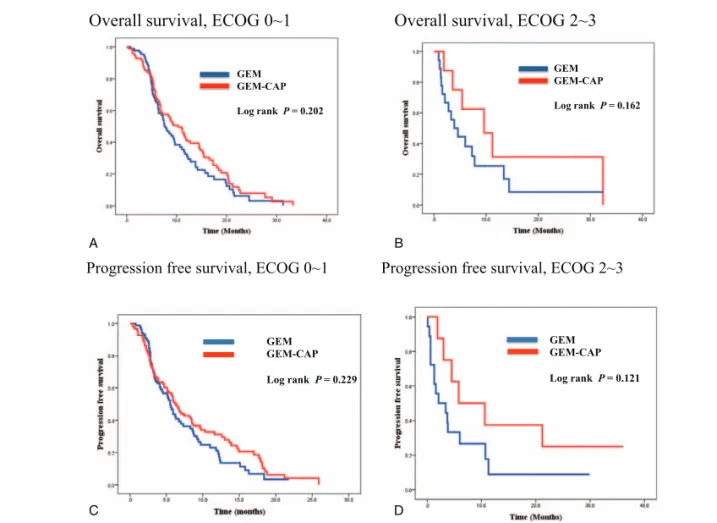
0.87; 95% CI, 0.73–1.03; P=0.08). The median PFS for GemCap was 6.2 months, and that for Gem was 5.3 months. The OS and PFS by treatment arm are indicated in Fig. 2. On subgroup analysis according to ECOG and age, there was no significant survival difference between the 2 groups (Fig. 3 and Supplementaryfigure, http://links.lww.com/MD/B477).
Table 1
Baseline characteristics of patients.
Gem n = 106 GemCap n = 108 P value Age 64 (43–85) 64 (37–80) 0.354 Sex Male 57 (53.8) 63 (58.3) 0.458 Female 49 (46.2) 45 (41.7) Hb 11.9±1.8 12.3±1.6 0.099 WBC 7382±2707 8675±11272 0.252 AST 44±57 37±42 0.376 ALT 60±97 49±79 0.348 ALP 266±315 257±270 0.826 T.bil 2.5±6.9 1.9±4.0 0.395 Albumin 3.9±0.5 3.9±0.5 0.657 CA 19-9 9102±59,833 1705±3299 0.241 ECOG 0 to 1 88 (83.0) 98 (90.7) 0.094 2 to 3 18 (17.0) 10 (9.3) Pain (0–100) <50 86 (81.1) 90 (83.3) 0.674 ≥50 20 (18.9) 18 (16.7) Analgesic No use 34 (32.1) 39 (36.1) 0.778 Nonopioid 13 (12.3) 14 (13.0) Opioid 59 (55.7) 55 (50.9) Stage II 10 (9.4) 6 (5.6) 0.536 III 20 (18.9) 23 (21.3) IV 76 (71.7) 79 (73.1) Tumor location Head 42 (39.6) 46 (42.6) 0.547 Body 26 (24.5) 21 (19.4) Tail 25 (23.6) 31 (28.7) Diffuse 13 (12.3) 9 (8.3)
Variables are expressed as the mean±SD or n (%).
ALP=alkaline phosphatase, ALT =alanine transaminase, AST=aspartate transaminase, CA 19-9= carbohydrate antigen 19-9, ECOG=Eastern Cooperative Oncology Group performance status, Gem = gemcitabine, GemCap=gemcitabine plus capecitabine, Hb=hemoglobin, T.bil=total bilirubin, WBC=white blood cell.
GEM GEM-CAP Log rank P = 0.06 GEM GEM-CAP Log rank P = 0.08 A B
Figure 2. Kaplan–Meier overall survival curves and progression-free survival curves in pancreatic cancer patients. A, Median overall survival (OS) time, the primary end point, was 10.3 and 7.5 months in the GemCap and Gem arm, respectively (P=0.06). B, Progression-free survival (PFS) was 6.2 and 5.3 months in the GemCap and Gem arm, respectively (P=0.08). Gem = gemcitabine, GemCap = gemcitabine plus capecitabine.
3.3. Response to treatment
Patients randomly assigned to GemCap treatment group had a significantly improved ORR over those assigned to Gem (43.7% vs 17.6%, respectively; P=0.001). The efficacies of the treat-ments are summarized in Table 2. Of the total 214 patients, none exhibited CR, 54 (25.2%) exhibited PR, and 58 (27.1%) were observed to have stable disease. Progressive disease occurred in the 66 patients (30.8%).
3.4. Toxicities
Therapy-related toxicities were monitored in all 204 patients who were treated with 1000 mg/m2Gem or 1660 mg/m2of oral Cap.
Both treatment arms were well tolerated. Table 3 summarizes the grade 3 or 4 toxicities associated with the treatment arms. The overall frequency of grade 3 or 4 toxicities was similar in each group. Neutropenia was the most frequently observed grade 3 or 4 toxicity in both groups (29.2%). Although GemCap treatment resulted in increased neutropenia compared with Gem treatment, febrile neutropenia was not observed more than Gem treatment. The frequencies of other adverse events such as nausea, vomiting, diarrhea, and stomatitis were similar between the 2 arms.
GEM GEM-CAP Log rank P = 0.202 GEM GEM-CAP Log rank P = 0.162
Overall survival, ECOG 0~1
Overall
A B C D
survival, ECOG 2~3
GEM GEM-CAP Log rank P = 0.229 GEM GEM-CAP Log rank P = 0.121Progression free survival, ECOG 0~1 Progression free survival, ECOG 2~3
Figure 3. Kaplan–Meier overall survival curves and progression-free survival curves in patients according to performance status. Subanalysis in patients with good performance status did not show a significant prolongation of median OS time and PFS time in the GemCap arm compared with Gem arm. Gem = gemcitabine, GemCap= gemcitabine plus capecitabine, OS = overall survival, PFS = progression free survival.
Table 2
Response rates according to RECIST criteria.
Gem (n = 106) GemCap (n = 108) P value Response rate CR 0 0 (0) 0.001 PR 16 (17.6) 38 (43.7) SD 33 (36.3) 25 (28.7) PD 42 (46.2) 24 (27.6) Overall RR 16 (17.6) 38 (43.7) Progression-free survival Median 5.3 6.2 0.08 95% CI 3.91–6.68 5.11–7.28 Overall survival Median 7.5 10.3 0.06 95% CI 6.22–8.77 7.94–12.65
Variables are expressed as n (%).
CI=confidence interval, CR=complete response, Gem =gemcitabine, GemCap=gemcitabine plus capecitabine, PD=disease progression, PR=partial response, RECIST=response evaluation criteria in solid tumors, RR=response rate, SD=stable disease.
Table 3
Grade 3 or 4 adverse events.
Adverse event Gem (n = 101) GemCap (n = 103)
Anemia 4 (3.9) 5 (4.8) Neutropenia 12 (11.8) 18 (17.4%) Thrombocytopenia 5 (4.9) 1 (0.9) Febrile neutropenia 1 (1) 1 (0.9) Nausea/vomiting 3 (2.9) 5 (4.8) Diarrhea 0 (0) 2 (1.9) Stomatitis 0 (0) 4 (3.8) Hand-foot syndrome 0 (0) 1 (0.9) General weakness 3 (2.9) 1 (0.9)
Variables are expressed as n (%).
4. Discussion
This study did not show the statistical OS improvement in GemCap compared with Gem treatment in advanced pancreatic cancer patients. However, a trend toward improved OS in patients treated with GemCap was observed. This study also showed that advanced pancreatic cancer patients responded better to GemCap with acceptable levels of adverse events.
Pancreatic cancer remains as one of the most common and lethal cancers. FU-based chemotherapy was known to improve overall survival by approximately 3 months compared with best supportive care alone.[8]In 1997, a study comparing Gem with
FU in patients with advanced pancreatic cancer showed an improved overall survival of 1 month among patients receiving Gem.[5] Over the next 10 years, multiple randomized studies comparing single-agent Gem with combination chemotherapy have been conducted showing no effective improvement in survival.[14–17]Exceptionally, the incorporation of erlotinib, an EGFR inhibitor, resulted in a significant improvement of the overall survival by approximately 2 weeks (HR 0.82,P=0.038, median 6.2 vs 5.9 months, respectively). However, owing to its limited effect and added toxicity, this treatment regimen has not been frequently adopted.[18]
Two recently conducted clinical trials showed prolonged overall survival of approximately 1 year in advanced pancreatic cancer patients. In thefirst study, more recent treatment regimens including FOLFIRINOX were associated with a significant improvement in median OS compared with Gem monotherapy (11.1 months vs 6.8 months, respectively;P<0.001).[7]In the second study, Gem plus nanoparticle albumin bound-paclitaxel was also associated with a prolonged OS compared with Gem monotherapy (8.5 months vs 6.7 months, respectively;P<0.001).[6]At present, these regimens
are considered standard treatment for patients with good PS. However, treatment-related adverse events were also worsened with these regimens compared with Gem monotherapy, including grade 3/4 neutropenia (45.7% and 38%, respectively), and diarrhea (12.7% and 6%, respectively).
Therefore, alternative combination chemotherapeutic regi-mens have been studied for the treatment of patients with advanced pancreatic cancer. Among them, GemCap was identified as an alternative combination therapy for patients with advanced pancreatic cancer.[19,20]In a randomized phase III trial, Cunningham et al[11]showed a significant improvement in the PFS (HR, 0.78; 95% CI, 0.66–0.93; P=0.004) and a trend towards improved OS (HR, 0.86; 95% CI, 0.72–1.02; P=0.08) in patients receiving GemCap therapy compared with those receiving Gem monotherapy. In the study, Cunningham et al used intensive dose-combination regimen compared with another phase III trial (oral capecitabine 1660 vs 650 mg/m2/day; gemcitabine infusion on days 1, 8, and 15, every 4 weeks vs 1 and 8, every 3 weeks) and intensive dose-combination showed more effective results than another regimen.[10,11] Using high dose of chemotherapy regimens, the present study of GemCap combination therapy produced significantly improved ORR of 43.7% and a median PFS of 6.2 months, respectively. These results were similar to previous phase II studies conducted in South Korea.[20]
To our knowledge, this study investigating the use of GemCap combination therapy for the treatment of advanced pancreatic cancer was a first in Asia. In this study, a longer OS of 10.3 months compared with previous phase III studies is reported. This is associated with the recent improvements in cancer supportive care such as pain control, complication control, and
nutritional support. This data was also in agreement with previous phase II study data (10.3 months vs 10 months, respectively).[20]
There are some limitations in the study. We failed to show the significant difference in overall survival between GemCap and Gem due to an insufficient number of enrolled patients differing from the initially planned number. South Korea has universal health insurance system that covers almost the entire population. The medical insurance system of government did not cover the use of gemcitabine plus capecitabine on pancreatic cancer during the present study period. We could not prescribe additive gemcitabine plus capecitabine chemotherapy in patients with pancreatic cancer. And as a result, we did not enroll the sufficient number of patients during the study period. However, we showed a trend towards improved OS in patients who received GemCap although this was not statistically significant. Furthermore, response rates were significantly higher in GemCap patients compared with Gem (43.7% vs 17.6%, respectively). Second, the results from the new trials such as Von Hoff et al[6]about the
increased survival in pancreatic cancer were published in 2013. Unfortunately, it decreases the value and novelty of the results from the current study. However, there was no phase III study
that has been conducted to evaluate the efficacy of GemCap
chemotherapy in an Asian patient population until now. Recently, many novel biological agents targeting pancreatic cancer and its microenvironment have been reported to be promising in preclinical investigations and phase I/II clinical studies.[21–24] However, an effective therapeutic agent for the treatment of pancreatic cancer does not exist presently. Depend-ing on patients’ health conditions, conventional chemotherapeu-tic agents are still administered.
In conclusion, this study was thefirst phase III study conducted in Asian patients using GemCap combination therapy. GemCap combination did not show statistically significant survival benefit compared with Gem treatment. There was a trend toward improved OS and better response in pancreatic cancer patients treated with GemCap.
Acknowledgments
The authors are grateful to Department of Research Affairs, Biostatistics Collaboration Unit, Yonsei University College of Medicine, Seoul, Korea for the help with the Statistical Analysis.
References
[1] Siegel RL, Miller KD, Jemal A. Cancer statistics, 2015. CA Cancer J Clin 2015;65:5–29.
[2] Kris MG, Benowitz SI, Adams S, et al. Clinical cancer advances 2010: annual report on progress against cancer from the American Society of Clinical Oncology. J Clin Oncol 2010;28:5327–47.
[3] Jung KW, Won YJ, Kong HJ, et al. Cancer statistics in Korea: incidence, mortality, survival, and prevalence in 2012. Cancer Res Treat 2015; 47:127–41.
[4] Kleeff J, Korc M, Apte M, et al. Pancreatic cancer. Nat Rev Dis Primers 2016;2:16022.
[5] Burris HA 3rd, Moore MJ, Andersen J, et al. Improvements in survival and clinical benefit with gemcitabine as first-line therapy for patients with advanced pancreas cancer: a randomized trial. J Clin Oncol 1997;15: 2403–13.
[6] Von Hoff DD, Ervin T, Arena FP, et al. Increased survival in pancreatic cancer with nab-paclitaxel plus gemcitabine. N Engl J Med 2013; 369:1691–703.
[7] Conroy T, Desseigne F, Ychou M, et al. FOLFIRINOX versus gemcitabine for metastatic pancreatic cancer. N Engl J Med 2011; 364:1817–25.
[8] Ryan DP, Hong TS, Bardeesy N. Pancreatic adenocarcinoma. N Engl J Med 2014;371:1039–49.
[9] Tempero MA, Malafa MP, Behrman SW, et al. Pancreatic adenocarci-noma, version 2.2014: featured updates to the NCCN guidelines. J Natl Compr Canc Netw 2014;12:1083–93.
[10] Herrmann R, Bodoky G, Ruhstaller T, et al. Gemcitabine plus capecitabine compared with gemcitabine alone in advanced pancreatic cancer: a randomized, multicenter, phase III trial of the Swiss Group for Clinical Cancer Research and the Central European Cooperative Oncology Group. J Clin Oncol 2007;25:2212–7.
[11] Cunningham D, Chau I, Stocken DD, et al. Phase III randomized comparison of gemcitabine versus gemcitabine plus capecitabine in patients with advanced pancreatic cancer. J Clin Oncol 2009;27:5513–8. [12] Aras M, Erdil TY, Dane F, et al. Comparison of WHO, RECIST 1.1, EORTC, and PERCIST criteria in the evaluation of treatment response in malignant solid tumors. Nucl Med Commun 2016;37:9–15.
[13] US Department of Health and Human Services, National Institute of Health, National Cancer institute. Common terminology criteria for adverse events v4.03. Available at: http://evs.nci.nih.gov/ftp1/CTCAE/ CTCAE_4.03_2010–06–14_QuickReference_5x7.pdf. Accessed 2015. [14] Stathopoulos GP, Syrigos K, Aravantinos G, et al. A multicenter phase III
trial comparing irinotecan-gemcitabine (IG) with gemcitabine (G) monotherapy asfirst-line treatment in patients with locally advanced or metastatic pancreatic cancer. Br J Cancer 2006;95:587–92. [15] Reni M, Cordio S, Milandri C, et al. Gemcitabine versus cisplatin,
epirubicin,fluorouracil, and gemcitabine in advanced pancreatic cancer: a randomised controlled multicentre phase III trial. Lancet Oncol 2005;6:369–76.
[16] Louvet C, Labianca R, Hammel P, et al. Gemcitabine in combination with oxaliplatin compared with gemcitabine alone in locally advanced or metastatic pancreatic cancer: results of a GERCOR and GISCAD phase III trial. J Clin Oncol 2005;23:3509–16.
[17] Poplin E, Feng Y, Berlin J, et al. Phase III, randomized study of gemcitabine and oxaliplatin versus gemcitabine (fixed-dose rate infusion) compared with gemcitabine (30-minute infusion) in patients with pancreatic carcinoma E6201: a trial of the Eastern Cooperative Oncology Group. J Clin Oncol 2009;27:3778–85.
[18] Moore MJ, Goldstein D, Hamm J, et al. Erlotinib plus gemcitabine compared with gemcitabine alone in patients with advanced pancreatic cancer: a phase III trial of the National Cancer Institute of Canada Clinical Trials Group. J Clin Oncol 2007;25:1960–6.
[19] Hubner RA, Worsnop F, Cunningham D, et al. Gemcitabine plus capecitabine in unselected patients with advanced pancreatic cancer. Pancreas 2013;42:511–5.
[20] Choi JG, Seo JH, Oh SC, et al. A phase II trial of gemcitabine plus capecitabine for patients with advanced pancreatic cancer. Cancer Res Treat 2012;44:127–32.
[21] Middleton G, Silcocks P, Cox T, et al. Gemcitabine and capecitabine with or without telomerase peptide vaccine GV1001 in patients with locally advanced or metastatic pancreatic cancer (TeloVac): an open-label, randomised, phase 3 trial. Lancet Oncol 2014;15:829–40.
[22] Jacobetz MA, Chan DS, Neesse A, et al. Hyaluronan impairs vascular function and drug delivery in a mouse model of pancreatic cancer. Gut 2013;62:112–20.
[23] O’Reilly EM, Niedzwiecki D, Hall M, et al. A Cancer and Leukemia Group B phase II study of sunitinib malate in patients with previously treated metastatic pancreatic adenocarcinoma (CALGB 80603). On-cologist 2010;15:1310–9.
[24] Kindler HL, Wroblewski K, Wallace JA, et al. Gemcitabine plus sorafenib in patients with advanced pancreatic cancer: a phase II trial of the University of Chicago Phase II Consortium. Invest New Drugs 2012;30:382–6.